Text update of August 15, 2023
Other names: Santo Antonio da Bocaína, S. João da Bocaína, Valparaíba, Cachoeira Paulista (1948)
This post locality with a railway station post office causes headaches for all philatelic researchers who deal with it, in several respects. For both the official place name, which apparently does not appear in any postmark, and the coincidence of two railway lines that do not fit together testify to chaotic postal and traffic conditions in imperial Brazil. And that is only part of the tangled stories that surround Cachoeira in São Paulo. Nevertheless, let’s try to shed a little light on it.
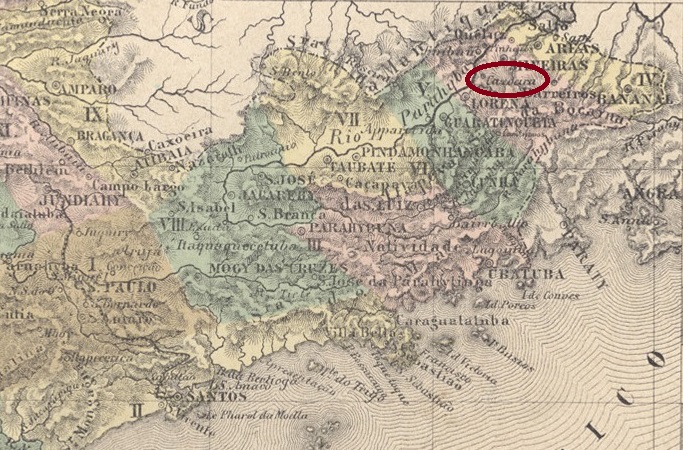
The original Arraial de Sto. Antonio do Porto da Cachoeira was located on the south bank of the Parahiba (today Rio Paraíba do Sul) near the mouth of the Bocaína, over 200 km northeast of the provincial capital São Paulo. In March 1876, it became the Freguesia de Sto. Antonio da Bocaína, which belonged to the Vila de Lorena and was elevated to an independent vila four years later. In May 1895 it was given the status of a town, now under the name of S. João da Bocaína. In October 1915, however, the name was changed to Cachoeira, a clear sign that the other place names were unpopular. Now there was another place in the province of São Paulo called Sto. Antonio da Cachoeira (SSP-1325), today the Município of Piracaia. So, the place name of our Cachoeira changed again in November 1944, this time to Valparaíba. This strange construction did not last long, and since December 1948 the Município has been called Cachoeira Paulista.
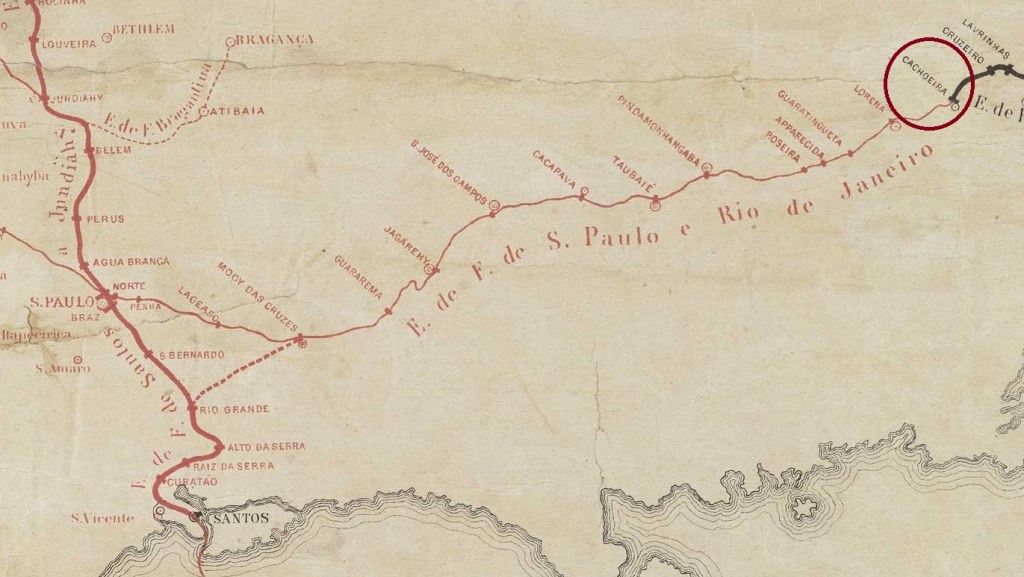
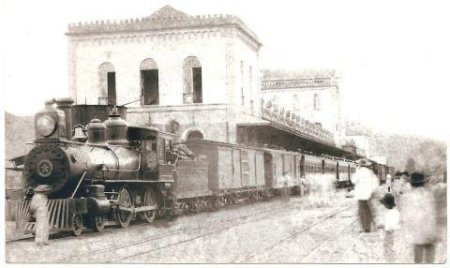
In July 1875, the station of the E.F. D. Pedro II company (São Paulo Branch) was inaugurated, after which they waited for the railway connection from São Paulo to come via the E.F. do Norte line built by the coffee plantation owners. In May 1877, this line was completed, but it was a narrow-gauge railway (1.0 m gauge), which did not match the 1.6 m gauge from Rio. The result was a time-consuming and costly change of trains at the station, which led to anger and reproaches.
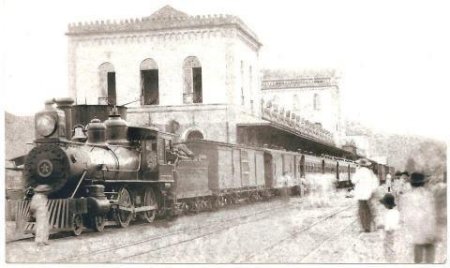
Previously (1867), an English consortium had built the São Paulo Railway, which provided a direct link between the new coffee plantations in the hinterland of the province, the provincial capital of São Paulo and the port of Santos. This created competition for traditional agriculture in the Paraíba Valley, accelerating its decline.
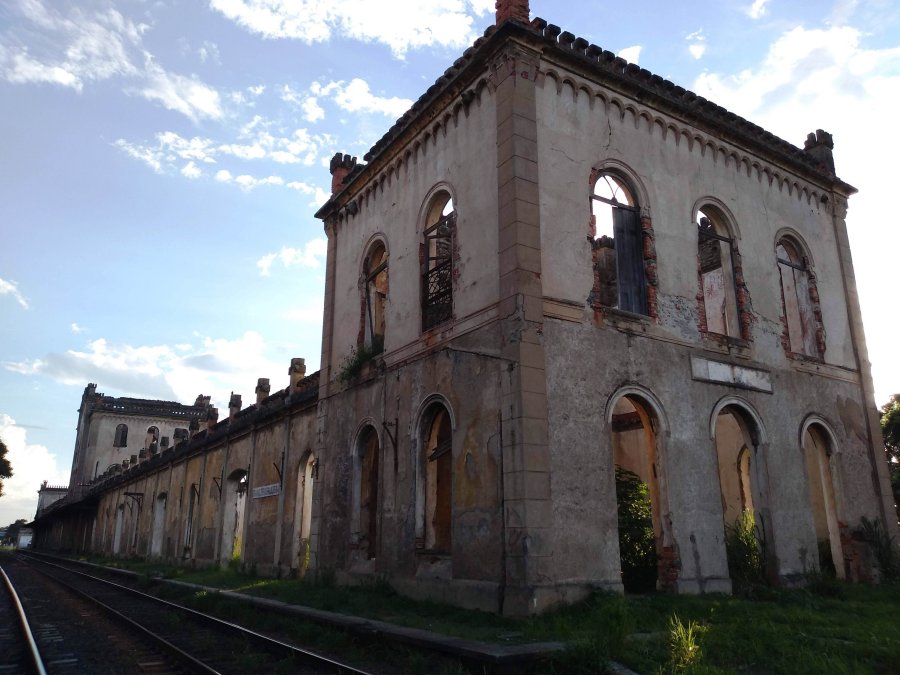
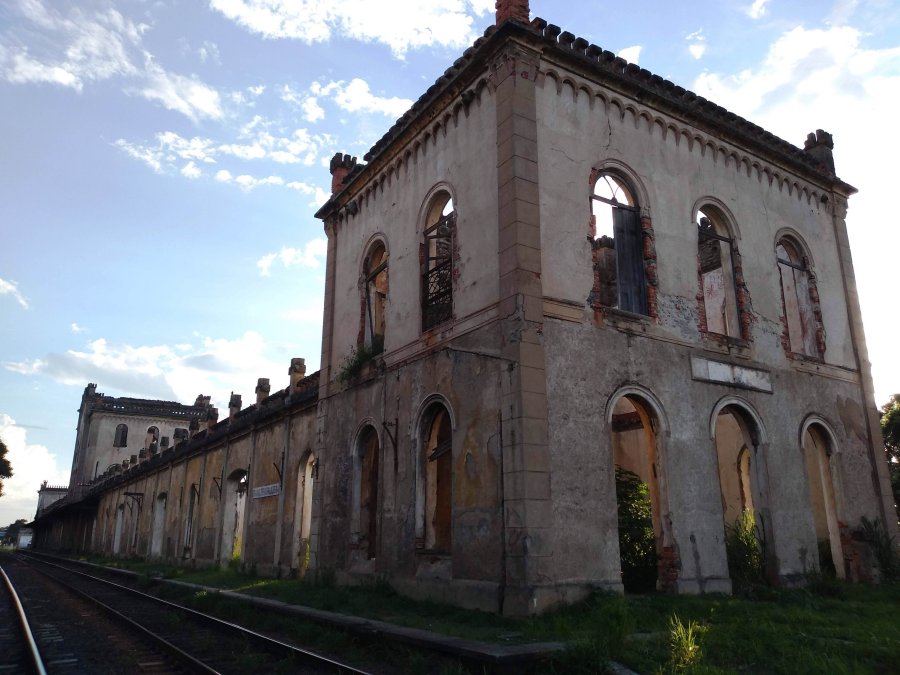
The line through Cachoeira station became the property of E.F. Central do Brasil in 1889 and belonged to Rede Ferroviária Federal S.A. (estacoesferroviarias.com.br) from 1975 until its closure in 1996. Today the tracks are still there, the station building is an abandoned ruin:
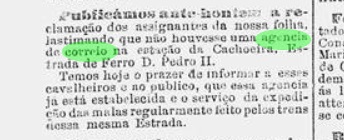
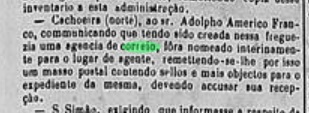
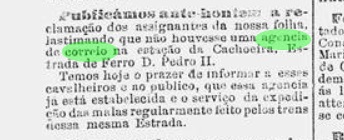
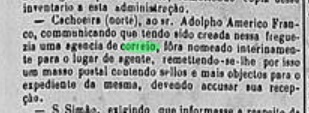
Two post agency creations were found for Cachoeira. Since both are in temporal proximity to the respective railway connections, there is probably a connection. The first was in August 1875, when it was decided to create a post office at the railway station, as reported in the Rio press:
The second opening announcement came in March 1877 from the province of São Paulo; here only the freguesia is mentioned, but not the station:
From the imperial period, there are so far six postmarks and two mute cancellations, all of which refer to railway operations, but neither the post office in the town nor – as noted above – mentions the correct place name Sto. Antonio da Bocaína. The oldest postmark has now appeared in the Fuad Ferreira Fo. collection: CSP-0216a was found on a beautiful letter from 1876, i.e. before the construction of the São Paulo station, which is confirmed by the mention of E.F. D. Pedro II on it:

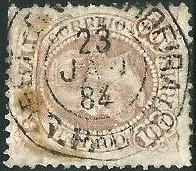
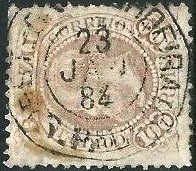
There followed CSP-0216b (image from the internet), which occurs also in blue, with dates from 1884-1885:
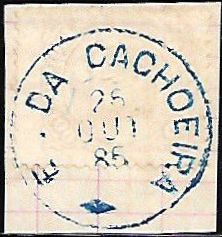
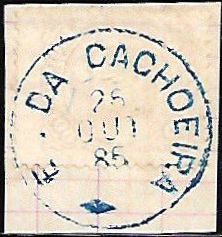
Almost at the same time, CSP-0216c (illustration from the internet) was also used, equally in blue. However, the internal dates range from 1885 to 1891:
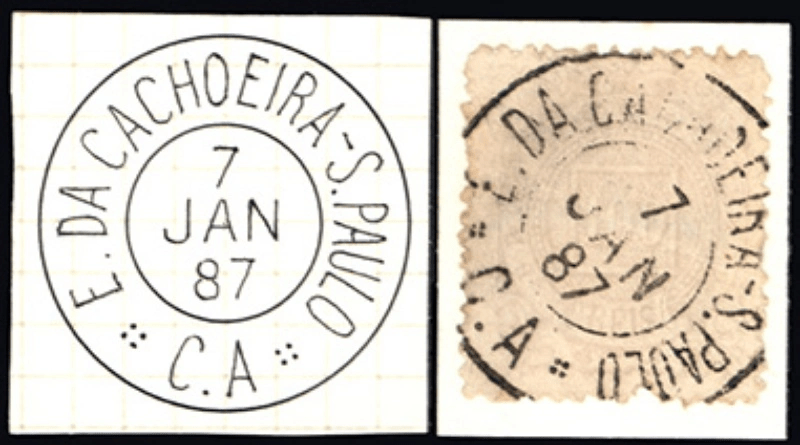
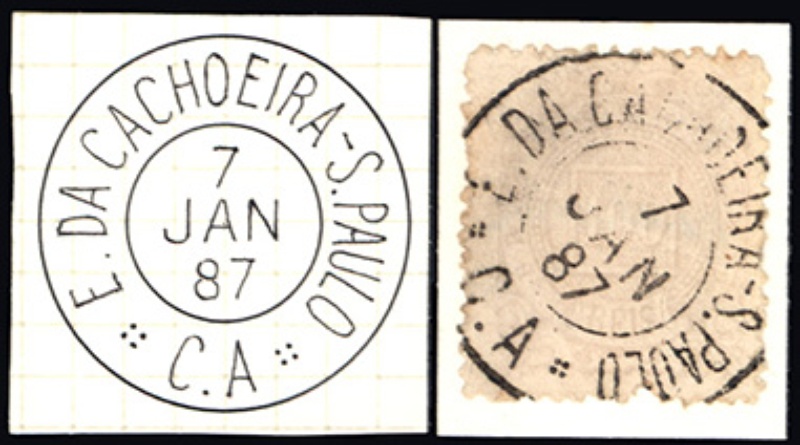
A fourth station cancel would be CSP-0216d (not illustrated in Koester’s Carimbologia VII). According to Koester’s description, it bears the inscription EST. DA CACHOEIRA, as well as an ornament at the bottom, with a date of 1886. Then there are two cancels for ambulant service in the mail coach:

The above-mentioned letter from Fuad Ferreira Fo. also had a mute cancel:

Finally, Koester showed us an ambulant mute cancellation, dated 1884:

Textaktualisierung am 15. August 2023
Andere Namen: Santo Antonio da Bocaína, S. João da Bocaína, Valparaíba, Cachoeira Paulista (1948)
Dieser Postort mit Bahnhofspostamt bereitet allen philatelistischen Forschern, die sich damit beschäftigen, in mehrfacher Hinsicht Kopfzerbrechen. Denn sowohl der offizielle Ortsname, der offenbar in keinem Poststempel auftaucht, als auch das Zusammentreffen zweier nicht zueinander passender Eisenbahnlinien zeugen von chaotischen Post- und Verkehrsverhältnissen im kaiserlichen Brasilien. Und das ist nur ein Teil der verworrenen Geschichten, die sich um Cachoeira in São Paulo ranken. Dennoch wollen wir versuchen, ein wenig Licht ins Dunkel zu bringen.
Der ursprüngliche Arraial de Sto. Antonio do Porto da Cachoeira lag am Südufer des Parahiba (heute Rio Paraíba do Sul) nahe der Mündung des Bocaína, über 200 km nordöstlich der Provinzhauptstadt São Paulo. Im März 1876 wurde die Freguesia de Sto. Antonio da Bocaína, die zur Vila de Lorena gehörte und vier Jahre später zur selbstständigen Vila erhoben wurde. Im Mai 1895 erhielt sie den Status einer Stadt, nun unter dem Namen S. João da Bocaína. Im Oktober 1915 wurde der Name jedoch in Cachoeira geändert, ein deutliches Zeichen dafür, dass die anderen Ortsnamen unbeliebt waren. Nun gab es in der Provinz São Paulo einen weiteren Ort, der Sto. Antonio da Cachoeira (SSP-1325), heute der Município von Piracaia. So änderte sich der Ortsname unseres Cachoeira im November 1944 erneut, diesmal in Valparaíba. Diese seltsame Konstruktion dauerte nicht lange, und seit Dezember 1948 heißt der Município Cachoeira Paulista.
Im Juli 1875 wurde der Bahnhof der Gesellschaft E.F. D. Pedro II (Abzweigung São Paulo) eingeweiht, danach wartete man auf die Eisenbahnverbindung aus São Paulo, die über die von den Kaffeeplantagenbesitzern gebaute Strecke der E.F. do Norte kommen sollte. Im Mai 1877 war diese Strecke fertiggestellt, aber es handelte sich um eine Schmalspurbahn (1,0 m Spurweite), die nicht zu den 1,6 m Spurweite aus Rio passte. Die Folge war ein zeit- und kostenaufwändiges Umsteigen am Bahnhof, was zu Ärger und Vorwürfen führte.
Zuvor (1867) hatte ein englisches Konsortium die São Paulo Railway gebaut, die eine direkte Verbindung zwischen den neuen Kaffeeplantagen im Hinterland der Provinz, der Provinzhauptstadt São Paulo und dem Hafen von Santos herstellte. Damit entstand eine Konkurrenz zur traditionellen Landwirtschaft im Paraíba-Tal, die deren Niedergang beschleunigte.
Die Strecke durch den Bahnhof Cachoeira ging 1889 in den Besitz der E.F. Central do Brasil über und gehörte von 1975 bis zu ihrer Stilllegung 1996 der Rede Ferroviária Federal S.A. (estacoesferroviarias.com.br). Heute sind die Gleise noch vorhanden, das Bahnhofsgebäude ist eine verlassene Ruine:
In Cachoeira wurden zwei Poststationsgründungen gefunden. Da beide in zeitlicher Nähe zu den jeweiligen Bahnanschlüssen liegen, besteht hier vermutlich ein Zusammenhang. Das erste Mal wurde im August 1875 die Gründung eines Postamtes am Bahnhof beschlossen, wie die Presse in Rio berichtete:
Die zweite Eröffnungsmeldung kam im März 1877 aus der Provinz São Paulo; hier wird nur die Freguesia, nicht aber der Bahnhof erwähnt:
Aus der Kaiserzeit gibt es bisher sechs Poststempel und zwei stumme Entwertungen, die alle auf den Bahnbetrieb hinweisen, aber weder das Postamt im Ort noch – wie oben vermerkt – den „richtigen“ Ortsnamen Sto. Antonio da Bocaína erwähnt. Der bisher älteste Poststempel ist jetzt in der Sammlung Fuad Ferreira Fo. aufgetaucht: CSP-0216a wurde auf einem schönen Brief aus dem Jahr 1876 gefunden, also vor dem Bau des Bahnhofs von São Paulo, was durch die Erwähnung von E.F. D. Pedro II. auf diesem Brief bestätigt wird:

Ihm folgte CSP-0216b (Abbildung aus dem Internet), ebenfalls in blau, mit Daten von 1884-1885 vorkommend:
Fast gleichzeitig wurde auch CSP-0216c (Abbildung aus dem Internet) verwendet, der ebenfalls in blau existiert. Die inneren Daten reichen jedoch von 1885 bis 1891:
Ein vierter Stationsstempel wäre CSP-0216d (nicht abgebildet in Koesters Carimbologia VII). Nach Koesters Beschreibung trägt er die Inschrift EST. DA CACHOEIRA, sowie ein Ornament am unteren Rand, mit einer Datierung von 1886. Dann gibt es noch zwei Stempel für den ambulanten Betrieb im Postwagen:

Der oben erwähnte Brief von Fuad Ferreira Fo. hatte ebenfalls einen stummen Stempel:

Schließlich zeigte uns Koester noch eine ambulante stumme Entwertung, datiert 1884:


 Carimbologia