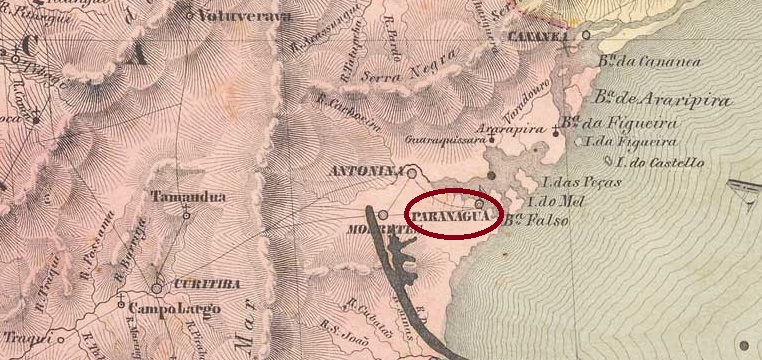
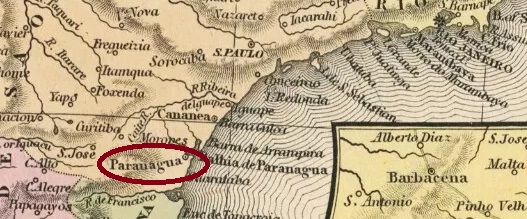
The Freguesia de N. Sra. do Rocio/Rosário de Paranaguá has been documented since 1647. It was located on the southern shore of Paranaguá Bay, 90 kilometres east of what would later become the provincial capital of Curitiba. In July 1648, it was elevated to the status of a vila and was even the seat of the Capitania de Paranaguá from 1660 to around 1710, before being assigned to the Capitania de São Paulo. In February 1842, it was designated a city, which was located in the province of Paraná from July 1854 onwards.
According to Nova Monteiro in Administrações e Agencias Postaes do Brasil Imperio (Brasil Filatelico/RJ, 1934–1935; reprinted by SPP 1994–1999), there had been a post office there since April 1828. However, philatelist Mário Celso Orsi Jr. gives a date that is exactly one year later, which could be a transcription error.
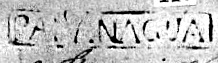
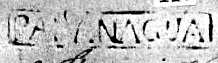
The oldest postmark to date is PPR-0150a, which also occurs in sepia and was given the code number P-SP-27 in the RHM catalogue:
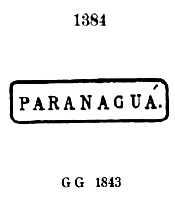
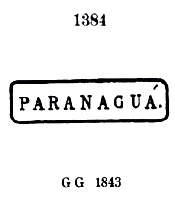
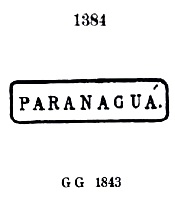
This was followed by PPR-0150b, which was given the number 1384 by P. Ayres in Catálogo de Carimbos Brasil-Império (S. Paulo, 1937, 1942):
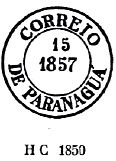
This was followed by PPR-0150c, also recorded by P. Ayres, this time with the number 1618:
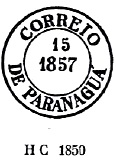
This was followed by the French type PPR-0150d, also listed by P. Ayres:

Shortly afterwards, PPR-0150e appeared, which is mostly found in blue:
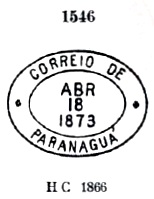
The following PPR-0150f also comes in blue and violet:

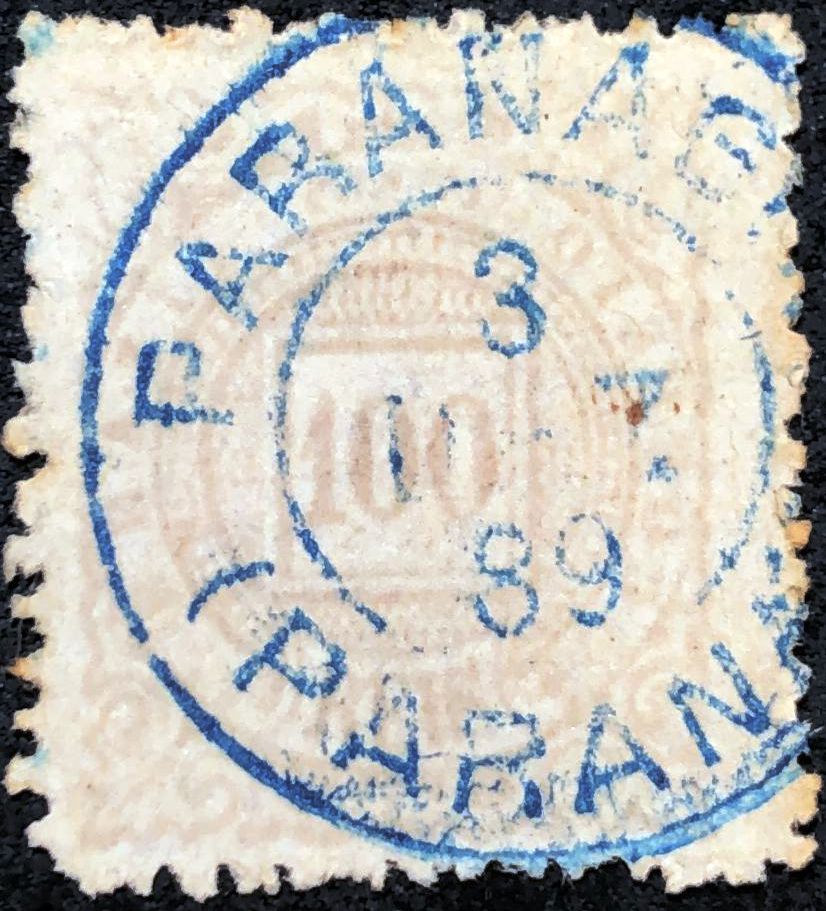
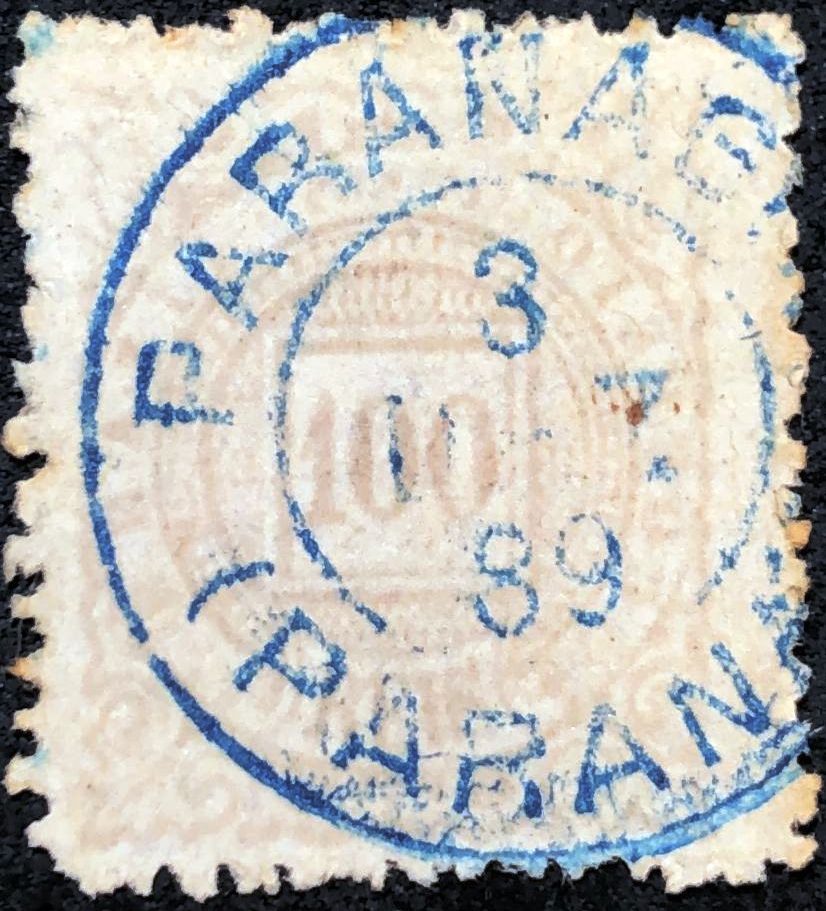
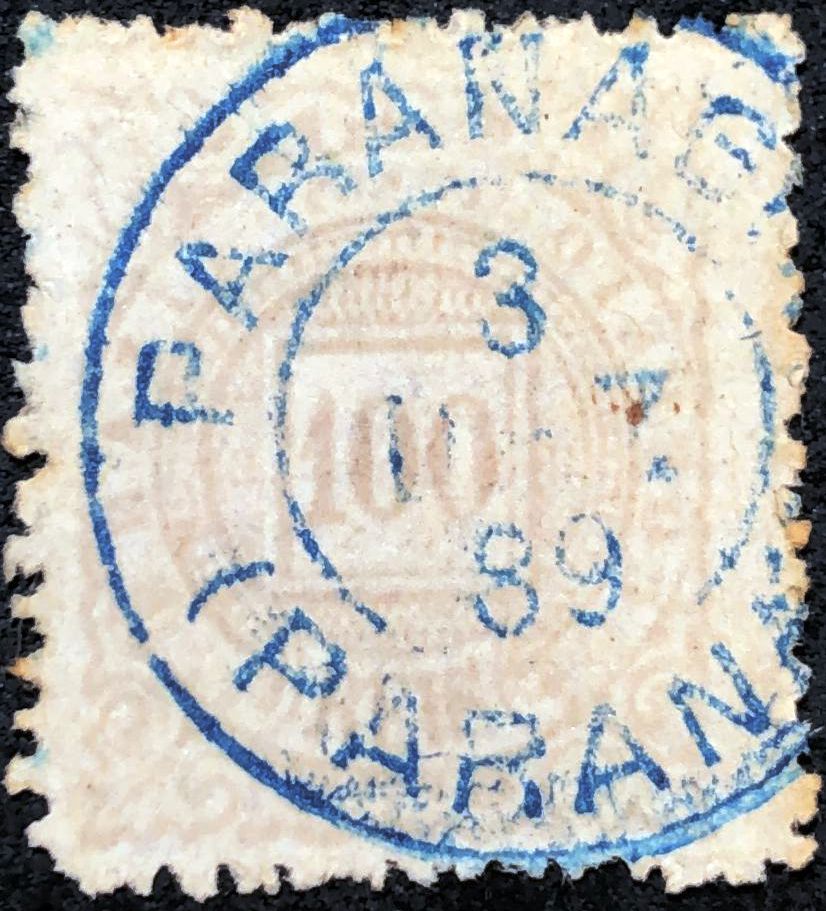
At the end of the Empire, PPR-0150g finally appeared, also in blue (fig. Luiz C. Fritzen):
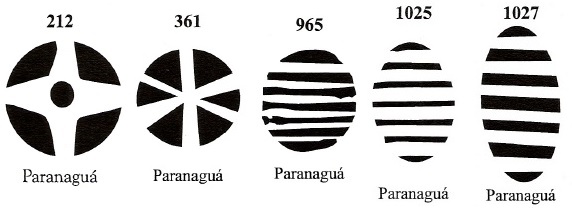
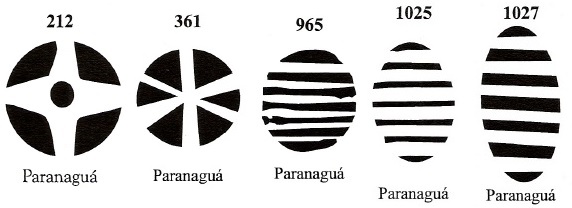
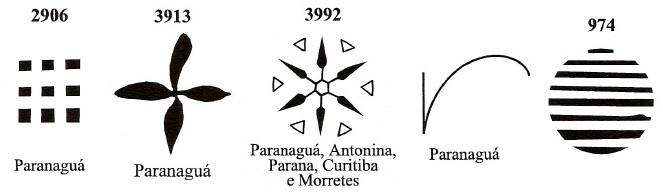
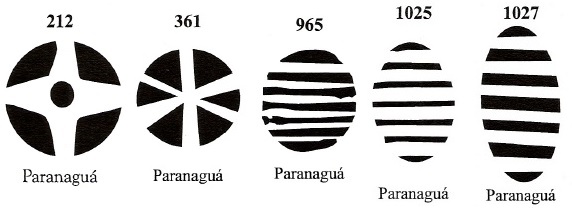
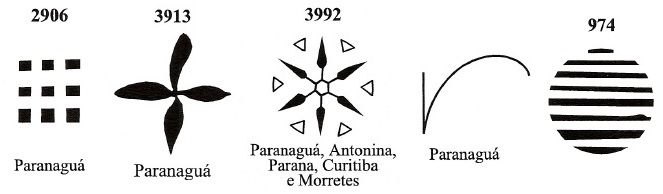
James Dingler and Klerman W. Lopes have listed 10 mute postmarks from Paranaguá in Mute Cancellations of the Brazil Empire/ Carimbos Mudos do Brasil Império (Brazil Philatelic Association, Rio de Janeiro, 2000):

A Freguesia de N. Sra. do Rocio/Rosário de Paranaguá foi mencionada desde 1647. Situava-se na margem sul da baía de Paranaguá, 90 quilômetros a leste da futura capital provincial, Curitiba. Em julho de 1648, foi elevada à categoria de vila e, de 1660 a cerca de 1710, foi sede da Capitania de Paranaguá, antes de ser atribuída à Capitania de São Paulo. Em fevereiro de 1842, foi nomeada cidade, passando a fazer parte da província do Paraná a partir de julho de 1854.
De acordo com Nova Monteiro em Administrações e Agencias Postaes do Brasil Imperio (Brasil Filatelico/RJ, 1934–1935; reimpressão SPP 1994–1999), havia uma agência dos correios no local desde abril de 1828. O filatelista Mário Celso Orsi Jr., no entanto, menciona uma data exatamente um ano depois, o que pode ser um erro de transcrição.
O carimbo postal mais antigo até agora é o PPR-0150a, que também aparece em sépia e recebeu o código P-SP-27 no catálogo RHM:

Seguiu-se o PPR-0150b, que recebeu o número 1384 de P. Ayres no Catálogo de Carimbos Brasil-Império (São Paulo, 1937, 1942):
Depois veio o PPR-0150c, também registrado por P. Ayres, desta vez com o número 1618:
Seguiu-se o tipo francês PPR-0150d, também listado por P. Ayres:

Pouco depois, surgiu o PPR-0150e, que aparece principalmente em azul:
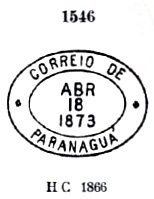
O seguinte PPR-0150f também aparece em azul e violeta:

No final do Império, surgiu finalmente o PPR-0150g, também em azul (fig. Luiz C. Fritzen):
James Dingler e Klerman W. Lopes listaram em Mute Cancellations of the Brazil Empire/ Carimbos Mudos do Brasil Império (Clube Filatélico do Brasil, Rio de Janeiro, 2000) 10 carimbos postais mudos de Paranaguá:

Die Freguesia de N. Sra. do Rocio/Rosário de Paranaguá ist seit 1647 überliefert. Sie lag am Südufer der Paranaguá-Bucht, 90 Kilometer östlich der späteren Provinzhauptstadt Curitiba. Im Juli 1648 wurde sie zur Vila erhoben und war von 1660 bis ca. 1710 sogar Sitz der Capitania de Paranaguá, bevor sie der Capitania de São Paulo zugesprochen wurde. Im Februar 1842 wurde sie zur Stadt ernannt, die ab Juli 1854 in der Provinz Paraná lag.
Laut Nova Monteiro in Administrações e Agencias Postaes do Brasil Imperio (Brasil Filatelico/RJ, 1934–1935; Nachdruck SPP 1994–1999) gab es dort seit April 1828 ein Postamt. Der Philatelist Mário Celso Orsi Jr. nennt jedoch ein Datum, das genau ein Jahr später liegt, was ein Abschreibfehler sein könnte.
Der bisher älteste Poststempel ist PPR-0150a, der auch in Sepia vorkommt und im RHM-Katalog die Code-Nr. P-SP-27 erhielt:
Es folgte PPR-0150b , der von P. Ayres in Catálogo de Carimbos Brasil-Império (São Paulo, 1937, 1942) die Nr. 1384 bekam:
Danach kam PPR-0150c, ebenfalls von P. Ayres erfasst, diesmal mit der Nr. 1618:
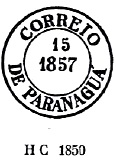
Es folgte der französische Typ PPR-0150d, auch von P. Ayres aufgeführt:

Kurz darauf erschien PPR-0150e, der meistens in Blau vorkommt:

Der folgende PPR-0150f kommt ebenfalls in Blau und Violett vor:

Am Ende des Kaiserreichs erschien schließlich PPR-0150g, auch in Blau (Abb. Luiz C. Fritzen):
James Dingler und Klerman W. Lopes haben in Mute Cancellations of the Brazil Empire/ Carimbos Mudos do Brasil Império (Brazil Philatelic Association, Rio de Janeiro, 2000) 10 stumme Poststempel aus Paranaguá aufgeführt:

 Carimbologia