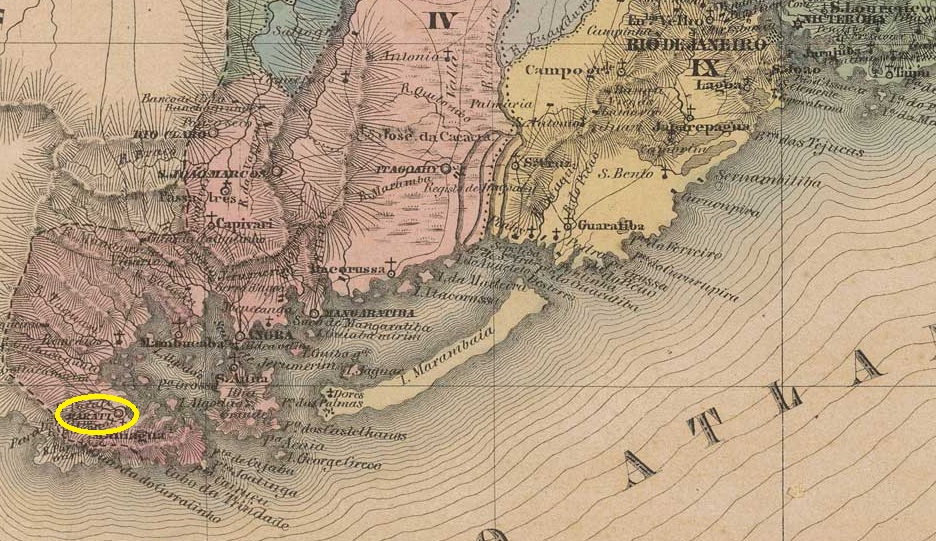
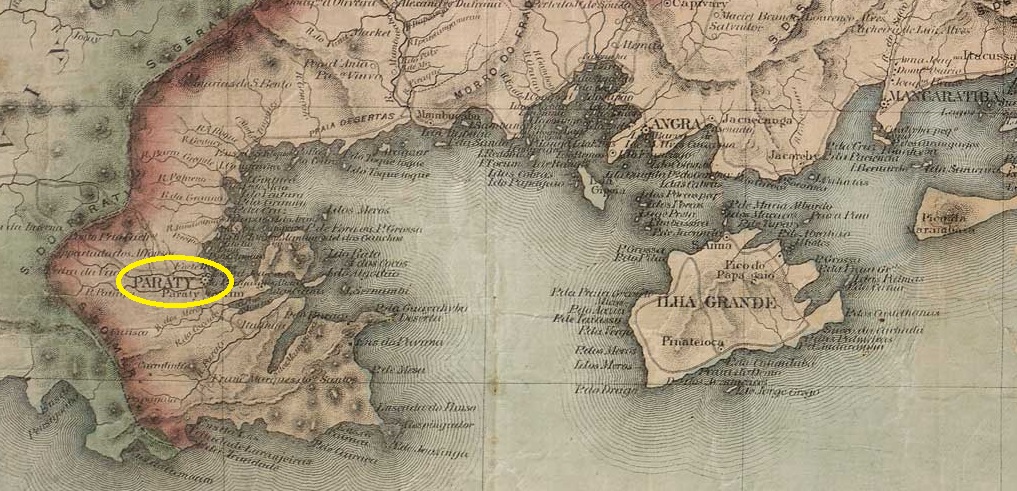
Alternative spelling: Parati
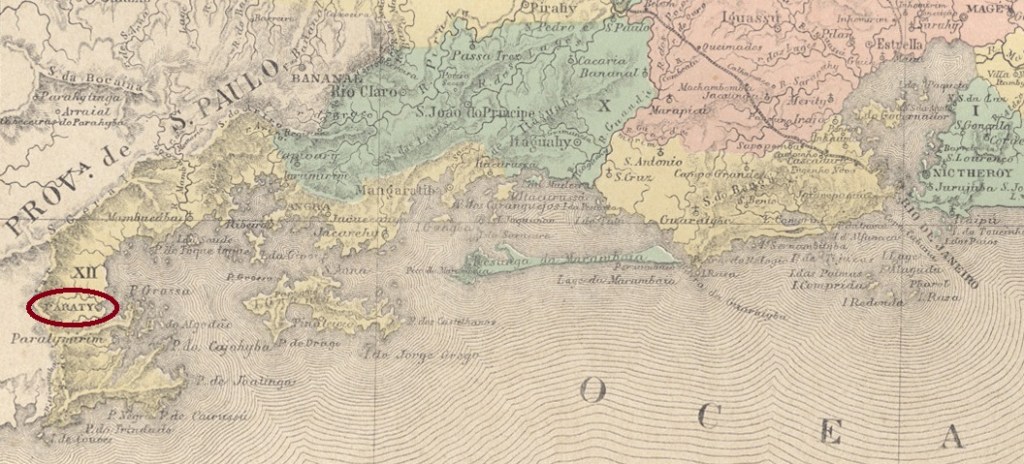
Around 1647, Paraty was a settlement belonging to the Vila de Angra dos Reis on Carioca Bay, 250 kilometres west of the capital Rio de Janeiro. In February 1667, it became the Vila and Freguesia de Nossa Senhora dos Remédios de Paraty, and in March 1844, it became a city. The Tupi word ‘Paraty’ refers to the Brazilian mullet

Two different dates have been found for the establishment of the local post office. R. Koester writes in Carimbologia XXX that it was March 1798, but unfortunately does not cite a source. Nova Monteiro, on the other hand, argues for January 1822 in Administrações e Agencias Postaes do Brasil Imperio (Brasil Filatelico/RJ, 1934–1935; reprinted SPP 1994–1999). The year is confirmed by the directory of imperial post offices (Tabella das Agencias do Correio do Imperio, Rio de Janeiro, 1885).
The oldest postmark to date is PRJ-0760a. It also appears in sepia and chestnut brown and was given the code number P-RJ-24 in the RHM catalogue.

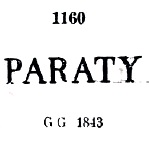
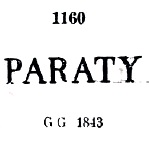
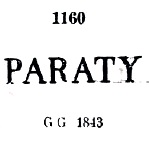
This was followed by PRJ-0760b, which was given the number 1160 by P. Ayres in Catálogo de Carimbos Brasil-Império (São Paulo, 1937, 1942):
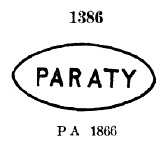
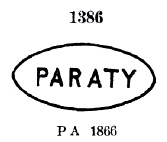
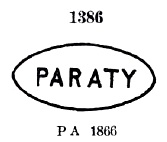
This was followed by PRJ-0760c, also recorded by Ayres, this time with no. 1386:
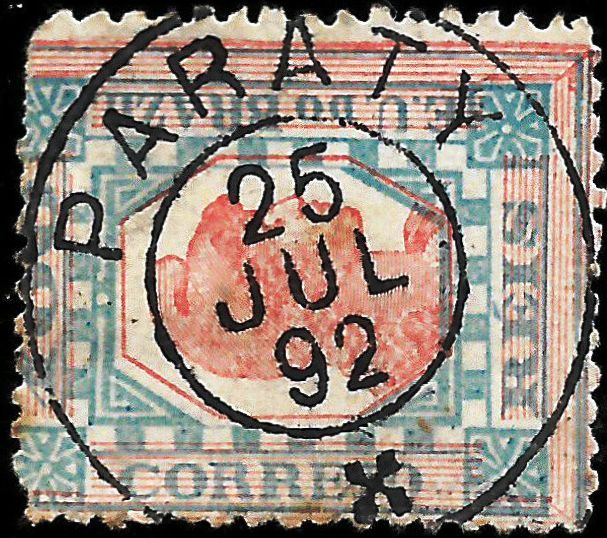
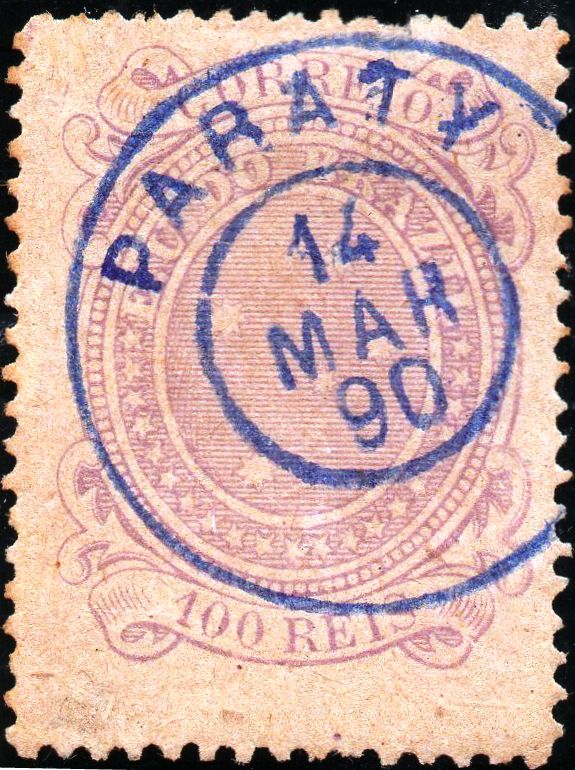
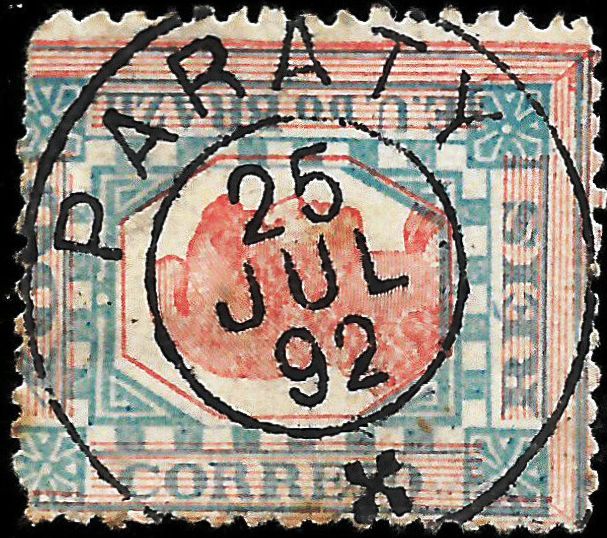
Towards the end of the Empire, PRJ-0760d (illustration from the Internet) appeared, which also occurs in purple or blue:
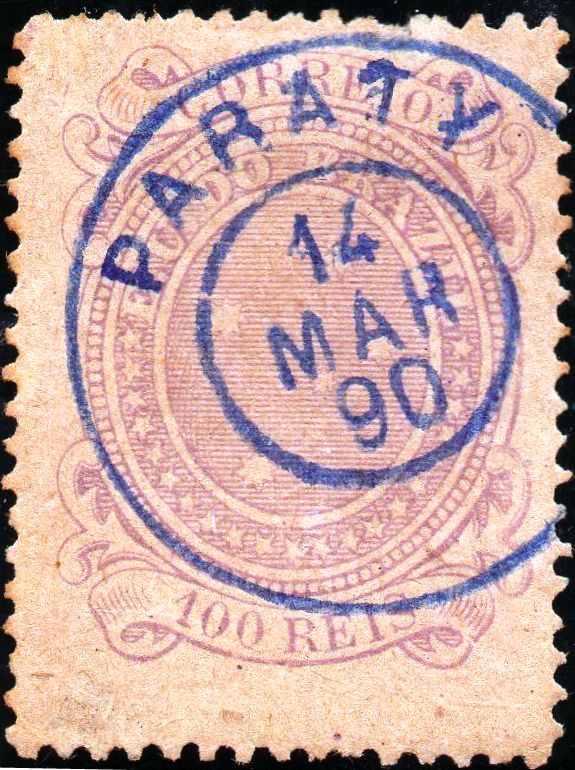
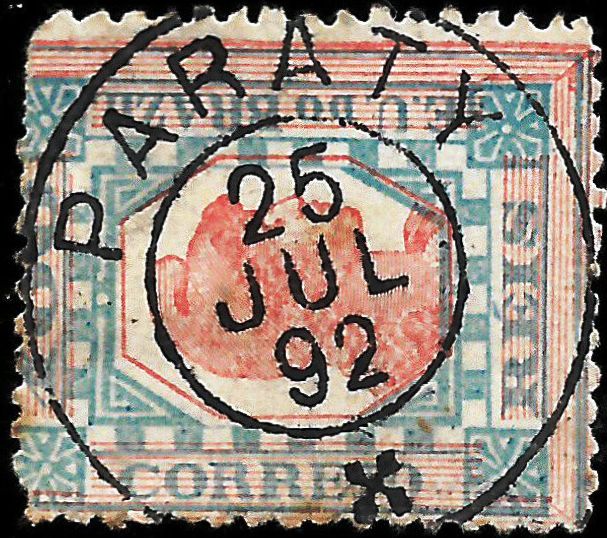
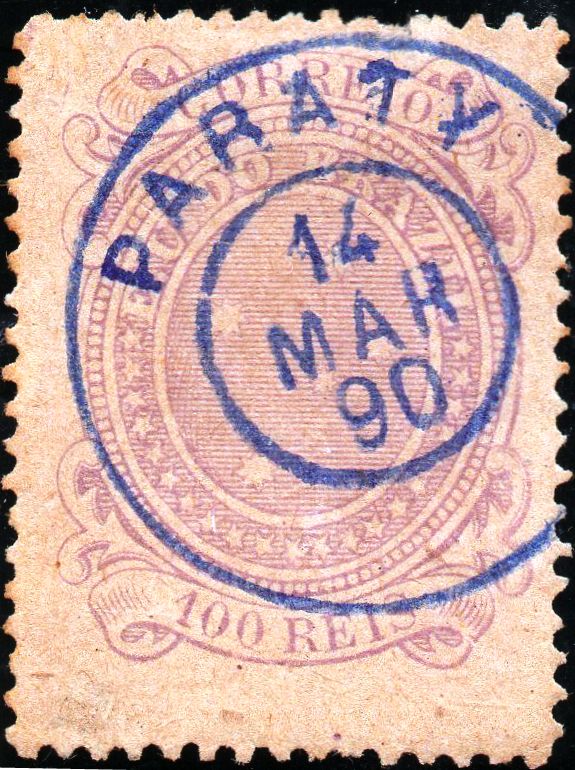
And at the end of the century, PRJ-0760e (illustration from the Internet) was used, also occurring in purple or blue:
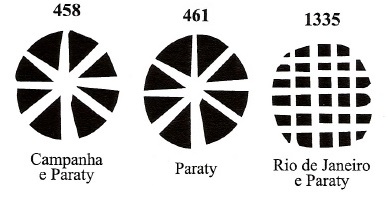
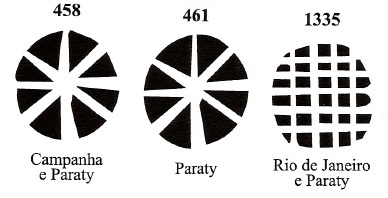
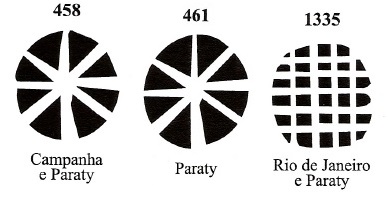
James A. Dingler and Klerman W. Lopes listed three mute postmarks in Mute Cancellations of the Brazil Empire / Carimbos Mudos do Brasil Império (Brazil Philatelic Association, Rio de Janeiro, 2000):
Outra grafia: Parati
Por volta de 1647, Paraty era um povoado da Vila de Angra dos Reis, na Baía da Carioca, 250 quilômetros a oeste da capital Rio de Janeiro. Em fevereiro de 1667, tornou-se Vila e Freguesia de Nossa Senhora dos Remédios de Paraty e, em março de 1844, cidade. A palavra tupi “Paraty” designa a tainha

Foram encontradas duas datas diferentes para a criação dos correios locais. R. Koester escreve em Carimbologia XXX março de 1798, mas infelizmente não cita nenhuma fonte. Nova Monteiro, por outro lado, defende janeiro de 1822 em Administrações e Agencias Postaes do Brasil Imperio (Brasil Filatelico/RJ, 1934–1935; reimpressão SPP 1994–1999). O ano é confirmado pela Tabella das Agências do Correio do Império (Rio de Janeiro, 1885).
O carimbo postal mais antigo até agora é o PRJ-0760a. Ele também aparece em sépia e marrom-castanho e recebeu o código P-RJ-24 no catálogo RHM.

Seguiu-se o PRJ-0760b, que recebeu o número 1160 de P. Ayres no Catálogo de Carimbos Brasil-Império (São Paulo, 1937, 1942):
Depois veio o PRJ-0760c, também registrado por Ayres, desta vez com o número 1386:
No final do Império, surgiu o PRJ-0760d (fig. da Internet), que também existe em violeta ou azul:
E, no final do século, foi utilizado o PRJ-0760e (fig. da Internet), também existente em violeta ou azul:
James A. Dingler e Klerman W. Lopes listaram três carimbos postais mudos em Mute Cancellations of the Brazil Empire / Carimbos Mudos do Brasil Império (Clube Filatélico do Brasil, Rio de Janeiro, 2000):
Andere Schreibweise: Parati
Paraty war um 1647 eine Siedlung der Vila de Angra dos Reis an der Carioca-Bucht, 250 Kilometer westlich der Hauptstadt Rio de Janeiro. Im Februar 1667 wurde sie zur Vila und Freguesia de Nossa Senhora dos Remédios de Paraty und im März 1844 zur Stadt. Das Tupi-Wort „Paraty” bezeichnet die brasilianische Meeräsche

Es wurden zwei verschiedene Daten zur Entstehung des örtlichen Postamts gefunden. R. Koester schreibt in Carimbologia XXX den März 1798, nennt jedoch leider keine Quelle. Nova Monteiro plädiert hingegen für den Januar 1822 in Administrações e Agencias Postaes do Brasil Imperio (Brasil Filatelico/RJ, 1934–1935; Nachdruck SPP 1994–1999). Das Jahr wird durch das Verzeichnis der kaiserlichen Postämter (Tabella das Agencias do Correio do Imperio, Rio de Janeiro, 1885) bestätigt.
Der bisher älteste Poststempel ist PRJ-0760a. Er kommt auch in Sepia und Kastanienbraun vor und erhielt im RHM-Katalog die Code-Nr. P-RJ-24.

Es folgte PRJ-0760b , der von P. Ayres in Catálogo de Carimbos Brasil-Império (São Paulo, 1937, 1942) die Nr. 1160 erhielt:
Danach kam PRJ-0760c, ebenfalls durch Ayres erfasst, diesmal mit Nr. 1386:
Gegen Ende des Kaiserreichs erschien PRJ-0760d (Abb. aus dem Internet), der auch in Violett oder Blau vorkommt:
Und am Ende des Jahrhunderts wurde PRJ-0760e (Abb. aus dem Internet) verwendet, ebenfalls in Violett bzw. Blau vorkommend:
James A. Dingler und Klerman W. Lopes haben drei stumme Poststempel in Mute Cancellations of the Brazil Empire / Carimbos Mudos do Brasil Império (Brazil Philatelic Association, Rio de Janeiro, 2000) aufgeführt:

 Carimbologia