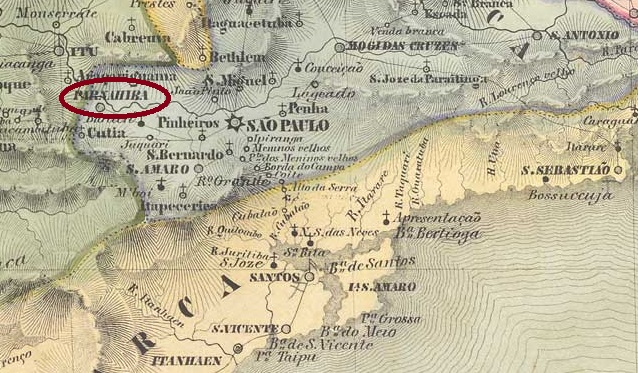
Other names: Santana de Parnaíba (1944)
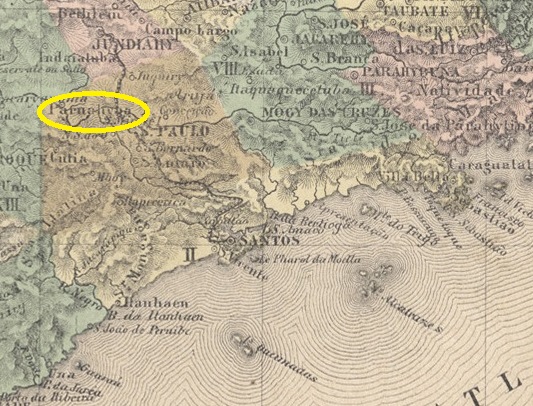
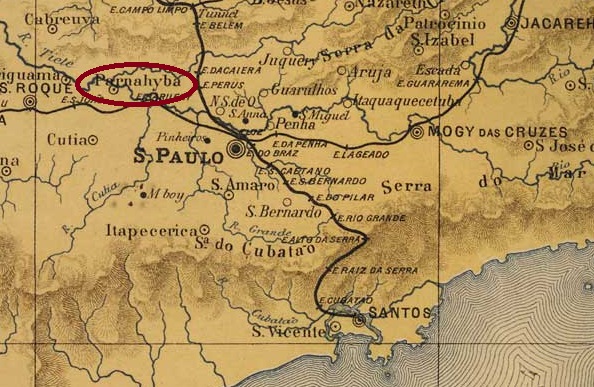
The Capela de Sant’Anna was built around 1580. It belonged to the Vila de São Paulo and was located on the west bank of the Tietê River, 40 kilometres northwest of what would later become the provincial capital. In November 1625, the Vila de Parnaíba was founded, which was declared a city in December 1906. Since November 1944, it has been officially named Município de Santana de Parnaíba to avoid confusion with Parnaíba in the state of Piauí.
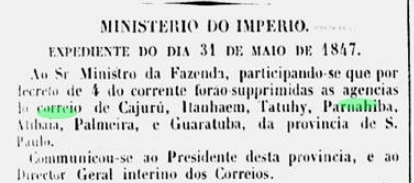
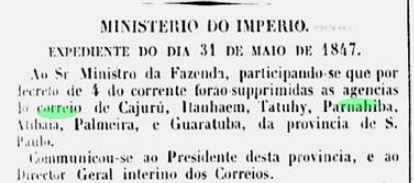
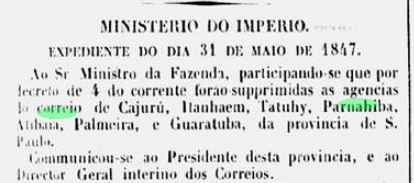
Two periods of operation were found for the local post office, although the start date of the first is unknown. It ended in May 1847, as reported by the official press in Rio de Janeiro:
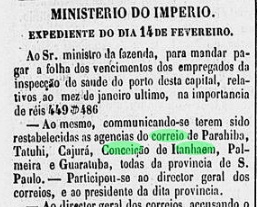
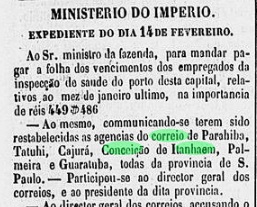
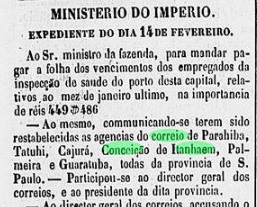
In February 1849, it was decided to reopen the post office, as reported in the Rio press:
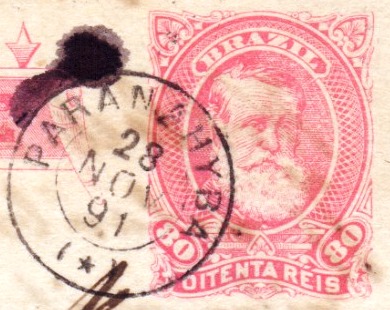
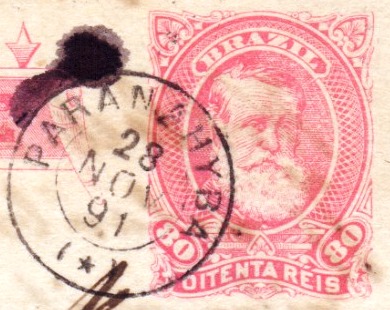
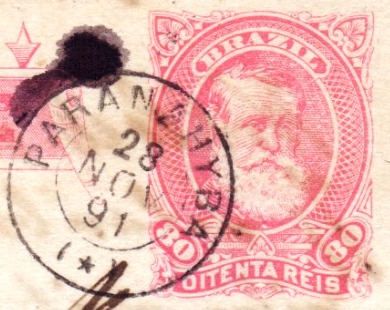
The oldest postmark to date is PSP-0875a, which was given the number 1159 by P. Ayres in Catálogo de Carimbos Brasil-Império (S. Paulo, 1937, 1942):

This was followed by the double circle PSP-0875b (illustration by Felipe Piccinini):

Then came the French type PSP-0875c (illustration by Rodrigo Baldassare):
Outros nomes: Santana de Parnaíba (1944)
A Capela de Sant’Anna foi construída por volta de 1580. Pertencia à Vila de São Paulo e ficava na margem oeste do rio Tietê, 40 quilômetros a noroeste da futura capital da província. Em novembro de 1625, foi fundada a Vila de Parnaíba, que em dezembro de 1906 foi declarada cidade. Desde novembro de 1944, ela leva o nome oficial de Município de Santana de Parnaíba, para evitar confusão com Parnaíba, no estado do Piauí.
Foram encontrados dois períodos de funcionamento para a agência postal local, sendo que o início do primeiro é desconhecido. Ele terminou em maio de 1847, conforme noticiado pela imprensa oficial do Rio de Janeiro:
Em fevereiro de 1849, foi decidido reabrir a agência dos correios, conforme noticiado pela imprensa do Rio:
O carimbo postal mais antigo até agora é o PSP-0875a, que recebeu o número 1159 de P. Ayres no Catálogo de Carimbos Brasil-Império (São Paulo, 1937, 1942):

Seguiu-se o círculo duplo PSP-0875b (fig. Felipe Piccinini):

Depois veio o tipo francês PSP-0875c (fig. Rodrigo Baldassare):
Andere Namen: Santana de Parnaíba (1944)
Die Capela de Sant’Anna wurde um 1580 errichtet. Sie gehörte zur Vila de São Paulo und lag am Westufer des Tietê, 40 Kilometer nordwestlich der späteren Provinzhauptstadt. Im November 1625 wurde die Vila de Parnaíba gegründet, die im Dezember 1906 zur Stadt erklärt wurde. Seit November 1944 trägt sie den offiziellen Namen Município de Santana de Parnaíba, um Verwechslungen mit Parnaíba im Bundesstaat Piauí zu vermeiden.
Es wurden zwei Betriebsperioden für das örtliche Postamt gefunden, wobei der Beginn der ersten nicht bekannt ist. Sie endete im Mai 1847, wie die Amtspresse in Rio de Janeiro berichtete:
Im Februar 1849 wurde beschlossen, das Postamt wiederzueröffnen, wie aus der Presse in Rio hervorgeht:
Der bisher älteste Poststempel ist PSP-0875a, der von P. Ayres in Catálogo de Carimbos Brasil-Império (São Paulo, 1937, 1942) die Nr. 1159 erhielt:

Es folgte der Doppelkreis PSP-0875b (Abb. Felipe Piccinini):

Danach kam der französische Typ PSP-0875c (Abb. Rodrigo Baldassare):

 Carimbologia