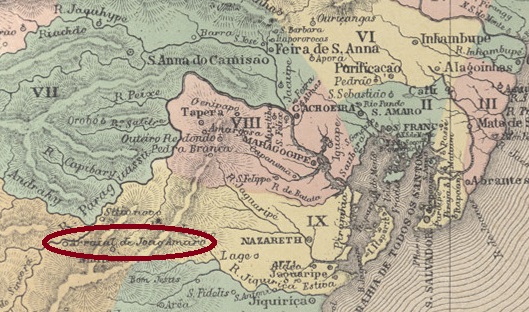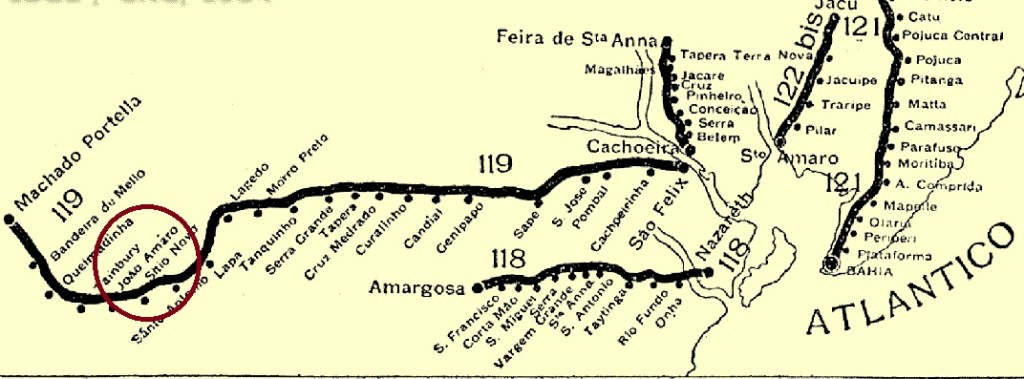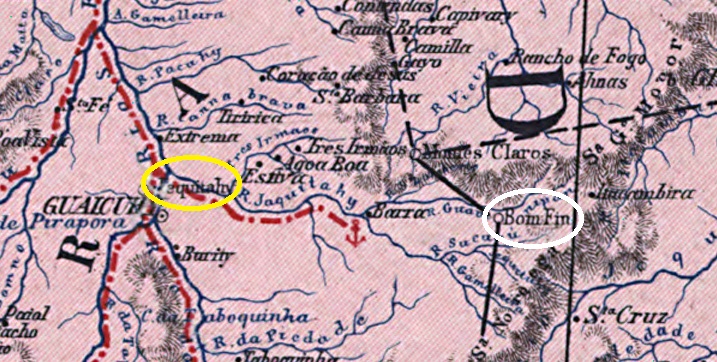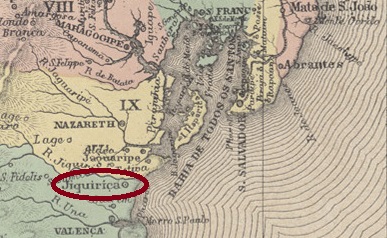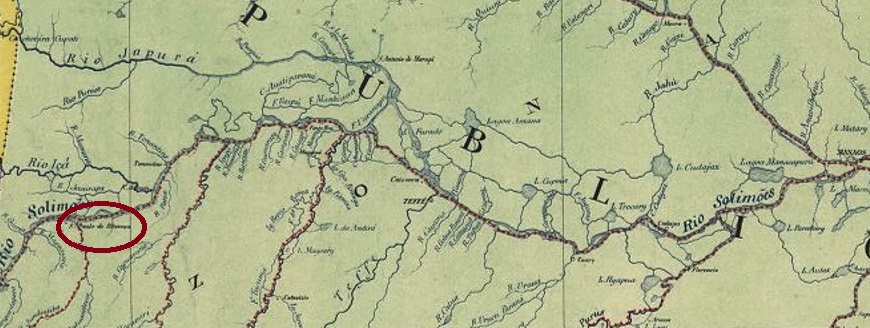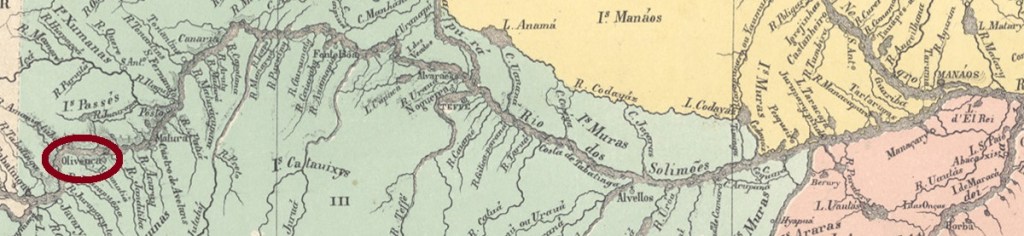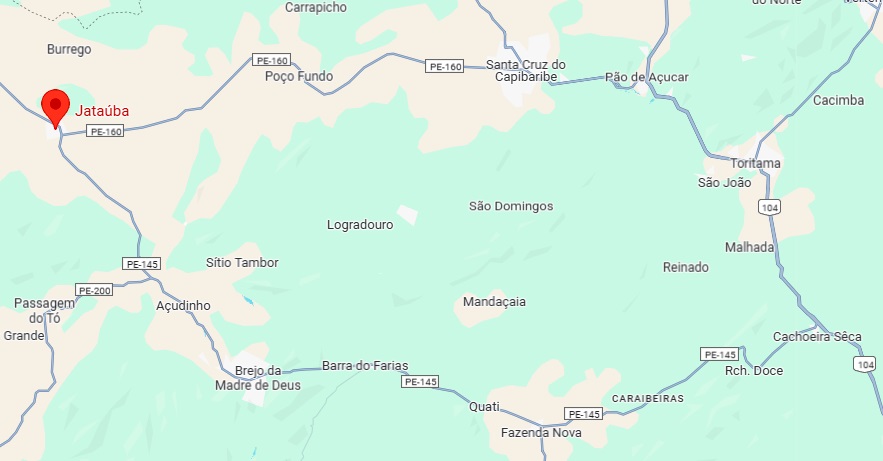
Around 1810, a harbour was built on the left bank of the Tapajós near the settlement of Pinhel, 900 km southwest of the later provincial capital of Belém do Pará. In 1853, the settlement created there was incorporated into the Freguesia de Boim, which belonged to the Vila de Santarém. In December 1856, it was elevated to Vila de Sant’Anna de Itaituba, which was declared a town in March 1900. In December 1930, it was downgraded to a district and assigned directly to the state of Pará. The Município de Itaituba has existed again since October 1935. The word comes from the Tupi language and means rivers rich in stones.
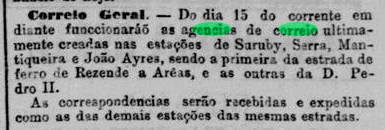
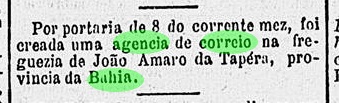
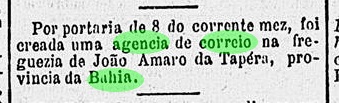
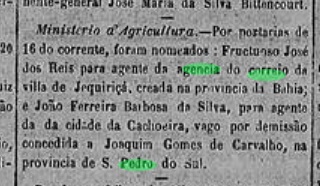
R. Koester writes in Carimbologia XXIII that there had been a post office there since 1882. However, this was a reopening, as there was a postal agency in Itaituba already mentioned in the regional press in December 1878:
O Liberal do Pará, 24/12/1878
As the post office is not mentioned in the imperial postal guide (Guia Postal do Imperio, 1880), it must have been closed by 1879 at the latest.
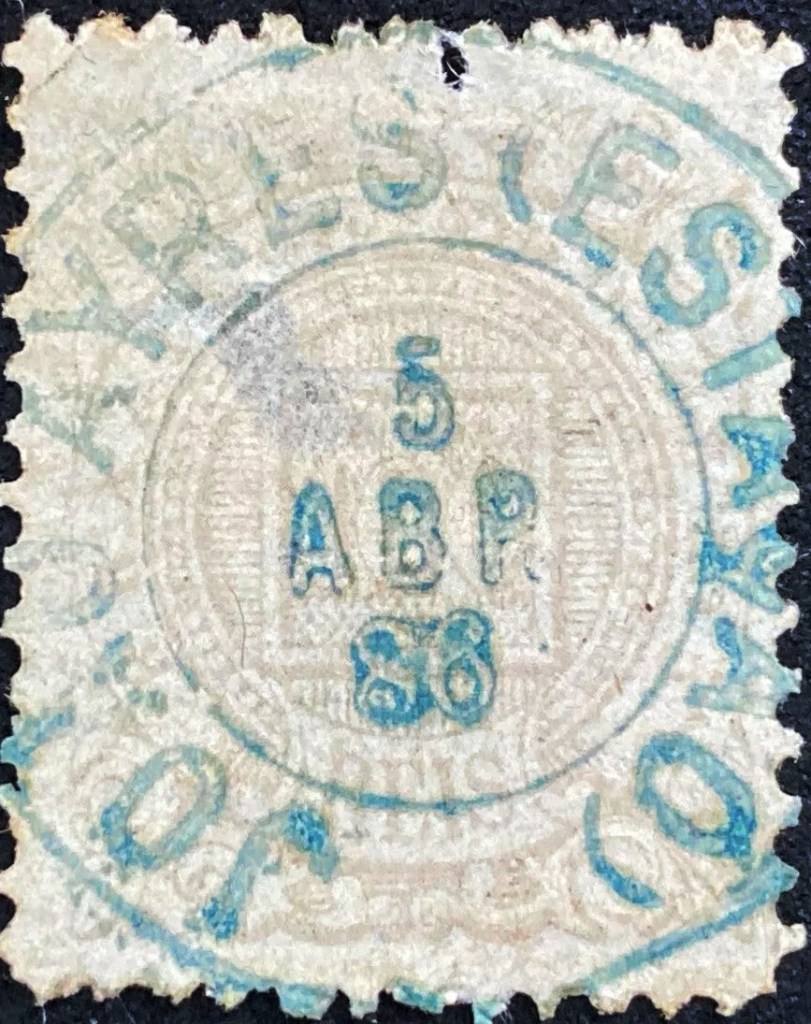
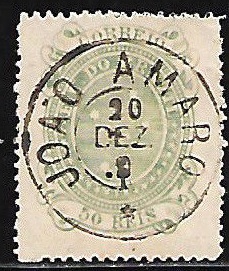
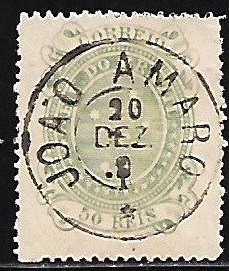
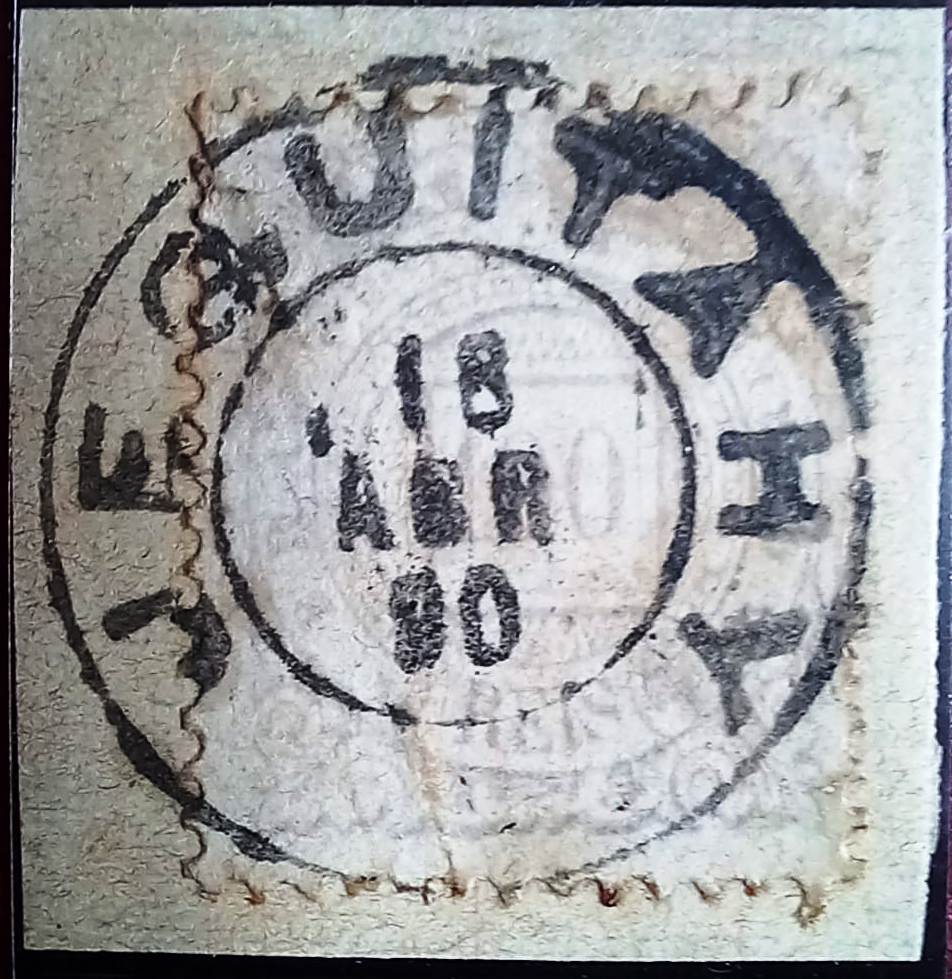
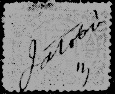
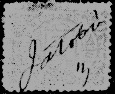
The oldest postmark to date is IPA-0140a (fig. Koester, op. cit.):
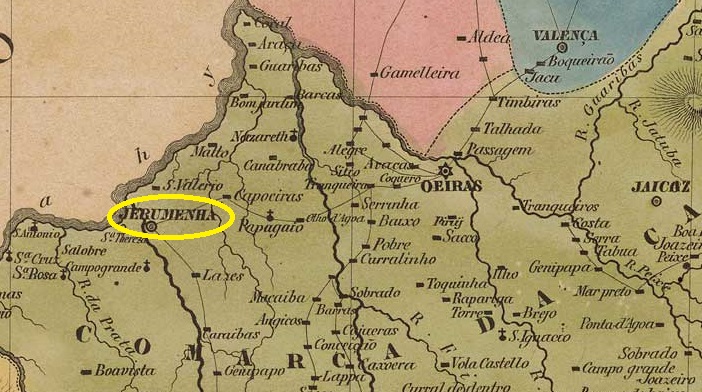
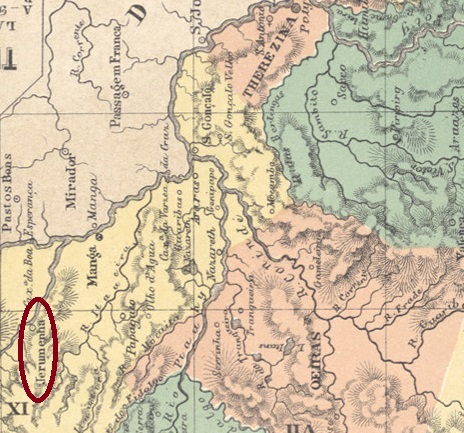
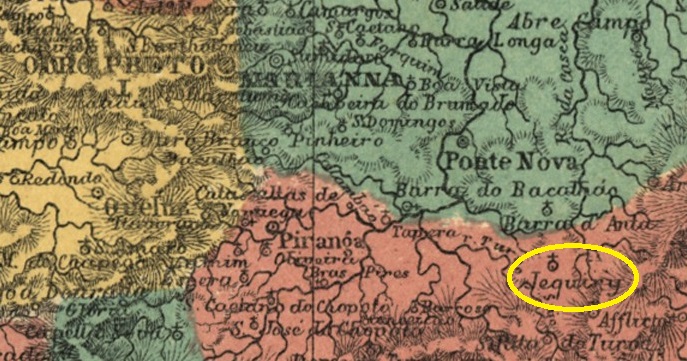
IPA-0140a (RK) 1890Carta da Republica dos Estados Unidos do Brazil, 1892
Um 1810 entstand am linken Ufer des Tapajós im Bereich der Siedlung Pinhel, 900 km südwestlich der späteren Provinzhauptstadt Belém do Pará, ein Hafen. 1853 wurde die dort entstandene Siedlung der Freguesia de Boim zugeschlagen, die zur Vila de Santarém gehörte. Im Dezember 1856 erfolgte die Erhebung zur Vila de Sant’Anna de Itaituba, die im März 1900 zur Stadt erklärt wurde. Im Dezember 1930 erfolgte die Herabstufung zum Distrikt, der direkt dem Bundesstaat Pará zugeordnet wurde. Seit Oktober 1935 gibt es wieder das Município de Itaituba. Das Wort stammt aus der Tupi-Sprache und bedeutet steinreiche Flüsse.
R. Koester schreibt in Carimbologia XXIII, dass es dort seit 1882 ein Postamt gab. Es handelt sich jedoch um eine Wiedereröffnung, da bereits im Dezember 1878 in der regionalen Presse von einer Postagentur in Itaituba die Rede war:
O Liberal do Pará, 24.12.1878
Da das Postamt im kaiserlichen Postführer (Guia Postal do Imperio, 1880) nicht erwähnt wird, muss es spätestens 1879 geschlossen worden sein.
Der bisher älteste Poststempel ist IPA-0140a (Abb. Koester, op. cit.):
Villiers de l’Ile Adam: Carta (…) da Provincia do Rio de Janeiro, 1850
Text update of January 8, 2025
Other names: Taipú
The Freguesia de S. Sebastião do Itaipú had existed since January 1755. It belonged to the Vila de Niterói and was located near the beach, 35 kilometres east of the capital Rio de Janeiro. In September 1890 it became a distrito of the Município de S. Gonçalo, but returned to the municipality of Niterói as a distrito in December 1943. The beautiful name Itaipu comes from the Tupi-guarani and means singing stone.
According to the regional press, there had been a post office there since August 1889:
Gazeta de Noticias, 29/08/1889
The only postmark from the imperial era to date, IRJ-1065a, had been presented by R. Koester in Carimbologia XXIII and bears the imperial seal:
IRJ-1065a (RK)
In the meantime, the double circle IRJ-1065b also appeared (Image: Felipe Piccinini):
IRJ-1065b (FP) 1891Colton & Colton: Provincia do Rio de Janeiro, 1866
Textaktualisierung am 8. Januar 2025
Andere Namen: Taipú
Die Freguesia de S. Sebastião do Itaipú bestand seit Januar 1755. Sie gehörte zur Vila de Niterói und lag in der Nähe des Strandes, 35 km östlich der Hauptstadt Rio de Janeiro. Im September 1890 wurde sie ein Distrito des Município de S. Gonçalo, kehrte aber im Dezember 1943 als Distrito zur Gemeinde Niterói zurück. Der schöne Name Itaipu kommt aus dem Tupi-guarani und bedeutet singender Stein.
Wie aus der regionalen Presse hervorgeht, gab es dort seit August 1889 ein Postamt:
Gazeta de Noticias, 29/08/1889
Der bisher einzige Poststempel aus der Kaiserzeit IRJ-1065a wurde von R. Koester in Carimbologia XXIII vorgestellt und trägt das kaiserliche Siegel:
IRJ-1065a (RK)
In der Zwischenzeit erschien auch der Doppelkreis IRJ-1065b (Bild: Felipe Piccinini):
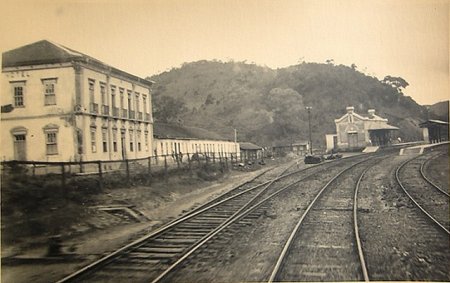
Itaipava station was opened in February 1886 by the railway company E.F. do Norte (formerly Príncipe do Grão-Pará) in the Município de Petrópolis, over 80 km north of the capital Rio de Janeiro. The line was taken over by the R.J. Northern Railway in 1888 and belonged to E.F. Leopoldina from around 1890 until it was closed in 1964. Today the tracks have disappeared and a shopping centre has been built on the former station site.
In May 1917 (Fon-Fon magazine, apud estacoesferroviarias.com.br)In July 2020 (photo Zezinho Suhett, on Google Maps)
The regional press reports that there has been a post office at the station since October 1889
Diario do Commercio, 07/10/1889
The oldest postmark to date is IRJ-1060a (Fig. agenciaspostais.com.br):
IRJ-1060a (PN) 1900-1906Estrada de Ferro Leopoldina
Der Bahnhof Itaipava wurde im Februar 1886 von der Eisenbahngesellschaft E.F. do Norte (ehemals Príncipe do Grão-Pará) eröffnet und lag im Município de Petrópolis, über 80 km nördlich der Hauptstadt Rio de Janeiro. Die Strecke wurde 1888 von der R.J. Northern Railway übernommen und gehörte von ca. 1890 bis zu ihrer Stilllegung 1964 der E.F. Leopoldina. Heute sind die Gleise verschwunden, auf dem ehemaligen Bahnhofsgelände befindet sich ein Einkaufszentrum.
Im Mai 1917 (Zeitschrift Fon-Fon, apud estacoesferroviarias.com.br)Im Juli 2020 (Foto Zezinho Suhett, auf Google Maps)
Die regionale Presse berichtet, dass es seit Oktober 1889 ein Postamt am Bahnhof gab:
Diario do Commercio, 07.10.1889
Der bisher älteste Poststempel ist IRJ-1060a (Abb. agenciaspostais.com.br):
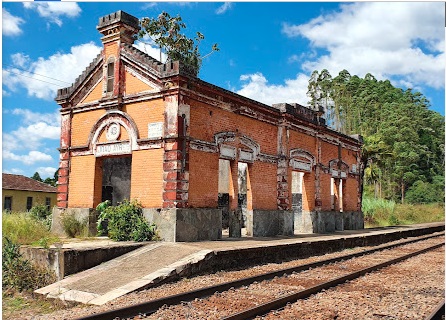
Itaicy station was opened in 1873 by the E.F. Ytuana railway company (Campinas branch line) and is located on the north bank of the Jundiaí in the Município Indaiatuba, 100 km north-west of the provincial capital of São Paulo. In the Tupi-Guarani language, Itaici means spring by the water. The railway line went to the Cia. União Sorocabana e Ytuana in 1892, to the Sorocabana Railway in 1907, to the E.F. Sorocabana in 1919 and belonged to FEPASA (estacoesferroviarias.com.br) from 1971 until it was shut down around 1988. Today, the tracks have disappeared and the station building has served as a cultural centre for the municipality of Indaiatuba since 2022.
Around 1940 (photo NN, on estacoesferroviarias.com.br)In March 2023 (photo Bruno Liberatori, on Google Maps)
As reported in the regional press; there had been a post office at the station since December 1879
Correio Paulistano, 27/12/1879
The imperial postmark is the French type ISP-1965a (coll. Fuad Ferreira Fo.), which also appears in blue:
ISP-1965a (FF) 1884-1891Cia. Sorocabana e Ytuana, 1898
Der Bahnhof Itaicy wurde 1873 von der Eisenbahngesellschaft E.F. Ytuana (Zweigbahn Campinas) eröffnet und liegt am Nordufer des Jundiaí im Município Indaiatuba, 100 km nordwestlich der Provinzhauptstadt São Paulo. In der Tupi-Guarani-Sprache bedeutet Itaici Quelle am Wasser. Die Bahnlinie ging 1892 an die Cia. União Sorocabana e Ytuana, 1907 an die Sorocabana Railway, 1919 an die E.F. Sorocabana und gehörte von 1971 bis zur Stilllegung um 1988 der FEPASA (estacoesferroviarias.com.br). heute sind die Gleise verschwunden, das Bahnhofsgebäude dient seit 2022 als Kulturzentrum der Gemeinde Indaiatuba.
Um 1940 (Foto NN, auf estacoesferroviarias.com.br)Im März 2023 (Foto Bruno Liberatori, auf Google Maps)
Wie in der regionalen Presse berichtet; seit Dezember 1879 gab es ein Postamt am Bahnhof:
Correio Paulistano, 27.12.1879
Der kaiserliche Poststempel ist der französische Typ ISP-1965a (Samml. Fuad Ferreira Fo.), der auch in blau vorkommt:
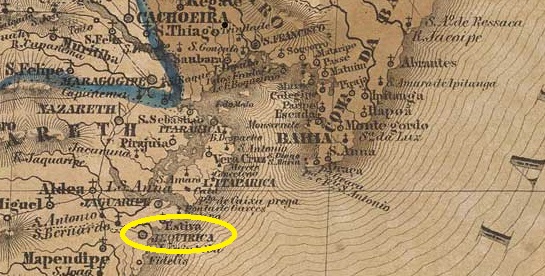
Here we have another village that has now disappeared from the map. Itahy (River of Stones, in Tupi-Guarani) was probably a settlement that emerged from a fazenda near the Freguesia de S. Pedro da Aldeia around Vila de Cabo Frio, 140 kilometres east of the capital Rio de Janeiro. Three changes of administration followed: in September 1890 to the newly founded Vila de Sapyatiba, in September 1892 back to the Vila de Cabo Frio and six months later to the Vila de S. Pedro da Aldeia.
As the press in Rio reported, there had been a post office there since November 1884:
Diario do Brazil, 29/11/1884
According to P. Novaes (agenciaspostais.com.br), the post office was closed in July 1931. The imperial postmark here is IRJ-1055a, which also exists in dark violet and is illustrated in P. Ayres’ Catálogo de Carimbos Brasil-Império (S. Paulo, 1937, 1942) on p. 121:
IRJ-1055a (P.A. p. 121) 1885-1887
R. Koester also showed the postmark with the imperial seal IRJ-1055b in Carimbologia XXIII:
IRJ-1055b (RK)Google Maps
Andere Namen: Itahim, Itaí
Hier haben wir eine weitere Ortschaft, die heute von der Landkarte verschwunden ist. Itahy (Fluss der Steine, in Tupi-Guarani) war vermutlich eine Siedlung, die aus einer Fazenda in der Nähe der Freguesia de S. Pedro da Aldeia im Gebiet der Vila de Cabo Frio, 140 km östlich der Hauptstadt Rio de Janeiro, hervorging. Es folgten drei Verwaltungswechsel: im September 1890 zur neu gegründeten Vila de Sapyatiba, im September 1892 zurück zur Vila de Cabo Frio und ein halbes Jahr später zur Vila de S. Pedro da Aldeia.
Wie die Presse in Rio berichtete, gab es dort seit November 1884 ein Postamt:
Diario do Brazil, 29.11.1884
Nach P. Novaes (agenciaspostais.com.br) wurde das Postamt im Juli 1931 geschlossen. Der kaiserliche Poststempel hier ist IRJ-1055a, den es auch in dunkelviolett gibt und der in P. Ayres‘ Catálogo de Carimbos Brasil-Império (S. Paulo, 1937, 1942) auf S. 121 abgebildet ist:
IRJ-1055a (P.A. S. 121) 1885-1887
R. Koester zeigte in Carimbologia XXIII auch den Poststempel mit dem kaiserlichen Siegel IRJ-1055b:

Villiers de l’Ile Adam: Carta (…) da Provincia do Rio de Janeiro, 1850
See also Tacoahy (TRJ-1600)
The parish of São Francisco Xavier de Tagoahy (or Tacoahy) was established in December 1795 by royal decree (Ordem Régia) 70 km west of the colonial capital Rio de Janeiro. The word Taguahy comes from the Tupi-Guarani language, means something like waters with yellow mud and names the river in the area that flows into the Sepetiba Bay. In 1818, the place was declared a vila for five months before being reclassified as a district in November of that year. In 1819 it became a vila again, and since June 1892 Itaguaí (as it is now spelled) has been a town in its own municipal charter.
Nova Monteiro (Administrações e Agencias Postaes do Brasil Imperio, in Brasil Filatelico/RJ, 1934-5; Reprint SPP 1994-1999) and Reinhold Koester (Carimbologia XXIII) agree that there was a post office there from May 1829. The first local postmark is also the only one with Tagoahy so far. TRJ-1600a has already been presentsed by Cicero A. Almeida under No. 380 in Carimbos Postais – século XIX (Rio de Janeiro, 1989):
TRJ-1600a (MPT 380) 1829ff
This was followed by local cancellations with the spelling Itaguahy, beginning with IRJ-0675a, which also exists in red and dark violet and which received the no. 1326 in P. Ayres Catálogo de Carimbos Brasil-Império (S. Paulo, 1937, 1942):
IRJ-0675a (P.A. 1326) 1866ff-1882ff
Then came the very rare French type IRJ-0675b (collect. Fuad Ferreira Fo.):
IRJ-0675b (FF) 1868
Its successor IRJ-0675c (fig. agenciaspostais.com.br), on the other hand, is more common:
IRJ-0675c (PN) 1877-1888
The following cancels were also used in the Republic, starting with IRJ-0675d, which is also included in P. Ayres (op. cit.):
A mute cancellation from Itaguahy was registered by James Dingler and Klerman W. Lopes as no. 3567 in Mute Cancellations of the Brazil Empire / Carimbos Mudos do Brasil Império (Brazil Philatelic Association, Rio de Janeiro, 2000):
BPA 3567 (1866ff-1877ff)
We can present three more cancellations of this type:
1866ff (image from the Internet)1868 (Fuad Ferreira Fo. collection)1878 (FM collection)Almanak Laemmert, 1866
Siehe auch Tacoahy (TRJ-1600)
Die Pfarrei São Francisco Xavier de Tagoahy (oder Tacoahy) wurde im Dezember 1795 durch königliche Verfügung (Ordem Régia) 70 km westlich der Kolonialhauptstadt Rio de Janeiro errichtet. Das Wort Taguahy kommt aus der Tupi-Guarani-Sprache, bedeutet etwa Gewässer mit gelbem Schlamm und benennt auch den Fluss der Gegend, der in die Bucht von Sepetiba mündet. 1818 wurde der Ort fünf Monate lang als Vila erklärt, bevor im November des Jahres die Rückstufung als Distrikt erfolgte. 1819 wurde daraus wieder eine Vila, und seit Juni 1892 ist Itaguaí (wie es heute geschrieben wird) eine Stadt im eigenen Gemeindesitz.
Nova Monteiro (Administrações e Agencias Postaes do Brasil Imperio, in Brasil Filatelico/RJ, 1934-5; Reprint SPP 1994-1999) und Reinhold Koester (Carimbologia XXIII) sind sich darüber einig, dass es dort seit Mai 1829 ein Postamt gab. Der erste lokale Poststempel ist auch bisher der einzige mit der Ortsbezeichnung Tagoahy. TRJ-1600a wurde bereits durch Cicero A. Almeida unter Nr. 380 in Carimbos Postais – século XIX (Rio de Janeiro, 1989) vorgestellt:
TRJ-1600a (MPT 380) 1829ff
Es folgten Ortsstempel mit der Schreibweise Itaguahy, beginnend mit IRJ-0675a, den es auch in rot und dunkelviolett gibt und der in P. Ayres Catálogo de Carimbos Brasil-Império (S. Paulo, 1937, 1942) die Nr. 1326 erhielt:
IRJ-0675a (P.A. 1326) 1866ff-1882ff
Dann kam der sehr seltene französische Typ IRJ-0675b (Samml. Fuad Ferreira Fo.):
IRJ-0675b (FF) 1868
Sein Nachfolger IRJ-0675c (Abb. agenciaspostais.com.br) ist dagegen häufiger anzutreffen:
IRJ-0675c (PN) 1877-1888
Die folgenden Stempel wurden auch in der Republik verwendet, beginnend mit IRJ-0675d, der auch in P. Ayres (op. cit.) enthalten ist:
Ein stummer Stempel aus Itaguahy wurde von James Dingler und Klerman W. Lopes als Nr. 3567 in Mute Cancellations of the Brazil Empire / Carimbos Mudos do Brasil Império (Brazil Philatelic Association, Rio de Janeiro, 2000) registriert:
BPA 3567 (1866ff-1877ff)
Wir können noch drei weitere Stempel dieser Art vorstellen:
1866ff (Abb. aus dem Internet)1868 (Samml. Fuad Ferreira Fo.)1878 (Samml. FM)
Villiers de l’Ile Adam: Carta (…) da Provincia do Rio de Janeiro, 1850
The Freguesia de Sant’Anna do Itacurussá was founded in December 1836. It belonged to the Vila de Mangaratiba and was idyllically situated on the beach opposite the island of Itacurussá, 90 kilometres west of the capital Rio de Janeiro. Not much happened after that: Itacurussá became a district of the Município de S. João Marcos in May 1892 and returned to the newly founded Município de Mangaratiba seven months later.
As Nova Monteiro writes in Administrações e Agencias Postaes do Brasil Imperio (Brasil Filatelico/RJ, 1934-5; reprint SPP 1994-1999), there had been a post office there since August 1837. The oldest postmark to date, IRJ-0670a, was given the no. 1325 in P. Ayres’ Catálogo de Carimbos Brasil-Império (S. Paulo, 1937, 1942):
Two postmarks followed as double circles, first IRJ-0670b (fig. Felipe Piccinini):
IRJ-0670b (FP) 1877-1884
Then also IRJ-0670c (fig. R. Koester, in Carimbologia XXIII):
IRJ-0670c (RK) 1886
Koester also showed the postmark with the imperial seal IRJ-0670d:
IRJ-0670d (RK)Colton & Colton: Provincia do Rio de Janeiro, 1866
Bereits im Dezember 1836 wurde die Freguesia de Sant’Anna do Itacurussá gegründet, sie gehörte zur Vila de Mangaratiba und lag idyllisch am Strand gegenüber der Insel Itacurussá, 90 km westlich der Hauptstadt Rio de Janeiro. Danach passierte nicht viel: Itacurussá wurde im Mai 1892 ein Distrito des Município de S. João Marcos und kehrte sieben Monate später zum neu gegründeten Município de Mangaratiba zurück.
Wie Nova Monteiro in Administrações e Agencias Postaes do Brasil Imperio (Brasil Filatelico/RJ, 1934-5; Reprint SPP 1994-1999) schreibt, gab es dort ein Postamt seit August 1837. Der bisher älteste Poststempel IRJ-0670a erhielt die Nr. 1325 in P. Ayres‘ Catálogo de Carimbos Brasil-Império (S. Paulo, 1937, 1942):
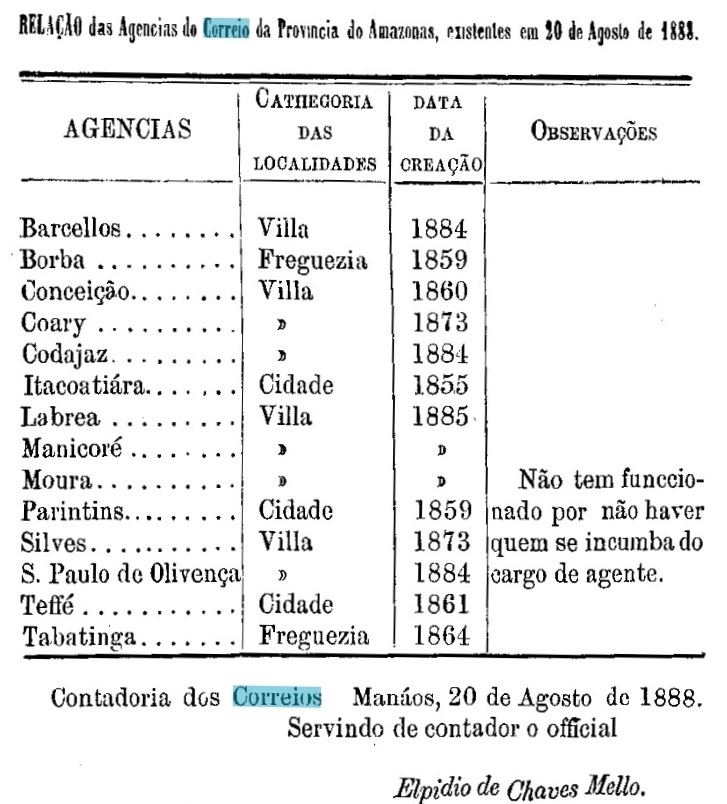
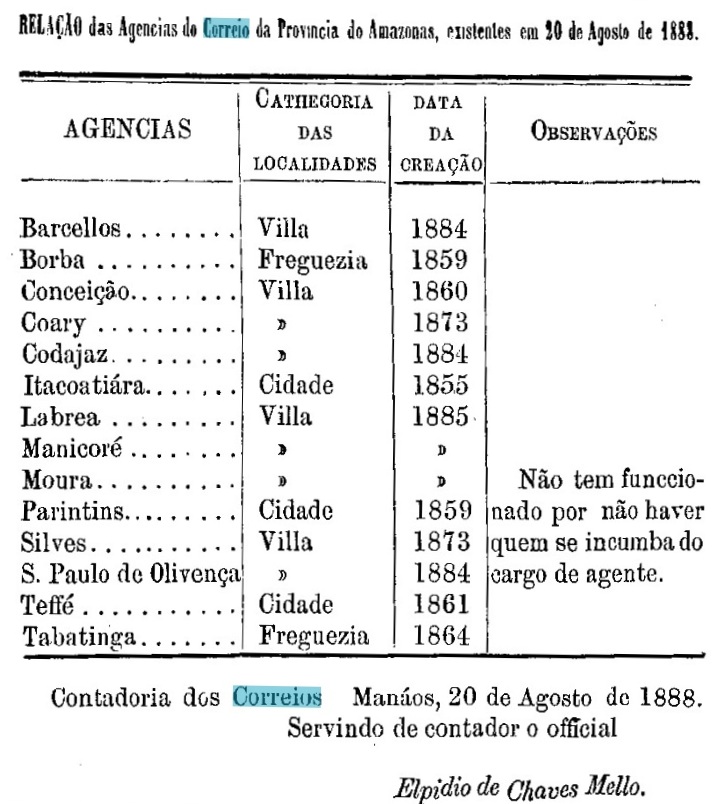
Nossa Senhora do Rosário de Serpa was the name of the villa that is said to have existed as early as 1759 on the north bank of the Amazon River, about 270 km east of the later provincial capital of Manaus. In 1833, the village was demoted to a district of Manaus, but in December 1857, it was again granted villa status. Since April 1874, the locality has been a town called Itacoatiara. The word from the Tupi language means painted stone.
Two opening years were found for the local post office. Nova Monteiro (Administrações e Agencias Postaes do Brasil Imperio, in Brasil Filatelico/RJ, 1934-5; Reprint SPP 1994-1999) writes September 1852 for it, while the Imperial Mail Register (Tabella das Agencias do Correio do Imperio, Rio de Janeiro, 1885) lists this agency from 1855 on. The second date is confirmed by the Rio de Janeiro press:
Jornal do Commercio/RJ, 21.09.1855
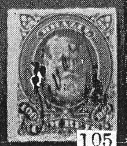
The only postmark from the imperial period to date is IAM-0050a (Coll. Fuad Ferreira Fo.):
IAM-0050a (FF) 1886Carta da Reüublica dos Estados Unidos do Brazil, 1892
Siehe auch Serpa (SAM-0115)
Nossa Senhora do Rosário de Serpa hieß die Villa, die bereits 1759 am Nordufer des Amazonas existiert haben soll, ca. 270 km östlich der späteren Provinzhauptstadt Manaus entfernt. Im Jahr 1833 wurde dann die Ortschaft zum Distrikt von Manaus degradiert, erhielt aber im Dezember 1857 erneut den Villa-Status. Seit April 1874 ist der Ort eine Stadt namens Itacoatiara. Das Wort aus der Tupi-Sprache bedeutet bemalter Stein.
Zwei Eröffnungsjahre wurden fürs örtliche Postamt gefunden. Nova Monteiro (Administrações e Agencias Postaes do Brasil Imperio, in Brasil Filatelico/RJ, 1934-5; Reprint SPP 1994-1999) schreibt dafür den September 1852, während das Verzeichnis der kaiserlichen Postämter (Tabella das Agencias do Correio do Imperio, Rio de Janeiro, 1885) diese Agentur ab 1855 auflistet. Das zweite Datum wird durch die Presse aus Rio de Janeiro bestätigt:
Jornal do Commercio/RJ, 21.09.1855
Der bisher einzige Poststempel der Kaiserzeit ist IAM-0050a (Samml. Fuad Ferreira Fo.):
Colton & Colton: Provincia do Rio de Janeiro, 1866
The settlement was founded in 1672 with the construction of the chapel of S. João Baptista de Itaborahy (also written Itaboray) on the east bank of the Rio da Vargem, 50 kilometres north-east of the future capital Rio de Janeiro. In June 1696, it was declared the Freguesia de S. João Baptista de Itaborahy, which belonged to the Vila de Sto. Antonio de Sá. In May 1833 it became a Vila and in January 1890 a town.
Nova Monteiro writes in Administrações e Agencias Postaes do Brasil Imperio (Brasil Filatelico/RJ, 1934-5; reprint SPP 1994-1999) that there had been a post office there since August 1829. The oldest postmark to date is IRJ-0665a, which was given the number 1324 by Paulo Ayres in Catálogo de Carimbos Brasil-Império (S. Paulo, 1937, 1942). However, the dot at the bottom right is missing in his illustration, as can be seen in the Catálogo ilustrado dos carimbos sobre os olhos-de-boi (4a. ed., Porto Alegre, 2017) by Henrique B. Ferreira:
IRJ-0665a (P.A. 1324 – RHM P-RJ-11, recte HBF) ca. 1840-1876ff
This was followed by the double circle IRJ-0665b (ill. R. Koester, in Carimbologia XXIII):
IRJ-0665b (RK) 1887
Two mute cancellations by James Dingler and Klerman W. Lopes are also known from Itaborahy (Mute Cancellations of the Brazil Empire / Carimbos Mudos do Brasil Império, Brazil Philatelic Association, Rio de Janeiro, 2000):
BPA 3381 (1866ff) – 3388Villiers de l’Ile Adam: Carta (…) da Provincia do Rio de Janeiro, 1850
Die Siedlung entstand 1672 mit dem Bau der Kapelle S. João Baptista de Itaborahy (auch Itaboray geschrieben) am Ostufer des Rio da Vargem, 50 km nordöstlich der späteren Hauptstadt Rio de Janeiro. Im Juni 1696 wurde sie zur Freguesia de S. João Baptista de Itaborahy erklärt, die zur Vila de Sto. Antonio de Sá gehörte. Im Mai 1833 wurde es zur Vila und im Januar 1890 zur Stadt erhoben.
Nova Monteiro schreibt in Administrações e Agencias Postaes do Brasil Imperio (Brasil Filatelico/RJ, 1934-5; Reprint SPP 1994-1999), dass es dort seit August 1829 ein Postamt gab. Der bisher älteste Poststempel ist IRJ-0665a, der von Paulo Ayres in Catálogo de Carimbos Brasil-Império (S. Paulo, 1937, 1942) die Nummer 1324 erhielt. Allerdings fehlt in seiner Abbildung der Punkt rechts unten, wie man dem Catálogo ilustrado dos carimbos sobre os olhos-de-boi (4a. ed., Porto Alegre, 2017) von Henrique B. Ferreira entnehmen kann:
IRJ-0665a (P.A. 1324 – RHM P-RJ-11, recte HBF) ca. 1840-1876ff
Es folgte der Doppelkreis IRJ-0665b (Abb. R. Koester, in Carimbologia XXIII):
IRJ-0665b (RK) 1887
Aus Itaborahy sind auch zwei stumme Abstempelungen von James Dingler und Klerman W. Lopes bekannt (Mute Cancellations of the Brazil Empire / Carimbos Mudos do Brasil Império, Brazil Philatelic Association, Rio de Janeiro, 2000):
Villiers de l’Ile Adam: Carta (…) da Provincia de Minas Geraes, 1849
Other names: Itabira de Matto Dentro, Getúlio Vargas (1943-1947)
The Freguesia de N. Sra. do Rosário de Itabira, which had existed since January 1827, belonged to the Vila de Caeté and was located on the north bank of the Rio do Peixe, 150 kilometres north of the provincial capital Ouro Preto. It was elevated to a vila in June 1833 and to a town in October 1848. In December 1943, the município was renamed in honour of the dictator Getúlio Vargas, but the old place name returned in March 1947. The word Itabira comes from the Tupi-Guarani and means shiny stone. It refers to the iron ore that brought prosperity to the municipality for a long time.
The Catálogo Enciclopédico RHM (S. Paulo, 1999) states that there has been a post office since December 1848. However, as the regional press reports on postal traffic to and from Itabira in August 1831 at the earliest, an earlier date of the establishment of the local post office in March 1829 is probably more accurate. This date is supported by R. Koester (Carimbologia XXIII), Paula Sobrinho (História Postal de Minas Gerais, Belo Horizonte, 1997) and Nova Monteiro (Administrações e Agencias Postaes do Brasil Imperio, in Brasil Filatelico/RJ, 1934-5; reprint SPP 1994-1999).
Two illustrations of the oldest postmark IMG-1345a can be found in P. Ayres’ Catálogo de Carimbos Brasil-Império (S. Paulo, 1937, 1942). However, the correct illustration is a mixture of both, as Henrique B. Ferreira shows in Catálogo ilustrado dos carimbos sobre os olhos-de-boi (4a. ed., Porto Alegre, 2017):
IMG-1345a (P.A. 1143-1144 – recte HBF) 1830-1862
Sometime in the 1860s, this cancel stamp broke and a replacement was not obtained in time. The stamps in Itabira were therefore cancelled by hand for at least 10 years. An illustration of this can also be found in P. Ayres (op. cit.), here together with an example from the Paulo Corchaki collection:
1866ff-1876 (P.A. p. 147 – P. Corchaki)
Only in the last decade of the Empire was the following circle cancellation IMG-1345b (Márcio Protzner collection) used:
IMG-1345b (MP) 1883-1892
The following mute cancellation (Carlos A. C. Balata Collection) probably also originates from Itabira:
1876ff (CB)Province of Minas Geraes, 1835
Andere Namen: Itabira de Matto Dentro, Getúlio Vargas (1943-1947)
Die seit Januar 1827 bestehende Freguesia de N. Sra. do Rosário de Itabira gehörte zur Vila de Caeté und lag am Nordufer des Rio do Peixe, 150 km nördlich der Provinzhauptstadt Ouro Preto. Die Erhebung zur Vila erfolgte im Juni 1833, die zur Stadt im Oktober 1848. Im Dezember 1943 wurde der Município zu Ehren des Diktators Getúlio Vargas umbenannt, aber im März 1947 kehrte der alte Ortsname zurück. Das Wort Itabira stammt aus dem Tupi-Guarani und bedeutet glänzender Stein. Es bezieht sich auf das Eisenerz, das der Gemeinde lange Zeit zu Wohlstand verhalf.
Im Catálogo Enciclopédico RHM (S. Paulo, 1999) ist zu lesen, dass es seit Dezember 1848 ein Postamt gab. Da jedoch in der regionalen Presse schon ab August 1831 über Postverkehr von und nach Itabira berichtet wird, dürfte das frühere Datum der Gründung des örtlichen Postamtes im März 1829 zutreffender sein. Dieses Datum wird von R. Koester (Carimbologia XXIII), Paula Sobrinho (História Postal de Minas Gerais, Belo Horizonte, 1997) und Nova Monteiro (Administrações e Agencias Postaes do Brasil Imperio, in Brasil Filatelico/RJ, 1934-5; Nachdruck SPP 1994-1999) vertreten.
Vom ältesten Poststempel IMG-1345a sind zwei Abbildungen in P. Ayres‘ Catálogo de Carimbos Brasil-Império (S. Paulo, 1937, 1942) zu finden. Die korrekte Abbildung dürfte jedoch eine Mischung aus beiden sein, wie Henrique B. Ferreira in Catálogo ilustrado dos carimbos sobre os olhos-de-boi (4a. ed., Porto Alegre, 2017) zeigt:
IMG-1345a (P.A. 1143-1144 – recte HBF) 1830-1862
Irgendwann in den 1860er Jahren ging dieser Stempel kaputt, und es wurde nicht rechtzeitig Ersatz beschafft. Daher wurden die Marken in Itabira mindestens 10 Jahre lang von Hand gestempelt. Eine Abbildung davon findet sich auch bei P. Ayres (op. cit.), hier zusammen mit einem Beispiel aus der Sammlung Paulo Corchaki:
1866ff-1876 (P.A. S. 147 – P. Corchaki)
Erst im letzten Jahrzehnt des Kaiserreichs wurde der folgende Kreisstempel IMG-1345b (Sammlung Márcio Protzner) verwendet:
IMG-1345b (MP) 1883-1892
Aus Itabira stammt vermutlich auch die folgende stumme Abstempelung (Samml. Carlos A. C. Balata):