Categories
Carimbologia C-D

Cuité, Paraíba (CPB-0125)

Atlas do Imperio do Brasil, 1868

Other names: Borborema, Serra do Cuité, Cuité (1938)

There are two versions of the origins of the Freguesia de N. Sra. das Mercês de Cuité. According to the first, it was founded in 1800, i.e. during the colonial period. The second date is later and more precise: 15 October 1827. Cuité was in any case 220 km north-west of the provincial capital Paraíba do Norte (today: João Pessoa). In May 1854, the first elevation to a Vila took place, followed by others in 1900 and in December 1936 (this time as Município de Serra do Cuité). In the meantime, Cuité was downgraded twice to a district of the Vila de Picuí: in 1891 and 1904. Since November 1938, the município has been called Cuité again.

Nova Monteiro writes in Administrações e Agencias Postaes do Brasil Imperio (Brasil Filatelico/RJ, 1934-5; reprint SPP 1994-1999) that there had been a post office there since October 1858. This date is confirmed by the postal report (Relatório Postal) for 1887. The only imperial postmark to date is CPB-0125b (fig. Jorge L. Pedreira):
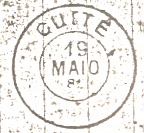
CPB-0125b (JP) 1881
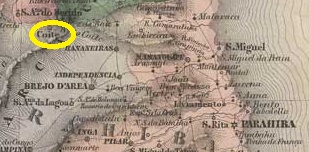
Villiers de l’Ile Adam: Carta (…) das Provincias do Rio Grande do Norte e Parahiba

Andere Namen: Borborema, Serra do Cuité, Cuité (1938)

Über die Entstehung der Freguesia de N. Sra. das Mercês de Cuité gibt es zwei Versionen. Nach der ersten wurde sie im Jahre 1800 gegründet, also bereits in der Kolonialzeit. Das zweite Datum ist später und genauer: 15.10.1827. Cuité lag jedenfalls 220 km nordwestlich der Provinzhauptstadt Paraíba do Norte (heute: João Pessoa). Im Mai 1854 erfolgte die erste Erhebung zur Vila, weitere folgten 1900 und im Dezember 1936 (diesmal als Município de Serra do Cuité). In der Zwischenzeit wurde Cuité zweimal zum Distrikt der Vila de Picuí herabgestuft: 1891 und 1904. Seit November 1938 heißt der Município wieder Cuité.

Nova Monteiro schreibt in Administrações e Agencias Postaes do Brasil Imperio (Brasil Filatelico/RJ, 1934-5; Reprint SPP 1994-1999), dass es dort seit Oktober 1858 ein Postamt gab. Dieses Datum wird durch den Postbericht (Relatório Postal) für 1887 bestätigt. Der bisher einzige kaiserliche Poststempel ist CPB-0125b (Abb. Jorge L. Pedreira):
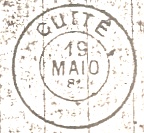
CPB-0125b (JP) 1881
Categories
Carimbologia C-D

Cuité, Bahia (CBA-0330)

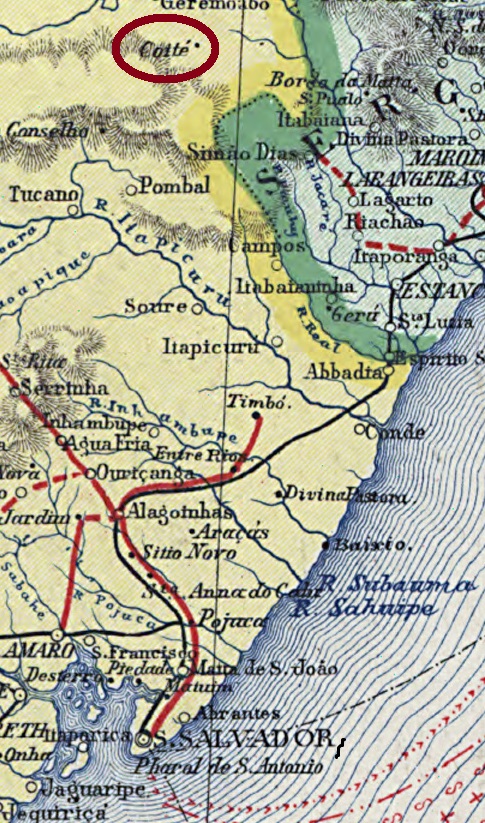
Carta da Republica dos Estados Unidos do Brazil, 1892

Other names: Coité, Patrocínio do Coité, Paripiranga (1931)

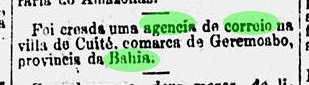
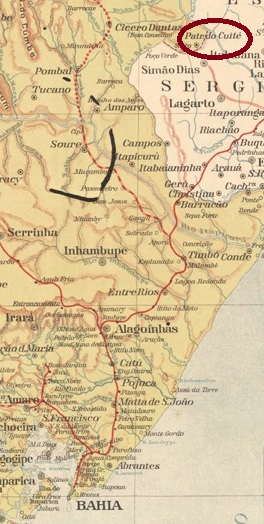
The Freguesia de N. Sra. do Patrocinio do Coité was founded in May 1871 and belonged to the Vila de Geremoabo on the provincial border with Sergipe, 320 kilometres north of the provincial capital Salvador da Bahia. In May 1886 it was elevated to the status of a Vila and since March 1931 it has been the Município de Paripiranga. The Indian name means red earth.

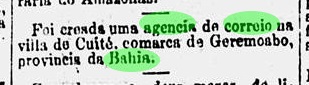
According to the Rio de Janeiro press, there has been a post office there since July 1887:

O Paiz/RJ, 31/07/1887

No imperial postmark from Cuité has yet been seen.

Estado da Bahia, 1913

Andere Namen: Coité, Patrocínio do Coité, Paripiranga (1931)

Die Freguesia de N. Sra. do Patrocinio do Coité wurde im Mai 1871 gegründet, sie gehörte der Vila de Geremoabo und lag an der Provinzgrenze zu Sergipe, 320 km nördlich der Provinzhauptstadt Salvador da Bahia. Im Mai 1886 erfolgte die Erhebung zur Vila und seit März 1931 ist der Ort Município de Paripiranga. Der indianische Name bedeutet rote Erde.

Wie der Presse von Rio de Janeiro zu entnehmen ist, gab es dort seit Juli 1887 ein Postamt:

O Paiz/RJ, 31.07.1887

Bisher wurde kein kaiserlicher Poststempel aus Cuité gesehen.

Categories
Carimbologia C-D

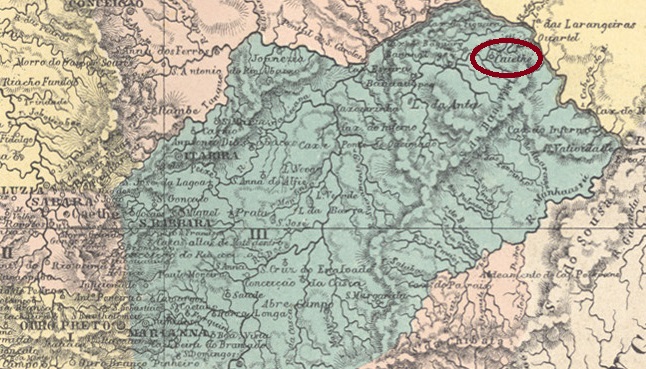
Cuiethé, Minas Gerais (CMG-0920)

Villiers de l’Ile Adam: Carta (…) da Provincia de Minas Geraes, 1849

Other names: Degredo, Cuieté, Cuyethi, Cuité, Barra do Cuieté, Cuieté Velho (1953)

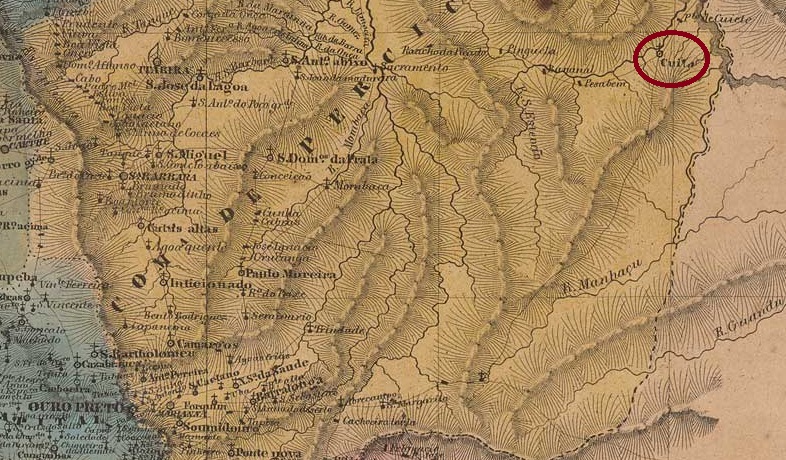
The Freguesia de N. Sra. da Conceição do Cuiethé was founded in 1824 on the south bank of the Cuieté (now Caratinga) in the Vila de Manhuaçu, 350 kilometres north-east of the provincial capital Ouro Preto. The Indian name means “vessel” and the place originated as a prison, hence the original name Degredo (exile).

Cuiethé became a district of Vila de Caratinga in February 1890 and as such went to the Município de Itanhomi in September 1923. There were then two name changes: in December 1938 to Barra do Cuieté (then in the Município de Conselheiro Pena) and five years later to Cuieté Velho.

Both R. Koester in Carimbologia XV and Paula Sobrinho in História Postal de Minas Gerais (Belo Horizonte, 1997) agree that there has been a post office there since October 1881. The imperial postmark is CMG-0920a (fig. Koester, op. cit.):

CMG-0920a (RK) 1885-1890
Atlas do Imperio do Brasil, 1868

Andere Namen: Degredo, Cuieté, Cuyethi, Cuité, Barra do Cuieté, Cuieté Velho (1953)

Die Freguesia de N. Sra. da Conceição do Cuiethé wurde 1824 gegründet und lag am Südufer des Cuieté (heute Caratinga-Fluss) im Gebiet der Vila de Manhuaçu, 350 km nordöstlich der Provinzhauptstadt Ouro Preto. Der indianische Name bedeutet “Gefäß” und der Ort entstand als Gefängnis, daher der ursprüngliche Name Degredo (Verbannung).

Cuiethé wurde im Februar 1890 zum Bezirk der Vila de Caratinga und wechselte als solcher im September 1923 zum Município de Itanhomi. Danach gab es zwei Namensänderungen: im Dezember 1938 in Barra do Cuieté (dann im Município de Conselheiro Pena) und fünf Jahre später in Cuieté Velho.

Sowohl R. Koester in Carimbologia XV als auch Paula Sobrinho in História Postal de Minas Gerais (Belo Horizonte, 1997) sind sich einig, dass es dort seit Oktober 1881 ein Postamt gab. Der kaiserliche Poststempel ist CMG-0920a (Abb. Koester, op. cit.):

CMG-0920a (RK) 1885-1890
Categories
Carimbologia C-D

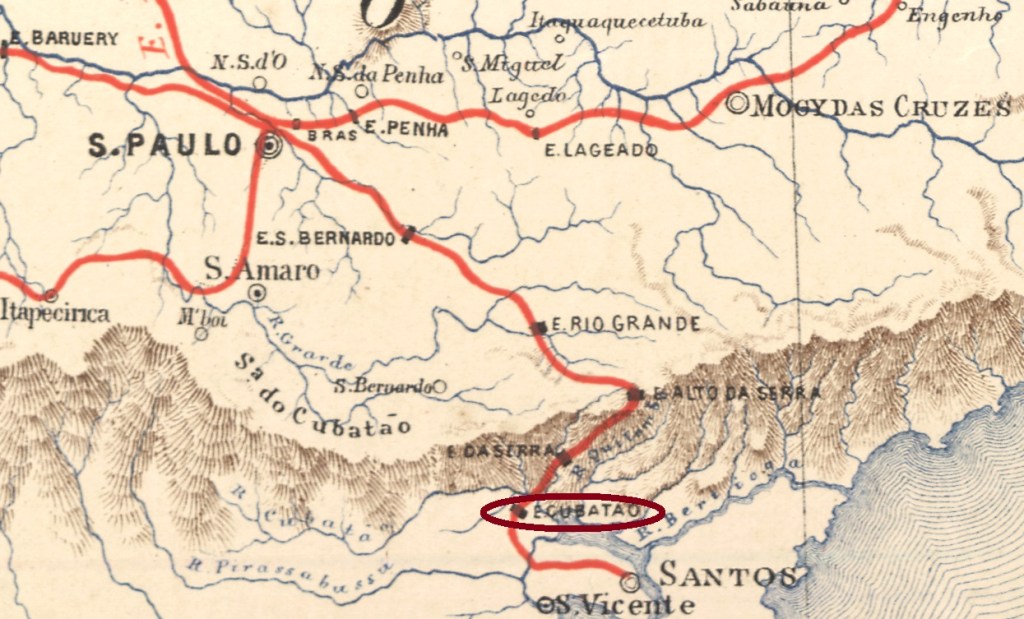
Cubatão (train station/Bahnhof), São Paulo (CSP-0410)

E. F. Central do Brasil, 1890

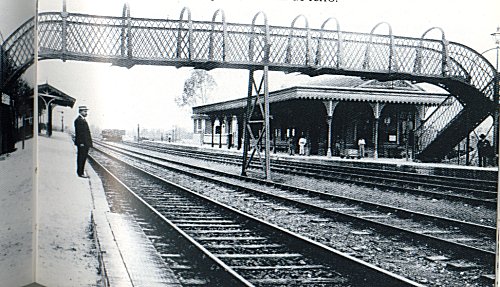
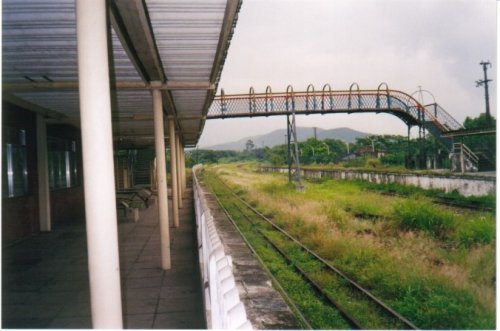
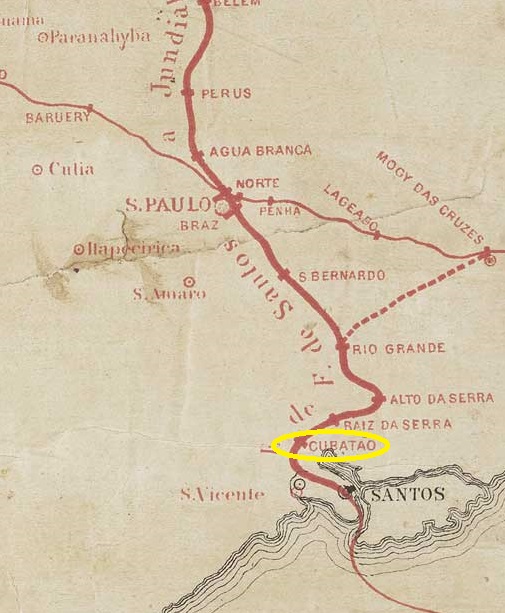
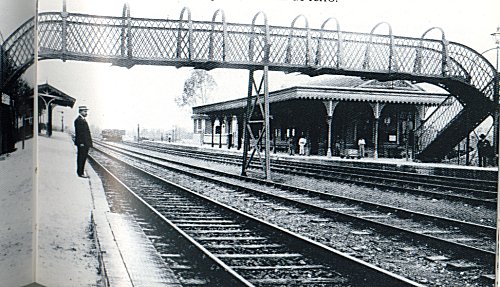
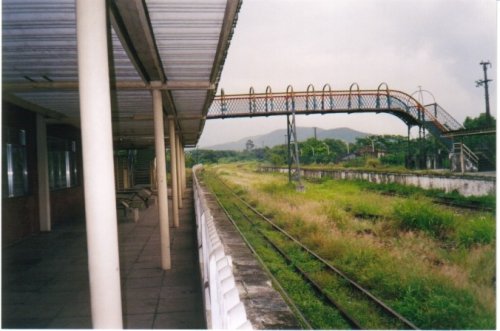
Cubatão station was opened in February 1867 by the São Paulo Railway (Main Line) on the south bank of the Cubatão in the Município de Santos, 70 km south of the provincial capital of São Paulo. The line was handed over to E.F. Santos a Jundiaí in 1946 and belonged to Rede Ferroviária Federal S.A. from 1975 until its closure in 1996 (estacoesferroviarias.com.br). Today, the tracks still exist and the station building houses the municipality’s tourist office.

Around 1920 (photo Cacilda Costa, on estacoesferroviarias.com.br)
In 2003 (photo Luiz Rafael de Souza, on estacoesferroviarias.com.br)

The area around the railway station became a district in December 1922 and the Município de Cubatão in December 1948.

As R. Koester writes in Carimbologia XV, there had been a post office at the station since February 1883, but no imperial postmark of Cubatão has been seen so far.

Estações (…) do Rio de Janeiro, São Paulo e Minas Geraes, 1880

Der Bahnhof Cubatão wurde im Februar 1867 von der Bahngesellschaft São Paulo Railway (Hauptlinie) eröffnet und lag am Südufer des Cubatão im Município de Santos, 70 km südlich der Provinzhauptstadt São Paulo. Die Strecke wurde 1946 an die E.F. Santos a Jundiaí übergeben und gehörte von 1975 bis zu ihrer Stilllegung 1996 der Rede Ferroviária Federal S.A. (estacoesferroviarias.com.br). Heute sind die Gleise noch vorhanden, das Bahnhofsgebäude beherbergt das Tourismusbüro der Gemeinde.

Um 1920 (Foto Cacilda Costa, auf estacoesferroviarias.com.br)
2003 (Foto Luiz Rafael de Souza, auf estacoesferroviarias.com.br)

Das Gebiet um den Bahnhof wurde im Dezember 1922 zum Distrikt und im Dezember 1948 zum Município de Cubatão.

Wie R. Koester in Carimbologia XV schreibt, gab es am Bahnhof seit Februar 1883 ein Postamt, aber bisher wurde kein kaiserlicher Poststempel von Cubatão gesehen.

Categories
Carimbologia C-D

Cruzeiro, São Paulo (CSP-0405)

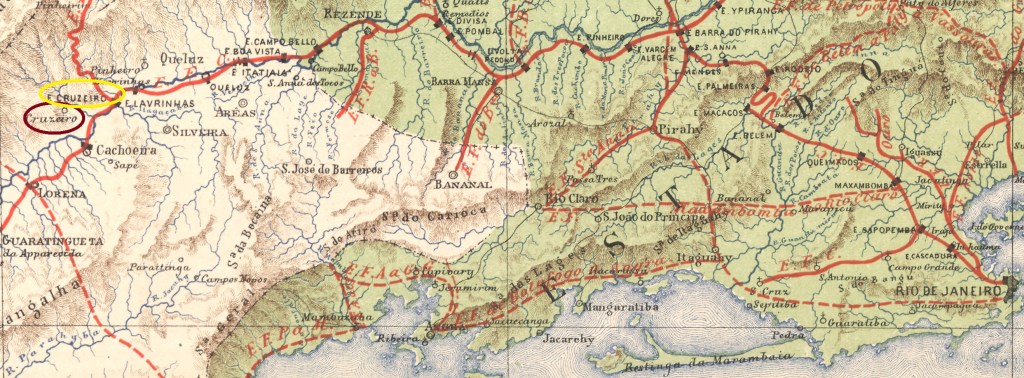
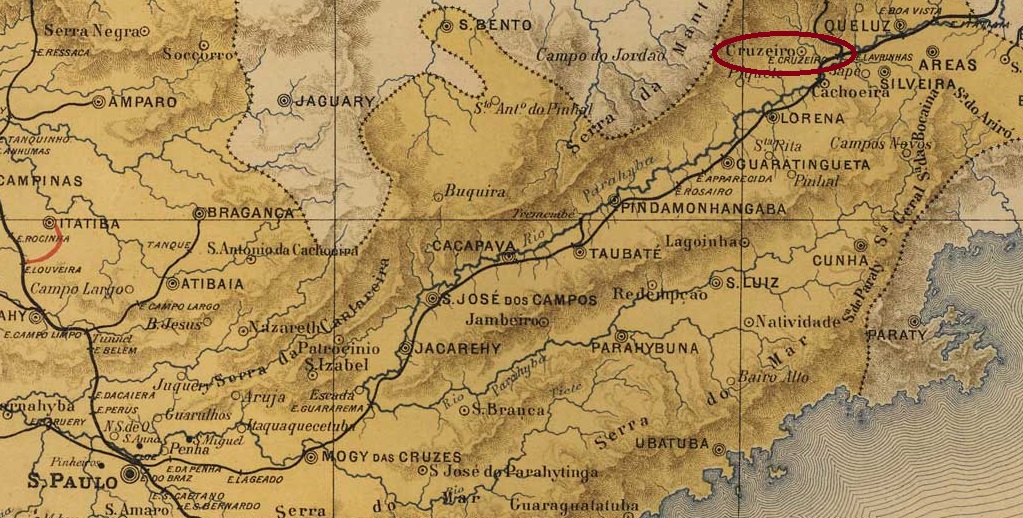
Estrada de Ferro Central do Brasil, 1890

Other Names: Conceição do Embaú, Embaú (1903)

See also Cruzeiro/train station (CSP-0406)

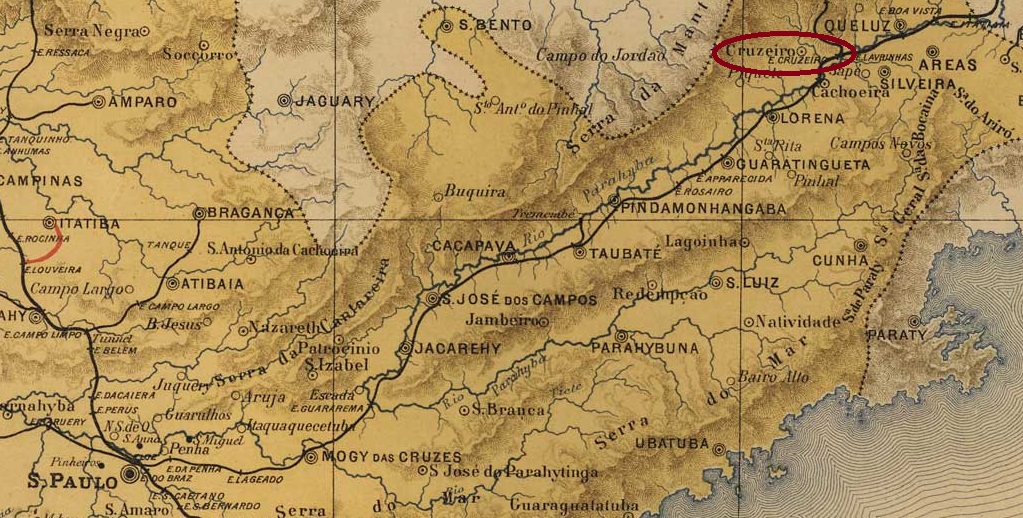
The Freguesia de N. Sra. da Conceição do Embaú was founded in February 1846 and belonged to the Vila de Lorena, 210 kilometres north-east of the provincial capital of São Paulo. As an important station on the old Estrada Real, it was elevated to Vila de Conceição do Cruzeiro in March 1871.

With the inauguration of the Cruzeiro railway station in September 1878, around 10 km east of Paraíba do Sul, the decline of the old Vila began. In June 1891, it became a district of the Município de Vila Novais (ex-Cruzeiro railway station, see CSP-0406). The renaming of the new Município in October 1901 to Cruzeiro (or Estação do Cruzeiro, depending on the source) led to a long period of confusion with the District de Conceição do Cruzeiro, which only ended in November 1903 when the district returned to its old name of Embaú.

The decline was unstoppable: Embaú lost its district status in December 1936 and was incorporated into the Município Cachoeira as a rural suburb barely two years later. This in turn was renamed twice: in 1944 to Valparaíba and in 1948 to what is now Cachoeira Paulista.

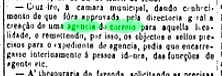
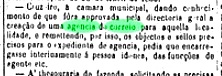
According to the regional press, there was a post office there from November 1876:

Correio Paulistano, 18/12/1876

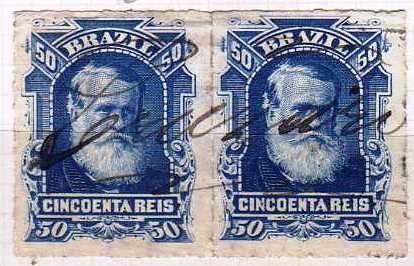
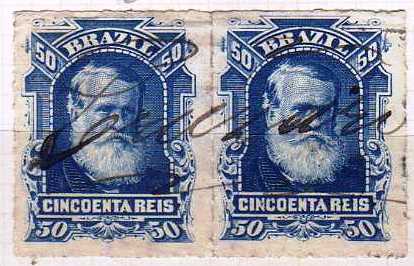
The stamps were initially cancelled by hand, as the official postmark apparently did not arrive in time:

1877ff (EB)

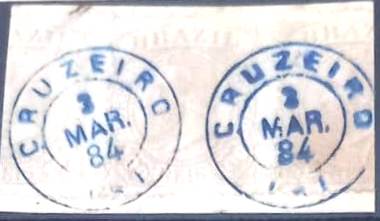
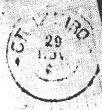
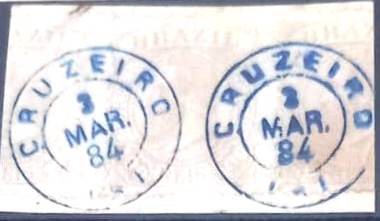
Later the French cancellation CSP-0405a was used, which also exists in blue (coll. Fuad Ferreira Fo.):

CSP-0405a (FF) 1884-1885

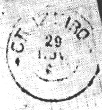
R. Koester showed in Carimbologia XIV the postmark CSP-0405b, whose attribution is still to be confirmed:

CSP-0405b (RK)

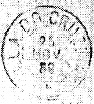
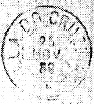
In contrast, CSP-0405c (fig. R. Koester, op. cit.) can be clearly assigned to this vila:

CSP-0405c (RK) 1887-1889
J.M.Ribeiro Lisboa: Provincia de São Paulo, 1884

Andere Namen: Conceição do Embaú, Embaú (1903)

Siehe auch Cruzeiro/Bahnhof (CSP-0406)

Die Freguesia de N. Sra. da Conceição do Embaú wurde im Februar 1846 gegründet und gehörte zur Vila de Lorena, 210 km nordöstlich der Provinzhauptstadt São Paulo. Da sie eine wichtige Station der alten Estrada Real war, wurde sie im März 1871 zur Vila de Conceição do Cruzeiro erhoben.

Mit der Einweihung des Bahnhofs von Cruzeiro im September 1878, etwa 10 km östlich von Paraíba do Sul, begann der Niedergang der alten Vila. Sie wurde im Juni 1891 als Distrikt dem Município de Vila Novais (ex-Bahnhof Cruzeiro, siehe CSP-0406) unterstellt. Die Umbenennung des neuen Município im Oktober 1901 in Cruzeiro (oder Estação do Cruzeiro, je nach Quelle) führte zu einer langen Verwechslung mit dem Distrikt de Conceição do Cruzeiro, die erst im November 1903 endete, als der Distrikt zu seinem alten Namen Embaú zurückkehrte.

Der Niedergang war nicht aufzuhalten: Im Dezember 1936 verlor Embaú seinen Distriktstatus und wurde knapp zwei Jahre später als ländlicher Vorort in das Município de Cachoeira eingegliedert. Dieses wiederum wurde zweimal umbenannt: 1944 in Valparaíba und 1948 in das heutige Cachoeira Paulista.

Aus der regionalen Presse geht hervor, dass es dort ab November 1876 ein Postamt gab:

Correio Paulistano, 18.12.1876

Die Briefmarken wurden zunächst von Hand entwertet, da der amtliche Poststempel anscheinend nicht rechtzeitig eintraf:

1877ff (EB)

Später kam der französische Stempel CSP-0405a, den es auch in blau gibt (Samml. Fuad Ferreira Fo.):

CSP-0405a (FF) 1884-1885

R. Koester zeigte in Carimbologia XIV den Stempel CSP-0405b, dessen Zuordnung noch zu bestätigen ist:

CSP-0405b (RK)

Dagegen ist CSP-0405c (Abb. R. Koester, op. cit.) eindeutig dieser Vila zuzuordnen:

CSP-0405c (RK) 1887-1889
Categories
Carimbologia C-D

Cruzeiro (train station/Bahnhof), São Paulo (CSP-0406)

J.M. Ribeiro Lisboa: Provincia de São Paulo, 1884

Text update of October 9, 2024

See also Cruzeiro (CSP-4605)

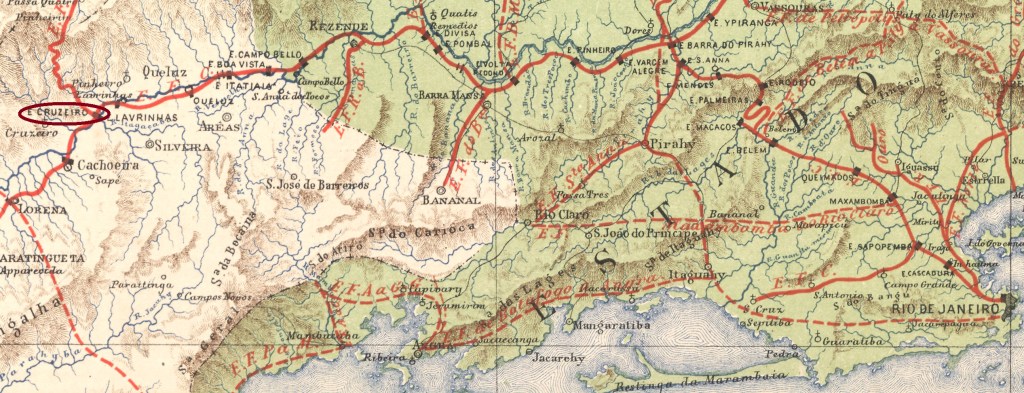
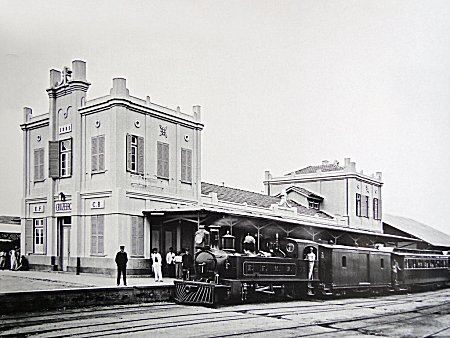
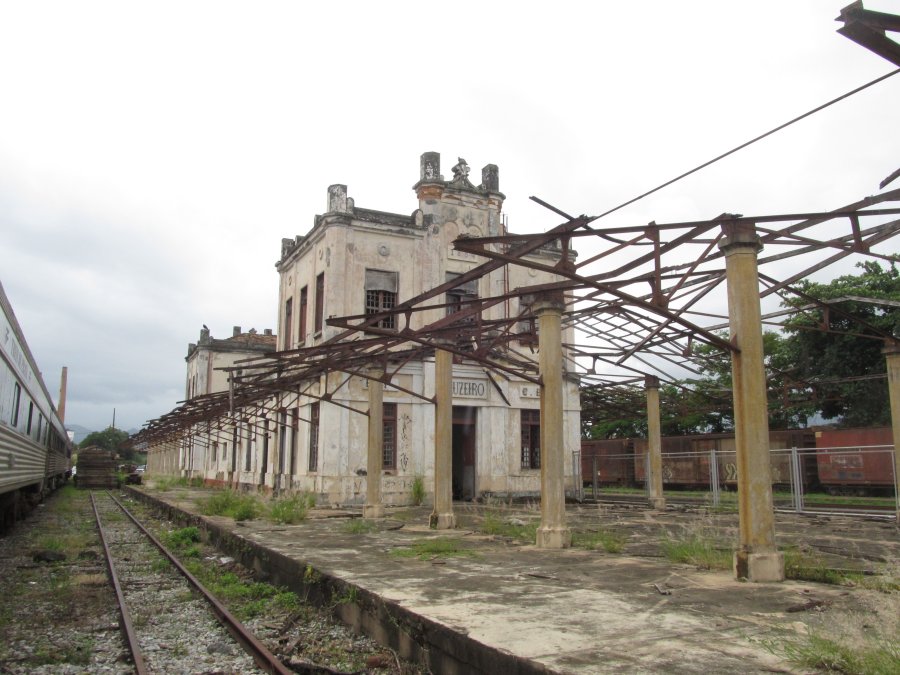
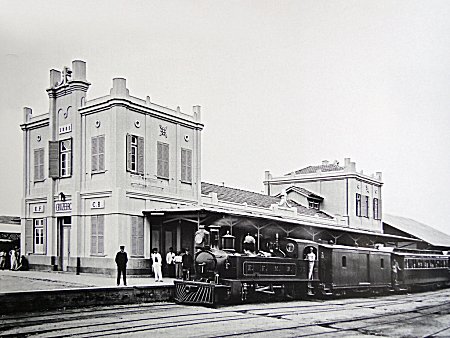
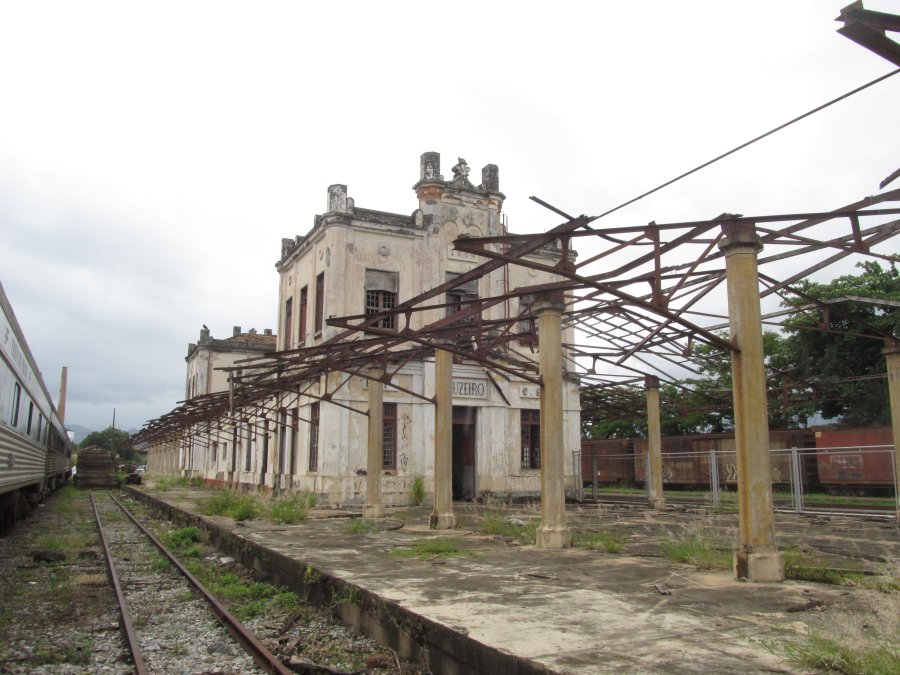
Although the Cruzeiro railway station originally belonged to the Vila de Conceição do Cruzeiro, the two post offices are shown separately as they now belong to two different municípios. The station was opened in September 1878 by the railway company E.F.D. Pedro II, S. Paulo line, and was located on the west bank of the river Paraíba do Sul, 220 km north-east of the provincial capital São Paulo. The line was transferred to E.F. Central do Brasil in 1889 and belonged to Rede Ferroviária Federal S.A. from 1975 until its closure in 1998 (estacoesferroviarias.com.br). The tracks are still there today, but the station building is closed.

1895 (Photo: N.N. on estacoesferroviarias.com.br)
2020 (Photo: N.N. on estacoesferroviarias.com.br)

The settlement around the railway station grew very quickly and became the Distrito de Estação do Cruzeiro in March 1891, the Município de Vila Novais three months later and the Município de Cruzeiro in October 1901, which was elevated to the status of a town in December 1906.

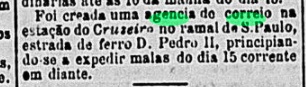
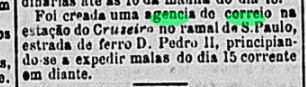
As the Rio press reported, there had been a post office at the railway station since November 1878:

Gazeta de Noticias/RJ, 13/11/1878

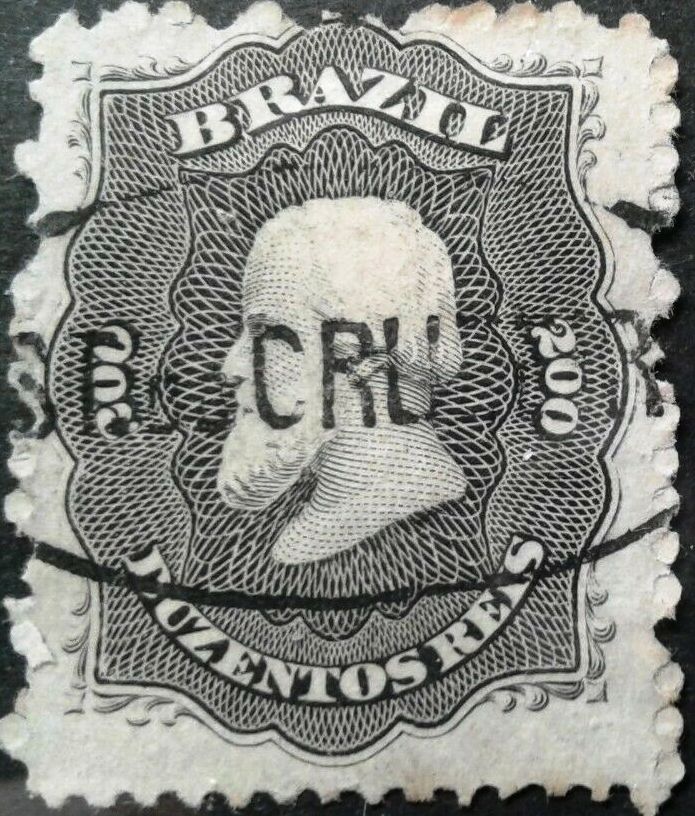
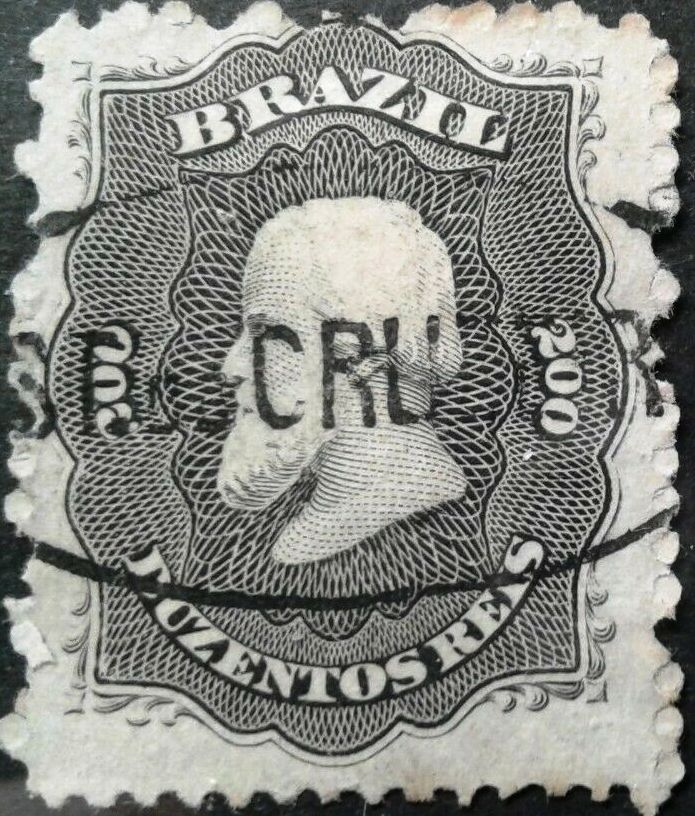
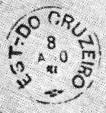
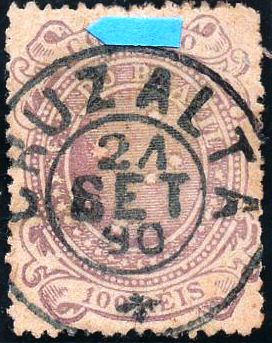
The first postmark is CSP-0406a (coll. FM):

CSP-0406a (FM) 1878-1882

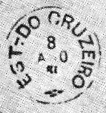
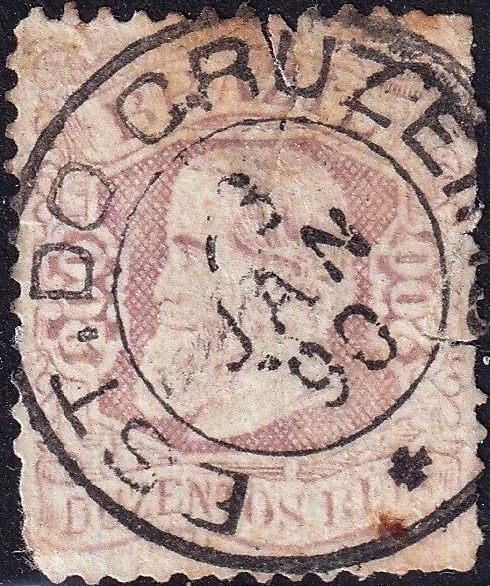
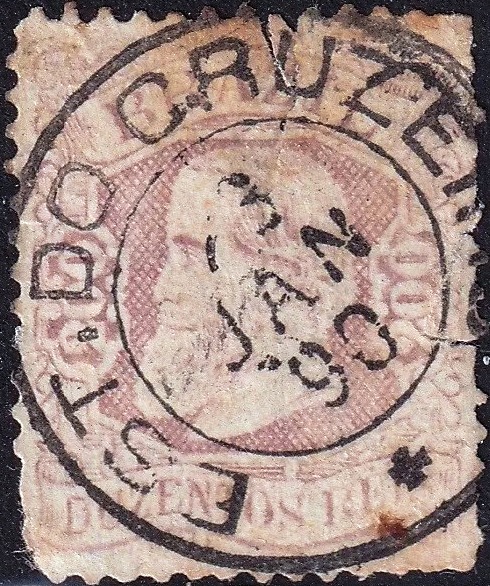
This was followed by the double circle CSP-0406b (fig. R. Koester, in Carimbologia XIV)

CSP-0406b (RK) 1881-1890

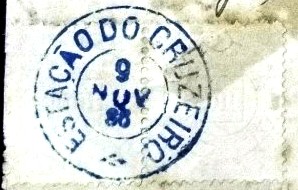
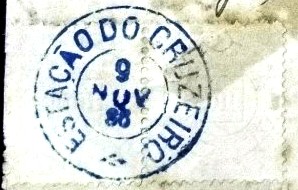
CSP-0406c (ill. Luiz C. Fritzen), which also exists in blue, appeared shortly afterwards:

CSP-0406c (LCF) 1883-1897

And at the end of the Empire came CSP-0406d (ill. Felipe Piccinini):

CSP-0406d (FP) 1890

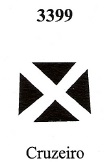
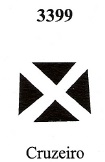
The following mute cancellation has the no. 3399 in Mute Cancellations of the Brazil Empire / Carimbos Mudos do Brasil Império, by James Dingler and Klerman W. Lopes (Brazil Philatelic Association, Rio de Janeiro, 2000). According to R. Koester (op. cit.) it also belongs to the Cruzeiro station:

BPA 3399 (P.A. 114) 1878ff
Estrada de Ferro Central do Brasil, 1890

Textaktualisierung vom 9. Oktober 2024

Siehe auch Cruzeiro (CSP-0405)

Obwohl der Bahnhof Cruzeiro ursprünglich zur Vila de Conceição do Cruzeiro gehörte, werden die beiden Postämter getrennt dargestellt, da sie heute zu zwei verschiedenen Municípios gehören. Der Bahnhof wurde im September 1878 von der Eisenbahngesellschaft E.F. D. Pedro II, S. Paulo-Linie, eröffnet und lag am Westufer des Flusses Paraíba do Sul, 220 km nordöstlich der Provinzhauptstadt São Paulo. Die Strecke ging 1889 an die E.F. Central do Brasil über und gehörte von 1975 bis zu ihrer Stilllegung 1998 der Rede Ferroviária Federal S.A. (estacoesferroviarias.com.br). Heute sind die Gleise noch vorhanden, das Bahnhofsgebäude ist geschlossen.

1895 (Foto: N.N. auf estacoesferroviarias.com.br)
2020 (Foto: N.N. auf estacoesferroviarias.com.br)

Die Siedlung um den Bahnhof wuchs sehr schnell und wurde im März 1891 zum Distrito de Estação do Cruzeiro, drei Monate später zum Município de Vila Novais und im Oktober 1901 zum Município de Cruzeiro, das im Dezember 1906 zur Stadt erhoben wurde.

Wie die Presse von Rio berichtete, gab es seit November 1878 ein Postamt am Bahnhof:

Gazeta de Noticias/RJ, 13.11.1878

Der erste Stempel ist CSP-0406a (Samml. FM):

CSP-0406a (FM) 1878-1882

Es folgte der Doppelkreis CSP-0406b (Abb. R. Koester, in Carimbologia XIV):

CSP-0406b (RK) 1881-1890

Kurz darauf erschien auch CSP-0406c (Abb. Luiz C. Fritzen), den es auch in blau gibt:

CSP-0406c (LCF) 1883-1897

Und am Ende des Kaiserreichs kam noch CSP-0406d (Abb. Felipe Piccinini):

CSP-0406d (FP) 1890

Der folgende stumme Stempel hat die Nr. 3399 in Mute Cancellations of the Brazil Empire / Carimbos Mudos do Brasil Império, von James Dingler und Klerman W. Lopes (Brazil Philatelic Association, Rio de Janeiro, 2000). Nach R. Koester (op. cit.) gehört er auch zum Bahnhof Cruzeiro:

BPA 3399 (P.A. 114) 1878ff
Categories
Carimbologia C-D

Cruz (train station/Bahnhof), Rio de Janeiro (CRJ-0415)

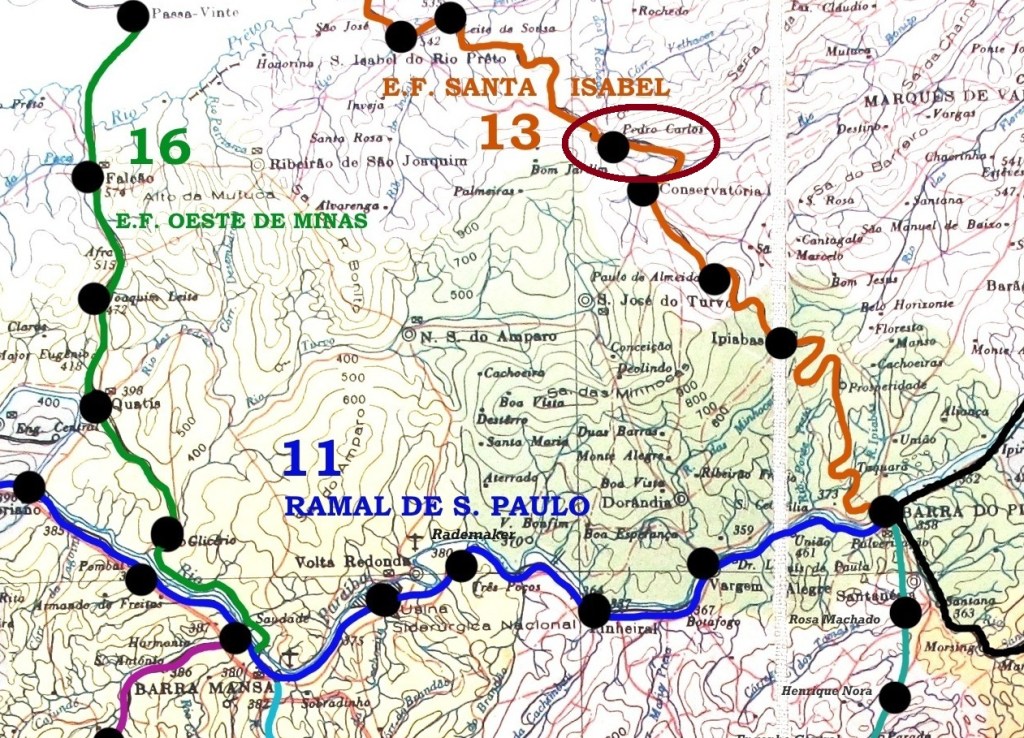
Almanak Laemmert, 1892

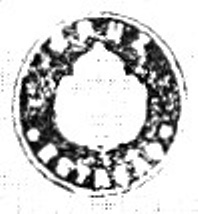
Other names: Pedro Carlos (around 1890)

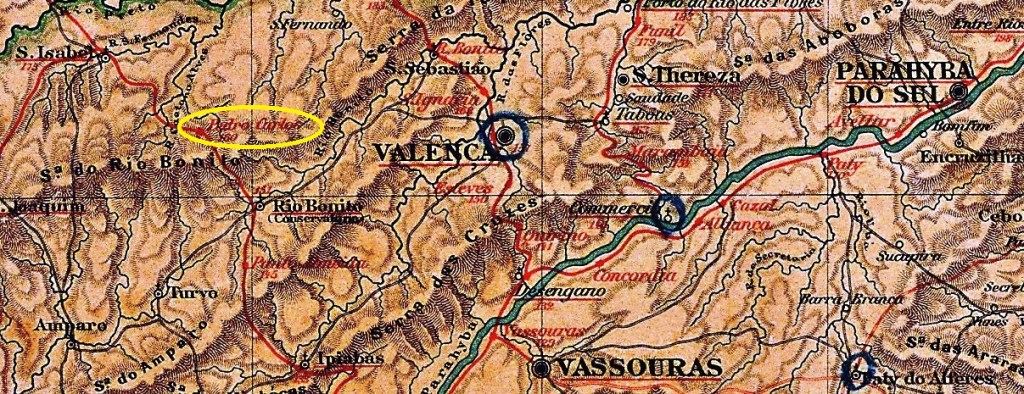
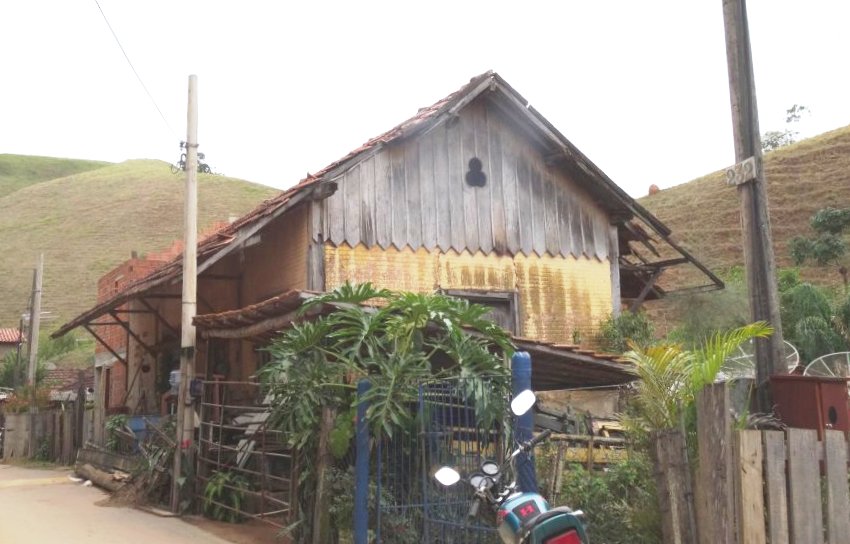
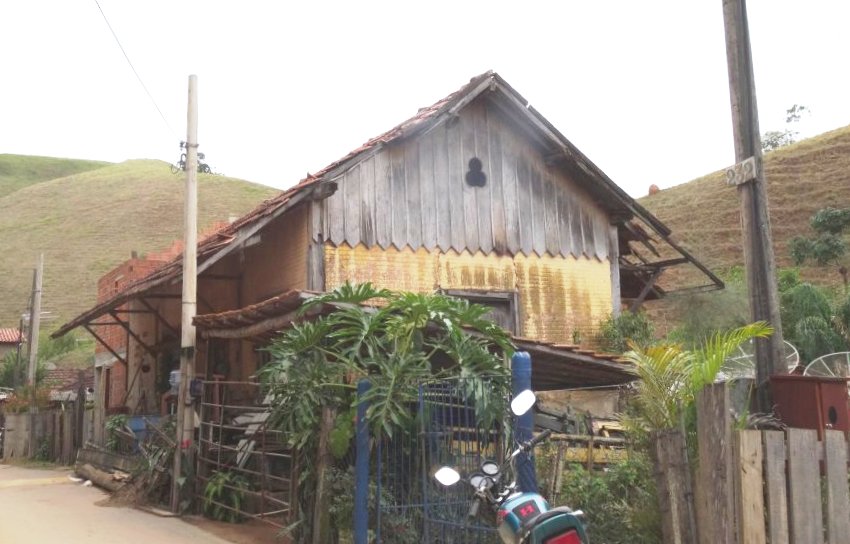
Cruz station was opened in June 1885 by the railway company E.F. Sta. Isabel do Rio Preto Barra Line) and was located 160 km north-west of the capital Rio de Janeiro in the Município de Valença. The line changed hands to V.F. Sapucahy in 1889. At this time, the station was renamed Pedro Carlos in honour of the engineer who was responsible for building the line. In 1910, the line changed hands again, this time to Rede Sul-Mineira, and belonged to Rede Mineira de Viação from 1931 until it was closed in 1961. Today, the tracks have been removed and the station building serves as a residential building in the Distrito de Conservatória near Valença.

In 2016 (Photo: Fernando Marietan, on estacoesferroviarias.com.br)

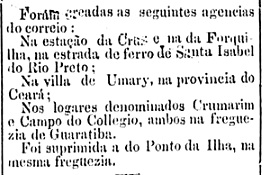
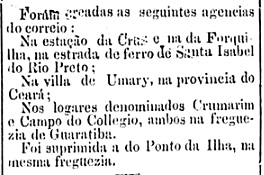
According to press reports from the capital, there had been a post office in the station since January 1887:

O Paiz, 05/02/1887

According to Paulo Novaes (agenciaspostais.com.br), the post office was closed “around 1889”.

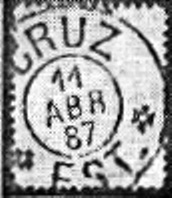
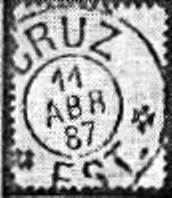
The oldest postmark is CRJ-0415a (fig. R. Koester, in Carimbologia XIV):

RJ-0415a (RK) 1887-1889

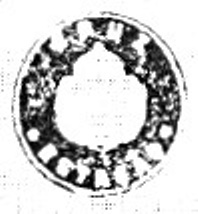
Koester (op. cit.) also shows the postmark CRJ-0415b, without further details:

CRJ-0415b (RK)
agenciaspostais.com.br

Andere Namen: Pedro Carlos (um 1890)

Der Bahnhof Cruz wurde im Juni 1885 von der Eisenbahngesellschaft E.F. Sta. Isabel do Rio Preto Barra-Linie) eröffnet und lag 160 km nordwestlich der Hauptstadt Rio de Janeiro im Município de Valença. Die Strecke wechselte 1889 den Besitzer zu V.F. Sapucahy. Zu dieser Zeit wurde der Bahnhof in Pedro Carlos umbenannt, zu Ehren des Ingenieurs, der für den Bau der Strecke verantwortlich war. Im Jahr 1910 wechselte die Strecke erneut den Besitzer, diesmal Rede Sul-Mineira, und gehörte von 1931 bis zu ihrer Stilllegung im Jahr 1961 der Rede Mineira de Viação. Heute sind die Gleise entfernt, das Bahnhofsgebäude dient als Wohnhaus im Distrito de Conservatória bei Valença.

2016 (Foto: Fernando Marietan, auf estacoesferroviarias.com.br)

Wie die Presse aus der Hauptstadt berichtet, gab es im Bahnhof seit Januar 1887 ein Postamt:

O Paiz, 05.02.1887

Laut Paulo Novaes (agenciaspostais.com.br) wurde das Postamt “um 1889” geschlossen.

Der älteste Poststempel ist CRJ-0415a (Abb. R. Koester, in Carimbologia XIV):

RJ-0415a (RK) 1887-1889

Koester (op. cit.) zeigt auch den Siegelstempel CRJ-0415b, ohne weitere Details:

CRJ-0415b (RK)
Categories
Carimbologia C-D

Cruz Alta, Rio Grande do Sul (CRS-0135)

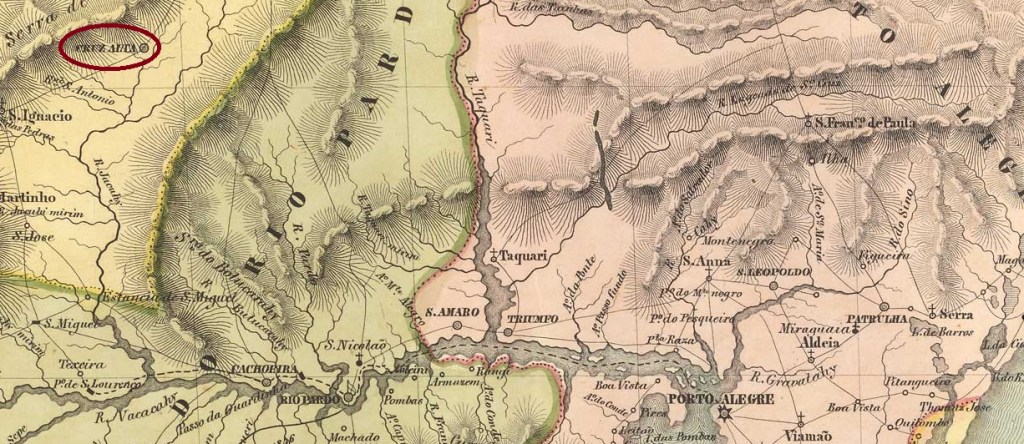
Atlas do Imperio do Brasil, 1868

Other names: Santa Teresa

The Indian settlement of Santa Teresa, founded by Spanish Jesuits in 1634, was destroyed by Portuguese invaders. It was not until October 1832 that the Freguesia do Divino Espírito Santo da Cruz Alta was founded there, 350 kilometres northwest of the provincial capital Porto Alegre. Five months later, Cruz Alta was declared a Vila and in April 1879 a city.

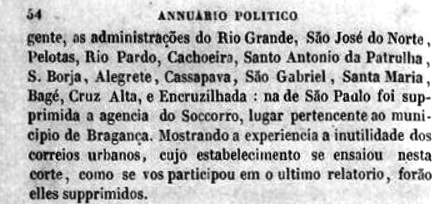
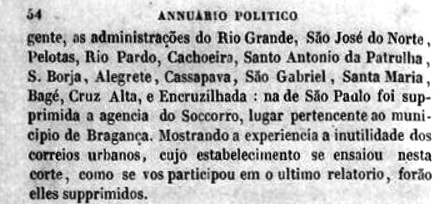
As Nova Monteiro writes in Administrações e Agencias Postaes do Brasil Imperio (Brasil Filatelico/RJ, 1934-5; reprint SPP 1994-1999), there had been a post office there since October 1831. This was probably closed during the Farroupilha Uprising (1835-1845) and only reopened in December 1845, as R. Koester reports in Carimbologia XIV. This is confirmed by the official Yearbook of Politics, History and Statistics of the following year:

Annuario Politico, Historico e Estatistico, 1846

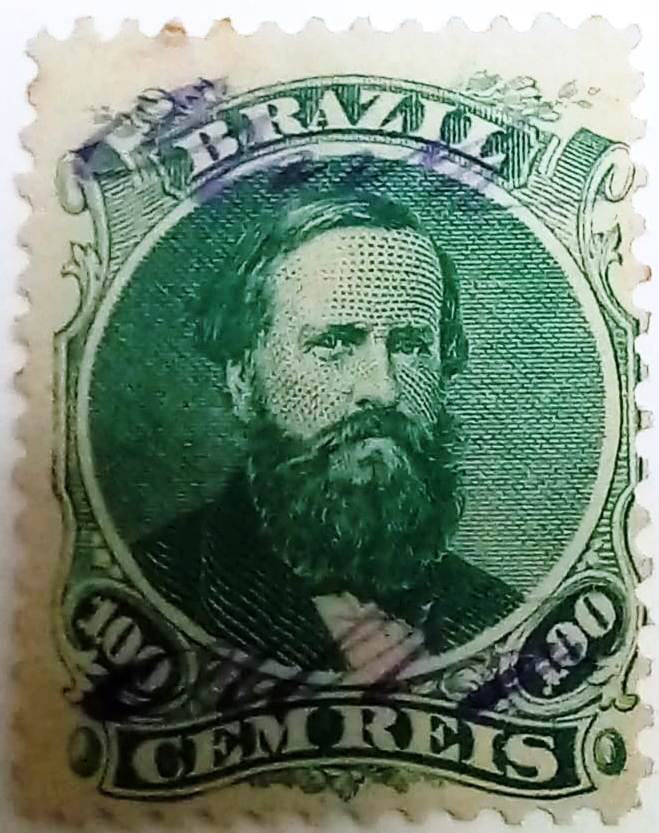
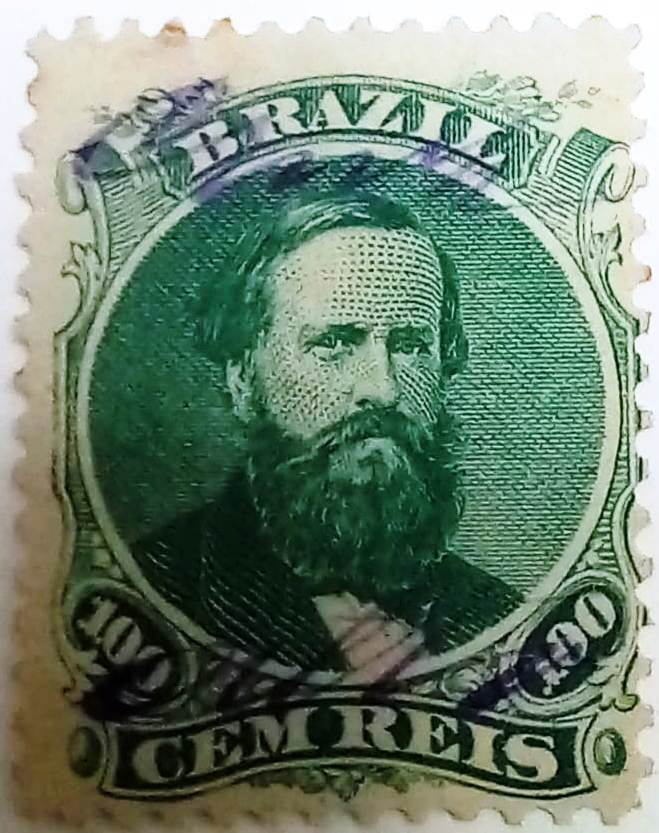
The oldest “postmark” is a handwritten cancellation on a D. Pedro issue from 1866 (Fuad Ferreira Fo. Collection):

1866ff (FF)

CRS-0135b (image by Claudio Coelho) followed from ca. 1877:

CRS-0135b (CC) 1877-1883

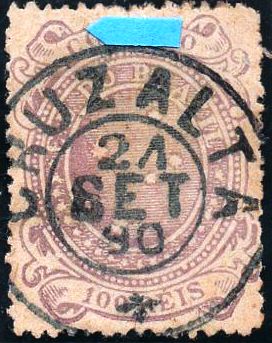
Then came the well-known CRS-0135c (illustration from the Internet):

CRS-0135c (EB) 1885-1891

James Dingler and Klerman W. Lopes show in Mute Cancellations of the Brazil Empire / Carimbos Mudos do Brasil Império (Brazil Philatelic Association, Rio de Janeiro, 2000) a mute cancellation, registered under no. 3300:

BPA 3300, 1876ff-1883ff
Villiers de l’Ile Adam: Carta (…) da Provincia de São Pedro do Sul, 1847

Andere Namen: Santa Teresa

Die von spanischen Jesuiten 1634 gegründete Indianersiedlung Santa Teresa wurde von portugiesischen Invasoren zerstört. Erst im Oktober 1832 wurde dort, 350 km nordwestlich der Provinzhauptstadt Porto Alegre, die Freguesia do Divino Espírito Santo da Cruz Alta gegründet. Fünf Monate später wurde Cruz Alta zur Vila und im April 1879 zur Stadt erklärt.

Wie Nova Monteiro in Administrações e Agencias Postaes do Brasil Imperio (Brasil Filatelico/RJ, 1934-5; Reprint SPP 1994-1999) schreibt, gab es dort seit Oktober 1831 ein Postamt. Dieses wurde wahrscheinlich während des Farroupilha-Aufstandes (1835-1845) geschlossen und erst im Dezember 1845 wieder eröffnet, wie R. Koester in Carimbologia XIV berichtet. Dies wird durch das offizielle Jahrbuch für Politik, Geschichte und Statistik des folgenden Jahres bestätigt:

Annuario Politico, Historico e Estatistico, 1846

Als ältester “Poststempel” muss noch eine handschriftliche Entwertung auf einer D. Pedro-Ausgabe von 1866 herhalten (Samml. Fuad Ferreira Fo.):

1866ff (FF)

Ab ca. 1877 folgte CRS-0135b (Abb. Claudio Coelho):

CRS-0135b (CC) 1877-1883

Danach kam die bekannte CRS-0135c (Abb. aus dem Internet):

CRS-0135c (EB) 1885-1891

James Dingler und Klerman W. Lopes zeigen in Mute Cancellations of the Brazil Empire / Carimbos Mudos do Brasil Império (Brazil Philatelic Association, Rio de Janeiro, 2000) auch eine stumme Entwertung, die unter Nr. 3300 registriert ist:

BPA 3300, 1876ff-1883ff
Categories
Carimbologia C-D

Crumarim, Município Neutro (CMN-0410)

Mappa do Municipio Neutro, ca. 1880

Other names: Grumari

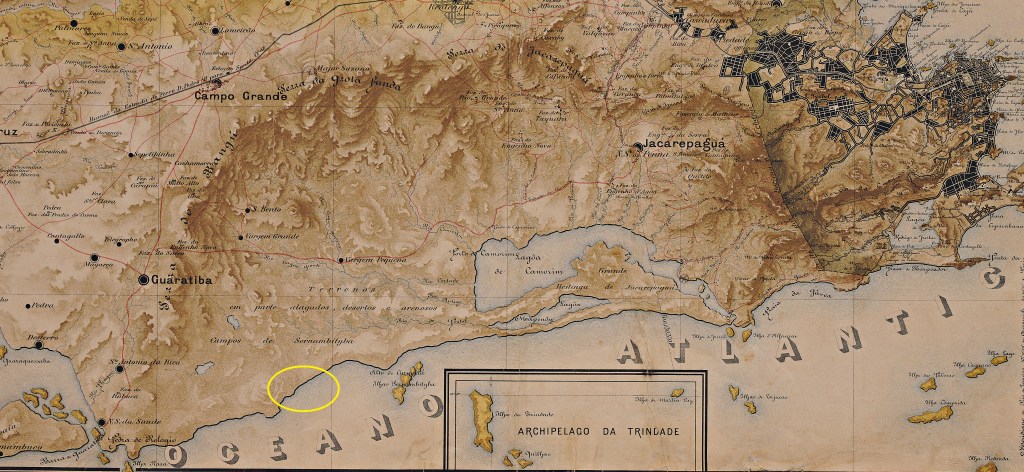
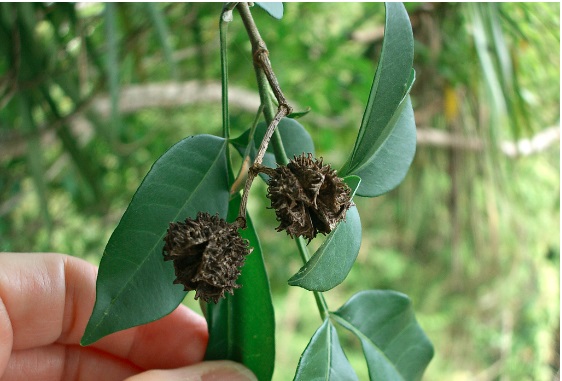
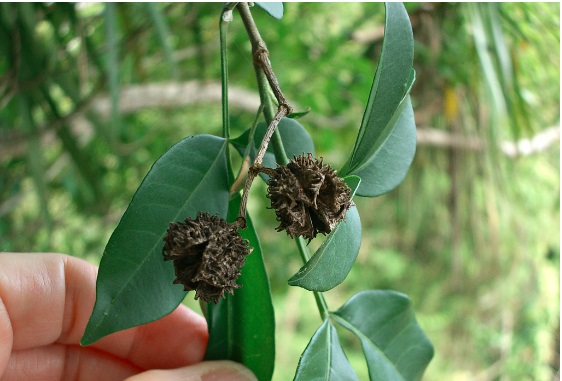
Here we have another locality that makes you wonder why a post office was set up here of all places, especially as only 167 inhabitants were counted in 2010. Crumarim (now Grumari) was an idyllic beach settlement in the Freguesia de Guaratiba, 50 kilometres west of the capital Rio de Janeiro. Since July 1981, it has been a district of the administrative region (Região Administrativa) of Barra da Tijuca. The name refers to a plant (Eisenbeckia febrifuga) from the cabbage family (Rutaceae).

Eisenbeckia febrifuga (Photo: Ruth Ripley, on biodiversity4all.org)

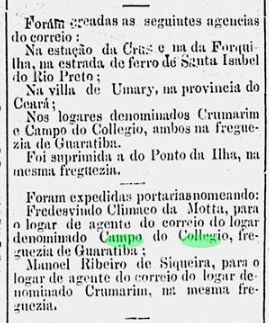
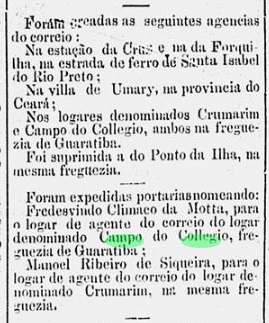
R. Koester writes in Carimbologia XIV that there has been a post office there since January 1887. This is confirmed by the press in Rio:

O Paiz, 05/02/1887

According to P. Novaes (agenciaspostais.com.br), the agency was closed “around 1940”. No imperial postmark from Crumarim has yet been found.

Google Maps

Andere Namen: Grumari

Hier haben wir wieder einen Ort, bei dem man sich fragt, warum ausgerechnet hier ein Postamt eingerichtet wurde, zumal noch 2010 nur 167 Einwohner gezählt wurden. Crumarim (heute Grumari) war eine idyllische Strandsiedlung in der Freguesia de Guaratiba, 50 km westlich der Hauptstadt Rio de Janeiro. Seit Juli 1981 ist es ein Stadtteil der Verwaltungsregion (Região Administrativa) Barra da Tijuca. Der Name bezieht sich auf eine Pflanze (Eisenbeckia febrifuga) aus der Familie der Kohlgewächse (Rutaceae).

Eisenbeckia febrifuga (Foto: Ruth Ripley, auf biodiversity4all.org)

R. Koester schreibt in Carimbologia XIV, dass es dort seit Januar 1887 ein Postamt gab. Dies wird von der Presse in Rio bestätigt:

O Paiz, 05.02.1887

Laut P. Novaes (agenciaspostais.com.br) wurde die Agentur „um 1940“ geschlossen. Bisher wurde kein kaiserlicher Poststempel aus Crumarim gefunden.

Categories
Carimbologia C-D

Cruangy, Pernambuco (CPE-0220)

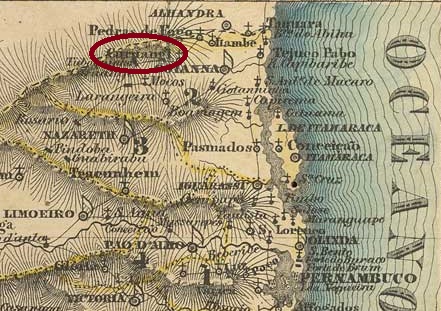
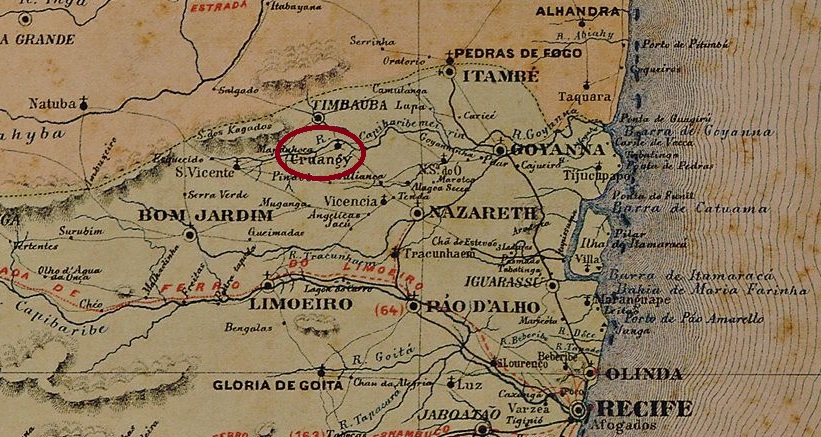
Villiers de l’Ile Adam: Carta (…) das Provincias de Pernambuco, Alagoas e Sergipe, 1848

The village was named after a nearby sugar factory in the Vila de Itambé and was located 100 kilometres northwest of the provincial capital Recife. In April 1879, it became the Freguesia de N. Sa. do Rosário de Cruangy, which now belonged to the Vila de Timbaúba. It has remained so to this day.

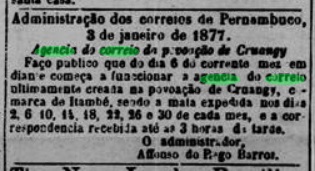
The list of imperial post offices (Tabella das Agencias do Correio do Imperio, Rio de Janeiro, 1885) shows that there had been a post office there since 1873. However, it was only opened in January 1877, as can be seen from the regional press:

Diario de Pernambuco, 04/01/1877

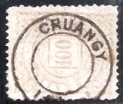
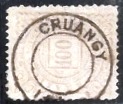
The oldest postmark to date is CPE-0220a (Fig. Jorge Pedreira):
CPE-0220a (JP) 1888ff
Carta Corographica da Provincia de Pernambuco, 1880

Der Ort wurde nach einer nahe gelegenen Zuckerfabrik in der Vila de Itambé benannt und lag 100 km nordwestlich der Provinzhauptstadt Recife. Im April 1879 wurde es zur Freguesia de N. Sa. do Rosário de Cruangy, die nun zur Vila de Timbaúba gehörte. So ist es bis heute geblieben.

Aus dem Verzeichnis der kaiserlichen Postämter (Tabella das Agencias do Correio do Imperio, Rio de Janeiro, 1885) geht hervor, dass es dort seit 1873 ein Postamt gab. Es wurde jedoch erst im Januar 1877 eröffnet, wie aus der regionalen Presse hervorgeht:

Diario de Pernambuco, 04.01.1877

Der bisher älteste Poststempel ist CPE-0220a (Abb. Jorge Pedreira):
CPE-0220a (JP) 1888ff