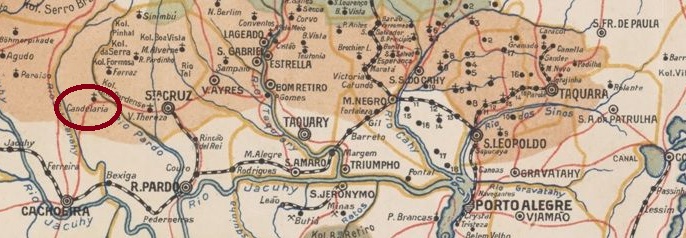
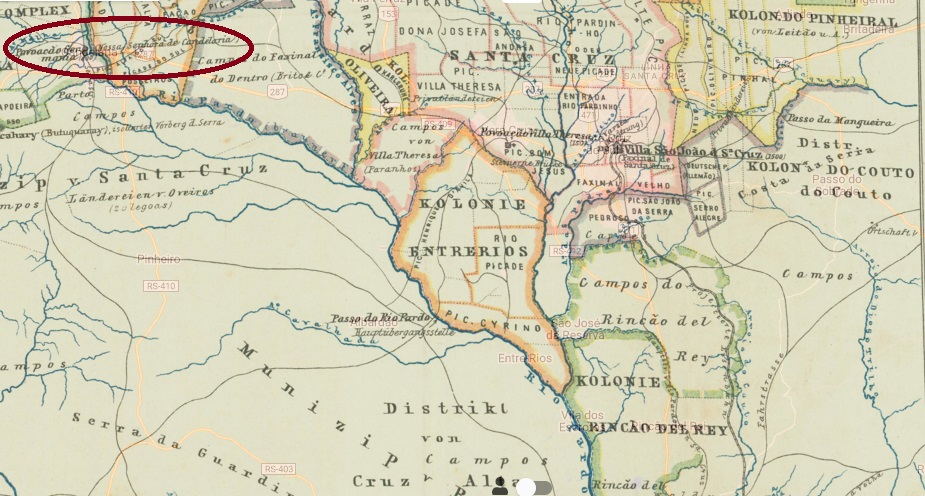
The Freguesia de N. Sra. da Candelaria da Germânia was founded in May 1876 around the Vila Rio Pardo and is located on the west bank of the Rio Pardo, 190 km west of the provincial capital Porto Alegre. In January 1898, the town was elevated to the status of a district and has been an independent município since July 1925.
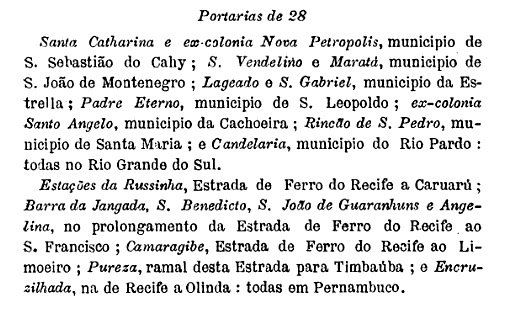
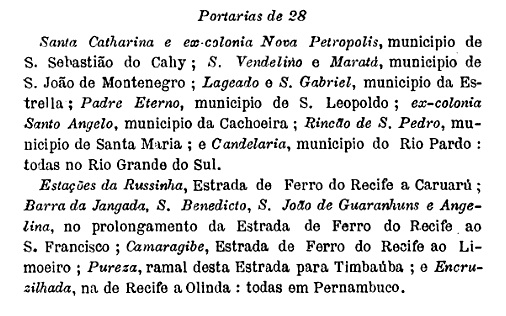
The local post office was founded in October 1889, a few weeks before the end of the Empire, as can be seen from the postal bulletin (Boletim Postal) of the following month:
Boletim Postal No. 7, November 1889
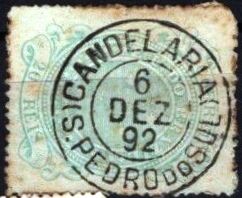
The oldest postmark is CRS-0083a (image from the internet) and is likely to be republican already:
CRS-0083a (EB) 1892-1901colonias.heuser.pro.br
Anderer Name: Villa Germania
Die Freguesia de N. Sra. da Candelaria da Germânia wurde im Mai 1876 im Gebiet der Vila Rio Pardo gegründet und liegt am Westufer des Rio Pardo, 190 km westlich der Provinzhauptstadt Porto Alegre. Im Januar 1898 wurde der Ort zum Distrikt erhoben und ist seit Juli 1925 ein eigenständiges Município.
Das örtliche Postamt wurde im Oktober 1889 gegründet, wenige Wochen vor dem Ende des Kaiserreichs, wie aus dem Postbulletin (Boletim Postal) des Folgemonats hervorgeht:
Boletim Postal Nr. 7, November 1889
Der älteste Poststempel ist CRS-0083a (Abbildung aus dem Internet) und dürfte bereits republikanisch sein:
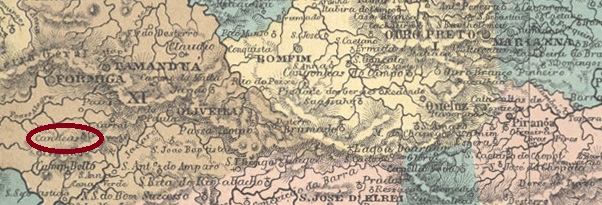
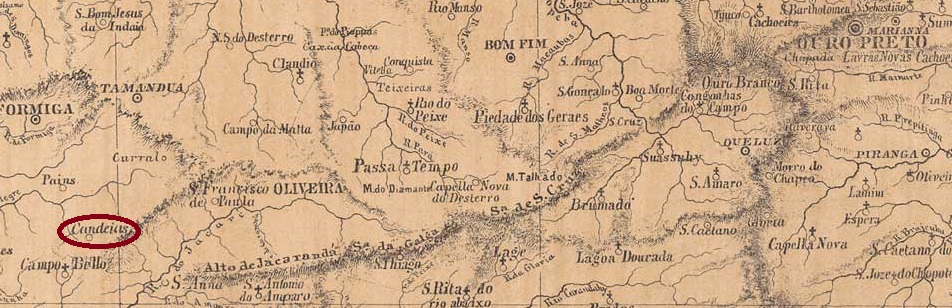
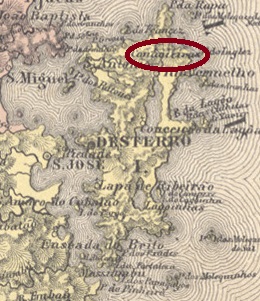
The Freguesia de N. Sra. de Candeias (also spelled Candeas) was founded in January 1866 and belonged to the Vila de Campo Belo, situated 280 km north of the provincial capital Ouro Preto. Since December 1938, the village has been Município de Candeias.
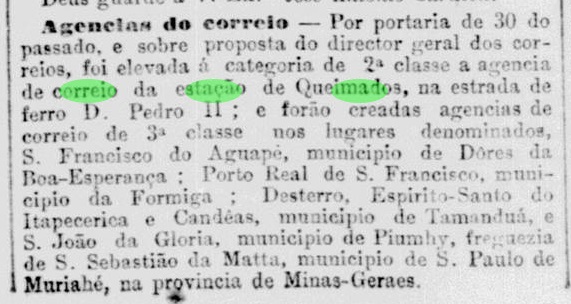
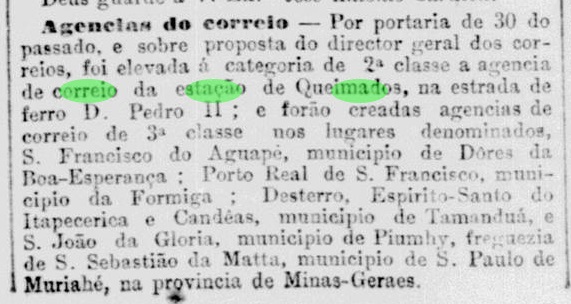
All sources agree that there has been a post office there since November 1881:
Jornal do COmmercio/RJ, 02.12.1881
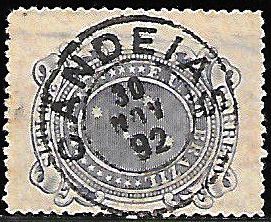
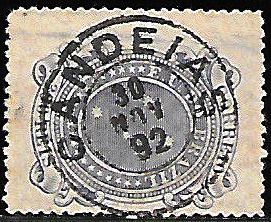
The only postmark from the imperial period so far is CMG-0530a (image from the internet), which also exists in blue, with dates from 1888 to 1892:
CMG-0530a (EB)Provincia de Minas Geraes, 1873
Die Freguesia de N. Sra. de Candeias (auch Candeas geschrieben) wurde im Januar 1866 gegründet und gehörte zur Vila de Campo Belo und lag 280 km nördlich der Provinzhauptstadt Ouro Preto. Seit Dezember 1938 ist der Ort Município de Candeias.
Alle Quellen stimmen darin überein, dass es dort seit November 1881 ein Postamt gab:
Jornal do Commercio/RJ, 02.12.1881
Der bisher einzige Poststempel aus der Kaiserzeit ist CMG-0530a (Abb. aus dem Internet), den es auch in blau, mit Daten von 1888 bis 1892 gibt:
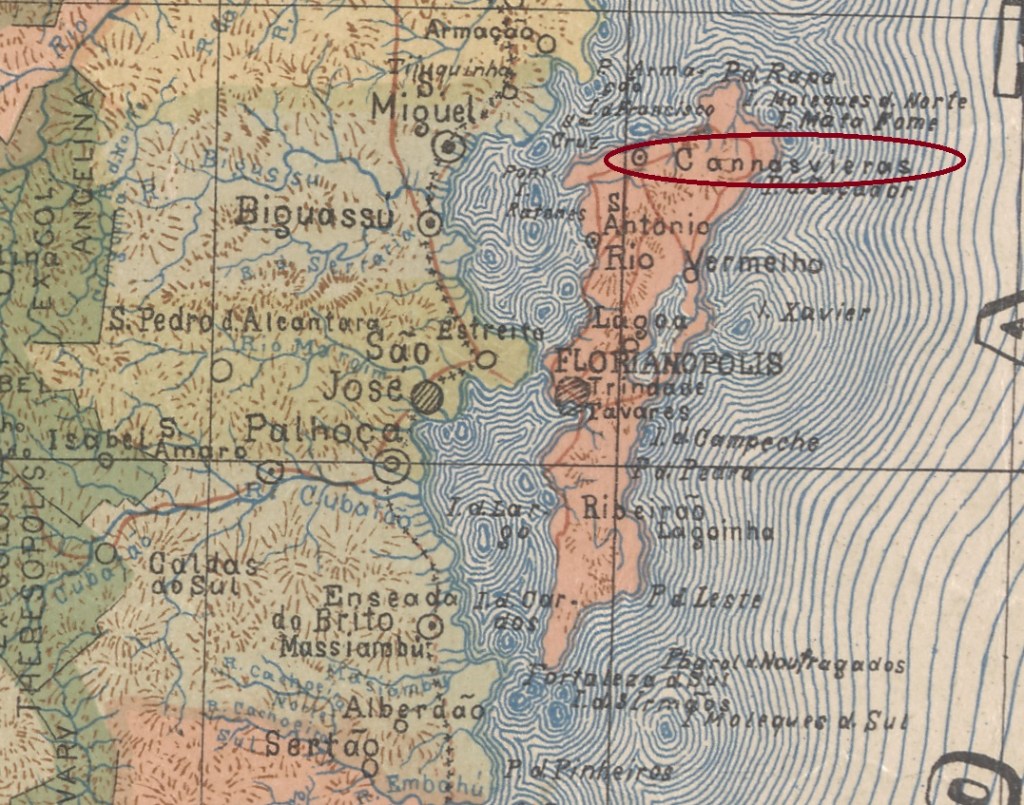
The parish of S. Francisco de Paula de Canavieiras was founded in April 1750 and was located on the beach of the same name on the island of Santa Catarina, 24 km north of the later provincial capital of Desterro (today: Florianópolis). In April 1835, it was elevated to freguesia status and even enjoyed the status of a villa from May 1877 to January 1880. Since October 1894, Canasvieiras – as it is written today – has been a district of the state capital Florianópolis.
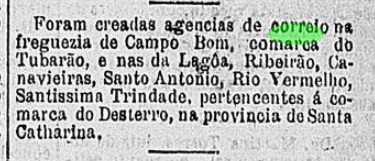
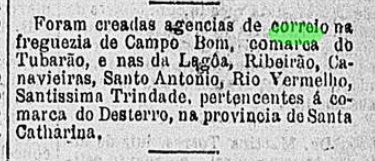
There had been a post office there since March 1884, as the Rio press reported:
Gazeta de Noticias/RJ, 09.03.1884
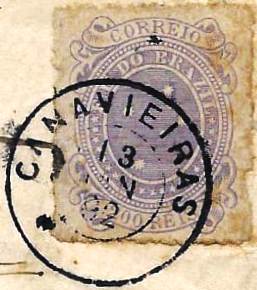
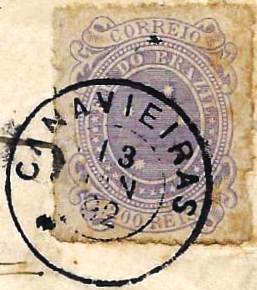
R. Koester has shown two postmarks from the imperial period in his Carimbologia VIII:
CSC-0050a (RK) 1889CSC-0050b (RK)Mappa do Estado de Santa Catharina, 1907
Anderer Name: Cannasvieiras
Die Pfarrei S. Francisco de Paula de Canavieiras wurde im April 1750 gegründet und lag am gleichnamigen Strand auf der Insel Santa Catarina, 24 km nördlich der späteren Provinzhauptstadt Desterro (heute: Florianópolis). Im April 1835 wurde es zur Freguesia erhoben und genoss von Mai 1877 bis Januar 1880 sogar den Status einer Villa. Seit Oktober 1894 ist Canasvieiras – wie es heute geschrieben wird – ein Stadtteil der Landeshauptstadt Florianópolis.
Ein Postamt gab es dort seit März 1884, wie die Presse in Rio berichtete:
Gazeta de Noticias/RJ, 09.03.1884
R. Koester hat in Carimbologia VIII zwei Poststempel aus der Kaiserzeit gezeigt:
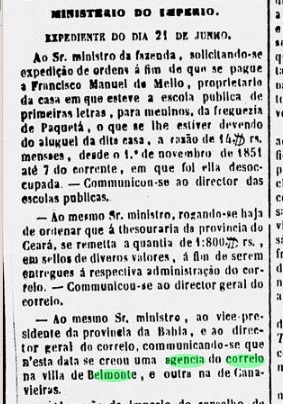
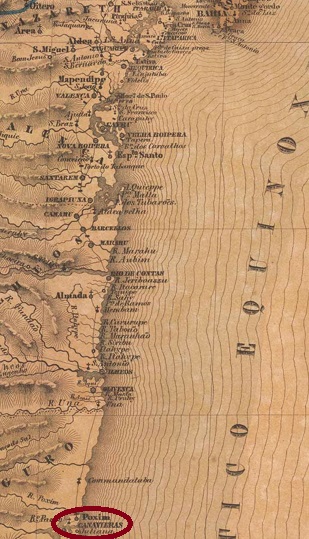
The history of the locality begins with the foundation of the Freguesia de S. Boaventura do Poxim, which belonged to the Vila de Ilhéus and was located on the west bank of the Rio Salsa, 430 km south of the former colonial capital Salvador da Bahia. In December 1832, it was elevated as Imperial of Vila de Canavieiras, which received city rights in May 1891.
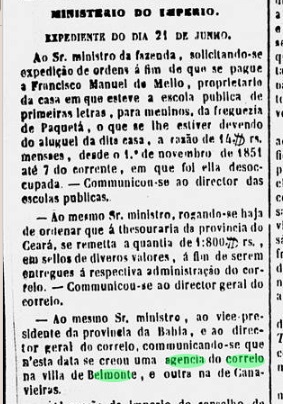
Two dates could be found for the foundation of the local post office. The first in June 1862, as Nova Monteiro wrote in Administrações e Agencias Postaes do Brasil Imperio (Brasil Filatelico/RJ, 1934-5; reprinted by SPP 1994-1999) and confirmed by the Rio press:
Diario do Rio de Janeiro, 03.07.1852
Then again in February 1866, as noted by R. Koester in Carimbologia VIII; the year is confirmed by the Directory of Imperial Post Offices (Tabella das Agencias do Correio do Imperio, Rio de Janeiro, 1885).
Currently, the oldest postmark of this agency is the French type CBA-0240b (Fig. José Renato C. de Souza):
CBA-0240b (JR) 1876ff-1878ff
It was followed by the double circle CBA-0240c (fig. José L. Fevereiro)
CBA-0240c (JLF) 1881ff-1892Villies de l’Ile Adam: Carta (…) da Provincia da Bahia, 1848
Andere Namen: Poxim
Die Geschichte der Stadt beginnt mit der Gründung der Freguesia de S. Boaventura do Poxim, die zur Vila de Ilhéus gehörte und am Westufer des Rio Salsa lag, 430 km südlich der ehemaligen Kolonialhauptstadt Salvador da Bahia. Im Dezember 1832 erfolgte die Erhebung zur Kaiserlichen Vila de Canavieiras, die im Mai 1891 die Stadtrechte erhielt.
Für die Gründung des örtlichen Postamtes konnten zwei Daten gefunden werden. Das erste im Juni 1862, wie Nova Monteiro in Administrações e Agencias Postaes do Brasil Imperio (Brasil Filatelico/RJ, 1934-5; Nachdruck SPP 1994-1999) schrieb und die Presse von Rio bestätigte:
Diario do Rio de Janeiro, 03.07.1852
Dann wieder im Februar 1866, wie R. Koester in Carimbologia VIII vermerkte; die Jahresangabe wird durch das Verzeichnis der kaiserlichen Postämter (Tabella das Agencias do Correio do Imperio, Rio de Janeiro, 1885) bestätigt.
Der derzeit älteste Poststempel dieser Agentur ist der französische Typ CBA-0240b (Abb. José Renato C. de Souza):
CBA-0240b (JR) 1876ff-1878ff
Es folgte der Doppelkreis CBA-0240c (Abb. José L. Fevereiro)
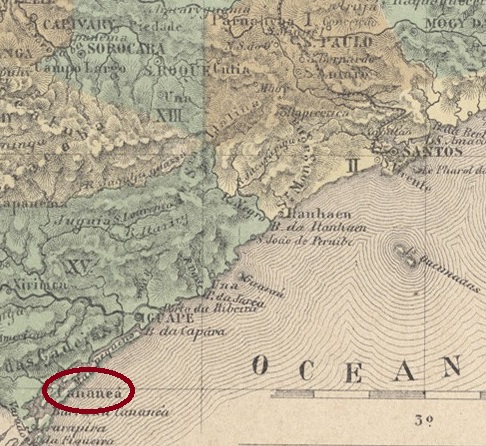
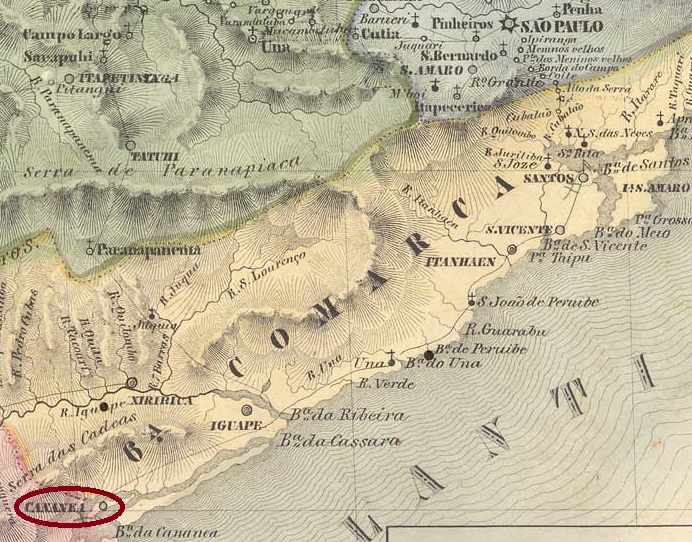
The Freguesia de S. João Baptista de Cananea was founded in July 1587 by royal letter (Carta Régia) on an island protected by a beautiful bay, 300 km southwest of the future capital São Paulo. The place became a vila in July 1600 and a town in July 1895, spelled Cananeia since December 1905.
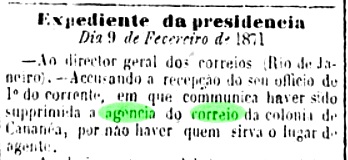
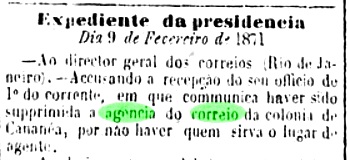
The local post office was established at least three times. The first time in April 1828, as Nova Monteiro writes in Administrações e Agencias Postaes do Brasil Imperio (Brasil Filatelico/RJ, 1934-5; reprinted by SPP 1994-1999). Then again in 1840, as shown in the Directory of Imperial Post Offices (Tabella das Agencias do Correio do Imperio, Rio de Janeiro, 1885). The third origin of the post office could not be dated precisely until now. All that is known is that the agency closed in February 1871:
Diario de São Paulo, 11.02.1871
and that it was active by April 1874:
Correio Paulistano, 21.04.1874
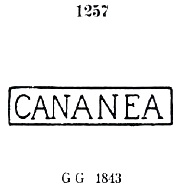
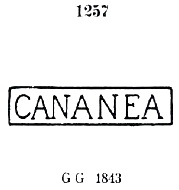
The oldest postmark was probably used in pre-philatelic times, although no evidence has yet surfaced, and was already made known by P. Ayres in the Catálogo de Carimbos Brasil-Império (S. Paulo, 1937, 1942) under No. 1257:
CSP-0270a (P.A. 1257) 1843ff-1866ff
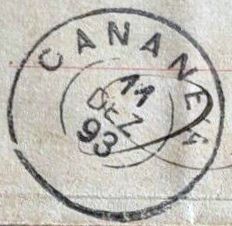
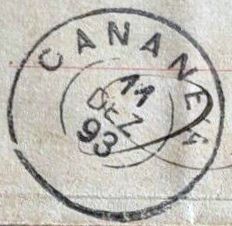
It was followed by the French type CSP-0270b, which was used from about 1877 and is mentioned by R. Koester in Carimbologia VIII – unfortunately without illustration. The last cancel of the 19th century is CSP-0270c (illustration from the internet):
CSP-0270c (EB) 1891-1899Villiers de l’Ile Adam: Carta (…) da Provincia de São Paulo, 1847
Die Freguesia de S. João Baptista de Cananea wurde im Juli 1587 durch einen königlichen Brief (Carta Régia) gegründet und lag auf einer durch eine schöne Bucht geschützten Insel, 300 km südwestlich der späteren Hauptstadt São Paulo. Der Ort wurde im Juli 1600 zur Vila und im Juli 1895 zur Stadt, die seit Dezember 1905 Cananeia geschrieben wird.
Das örtliche Postamt wurde mindestens dreimal eingerichtet. Das erste Mal im April 1828, wie Nova Monteiro in Administrações e Agencias Postaes do Brasil Imperio (Brasil Filatelico/RJ, 1934-5; Nachdruck SPP 1994-1999) schreibt. Dann wieder 1840, wie aus dem Verzeichnis der kaiserlichen Postämter (Tabella das Agencias do Correio do Imperio, Rio de Janeiro, 1885) hervorgeht. Die dritte Entstehung des Postamtes konnte bisher nicht genau datiert werden. Es ist lediglich bekannt, dass die Agentur im Februar 1871 geschlossen wurde:
Diario de São Paulo, 11.02.1871
und dass es im April 1874 wieder in Betrieb war:
Correio Paulistano, 21.04.1874
Der älteste Poststempel wurde wahrscheinlich schon in vorphilatelistischer Zeit verwendet, obwohl bisher keine Belege aufgetaucht sind, und wurde bereits von P. Ayres im Catálogo de Carimbos Brasil-Império (S. Paulo, 1937, 1942) unter der Nr. 1257 bekannt gemacht:
CSP-0270a (P.A. 1257) 1843ff-1866ff
Ihm folgte der französische Typ CSP-0270b, der ab ca. 1877 verwendet wurde und von R. Koester in Carimbologia VIII – leider ohne Abbildung – erwähnt wird. Der letzte Stempel des 19. Jahrhunderts ist CSP-0270c (Abbildung aus dem Internet):
Villiers de l’Ile Adam: Carta (…) das Provincias de Pernambuco, Alagoas e Sergipe, 1848
Other names: Rio Real de Cima, Campos do Rio Real, Tobias Barreto (1943)
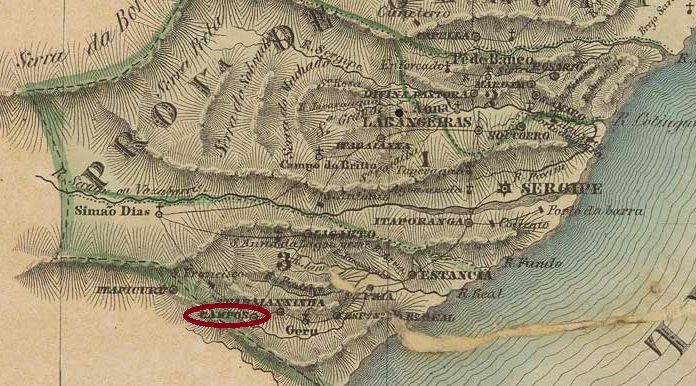
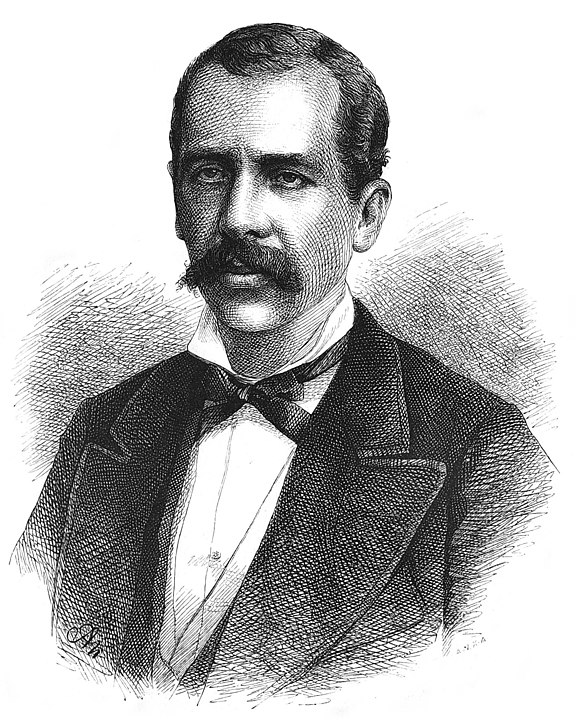
The Rio Real still forms the natural border between the states of Sergipe and Bahia. At the mouth of the Jabiberi in the upper reaches of the river, the Freguesia de N. Sra. dos Campos do Rio Real was founded in October 1718, 130 km west of the later provincial capital Aracaju. The place was declared a vila in January 1835 and a town in October 1909. It has been the Município of Tobias Barreto since December 1943. The name commemorates the poet, philosopher and jurist Tobias Barreto de Menezes (1839-1889), who was born here and who, as an ardent admirer of Ernst Haeckel and Ludwig Büchner, also wrote books in German.
Die Gartenlaube, 1879
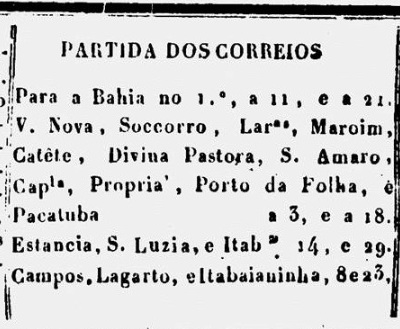
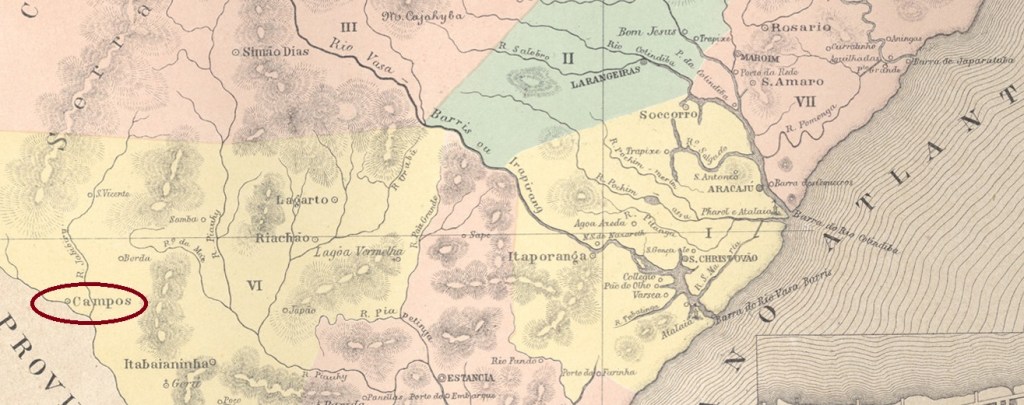
Nova Monteiro writes in Administrações e Agencias Postaes do Brasil Imperio (Brasil Filatelico/RJ, 1934-5; Reprint SPP 1994-1999) that there was a post office in Campos from December 1844, while the Directory of Imperial Post Offices (Tabella das Agencias do Correio do Imperio, Rio de Janeiro, 1885) gives the following year. Presumably, the agency started operating in 1845. But already in March 1844 there was a relay service there, as the regional press reported:
O Correio Sergipense, 13.03.1844
So far, no imperial postmarks are known from there.
Atlas do Imperio do Brasil, 1868
Andere Namen: Rio Real de Cima, Campos do Rio Real, Tobias Barreto (1943)
Der Rio Real bildet bis heute die natürliche Grenze zwischen den Bundesstaaten Sergipe und Bahia. An der Mündung des Jabiberi in den Oberlauf des Flusses wurde im Oktober 1718 die Freguesia de N. Sra. dos Campos do Rio Real gegründet, 130 km westlich der späteren Provinzhauptstadt Aracaju. Der Ort wurde im Januar 1835 zur Vila und im Oktober 1909 zur Stadt erklärt. Seit Dezember 1943 ist es der Município von Tobias Barreto. Der Name erinnert an den hier geborenen Dichter, Philosophen und Juristen Tobias Barreto de Menezes (1839-1889), der als glühender Verehrer von Ernst Haeckel und Ludwig Büchner auch Bücher in deutscher Sprache verfasste.
Die Gartenlaube, 1879
Nova Monteiro schreibt in Administrações e Agencias Postaes do Brasil Imperio (Brasil Filatelico/RJ, 1934-5; Reprint SPP 1994-1999), dass es in Campos ab Dezember 1844 ein Postamt gab, während das Verzeichnis der kaiserlichen Postämter (Tabella das Agencias do Correio do Imperio, Rio de Janeiro, 1885) das folgende Jahr angibt. Vermutlich nahm die Agentur 1845 ihre Tätigkeit auf. Aber bereits im März 1844 gab es dort einen Stafettendienst, wie die regionale Presse berichtete:
O Correio Sergipense, 13.03.1844
Bisher sind keine kaiserlichen Poststempel von dort bekannt.
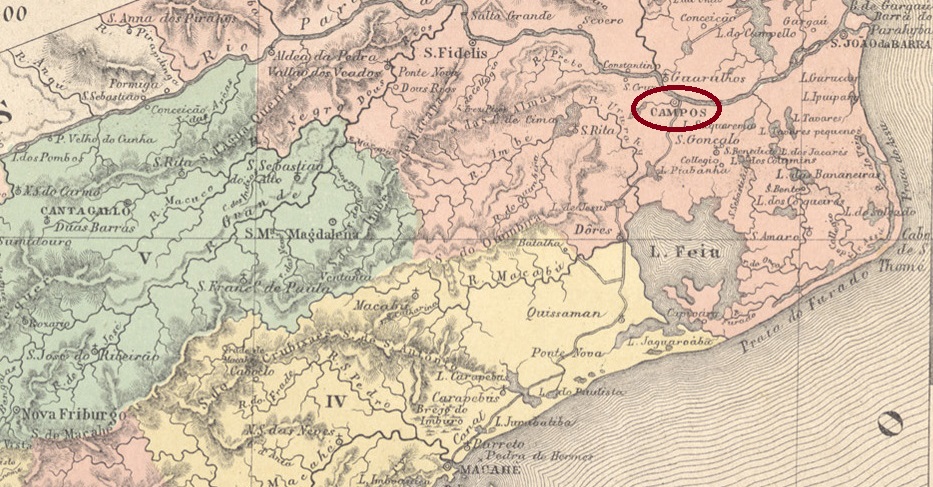
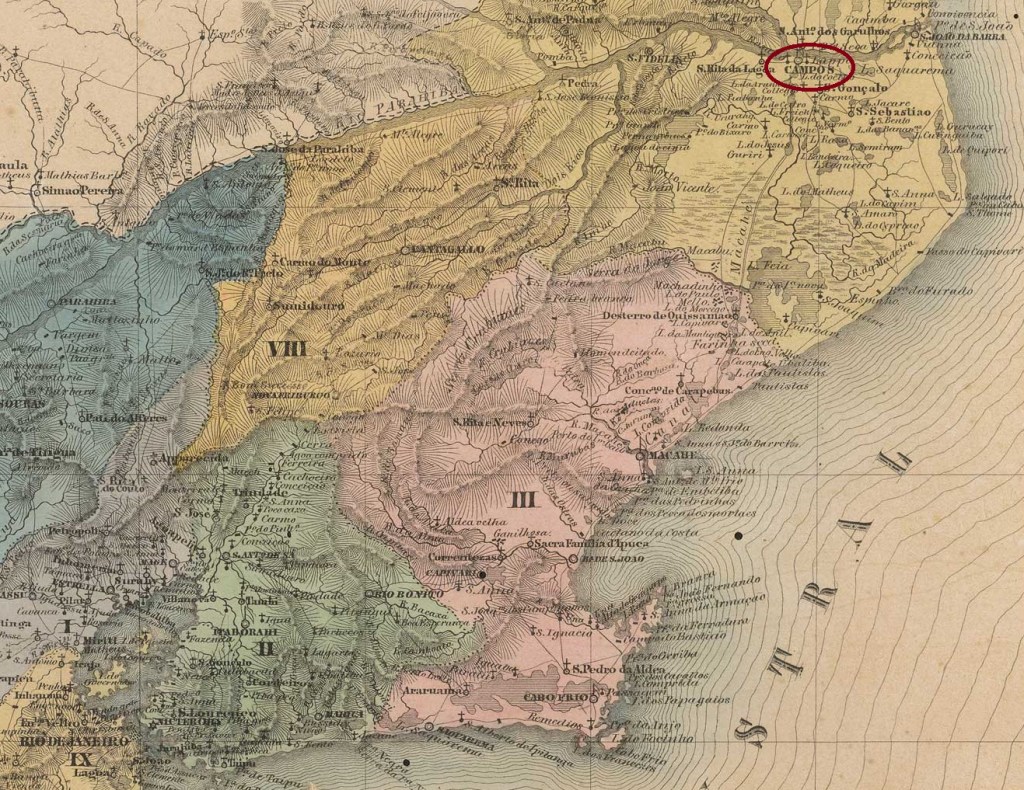
The locality, which first became a vila in 1673 and a freguesia the following year, was called São Salvador dos Campos and was on the south bank of the Paraíba do Sul, 280 km northeast of the capital Rio de Janeiro. In 1753, Campos still belonged to the Capitania do Espirito Santo (very formerly also to the Capitania of S. Thomé), but in August 1832 it changed to the imperial province of Rio de Janeiro. Since March 1835 Campos has been a town, and since October 1986 it has been called Campos dos Goitacazes.
The local post office existed as early as 1798, although Nova Monteiro in Administrações e Agencias Postaes do Brasil Imperio (Brasil Filatelico/RJ, 1934-5; reprinted by SPP 1994-1999) still gives February as the date of creation, while Paulo Novaes on agenciaspostais.com.br writes a more accurate date of June that year.
The first postmark is CRJ-0285a, with No. 1135 by P. Ayres (Catálogo de Carimbos Brasil-Império, S. Paulo, 1937, 1942), but the RHM catalogue shows an altered image under P-RJ-04:
CRJ-0285a (P.A. 1135, recte RHM P-RJ-04) 1826-1838 (also in brown)
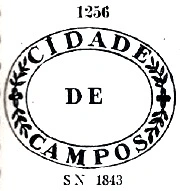
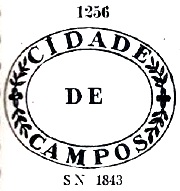
It was followed by CRJ-0285b, also known from Ayres (op. cit.), now under No. 1256:
CRJ-0285b (P.A. 1256, RHM P-RJ-06) 1839-1869 (also in red)
The enigmatic cancel CRJ-0285c also appeared in red and sepia from around 1843. According to new findings, the letters S.I. mean Serviço Imperial:
CRJ-0285c (RHM P-RJ-05) 1843ff-1850gg
From about 1868 onwards, the French type CRJ-0285d appears (Fig. José L. Fevereiro)
CRJ-0285d (JLF) 1868-1880
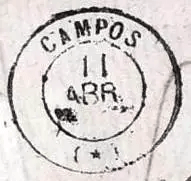
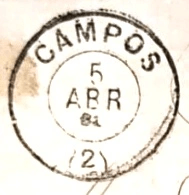
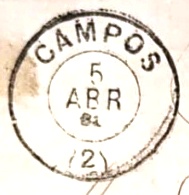
In the early 1980s, two almost identical cancels appeared, differing only by the numbers 1 and 2 at the bottom: CRJ-0285e (illustration from the Internet) and CRJ-0285f (illustration by Luiz C. Fritzen):
CRJ-0285e (EB) 1884-1893CRJ-0285f (LCF) 1881-1888
Around the same time, the simple CRJ-0285g (image from the internet) was also in service:
CRJ-0285g (EB) 1884-1888
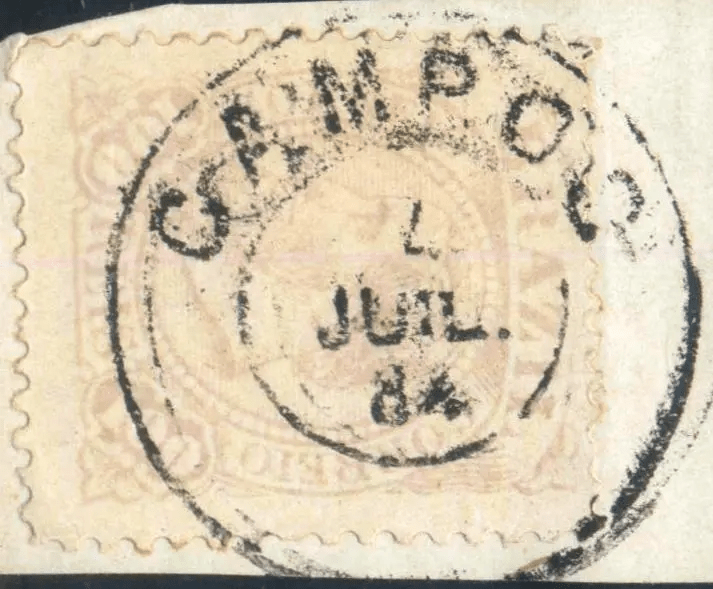
Towards the end of the Empire, two identical postmarks appeared again, this time differing in letter size: CRJ-0285h (ill. R. Koester, in Carimbologia VIII) and CRJ-0285i (ill. from the Internet):
CRJ-0285 h (RK) 1888-1890CRJ-0285i (EB) 1888-1899
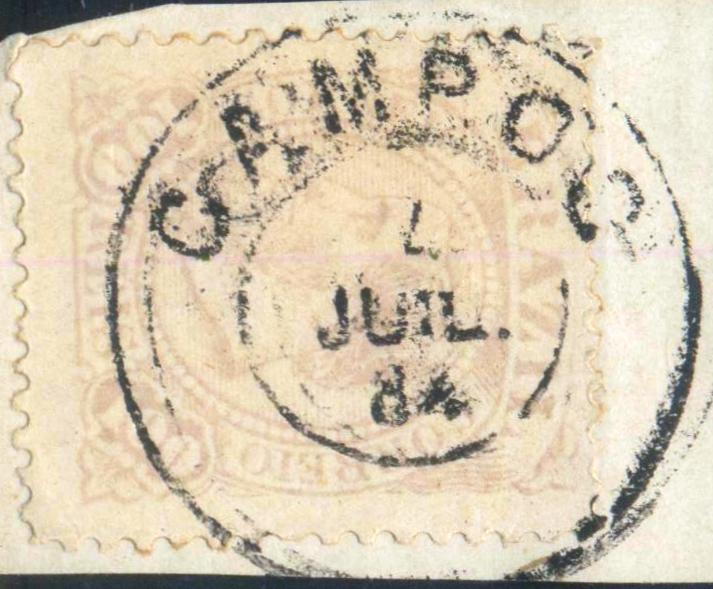
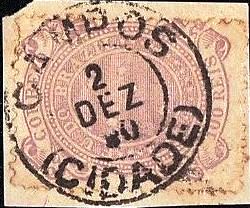
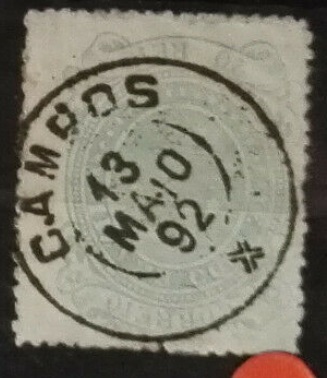
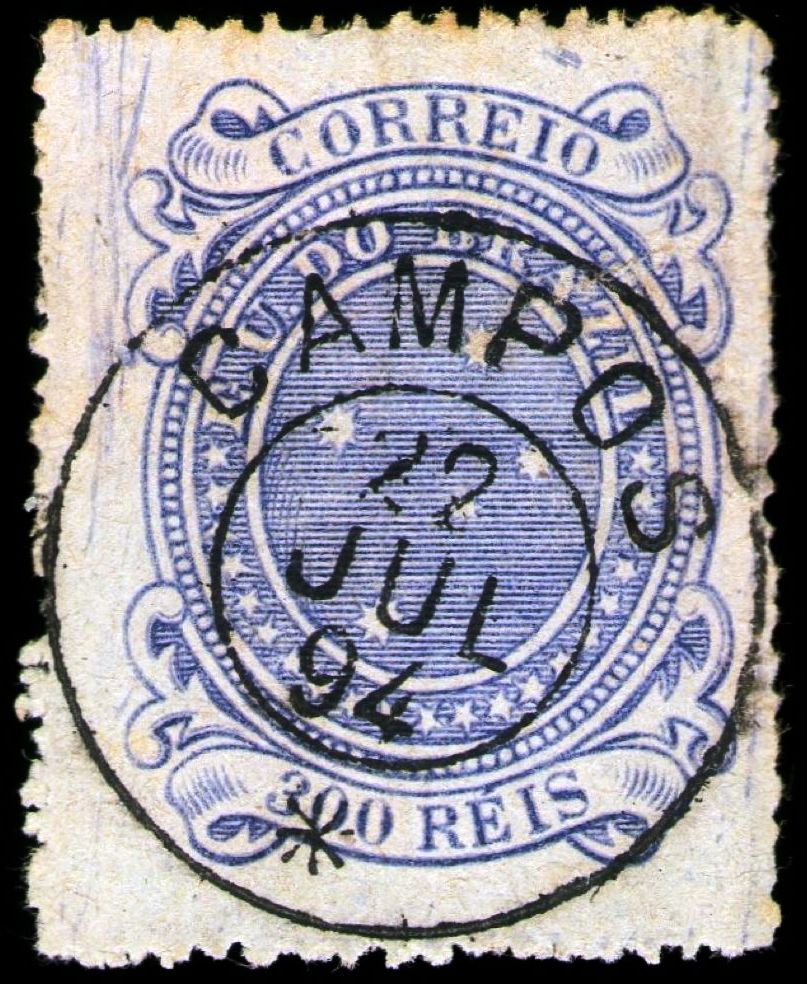
The last two 19th century postmarks may already be Republican, as they are dated after the November 1889 coup d’état:
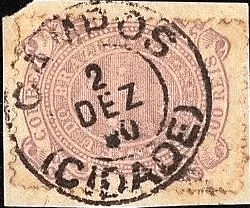
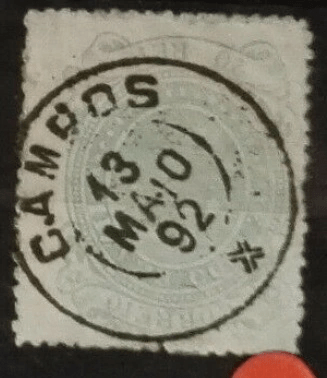
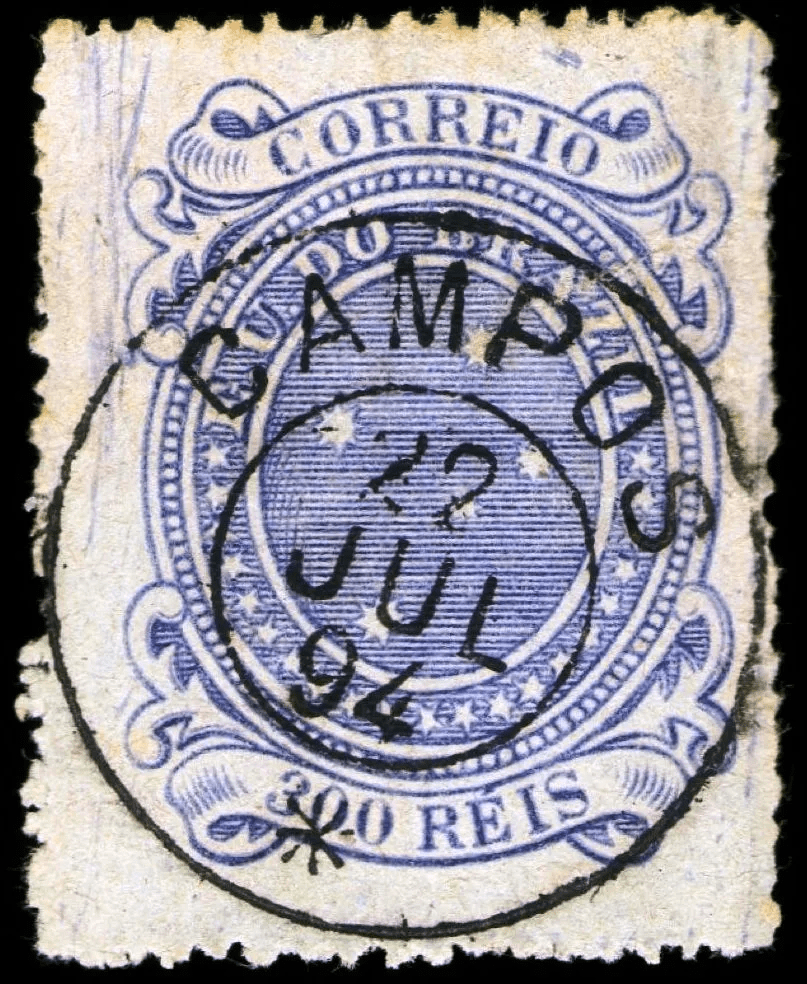
CRJ-0285j (EB) 1891-1899CRJ-0285k (CC) 1894-1896
From the Fuad Ferreira Fo. collection there also came three other postmarks from Campos that were formerly in the Koester collection:
CRJ-0285f (FF/RK)CRJ-0285m (FF/RK)s.d. (FF/RK)
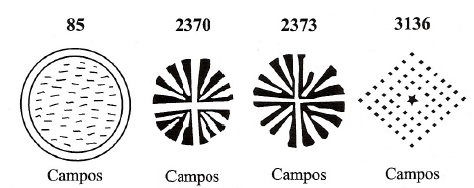
Five mute cancellations from the imperial Campos have been found so far, the first four of them in Mute Cancellations of the Brazil Empire / Carimbos Mudos do Brasil Império (Brazil Philatelic Association, Rio de Janeiro, 2000), by J. Dingler and K. W. Lopes:
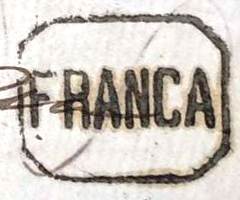
Last we have a FRANCA postmark (= fee paid to consignee) from Campos on a cover of José L. Fevereiro:
1877 (JLF)Villiers de l’Ile Adam: Carta (…) da Provincia do Rio de Janeiro, 1850
Textaktualisierung am 30. September 2023
Anderer Name: Campos dos Goitacazes (1986)
Der Ort, der 1673 zunächst eine Vila und erst im folgenden Jahr eine Freguesia wurde, hieß São Salvador dos Campos und lag am Südufer des Paraíba do Sul, 280 km nordöstlich der Hauptstadt Rio de Janeiro. Im Jahre 1753 gehörte Campos noch zur Capitania do Espirito Santo (ganz früher auch zur Capitania von S. Thomé), wechselte aber im August 1832 zur kaiserlichen Provinz Rio de Janeiro. Seit März 1835 ist Campos eine Stadt, die seit Oktober 1986 Campos dos Goitacazes heißt.
Das örtliche Postamt existierte bereits 1798, wobei Nova Monteiro im Administrações e Agencias Postaes do Brasil Imperio (Brasil Filatelico/RJ, 1934-5; Nachdruck SPP 1994-1999) noch den Februar als Gründungsdatum angibt, während Paulo Novaes auf agenciaspostais.com.br ein genaueres Datum im Juni d.J. schreibt.
Der erste Poststempel ist CRJ-0285a von P. Ayres (Catálogo de Carimbos Brasil-Império, S. Paulo, 1937, 1942) mit der Nr. 1135 versehen. Der RHM-Katalog zeigt jedoch eine veränderte Abbildung unter P-RJ-04:
CRJ-0285a (P.A. 1135, recte RHM P-RJ-04) 1826-1838 (auch in braun)
Gefolgt von CRJ-0285b, ebenfalls bekannt von Ayres (op. cit.), jetzt unter Nr. 1256:
CRJ-0285b (P.A. 1256, RHM P-RJ-06) 1839-1869 (auch in rot)
Der rätselhafte Stempel CRJ-0285c erschien um 1843 auch in Rot und Sepia. Die Buchstaben S.I. bedeuten nach neuen Erkenntnissen Serviço Imperial:
CRJ-0285c (RHM P-RJ-05) 1843ff-1850ff
Ab ca. 1868 erscheint der französische Typ CRJ-0285d (Abb. José L. Fevereiro)
CRJ-0285d (JLF) 1868-1880
Anfang der 80er Jahre erschienen zwei fast identische Stempel, die sich nur durch die Ziffern 1 und 2 unten unterscheiden: CRJ-0285e (Abb. aus dem Internet) und CRJ-0285f (Abb. Luiz C. Fritzen):
CRJ-0285e (EB) 1884-1893CRJ-0285f (LCF) 1881-1888
Parallel dazu war auch die einfache CRJ-0285g (Bild aus dem Internet) im Einsatz:
CRJ-0285g (EB) 1884-1888
Gegen Ende des Kaiserreichs erschienen wieder zwei gleichlautende Poststempel, die sich diesmal durch die Buchstabengröße unterscheiden: CRJ-0285h (Abb. R. Koester, in Carimbologia VIII) und CRJ-0285i (Abb. aus dem Internet):
CRJ-0285h (RK) 1888-1890CRJ-0285i (EB) 1888-1899
Die beiden letzten Poststempel des 19. Jahrhunderts können bereits republikanisch sein, da sie nach dem Staatsstreich vom November 1889 datiert sind:
CRJ-0285j (EB) 1891-1899CRJ-0285k (CC) 1894-1896
Aus der Sammlung Fuad Ferreira Fo. kamen auch drei weitere Poststempel aus Campos, die früher in der Sammlung Koester waren:
CRJ-0285l (FF/RK)CRJ-0285m (FF/RK)s.d. (FF/RK)
Bisher wurden fünf stumme Abstempelungen aus dem kaiserlichen Campos gefunden, die ersten vier davon in Mute Cancellations of the Brazil Empire / Carimbos Mudos do Brasil Império (Brazil Philatelic Association, Rio de Janeiro, 2000), von J. Dingler und K. W. Lopes:
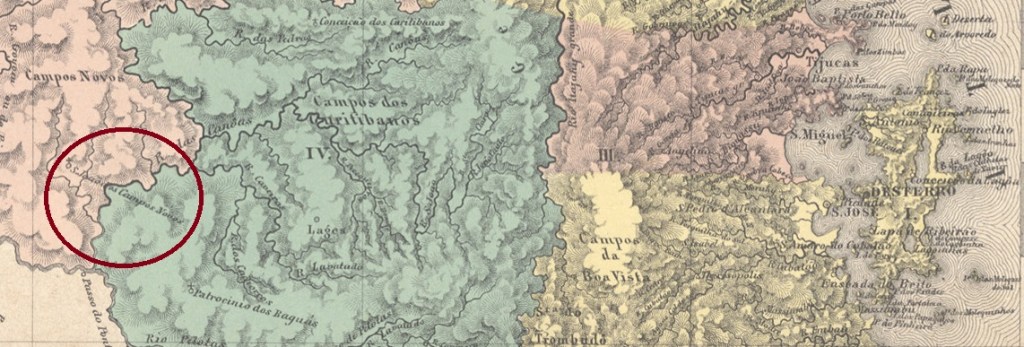
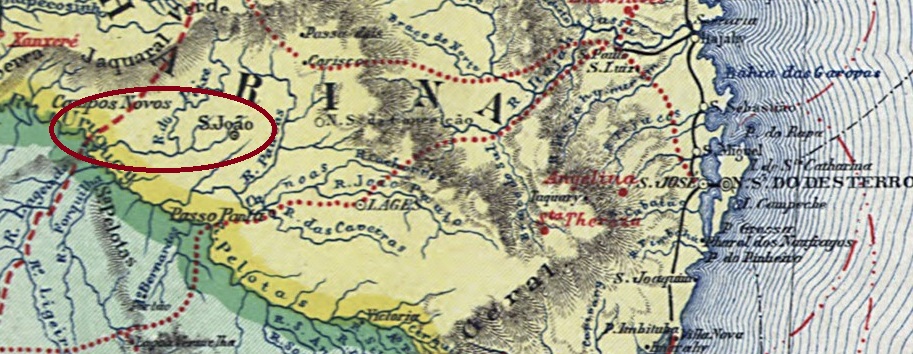
The Freguesia of S. João Baptista de Campos Novos was founded in June 1854, belonged to the Vila of Curitibanos and was located 350 km west of the provincial capital Desterro (today: Florianópolis). In March 1881, it was elevated to the status of vila and has been an independent município ever since.
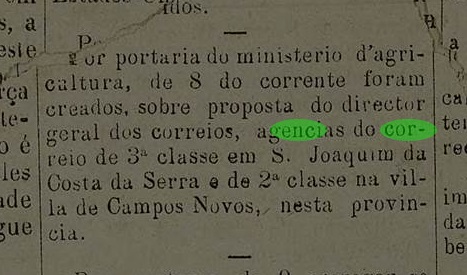
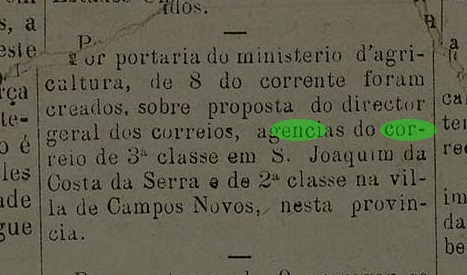
The directory of imperial post offices (Tabella das Agencias do Correio do Imperio, Rio de Janeiro, 1885) shows that there had been a post office there since 1872. This must be a transcription error, because the regional press reported the founding of this agency exactly ten years later:
Jornal do Commercio/SC, 15.02.1882
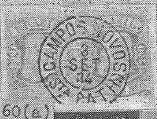
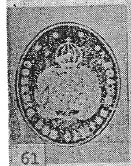
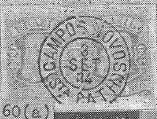
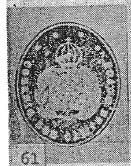
Two cancels from the imperial period have already been described by R. Koester in Carimbologia VIII:
CSC-0045a (RK) 1884CSC-0045b (RK)Carta da Republica dos Eestados Unidos do Brasil, 1892
Die Freguesia von S. João Baptista de Campos Novos wurde im Juni 1854 gegründet, gehörte zur Vila von Curitibanos und lag 350 km westlich der Provinzhauptstadt Desterro (heute: Florianópolis). Im März 1881 wurde es zur Vila erhoben und ist seitdem ein eigenständiges Município.
Aus dem Verzeichnis der kaiserlichen Postämter (Tabella das Agencias do Correio do Imperio, Rio de Janeiro, 1885) geht hervor, dass es dort seit 1872 ein Postamt gab. Dabei muss es sich um einen Abschreibfehler handeln, denn die regionale Presse berichtete genau zehn Jahre später über die Gründung dieser Agentur:
Jornal do Commercio/SC, 15.02.1882
Zwei Stempel aus der Kaiserzeit wurden bereits von R. Koester in Carimbologia VIII vorgestellt:
Other names: Campos Novos de Paranapanema, Nuretama (1944), Campos Novos Paulista (1948)
See also São José do Rio Novo (SSP-1178)
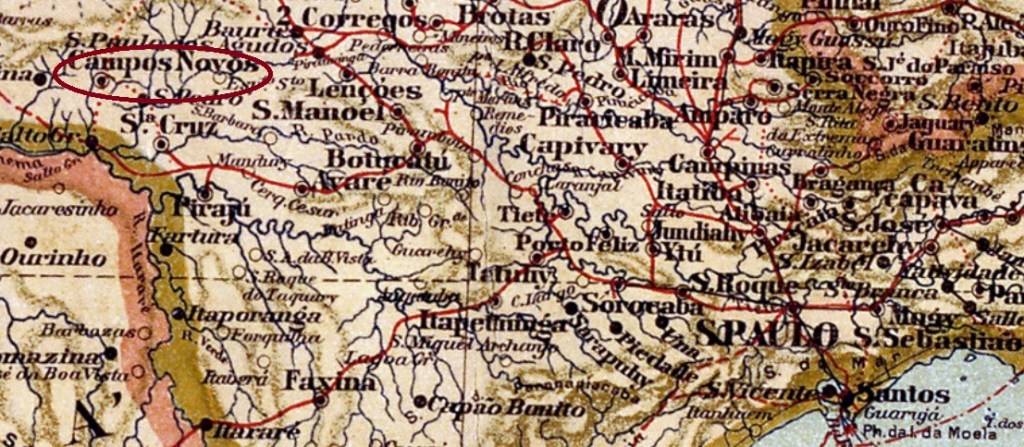
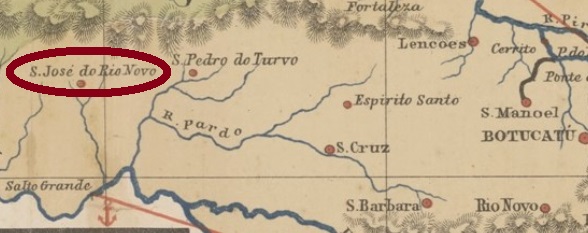
This was a settlement on the eastern bank of the Novo River, a tributary of the Paranapanema – located about 400 km west of the provincial capital of São Paulo. In April 1880, it became a district of Santa Cruz do Rio Pardo, under the long name of São José do Rio Novo de Campos Novos do Paranapanema. In March 1885, it became a villa in his own municipality and in December 1906 a town. After that, the municipality must have fared so badly economically that in November 1944 it was degraded to a district called Nuretama in the municipality of Ibirarema. But four years later, in December 1948, it rose again – to the still current municipality of Campos Novos Paulista.
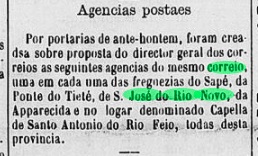
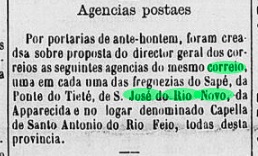
The local post office was established in April 1881, as can be read from the press in São Paulo:
Jornal da Tarde, 04.09.1881
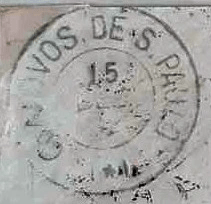
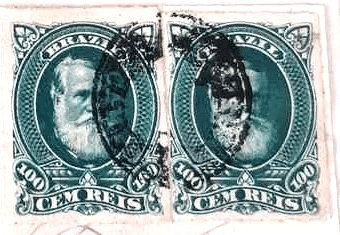
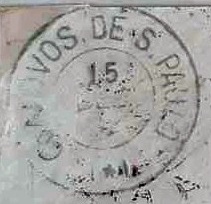
R. Koester mentions in Carimbologia VIII a postmark in a double circle on a cypher issue from 1888 with the inscription C. NOVOS D…, which would be this CSP-0265a:
CSP-0265a (Rölli Auctions) 1881ff
On the same object one can find this seal cancel:
CSP-0265b (Rölli Auctions) 1881ff
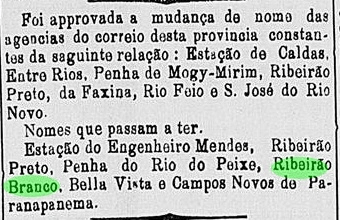
The regional press also reported the agency name change to Campos Novos de Paranapanema in September 1886:
Correio Paulistano, 14.09.1886
For cancels with S. JOSÉ DO RIO NOVO see SSP-1178a.
Provincia de São Paulo, 1886
Andere Namen: Campos Novos de Paranapanema, Nuretama (1944), Campos Novos Paulista (1948)
Siehe auch São José do Rio Novo (SSP-1178)
Diese war eine Siedlung am Ostufer des Rio Novo – ein Zufluss des Paranapanema – die gut 400 km westlich der Provinzhauptstadt São Paulo entfernt lag. Im April 1880 wurde der Ort ein Distrikt von Santa Cruz do Rio Pardo, unter dem langen Namen São José do Rio Novo de Campos Novos do Paranapanema. Im März 1885 wurde er eine Villa im eigenen Município und im Dezember 1906 eine Stadt. Danach muss es der Gemeinde wirtschaftlich so schlecht ergangen sein, dass sie im November 1944 zu einem Distrikt namens Nuretama im Município von Ibirarema wurde. Aber vier Jahre später, im Dezember 1948, stieg sie wieder auf – zum noch aktuellen Município von Campos Novos Paulista.
Das örtliche Postamt entstand im April 1881, wie aus der Presse in São Paulo entnommen werden kann:
Jornal da Tarde, 09.04.1881
R. Koester erwähnt in Carimbologia VIII einen Poststempel im Doppelkreis auf einer Zifferausgabe aus 1888 mit der Inschrift C. NOVOS D…, was dieser CSP-0265a wäre:
CSP-0265a (Rölli Auktionen), 1881ff
Auf demselben Beleg war auch ein Siegelstempel verwendet:
CSP-0265b (Rölli Auktionen) 1881ff
Die Regionalpresse meldete auch den Wechsel des Agenturnamens zu Campos Novos de Paranapanema im September 1886:
Correio Paulistano, 14.09.1886
Für Stempel mit S. JOSÉ DO RIO NOVO siehe SSP-1178a.
J. M. Ribeiro Lisboa: Provincia de São Paulo, 1884
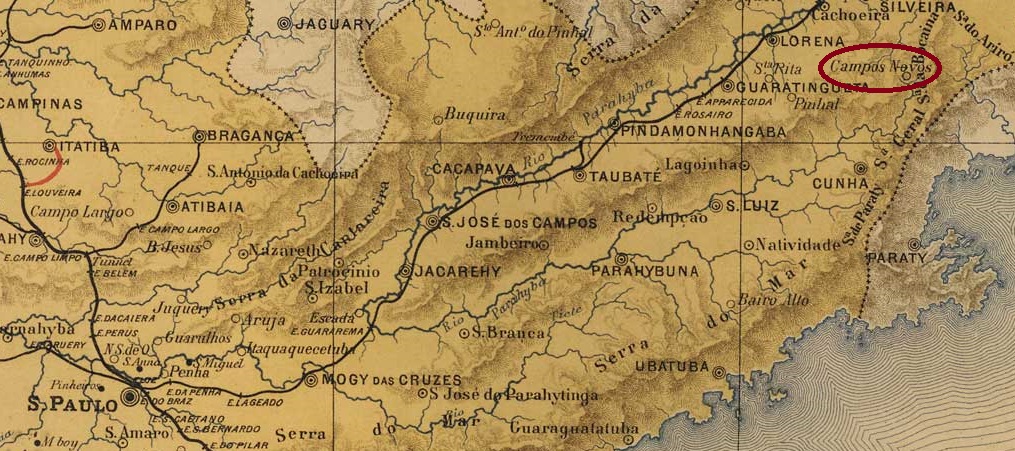
Another name: Campos de Cunha (1938)
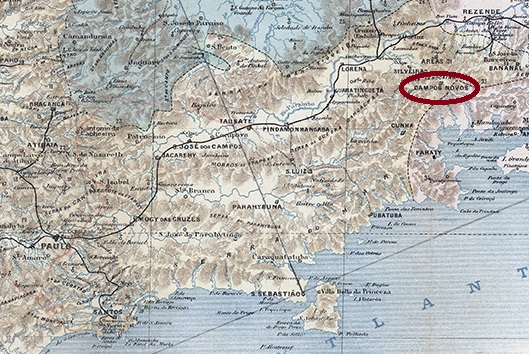
The Freguesia de N. Sra. dos Remédios de Campos Novos was founded in March 1872 and was located near Vila de Cunha, 260 km east of the provincial capital São Paulo. Since November 1938, it has been the district of Campos de Cunha.
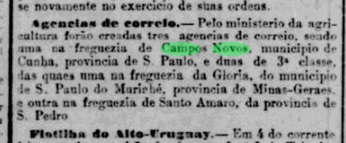
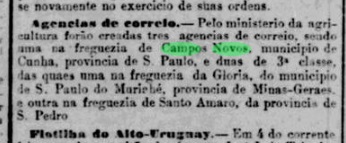
As reported by the Rio press, there had been a post office there since May 1881:
Jornal do Commercio/RJ, 07.05.1881
An imperial postmark from this place is not known so far.
C. Rath: Provincia de São Paulo, 1886
Anderer Name: Campos de Cunha (1938)
Die Freguesia de N. Sra. dos Remédios de Campos Novos wurde im März 1872 gegründet und lag in der Nähe von Vila de Cunha, 260 km östlich der Provinzhauptstadt São Paulo. Seit November 1938 ist es der Bezirk Campos de Cunha.
Wie die Presse in Rio berichtete, gab es dort seit Mai 1881 ein Postamt:
Jornal do Commercio/RJ, 07.05.1881
Ein kaiserlicher Poststempel aus diesem Ort ist bisher nicht bekannt.
























 Carimbologia