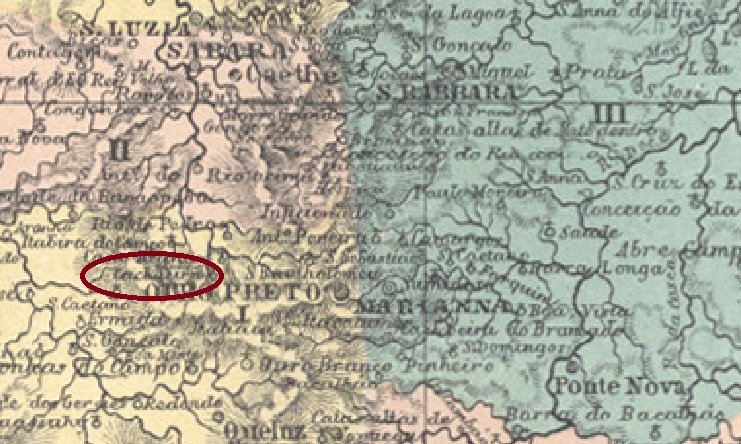
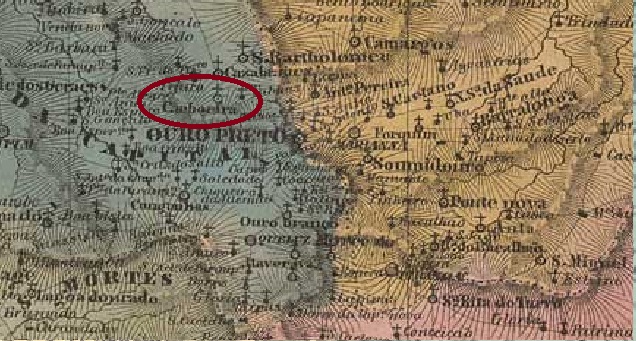
The Freguesia de N. Sra. de Nazareth da Cachoeira do Campo was founded in February 1724 and belonged to Vila de Ouro Preto, 24 km to the east. This has remained the case to this day, except that the place has been a district since April 1836.
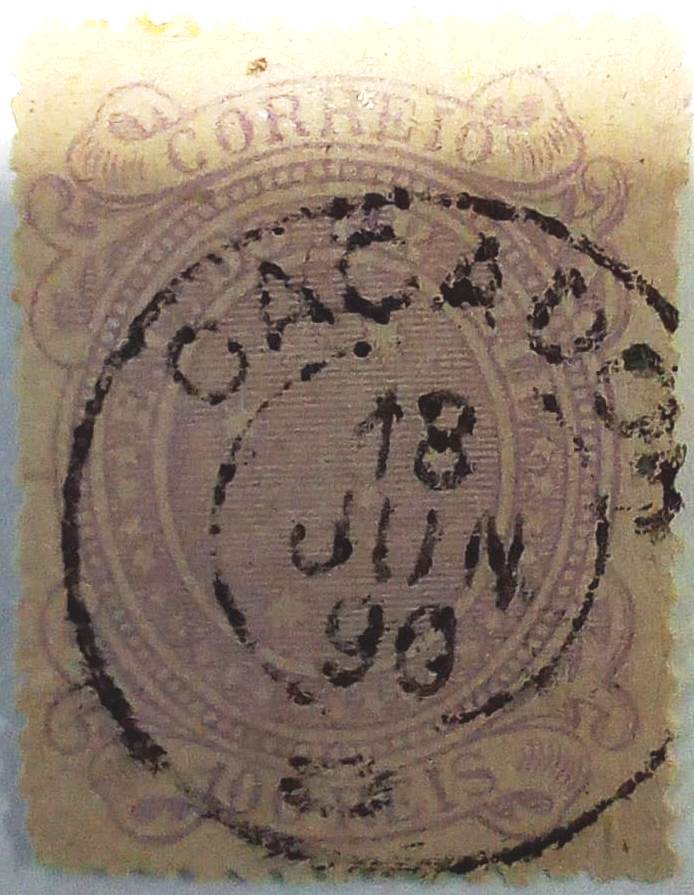
As Paula Sobrinho writes in História Postal de Minas Gerais (Belo Horizonte, 1997), there has been a post office there since July 1872. Curiously, only one mute postmark from Cachoeira do Campo has so far been found from the imperial period, registered as No. 4002 in Mute Cancellations of the Brazil Empire / Carimbos Mudos do Brasil Império (Brazil Philatelic Association, Rio de Janeiro, 2000) by James Dingler and Klerman W. Lopes:
BPA 4002
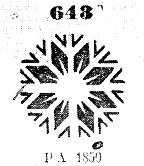
Reinhold Koester (Carimbologia VII) assumes that the Cachoeira do Campo post office was so close to Ouro Preto that the provincial administration did not consider it necessary to have a separate cancel – apart from the mute cancellation – for the small post office. His assumption is strengthened by the existence of another mute postmark, which was originally intended for use in Ouro Preto, but was occasionally also used on letters from Cachoeira do Campo. This cancel from Ouro Preto bears the number 643 (BPA 4004) in the Catálogo de Carimbos Brasil-Império (S. Paulo, 1937, 1942) by Paulo Ayres:
P.A. 643, BPA 4004Villiers de l’Ile Adam: Carta (…) da Provincia de Minas Geraes, 1849
Die Freguesia de N. Sra. de Nazareth da Cachoeira do Campo wurde im Februar 1724 gegründet und gehörte zur 24 km östlich gelegenen Vila de Ouro Preto. Das ist bis heute so geblieben, nur dass der Ort seit April 1836 ein Distrikt ist.
Wie Paula Sobrinho in História Postal de Minas Gerais (Belo Horizonte, 1997) schreibt, gibt es dort ein Postamt seit Juli 1872. Merkwürdigerweise wurde aus der Kaiserzeit bisher nur ein einziger stummer Poststempel aus Cachoeira do Campo gefunden, der unter der Nr. 4002 in Mute Cancellations of the Brazil Empire / Carimbos Mudos do Brasil Império (Brazil Philatelic Association, Rio de Janeiro, 2000) von James Dingler und Klerman W. Lopes registriert ist:
BPA 4002
Reinhold Koester (Carimbologia VII) vermutet, dass das Postamt Cachoeira do Campo so nahe bei Ouro Preto lag, dass die Provinzverwaltung es nicht für nötig hielt, für das kleine Postamt einen eigenen Stempel – abgesehen von der stummen Entwertung – anfertigen zu lassen. Seine Vermutung wird durch die Existenz eines weiteren stummen Poststempels bestärkt, der eigentlich für Ouro Preto bestimmt war, aber gelegentlich auch auf Briefen aus Cachoeira do Campo verwendet wurde. Dieser Stempel aus Ouro Preto trägt die Nummer 643 (BPA 4004) im Catálogo de Carimbos Brasil-Império (S. Paulo, 1937, 1942) von Paulo Ayres:
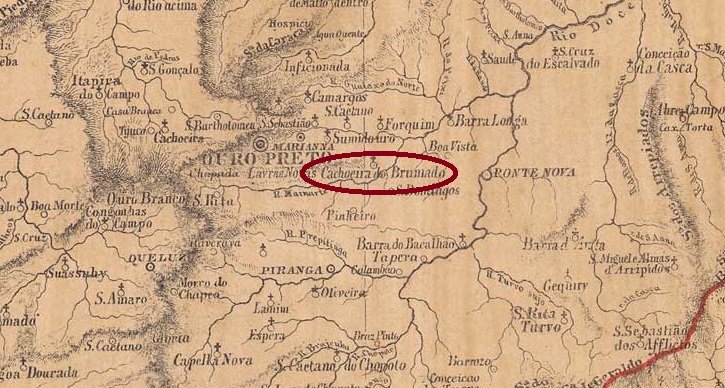
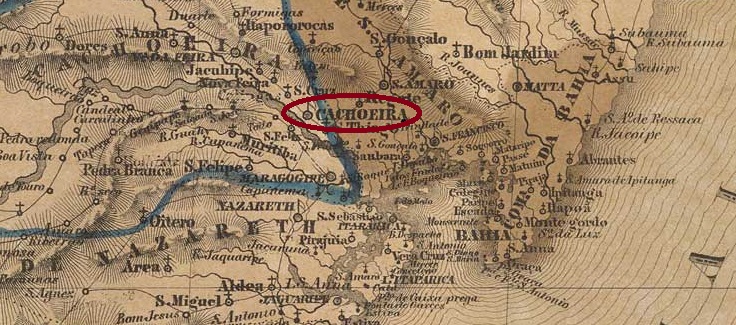
The Freguesia de N. Sra. da Cachoeira do Brumado was founded in June 1850, belonged to the Vila de Mariana and was located 35 km east of the provincial capital Ouro Preto. It remains so today, except that the place is now a district.
As Paula Sobrinho writes in História Postal de Minas Gerais (Belo Horizonte, 1997), there had been a post office there since September 1888, which was closed in May 1897 and only reopened in January 1927. So far, there are no known imperial postmarks from Cachoeira do Brumado.
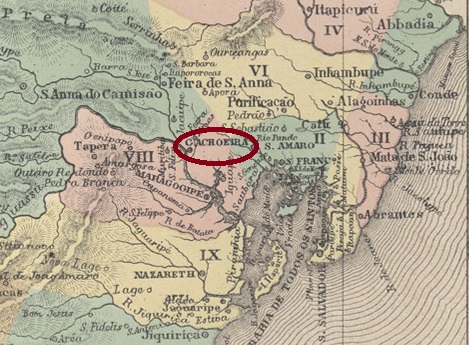
Atlas do Imperio do Brasil, 1868
Die Freguesia de N. Sra. da Cachoeira do Brumado wurde im Juni 1850 gegründet, gehörte zur Vila de Mariana und lag 35 km östlich der Provinzhauptstadt Ouro Preto. Das ist bis heute so geblieben, nur dass der Ort jetzt als Distrikt fungiert.
Wie Paula Sobrinho in História Postal de Minas Gerais (Belo Horizonte, 1997) schreibt, gab es dort seit September 1888 ein Postamt, das im Mai 1897 geschlossen und erst im Januar 1927 wieder eröffnet wurde. Bisher sind keine kaiserlichen Poststempel aus Cachoeira do Brumado bekannt.
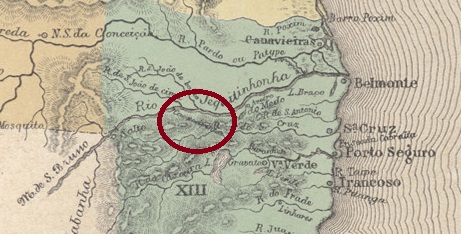
The Freguesia de Cachoeira (then also called Cachoeirinha) was founded in August 1881 and is located on the north bank of the Jequitinhonha, just under 600 km south of the provincial capital Salvador da Bahia. Towards the end of the Empire, the place became a district of the Vila de Belmonte. Since August 1958, it has been a rural suburb of the Município Itapebi.
As Reinhold Koester writes in Carimbologia VII, there was a post office there from March 1881, of which no imperial postmark is known so far.
Mappa do Estado da Bahia, 1913
Anderer Name: Cachoeirinha do Baixo Jequitinhonha
Die Freguesia de Cachoeira (damals auch Cachoeirinha genannt) wurde im August 1881 gegründet und liegt am Nordufer des Jequitinhonha, knapp 600 km südlich der Provinzhauptstadt Salvador da Bahia. Gegen Ende des Kaiserreichs wurde der Ort ein Bezirk der Vila de Belmonte. Seit August 1958 ist es ein ländlicher Vorort des Município Itapebi.
Wie Reinhold Koester in Carimbologia VII schreibt, gab es dort seit März 1881 ein Postamt, von dem bisher kein kaiserlicher Poststempel bekannt ist.
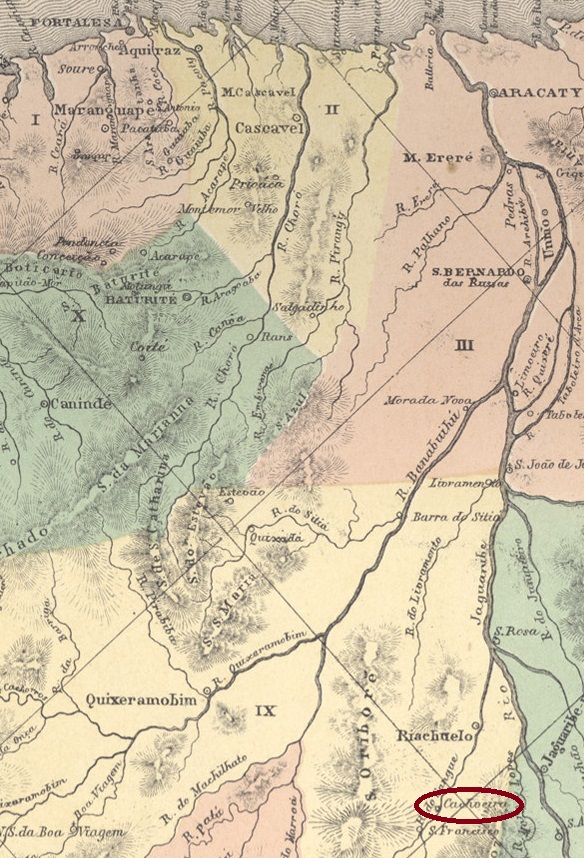
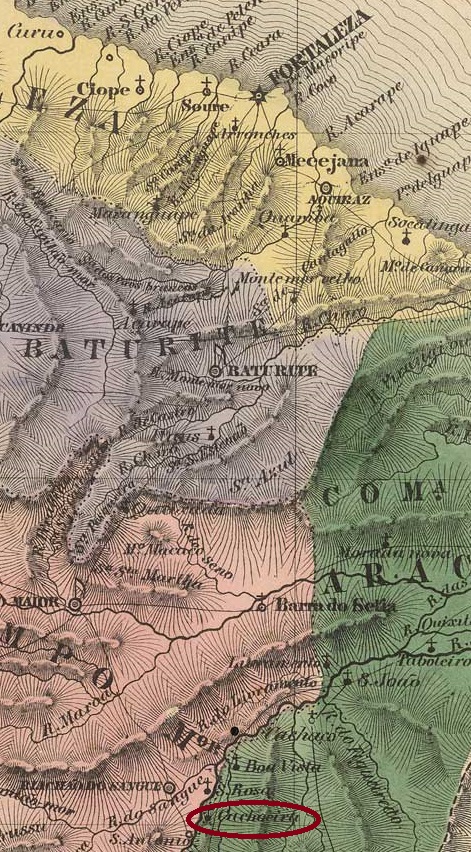
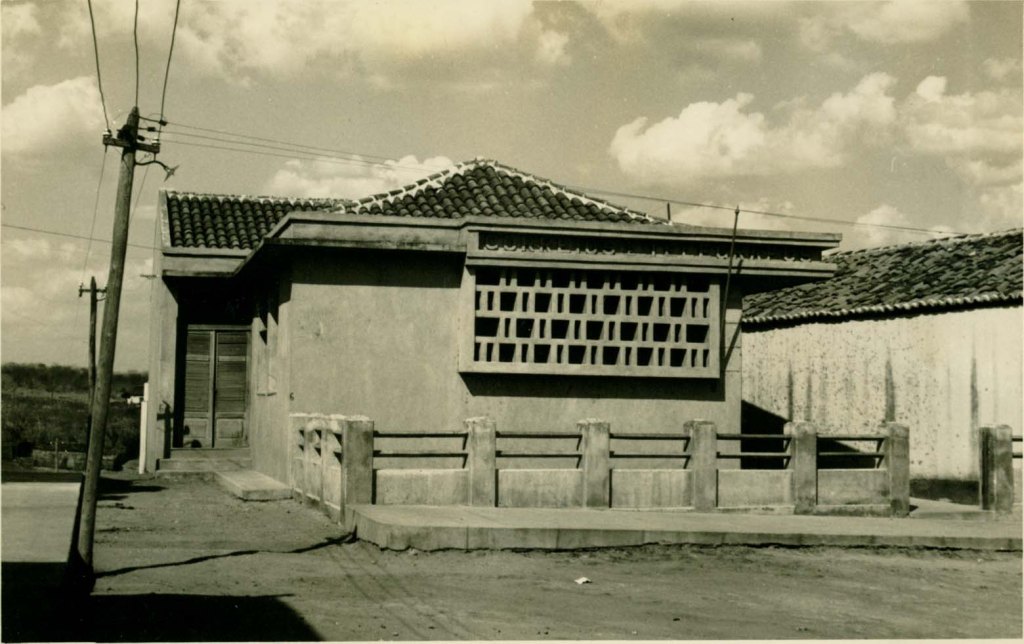
The parish of Bom Jesus Aparecido da Cachoeira, inaugurated in December 1863, belonged to the Vila of Jaguaribe-Mirim and was located on the north bank of the Riacho Velho, 250 km south of the provincial capital Fortaleza. It was elevated to the status of vila three times (1870, 1893 and 1935) and in the meantime downgraded to the district of Jaguaribe-Mirim (1892 and 1931). Since December 1943, it has been the Município of Solonópole. The name commemorates the journalist, politician, and jurist Manuel Solon Rodrigues Pinheiro (1864-1917), who was born there.
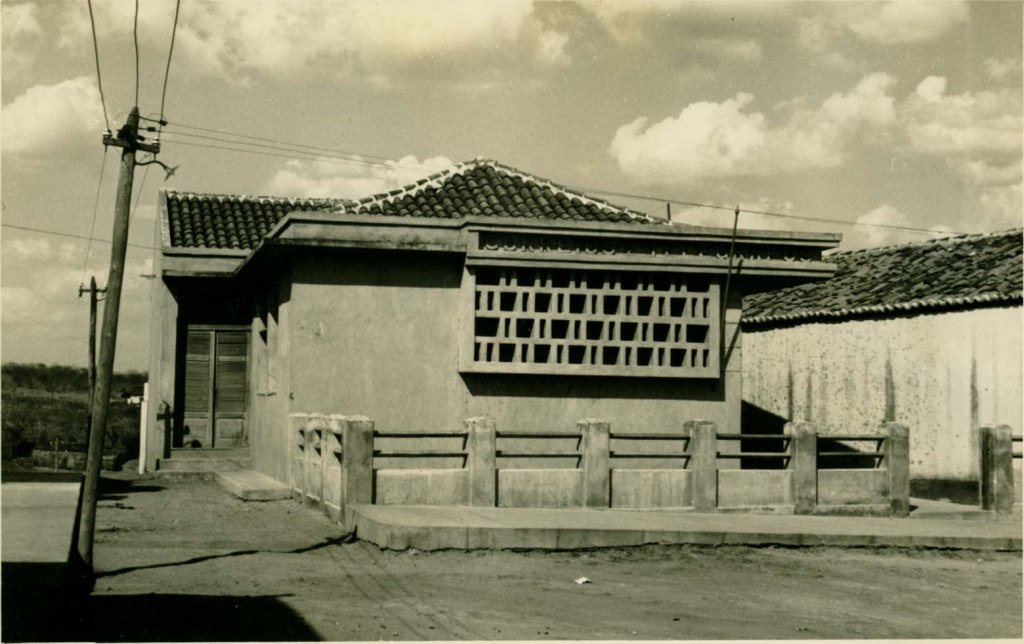
Cachoeira Post Office, ca. 1960 (IBGE)
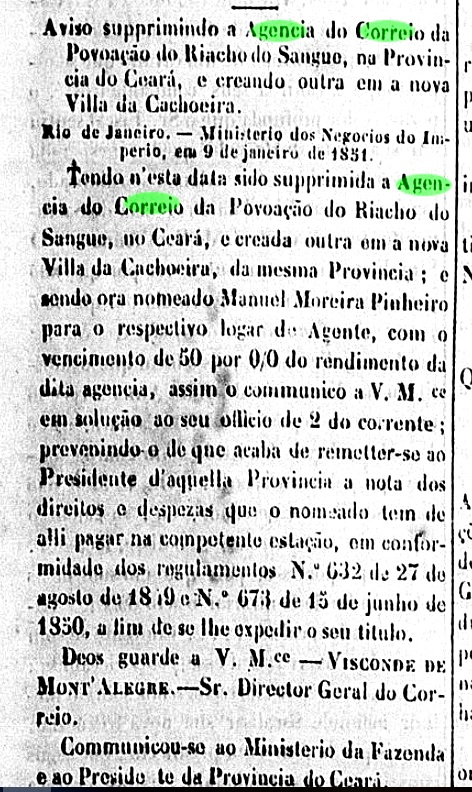
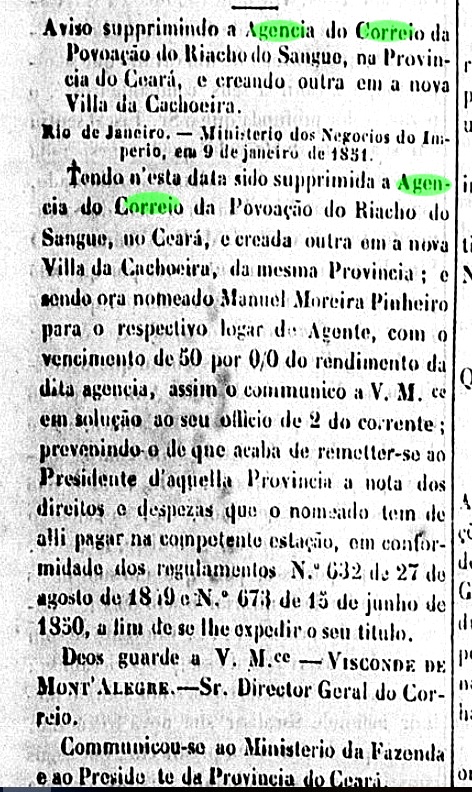
Two foundation dates have been found for the local post office. The first in January 1851, according to the Rio Press:
Correio da Tarde/RJ, 25.04.1851
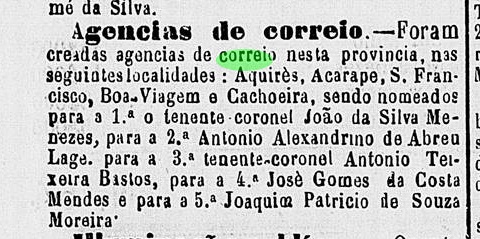
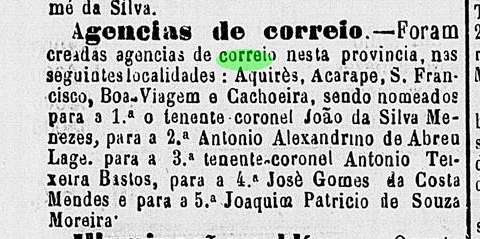
Then again in May 1872, as shown in the regional press:
Cearense, 04.07.1872
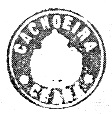
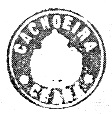
The only postmark so far is illustrated in Koester’s Carimbologia VII, unfortunately without further details:
CCE-0065b (RK)Villiers de l’Ile Adam: Carta (…) da Provincia do Ceará, 1849
Anderer Name: Solonópole (1943)
Die im Dezember 1863 eingeweihte Pfarrei Bom Jesus Aparecido da Cachoeira gehörte zur Vila von Jaguaribe-Mirim und lag am Nordufer des Riacho Velho, 250 km südlich der Provinzhauptstadt Fortaleza. Der Ort wurde dreimal zur Vila erhoben (1870, 1893 und 1935) und zwischenzeitlich zum Distrikt von Jaguaribe-Mirim herabgestuft (1892 und 1931). Seit Dezember 1943 ist es das Município von Solonópole. Der Name erinnert an den dort geborenen Journalisten, Politiker und Juristen Manuel Solon Rodrigues Pinheiro (1864-1917).
Postamt Cachoeira, ca. 1960 (Foto: IBGE)
Für das örtliche Postamt wurden zwei Gründungsdaten gefunden. Die erste im Januar 1851, wie in der Rio-Presse zu lesen ist:
Correio da Tarde/RJ, 25.04.1851
Dann wieder im Mai 1872, wie aus der regionalen Presse hervorgeht:
Cearense, 04.07.1872
Der bisher einzige Poststempel ist in Koesters Carimbologia VII abgebildet, leider ohne weitere Angaben:
The Freguesia de N. Sra. do Rosário do Porto da Cachoeira was founded in 1696 and was located on the north bank of the Paraguaçu, 110 km northwest of the former colonial capital Salvador da Bahia. It was named a Vila in January 1698 and from March 1837 was called Cidade Heróica (Heroic City) of Cachoeira, after the bloody clashes between Brazilian and Portuguese soldiers following Brazil’s Declaration of Independence.
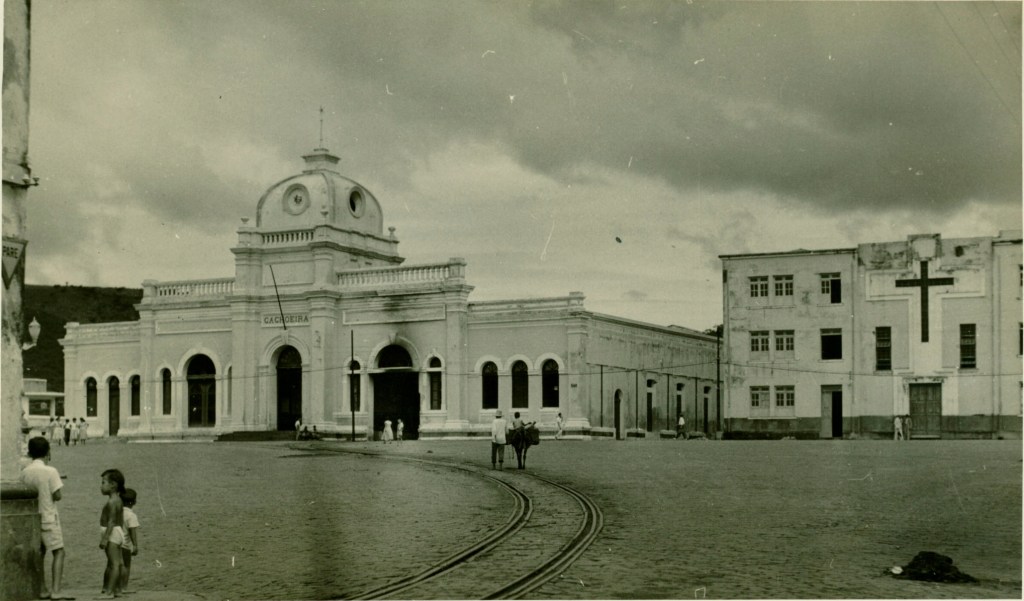
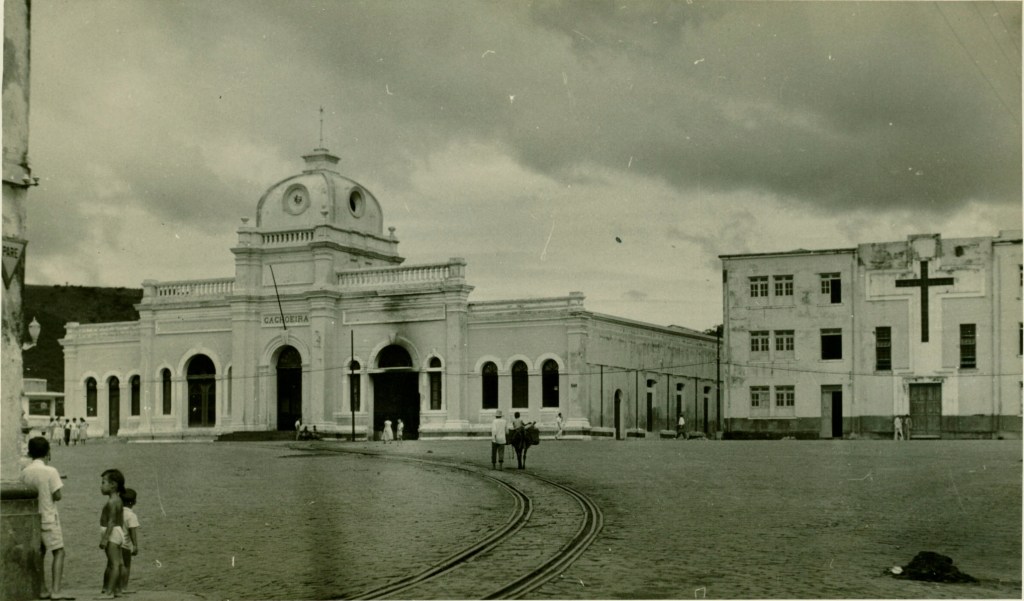
Cachoeira (Waterfall) was the most important town in the imperial province of Bahia after Salvador and had over 70,000 inhabitants around 1880, more than twice as many as today. Prosperity was based on transport (important river port), trade and agriculture (sugar cane, tobacco) and was enhanced by the railway line of the E.F. Central da Bahia company, which inaugurated a magnificent station in December 1876. The tracks led into the building, so the passengers were protected from the sun and rain, but there were clear traces of smoke on the façade.
Around 1957 (Photo: IBGE)
The railway line passed to the Chemins de Fer Fédéraux de l’Est Brésilien in 1911 and to the V.F.F. Leste Brasileiro in 1935. From 1975 until its closure in 1996, it belonged to Rede Ferroviária Federal S.A.
From the end of the 19th century, the proud city began its economic decline, with the number of inhabitants dropping on a quarter. The situation worsened around 1924, when tobacco prices fell sharply, and shipping traffic became increasingly insignificant. From 1940, rail transport, which had been heavily subsidised until then, also collapsed, as the construction of trunk roads meant that goods were increasingly transported by lorry.
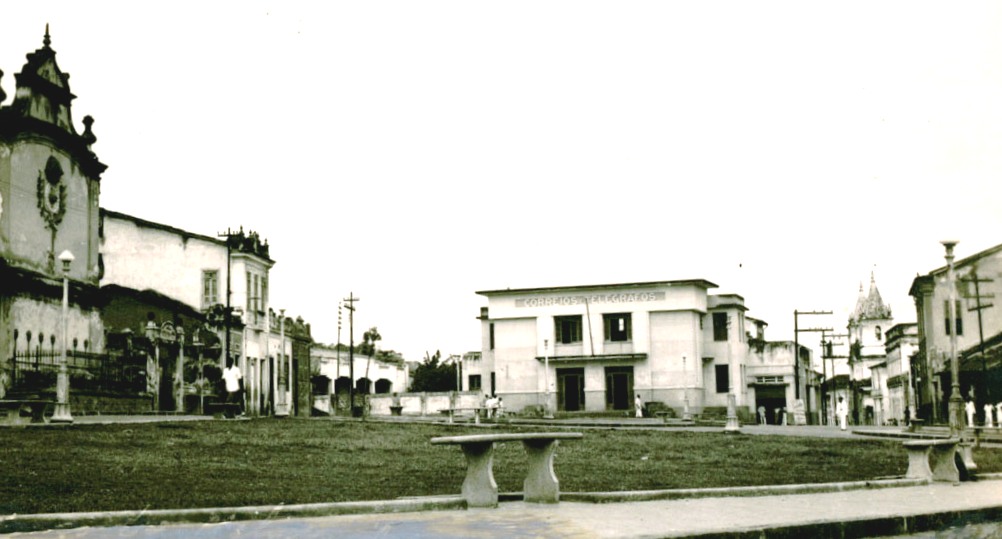
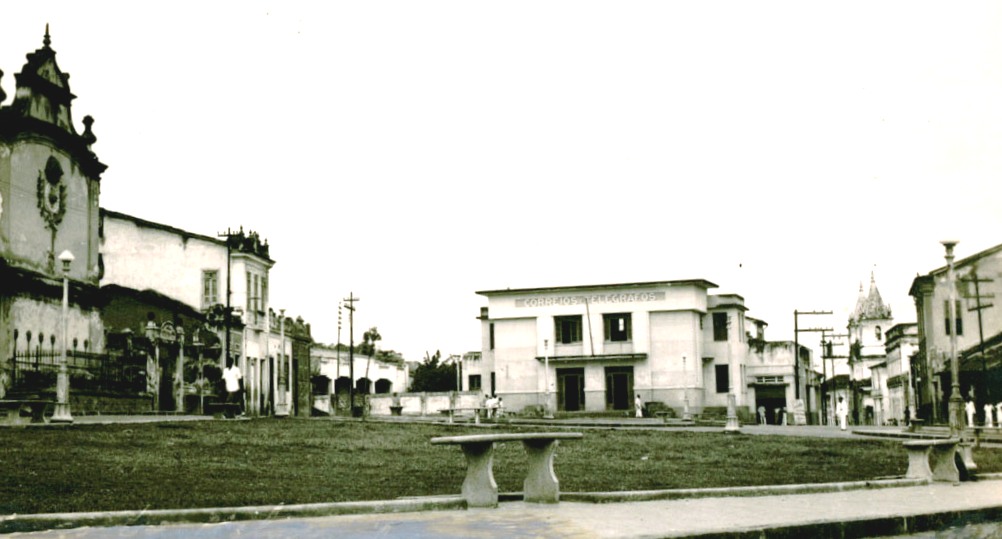
Cachoeira post office, 1949 (Photo: IBGE)
Two foundation dates have been found for the local post office. Once in March 1829, as Nova Monteiro writes in Administrações e Agencias Postaes do Brasil Imperio (Brasil Filatelico/RJ, 1934-5; reprinted by SPP 1994-1999). Then again in April 1835, as can be read in R. Koester’s Carimbologia VII.
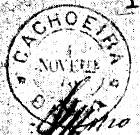
The wealth of the city at that time is reflected in the quantity and variety of postmarks. First is probably CBA-0180a, found so far in the period 1837-1843ff and registered in the RHM catalogue under P-BA-05. It is also illustrated in P. Ayres’ Catálogo de Carimbos Brasil-Império (S. Paulo, 1937, 1942) under No. 1131. However, the illustrations differ slightly from each other:
CBA-0180a (RHM P-BA-05, from the Internet, P.A. 1131)
This is followed by CBA-0180b, whose 1873 copy is illustrated in R. Koester (op. cit.):
CBA-0180b (RK) 1873
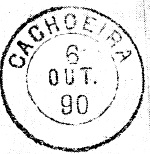
Its successor CBA-0180c is supposed to be a French type from 1879 according to Koester, unfortunately without illustration so far. The cancel CBA-0180d (R. Koester), on the other hand, is so widespread that one wonders how often it was used in the province of Bahia.
CBA-0180d (RK) 1886-1897
Almost exactly parallel to this, CBA-0180e was found, which leads to the suspicion that this stamp (or its contemporary) was intended for a station post office not yet discovered. It exists in several variants, first in the original form (Coll. Everaldo N. dos Santos):
CBA-0180e (ENS) 1886
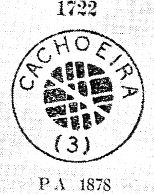
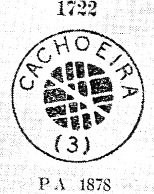
Then the form shown by P. Ayres (op. cit.) under no. 1722:
CBA-0180e (P.A. 1722) 1878ff-1887ff
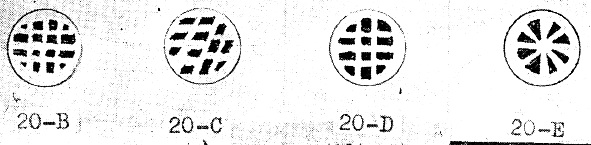
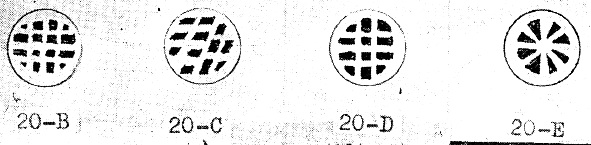
Other variants published by Koester:
CBA-0180e (RK) variants
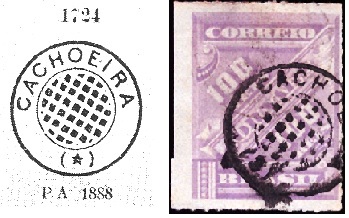
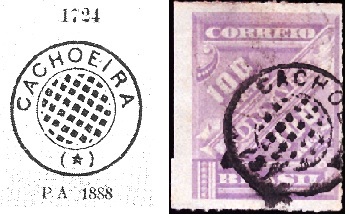
P. Ayres shows under no. 1724 a variant which has the star (as in French types) at the bottom. Koester thinks this is a mistake, the correct stamp would be another variant of CBA-0180e. He could be right, as Claudio Coelho’s illustration shows:
CBA-0180f (P.A. 1724, recte CC) 1888ff-1891ff
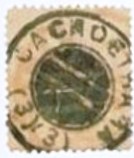
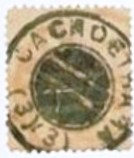
From the Everaldo N. dos Santos collection comes a bizarre variant that deserves its own number:
CBA-0180g (ENS) 1888
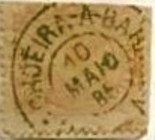
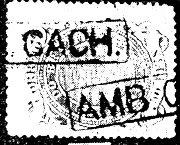
From the mail wagons that passed through Cachoeira in the last quarter of the 19th century came three ambulant postmarks:
CBA-0181a (ENS) 1885CBA-0181b (RK) 1889-1893ff also dark blueCBA-0181c (FF) 1890-1892
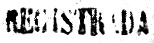
Otherwise, R. Koester showed us a mute cancel and a registered postmark from Cachoeira, both on an object from 1873, now in the Fuad Ferreira Fo. collection:
1873 (FF)1873 (RK)Villiers de l’Ile adam: Carta (…) da Provincia da Bahia, 1848
Die Freguesia de N. Sra. do Rosário do Porto da Cachoeira wurde 1696 gegründet und lag am Nordufer des Paraguaçu, 110 km nordwestlich der ehemaligen Kolonialhauptstadt Salvador da Bahia. Im Januar 1698 wurde die Stadt zur Vila ernannt und hieß ab März 1837 Cidade Heróica (Heldenstadt) von Cachoeira, nach den blutigen Auseinandersetzungen zwischen brasilianischen und portugiesischen Soldaten nach der Unabhängigkeitserklärung Brasiliens.
Cachoeira (Wasserfall) war nach Salvador die wichtigste Stadt der kaiserlichen Provinz Bahia und hatte um 1880 über 70.000 Einwohner, mehr als doppelt so viele wie heute. Der Wohlstand beruhte auf dem Verkehr (wichtiger Flusshafen), dem Handel und der Landwirtschaft (Zuckerrohr, Tabak) und wurde durch die Eisenbahnlinie der Gesellschaft E.F. Central da Bahia, die im Dezember 1876 einen prächtigen Bahnhof einweihte, noch verstärkt. Die Gleise führten in das Gebäude hinein, so dass die Passagiere vor Sonne und Regen geschützt waren, dafür aber deutliche Rauchspuren an der Fassade blieben.
Um 1957 (Foto: IBGE)
Die Bahnlinie ging 1911 an die Chemins de Fer Fédéraux de l’Est Brésilien und 1935 an die V.F.F. Leste Brasileiro über. Von 1975 bis zu ihrer Stilllegung 1996 gehörte sie zur Rede Ferroviária Federal S.A.
Ab Ende des 19. Jahrhunderts begann der wirtschaftliche Niedergang der stolzen Stadt, die Einwohnerzahl sank um ein Viertel. Um 1924 verschärfte sich die Situation, als die Tabakpreise stark fielen und der Schiffsverkehr immer unbedeutender wurde. Ab 1940 brach auch der bis dahin stark subventionierte Eisenbahnverkehr zusammen, da durch den Bau von Fernstraßen die Güter zunehmend mit Lastwagen transportiert wurden.
Postamt Cachoeira, 1949 (Foto: IBGE)
Für das örtliche Postamt wurden zwei Gründungsdaten gefunden. Einmal im März 1829, wie Nova Monteiro in Administrações e Agencias Postaes do Brasil Imperio (Brasil Filatelico/RJ, 1934-5; Nachdruck SPP 1994-1999) schreibt. Dann wieder im April 1835, wie in R. Koesters Carimbologia VII zu lesen ist.
Der Reichtum der Stadt zu dieser Zeit spiegelt sich in der Menge und Vielfalt der Poststempel wider. An erster Stelle steht CBA-0180a, der bisher im Zeitraum 1837-1843ff gefunden wurde und im RHM-Katalog unter P-BA-05 registriert ist. Er ist auch in P. Ayres‘ Catálogo de Carimbos Brasil-Império, (S. Paulo, 1937, 1942) unter der Nr. 1131 abgebildet. Die Abbildungen unterscheiden sich jedoch geringfügig voneinander:
CBA-0180a (RHM P-BA-05, aus dem Internet, P.A. 1131)
Es folgt CBA-0180b, dessen Exemplar von 1873 in R. Koester (op. cit.) abgebildet ist:
CBA-0180b (RK) 1873
Sein Nachfolger CBA-0180c soll nach Koester ein französischer Typ von 1879 sein, leider bisher ohne Abbildung. Der Stempel CBA-0180d (Abb. R. Koester) ist dagegen so weit verbreitet, dass man sich wundert, wie oft er im Hinterland Bahias verwendet wurde.
CBA-0180d (RK) 1886-1897
Ziemlich genau parallel dazu wurde CBA-0180e gebraucht, was den Verdacht aufkommen lässt, dass dieser Stempel (oder sein Zeitgenosse) für ein noch nicht entdecktes Bahnhofspostamt bestimmt war. Er existiert in mehreren Varianten, zunächst in der Urform (Samml. Everaldo N. dos Santos):
CBA-0180e (ENS) 1886
Dann die bei P. Ayres (op. cit.) unter Nr. 1722 gezeigte Form:
CBA-0180e (P.A. 1722) 1878ff-1887ff
Weitere von Koester veröffentlichte Varianten:
CBA-0180e (RK) Varianten
P. Ayres zeigt unter Nr. 1724 eine Variante, die den Stern (wie bei franz. Typen) unten hat. Koester hält dies für einen Fehler, der richtige Stempel wäre eine andere Variante von CBA-0180e. Er könnte Recht haben, wie die Abbildung von Claudio Coelho zeigt:
CBA-0180f (P.A. 1724, recte CC) 1888ff-1891ff
Aus der Sammlung Everaldo N. dos Santos kommt eine skurrile Variante, die eine eigene Nummer verdient:
CBA-0180g (ENS) 1888
Aus den Postwagons, die im letzten Viertel des 19. Jahrhunderts durch Cachoeira fuhren, kamen drei ambulante Poststempel:
CBA-0181a (ENS) 1885CBA-0181b (RK) 1889-1893ff auch dunkelblauCBA-0181c (FF) 1890-1892
Sonst zeigte uns R. Koester einen stummen Stempel und einen Einschreib-Stempel aus Cachoeira, beides auf einem Objekt aus 1873, heute in der Sammlung Fuad Ferreira Fo.:
Other names: Cachoeiras, Cachoeiras de Macacu (1943)
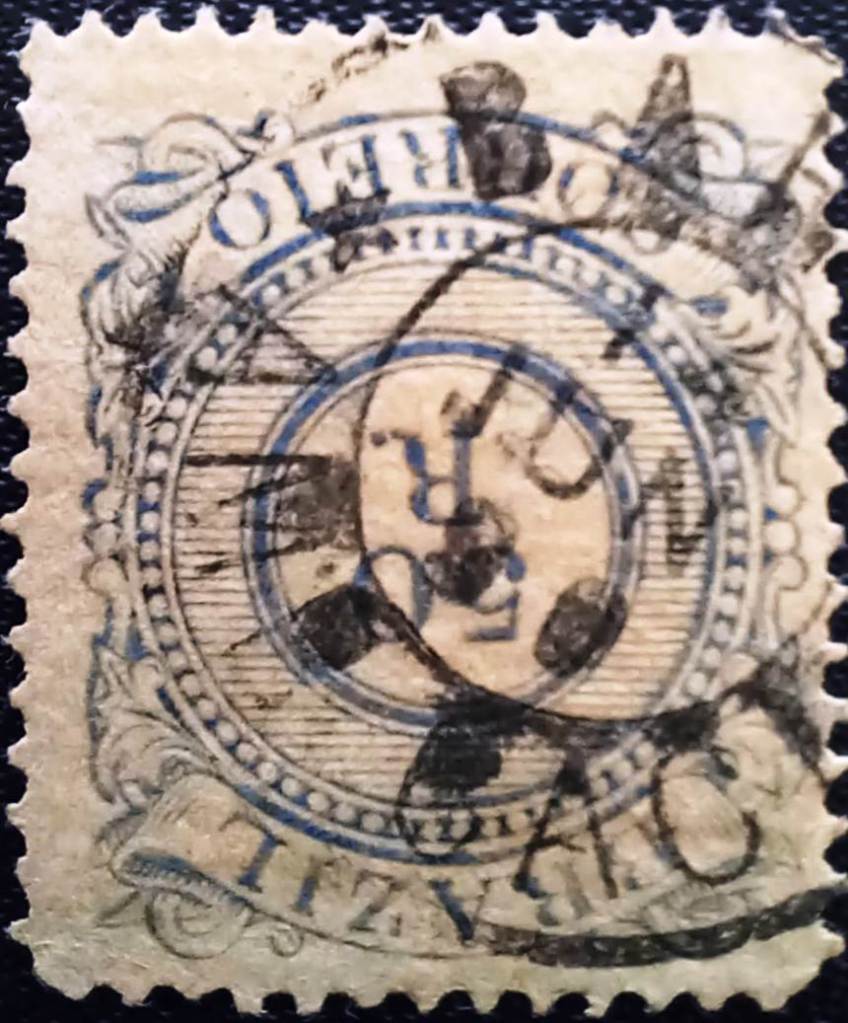
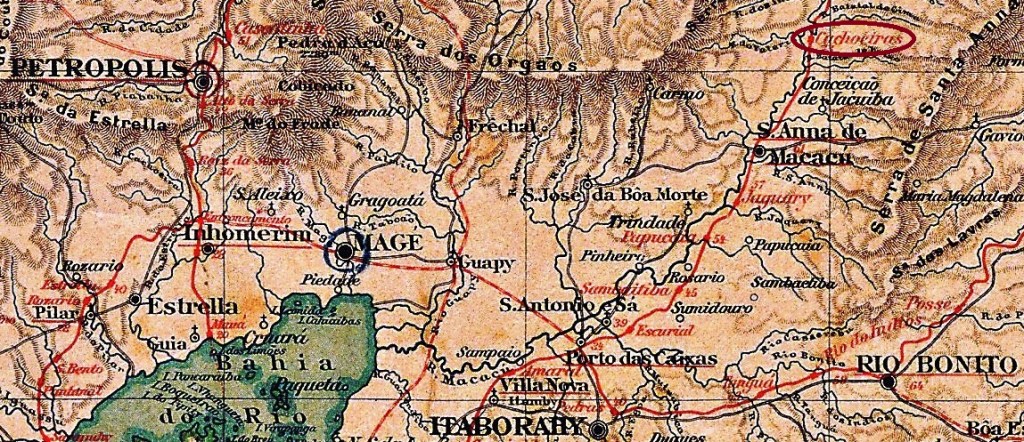
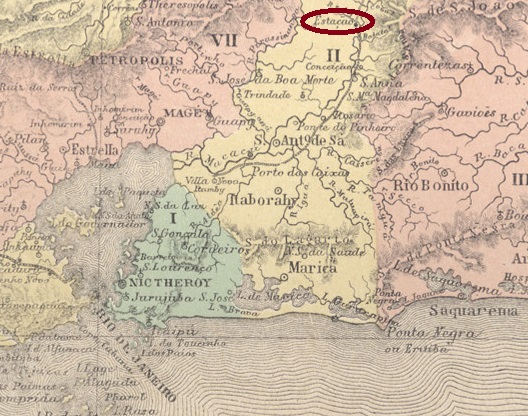
The settlement originated in the valley of the Macacu, belonged to the Vila de Sto. Antonio de Sá and was located 100 km northeast of the capital Rio de Janeiro. In September 1877, the arraial passed into the Vila Sant’Anna de Macacu and only became a Distrito in November 1894. The responsible município was renamed Sant’Anna de Japuíba in December 1898. Finally, in March 1938, it was emancipated into a município called Cachoeiras, which has been called Cachoeiras de Macacu since December 1943.
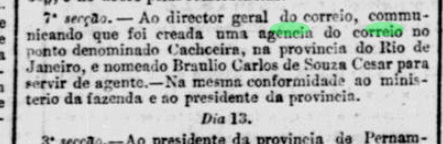
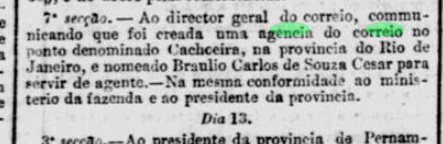
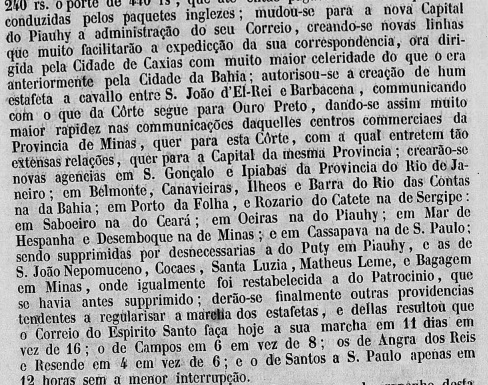
According to the Rio press, the local post office was created in June 1860:
Jornal do Commercio, 14.09.1860
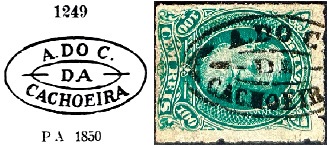
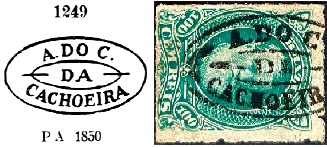
This postal connection must have been caused by the inauguration of the E.F. do Cantagallo station in April of the same year. However, confirmation that it is a station post office is still missing today. The first cancel CRJ-0229a also occurs in blue and was already presented by Paulo Ayres in the Catálogo de Carimbos Brasil-Império (S. Paulo, 1937, 1942) under No. 1249. However, his published illustration has some differences with the actual postmark, as Claudio Coelho’s image shows:
CRJ-0229a (P.A. 1249, recte CC) 1860ff-1878ff
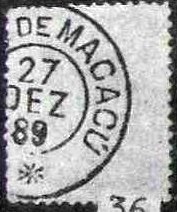
This was followed by CRJ-0230a, previously seen with dates between 1887 and 1894 and depicted by P. Ayres:
CRJ-0230a (P.A. p.120)
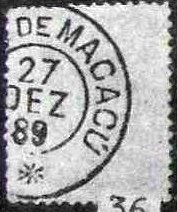
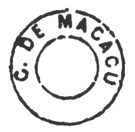
The following cancel CRJ-0230b was shown in R. Koster’s Carimbologia VII:
CRJ-0230b (RK) 188
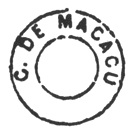
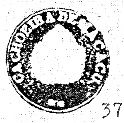
Koester also showed a seal postmark of Cachoeira de Macacu:
CRJ-0230c (RK)
And in Carimbos Postais – século XIX (Rio de Janeiro, 1989), Cicero A. Almeida shows the postmark CRJ-0230d under MPT 771, without further information:
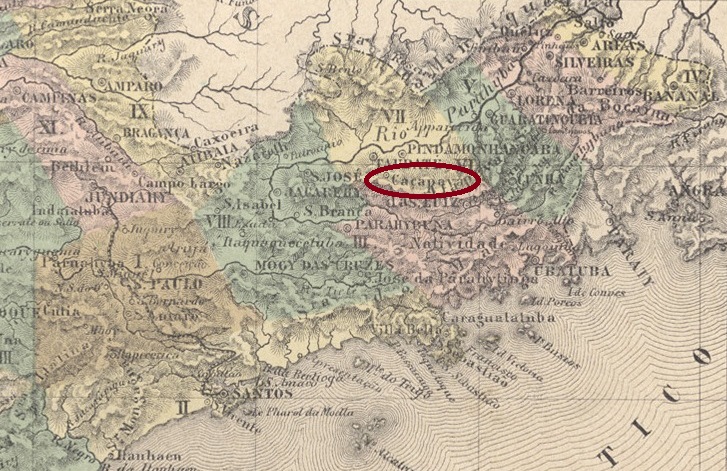
CRJ-0230d (MPT 771)Atlas do Imperio do Brasil, 1868
Andere Namen: Cachoeiras, Cachoeiras de Macacu (1943)
Die Siedlung entstand im Tal des Macacu, gehörte zur Vila de Sto. Antonio de Sá und lag 100 km nordöstlich der Hauptstadt Rio de Janeiro. Im September 1877 ging der Arraial in die Vila Sant’Anna de Macacu über und wurde erst im November 1894 zum Distrito. Das zuständige Município wurde im Dezember 1898 in Sant’Anna de Japuíba umbenannt. Im März 1938 erfolgte schließlich die Emanzipation zum Município namens Cachoeiras, das seit Dezember 1943 Cachoeiras de Macacu heißt.
Wie aus der Presse von Rio hervorgeht, entstand das örtliche Postamt im Juni 1860:
Jornal do Commercio, 14.09.1860
Diese postalische Verbindung muss durch die Einweihung des Bahnhofs der E.F. do Cantagallo im April desselben Jahres verursacht sein. Allerdings fehlt bis heute die Bestätigung, dass es sich um ein Bahnhofspostamt handelt. Der erste Stempel CRJ-0229a kommt auch in blau vor und wurde bereits von Paulo Ayres im Catálogo de Carimbos Brasil-Império (S. Paulo, 1937, 1942) unter der Nr. 1249 vorgestellt. Seine veröffentlichte Abbildung weist jedoch einige Unterschiede zum tatsächlichen Poststempel auf, wie die Abbildung von Claudio Coelho zeigt:
CRJ-0229a (P.A. 1249, recte CC) 1860ff-1878ff
Es folgte CRJ-0230a, der bisher mit Daten zwischen 1887 und 1894 gesehen wurde und auch bei P. Ayres zu sehen war:
CRJ-0230a (P.A. S.120)
Der folgende Stempel CRJ-0230b war in R. Kosters Carimbologia VII abgebildet:
CRJ-0230b (RK) 1889
Koester zeigte auch einen Siegel-Stempel von Cachoeira de Macacu:
CRJ-0230c (RK)
Und in Carimbos Postais – século XIX (Rio de Janeiro, 1989) zeigt Cicero A. Almeida zeigt den Poststempel CRJ-0230d unter MPT 771, ohne weitere Informationen:
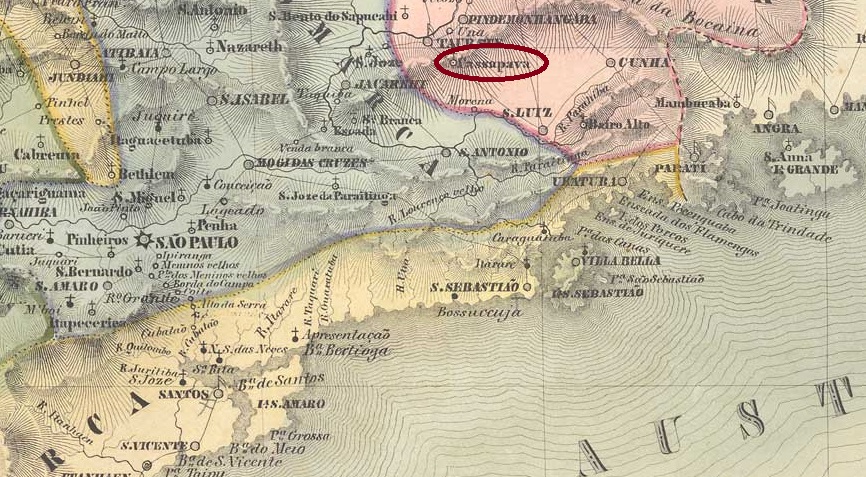
The freguesia called N. Sa. da Ajuda de Caçapava was founded in March 1833, belonged to the Vila de Taubaté and was located on the south bank of the Paraíba do Sul, 260 km northeast of the provincial capital São Paulo. In April 1855, Caçapava was elevated to the status of vila named S. João Baptista de Caçapava, and 20 years later it became a city.
Again, three dates have been found for the local post office. The first around 1851, according to the report of the Imperial Ministry from the following year:
Relatorio do Ministerio do Imperio, 1852
Then again in 1853, as recorded in the Directory of Imperial Post Offices (Tabella das Agencias do Correio do Imperio, Rio de Janeiro, 1885). And finally in January 1854, as Nova Monteiro writes in Administrações e Agencias Postaes do Brasil Imperio (Brasil Filatelico/RJ, 1934-5; reprint SPP 1994-1999).
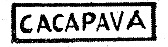
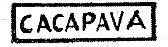
The first cancel is CSP-0210a, already described by R. Koester (Carimbologia VII):
CSP-0210a (RK) 1867
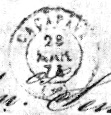
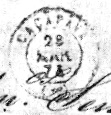
It was followed by the French type CSP-0210b, which is also illustrated by Koester (op. cit.) and occurs also in blue:
CSP-0210b (RK) 1871-1890
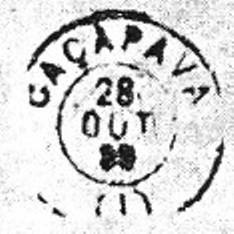
The following cancel CSP-0210c (illustration from the Internet) still must be confirmed, as it could also come from the town of the same name in the province of Rio Grande do Sul:
CSP-0210c (EB) 1886-1890
Philatelist Mario Celso Orsi Jr. showed a handwritten cancellation from Caçapava/SP existing on an item from 1851:
1851ff (MO)
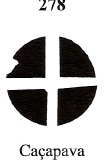
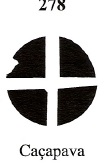
Finally, James Dingler and Klerman W. Lopes in Mute Cancellations of the Brazil Empire / Carimbos Mudos do Brasil Império (Brazil Philatelic Association, Rio de Janeiro, 2000) showed a mute cancellation from Caçapava under no. 278:
BPA 278 (1877ff)Villiers de l’Ile Adam: Carta (…) da Provincia de São Paulo, 1847
Die Freguesia namens N. Sa. da Ajuda de Caçapava wurde im März 1833 gegründet, gehörte zur Vila de Taubaté und lag am Südufer des Paraíba do Sul, 260 km nordöstlich der Provinzhauptstadt São Paulo. Im April 1855 wurde Caçapava unter S. João Baptista de Caçapava zur Vila erhoben und 20 Jahre später zur Stadt.
Auch hier wurden drei Daten für das örtliche Postamt gefunden. Das erste um 1851, nach dem Bericht des kaiserlichen Ministeriums aus dem folgenden Jahr:
Relatorio do Ministerio do Imperio, 1852
Dann wieder 1853, wie im Verzeichnis der kaiserlichen Postämter (Tabella das Agencias do Correio do Imperio, Rio de Janeiro, 1885) angegeben. Und schließlich im Januar 1854, wie Nova Monteiro in Administrações e Agencias Postaes do Brasil Imperio (Brasil Filatelico/RJ, 1934-5; Nachdruck SPP 1994-1999) schreibt.
Der erste Stempel ist CSP-0210a, der bereits von R. Koester (Carimbologia VII) beschrieben wurde:
CSP-0210a (RK) 1867
Ihm folgte der französische Typ CSP-0210b, der ebenfalls bei Koester (op. cit.) abgebildet ist und auch in Blau vorkommt:
CSP-0210b (RK) 1871-1890
Der folgende Stempel CSP-0210c (Abbildung aus dem Internet) muss noch bestätigt werden, da er auch aus dem gleichnamigen Ort in der Provinz Rio Grande do Sul stammen könnte:
CSP-0210c (EB) 1886-1890
Der Philatelist Mario Celso Orsi Jr. zeigte eine handschriftliche Entwertung aus Caçapava/SP, die auf einem Objekt von 1851 existiert:
1851ff (MO)
Schließlich zeigten James Dingler und Klerman W. Lopes in Mute Cancellations of the Brazil Empire / Carimbos Mudos do Brasil Império (Brazil Philatelic Association, Rio de Janeiro, 2000) eine stumme Entwertung aus Caçapava unter der Nr. 278:
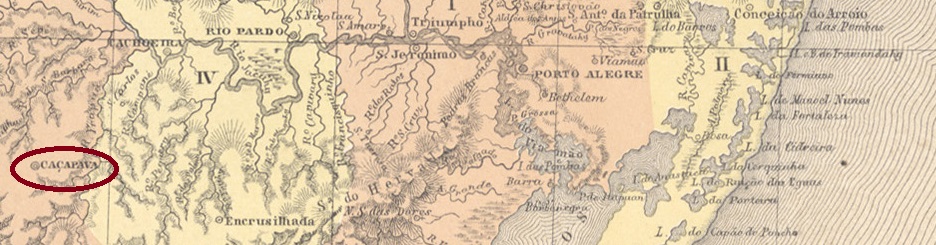
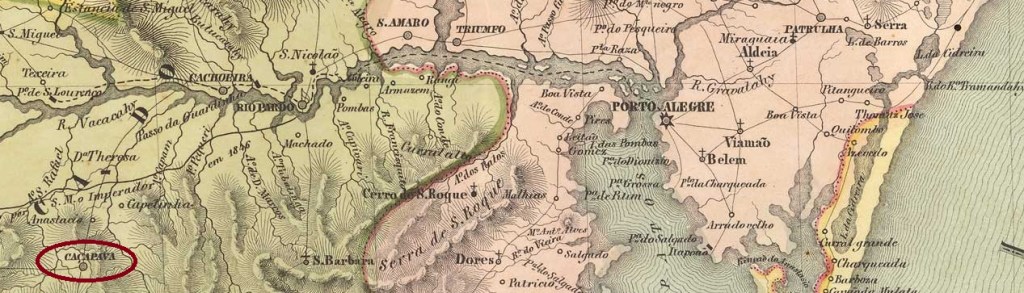
Caçapava (formerly also spelled Cassapava) means forest clearing in the Tupi-Guarani language. The chapel of N. Sra. de Assunção de Caçapava was built in July 1800, belonged to the Vila de Cachoeira and was located 260 km west of the later provincial capital Porto Alegre. It was elevated to vila status in October 1831 and became in January 1839 the capital of the Piratini Republic, proclaimed by the Farroupilha revolutionaries. After the end of the uprising in 1845, some calm returned and since December 1885 Caçapava has been a town, called Caçapava do Sul since December 1944, as opposed to Caçapava in the state of São Paulo.
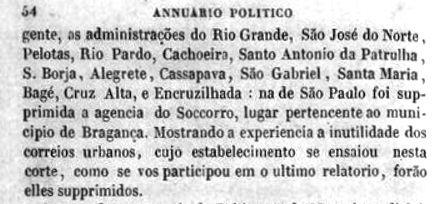
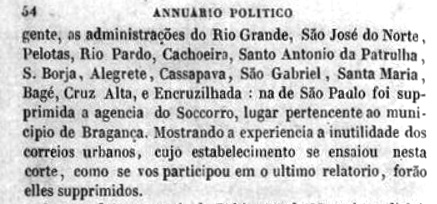
Three creation dates have been found for the local post office. First in 1831, as Nova Monteiro writes in Administrações e Agencias Postaes do Brasil Imperio (Brasil Filatelico/RJ, 1934-5; reprinted by SPP 1994-1999). Then in 1833, as indicated in the Directory of Imperial Post Offices (Tabella das Agencias do Correio do Imperio, Rio de Janeiro, 1885). And finally, around 1845, after the end of the Farroupilha uprising, as indicated in the Official Yearbook 1846:
Annuario Politico, Historico e Estatistico do Brazil, 1846
The first postmark is CRS-0050a, which also occurs in sepia and can be seen in the RHM catalogue under P-RS-04. However, the illustration there shows some differences from the actual cancel (José A. Junges coll.):
CRS-0050a (RHM P-RS-04, recte JJ) 1831ff
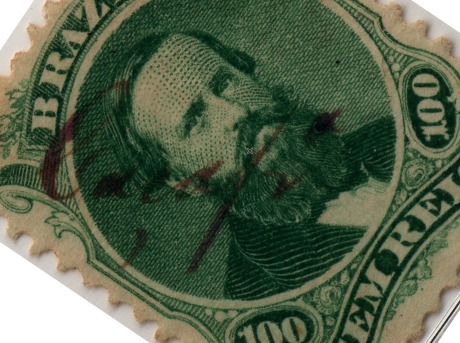
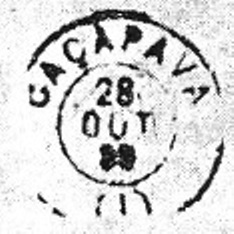
After the peace of 1845, it took some time for the official postmarks to arrive. The postal agency had to bridge the waiting time with handwritten marks:
1866ff (image from the internet)
The next postmark CRS-0050b is not yet confirmed, but according to R. Koester (Carimbologia VII) it is assumed to belong to the province of Rio Grande do Sul:
CRS-0050b (RK) 1886-1896Villiers de l’Ile Adam: Carta (…) da Provincia de São Pedro do Sul, 1847
Anderer Name: Caçapava do Sul (1943)
Caçapava (früher auch Cassapava geschrieben) bedeutet in der Sprache der Tupi-Guarani Waldlichtung. Die Kapelle der N. Sra. de Assunção de Caçapava wurde im Juli 1800 errichtet, gehörte zur Vila de Cachoeira und lag 260 km westlich der späteren Provinzhauptstadt Porto Alegre. Im Oktober 1831 wurde sie zur Vila erhoben und im Januar 1839 zur Hauptstadt der von den Farroupilha-Revolutionären ausgerufenen Piratini-Republik. Nach dem Ende des Aufstandes 1845 kehrte etwas Ruhe ein, und seit Dezember 1885 ist Caçapava eine Stadt, die seit Dezember 1944 Caçapava do Sul heißt, im Gegensatz zu Caçapava im Bundesstaat São Paulo.
Für das örtliche Postamt wurden drei Gründungsdaten gefunden. Zuerst 1831, wie Nova Monteiro in Administrações e Agencias Postaes do Brasil Imperio (Brasil Filatelico/RJ, 1934-5; Nachdruck SPP 1994-1999) schreibt. Dann 1833, wie im Verzeichnis der kaiserlichen Postämter (Tabella das Agencias do Correio do Imperio, Rio de Janeiro, 1885) angegeben. Und schließlich um 1845, nach dem Ende des Farroupilha-Aufstandes, wie aus dem Amtlichen Jahrbuch 1846 hervorgeht:
Annuario Politico, Historico e Estatistico do Brazil, 1846
Der erste Poststempel ist CRS-0050a, der auch in Sepia vorkommt und im RHM-Katalog unter P-RS-04 zu sehen ist. Die Abbildung dort weist jedoch einige Unterschiede zum tatsächlichen Stempel (Samml. José A. Junges) auf:
CRS-0050a (RHM P-RS-04, recte JJ) 1831ff
Nach dem Frieden von 1845 dauerte es einige Zeit, bis die offiziellen Poststempel eintrafen. Die Postagentur musste die Wartezeit mit handschriftlichen Entwertungen überbrücken:
1866ff (Abbildung aus dem Internet)
Der nächste Stempel CRS-0050b ist noch nicht bestätigt, wird aber nach R. Koester (Carimbologia VII) als zur Provinz Rio Grande do Sul gehörig vermutet:
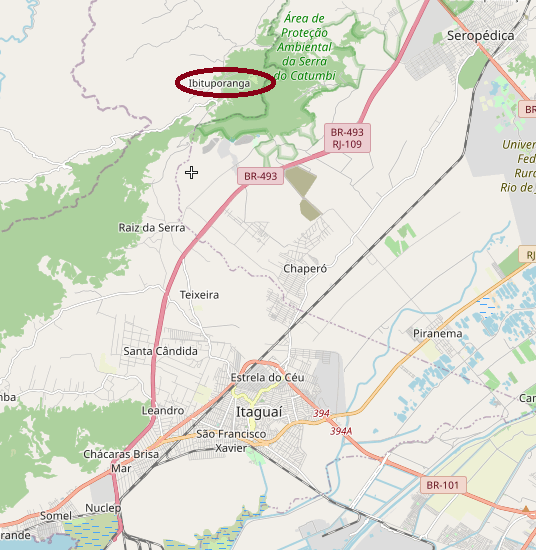
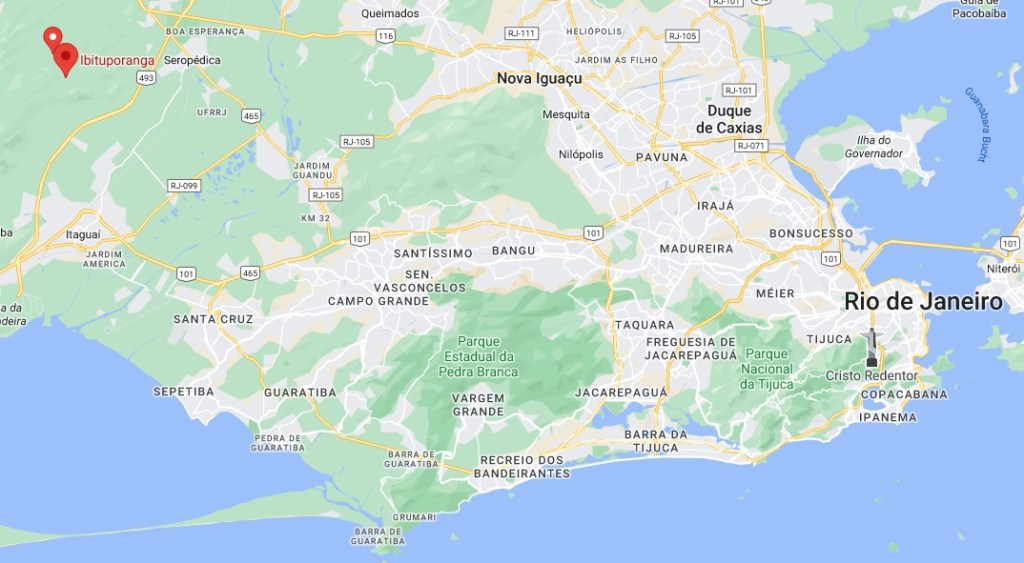
This is another place that received a post office for no good reason. Caçador (Hunter) was the name of a small hamlet 80 km west of Rio de Janeiro, at the beginning of the Royal Road (Estrada Real) of the Serra da Calçada, which connected the imperial domain of Santa Cruz with the province of São Paulo. It was only in November 1926 that Caçador became a district of the Município of Itaguahy, which has been called Ibituporanga since December 1943. The word means Beautiful Mountain in the Tupi language.
As the Rio press reported, there had been a post office there since February 1889:
Jornal do Commercio, 27.02.1889
According to Paulo Novaes (agenciaspostais.com.br), the post office was closed at the end of 1943.
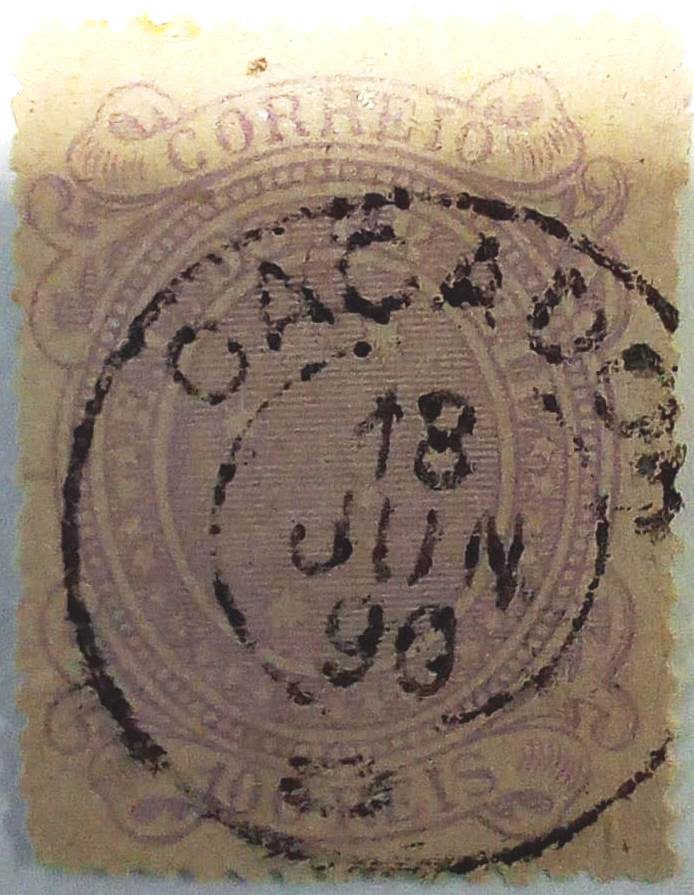
In the meantime, a postmark from 1890 has appeared in the Fuad Ferreira Fo. collection:
CRJ-0220a (FF) 1890
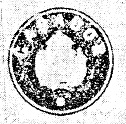
Otherwise, the CRJ-0220b postmark can be seen in R. Koester’s Carimbologia VII without further details:
CRJ-0220b (RK)Google Maps
Textaktualisierung vom 18. August 2023
Anderer Name: Ibituporanga (1943)
Auch dies ist ein Ort, der ohne triftigen Grund ein Postamt erhielt. Caçador (Jäger) war der Name eines kleinen Weilers 80 km westlich von Rio de Janeiro, am Anfang der Königlichen Straße (Estrada Real) der Serra da Calçada, die die kaiserliche Domäne Santa Cruz mit der Provinz São Paulo verband. Erst im November 1926 wurde Caçador ein Bezirk des Município von Itaguahy, der seit Dezember 1943 Ibituporanga heißt. Das Wort bedeutet in der Tupi-Sprache Schöner Berg.
Wie die Presse von Rio berichtete, gab es dort seit Februar 1889 ein Postamt:
Jornal do Commercio, 27.02.1889
Laut Paulo Novaes (agenciaspostais.com.br) wurde das Postamt Ende 1943 geschlossen.
Inzwischen ist in der Sammlung Fuad Ferreira Fo. ein Poststempel von 1890 aufgetaucht:
CRJ-0220a (FF) 1890
Ansonsten ist der Siegelstempel CRJ-0220b in R. Koesters Carimbologia VII ohne weitere Angaben zu sehen:
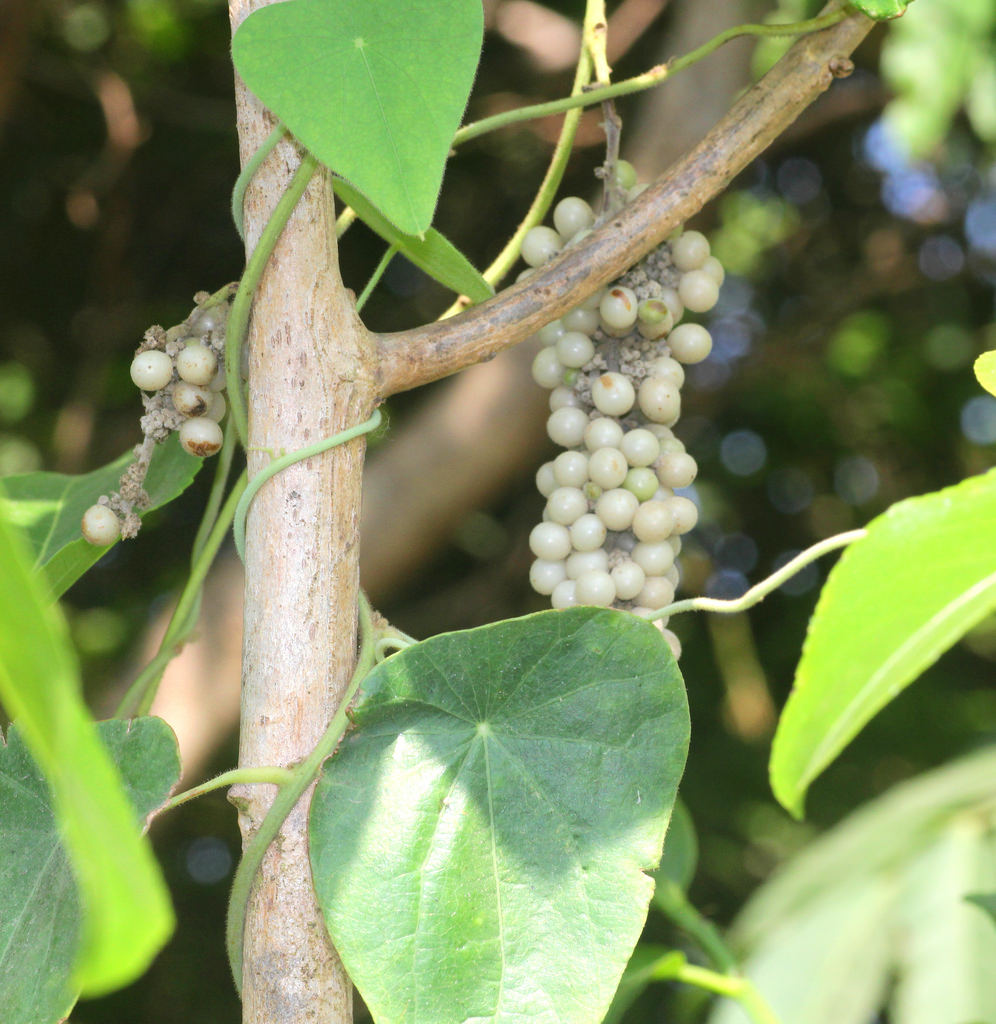
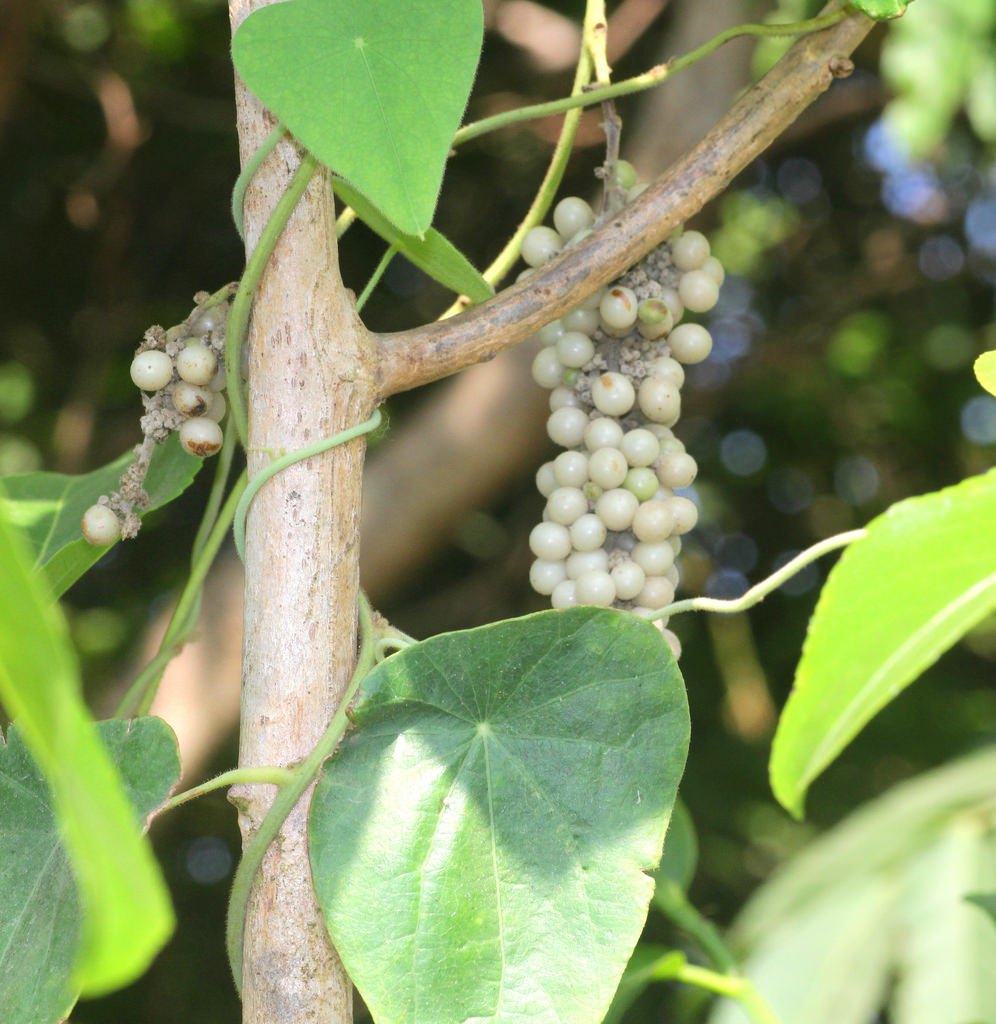
The word Cabuçu in its various spellings is of Indian origin (Tupi) and has two main meanings. The botanical interpretation would be a shrub, also called guajabara in Brazil (Coccoloba peltata, family Polygonaceae); the zoological interpretation would be a large wasp.
Coccoloba peltata
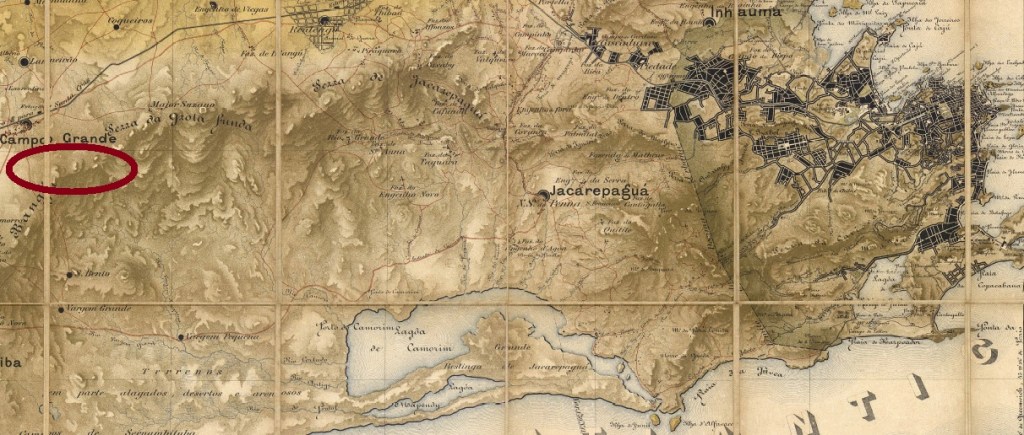
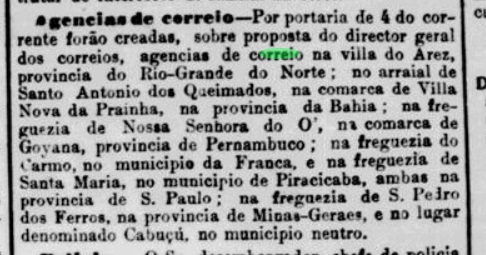
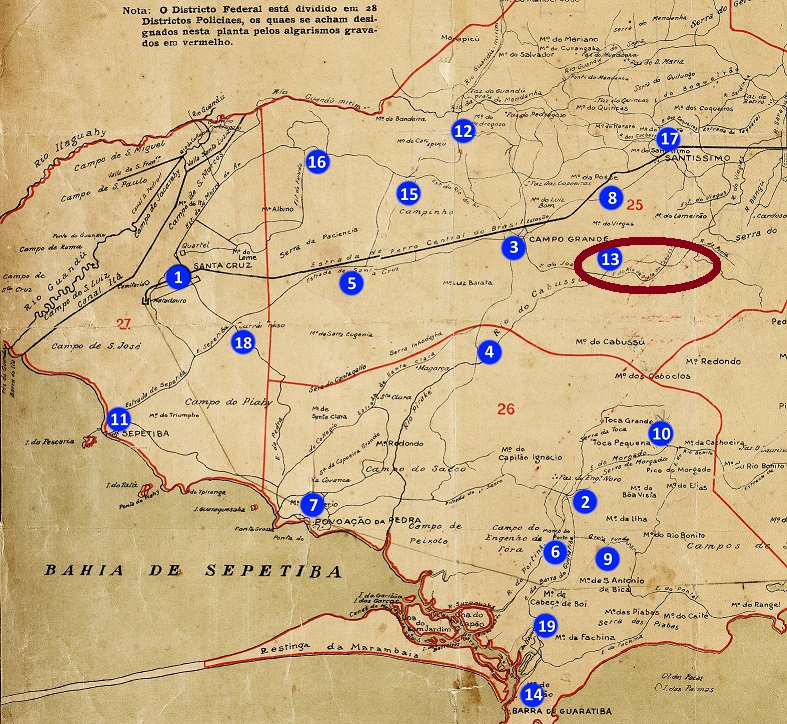
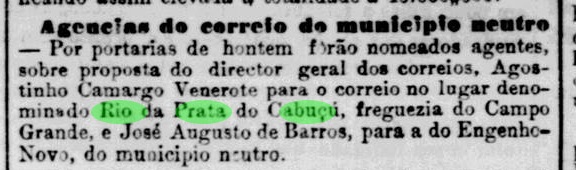
Rio da Prata do Cabuçu (= Silver River of Cabuçu) was a small settlement near Campo Grande on the western edge of the Município Neutro (= Neutral District) in the province of Rio de Janeiro, which had grown out of a large coffee and sugar cane plantation. According to Paulo Novaes (agenciaspostais.com.br), there were three post offices with Cabuçu in Rio province, but Rio da Prata do Cabuçu was the only one already active in the Empire. The post office was founded in May 1882, as introduced in the press:
Jornal do Commercio, 06.05.1882
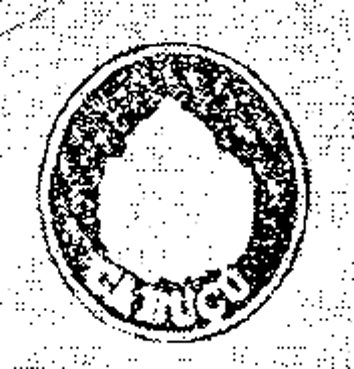
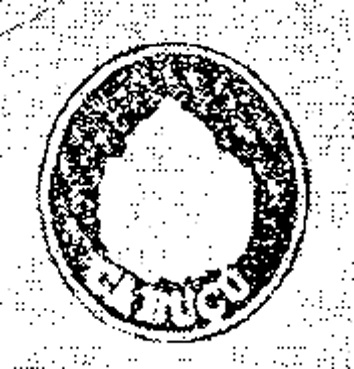
Although the agency was in operation until about 1963, the only postmark, CMN-0065a, with the imperial seal was shown in Carimbologia VII by R. Koester:
CMN-0065a (RK) 1890ffagenciaspostais.com.br
Siehe auch Rio da Prata de Cabuçu (RMN-0065)
Das Wort Cabuçu in seinen verschiedenen Schreibweisen ist indianischen Ursprungs (Tupi) und hat zwei Hauptbedeutungen. Die botanische Deutung wäre ein Strauch, der in Brasilien auch Guajabara genannt wird (Coccoloba peltata, Familie Polygonaceae); die zoologische Deutung wäre eine große Wespe.
Coccoloba peltata
Rio da Prata do Cabuçu (= Silberfluss von Cabuçu) war eine kleine Siedlung bei Campo Grande am westlichen Rand des Município Neutro (= Neutraler Bezirk) in der Provinz Rio de Janeiro, die aus einer großen Kaffee- und Zuckerrohrplantage hervorgegangen war. Laut Paulo Novaes (agenciaspostais.com.br) gab es drei Postämter mit Cabuçu in der Provinz Rio, aber Rio da Prata do Cabuçu war das einzige, das bereits im Kaiserreich aktiv war. Das Postamt wurde im Mai 1882 gegründet und der erste Angestellte wurde sofort in der Presse vorgestellt:
Jornal do Commercio, 16.05.1882
Obwohl die Agentur bis etwa 1963 in Betrieb war, wurde der einzige Stempel, CMN-0065a, mit dem kaiserlichen Siegel von R. Koester in Carimbologia VII gezeigt:




















 Carimbologia