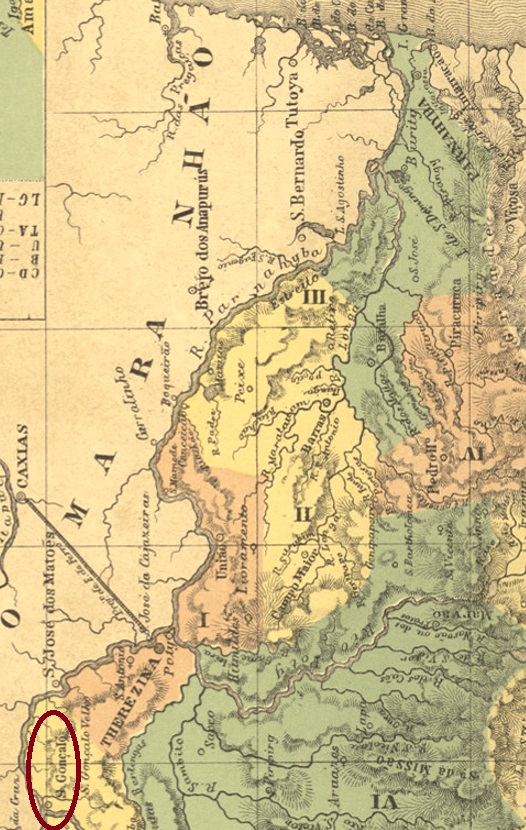
Another name: São Gonçalo de Amarante
See also São Gonçalo (SPI-0199)
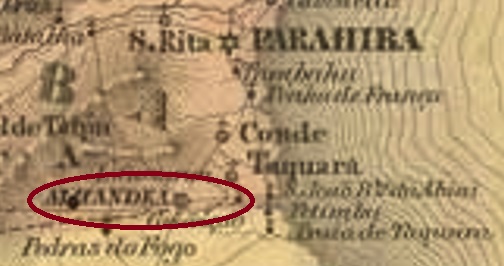
This villa has a long and confused history, which is directly connected both to the current city of Amarante and the old Villa of São Gonçalo. Both villages were one but were separated in 1861 when a large part of the local population, together with the administration, moved to an area closer to the River Parnaíba, located 160 km south of the provincial capital Teresina. The resettlement was called Amarante, and the former S. Gonçalo (S. Gonçalo Velho) became in August 1871 the district of São Gonçalo da Regeneração under Amarante.
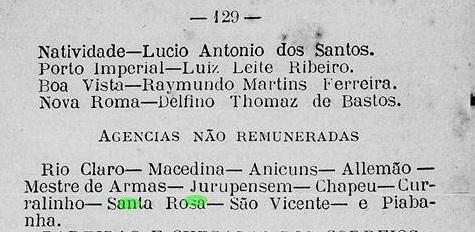
As one reads in the Directory of Imperial Post Offices (Tabella das Agencias do Correio do Imperio, Rio de Janeiro, 1885), there had been a post office there since 1880. This date is likely to be a reopening, as the Imperial Postal Guide (Guia Postal do Império do Brazil, Rio de Janeiro, 1880) already listed the agency. Two postmarks were found for the imperial period. API-0010a (illustration from the Internet) is a simple double circle with the inscription AMARANTE at the top and dates in the middle between 1883 and 1892. API-0010b was already presented to us by Paulo Ayres (Catálogo de Carimbos Brasil-Império, S. Paulo, 1937, 1942) on p. 144:

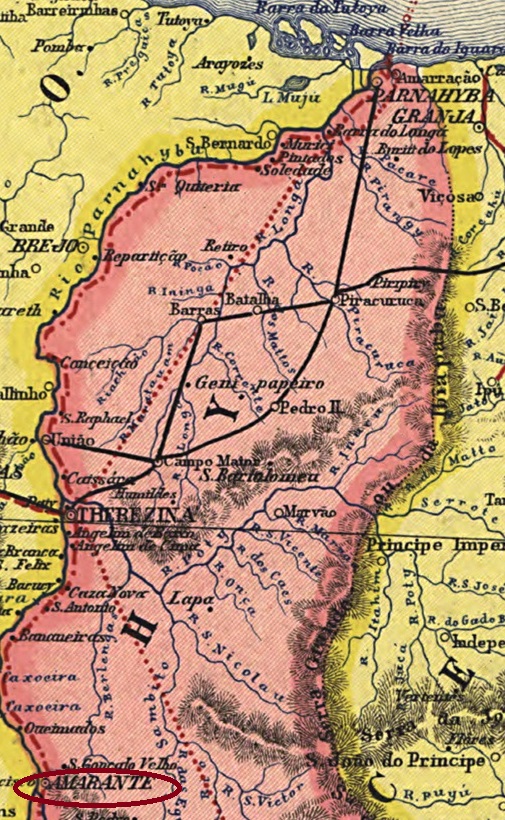
Anderer Name: São Gonçalo de Amarante
Siehe auch São Gonçalo (SPI-0199)
Diese Villa hat eine lange und konfuse Geschichte, die direkt sowohl mit der aktuellen Stadt Amarante als auch mit der alten Villa von São Gonçalo verbunden ist. Beide Ortschaften waren eins, wurden aber 1861 getrennt, als ein Großteil der lokalen Bevölkerung, zusammen mit der Verwaltung, in ein Gebiet näher an den Fluss Parnaíba abzog, 160 km südlich der Provinzhauptstadt Teresina entfernt. Die Umsiedlung wurde Amarante genannt, und die ehemalige S. Gonçalo (S. Gonçalo Velho) wurde im August 1871 in Amarante der Distrikt von São Gonçalo da Regeneração.
Wie man im Verzeichnis der kaiserlichen Postämter (Tabella das Agencias do Correio do Imperio, Rio de Janeiro, 1885) liest, gab es dort ein Postamt seit 1880. Dieses Datum dürfte eine Wiedereröffnung sein, denn im kaiserlichen Postführer (Guia Postal do Império do Brazil, Rio de Janeiro, 1880) wurde die Agentur bereits aufgelistet. Zwei Poststempel wurden für die Kaiserzeit gefunden. API-0010a (Abb. aus dem Internet) ist ein einfacher Doppelkreis mit der Inschrift AMARANTE oben und Daten in der Mitte zwischen 1883 und 1892. API-0010b wurde uns schon von Paulo Ayres (Catálogo de Carimbos Brasil-Império, S. Paulo, 1937, 1942) auf S. 144 vorgestellt:







 Carimbologia