Categories
Carimbologia E-G

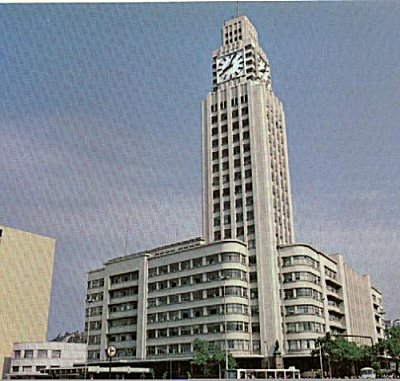
Estação Central (Central Station/Hauptbahnhof) E.F. Dom Pedro II, Município Neutro (EMN-0025)

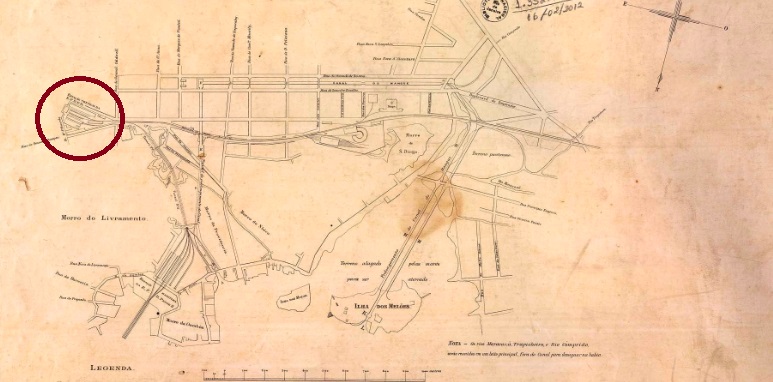
Mappa do Municipio Neutro, ca. 1880

Other names: Estação do Campo de Sant’Anna/da Aclamação, Estação da Corte, Dom Pedro II (1925)

The main station of Brazil’s most important railway line in the 19th century was inaugurated in March 1858 by the E.F. D. Pedro II and was located on the Campo de Aclamação field, relatively close to Rio de Janeiro’s city centre. After the republican military coup in 1889, the railway line was renamed E.F. Central do Brasil. From 1925, the station was called Estação D. Pedro II, but the population simply continued to call it Estação Central. The line became the property of Rede Ferroviária Federal S.A. in 1975 and has been operated by the Supervia consortium since 1997.

Ca. 1870 (Biblioteca Nacional)
In 2003 (Photo NN, on estacoesferroviarias.com.br)

As Paulo Novaes reports in agenciaspostais.com.br, there had been a post office at the station since August 1869, which operated under the name Estação Central from November 1889. To avoid duplicate code numbers for the same postmarks, the numbers used here are the same from the Carimbologia book on provincial administrations (ArGe-Brasilien, Lohmar, 2023).

The oldest cancel is RJA-0020 (fig. R. Koester, in Carimbologia XVIII):

RJA-0020 (RK) 1869ff

The Correio Urbano postmark RJU-0014 (P.A. 1029), known from Paulo Ayres’ Catálogo de Carimbos Brasil-Império (S. Paulo, 1937, 1942) with no. 1029, was also used at about the same time.

RJU-0014 (P.A. 1029) 1869ff-1870ff

This was followed by RJA-0021 (fig. P. Novaes, op. cit.):

RJA-0021 (PN) 1876ff-1883ff

This was followed by the previously unknown EMN-0025a (fig. Koester-Novaes):

EMN-0025a (RK-PN) 1885

Towards the end of the Empire, two more postmarks appeared as double circles: RJA-0022 (ill. José A. Junges) and RJA-0023 (ill. Fuad Ferreira Fo.):

RJA-0022 (JJ) 1886-1889
RJA-0023 (FF) 1888-1889
Biblioteca Nacional

Andere Namen: Estação do Campo de Sant’Anna/da Aclamação, Estação da Corte, Dom Pedro II (1925)

Der Hauptbahnhof der wichtigsten Eisenbahnlinie Brasiliens im 19. Jahrhundert wurde im März 1858 von der E.F. D. Pedro II. eingeweiht und lag auf dem Feld Campo de Aclamação, relativ nahe am Stadtzentrum von Rio de Janeiro. Nach dem republikanischen Militärputsch 1889 wurde die Bahnlinie in E.F. Central do Brasil umbenannt. Ab 1925 hieß der Bahnhof Estação D. Pedro II, aber die Bevölkerung nannte ihn einfach weiterhin Estação Central. Die Strecke ging 1975 in den Besitz der Rede Ferroviária Federal S.A. über und wird seit 1997 vom Konsortium Supervia betrieben.

Ca. 1870 (Biblioteca Nacional)
2003 (Foto NN, auf estacoesferroviarias.com.br)

Wie Paulo Novaes in agenciaspostais.com.br berichtet, gab es seit August 1869 ein Postamt am Bahnhof, das ab November 1889 unter dem Namen Estação Central firmierte. Um doppelte Codenummern bei den Poststempeln zu vermeiden, werden hier die Nummern übernommen, wie sie im Carimbologia-Buch der Postverwaltungen in den Provinzen verwendet wurden (ArGe-Brasilien, Lohmar, 2023).

Der älteste Stempel ist RJA-0020 (Abb. R. Koester, in Carimbologia XVIII):

RJA-0020 (RK) 1869ff

Etwa zur gleichen Zeit wurde auch der Poststempel des Correio Urbano RJU-0014 (P.A. 1029) verwendet, bekannt durch Paulo Ayres‘ Catálogo de Carimbos Brasil-Império (S. Paulo, 1937, 1942) mit Nr. 1029.

RJU-0014 (P.A. 1029) 1869ff-1870ff

Es folgte RJA-0021 (Abb. P. Novaes, op. cit.):

RJA-0021 (PN) 1876ff-1883ff

Es folgte der bisher unbekannte EMN-0025a (Abb. Koester-Novaes):

EMN-0025a (RK-PN) 1885

Gegen Ende des Kaiserreichs erschienen noch zwei weitere Poststempel als Doppelkreise: RJA-0022 (Abb. José A. Junges) und RJA-0023 (Abb. Fuad Ferreira Fo.):

RJA-0022 (JJ) 1886-1889
RJA-0023 (FF) 1888-1889
Categories
Carimbologia E-G

Estação Central (Central Station/Hauptbahnhof) E.F. Carangola, Rio de Janeiro (ERJ-0490)

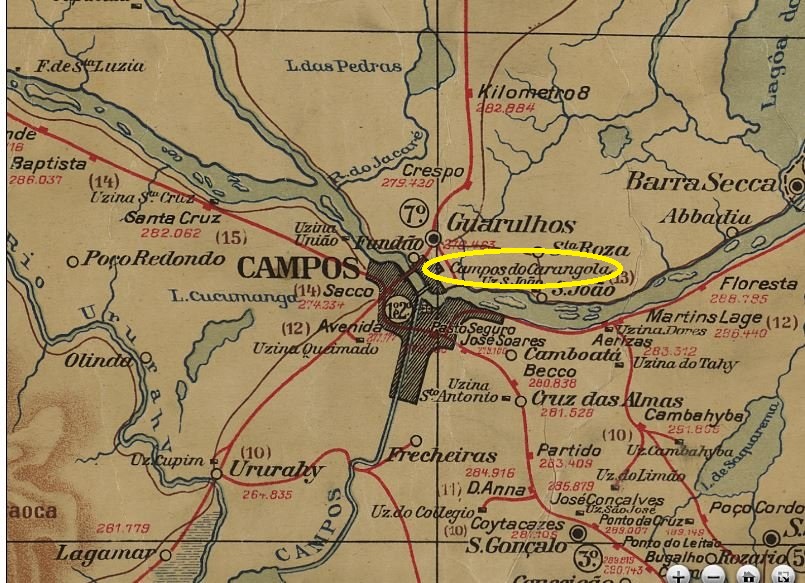
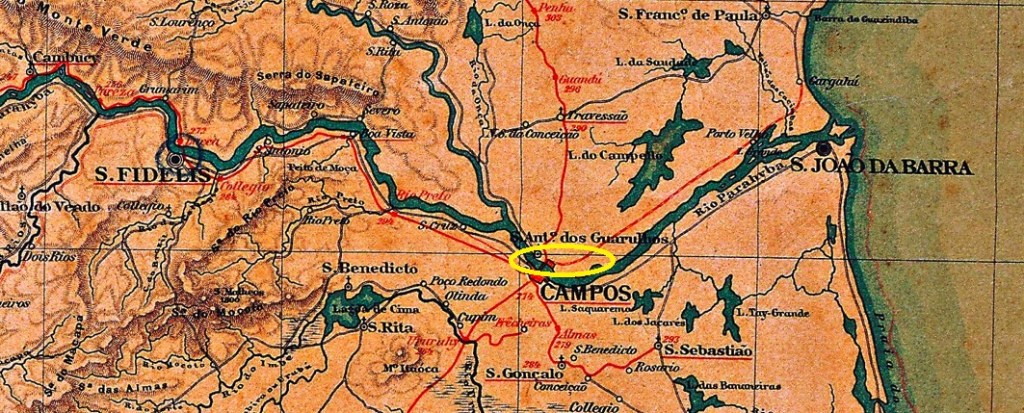
Municipio de Campos, 1922 (estacoesferroviarias.com.br)

Other names: Campos do Carangola

The main station of the E.F. Carangola was inaugurated around September 1877 and was located on the north bank of the Paraíba do Sul on the outskirts of Campos, 280 km north-east of the capital Rio de Janeiro. The line became the property of the company E.F. Barão de Araruama in 1890, which sold it to the company E.F. Leopoldina in the same year. From 1975 until the line was closed in 1996, it belonged to Rede Ferroviária Federal S.A. (estacoesferroviarias.com.br).

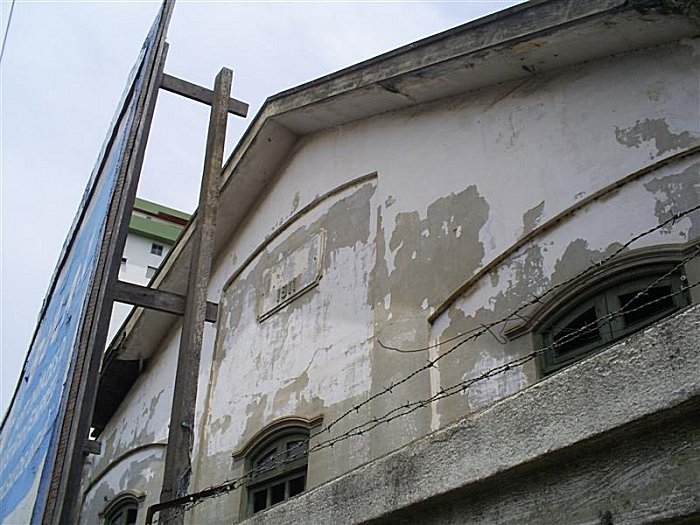
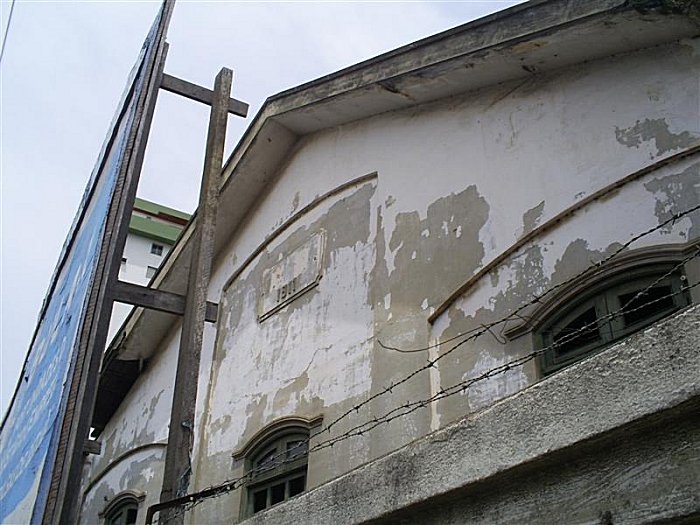
Presumably, after the inauguration of the railway bridge over the Paraíba do Sul in 1907, the main station was converted into a cargo station of the E.F. Leopoldina and the station on the south bank became responsible for passenger traffic. This hypothesis is supported by the year 1911 on the now abandoned cargo station building.

In October 2010 (Photo: Eduardo Moreira, on estacoesferroviarias.com.br)

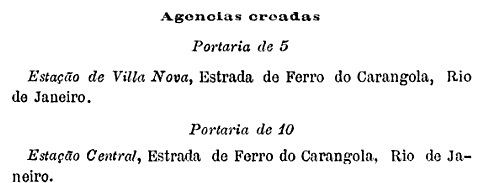
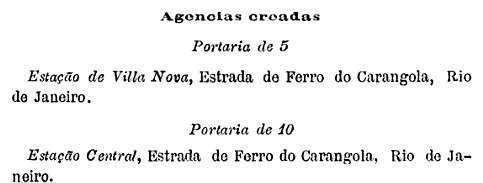
In September 1889, a station post office was opened, as can be seen from the postal bulletin (Boletim Postal) no. 6 of the following month:

Boletim Postal No. 6, October 1889

No imperial postmark from this post office has ever been seen before, so it must be rare.

Almanak Laemmert, 1892

Andere Namen: Campos do Carangola

Der Hauptbahnhof der E.F. Carangola wurde um September 1877 eingeweiht und lag am Nordufer des Paraíba do Sul am Stadtrand von Campos, 280 km nordöstlich der Hauptstadt Rio de Janeiro. Die Strecke ging 1890 in den Besitz der Firma E.F. Barão de Araruama über, die sie im selben Jahr an die Firma E.F. Leopoldina verkaufte. Von 1975 bis zur Stilllegung der Strecke 1996 gehörte sie der Rede Ferroviária Federal S.A. (estacoesferroviarias.com.br).

Vermutlich wurde der Hauptbahnhof nach der Einweihung der Eisenbahnbrücke über den Paraíba do Sul 1907 in einen Güterbahnhof der E.F. Leopoldina umgewandelt und der Bahnhof am Südufer für den Personenverkehr zuständig. Diese Hypothese wird durch die Jahreszahl 1911 auf dem heute verlassenen Güterbahnhofsgebäude gestützt.

Im Oktober 2010 (Foto: Eduardo Moreira, auf estacoesferroviarias.com.br)

Im September 1889 wurde ein Bahnhofspostamt eröffnet, wie aus dem Postbulletin (Boletim Postal) Nr. 6 des Folgemonats hervorgeht:

Boletim Postal Nr. 6, Oktober 1889

Bisher wurde noch kein kaiserlicher Poststempel von diesem Bahnhof gesehen, es muss sich also um einen seltenen Stempel handeln.

Categories
Carimbologia E-G

Estancia, Sergipe (ESE-0070)

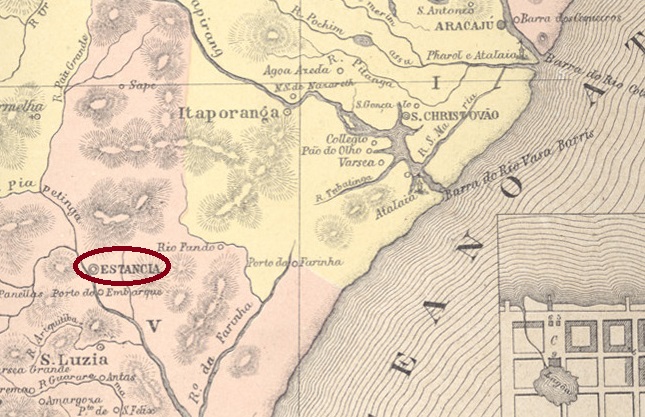
Atlas do Imperio do Brasil, 1868

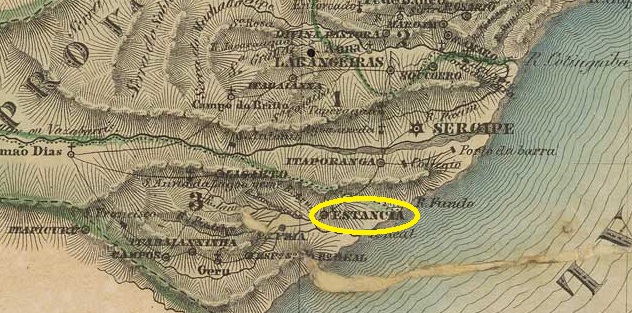
The original settlement called N. Sra. de Guadelupe has been known since April 1757. It belonged to the Vila de Sta. Luzia do Real and was located on the north bank of the Piauí, 80 kilometres southwest of the later provincial capital of Aracaju. In October 1831 it became the Freguesia e Vila Constitucional da Estancia and in May 1848 it was elevated to the status of a town.

Both Nova Monteiro (Administrações e Agencias Postaes do Brasil Imperio, in Brasil Filatelico/RJ, 1934-5; reprint SPP 1994-1999) and R. Koester (Carimbologia XVIII) write that there had been a post office there since December 1844. The directory of imperial post offices (Tabella das Agencias do Correio do Imperio, Rio de Janeiro, 1885) gives here the year 1845, which perhaps indicates that the agency was then set in operation.

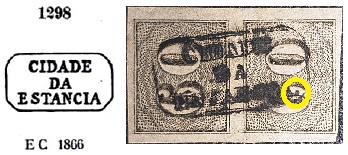
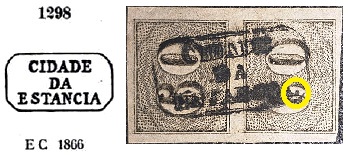
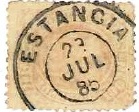
Here we can be relatively certain that the first postmark is missing, as the oldest ESE-0070b to date bears the inscription Cidade (city) and was therefore used in 1848 at the earliest. It bears the no. 1298 in P. Ayres’ Catálogo de Carimbos Brasil-Império (S. Paulo, 1937, 1942), but the dot after ESTANCIA is here missing, as can be seen in the other illustration (image: F. Piccinini):

ESE-0070b (P.A. 1298 /recte FP) 1850ff-1876ff

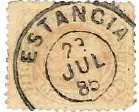
R. Koester (op. cit.) also shows the French type ESE-0070c:

ESE-0070c (MPT 393, RK)

ESE-0070d (image from the Internet) was also used about the same time:

ESE-0070d (EB) 1877-1894
Villiers de l’Ile Adam: Carta (…) das Provincias de Pernambuco, Alagoas e Sergipe, 1848

Die ursprüngliche Siedlung N. Sra. de Guadelupe ist seit April 1757 bekannt, sie gehörte zur Vila de Sta. Luzia do Real und lag am Nordufer des Piauí, 80 km südwestlich der späteren Provinzhauptstadt Aracaju. Im Oktober 1831 wurde es zur Freguesia e Vila Constitucional da Estancia und im Mai 1848 zur Stadt erhoben.

Sowohl Nova Monteiro (Administrações e Agencias Postaes do Brasil Imperio, in Brasil Filatelico/RJ, 1934-5; Reprint SPP 1994-1999) als auch R. Koester (Carimbologia XVIII) schreiben, dass es dort seit Dezember 1844 ein Postamt gab. Das Verzeichnis der kaiserlichen Postämter (Tabella das Agencias do Correio do Imperio, Rio de Janeiro, 1885) gibt hier das Jahr 1845 an, was vielleicht auf die Inbetriebnahme der Agentur hinweist.

Hier können wir relativ sicher sein, dass der erste Poststempel fehlt, da der bisher älteste ESE-0070b die Aufschrift Cidade (Stadt) trägt und somit frühestens 1848 verwendet wurde. Er trägt die Nr. 1298 in P. Ayres‘ Catálogo de Carimbos Brasil-Império (S. Paulo, 1937, 1942), aber der Punkt nach ESTANCIA fehlt hier, wie auf der anderen Abbildung zu sehen ist (Foto: F. Piccinini):

ESE-0070b (P.A. 1298 /recte FP) 1850ff-1876ff

R. Koester (op. cit.) zeigt hier auch den französischen Typ ESE-0070c:

ESE-0070c (MPT 393, RK)

Parallel dazu wurde auch ESE-0070d (Bild aus dem Internet) verwendet:

ESE-0070d (EB) 1877-1894
Categories
Carimbologia E-G

Estallo (train station/Bahnhof), Rio de Janeiro (ERJ-0505)

Estações (…) do Rio de Janeiro, São Paulo e Minas Geraes, 1880

Text update on August 16, 2024

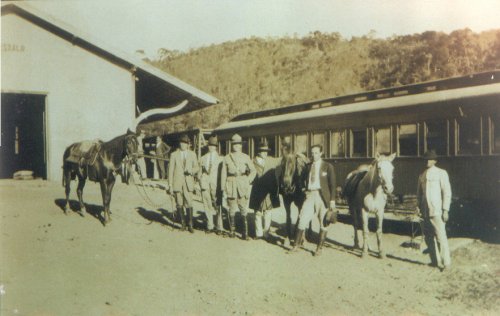
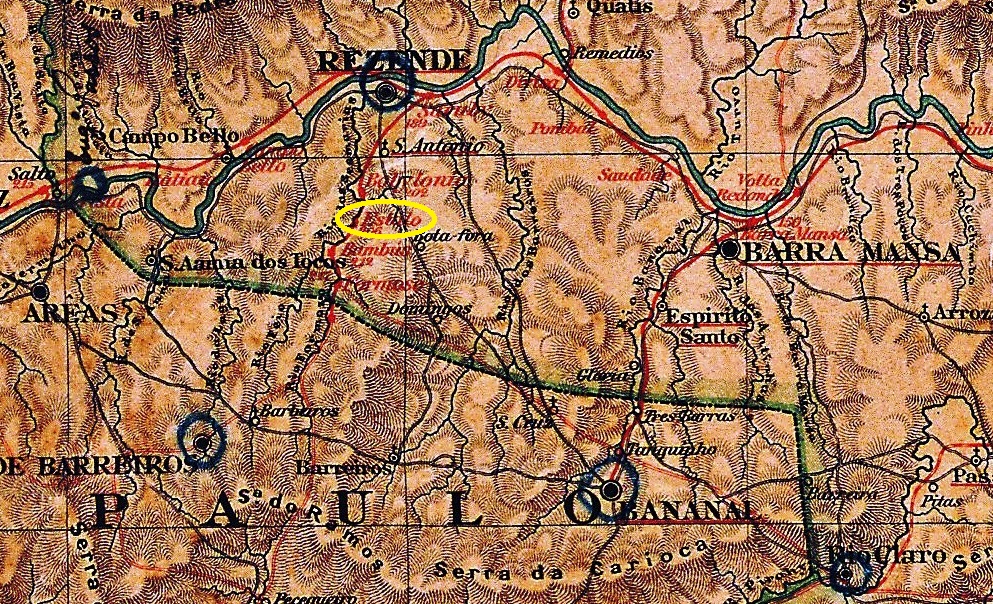
Estallo station was opened in November 1877 by the railway company E.F. de Resende a Areias (later E.F. de Resende a Bocaína) on the east bank of the river Sesmaria in the Município Resende, 180 km west of the capital Rio de Janeiro. The railway line was closed in 1928 and today both the station building and the tracks have disappeared (estacoesferroviarias.com.br).

Early 20th century (Photo: NN, on estacoesferroviarias.com.br)

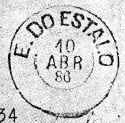
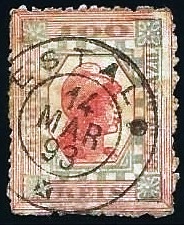
As Paulo Novaes writes on agenciaspostais.com.br, there had been a post office at the station since July 1878. The first postmark is ERJ-0505a, which was given the number 1296 by P. Ayres in the Catálogo de Carimbos Brasil-Império (S. Paulo, 1937, 1942):

ERJ-0505a (P.A. 1296) 1878ff

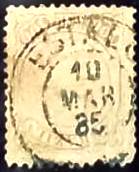
It was followed by the French type ERJ-0505b, of which unfortunately the illustration is missing.  ERJ-0505c from the Fuad Ferreira Fo. collection has since appeared:

ERJ-0505c (FF) 1885

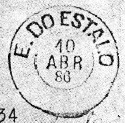
Towards the end of the Empire, ERJ-0505d (ill. R. Koester on Carimbologia XVIII) was also used:

ERJ-0505d (RK) 1886-1889

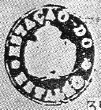
R. Koester (op. cit.) also shows the cancel with the imperial seal ERJ-0505e:

ERJ-0505e (RK)

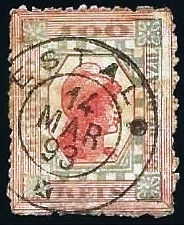
The following ERJ-0505f (ill. agenciaspostais.com.br) is probably already republican:

ERJ-0505f (PN) 1893
Almanak Laemmert, 1892

Textaktualisierung am 16. August 2024

Der Bahnhof Estallo wurde im November 1877 von der Eisenbahngesellschaft E.F. de Resende a Areias (später E.F. de Resende a Bocaína) eröffnet und lag am Ostufer des Flusses Sesmaria im Município Resende, 180 km westlich der Hauptstadt Rio de Janeiro. Die Bahnlinie wurde 1928 stillgelegt, heute sind sowohl das Bahnhofsgebäude als auch die Gleise verschwunden (estacoesferroviarias.com.br).

Anfang des 20. Jahrhunderts (Foto: NN, auf estacoesferroviarias.com.br)

Wie Paulo Novaes auf agenciaspostais.com.br schreibt, gab es ein Postamt am Bahnhof seit Juli 1878. Der erste Poststempel ist ERJ-0505a, der die Nr. 1296 von P. Ayres im Catálogo de Carimbos Brasil-Império (S. Paulo, 1937, 1942) erhielt:

ERJ-0505a (P.A. 1296) 1878ff

Es folgte der französische Typ ERJ-0505b, von dem leider die Abbildung noch fehlt.  Aus der Sammlung Fuad Ferreira Fo. erschien inzwischen ERJ-0505c:

ERJ-0505c (FF) 1885

Gegen Ende des Kaiserreichs kam auch ERJ-0505d (Abb. R. Koester auf Carimbologia XVIII):

ERJ-0505d (RK) 1886-1889

R. Koester (op. cit.) zeigt auch den Stempel mit dem kaiserlichen Siegel ERJ-0505e:

ERJ-0505e (RK)

Der folgende ERJ-0505f (Abb. agenciaspostais.com.br) dürfte bereits republikanisch sein:

ERJ-0505f (PN) 1893
Categories
Carimbologia E-G

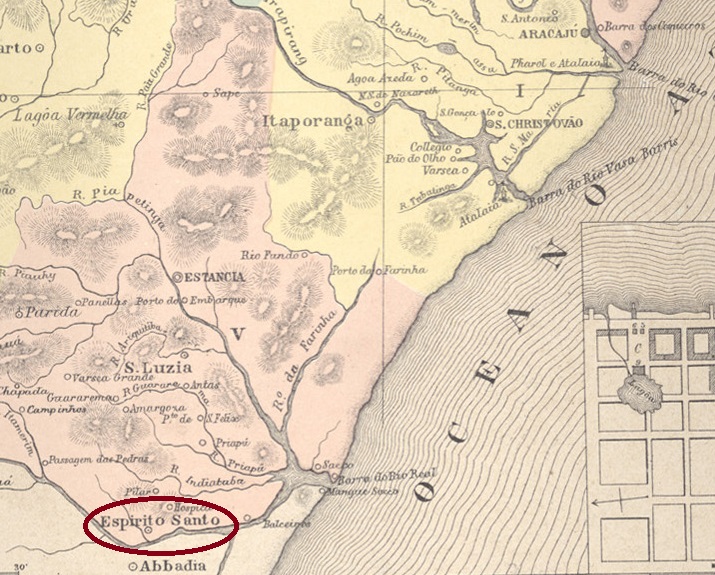
Espirito Santo, Sergipe (ESE-0065)

Atlas do Imperio do Brasil, 1868

Other names: Espirito Santo do Rio Real, Indiaroba (1943)

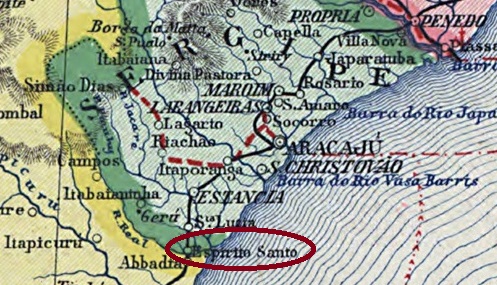
The Freguesia do Espirito Santo, founded in March 1841, belonged to the Vila de Estância and was located on the north bank of the Rio Real on the provincial border with Bahia, 100 kilometres south of the later capital Aracaju. Five years later it was elevated to Vila do Espirito Santo do Rio Real and since December 1943 the município has been called Indiaroba. The term comes from the Tupi-Guarani and means seed of the Indaiá palm.

Nova Monteiro writes in Administrações e Agencias Postaes do Brasil Imperio (Brasil Filatelico/RJ, 1934-5; reprint SPP 1994-1999) that there has been a post office there since December 1861. This is confirmed by the regional press:

Correio Sergipense, 06.01.1862

Unfortunately, no imperial postmark has yet been assigned to this place with certainty.

Carta da Republica dos Estados Unidos do Brazil, 1892

Andere Namen: Espirito Santo do Rio Real, Indiaroba (1943)

Die im März 1841 gegründete Freguesia do Espirito Santo gehörte zur Vila de Estância und lag am Nordufer des Rio Real an der Provinzgrenze zu Bahia, 100 km südlich der späteren Hauptstadt Aracaju. Fünf Jahre später erfolgte die Erhebung zur Vila do Espirito Santo do Rio Real und seit Dezember 1943 heißt der Município Indiaroba. Der Begriff stammt aus dem Tupi-Guarani und bedeutet Samen der Indaiá-Palme.

Nova Monteiro schreibt in Administrações e Agencias Postaes do Brasil Imperio (Brasil Filatelico/RJ, 1934-5; Reprint SPP 1994-1999), dass es dort seit Dezember 1861 ein Postamt gab. Dies wird von der regionalen Presse bestätigt:

Correio Sergipense, 06.01.1862

Leider konnte bisher kein kaiserlicher Poststempel mit Sicherheit diesem Ort zugeordnet werden.

Categories
Carimbologia E-G

Espirito Santo (train station/Bahnhof), Minas Gerais (EMG-1130)

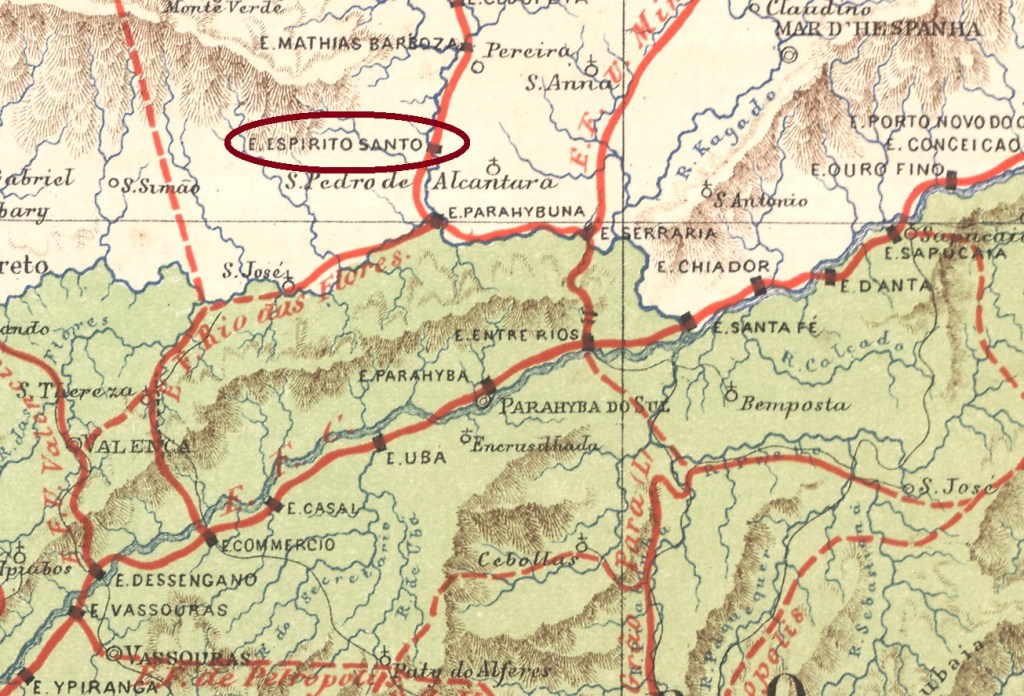
Estrada de Ferro Central do Brasil, 1890

Other Names: Sobragy (1881)

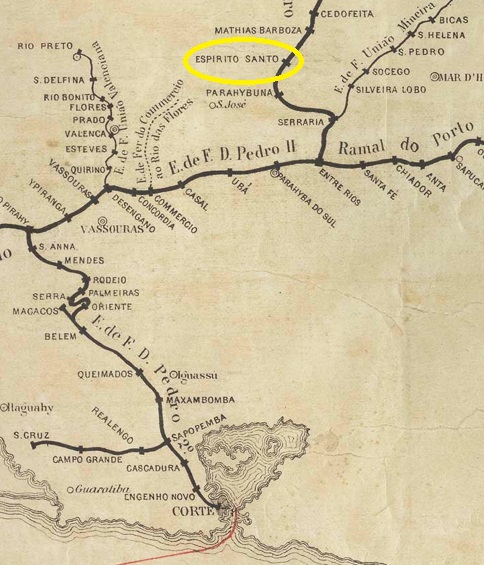
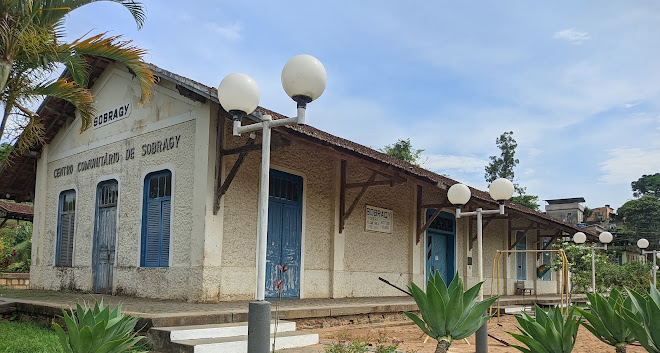
Espirito Santo railway station was opened in October 1875 by the E.F.D. Pedro II railway company (Central Line) and is located on the west bank of the Paraibuna in the Município Juiz de Fora, 250 km south of the provincial capital Ouro Preto. In July 1881, the station was renamed Sobragy in honour of Bento José Ribeiro Sobragy, who ruled the E.F.D. Pedro II for two terms.

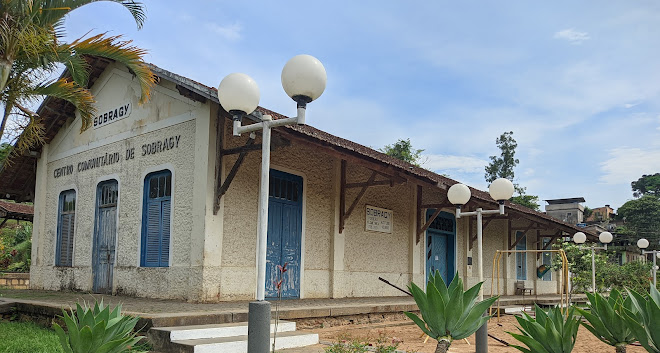
The railway line was transferred to the E.F. Central d Brasil in 1889 and belonged to Rede Ferroviária Federal S.A. (estacoesferroviarias.com.br) from 1975 until its closure in 1996. Today, the tracks are still in place and the station building serves the municipality as a multi-purpose hall.

In 2023 (Photo: Catarina Gonçalves, on Google Maps)

The area around the railway station belonged to the Freguesia de Vargem Grande from September 1882 and to the Distrito de Ibitiguara from December 1943. Since November 1962, it has belonged to the Município de Belmiro Braga.

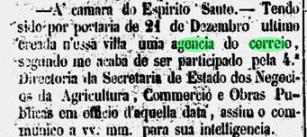
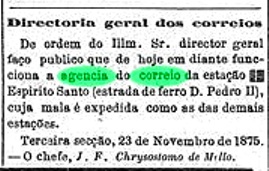
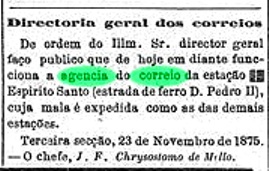
According to the Rio press, there was a railway station post office from November 1875:

Diario do Rio de Janeiro, 23/11/1875

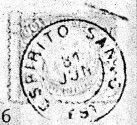
R. Koester gives the year 1876 in Carimbologia XVIII, which could well correspond to the start of operations of the post office. The oldest postmark is EMG-1130a, which was given the no. 1294 by Paulo Ayres (Catálogo de Carimbos Brasil-Império, S. Paulo, 1937, 1942):

EMG-1130a (P.A. 1294) 1875-1876ff

This was followed by EMG-1130b (fig. R. Koester, op. cit.), which also occurs in blue:

EMG-1130b (RK) 1877-1883ff

At the end of the Empire, when the station had long been called Sobragy, there was another stamp with the old name: EMG-1130c (fig. R. Koester), also in blue:

EMG-1130c (RK) 1885-1890
Estações (…)do Rio de Janeiro, São Paulo e Minas Geraes, 1880

Andere Namen: Sobragy (1881)

Der Bahnhof Espirito Santo wurde im Oktober 1875 von der Eisenbahngesellschaft E.F.D. Pedro II (Central-Linie) eröffnet und liegt am Westufer des Paraibuna im Município Juiz de Fora, 250 km südlich der Provinzhauptstadt Ouro Preto. Im Juli 1881 wurde der Bahnhof in Sobragy umbenannt, zu Ehren von Bento José Ribeiro Sobragy, der die E.F.D. Pedro II während zwei Amtszeiten regierte.

Die Bahnlinie ging 1889 an die E.F. Central d Brasil über und gehörte von 1975 bis zu ihrer Schließung 1996 der Rede Ferroviária Federal S.A. (estacoesferroviarias.com.br). Heute sind die Gleise noch vorhanden, das Bahnhofsgebäude dient der Gemeinde als Mehrzweckhalle.

2023 (Foto: Catarina Gonçalves, auf Google Maps)

Das Gebiet um den Bahnhof gehörte ab September 1882 zur Freguesia de Vargem Grande und ab Dezember 1943 zum Distrito de Ibitiguara. Seit November 1962 gehört es zum Município de Belmiro Braga.

Wie die Presse von Rio berichtete, gab es ab November 1875 ein Bahnhofspostamt:

Diario do Rio de Janeiro, 23.11.1875

R. Koester gibt das Jahr 1876 in Carimbologia XVIII an, was wohl dem Betriebsbeginn des Postamtes entsprechen könnte. Der älteste Stempel ist EMG-1130a, der von Paulo Ayres (Catálogo de Carimbos Brasil-Império, S. Paulo, 1937, 1942) die Nr. 1294 erhielt:

EMG-1130a (P.A. 1294) 1875-1876ff

Es folgte EMG-1130b (Abb. R. Koester, op. cit.), der auch in blau erhältlich ist:

EMG-1130b (RK) 1877-1883ff

Am Ende des Kaiserreichs, als der Bahnhof längst Sobragy hieß, gab es noch einen weiteren Stempel mit dem alten Namen: EMG-1130c (Abb. R. Koester), ebenfalls in blau vorkommend:

EMG-1130c (RK) 1885-1890
Categories
Carimbologia E-G

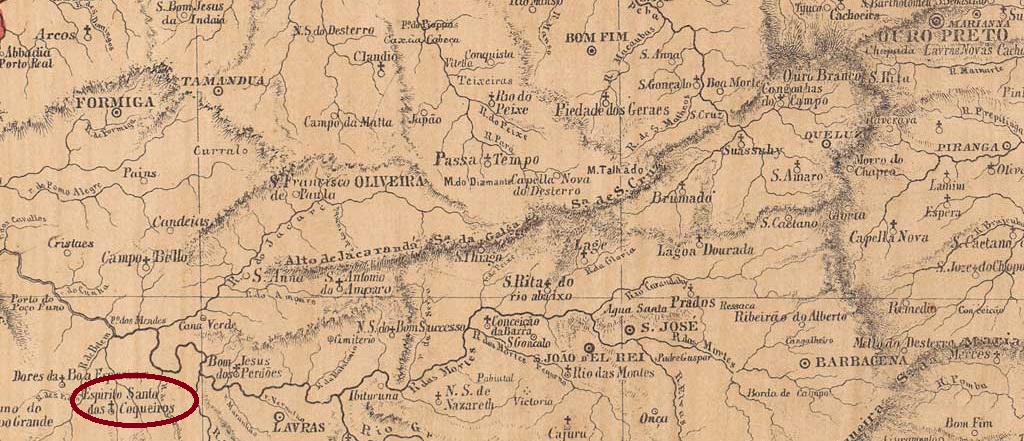
Espirito Santo dos Coqueiros, Minas Gerais (EMG-1150)

Provincia de Minas Geraes, 1873

Other names: Espirito Santo dos Sertões e Sapê, Coqueiral (1923)

The settlement was originally called Arraial do Espírito Santo dos Sertões e Sapê and in 1846 became the Distrito do Espírito Santo dos Coqueiros on the south bank of the João Borges, 310 km south-west of the provincial capital Ouro Preto. In May 1855, it became the Freguesia do Divino Espírito Santo, which belonged to the Vila de Dores da Boa Esperança. In September 1923 it was renamed Coqueiral, which since December 1948 has been an independent municipality.

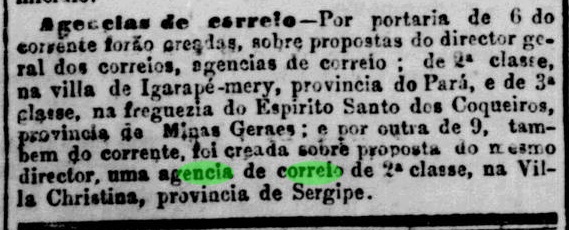
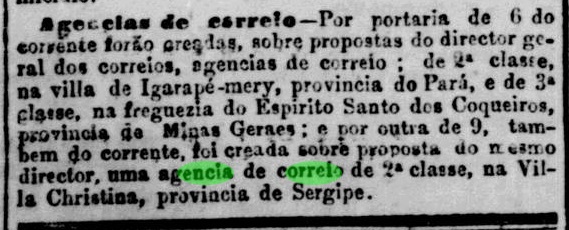
R. Koester writes in Carimbologia XVIII that there had been a post office there since October 1882. This is confirmed by the press in Rio:

Jornal do Commercio/RJ, 11 Oct. 1882

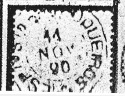
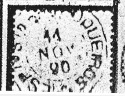
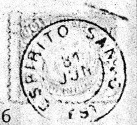
The imperial postmark is EMG-1150a (fig. R. Koester, op. cit.):
EMG-1150a (RK) 1890
Atlas do Imperio do Brasil, 1868

Andere Namen: Espirito Santo dos Sertões e Sapê, Coqueiral (1923)

Die Siedlung hieß ursprünglich Arraial do Espírito Santo dos Sertões e Sapê und wurde 1846 zum Distrito do Espírito Santo dos Coqueiros am Südufer des João Borges, 310 km südwestlich der Provinzhauptstadt Ouro Preto. Im Mai 1855 wurde daraus die Freguesia do Divino Espírito Santo, die zur Vila de Dores da Boa Esperança gehörte. Im September 1923 erfolgte die Umbenennung in Coqueiral, seit Dezember 1948 ist Coqueiral ein eigenständiges Municipio.

R. Koester schreibt in Carimbologia XVIII, dass es dort seit Oktober 1882 ein Postamt gab. Dies wird von der Presse in Rio bestätigt:

Jornal do Commercio/RJ, 11.10.1882

Der kaiserliche Poststempel ist EMG-1150a (Abb. R. Koester, op. cit.):

EMG-1150a (RK) 1890
Categories
Carimbologia E-G

Espirito Santo dos Barretos, São Paulo (ESP-0500)

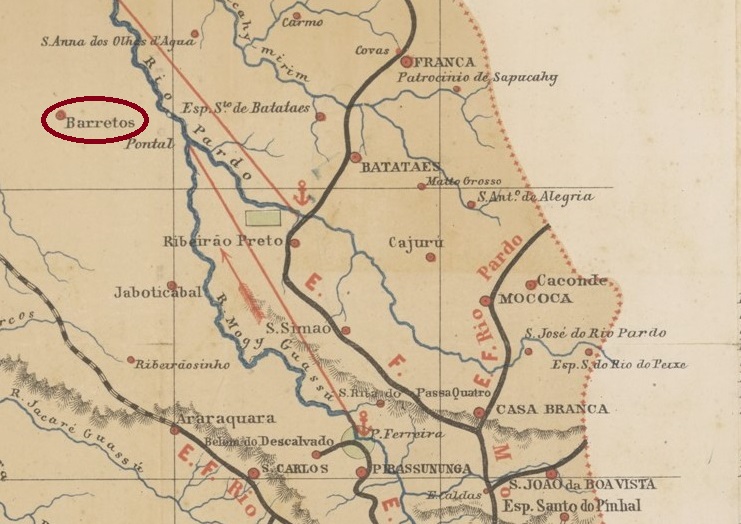
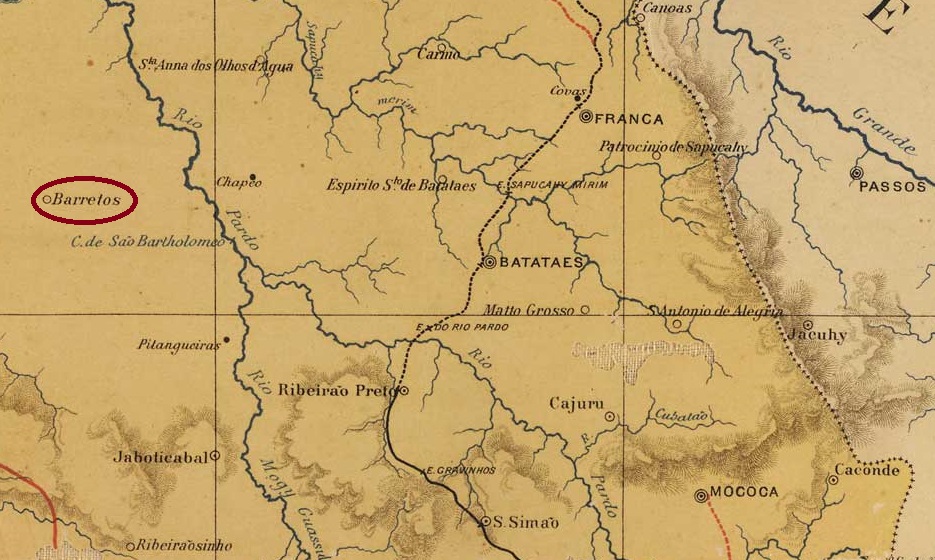
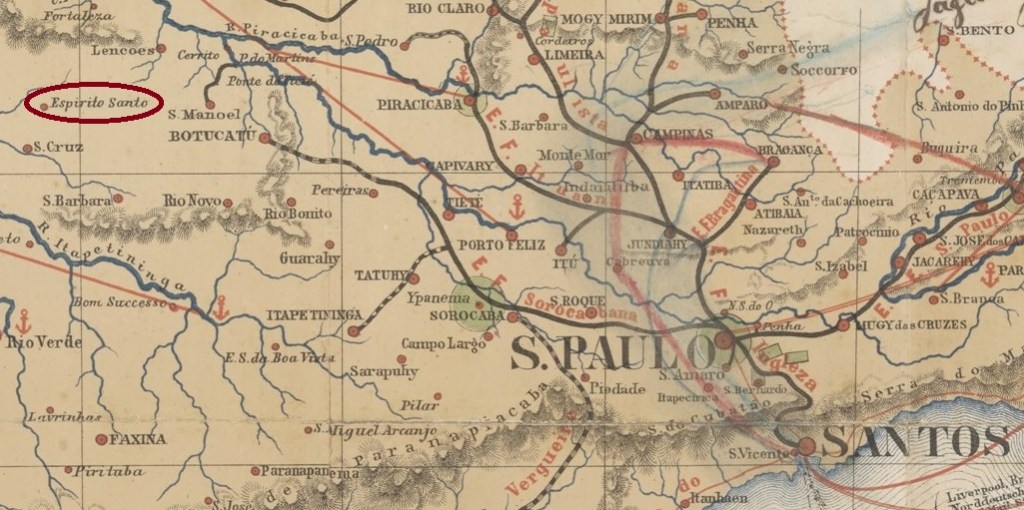
Provincia de São Paulo, 1886

Other names: Barretos (1906)
The Chapel Divino Espirito Santo dos Barretos was built in 1849 on the north bank of the Pitangueiras, 420 kilometres north of the provincial capital of São Paulo. In April 1874, the village was elevated to a freguesia of Vila de Jaboticabal, in March 1885 to a vila and in January 1897 to a town. The simplified place name Barretos has been used since November 1906.

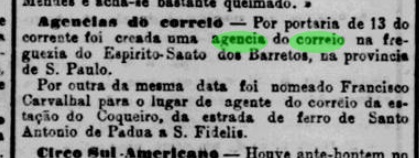
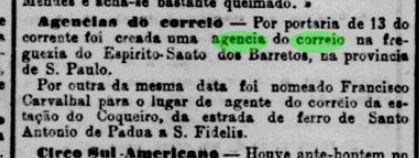
The list of imperial post offices (Tabella das Agencias do Correio do Imperio, Rio de Janeiro, 1885) shows that there had been a post office since 1883. This is confirmed by the press in Rio:

Jornal do Commercio/RJ 15/12/1883

However, R. Koester in Carimbologia XVIII gives 1884, presumably the year in which the agency began operating.

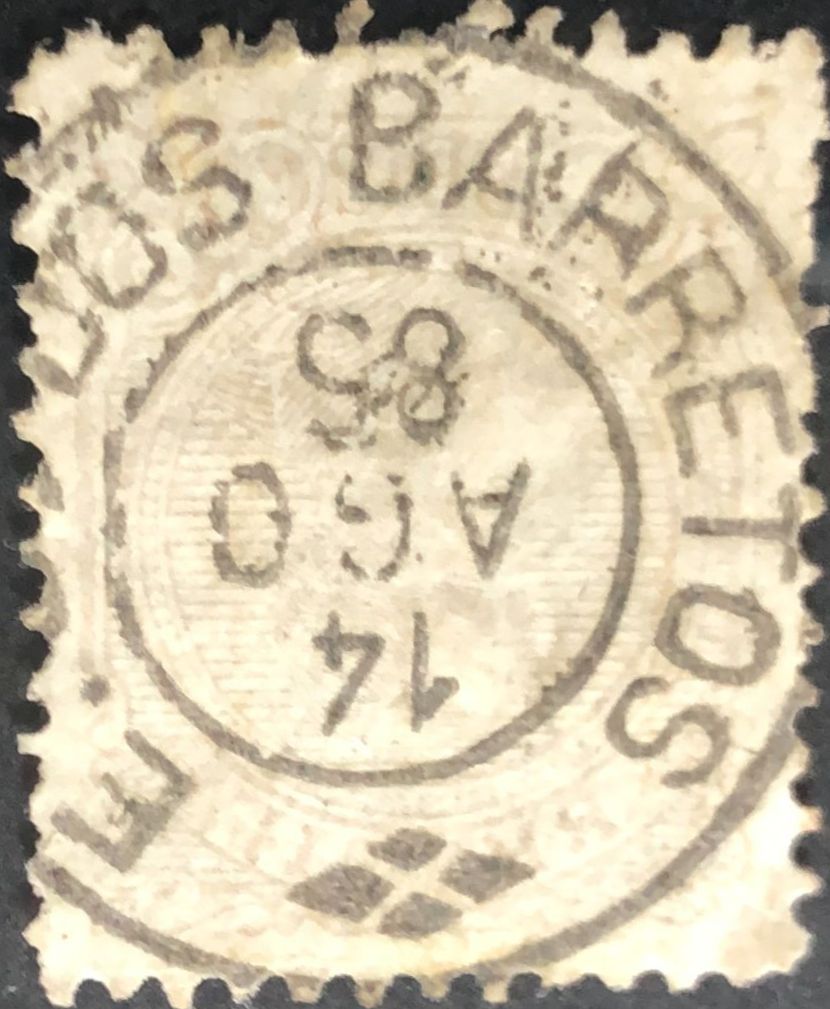
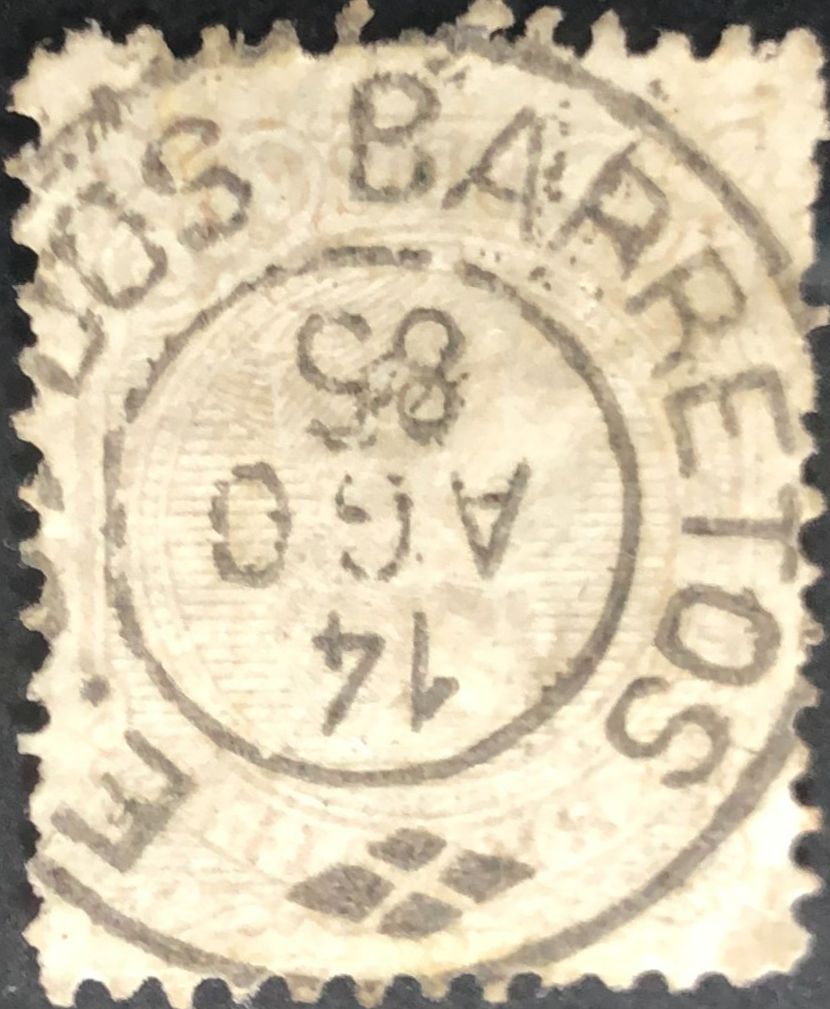
The only imperial postmark to date is ESP-0500a (fig. Robson Peniche):

ESP-0500a (RP) 1884-1887
J. M. Ribeiro Lisboa: Provincia de São Paulo, 1884

Andere Namen: Barretos (1906)

1849 wurde die Capela do Divino Espirito Santo dos Barretos am Nordufer des Pitangueiras, 420 km nördlich der Provinzhauptstadt São Paulo, errichtet. Im April 1874 wurde der Ort zur Freguesia der Vila de Jaboticabal, im März 1885 zur Vila und im Januar 1897 zur Stadt erhoben. Seit November 1906 wird der vereinfachte Ortsname Barretos verwendet.

Aus dem Verzeichnis der kaiserlichen Postämter (Tabella das Agencias do Correio do Imperio, Rio de Janeiro, 1885) geht hervor, dass es seit 1883 ein Postamt gab. Dies wird von der Presse in Rio bestätigt:

Jornal do Commercio/RJ 15.12.1883

Allerdings gibt R. Koester in Carimbologia XVIII das Jahr 1884 an, vermutlich das Jahr, in dem die Agentur ihren Betrieb aufnahm.

Der bisher einzige kaiserliche Poststempel ist ESP-0500a (Abb. Robson Peniche):

ESP-0500a (RP) 1884-1887
Categories
Carimbologia E-G

Espirito Santo do Turvo, São Paulo (ESP-0495)

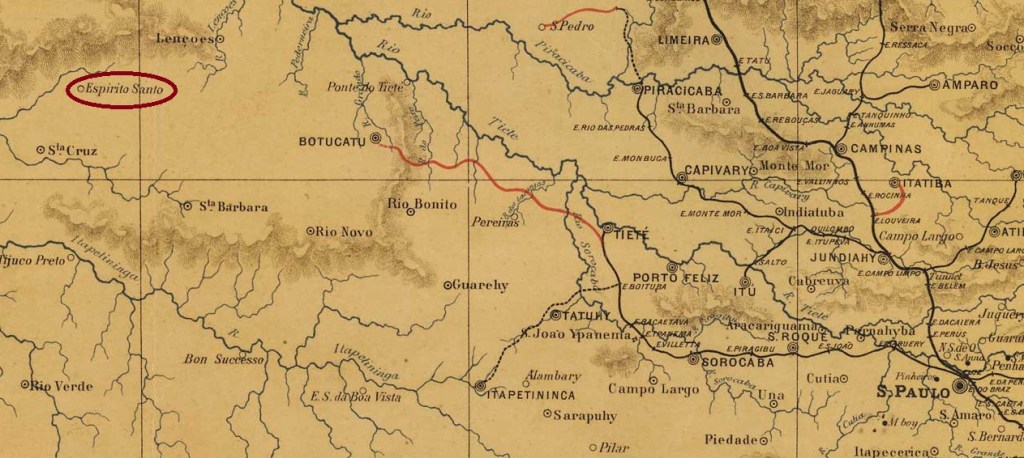
Provincia de São Paulo, 1886

Other names: Rio Turvo

The Freguesia do Espírito Santo do Turvo, founded in March 1878, belonged to the Vila de Lençóis and was located on the south bank of the Turvo, 320 kilometres west of the provincial capital of São Paulo. In March 1885, the village was elevated to a Vila and in December 1906 to a town. In May 1934, however, it was downgraded to a distrito in the Município de Santa Cruz do Rio Pardo and renamed Rio Turvo in November 1938. It was not until January 1990 that it regained the status of a município, now with the old place name Espirito Santo do Turvo.

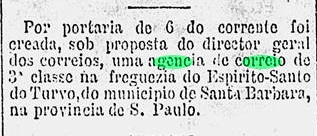
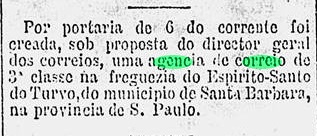
R. Koester writes in Carimbologia XVIII that there had been a post office there since October 1881. This is confirmed by the press in Rio:

Gazeta de Noticias/RJ, 09/10/1881

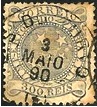
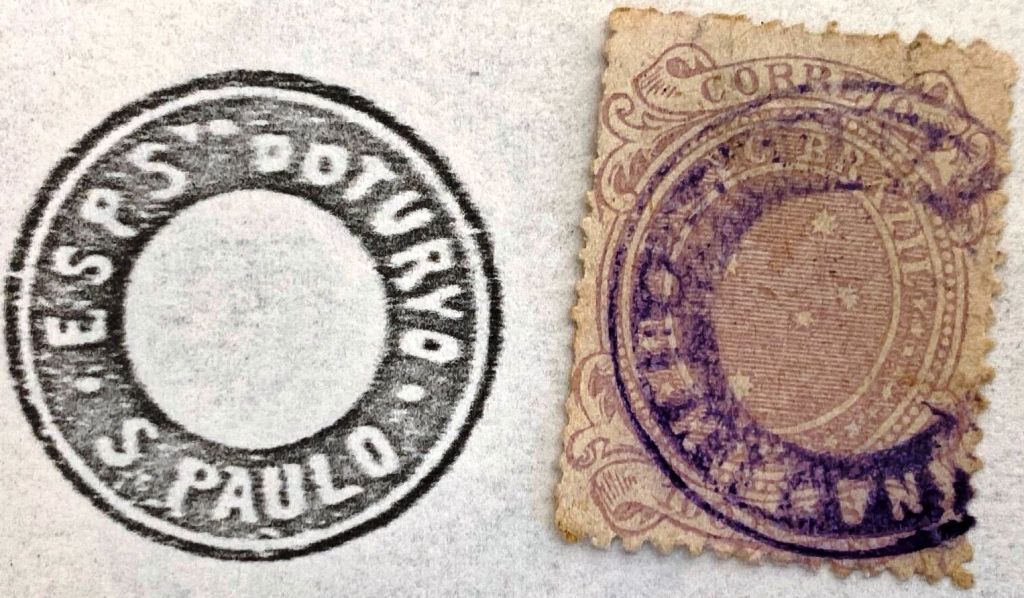
Two postmarks were found for the 19th century, the double circle ESP-0495a (ill. by Mario Celso Orsi Jr.) and the archaic-looking ESP-0495b (ill. by Roberto Assef Jr.), which also exists in dark violet:

ESP-0495a (MO) 1885-1890
ESP-0495b (RA) 1890ff
J. M. Ribeiro Lisboa: Provincia de São PAulo, 1884

Andere Namen: Rio Turvo

Die im März 1878 gegründete Freguesia do Espírito Santo do Turvo gehörte zur Vila de Lençóis und lag am Südufer des Turvo, 320 km westlich der Provinzhauptstadt São Paulo. Im März 1885 wurde der Ort zur Vila und im Dezember 1906 zur Stadt erhoben. Im Mai 1934 wurde es jedoch zum Distrito im Município de Santa Cruz do Rio Pardo herabgestuft und im November 1938 in Rio Turvo umbenannt. Erst im Januar 1990 wurde der Status eines Município wiedererlangt, nun mit dem alten Ortsnamen Espirito Santo do Turvo.

R. Koester schreibt in Carimbologia XVIII, dass es dort seit Oktober 1881 ein Postamt gab. Dies wird von der Presse in Rio bestätigt:

Gazeta de Noticias/RJ, 09.10.1881

Für das 19. Jahrhundert wurden zwei Poststempel gefunden, der Doppelkreis ESP-0495a (Abb. Mario Celso Orsi Jr.) und der archaisch anmutende ESP-0495b (Abb. Roberto Assef Jr.), den es auch in dunkelviolett gibt:

ESP-0495a (MO) 1885-1890
ESP-0495b (RA) 1890ff
Categories
Carimbologia E-G

Espirito Santo do Rio do Peixe, São Paulo (ESP-0490)

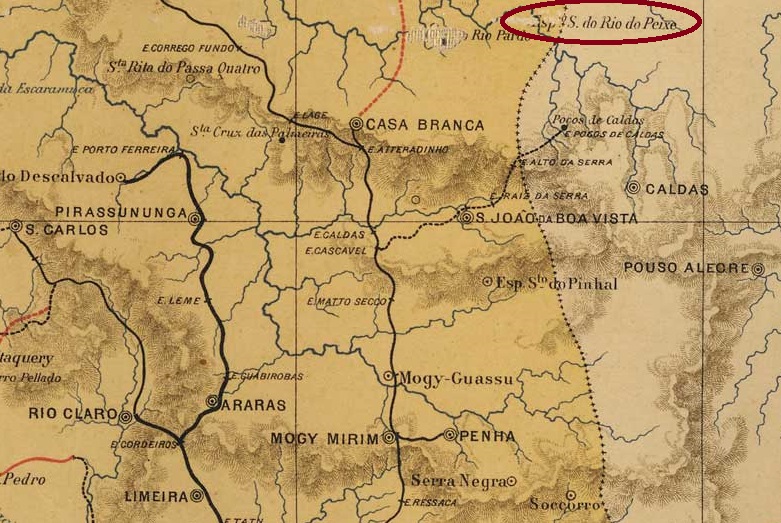
J. M. Ribeiro Lisboa: Provincia de São Paulo, 1884

Other names: N. Sra. da Natividade do Rio do Peixe, Sapecado, Divinolândia (1953)

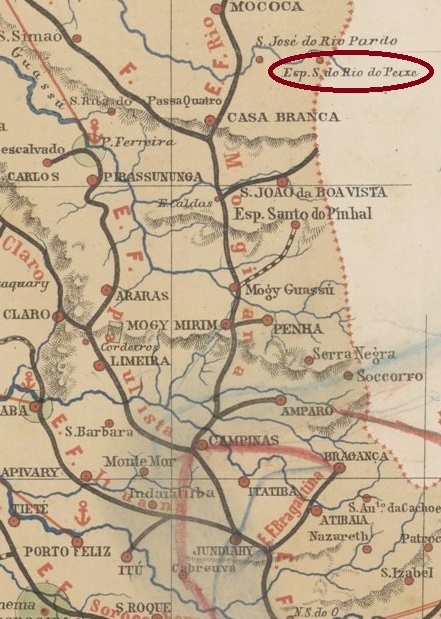
The Divino Espírito Santo chapel, built in January 1858, belonged to the Vila de Caconde and was located on the south bank of the Rio de Peixe (a tributary of the Pardo) near the provincial border with Minas Gerais, 260 kilometres north of the capital São Paulo. In March 1865, it was elevated to a freguesia, which from August 1898 belonged to the Município de S. José do Rio Pardo. Two name changes followed: in November 1938 as Distrito de Sapecado and in December 1953 as Município de Divinolândia.

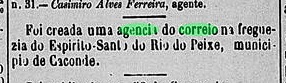
R. Koester writes in Carimbologia XVIII that there had been a post office there since 1880, which is confirmed by the regional press:

Jornal da Tarde, 24/07/1880

The imperial postmark is the French type ESP-0490a (fig. Claudio Coelho), which was found with dates up to 1925 (!):

ESP-0490a (CC) 1885-1925
Provincia de São Paulo, 1886

Andere Namen: N. Sra. da Natividade do Rio do Peixe, Sapecado, Divinolândia (1953)

Die im Januar 1858 errichtete Kapelle Divino Espírito Santo gehörte zur Vila de Caconde und lag am Südufer des Rio de Peixe (einem Nebenfluss des Pardo) nahe der Provinzgrenze zu Minas Gerais, 260 km nördlich der Hauptstadt São Paulo. Im März 1865 wurde es zur Freguesia erhoben, die ab August 1898 zum Município de S. José do Rio Pardo gehörte. Zwei Namensänderungen folgten: Im November 1938 als Distrito de Sapecado und im Dezember 1953 als Município de Divinolândia.

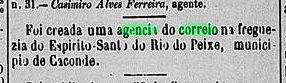
R. Koester schreibt in Carimbologia XVIII, dass es dort seit 1880 ein Postamt gab, was von der regionalen Presse bestätigt wird:

Jornal da Tarde, 24.07.1880

Der kaiserliche Poststempel ist der französische Typ ESP-0490a (Abb. Claudio Coelho), der mit Daten bis 1925 (!) gefunden wurde:

ESP-0490a (CC) 1885-1925