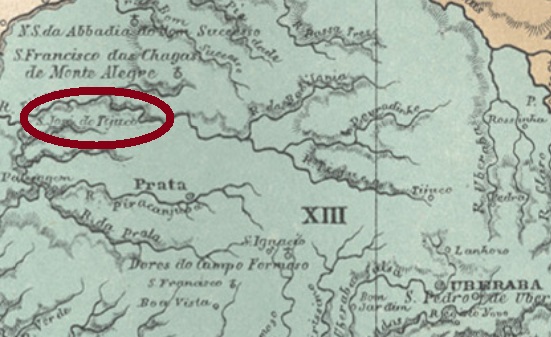
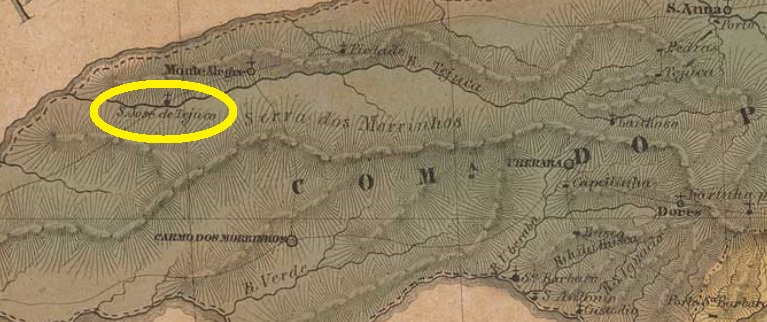
The word Tejuco (also Tijuco or Tijuca) is very common in Brazilian place names and means mud. From April 1839, São José do Tejuco was a freguesia near Prata, located on the South bank of the Tijuco River, about 750 km west of the provincial capital Ouro Preto. In September 1901, it became politically independent as the municipality of Villa Platina, which has been called Ituiutaba since September 1915. This name has Native American origin and means village on the river meadow.
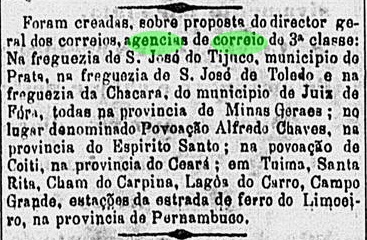
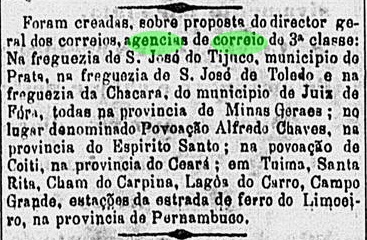
As Paula Sobrinho writes in Historia Postal de Minas Gerais (Belo Horizonte, 1997), the local post office was established in October 1882. This can be confirmed by the press from Rio:
O Globo/RJ, 28 October 1882
The imperial postmark is SMG-2485a (Coll. José A. Junges): a double circle with the inscription S. JOSÉ DO TEJUCO above and an ornament in diamond form at the bottom, the four sides of which are open. The dates inside date back to the period 1887-1903.
Villiers de l’Ile Adam: Carta (…) da Provincia de Minas Geraes, 1849
Andere Namen: Villa Platina, Ituiutaba
Das Wort Tejuco (auch Tijuco oder auch Tijuca) kommt sehr häufig in brasilianischen Ortsnamen vor und bedeutet Schwemmland oder Schlamm. São José do Tejuco war ab April 1839 eine Freguesia bei Prata, die am Südufer des Tijuco-Flusses lag, gut 750 km westlich der Provinzhauptstadt Ouro Preto entfernt. Im September 1901 erhielt sie ihre politische Eigenständigkeit als der Município von Villa Platina, der seit September 1915 Ituiutaba heißt. Dieser Name hat indianischen Ursprung und bedeutet Dorf an der Flussaue.
Wie Paula Sobrinho in Historia Postal de Minas Gerais (Belo Horizonte, 1997) schreibt, wurde das örtliche Postamt im Oktober 1882 ins Leben gerufen. Das kann die Presse aus Rio bestätigen:
O Globo/RJ, 28. Oktober 1882
Der kaiserliche Poststempel ist SMG-2485a (Samml. José A. Junges): ein Doppelkreis mit der Inschrift S. JOSÉ DO TEJUCO oben und einem Ornament in Raute unten, dessen vier Seiten offen sind. Die Daten in der Mitte entstammen dem Zeitraum 1887-1903.
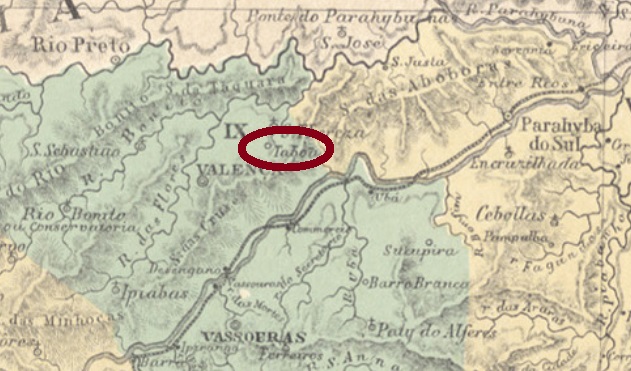
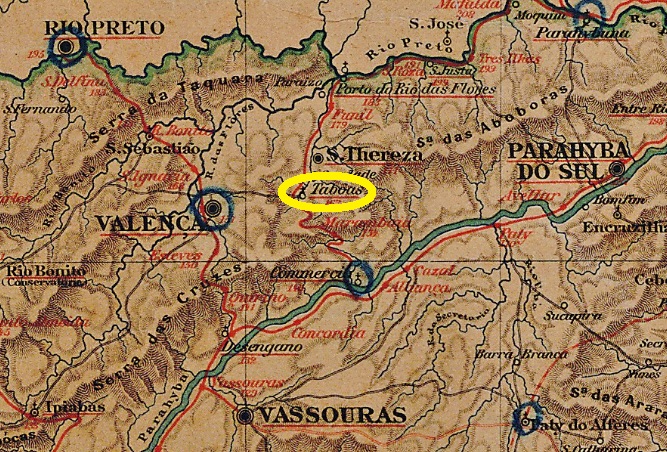
This locality was a former freguesia of Valença, about 170 km northwest of the imperial capital, Rio de Janeiro. It changed to the newly founded municipality of Santa Theresa de Valença in 1890. It remained so when, in December 1943, this municipality was renamed Rio das Flores.
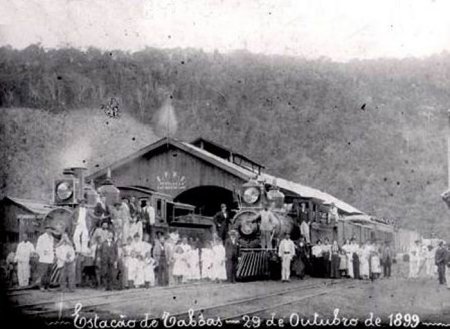
According to the Imperial Mail Register (Tabella das Agencias do Correio do Imperio) from 1885, there has been a post office there since 1880. However, since in November 1882 a local station of the Estrada de Ferro do Commercio e Rio das Flores railway company was inaugurated, the agency subsequently became a station post office – apparently without noting it on the postmarks. In 1910, the line possession went to the E. F. Central do Brasil until the end of 1965. The station was renamed Taboas in 1941.
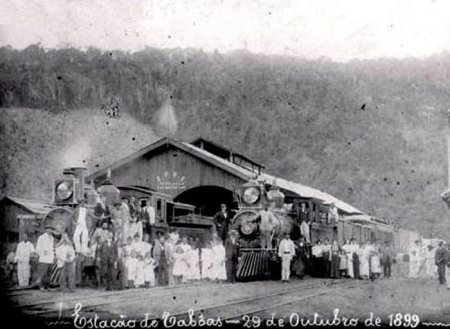
In 1899 (Photo: Alberto Lamego, estacoesferroviarias.com.br)
Three postmarks of the 19th century were found. SRJ-2210a (RHM) is the oldest of these, it is also found in blue and was used until at least 1885. Unfortunately, it has not yet been fully handed down, but one sees an ellipse with the inscription S. J. DAS TA (BÔAS). He was followed by SRJ-2210b (Coll. José A. Junges): a double circle with the inscription S. J. DAS TABÔAS above, which also exists in blue. The dates inside date back to the period 1883-1887. The third postmark is probably already Republican. SRJ-2210c (Fig. from the Internet) is also a double circle, now with the inscription S. JOSÉ DAS TABÔAS at the top and an X-shaped ornament at the bottom. Dates inside from 1894 to 1919.
Almanak Laemmert, 1892
Anderer Name: Taboas (1941)
São José das Tabôas war eine frühere Freguesia von Valença, die ca. 170 km nordwestlich der kaiserlichen Hauptstadt Rio de Janeiro entfernt lag. Sie wechselte um 1890 als Distrikt zum neu gegründeten Município von Santa Theresa de Valença. Dabei ist es geblieben, als im Dezember 1943 dieser Município zu Rio das Flores umbenannt wurde.
LautVerzeichnis der kaiserlichen Postämter (Tabella das Agencias do Correio do Imperio) von 1885 gibt es dort ein Postamt seit 1880. Da aber im November 1882 ein Ortsbahnhof der Estrada de Ferro do Commercio e Rio das Flores Bahngesellschaft eingeweiht wurde, wurde anschließend aus der Agentur ein Bahnhofspostamt – offenbar ohne dieses auf den Poststempeln zu vermerken. 1910 ging die Bahnlinie in Besitz der E. F. Central do Brasil bis Betriebsende 1965. Der Bahnhof wurde 1941 Taboas umbenannt.
Der Bahnhof in 1899 (Foto: Alberto Lamego, estacoesferroviarias.com.br)
Drei Poststempel des 19. Jahrhunderts wurden gefunden. SRJ-2210a (RHM) ist davon der älteste, er kommt auch in blau vor und wurde bis mindestens 1885 gebraucht. Leider ist er bisher nicht vollständig überliefert, aber man sieht eine Ellipse mit der Inschrift S. J. DAS TA(BÔAS). Ihm folgte SRJ-2210b (Samml. José A. Junges): ein Doppelkreis mit der Inschrift S. J. DAS TABÔAS oben, den auch in blau gibt. Die Daten in der Mitte entstammen dem Zeitraum 1883-1887. Der dritte Poststempel ist wohl schon republikanisch. SRJ-2210c (Abb. aus dem Internet) ist ebenfalls ein Doppelkreis, nun mit der Inschrift S. JOSÉ DAS TABÔAS oben und einem X-förmigen Ornament unten. Daten in der Mitte 1894 bis 1919.
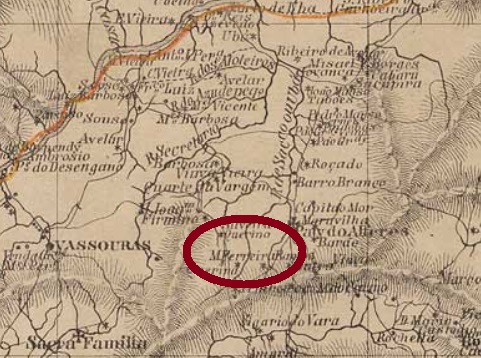
Bellegard-Niemeyer: Carta Corographica da Provincia do Rio de Janeiro, 1867
Another name: São José das Rolinhas
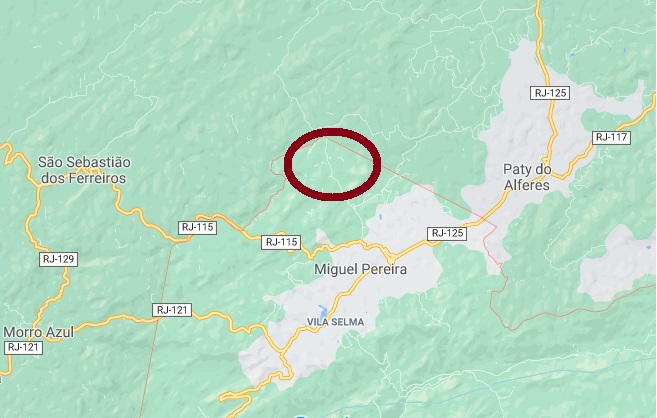
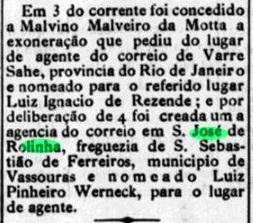
This village was from December 1864 a small settlement in the freguesia of S. Sebastião dos Ferreiros in the municipality of Vassouras, which was located on the hillside, about 120 km north of the imperial capital Rio de Janeiro. And it remained so until December 1943, when the political emancipation of Miguel Pereira as Municipio took place. Today it is a rural suburb of this town, now called S. José das Rolinhas, a peaceful tourist destination.
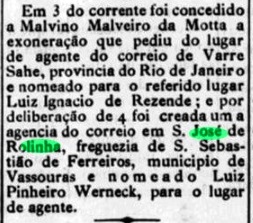
The local post office was established in February 1887, as can be read in the Rio press:
O Fluminense, 9 February 1887
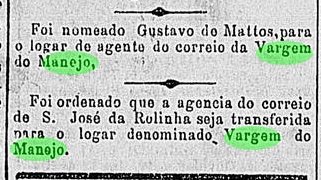
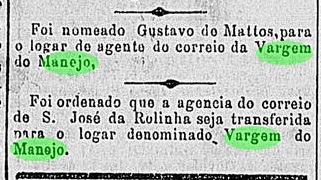
However, eight months later this agency has moved further north to Vargem do Manejo:
Novidades, 8 October 1887
No postmark of the imperial era has been found so far. This cancel must be a great rarity, given that the agency was small – and had a very short operating time.
Google Maps
Anderer Name: São José das Rolinhas
Diese Ortschaft war ab Dezember 1864 eine kleine Siedlung der Freguesia von S. Sebastião dos Ferreiros im Município von Vassouras, die am Berghang, gut 120 km nördlich der kaiserlichen Hauptstadt Rio de Janeiro entfernt lag. Und so blieb es bis Dezember 1943, als die politische Emanzipation von Miguel Pereira als Município stattfand. Heute ist es ein ländlicher Vorort dieses Städtchens, der nun S. José das Rolinhas heißt und vom Tourismus lebt.
Das örtliche Postamt entstand im Februar 1887, wie aus der Rio-Presse hervorgeht:
O Fluminense, 9. Februar 1887
Allerdings wurde diese Agentur acht Monate später weiter nördlich nach Vargem do Manejo verlegt:
Novidades, 8. Oktober 1887
Kein Poststempel der Kaiserzeit wurde bisher gefunden. Dieser Stempel muss eine große Seltenheit sein, da die Agentur sein klein war – und eine sehr kurze Betriebszeit hatte.
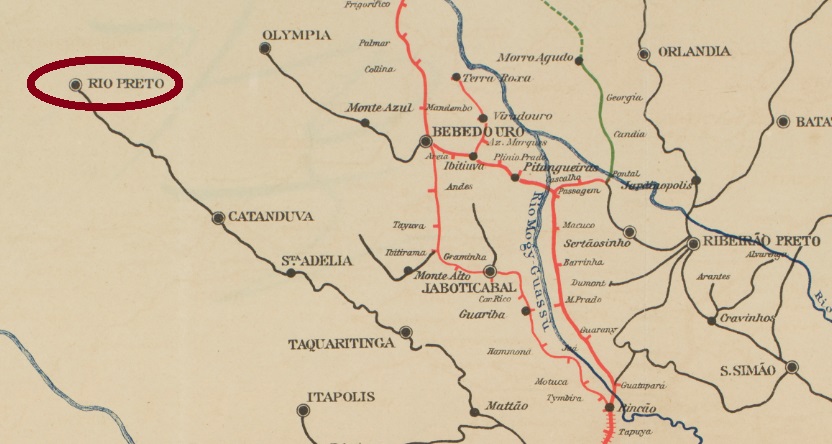
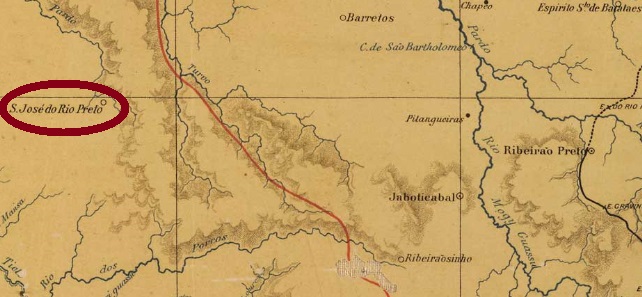
This village was from March 1879 a district in the municipality of Jaboticabal, which was located directly on the Rio Preto, about 440 km northwest of the provincial capital of São Paulo. In July 1894, it ascended to a Município, which was simply called Rio Preto between 1906 and 1944, before the original name returned.
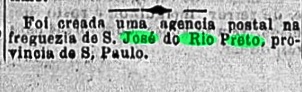
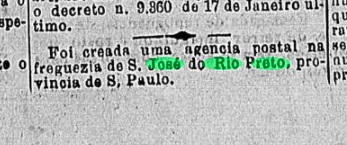
As the philatelist Mario Celso Orsi Jr. found out, the local post office was established in March 1885, which is confirmed by the Rio press:
Gazeta de Noticias, 18 March 1885
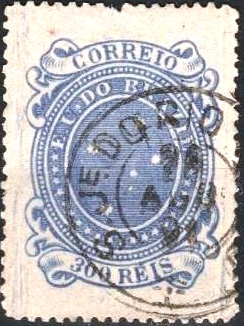
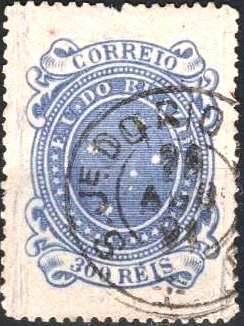
The only imperial postmark seen so far is SSP-1185a (Coll. Fuad Ferreira Fo.): a double circle with the inscription S. JOSÉ DO R. PRETO above and (S. PAULO) below. A single copy was found, dated 1887 inside.
SSP-1185b (coll. Mário Celso Orsi Jr.) also appeared at the beginning of the Republic:
SSP-1185b (MO) 1891-1897J. M. Ribeiro Lisboa: Provincia de São Paulo, 1884
Textaktualisierung am 25.12.2024
Anderer Name: Rio Preto
Diese Ortschaft war ab März 1879 ein Distrikt im Município von Jaboticabal, der direkt am Rio Preto lag, gut 440 km nordwestlich der Provinzhauptstadt São Paulo entfernt. Im Juli 1894 steig sie zum Município auf, der zwischen 1906 und 1944 einfach Rio Preto hieß, bevor der ursprüngliche Ortsname zurückkehrte.
Wie der Philatelist Mario Celso Orsi Jr. ermittelt hat, entstand das örtliche Postamt im März 1885, was durch die Presse aus Rio bestätigt wird:
Gazeta de Noticias, 18. März 1885
Der einzige bisher gesehene Poststempel der Kaiserzeit ist SSP-1185a (Samml. Fuad Ferreira Fo.): ein Doppelkreis mit der Inschrift S. JOSÉ DO R. PRETO oben und (S. PAULO) unten. Ein Exemplar gefunden, datiert 1887 in der Mitte.
Am Anfang der Republik erschien auch SSP-1185b (Samml. Mário Celso Orsi Jr.):
Other names: São José da Serra, São José, Paraúna, São José do Vale do Rio Preto (1987)
See also Rio Preto (SRJ-0853)
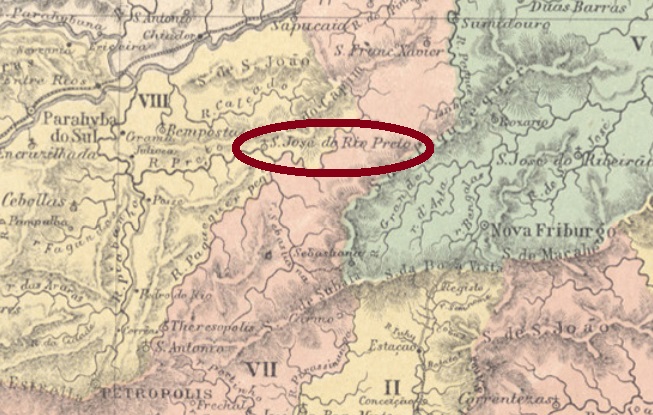
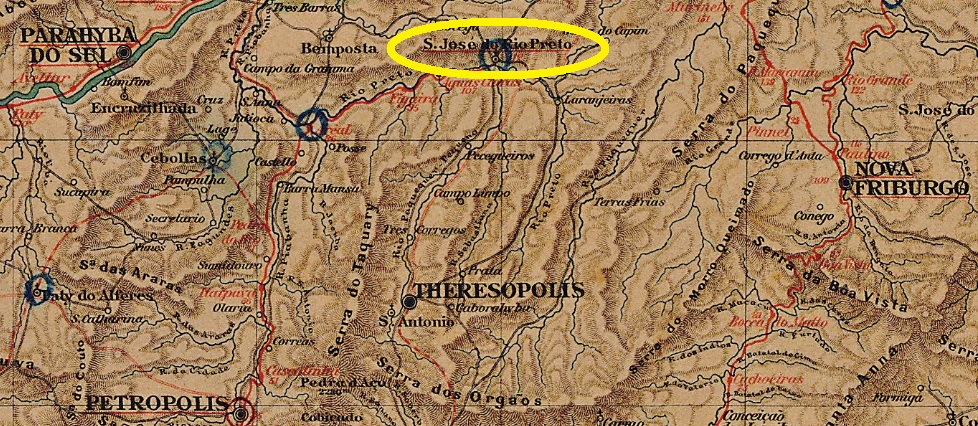
This Rio Preto (= Black River) emerges from the mountains of the same name in the north of the province of Rio de Janeiro. From November 1815, the village of Rio Preto was a freguesia of Niteroi, about 130 km north of the colonial capital Rio de Janeiro. The freguesia went from 1833 as a district to Parahyba do Sul and from May 1892 to Petropolis. Since then, the place changed its name three times: in March 1938 to São José, in December 1943 to Paraúna, and in June 1947 to the district of São José do Rio Preto. Since December 1987, it has been the municipality of S. José do Vale do Rio Preto.
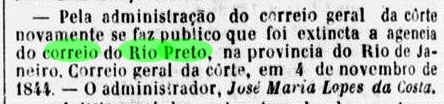
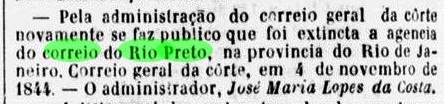
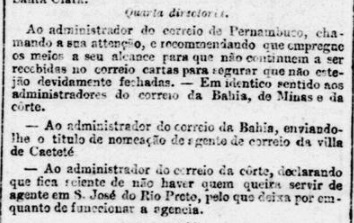
The local post office opened twice: first, about 1839, and it was closed in November 1844, as can be read in the press from Rio:
Jornal do Commercio, 06 November 1844
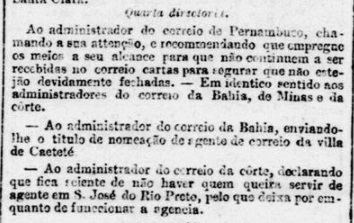
As Paulo Novaes (agenciaspostais.com.br) informs, this post office was created for the second time in November 1860. However, it is questionable whether the operation started immediately, for at the beginning of 1862 a postal clerk was still sought for this agency:
Expediente do Ministerio da Agricultura, 21 January 1862
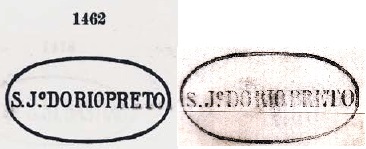
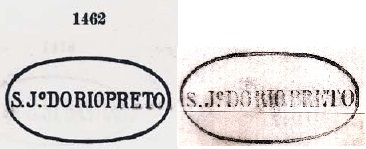
Two town and two mute cancels in the imperial period were found. SRJ-1460a was in circulation from about 1860 to at least 1876 and was already depicted by Paulo Ayres (Catalogo de Carimbos Brasil-Império, S. Paulo, 1937, 1942) under No. 1462. This figure, however, has a false letter: the original e became an o, as if an abbreviation for Sao João was instead of José:
P.A. 1462 – SRJ-1460a recte
It was followed by SRJ-1460b (Coll. José A. Junges): a double circle with the inscription S. J. DO RIO PRETO above. The dates inside were found so far for the period 1879-1899.
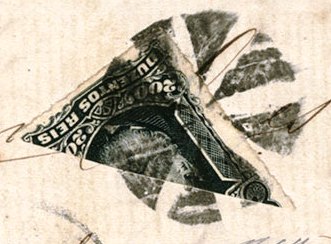
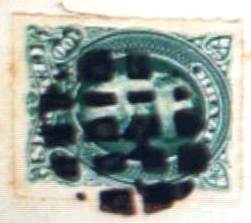
The first mute cancel was found on a letter from 1879 and circulated until at least 1882:
(Coll. Paulo R. Risi) 1879-1882
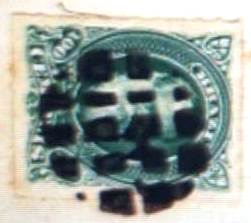
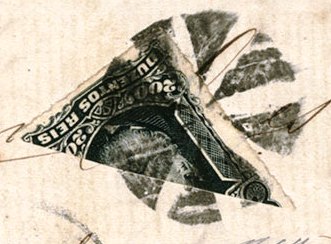
The second one was seen on a letter from 1880:
(EB) 1880Almanak Laemmert, 1892
Andere Namen: São José da Serra, São José, Paraúna, São José do Vale do Rio Preto (1987)
Siehe auch Rio Preto (SRJ-0853)
Dieser Rio Preto (= Schwarzer Fluss) entspringt dem gleichnamigen Gebirge im Norden der Provinz Rio de Janeiro. São José do Rio Preto war ab November 1815 eine Freguesia von Niteroi, die ca. 130 km nördlich der kolonialen Hauptstadt Rio de Janeiro lag. Die Freguesia ging ab 1833 als Distrikt zu Parahyba do Sul und ab Mai 1892 zu Petrópolis. Danach wechselte der Ortsname dreimal: im März 1938 zu São José, im Dezember 1943 zu Paraúna und im Juni 1947 zurück zu São José do Rio Preto. Seit Dezember 1987 ist es der Município von S. José do Vale do Rio Preto.
Das örtliche Postamt eröffnete zweimal: erstens ca. 1839, und es wurde im November 1844 geschlossen, wie man in der Presse aus Rio lesen kann:
Jornal do Commercio, 06. November 1844
Wie Paulo Novaes (agenciaspostais.com.br) informiert, entstand dieses Postamt zum zweiten Mal im November 1860. Allerdings ist es fraglich, ob der Betrieb gleich aufgenommen wurde, zumal noch am Anfang 1862 ein Postangestellter für diese Agentur gesucht war:
Expediente do Ministerio da Agricultura, 21. Januar 1862
Zwei Ortsstempel und zwei stumme Entwertungen der Kaiserzeit wurden gefunden. SRJ-1460a war von ca. 1860 bis mindestens 1876 im Umlauf und wurde zwar bereits durch Paulo Ayres (Catálogo de Carimbos Brasil-Império, S. Paulo, 1937, 1942) unter Nr. 1462 abgebildet. Diese Abbildung hat aber einen falschen Buchstaben: aus dem ursprünglichen e wurde ein o, als wäre eine Abkürzung für São João statt José:
P.A. 1462 – SRJ-1460a recte
Ihm folgte SRJ-1460b (Samml. José A. Junges): ein Doppelkreis mit der Inschrift S. J. DO RIO PRETO oben. Die Daten in der Mitte wurden bisher für den Zeitraum 1879-1899 gefunden.
Der erste stumme Stempel wurde auf einem Brief aus 1879 gefunden und wurde zumindest bis 1882 verwendet:
From May 1850, this village was a district of Santo Antonio do Parahybuna (now Juiz de Fora), located about 260 km south of the provincial capital Ouro Preto. Since then, the place name has changed three times: in September 1923 to Torreão, in September 1927 to São José das Três Ilhas, and four years later to the simplified Três Ilhas. It has been a district of Belmiro Braga since December 1962. The name (=Three Islands) is somewhat enigmatic, as there is no river or island in the area.
According to Paula Sobrinho (História Postal de Minas Gerais, Belo Horizonte, 1997), there has been a post office there since June 1879. A place cancel was found. SMG-2480a (Coll. Fuad Ferreira Fo.) has a double circle with the inscription. S. JOSÉ DO RIO PRETO above and an ornament in cross below consisting of four converging arrows. Dates inside from 1885 to 1902.
Provincia de Minas Geraes, 1873
Andere Namen: São José, Torreão, Três Ilhas (1938)
Diese Ortschaft war ab Mai 1850 ein Distrikt von Santo Antonio do Parahybuna (heute: Juiz de Fora), der ca. 260 km südlich der Provinzhauptstad Ouro Preto entfernt lag. Seitdem wechselte der Ortsname dreimal: im September 1923 zu Torreão, im September 1927 zu São José das Três Ilhas, und vier Jahre später zum vereinfachten Três Ilhas. Seit Dezember 1962 ist Três Ilhas ein Distrikt von Belmiro Braga. Der Name (Drei Insel) ist etwas rätselhaft, da weder ein Fluss noch Insel in der Umgebung vorhanden sind.
Laut Paula Sobrinho (História Postal de Minas Gerais, Belo Horizonte, 1997) gibt es dort ein Postamt seit Juni 1879. Ein Ortsstempel wurde gefunden. SMG-2480a (Samml. Fuad Ferreira Fo.) hat einen Doppelkreis mit der Inschrift. S. JOSÉ DO RIO PRETO oben und ein Ornament in Kreuz unten, das aus vier konvergierenden Pfeilen besteht. Daten in der Mitte von 1885 bis 1902.
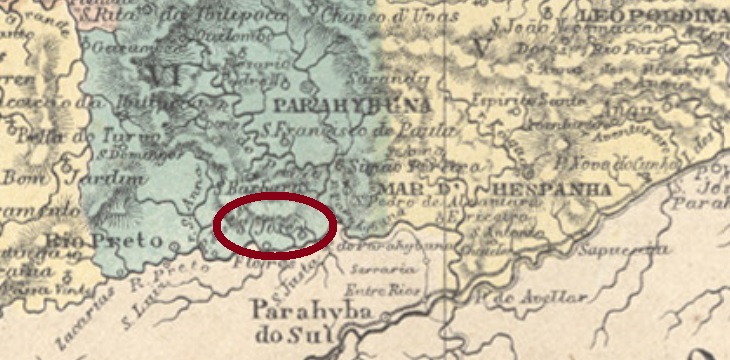
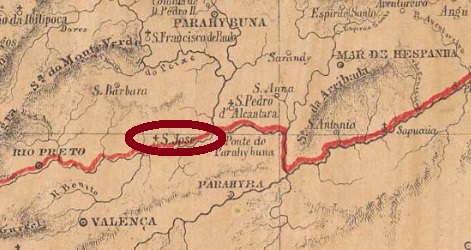
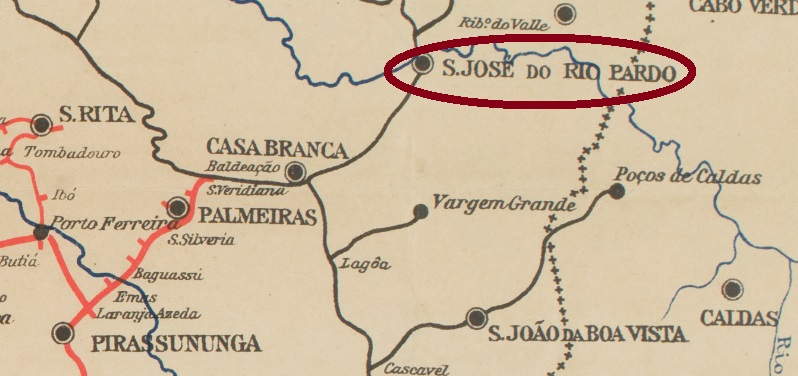
From April 1874, this village was a freguesia near Casa Branca, located on the southern bank of the Rio Pardo, about 260 km north of the provincial capital São Paulo. In May 1877, it became a district of Caconde, which in April 1880 changed to the municipality of Casa Branca. Since March 1885, the town has been a villa in the municipality of Rio Pardo, and became a town in May 1891.
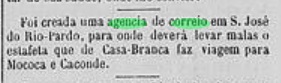
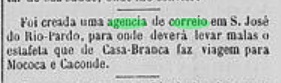
The local post office was established in July 1879, as can be read in the press in São Paulo:
Jornal da Tarde, 1 August 1879
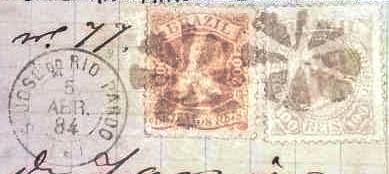
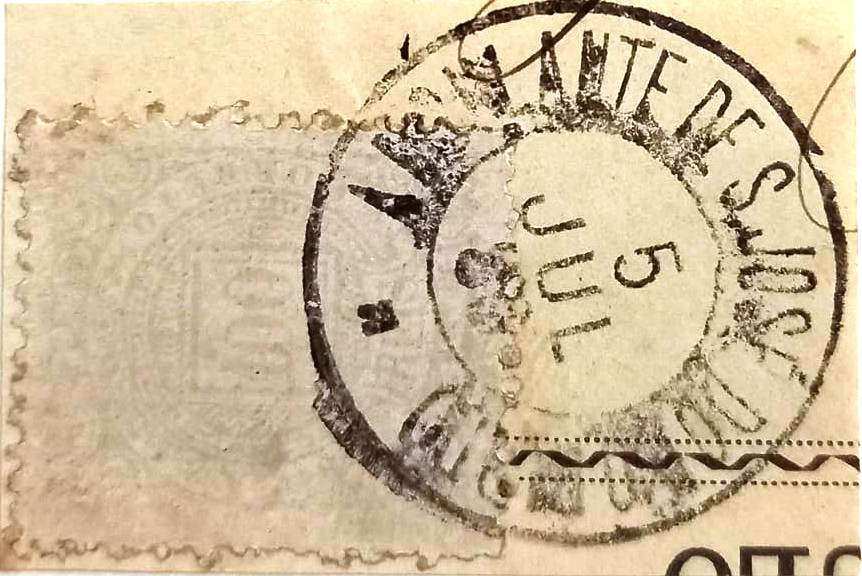
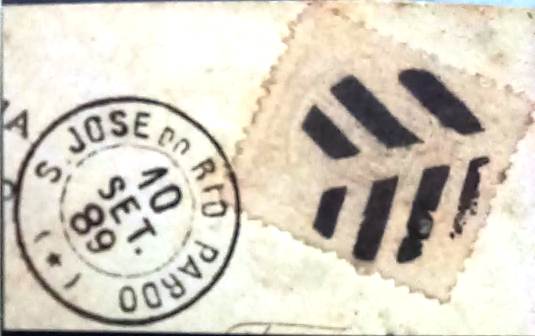
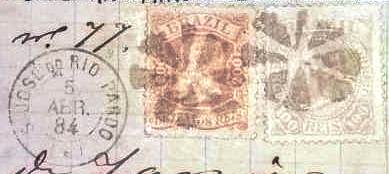
One local and one mute cancel were found. SSP-1180a (Coll. Fuad Ferreira Fo.) is a French type, with the inscription S. JOSÉ DO RIO PARDO above and the typical star between brackets below. The dates inside were found for the period 1884-1890. The mute cancellation (Coll. Fuad Ferreira Fo.) was found on a fragment from 1884, in connection with SSP-1180:
SSP-1180a (Coll. Fuad Ferreira Fo.) 1884
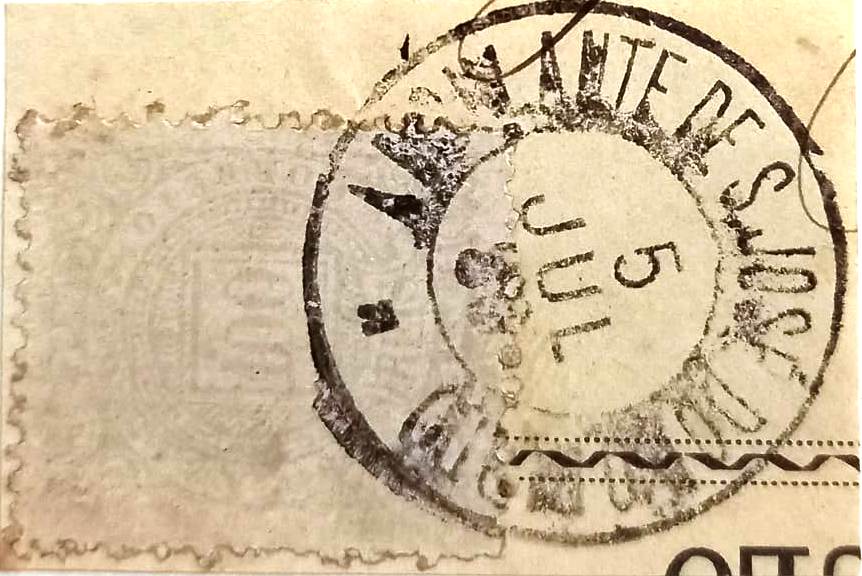
After the opening of the train station in 1887 with the construction of a line branch from Casa Branca, a cancellation for itinerant railway mail was also used. As this postmark has not yet been seen in Carimbologia S2, SSP-1181a is shown here:
SSP-1181a (Coll. Fuad Ferreira Fo.) 1889
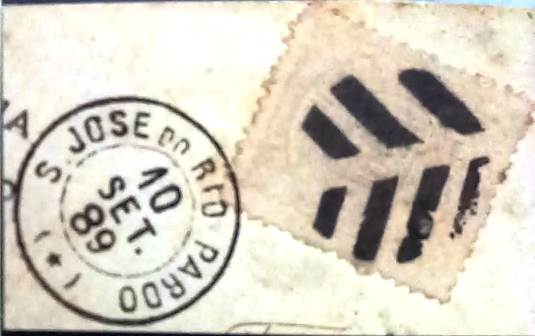
In the meantime, another mute cancel from this locality has also shown up, which was to be used at the end of the Empire in connection with SSP-1180a. However, caution is advised here, as such a late date and a hitherto unknown design are very unusual:
1889 (Coll. Fuad Ferreira Fo.)Companhia Paulista
Aktualisierung der Printausgabe, am 19. Dezember 2021
Diese Ortschaft war ab April 1874 eine Freguesia bei Casa Branca, die am Südufer des Rio Pardo lag, knapp 260 km nördlich der Provinzhauptstadt São Paulo entfernt. Im Mai 1877 wurde sie ein Distrikt von Caconde, der im April 1880 zum Município von Casa Branca wechselte. Seit März 1885 ist São José do Rio Pardo eine Villa im eigenen Município, die sich seit Mai 1891 eine Stadt nennen darf.
Das örtliche Postamt ist im Juli 1879 entstanden, wie aus der Presse im São Paulo hervorgeht:
Jornal da Tarde, 1. August 1879
Ein Orts- und ein stummer Stempel wurden gefunden. SSP-1180a (Samml. Fuad Ferreira Fo.) ist ein Französischer-Typ, mit der Inschrift S. JOSÉ DO RIO PARDO oben und dem typischen Stern zwischen Klammern unten. Die Daten in der Mitte wurden für den Zeitraum 1884-1890 gefunden. Der stumme Stempel (Samml. Fuad Ferreira Fo.) wurde auf einem Fragment aus 1884 gefunden, in Verbindung mit SSP-1180:
SSP-1180a (Samml. Fuad Ferreira Fo.) 1884
Nach der Eröffnung des Bahnhofs im Jahr 1887 durch den Bau einer Linienabzweigung von Casa Branca aus wurde auch eine Abstempelung für die ambulante Bahnpost verwendet. Da dieser Poststempel in Carimbologia S2 noch nicht zu sehen war, wird SSP-1181a hier gezeigt:
SSP-1181a (Samml. Fuad Ferreira Fo.) 1889
Inzwischen ist auch ein weiterer stummer Stempel aus dieser Ortschaft aufgetaucht, der am Ende des Kaiserreichs in Verbindung mit SSP-1180a verwendet werden sollte. Allerdings ist hier Vorsicht geboten, da solch ein spätes Datum und auch ein bisher unbekanntes Muster sehr unüblich sind:
José Ribeiro Lisboa: Mappa da Provincia de São Paulo, 1884
Other names: Nuretama (1944), Campos Novos Paulista (1948)
See also Campos Novos do Paranapanema (R. Koester: Carimbologia VIII)
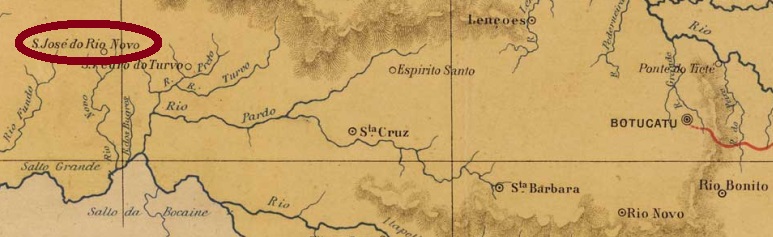
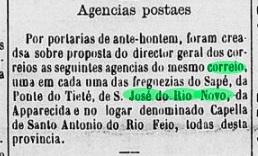
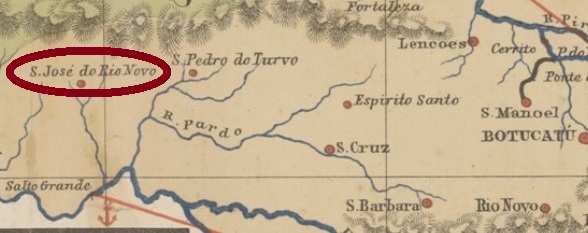
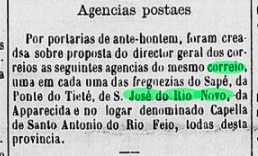
In the imperial province of São Paulo, there were two others that bring a risk of confusion with this village (SSP-1178): Rio Novo (RSP-1125) and São José do Paranapanema (SSP-1175). This São José do Rio Novo was a settlement on the eastern bank of the Novo River, a tributary of the Paranapanema – located about 400 km west of the provincial capital São Paulo. In April 1880, it became a district of Santa Cruz do Rio Pardo, bearing the long name of São José do Rio Novo de Campos Novos do Paranapanema. In March 1885, it became a villa in his own municipality and in December 1906 a town. After that, the municipality must have fared so badly economically that in November 1944 it was degraded to a district called Nuretama in the municipality of Ibirarema. But four years later, in December 1948, it rose again – to the still current municipality of Campos Novos Paulista.
The local post office was established in April 1881, as can be read from the press in São Paulo:
Jornal da Tarde, April 9, 1881
A cancel of the imperial period was found, apparently a French-type: SSP-1178a (Coll. José A. Junges) has a double circle with the inscription S. JOSÉ DO RIO NOVO above and apparently a star between brackets below. Dates inside from 1889 to 1896. For cancels with CAMPOS NOVOS DO PARANAPANEMA see Koester, Carimbologia VIII.
Provincia de São Paulo, 1886
Andere Namen: Nuretama (1944), Campos Novos Paulista (1948)
Siehe auch Campos Novos do Paranapanema (R. Koester: Carimbologia VIII)
In der kaiserlichen Provinz São Paulo gab es – außer dieser Ortschaft – zwei weitere, die durch ihre Namen Verwechslungsgefahr damit bringen: Rio Novo (RSP-1125) und São José do Paranapanema (SSP-1175). Dieser São José do Rio Novo war eine Siedlung am Ostufer des Rio Novo – ein Zufluss des Paranapanema – die gut 400 km westlich der Provinzhauptstadt São Paulo entfernt lag. Im April 1880 wurde der Ort ein Distrikt von Santa Cruz do Rio Pardo, unter dem langen Namen São José do Rio Novo de Campos Novos do Paranapanema. Im März 1885 wurde er eine Villa im eigenen Município und im Dezember 1906 eine Stadt. Danach muss es der Gemeinde wirtschaftlich so schlecht ergangen sein, dass sie im November 1944 zu einem Distrikt namens Nuretama im Município von Ibirarema wurde. Aber vier Jahre später, im Dezember 1948, stieg sie wieder auf – zum noch aktuellen Município von Campos Novos Paulista.
Das örtliche Postamt entstand im April 1881, wie aus der Presse in São Paulo entnommen werden kann:
Jornal da Tarde, 09.04.1881
Ein Stempel der Kaiserzeit war zu finden, scheinbar ein Französischer-Typ: SSP-1178a (Samml. José A. Junges) hat einen Doppelkreis mit der Inschrift S. JOSÉ DO RIO NOVO oben und – wie es aussieht – einen Stern zwischen Klammern unten. Daten in der Mitte: 1889-1896. Für Stempel mit CAMPOS NOVOS DO PARANAPANEMA siehe Koester, Carimbologia VIII.
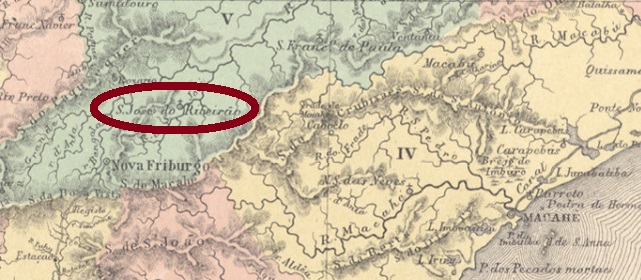
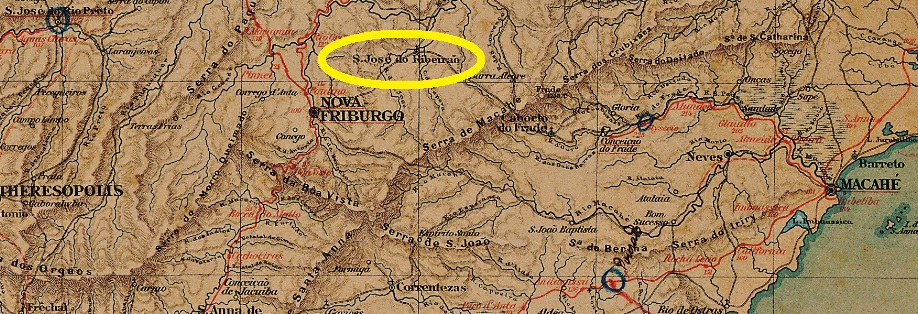
From May 1850, this village was a freguesia of Nova Friburgo, located about 200 km northeast of the imperial capital Rio de Janeiro. In December 1892, it became a district of Bom Jardim. After that, the place name changed twice. In December 1938 to Ribeirão and five years later to Paraim, before the original name finally returned in October 1949.
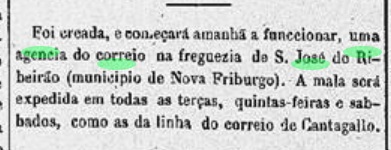
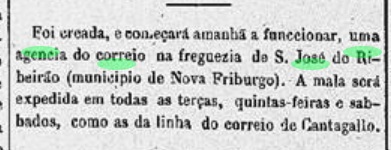
In the Imperial Mail Register (Tabella das Agencias do Correio do Imperio) of 1885, the local post office is listed from 1877, but apparently the operation only began the following year, as can be read in the Rio press:
Diario do Rio de Janeiro, 18 January 1878
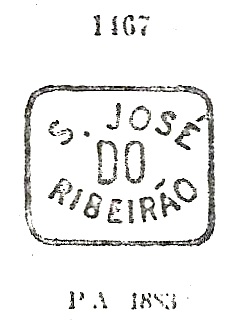
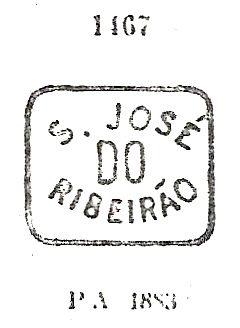
Three early postmarks from there are known. SRJ-1455a is the first one, as registered by Paulo Ayres (Catalogo de Carimbos Brasil-Império, S. Paulo, 1937, 1942) under No. 1467:
SRJ-1455a (P. Ayres 1467) 1877ff-1884ff
It was followed by SRJ-1455b (Coll. José A. Junges): a double circle with the inscription S. JOSÉ DO RIBEIRĀO above and an ornament in diamond form at the bottom, consisting of four small diamonds. Dates inside from ca.1887 to 1890. The last cancel will already be Republican: SRJ-1455c (image from the Internet) is also a double circle. The inscription above is now S. JE do RIBEIRÃO, there is an ornament in cross below. Dated 1896-1897 inside.
Almanak Laemmert, 1892
Andere Namen: Ribeirão, Paraim
Diese Ortschaft war ab Mai 1850 eine Freguesia von Nova Friburgo, die knapp 200 km nordöstlich der kaiserlichen Hauptstadt Rio de Janeiro lag. Im Dezember 1892 wurde sie ein Distrikt von Bom Jardim. Danach wechselte der Ortsname zweimal. Im Dezember 1938 zu Ribeirão und fünf Jahre später zu Paraim, bevor der ursprüngliche Name im Oktober 1949 definitiv zurückkehrte.
Ihm folgte SRJ-1455b (Samml. José A. Junges): ein Doppelkreis mit der Inschrift S. JOSÉ DO RIBEIRĀO oben und einem Ornament in Raute unten, das aus vier kleinen Rauten besteht. Daten in der Mitte von 1887 bis 1890. Der letzte Stempel wird bereits republikanisch sein: SRJ-1455c (Abb. aus dem Internet) ist auch ein Doppelkreis. Die Inschrift oben lautet nun S. JE do RIBEIRÃO, unten sieht man ein Ornament in Kreuz. Datiert 1896-1897 in der Mitte.
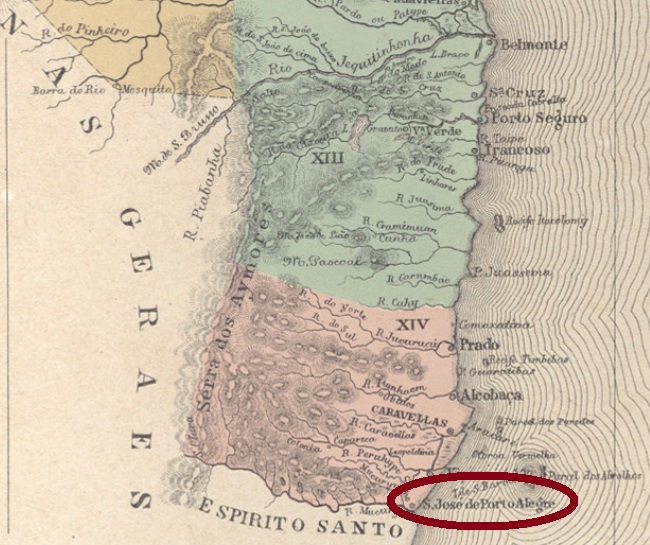
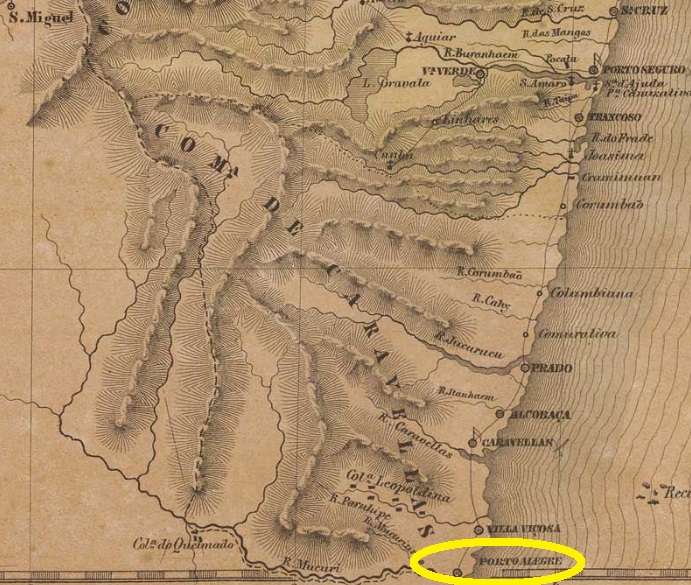
This village was an old freguesia on the beach of Viçosa, which rose to a villa already in October 1769, and was located north of the mouth of the Mucury River, 900 km south of the former colonial capital Salvador da Bahia. In January 1931, the place name was changed to Mucury, now written Mucuri.
Three different dates were found for the creation of the local postal agency. The oldest of these would be July 1855, as Aureo G. Santos reports in Agências de Correio Criadas e Suprimidas 1851, 1855, 1856 e 1857 (in Brasil Filatélico 181, Rio de Janeiro, 1977):
Aureo Santos (op. cit.)
Nova Monteiro lists the post office in Administrações e Agencias Postaes do Brasil Imperio (in Brasil Filatelico/RJ, 1934-5; Reprint SPP 1994-1999) of December 1855), and the Imperial Mail Register (Tabella das Agencias do Correio do Imperio) of 1885 writes the year 1867. Apparently the post office was closed there at least once.
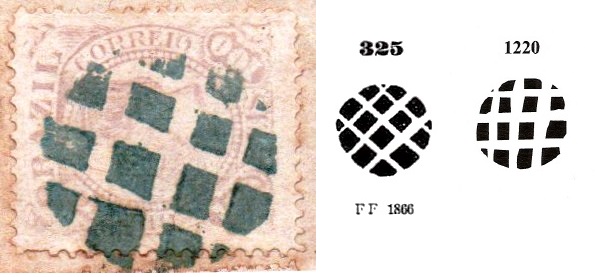
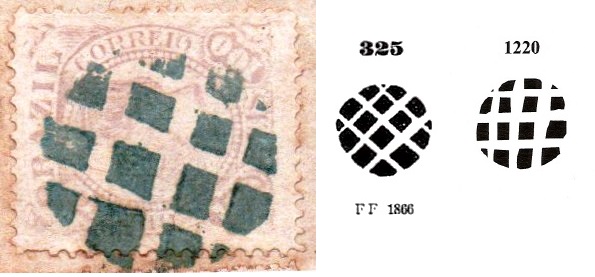
A local cancel and a mute cancellation were found, both from near the end of the Empire. SBA-0625b (Coll. José A. Junges) has a double circle with the inscription S. J. DE PORTO ALEGRE above. The dates inside vary from 1881 until 1883. The mute cancel was found on a fragment from 1883 and bears great resemblance to cancel No.325 by Paulo Ayres (Catalogo de Carimbos Brasil-Império, S. Paulo, 1937, 1942), as well as to cancel No. 1220 by J. Dingler and K. W. Lopes (Mute Cancellations of the Brazil Empire / Carimbos Mudos do Brasil Império, Brazil Philatelic Association, Rio de Janeiro, 2000):
1883 (Coll. José A. Junges) – P. Ayres 325 – BPA 1220Villiers de l’Ile Adam: Carta (…) da Provincia da Bahia, 1848
Andere Namen: Porto Alegre, Mucury
Diese Ortschaft war eine alte Freguesia am Strand von Viçosa, die bereits in der Kolonialzeit, im Oktober 1769, zur Villa erhoben wurde und nördlich der Mündung des Flusses Mucury lag, 900 km südlich der ehemaligen Kolonialhauptstadt Salvador da Bahia entfernt. Im Januar 1931 wurde der Ortsname zu Mucury geändert, der sich heute Mucuri schreibt.
Ein Ortsstempel und eine stumme Entwertung wurden gefunden, beide aus späteren Betriebszeiten im Kaiserreich. SBA-0625b (Samml. José A. Junges) hat einen Doppelkreis mit der Inschrift S. J. DE PORTO ALEGRE oben. Die Daten in der Mitte wurden für die Jahre 1881-1883 gefunden. Der stumme Stempel wurde auf einem fragment von 1883 gefunden und zeit große Ähnlichkeit mit dem Stempel Nr.325 von Paulo Ayres (Catálogo de Carimbos Brasil-Império, S. Paulo, 1937, 1942), der Stempel-Nr. 1220 von J. Dingler und K. W. Lopes (Mute Cancellations of the Brazil Empire / Carimbos Mudos do Brasil Império, Brazil Philatelic Association, Rio de Janeiro, 2000) entspricht:
1883 (Samml. José A. Junges) – P. Ayres 325 – BPA 1220



 Carimbologia