Categories
Carimbologia S

São Gothardo, Minas Gerais (SMG-2340)

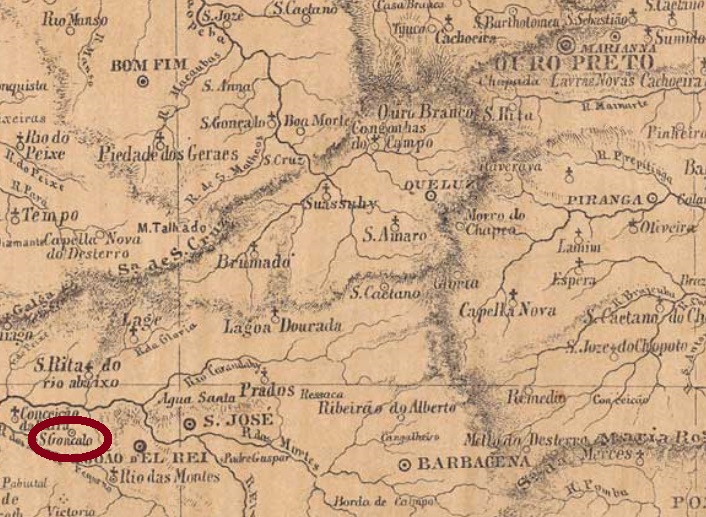
Provincia de Minas Geraes, 1873

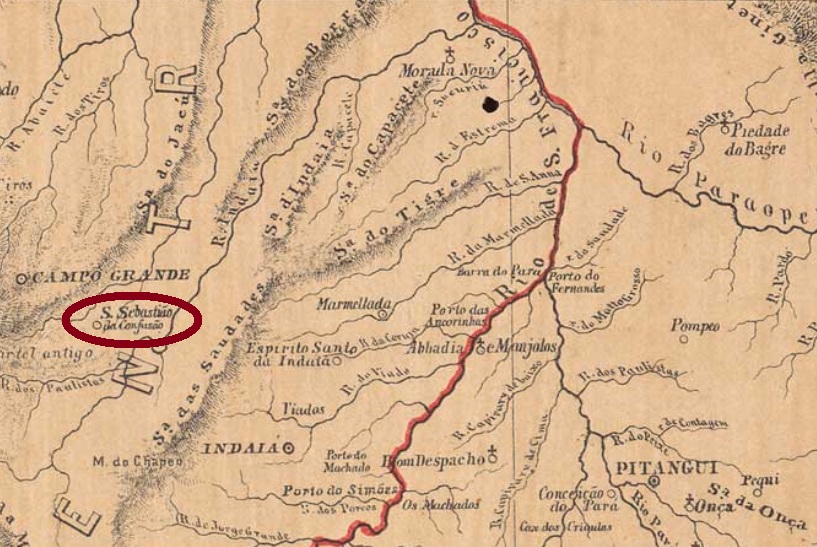
Other names: São Sebastião da Confusão, São Sebastião de Pouso Alegre

See also São Sebastião de Pouso Alegre (SMG-2247)

São Gothardo (today written Gotardo) was the third name of this village in the province of Minas Gerais, located near Pitangui, about 400 km west of the capital Ouro Preto. At the beginning, the Arraial (settlement) was called S. Sebastião da Confusão, i.e. Saint Sebastian of Confusion. Such a name was apparently too bizarre for the authorities, so in May 1852 the place was officially renamed to São Sebastião de Pouso Alegre, although the old name remained in use. In July 1868, the town changed to the new municipality of Dores do Indayá, and it was not until August 1885 that it was called São Gothardo. After that, it changed the municipality twice: in November 1890 to Carmo do Paranahyba, and in August 1911 to Rio Paranahyba. Since September 1914, São Gotardo has been an independent municipality.

According to Paula Sobrinho (História Postal de Minas Gerais, Belo Horizonte, 1997), there has been a post office there since November 1883, at a time when the place was still called São Sebastião de Pouso Alegre. Since postmarks with S. SEBASTIÃO DE POUSO ALEGRE with dates from 1887 to 1896 have been found so far, we must fear that all São Gothardo cancels are Republican. Anyway, the oldest among them is SMG-2340a (Coll. Dieter Kerkhoff): a double circle with the inscriptions S. GOTHARDO above and (MINAS) below. The dates seen so far go from 1897 to 1902.   
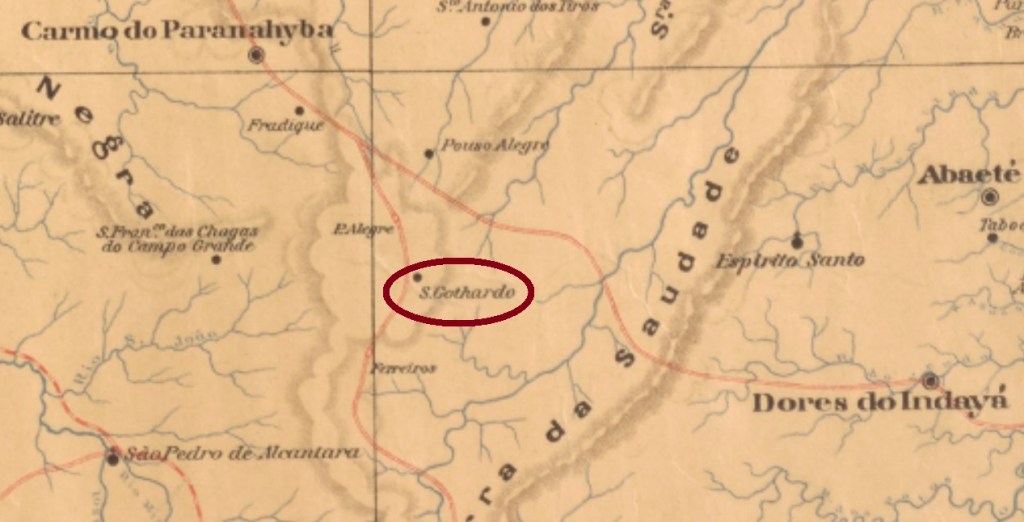
Mappa de Minas Geraes, 1910

Andere Namen: São Sebastião da Confusão, São Sebastião de Pouso Alegre

Siehe auch São Sebastião de Pouso Alegre (SMG-2247)

São Gothardo (heute Gotardo geschrieben) war der dritte Name dieser Ortschaft der Provinz Minas Gerais, die bei Pitangui, knapp 400 km westlich der Hauptstadt Ouro Preto entfernt lag. Zu Beginn hieß der Arraial (Siedlung) São Sebastião da Confusão, also Heiliger Sebastian der Verwirrung. Solcher Name war der Obrigkeit offenbar zu bunt, also wurde der Ort im Mai 1852 offiziell zu São Sebastião de Pouso Alegre umbenannt, obwohl der alte Name weiterhin in Gebrauch blieb. Im Juli 1868 wechselte der Ort zum neuen Municipio von Dores do Indayá, und erst im August 1885 hieß er dann São Gothardo. Er wechselte noch zweimal seine Zuständigkeit: im November 1890 zu Carmo do Paranahyba, und im August 1911 zu Rio Paranahyba. Seit September 1914 ist São Gotardo ein eigenständiger Município.

Laut Paula Sobrinho (História Postal de Minas Gerais, Belo Horizonte, 1997) gibt es dort ein Postamt seit November 1883, also zu einer Zeit, als der Ort noch São Sebastião de Pouso Alegre hieß. Da bisher Poststempel mit S. SEBASTIÃO DE POUSO ALEGRE mit Daten von 1887 bis 1896 gefunden wurden, müssen wir befürchten, dass alle São Gothardo-Stempel republikanisch sind. Wie es dem auch sei, ist der älteste davon SMG-2340a (Samml. Dieter Kerkhoff): ein Doppelkreis mit den Inschriften S. GOTHARDO oben und (MINAS) unten. Die bisher gesehenen Daten entstammen dem Zeitraum 1897-1902.    
Categories
Carimbologia S

São Gonçalo de Una, Pernambuco (SPE-0535)

Atlas do Imperio do Brasil, 1868

Other names: Nossa Senhora da Purificação de Sao Gonçalo do Una, Freguesia do Una, Propriedade do Una, Una

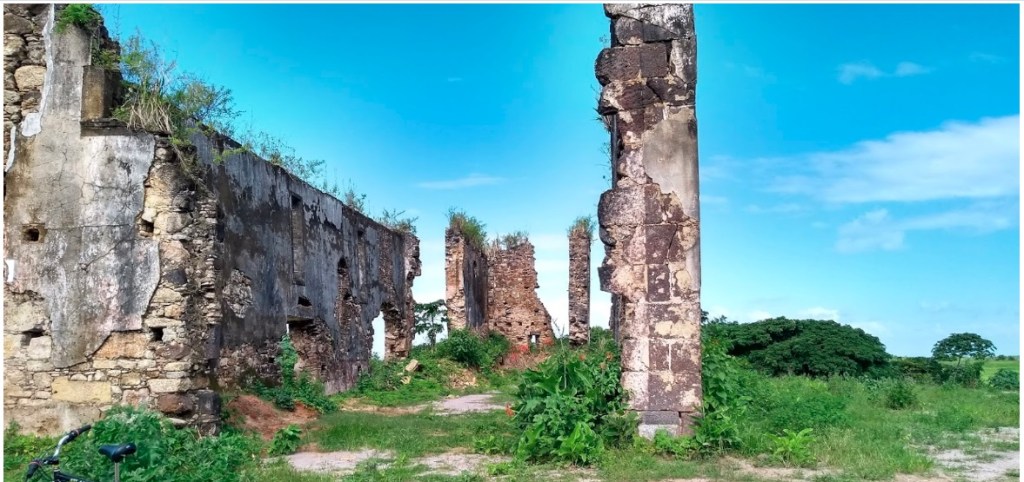
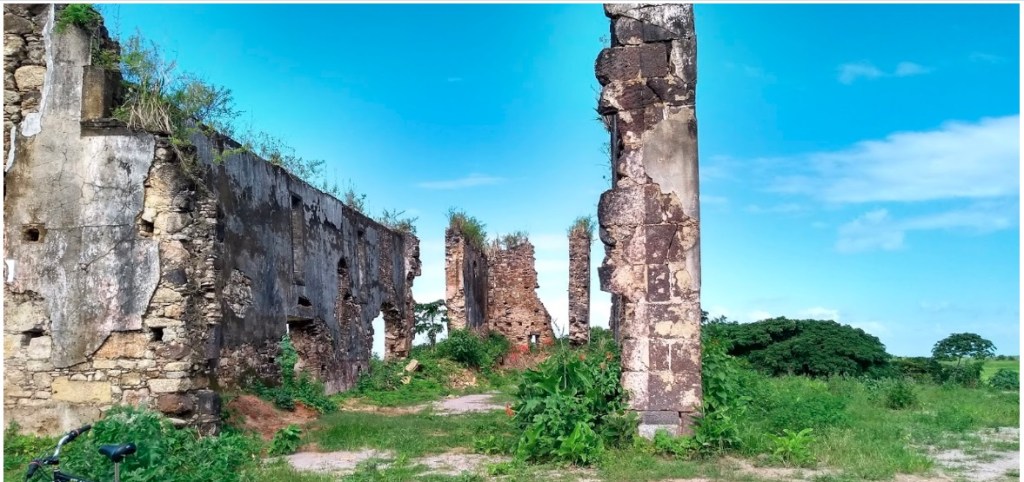
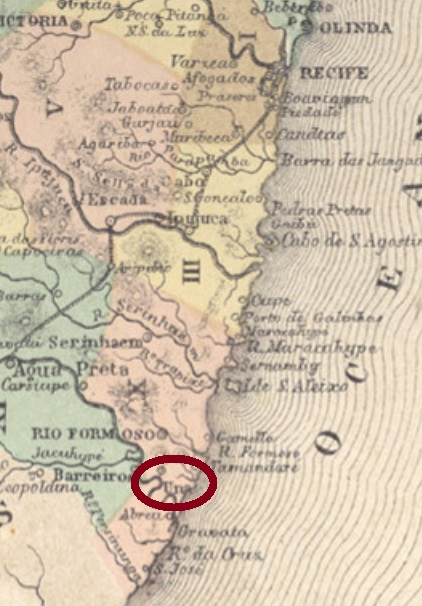
This is another village in imperial Brazil that has disappeared from the map today. The freguesia of Nossa Senhora da Purificação de Sao Gonçalo do Una, located about 110 km south of Recife, was already mentioned in the 17th century and is said to have had one of the most beautiful churches along the coast of Pernambuco. In May 1861, the district of Rio Formoso was established under the official name Propriedade do Una and passed to the municipality of Barreiros around 1930. In the 19th century this village was very prosperous, with 5 large sugar processing plants (Engenhos), but today only the church ruins remain:

Photo: Jonatas Jon, 2019 (Google-CC)

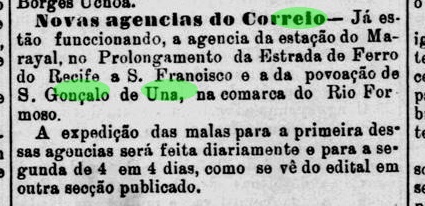
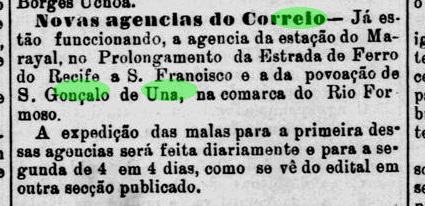
Two creation dates for the local post office were found; since both are well documented, we can assume that the agency has been closed in between. The Postal Reports of 1856, 1857 and 1886 write 1854 as the creation year for the post office. The press from Recife reports on a reopening in October 1886:

Jornal de Recife, 12 October 1886

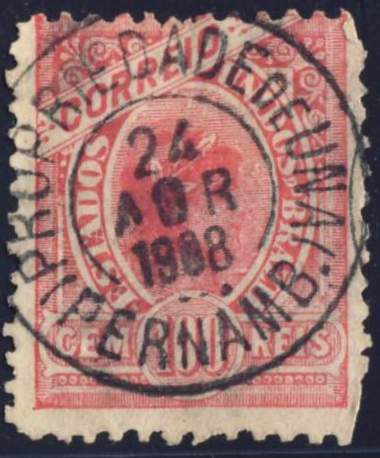
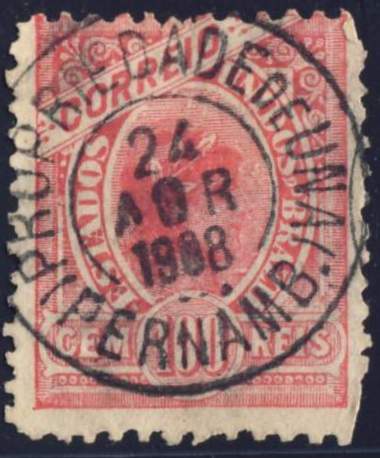
Until now, no imperial postmark could be found under this place name. It is quite possible that there are some under UNA, and from the early Republic a cancel with PROPRIEDADE DE UNA is known:

Coll. Dieter Kerkhoff

There is also a confusion risk with two other post offices along the Una River: São Bento do Una (see São Bento/PE, SPE-0525) and Una train station (later Palmares).

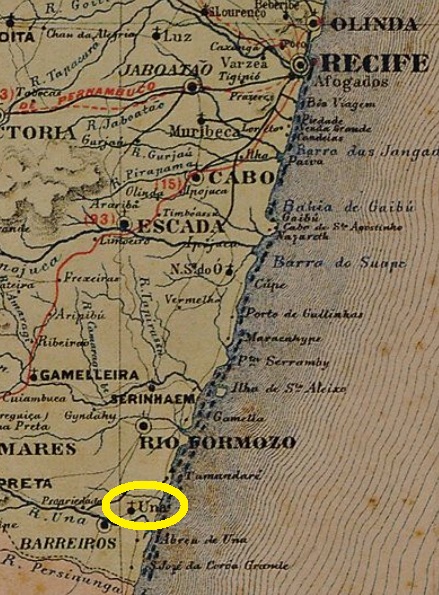
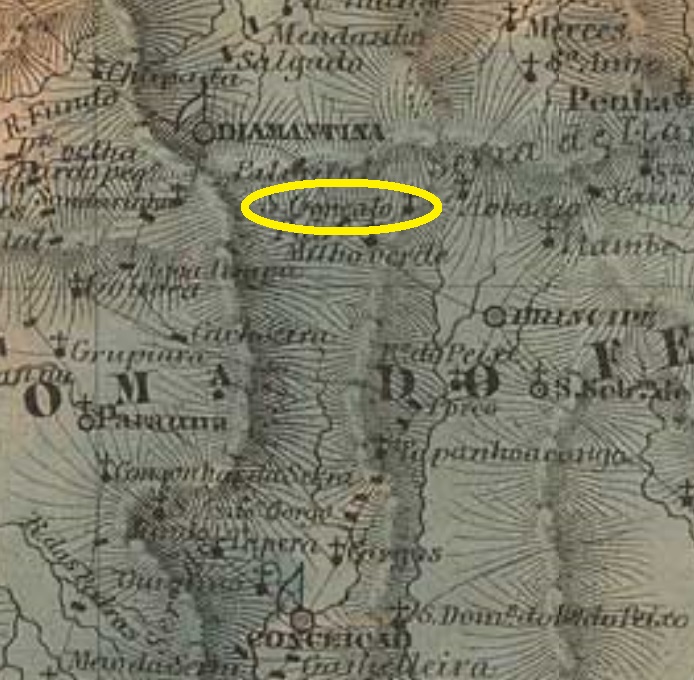
Carta Corographica da Provincia de Pernambuco, 1880

Andere Namen: Nossa Senhora da Purificação de São Gonçalo do Una, Freguesia do Una, Propriedade do Una, Una

Diese ist eine weitere Ortschaft im imperialen Brasilien, die heute aus der Landkarte verschwunden ist. Die Freguesia von Nossa Senhora da Purificação de São Gonçalo do Una lag ca. 110 km südlich von Recife, wurde bereits im 17. Jahrhundert urkundlich erwähnt und soll eine der schönsten Kirchen entlang der Küste Pernambucos gehabt haben. Im Mai 1861 wurde zum Distrikt von Rio Formoso unter dem offiziellen Namen Propriedade do Una erhoben und ging irgendwann um 1930 zum Município von Barreiros über. Im 19. Jahrhundert war dieses Dorf sehr wohlhabend, mit 5 Großbetrieben zur Zuckerverarbeitung (Engenhos), aber heute sind nur noch die Kirchenruinen da:

Foto: Jonatas Jon, 2019 (Google-CC)

Zwei Gründungsdaten fürs örtliche Postamt wurden gefunden; da beide gut belegt sind, können wir davon ausgehen, dass die Agentur zwischendurch geschlossen wurde. Die Postberichte von 1856, 1857 und 1886 schreiben den 1854 als Entstehungsjahr des Postamts. Über eine Wiedereröffnung im Oktober 1886 berichtet die Presse aus Recife:

Jornal de Recife, 12. Oktober 1886

Bisher konnte kein Poststempel der Kaiserzeit unter diesem Ortsnamen gefunden werden. Es ist gut möglich, dass es welche unter UNA gibt, und aus der frühen Republik ist eine Entwertung mit PROPRIEDADE DE UNA bekannt:

Samml. Dieter Kerkhoff

Ferner besteht Verwechslungsgefahr mit zwei weiteren Postämtern am Fluss Una: São Bento do Una (siehe São Bento/PE, SPE-0525) und Bahnhofspostamt Una (später: Palmares).

Categories
Carimbologia S

São Gonçalo do Serro, Minas Gerais (SMG-2335)

Villieers de l’Ile Adam: Carta (…) da Provincia de Minas Geraes, 1849

Text update on November 27, 2021

Other name: São Gonçalo do Rio das Pedras

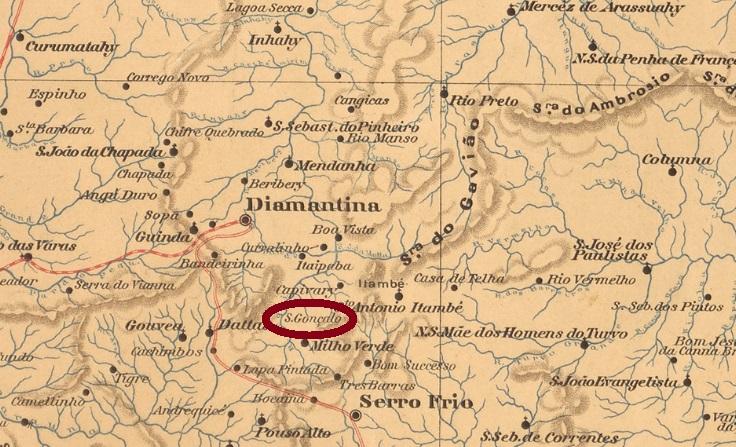
From 1857 (or 1867, the sources diverge) this São Gonçalo was a parish in the municipality of Serro, which is also called the Sao Gonçalo do Rio das Pedras, located almost 400 km north of the provincial capital Ouro Preto. The Rio das Pedras is a small tributary of the Jequitinhonha, which has very nice, small waterfalls.

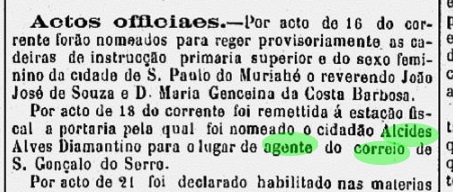
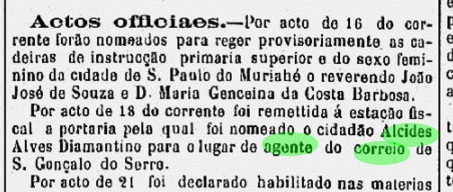
Two different sources state that the local post office was created in 1881. Paula Sobrinho (História Postal de Minas Gerais, Belo Horizonte, 1997) writes the month of November for this, while in the postal report (Relatório Postal) for 1886 it is July. Moreover, a press release of 1869 reveals that the agency had been in operation at that time:

Noticiador de Minas, 28 September 1869

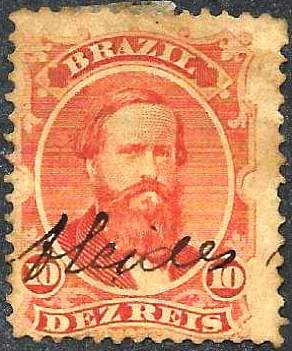
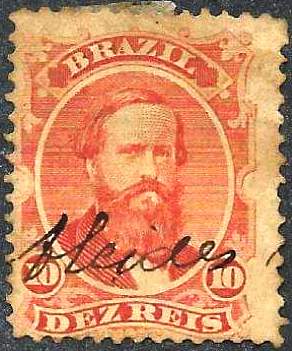
A newly discovered handwritten cancellation could be made by the referred post clerk, for no other agent called Alcides is known within that period in Brazil:

1869ff (coll. FM)

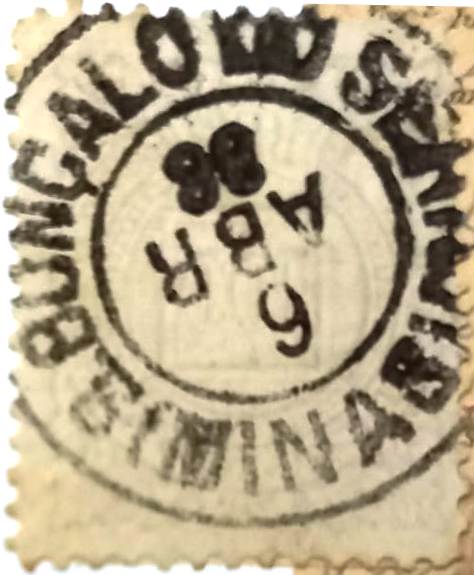
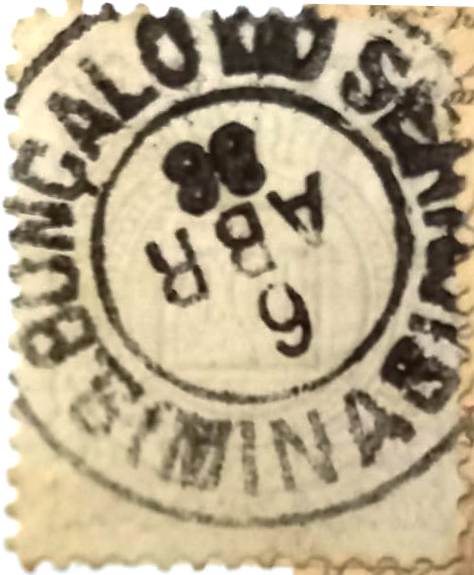
Two postmarks of the imperial period have been recorded. SMG-2335a (Coll. José A. Junges) consists of a circle with the inscription S. GONÇALO DO S(ERRO) above and possibly an ornament below, which was unfortunately not visible in the only copy found. Dated ca. 1884 at the centre. SMG-2335b was recently located in the Fuad Ferreira Fo. collection. As it was not shown in Carimbologia S1, here it is:

Coll. Fuad Ferreira Fo. (1888)
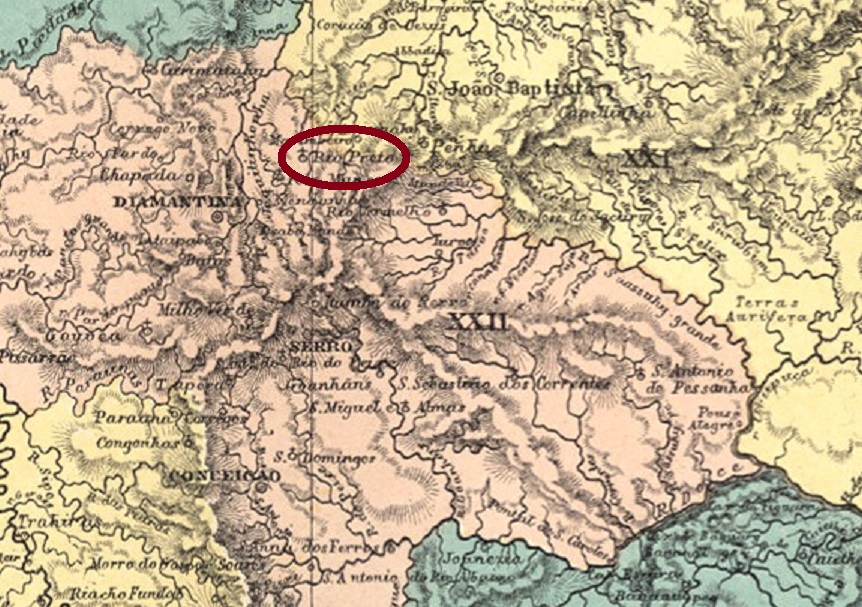
Mappa de Minas Geraes, 1910

Textaktualisierung vom 27. November 2021

Anderer Name: São Gonçalo do Rio das Pedras

Dieser São Gonçalo war ab 1857 (oder 1867, die Quellen sind sich nicht einig) eine Pfarrei im Município von Serro, die auch São Gonçalo do Rio das Pedras heißt und fast 400 km nördlich der Provinzhauptstadt Ouro Preto entfernt liegt. Der Rio das Pedras ist ein kleiner Zufluss des Jequitinhonha, der sehr schöne, kleine Wasserfälle aufweist.

Zwei Quellen behaupten, das örtliche Postamt wurde 1881 gegründet. Paula Sobrinho (História Postal de Minas Gerais, Belo Horizonte, 1997) schreibt dafür den Monat November, während es im Postbericht (Relatório Postal) für 1886 Juli steht. Dennoch zeigt eine Zeitungsnotiz aus 1869, dass bereits damals diese Agentur ihren Betrieb aufnahm:

Noticiador de Minas, 28. September 1869

Eine gerade wiederentdeckte handschriftliche Entwertung könnte vom genannten Postangestellter stammen, da kein weiterer Agent namens Alcides im ganzen Brasilien damals bekannt war:

1869ff (Samml. FM)

Zwei Poststempel der Kaiserzeit sind überliefert. SMG-2335a (Samml. José A. Junges) besteht aus einem Kreis mit der Inschrift S. GONÇALO DO S(ERRO) oben und möglicherweise einem Ornament unten, das im einzig gefundenen Exemplar leider nicht mehr sichtbar war. Datiert ca. 1884 in der Mitte. SMG-2335b wurde kürzlich in der Sammlung von Fuad Ferreira Fo. gefunden. Da es in Carimbologia S1 nicht gezeigt wurde, hier ist es:

Samml. Fuad Ferreira Fo. (1888)

Categories
Carimbologia S

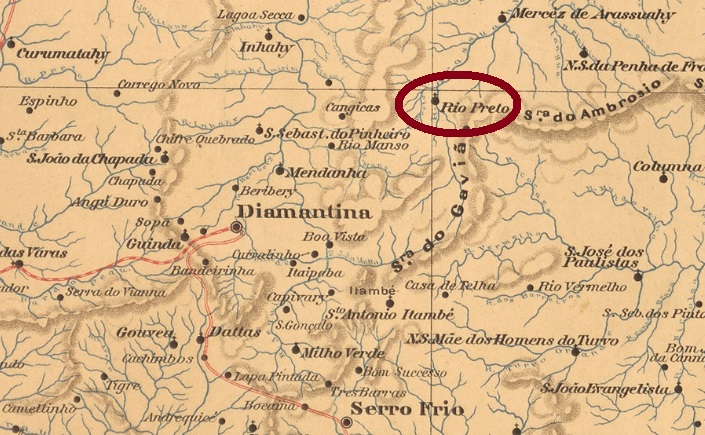
São Gonçalo do Rio Preto, Minas Gerais (SMG-2325)

Atlas do Imperio do Brasil, 1868

Other names: Rio Preto do Serro, Felisberto Caldeira (1923-1986)

Since October 1821, São Gonçalo do Rio Preto (also known as Rio Preto do Serro) was a freguesia near Diamantina, more than 400 km north of the future provincial capital Ouro Preto. It remained so until September 1923, when it was renamed as the district of Felisberto Caldeira. The name was to be reminiscent of Felisberto Caldeira Brant (ca. 1700-1756), a dazzling personality of the region. Caldeira Brant had received a concession for the exploitation of diamonds in Tejuco (now Diamantina). He became eventually very rich but lost everything due to a tax dispute with the Portuguese authorities. In December 1962, the village became an independent municipality, which since July 1986 has been again called São Gonçalo do Rio Preto.

Paula Sobrinho (História Postal de Minas Gerais, Belo Horizonte, 1997) and Nova Monteiro (Administrações e Agencias Postaes do Brasil Imperio, in Brasil Filatelico/RJ, 1934-5; Reprint SPP 1994-1999) agree that a post office was opened there in September 1866. However, the agency was later closed and reopened in 1880, as can be read in the Imperial Mail Register(Tabella das Agencias do Correio do Imperio) from 1885. A handwritten cancellation of the second operating period was found: SMG-2325a (Coll. Márcio Protzner) t was found on an issue from 1884. One reads “S. Gon” (çalo do Rio) Preto, (…) de 18 (…)”.

Mappa de Minas Geraes, 1910

Andere Namen: Rio Preto do Serro, Felisberto Caldeira (1923-1986)

São Gonçalo do Rio Preto – auch Rio Preto do Serro genannt – war schon im Oktober 1821 eine Freguesia bei Diamantina, die über 400 km nördlich der künftigen Provinzhauptstadt Ouro Preto entfernt lag. Und so blieb es bis September 1923, als es zum Distrikt von Felisberto Caldeira ernannt wurde. Der Name sollte an Felisberto Caldeira Brant (ca. 1700-1756) erinnern, eine schillernde Persönlichkeit der Region. Caldeira Brant hatte eine Konzession zur Ausbeutung von Diamanten in Tejuco (heute Diamantina) erhalten. Er wurde dadurch sehr reich, verlor aber alles durch einen Steuerstreit mit der portugiesischen Obrigkeit. Im Dezember 1962 wurde die Ortschaft ein eigenständiger Município, der seit Juli 1986 wieder São Gonçalo do Rio Preto heißt.

Paula Sobrinho (História Postal de Minas Gerais, Belo Horizonte, 1997) und Nova Monteiro (Administrações e Agencias Postaes do Brasil Imperio, in Brasil Filatelico/RJ, 1934-5; Reprint SPP 1994-1999) sind sich darüber einig, dass es dort ein Postamt im September 1866 eröffnet wurde. Allerdings war die Agentur später geschlossen und eröffnete 1880 wieder, wie im Verzeichnis der kaiserlichen Postämter (Tabella das Agencias do Correio do Imperio) aus 1885 zu lesen ist. Eine handschriftliche Entwertung der zweiten Betriebsperiode wurde gefunden: SMG-2325a (Samml. Márcio Protzner) war auf einer Marke aus 1884 anzutreffen. Man liest „S. Gonç(alo do Rio) Prêto, (…) de 18 (…)“

Categories
Carimbologia S

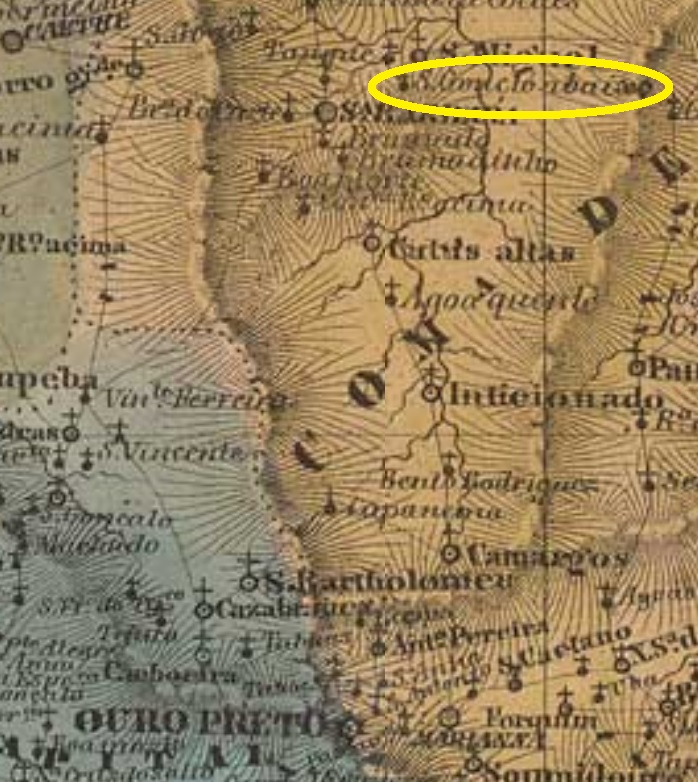
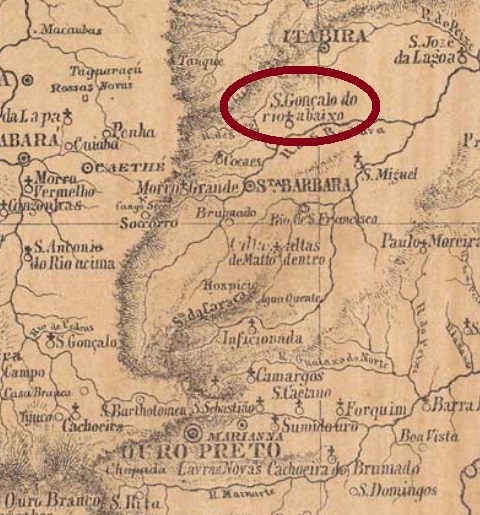
São Gonçalo do Rio Abaixo, Minas Gerais (SMG-2320)

Villiers de l’Ile Adam: Carta (…) da Provincia de Minas Geraes, 1849

São Gonçalo do Rio Abaixo (= of the Lower Course) was from June 1850 on a district in the municipality of Santa Bárbara, about 100 km north of the provincial capital Ouro Preto. This status remained until November 1962, when the village became its own municipality. The mentioned lower course refers to the Rio Santa Barbara; this is a tributary of the Rio Piracicaba, located in the southeast of Minas Gerais.

According to Paula Sobrinho (História Postal de Minas Gerais, Belo Horizonte, 1997), the local post office was established in August 1879. The only postmark of the imperial period is SMG-2330a (Coll. José A. Junges): a double circle with the inscription S. GONÇALO DO RIO ABAIXO above and an ornament at the bottom consisting of four diamonds in cross. The dates at the centre were found for the period 1887-1890.

Provincia de Minas Geraes, 1873

São Gonçalo do Rio Abaixo (= vom Unterlauf) war ab Juni 1850 ein Distrikt im Município von Santa Bárbara, der gut 100 km nördlich der Provinzhauptstadt Ouro Preto entfernt lag. Dieser Status ist bis November 1962 erhalten geblieben, als die Ortschaft ein selbständiger Município wurde. Der genannte Unterlauf bezieht sich auf den Rio Santa Bárbara; dieser Zufluss des Rio Piracicaba liegt in Südosten von Minas Gerais.

Laut Paula Sobrinho (História Postal de Minas Gerais, Belo Horizonte, 1997) entstand das örtliche Postamt im August 1879. Der einzige Poststempel der Kaiserzeit ist SMG-2330a (Samml. José A. Junges): ein Doppelkreis mit der Inschrift S. GONÇALO DO RIO ABAIXO oben und einem Ornament unten, das aus vier Rauten in Kreuz besteht. Die Daten in der Mitte entstammen dem Zeitraum 1887-1890.

Categories
Carimbologia S

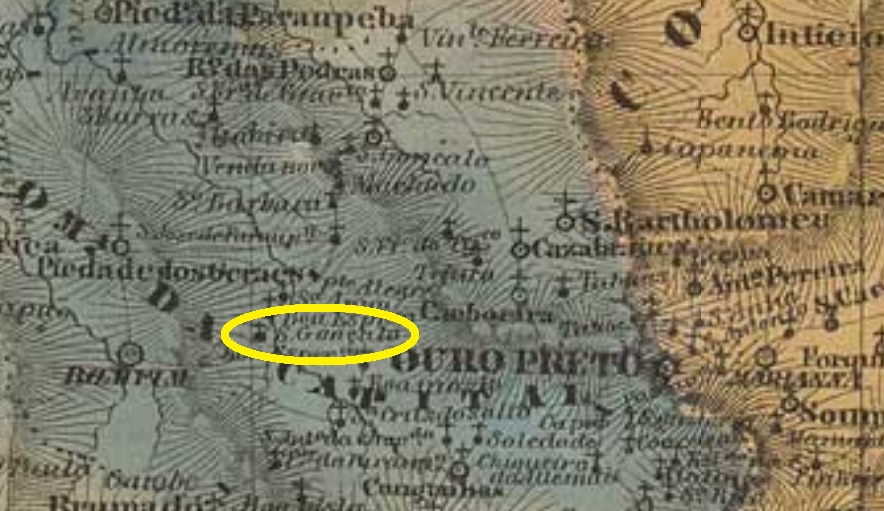
São Gonçalo da Ponte, Minas Gerais (SMG-2300)

Villiers de l’Ile Adam: Carta (…) da Provincia de Minas Geraes, 1849

Another name: Bello Valle (1914)

São Gonçalo da Ponte (= of the Bridge) was from July 1857 on a district in the municipality of Bomfim, located about 90 km west of the provincial capital Ouro Preto. In September 1914, the toponym changed to Bello Valle (now spelled Belo Vale), and under this name the village was given its political emancipation in December 1938.

According to Paula Sobrinho (História Postal de Minas Gerais, Belo Horizonte, 1997), the local post office was established in September 1887. Two early double-circle cancellations were found: SMG-2300a (Coll. Márcio Protzner) is the older one. Here are the inscriptions S. GONÇALO DA PONTE above and (MINAS) below. The only seen copy to date has a date of 1889 at the centre. At SMG-2300b (Coll. José A. Junges) the only difference consists in the inscription below, now (M. GERAES). So far, dates from 1894-1905 have been found, so this cancel will probably be Republican.

Provincia de Minas Geraes, 1873

Anderer Name: Bello Valle (1914)

São Gonçalo da Ponte (= der Brücke) war ab Juli 1857 ein Distrikt im Município von Bomfim, der ca. 90 km westlich der Provinzhauptstadt Ouro Preto entfernt lag. Im September 1914 änderte sich der Ortsname zu Bello Valle (heute Belo Vale geschrieben), und unter dieser Bezeichnung erhielt die Ortschaft ihre politische Emanzipation im Dezember 1938.

Laut Paula Sobrinho (História Postal de Minas Gerais, Belo Horizonte, 1997) entstand das örtliche Postamt im September 1887. Zwei frühe Doppelkreis-Stempel wurden gefunden SMG-2300a (Samml. Márcio Protzner) ist davon der erste. Hier lauten die Inschriften S. GONÇALO DA PONTE oben und (MINAS) unten. Das einzig vorhandene Exemplar trägt ein Datum von 1889 in der Mitte. Bei SMG-2300b (Samml. José A. Junges) besteht der einzige Unterschied daran, dass die untere Inschrift (M. GERAES) lautet. Bisher wurden Daten von 1894-1905 gefunden, dieser Stempel wird wohl republikanisch sein.

Categories
Carimbologia S

São Gabriel (Estrella), Rio Grande do Sul (SRS-0316) NEW! NEU!

In 1924 (colonias.heuser.pro.br)

Other names: São Gabriel da Estrella, Setembrina (1944-1949), Cruzeiro do Sul (1939-1944, 1949)

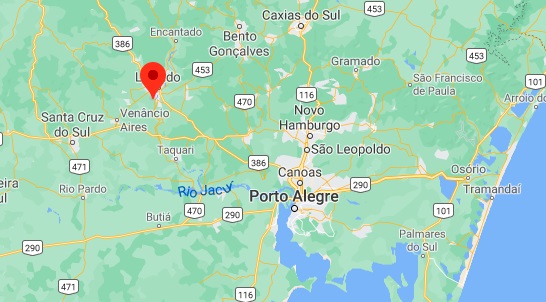
Since July 1883, São Gabriel was a chapel near Estrella, located on the west bank of the Taquary River, about 120 km northwest of the provincial capital Porto Alegre. In August 1922 it became a district, which was called Cruzeiro do Sul (South Cross) from June 1939. After almost five years under the toponym Setembrina (1944-1949), the old place name Cruzeiro do Sul returned for good. Since November 1963, Cruzeiro do Sul has been a municipality of its own.

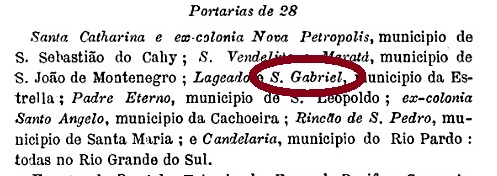
The local post office was established in October 1889, less than three weeks before the end of the Empire, as reported in the Postal Newsletter for November of that year:

Boletim Postal 7/ October 1889

So far, no imperial postmark for this village has been found.

Google Maps

Andere Namen: São Gabriel da Estrella, Setembrina (1944-1949), Cruzeiro do Sul (1939-1944, 1949)

São Gabriel war seit Juli 1883 eine Kapelle bei Estrella, die am Westufer des Flusses Taquary lag, gut 120 km nordwestlich der Provinzhauptstadt Porto Alegre entfernt. Im August 1922 wurde daraus ein Distrikt, der ab Juni 1939 Cruzeiro do Sul (Kreuz des Südens) hieß. Nachdem knapp fünf Jahre lang die Ortschaft Setembrina genannt wurde (1944-1949), kehrte der Ortsname Cruzeiro do Sul wieder. Seit November 1963 ist Cruzeiro do Sul ein eigener Município.

Das örtliche Postamt entstand im Oktober 1889, knapp drei Wochen vor dem Ende des Kaiserreichs, wie im Newsletter der Post für November d.J. vermerkt:

Boletim Postal 7/ Oktober 1889

Bisher konnte kein kaiserlicher Poststempel für diese Ortschaft gefunden werden.

Categories
Carimbologia S

São Gonçalo de Pedro II, Mato Grosso (SMT-0095)

Atlas do Imperio do Brasil, 1868

Other names: S. Gonçalo do Porto, S. Gonçalo do Amarante de Pedro II

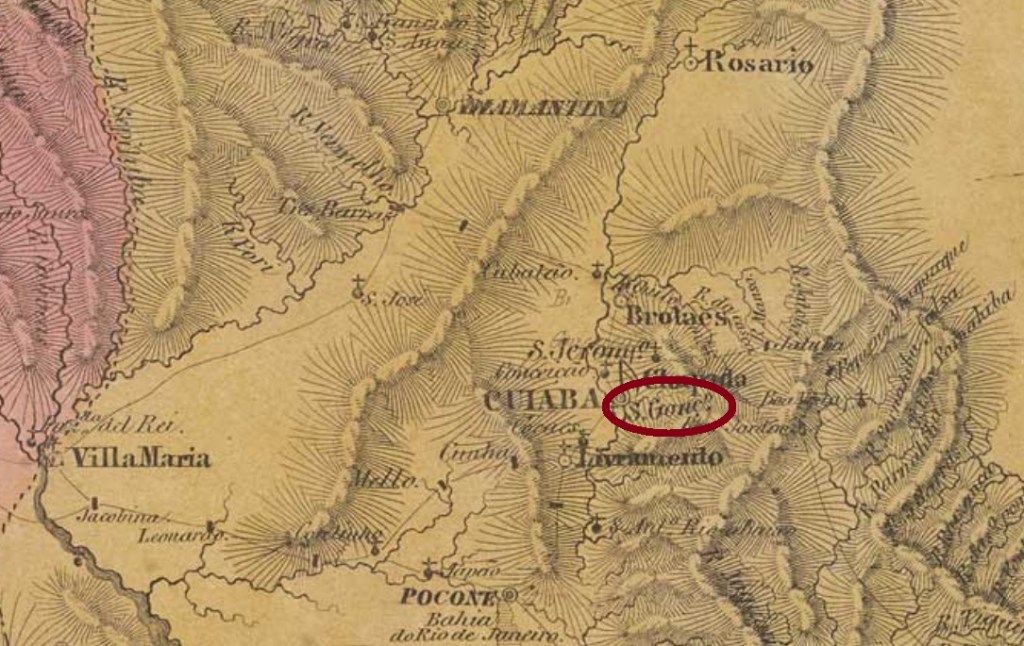
From August 1835 on, this was a southern district of Cuiabá, which was closer to the Cuiabá River. In April 1843 it became a freguesia, but sometime later the capital grew to the point where the village was incorporated. Today, it is a quarter of Cuiabá.

So far, no creation date has been found for the local post office. It is listed in the 1880 Postal Guide (Guia Postal do Império do Brazil), but it is no longer in the Imperial Post Register (Tabella das Agencias do Correio do Imperio) of 1885. Nor could any postmark of the imperial era be found.

Villiers de l’Ile Adam: Carta (…) da Provincia do Matto Grosso, 1850

Andere Namen: S. Gonçalo do Porto, S. Gonçalo do Amarante de Pedro II

São Gonçalo do Amarante de Pedro II war ab August 1835 ein südlicher Distrikt von Cuiabá, der näher am Fluss Cuiabá lag. Im April 1843 wurde daraus eine Freguesia, aber irgendwann ist die Hauptstadt so gewachsen, dass São Gonçalo eingemeindet wurde. Heute ist es ein Stadtteil Cuiabás.

Bisher konnte kein genaues Datum über das örtliche Postamt ermittelt werden. Im Postführer von 1880 (Guia Postal do Império do Brazil) wird es aufgelistet, aber im Verzeichnis der kaiserlichen Postämter (Tabella das Agencias do Correio do Imperio) von 1885 ist es nicht mehr zu sehen. Auch kein Poststempel der Kaiserzeit konnte gefunden werden.

Categories
Carimbologia S

São Gonçalo do Pará, Minas Gerais (SMG-2315)

Provincia de Minas Geraes, 1873

Print edition update from March 11, 2021

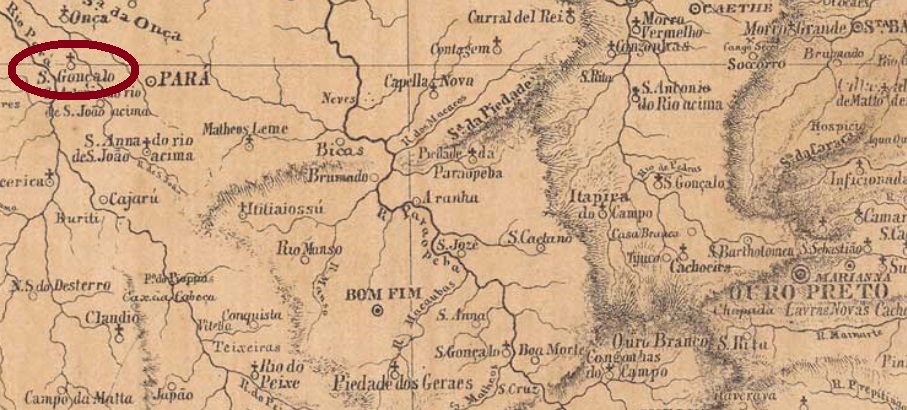
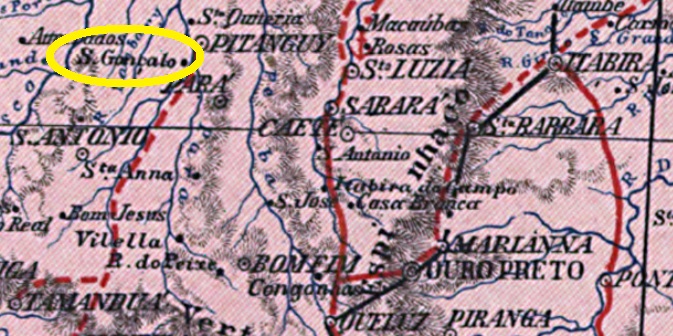
Pará is a former province of northern Brazil, now a state, but so was also called a municipality in Minas Gerais, today’s Pará de Minas. From May 1856, São Gonçalo was a freguesia of Pará, located more than 200 km west of the provincial capital Ouro Preto. Since December 1948, this village has been a municipality of its own.

As Paula Sobrinho writes in História Postal de Minas Gerais (Belo Horizonte, 1997), there has been a post office there since October 1881. In Carimbologia S1 we have already presented the stamp SMG-2315a (image from the Internet): a double circle with the inscription S. GONÇALO DO PARÁ above and an ornament in diamond form below, the four sides of which are open. Meanwhile, an earlier postmark was also found from there. SMG-2315b (Coll. Fuad Ferreira Fo.) was seen from a D. Pedro issue of 1883:

SMG-2315b (Coll. Fuad Ferreira Fo.)
Carta da Republica dos Estados Unidos do Brazil, 1892

Printausgabe-Aktualisierung vom 11. März 2021

Pará ist eine ehemalige Provinz – und heute Bundesstaat – Nordbrasiliens, aber so hieß auch eine Gemeinde in Minas Gerais, die heutige Pará de Minas. São Gonçalo do Pará war ab Mai 1856 eine Freguesia von Pará, die über 200 km westlich der Provinzhauptstadt Ouro Preto entfernt lag. Seit Dezember 1948 ist diese Ortschaft ein eigener Município.

Wie Paula Sobrinho in História Postal de Minas Gerais (Belo Horizonte, 1997) schreibt, gibt es dort ein Postamt seit Oktober 1881. In Carimbologia S1 haben wir bereits den Stempel SMG-2315a vorgestellt (Abb. aus dem Internet): ein Doppelkreis mit der Inschrift S. GONÇALO DO PARÁ oben und einem Ornament in Rautenform unten, dessen vier Seiten offen sind. Inzwischen fand sich auch ein früherer Poststempel von dort. SMG-2315b (Samml. Fuad Ferreira Fo.) war aus einer D. Pedro-Ausgabe von 1883 zu sehen:

SMG-2315b (Samml. Fuad Ferreira Fo.)

Categories
Carimbologia S

São Gonçalo de Ibituruna, Minas Gerais (SMG-2310)

Atlas do Imperio do Brasil, 1868

Another name: Ibituruna (1923)

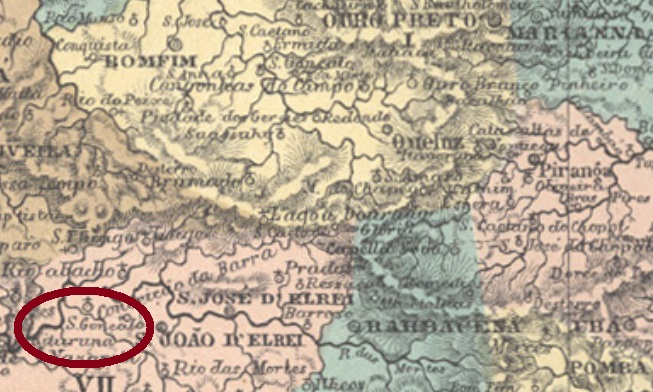
São Gonçalo de Ibituruna is said to be one of the oldest settlements in the Minas Gerais, but it was not until November 1865 that it became a freguesia in the municipality of São João d’El Rey, which was located on the Rio das Mortes, about 230 km southwest of the provincial capital Ouro Preto. In September 1923, the name changed to Ibituruna, which is an independent municipality since 1962. The word Ibituruna comes from the Tupi-guarani language and means black rock.

According to Paula Sobrinho (História Postal de Minas Gerais, Belo Horizonte, 1997), there has been a post office there since March 1883. An imperial cancel was found. SMG-2310a (Coll. José A. Junges) consists of a double circle with the inscription S. GONÇALO DE IBITURUNA at the top and a diamond-shaped ornament at the bottom, formed by four small diamonds. The dates at the centre are within the period 1885-1894.

Provincia de Minas Geraes, 1873

Anderer Name: Ibituruna (1923)

São Gonçalo de Ibituruna soll eine der ältesten Siedlungen im Minas Gerais sein, wurde aber erst im November 1865 eine Freguesia im Município von São João d’El Rey, die am Rio das Mortes, rund 230 km südwestlich von der Provinzhauptstadt Ouro Preto lag. Im September 1923 wechselte der Ortsname zu Ibituruna, und es ist eine eigenständige Gemeinde seit 1962. Das Wort Ibituruna kommt aus der Tupi-guarani-sprache und bedeutet Schwarzes Gestein.

Laut Paula Sobrinho (História Postal de Minas Gerais, Belo Horizonte, 1997), gibt es dort ein Postamt seit März 1883. Ein Stempel der Kaiserzeit war zu finden. SMG-2310a (Samml. José A. Junges) besteht aus einem Doppelkreis mit der Inschrift S. GONÇALO DE IBITURUNA oben und einem rautenförmigen Ornament unten, das aus vier kleinen Rauten gebildet wird. Die Daten in der Mitte entstammen dem Zeitraum 1885-1894.