See also Pinheiro(s), Maranhão (R. Koester: Carimbologia XXXI)
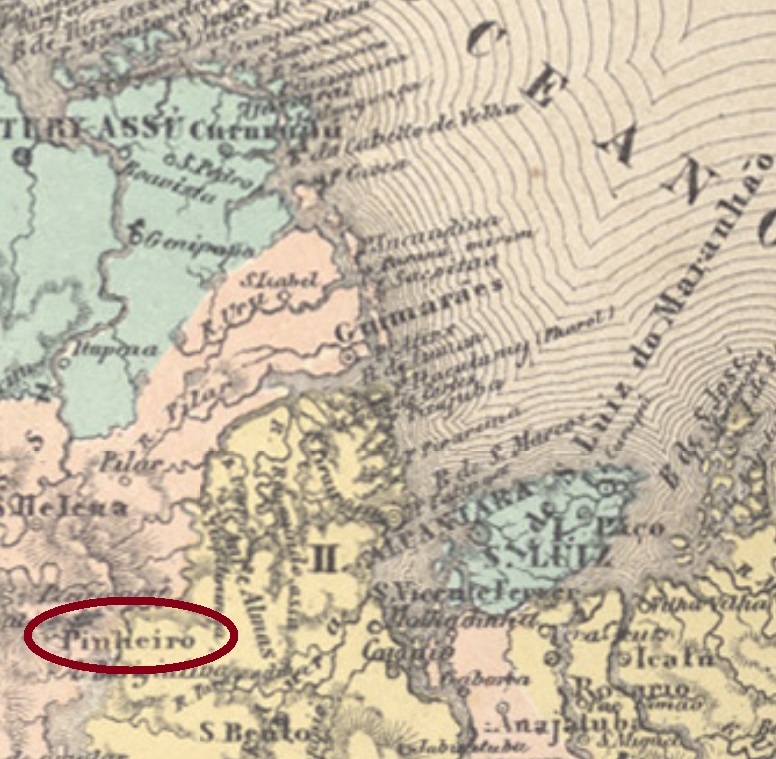
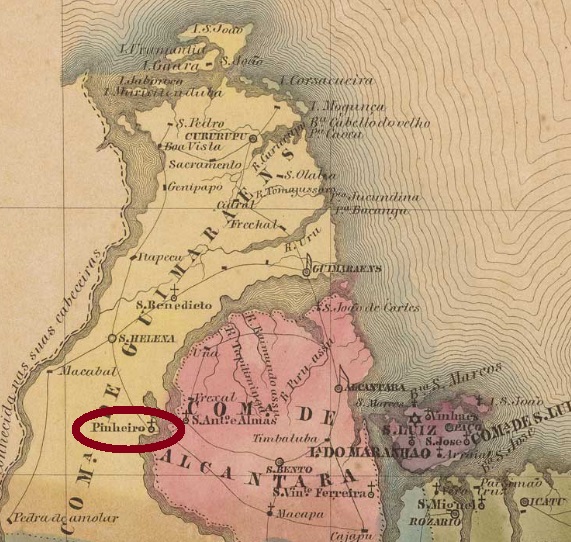
Santo Ignacio do Pinheiro was since May 1855 a district in the municipality of Guimarães, situated on the west bank of the Pericumã River, some 120 km west of the provincial capital São Luis do Maranhão. The name Pinheiro does not evoke pine trees in this tropical region; it refers rather to the local governor (Capitão-Mor) who had founded the locality. Latter became a villa in own municipality already in September 1856 and is the town of Pinheiro since March 1920.
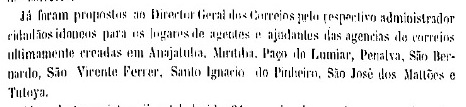
According to theImperial Mail Register (Tabella das Agencias do Correio do Imperio) of 1885, the local post office was created in 1875. It must have taken place at the beginning of the year, because a local post clerk had been found by February, when the Province President Report was published:
Relatorio do Presidente da Provincia, February 1875
No imperial post cancel from this locality could be safely identified until now.
Villiers de l’Ile Adam: Carta (…) da Provincia do Maranhão, 1850
Andere Namen: Pinheiros, Pinheiro (1920)
Siehe auch Pinheiro(s), Maranhão (R. Koester: Carimbologia XXXI)
Santo Ignacio do Pinheiro war ab Mai 1855 ein Distrikt im Município von Guimarães, der am Westufer des Flusses Pericumã lag, etwa 120 km westlich der Provinzhauptstadt São Luis do Maranhão entfernt. Der Name Pinheiro soll nicht an Pinienbäume in den Tropen erinnern, eher an den lokalen Oberbefehlshaber (Capitão-Mor), der die Ortschaft gegründet hatte. Letztere wurde eine Villa im eigenen Município bereits im September 1856 und nennt sich seit März 1920 die Stadt Pinheiro.
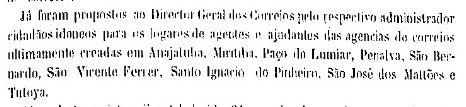
Laut Verzeichnis der kaiserlichen Postämter (Tabella das Agencias do Correio do Imperio) von 1885 gibt es dort ein Postamt seit 1875. Das wird wohl am Jahresanfang entstanden sein, da sein Postangestellter bereits im Februar bekannt war, wie der Bericht des Provinzpräsidenten verrät:
Relatorio do Presidente da Provincia, Februar 1875
Kein Poststempel der Kaiserzeit für diese Ortschaft konnte bisher sicher identifiziert werden.
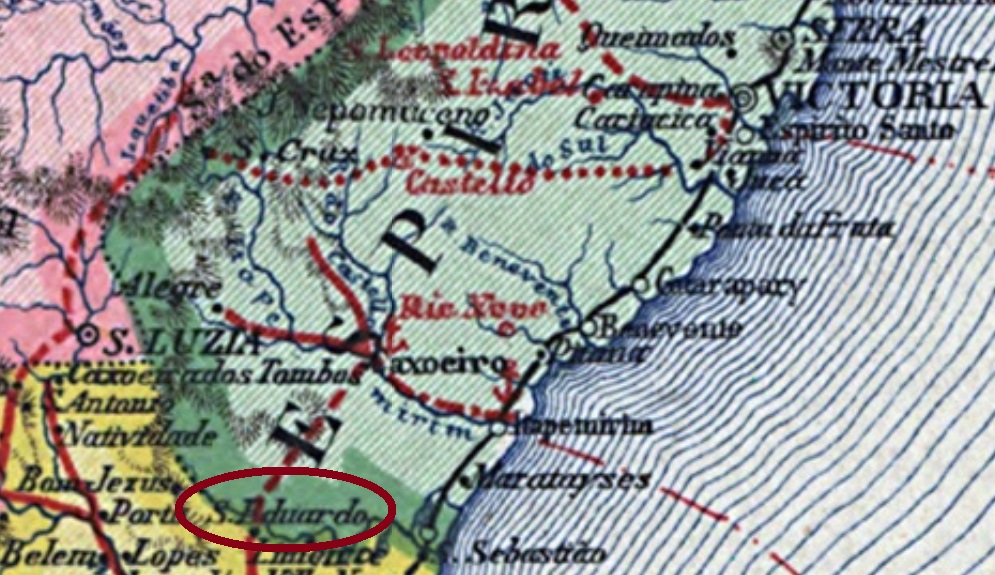
Carta da Republica dos Estados Unidos do Brazil, 1892
Other names: Ponte de Santo Eduardo, Itabapoana, Ponte de Itabapoana (1930)
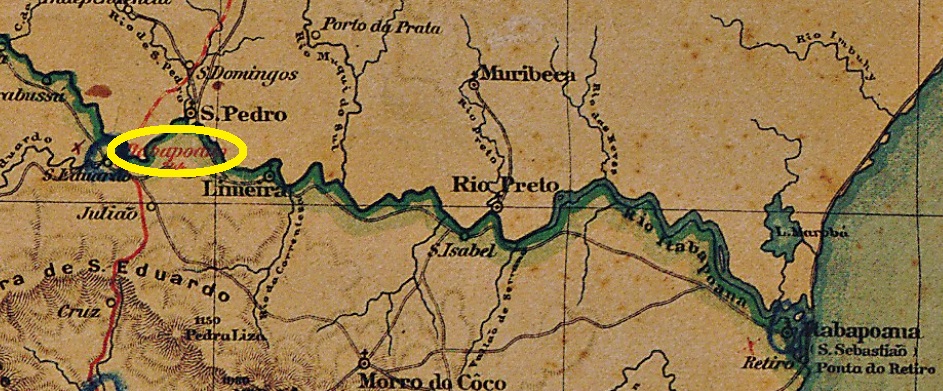
The district of Santo Eduardo has belonged to the former municipality of São Pedro de Alcantara and was situated on the north bank of the Itabapoana River, which separated the Rio de Janeiro and Espirito Santo provinces, round 200 km southwest of the capital Victoria. In August 1896 it ascended to a villa named Ponte de Santo Eduardo (= St. Edward Bridge), but returned to the district status in January 1930, now under the still actual name Ponte do Itabapoana. The municipality was then called São Pedro de Itabapoanna, but has changed twice since that time: in November 1930 to João Pessoa, and in December 1943 to the present Mimoso do Sul.
Since on the Rio de Janeiro side of the Itabapoanna River a train station with exactly the same name was built in June 1879, which received an own post office in March 1893, a very pretty confusion originated between both localities, their stations, post offices and cancels. Details (in portuguese) here: http://agenciaspostais.com.br/?page_id=20075
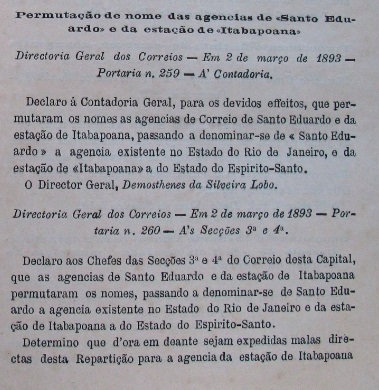
The confusion increased at that time, when both post offices switched their names. So from then on the Santo Eduardo office in Espirito Santo was named Itabapoana station, whereas the Itabapoana station in Rio was called Santo Eduardo, as ordered by the Rio postal administration:
Boletim Postal, April 1893
Considering that Paulo Novaes tells us that the Santo Eduardo post office in Espirito Santo was created already in September 1879 (see http://agenciaspostais.com.br/?page_id=7511), we can conclude that all postal cancels from that time until February 1893 must be related to this agency. So two different cancels are present here. SES-0175a (Coll. Fuad Ferreira Fo.) has a double circle with the inscription SANTO EDUARDO above and a diamond ornament below, whose four sides are open. It occurs in black, blue and lilac and shows dates from 1880 until 1888 at the centre. SES-0175b (image from the internet) might be already republican, for the dates at the centre go from 1891 to 1893. It is a double circle in black or blue with inscriptions S. EDUARDO above and (ESP. SANTO) below.
Almanak Laemmert, 1892
Andere Namen: Ponte de Santo Eduardo, Itabapoana, Ponte de Itabapoana (1930)
Der Distrikt von Santo Eduardo gehörte dem ehemaligen Município von São Pedro de Alcantara und lag am Nordufer des Flusses Itabapoana, der die Provinzen Rio de Janeiro und Espirito Santo voneinander trennte, rund 200 km südwestlich der Hauptstadt Victoria. Im August 1896 stieg der Ort zu einer Villa namens Ponte de Santo Eduardo (= St. Eduards Brücke) auf, um im Januar 1930 wieder zu Distrikt degradiert zu werden, nun unter dem heutigen Namen Ponte do Itabapoana. Der Município hieß nun São Pedro de Itabapoanna, aber wechselte den Namen seitdem zweimal: im November 1930 zu João Pessoa, und im Dezember 1943 zum noch aktuellen Mimoso do Sul.
Eine sehr schöne Verwechslung entstand im Juni 1879, als auf der Rio de Janeiro-Seite des Itabapoanna ein Bahnhof gebaut wurde, der exakt den gleichen Namen bekam und ab März 1893 auch ein Postamt beherbergte. Details (in Portugiesisch) hier: http://agenciaspostais.com.br/?page_id=20075
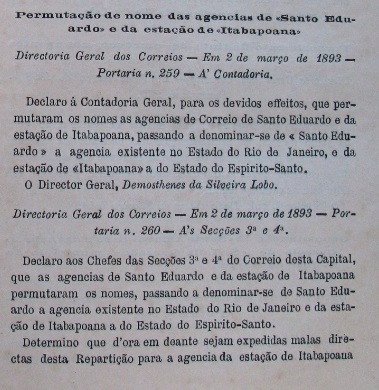
Zu dieser Zeit wurde die Konfusion perfekt, da beide Postämter ihren Namen umtauschten. So hieß das Postamt Santo Eduardo in Espirito Santo fortan Bahnhof Itabapoana, während aus dem Bahnhof Itabapoana in Rio der Bahnhof Santo Eduardo wurde, wie von der Postverwaltung in Rio befohlen:
Boletim Postal, April 1893
Zum Glück berichtet uns Paulo Novaes auch darüber, dass das Postamt Santo Eduardo in Espirito Santo bereits im September 1879 entstanden ist (siehe http://agenciaspostais.com.br/?page_id=7511). Daraus folgt, dass alle Poststempel ab diesem Datum bis Februar 1893 aus diesem Postamt stammen müssen. Und davon gibt es zwei Stück. SES-0175a (Samml. Fuad Ferreira Fo.) hat einen Doppelkreis mit der Inschrift SANTO EDUARDO oben und einem Rautenornament unten, dessen vier Seiten offen sind. Er kommt in schwarz, blau und lila vor und zeigt in seiner Mitte Daten von 1880 bis 1888. SES-0175b (Abb. aus dem Internet) könnte bereits republikanisch sein, da die Daten im Inneren von 1891 bis 1893 gehen. Es ist ein Doppelkreis in schwarz oder auch blau mit Inschriften S. EDUARDO oben and (ESP. SANTO) unten.
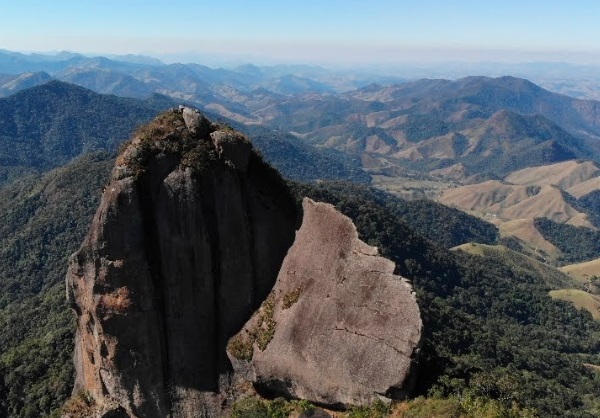
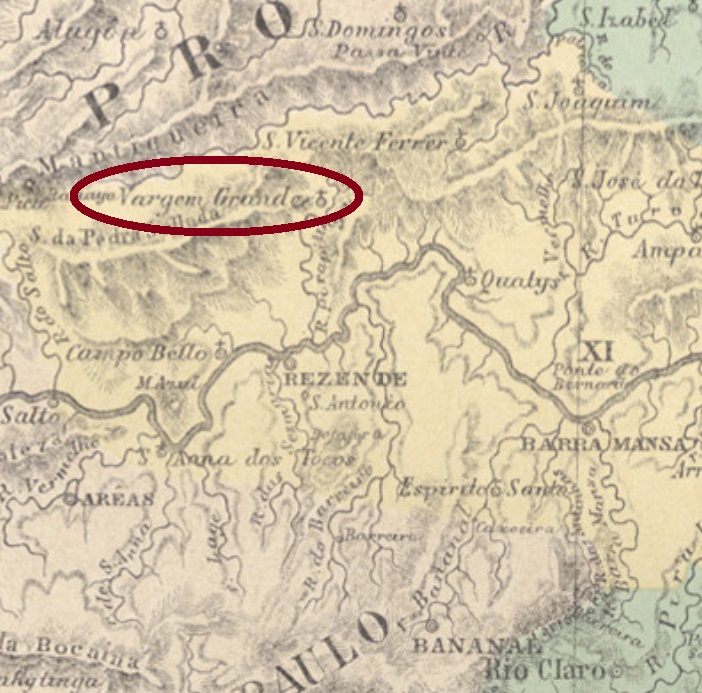
From the beginning in October 1856 until today, Santo Antonio da Vargem Grande has remained a district in the municipality of Resende, situated some 200 km northwest of the imperial capital Rio de Janeiro. In December 1943 the name changed to Pedra Selada, a famous mountain in the region.
Two Imperial cancels exist. SRJ-1350a (Coll. José A. Junges) has a double circle with the inscription S. A. DA V. GRANDE, dated 1880 at the centre. SRJ-1350b (Coll. José A. Junges) has a slightly modified text between circles: S. A. DA VARGEM GRANDE. The only found example presents a hand written date of 1887 at the centre.
Atlas do Imperio do Brasil, 1868
Anderer Name: Pedra Selada (1943)
Seit der Gründung im Oktober 1856 bis heute erhält Santo Antonio da Vargem Grande den Status eines Distrikts im Município von Resende, etwa 200 km nordwestlich der kaiserlichen Hauptstadt Rio de Janeiro gelegen. Im Dezember 1943 wechselte der Ortsname zu Pedra Selada, wie eine berühmte Bergkuppe der Region heißt (s. Abb. oben).
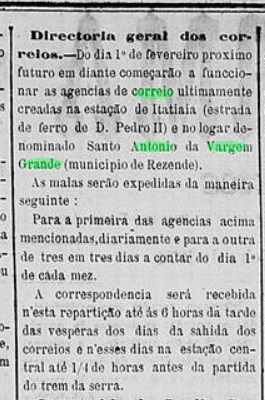
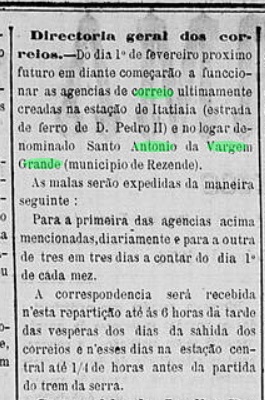
Laut Verzeichnis der kaiserlichen Postämter (Tabella das Agencias do Correio do Imperio) von 1885 gibt es dort ein Postamt seit 1873. Dessen Entstehung muss aber gegen Jahresende stattgefunden haben, denn die Agentur startete den Betrieb erst im Februar 1874, wie die Presse aus Rio berichtet:
A Reforma, 28. Januar 1874
Zwei Poststempel der Kaiserzeit sind vorhanden. SRJ-1350a (Samml. José A. Junges) hat einen Doppelkreis mit der Inschrift S. A. DA V. GRANDE, dazu Datum aus 1880 in der Mitte. SRJ-1350b (Samml. José A. Junges) hat einen leicht veränderten Text zwischen den Kreisen: S. A. DA VARGEM GRANDE. Das einzig vorhandene Exemplar zeigt ein handgeschriebenes Datum von 1887 in der Mitte.
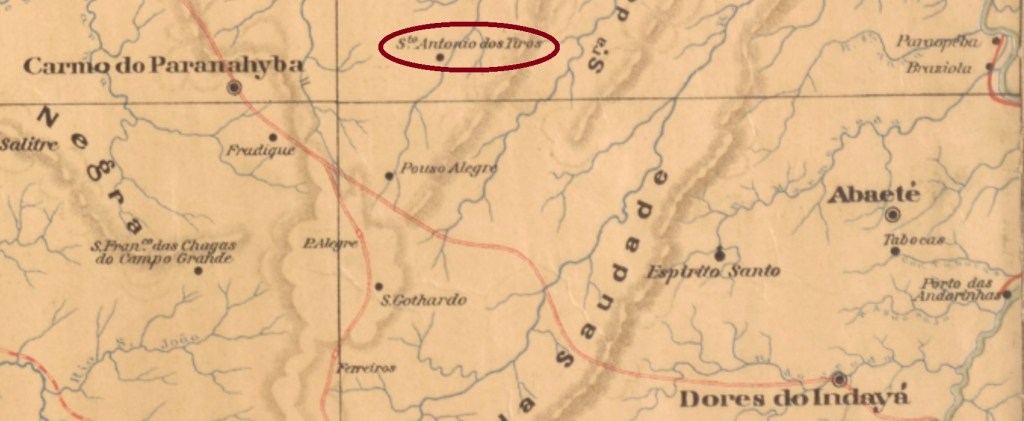
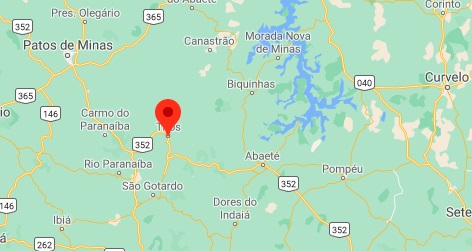
Santo Antonio dos Tiros was a district in the municipality of Abaeté, established in December 1867 and situated round 400 km northwest of the province capital Ouro Preto. Since September 1923 it is the municipality of Tiros. Tiros means gunshots in Portuguese, this was the name of the local brook.
According to Paula Sobrinho (História Postal de Minas Gerais, Belo Horizonte, 1997), the local post office exists since April 1881. No cancel of the Empire has appeared until now.
Google Maps
Anderer Name: Tiros (1923)
Santo Antonio dos Tiros war ab Dezember 1867 ein Distrikt im Município von Abaeté, der ca. 400 km nordwestlich der Provinzhauptstadt Ouro Preto lag. Seit September 1923 ist es der Município von Tiros. Das portugiesische Wort bedeutet Waffenschüsse, und so hieß der Bach im Ort.
Wie Paula Sobrinho in seiner História Postal de Minas Gerais (Belo Horizonte, 1997) berichtet, gibt es dort ein Postamt seit April 1881. Kein Poststempel des Kaiserreichs war bisher zu sehen.
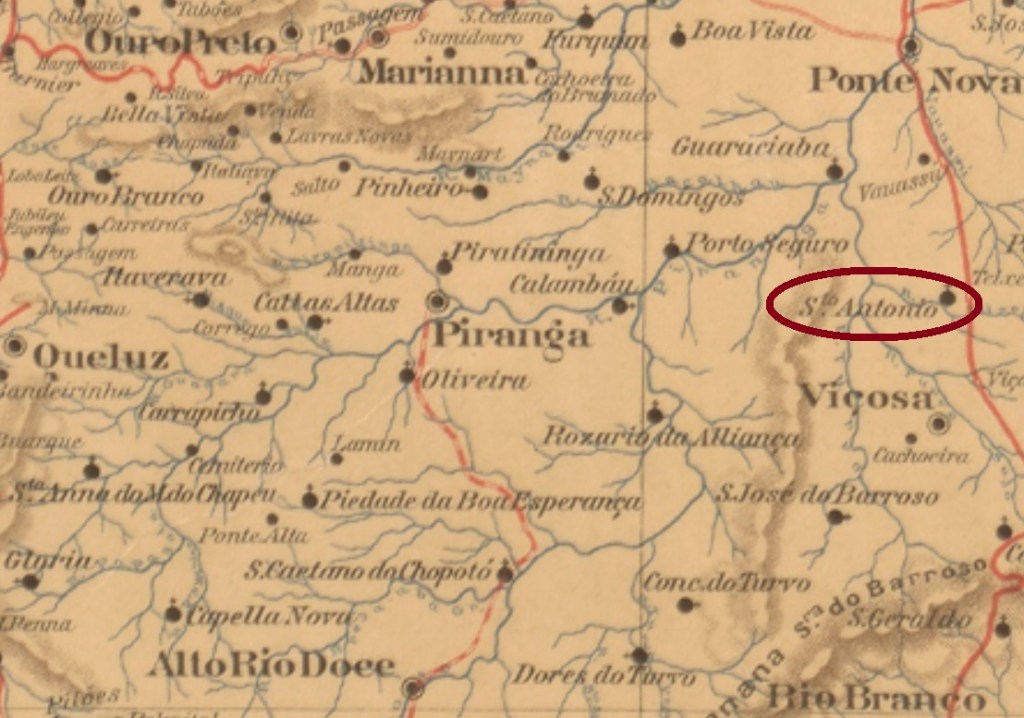
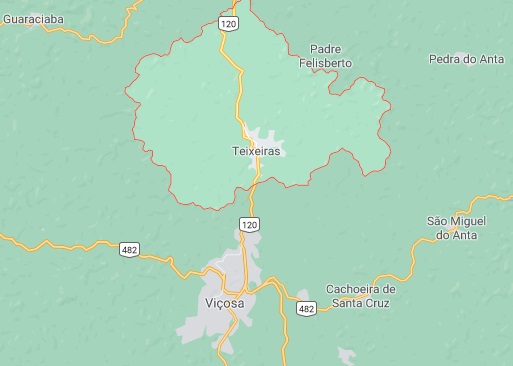
This Santo Antonio dos Teixeiras was from October 1883 on a district in the municipality of Viçosa (the former Santa Rita do Turvo), situated round 100 km east of the province capital Ouro Preto. The name celebrates a pioneer family that had settled in the region around 1850. The locality emancipated politically in December 1938 under the actual name of Teixeiras.
Paula Sobrinho writes in his História Postal de Minas Gerais (Belo Horizonte, 1997) that the local post office was created in September 1896, i.e. already in the republic. This is rather a mistake or a reopening date, because cancels from there appeared with dates from 1885 on. Indeed, the Postal Report for 1890 lists this agency with the more plausible creation date of August 9, 1884. This is confirmed by the Rio press:
Jornal do Commercio, RJ, August 10, 1884
One imperial cancel is recorded: SMG-3075a (Coll. Karlheinz Wittig) has a double circle with the inscription S. ANTONIO DOS TEIXEIRAS above and a five-leg starfish below. The dates at the centre were found for 1885-1897.
Google Maps
Anderer Name: Teixeiras (1938)
Santo Antonio dos Teixeiras war ab Oktober 1883 ein Distrikt im Município von Viçosa (ehemals Santa Rita do Turvo), der rund 100 km östlich der Provinzhauptstadt Ouro Preto entfernt lag. Der Name soll an die Pionierfamilie erinnern, die sich ab ca. 1850 in diesem Gebiet niedergelassen hatte. Die Ortschaft erhielt die politische Eigenständigkeit im Dezember 1938, als Município von Teixeiras.
Paula Sobrinho schreibt in seiner História Postal de Minas Gerais (Belo Horizonte, 1997), dass es dort erst seit September 1896 – d.h. bereits in der Republik – ein Postamt gibt. Das ist entweder ein Wiedereröffnungsdatum oder ein Druckfehler, da örtliche Poststempel ab 1885 auffindbar waren. Vielmehr listet der 1890er-Postbericht diese Agentur ab 9. August 1884 auf. Dieses Datum ist plausibler und kann durch die Rio-Presse bestätigt werden:
Jornal do Commercio, RJ; 10. August 1884
Ein Stempel der Kaiserzeit ist überliefert: SMG-3075a (Samml. Karlheinz Wittig) hat einen Doppelkreis mit der Inschrift S. ANTONIO DOS TEIXEIRAS oben und einem fünfbeinigen Seestern unten. Daten in der Mitte zwischen 1885 und 1897.
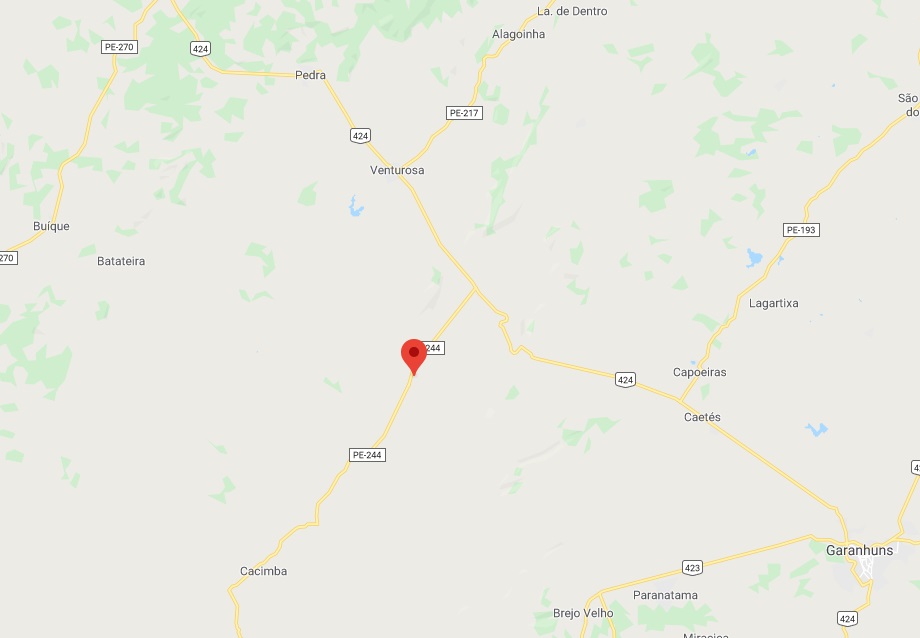
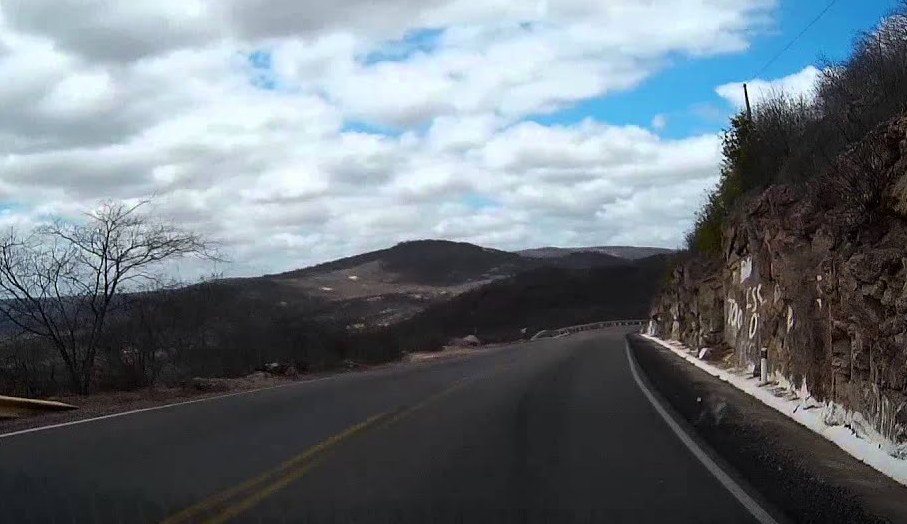
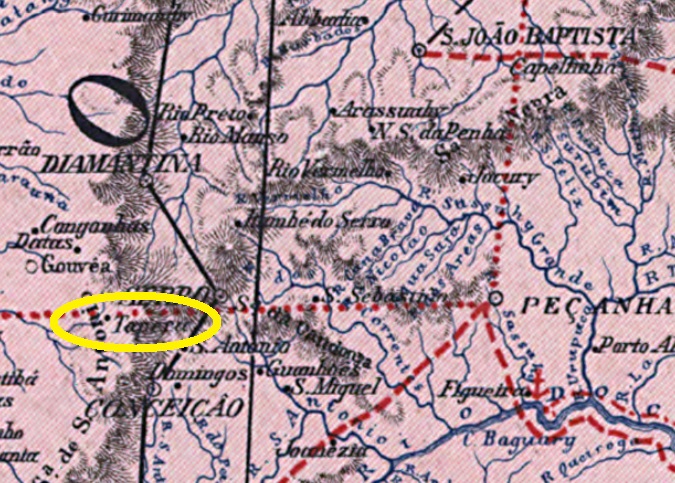
The history Santo Antonio do Tará has begun as a settlement in the municipality of Buique, situated ca. 250 km southwest of the province capital Recife. The word tará has probably Indian origin and named a mountain range of the region. In April 1893 the district changed to the new municipality of Pedra, it is called simply Santo Antonio since June 1986.
According to the Postal Report for 1887, the local post office was created in 1885. No cancel from the Empire has appeared until now.
Serra do Tará (Photo: Adelson Pereira)
Andere Namen: Tará, Santo Antônio (1986)
Die Geschichte dieser Ortschaft begann als eine Siedlung im Município von Buique, die ca. 250 km südwestlich der Provinzhauptstadt Recife entfernt lag. Das Wort tará ist wohl indianischen Ursprungs und nannte eine Bergkette der Region. Im April 1893 wechselte der Distrikt zum Município von Pedra, und im Juni 1986 wurde sein Name zu Santo Antonio vereinfacht.
Der Postbericht für 1887 listet das örtliche Postamt ab 1885 auf. Kein Stempel der Kaiserzeit war bisher zu sehen.
Other names: Tapera, Santo Antonio do Norte (1938)
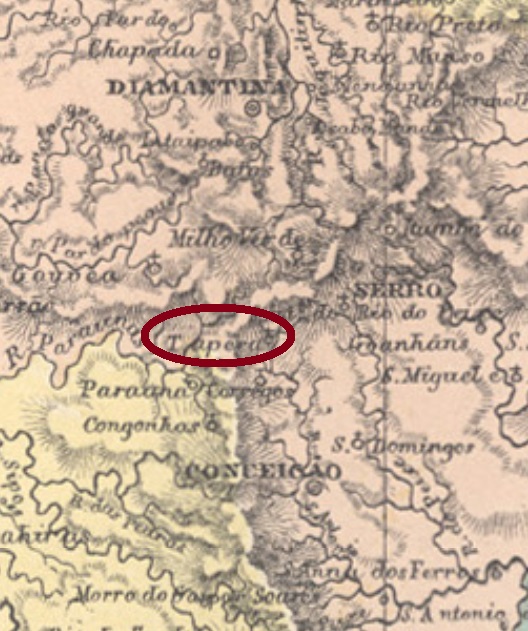
Santo Antonio da Tapera (= of the Mud Hut) was a district of the municipality of Conceição do Serro, established in June 1858 and situated ca. 250 km north of the provincial capital Ouro Preto. It kept this administrative status until today, but is called Santo Antonio do Norte since December 1938, while the municipality’s name today is Conceição do Mato Dentro. The local population has also considerably shrunk in the meantime: from over 3.3 thousand in 1880 to 662 souls in 2010.
Paula Sobrinho (História Postal de Minas Gerais, Belo Horizonte, 1997) tells us that the local post office was created in June 1884. One single cancel of the Empire has been found: SMG-2990a (Coll. Márcio Protzner) has a double circle with the inscription S. ANTONIO DA TAPERA above and an x-form ornament below, dated 1886 at the centre.
Carta da Republica dos Estados Unidos do Brazil, 1892
Andere Namen: Tapera, Santo Antonio do Norte (1938)
Santo Antonio da Tapera (= der Lehmhütte) war ab Juni 1858 ein Distrikt im Município von Conceição do Serro, der ca. 250 km nördlich der Provinzhauptstadt Ouro Preto entfernt lag. Dieser Verwaltungsstatus gilt bis heute, aber die Ortschaft heißt seit Dezember 1938 Santo Antonio do Norte, und der Município nennt sich heute Conceição do Mato Dentro. Auch die Ortsbevölkerung ist seitdem merklich geschrumpft: von über 3.300 (1880) zu 662 Einwohnern im Jahr 2010.
Paula Sobrinho (História Postal de Minas Gerais, Belo Horizonte, 1997) schreibt den Juni 1884 als Entstehungsdatum fürs örtliche Postamt. Nur ein Stempel aus der Kaiserzeit wurde bisher gefunden: SMG-2990a (Samml. Márcio Protzner) hat einen Doppelkreis mit der Inschrift S. ANTONIO DA TAPERA oben und einem X-förmigen Ornament unten, datiert 1886 in der Mitte.
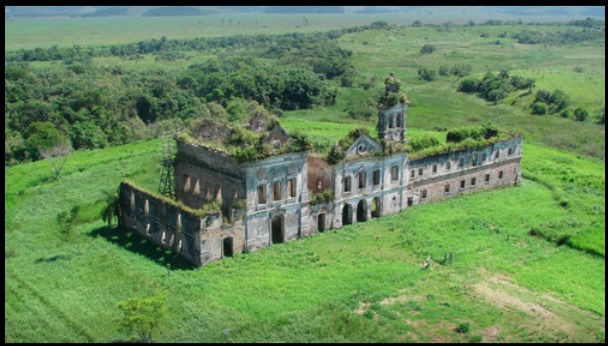
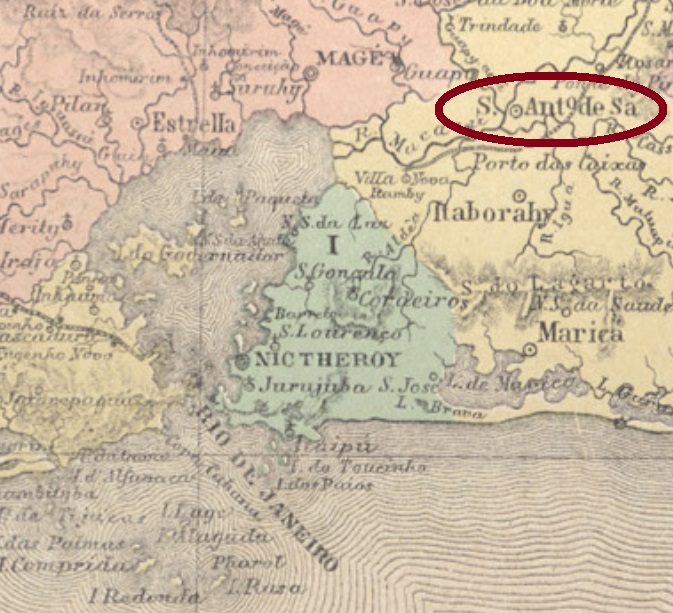
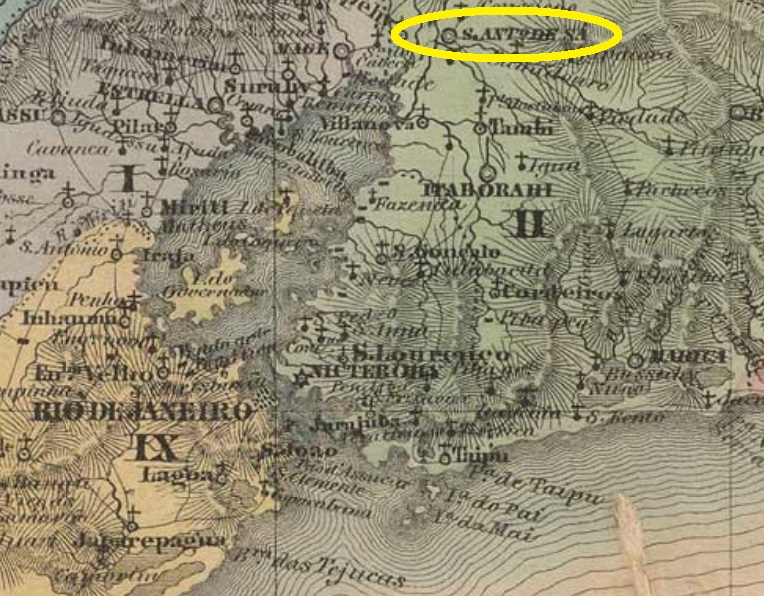
This location won’t be found on any actual map, because the villa does not exist anymore since 1875. The former freguesia of Santo Antonio do Caceribu was created as early as February 1647 near Itaborahy, ca. 60 km northeast of the later colony capital Rio de Janeiro. At that time, Brazil’s capital was still Salvador da Bahia. In August 1697 it was elevated to the villa of Santo Antonio de Sá, a tribute to the Portuguese Sá family, which founded and governed Rio de Janeiro during at least half a century. The villa was officially extinguished in 1875, at the end of a decline period caused by an increase of tropical deseases related to the massive and fast deforestation in the region. Possibly one of Brazil’s earliest ecologic desasters. There are still a few traces of this villa nowadays, the most important are the ruins of the São Boaventura cloister near the Macacu delta in Itaboraí (see above).
Atlas do Imperio do Brasil, 1868
After loosing the villa status, Santo Antonio de Sá became a district of Itaborahy in May 1892, which was renamed to the actual Sambaetiba in October 1910.
Villiers de l’Ile Adam: Carta (…) da Provincia do Rio de Janeiro, 1850
Anderer Name: Sambaetiba (1910)
Diese Ortschaft steht auf keiner Karte heutzutage: die Villa existiert seit 1875 nicht mehr. Die ehemalige Freguesia von Santo Antonio do Caceribu entstand bereits in Februar 1647 nahe Itaborahy, ca. 60 km nordöstlich der späteren kolonialen Hauptstadt Rio de Janeiro. (Damals war noch Salvador da Bahia die Hauptstadt.) Im August 1697 stieg sie zur Villa von Santo Antonio de Sá, als eine Hommage an die portugiesische Familie Sá, die Rio de Janeiro sowohl gegründet als auch über einem halben Jahrhundert lang regiert hat. Das Ende der Villa 1875 war der Schlusspunkt einer langen Dekadenz, die durch tropische Krankheiten verursacht wurde, die wiederum von der massiven und raschen Waldabholzung in der Region begünstigt waren. Diese war womöglich eine der ersten ökologischen Katastrophen Brasiliens. Unter den letzten Spuren der verschwundenen Ortschaft ist die Klosterruine São Boaventura die wichtigste, die sich nah am Macacu-Delta befindet (siehe ganz oben). Nach dem Ende als Villa wurde Santo Antonio de Sá im Mai 1892 ein Distrikt im Município von Itaborahy, der seit Oktober 1910 Sambaetiba heißt.
Laut Nova Monteiro (Administrações e Agencias Postaes do Brasil Imperio, in Brasil Filatelico/RJ, 1934-5; Reprint SPP 1994-1999) entstand das örtliche Postamt im Januar 1820. Paulo Novaes (agenciaspostais.com.br) berichtet über eine Postschließung im September 1897. Kein Stempel der Kaiserzeit war bisher zu sehen.
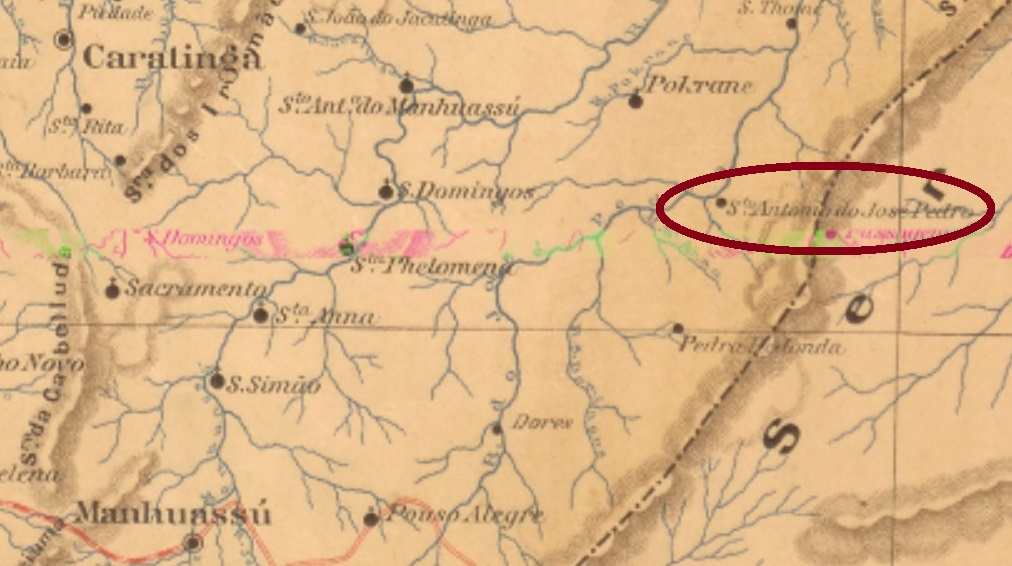
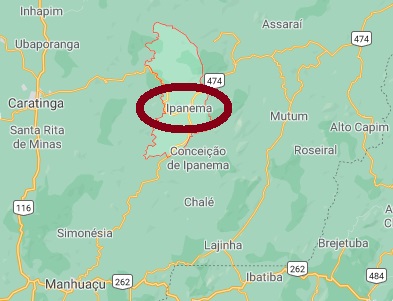
Other names: Sto. Antonio do José Pedro, Rio José Pedro, José Pedro, Ipanema (1928)
The Rio José Pedro has its source in the Caparaó mountains and flows about 200 km towards north along the border between Espirito Santo and Minas Gerais, until its mouth on the right bank of the Manhuaçu River. Santo Antonio do Rio José Pedro was since July 1879 a district in the municipality of Manhuassu, situated over 260 km east of the provincial capital Ouro Preto. In August 1911 the locality emancipated politically as the municipality of Rio José Pedro, which has twice changed the name since then: to José Pedro in September 1923 and to the actual Ipanema five years later. This tupi word means dirty water.
According to the 1890 Postal Report, the local post office was created in October 1883. Another source writes October 1889, but this is probably a misprint, for earlier cancels have been found, under SMG-3060a (Coll. José A. Junges): a double circle featuring the inscription S. ANTONIO DO RIO JOSÉ PEDRO above and a five-leg star below. The dates at the centre are from 1887 until 1894.
GoogleMaps
Andere Namen: Sto. Antonio do José Pedro, Rio José Pedro, José Pedro, Ipanema (1928)
Der José-Pedro-Fluss hat seine Quelle im Caparaó-Gebirge und fließt ca. 200 km nordwärts entlang der Grenze zwischen Espirito Santo und Minas Gerais bis zur Mündung am rechten Ufer des Manhuaçu. Santo Antonio do Rio José Pedro war ab Juli 1879 ein Distrikt im Município von Manhuassu, der über 260 km östlich der Provinzhauptstadt Ouro Preto lag. Im August 1911 erlangte die Ortschaft ihre politische Eigenständigkeit als der Município von Rio José Pedro. Seitdem wechselte der Ortsnamen zweimal: zu José Pedro im September 1923 und zum aktuellen Ipanema fünf Jahre später. Das Tupi-Wort bedeutet schmutziges Gewässer.
Laut dem Postbericht für 1890 gab es dort ein Postamt seit Oktober 1883. Andere Quelle schreibt dafür den Oktober 1889, aber das wird wohl ein Druckfehler sein, da frühere Stempel existieren. Und zwar als SMG-3060a (Samml. José A. Junges): ein Doppelkreis mit der Inschrift S. ANTONIO DO RIO JOSÉ PEDRO oben und einem fünfzackigen Stern unten. Die Daten in der Mitte gehen von 1887 bis 1894.
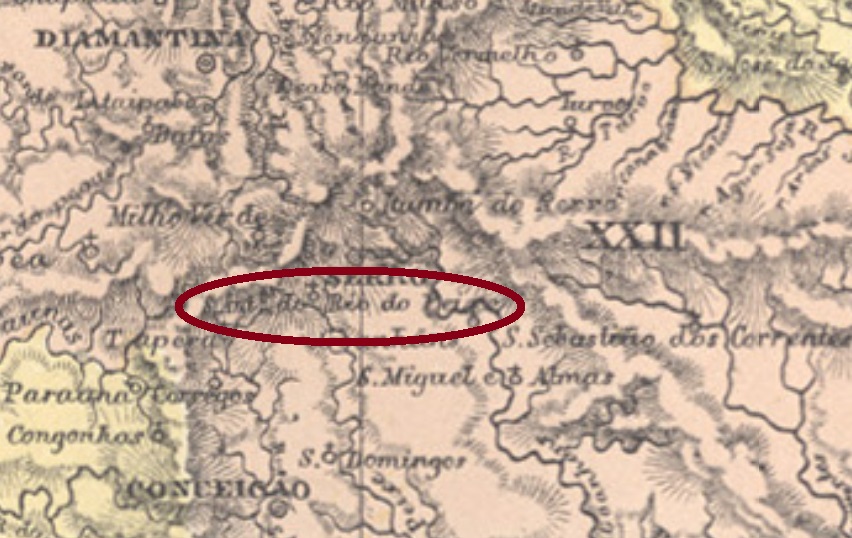
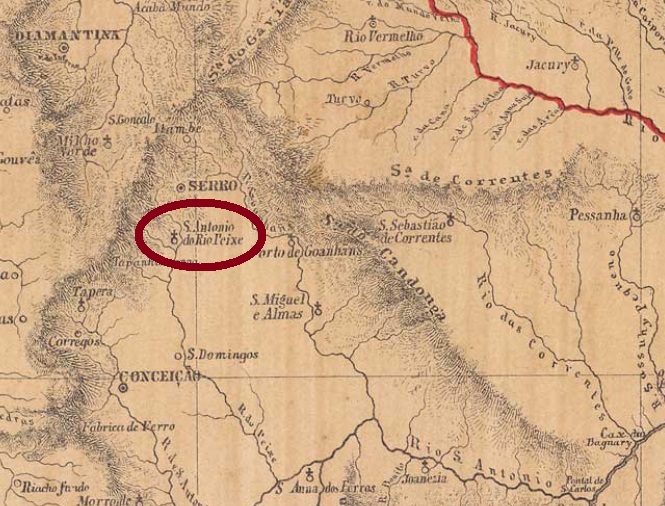
This Santo Antonio of the Fish River was since April 1831 a district in the municipality of Serro, situated on the west bank of the Rio do Peixe, over 250 km north of the province capital Ouro Preto. The Rio do Peixe is an affluent to the Santo Antonio River which originates in the Serro Mountains, on the opposite side of the Jequitinhonha River source. The political emancipation came in December 1962, when the locality became the municipality of Alvorada de Minas.
According to Paula Sobrinho (História Postal de Minas Gerais, Belo Horizonte, 1997), the local post office was created in June 1879. The only imperial post cancel found until now is SMG-3055a (Coll. José A. Junges): a double circle with the inscription S. ANTONIO DO RIO DO PEIXE above and a diamond ornament below, formed by four small diamonds. The dates at the centre are from 1885 until 1896.
Provincia de Minas Geraes, 1873
Anderer Name: Alvorada de Minas (1962)
Dieser Santo Antonio vom Fischfluss war ab April 1831 ein Distrikt im Município von Serro, der am Westufer des Rio do Peixe, über 250 km nördlich der Provinzhauptstadt Ouro Preto lag. Der Rio do Peixe ist ein Zufluss des Santo Antonio River, der im Serro-Gebirge entspringt – gegenüber der Quelle des Jequitinhonha-Flusses. Die Ortschaft erhielt die politische Selbständigkeit im Dezember 1962, als sie der Município von Alvorada de Minas wurde.
Wie Paula Sobrinho in seiner História Postal de Minas Gerais (Belo Horizonte, 1997) berichtet, gibt es dort ein Postamt seit Juni 1879. Der einzige bisher gefundene Poststempel im Kaiserreich ist SMG-3055a (Samml. José A. Junges): ein Doppelkreis mit der Inschrift S. ANTONIO DO RIO DO PEIXE oben und einem Rautenornament unten, der aus vier kleinen Rauten besteht. Die Daten in der Mitte gehen von 1885 bis 1896.


 Carimbologia