Categories
Carimbologia S

Santo Antonio do Rio Bonito, Rio de Janeiro (SRJ-0910)

Atlas do Imperio do Brasil, 1868

Other names: Rio Bonito de Valença, Conservatória (1938)

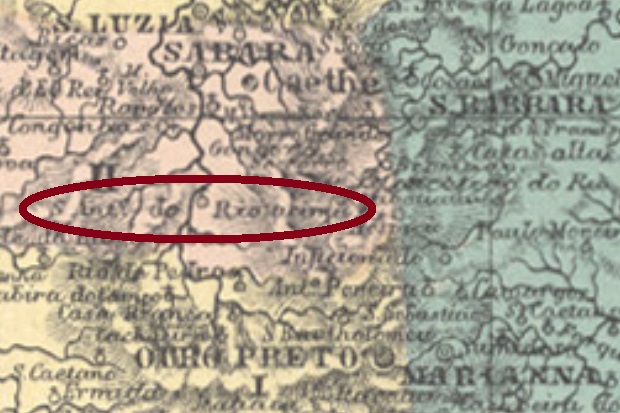
Santo Antonio do Rio Bonito (= of the Beautiful River) was since March 1839 a district in the municipality of Valença, situated round 150 km northwest of the imperial capital Rio de Janeiro. The Rio Bonito is an affluent on the left bank of the Rio das Flores, but barely visible on actual maps. In March 1938 the district was given the actual toponym Conservatória.

According to Nova Monteiro (Administrações e Agencias Postaes do Brasil Imperio, in Brasil Filatelico/RJ, 1934-5; Reprint SPP 1994-1999), the local post office was created in February 1849, which can be ratified by the local press:
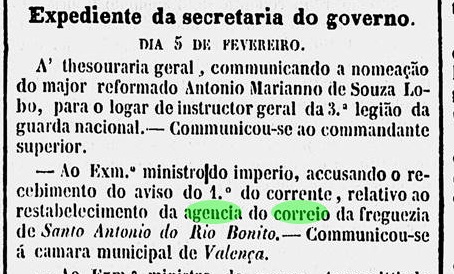
Diário do Rio de Janeiro, February 17, 1849

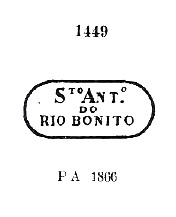
However, the official text mentions a restabelecimento (re-establishment), thus suggesting the existence of an earlier agency on place, which has been closed in the interim. Three early post cancels were found; the oldest of them, SRJ-0910a, circulated supposedly from 1849 until at least 1878 and was already presented by Paulo Ayres in his Catálogo de Carimbos Brasil-Império (S. Paulo, 1937,1942) under # 1449:
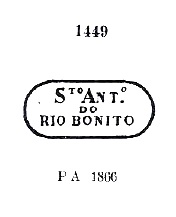
SRJ-0910a (P.A. 1449)

In Ayres’ image of SRJ-0910a there is a missing dot after BONITO. There followed SRJ-0910b (Coll. Karlheinz Wittig): a double circle with the inscription S.A. DO R. BONITO. The dates in the inner circle go from 1879 to 1889. The last cancel may be already republican, for it shows dates of 1894-1895 inside. SRJ-0910c (Coll. Paulo Novaes) has a double circle with the inscription S. ANT. DO RIO BONITO above and an ornament below, unfortunately not clearly visible in the observed examples.
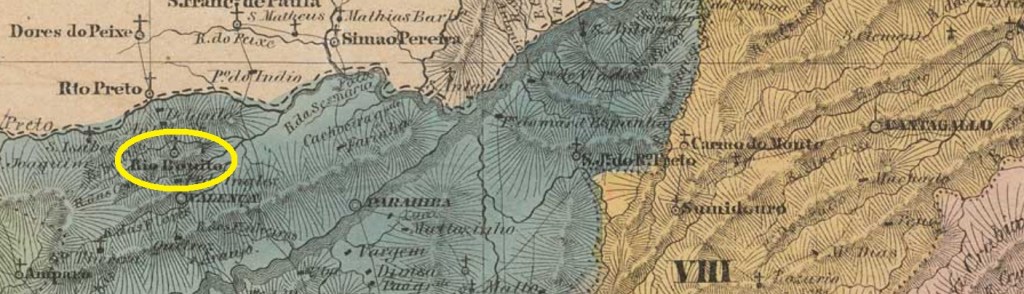
Villiers de l’Ile Adam: Carta (…) da Provincia do Rio de Janeiro, 1850

Andere Namen: Rio Bonito de Valença, Conservatória (1938)

Santo Antonio do Rio Bonito (= vom Schönen Fluss) war ab März 1839 ein Distrikt im Município von Valença, der rund 150 km nordwestlich der kaiserlichen Hauptstadt Rio de Janeiro lag. Der Rio Bonito ist ein Zufluss am linken Ufer des Rio das Flores, heute aber kaum auf Karten zu finden. Im März 1938 erhielt der Distrikt den aktuellen Namen Conservatória.

Laut Nova Monteiro (Administrações e Agencias Postaes do Brasil Imperio, in Brasil Filatelico/RJ, 1934-5; Reprint SPP 1994-1999) gibt es dort ein Postamt seit Februar 1849, was dudrch die Regionalpress bestätigt wird:
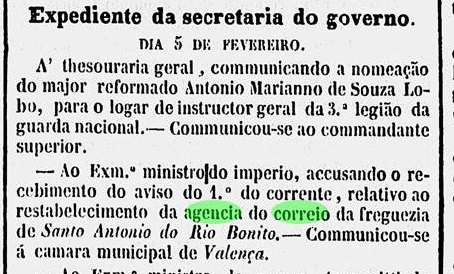
Diário do Rio de Janeiro, 17. Februar 1849

Gleichwohl wird hier von offizieller Seite ein restabelecimento (Wiedererrichtung) erwähnt, und damit die Existenz einer früheren Agentur dort angedeutet, die dann geschlossen wurde. Drei frühe Poststempel waren auffindbar; der Älteste davon, SRJ-0910a, war wohl von 1849 an bis mindestens 1878 im Umlauf und wurde bereits durch Paulo Ayres in seinem Catálogo de Carimbos Brasil-Império (S. Paulo, 1937, 1942) unter Nr. 1449 vorgestellt:
SRJ-0910a (P.A. 1449)

In Ayres’ Abbildung fehlt dennoch ein Punkt nach BONITO. Der zweite Stempel ist SRJ-0910b (Samml. Karlheinz Wittig): ein Doppelkreis mit der Inschrift S.A. DO R. BONITO. Die Daten in inneren Kreis gehen von 1879 bis 1889. Der letzte Stempel wäre vielleicht schon republikanisch, da seine Daten um 1894-1895 liegen. SRJ-0910c (Samml. Paulo Novaes) hat einen Doppelkreis mit der Inschrift S. ANT. DO RIO BONITO oben und einem Ornament unten, das leider nicht klar leserlich ist.
Categories
Carimbologia S

Santo Antonio do Rio Acima, Minas Gerais (SMG-3050)

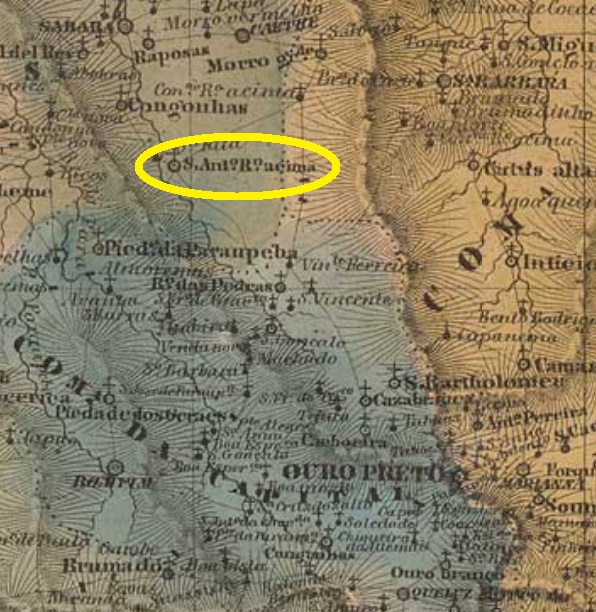
Atlas do Imperio do Brasil, 1868

Another name: Rio Acima (1923)

Santo Antonio do Rio Acima (= of the Upper Course) was since April 1839 a district in the municipality of Sabará, situated ca. 70 km northwest of the provincial capital Ouro Preto. Oddly enough, the river hier is not the Santo Antonio – as in Santo Antonio do Rio Abaixo (SMG-3045) – but the legendary Rio das Velhas, an affluent to the São Francisco which flows through most prominent regions in imperial Minas Gerais. The locality went in February 1891 to Nova Lima and got the name simplified as Rio Acima in September 1923. It became emancipated in December 1948 as the municipality of Rio Acima.

According to Paula Sobrinho (História Postal de Minas Gerais, Belo Horizonte, 1997), the local post office was created in February 1880, but closed in November 1932. One early cancel has been found, whose dates, however, are already republican until now: SMG-3050a (Coll. Márcio Protzner) has a double circle with the inscription S. ANTONIO DO RIO ACIMA above and a diamond ornament below, formed by four small diamonds. Dates at the centre, between 1895 and 1898.

Villiers de l’Ile Adam: Carta (…) da Provincia de Minas Geraes, 1849

Anderer name: Rio Acima (1923)

Santo Antonio do Rio Acima (= am Oberlauf) war ab April 1839 ein Distrikt im Município von Sabará, der ca. 70 km nordwestlich der Provinzhauptstadt Ouro Preto entfernt lag. Merkwürdigerweise ist der Fluss hier nicht der Santo Antonio – wie bei Santo Antonio do Rio Abaixo (SMG-3045) – sondern der legendäre Rio das Velhas, ein Zufluss des São Francisco, der durch wichtigste Regionen im kaiserlichen Minas Gerais fließt. Die Ortschaft ging im Februar 1891 zu Nova Lima über und bekam den vereinfachten Namen Rio Acima im September 1923. Im December 1948 kam dann die politische Emanzipation, als der Município von Rio Acima gegründet wurde.

Laut Paula Sobrinho (História Postal de Minas Gerais, Belo Horizonte, 1997) entstand das örtliche Postamt im Februar 1880, schloss aber im November 1932 wieder. Ein früher Stempel war zu finden, dessen bisherigen Daten dennoch aus der Republik entstammen: SMG-3050a (Samml. Márcio Protzner) hat einen Doppelkreis mit der Inschrift S. ANTONIO DO RIO ACIMA oben und einem rautenförmigen Ornament unten, das aus vier kleinen Rauten besteht. Die Daten in der Mitte gehen von 1895 bis 1898.

Categories
Carimbologia S

Santo Antonio do Rio Abaixo, Minas Gerais (SMG-3045)

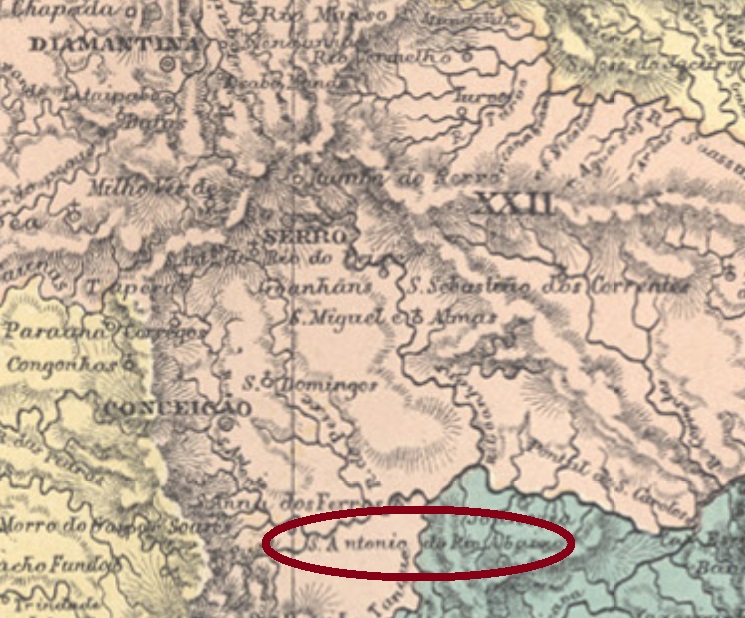
Atlas do Imperio do Brasil, 1868

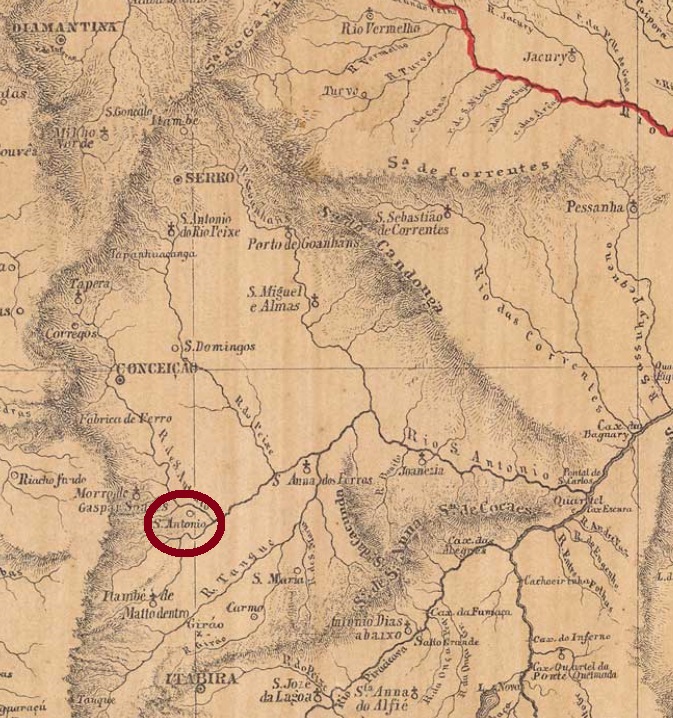
Santo Antonio do Rio Abaixo (= of the Lower Course) was since January 1875 a district in the municipality of Conceição do Serro, situated ca. 200 km north of the province capital Ouro Preto. It has kept the administrative status through the name changes of the municipality (in 1923 to Conceição and in 1943 to the actual Conceição do Mato Dentro) until the political emancipation in December 1962. Now the locals are used to call it S.A.R.A. (Wikipedia). The river here meant is the Santo Antonio, an affluent to the Rio Doce that springs up between the Serra do Espinhaço mountains and flows almost 300 km towards east.

According to Paula Sobrinho (História Postal de Minas Gerais, Belo Horizonte, 1997), the local post office was created in October 1882. One imperial cancel is recorded: SMG-3045a (Coll. José A. Junges) has a double circle with the inscription S. ANTONIO DO RIO ABAIXO above and a diamond ornament below, whose four sides are open. Dates at the centre from 1884 until at least 1890.

Mappa da Provincia de Minas Geraes, 1873

Santo Antonio do Rio Abaixo (= am Unterlauf) war ab Januar 1875 ein Distrikt im Município von Conceição do Serro, der ca. 200 km nördlich der Provinzhauptstadt Ouro Preto entfernt lag. Er erhielt diesen Verwaltungsstatus bis zur politischen Selbständigkeit im Dezember 1962, wenngleich zwischendurch Conceição do Serro zwei neue Namen verpasst bekam: Conceição (1923) und Conceição do Mato Dentro (ab 1943). Heute wird die Stadt Santo Antonio do Rio Abaixo von den Einwohnern S.A.R.A. genannt (Wikipedia). Der Fluss, der hier gemeint ist, heißt ebenfalls Santo Antonio. Er entspringt im Gebirge der Serra do Espinhaço und fließt ostwärts fast 300 km bis zur Mündung in den Rio Doce.

Wie Paula Sobrinho in seiner História Postal de Minas Gerais (Belo Horizonte, 1997) berichtet, gibt es dort ein Postamt seit Oktober 1882. Ein Stempel der Kaiserzeit ist überliefert: SMG-3045a (Samml. José A. Junges) hat einen Doppelkreis mit der Inschrift S. ANTONIO DO RIO ABAIXO oben und einem Rautenornament unten, dessen vier Seiten offen sind. Die Daten in der Mitte gehen von 1884 bis zumindest 1890.

Categories
Carimbologia S

Santo Antonio da Rifaina, São Paulo (SSP-1605)

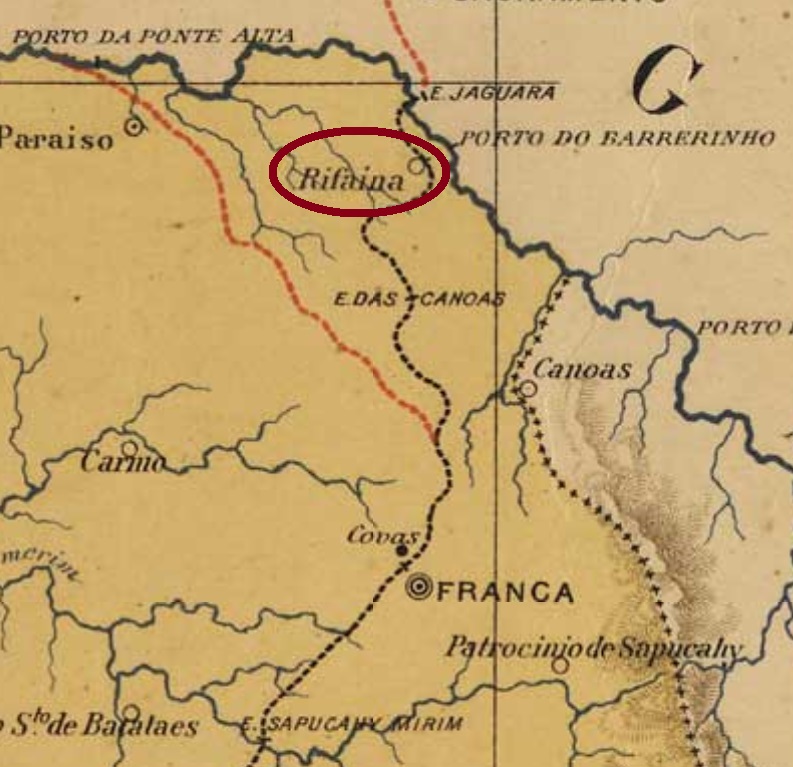
J. M. Ribeiro Lisboa; Mappa da Provincia de São Paulo, 1884

Other names: Arraial do Cervo, Santo Antonio da Rifana, Rifaina (1948)

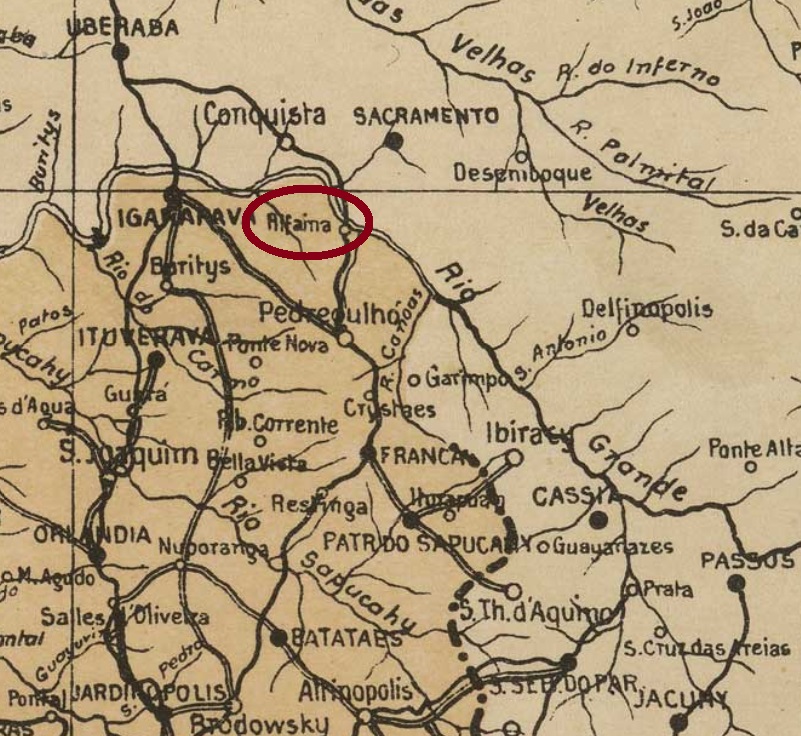
Originally called Arraial do Cervo, Santo Antonio da Rifaina (or Rifana) became in April 1873 a district in the municipality of Franca, and was situated on the south bank of the Rio Grande at the Minas Gerais border, almost 500 km north of the province capital São Paulo. After that, it changed twice the municipality: in November 1907 to Igarapava and in December 1921 to Pedregulho, before emancipating in December 1948 under the simplified toponym of Rifaina.

Considering that the São Paulo postal administration ordered supplying and facilities for the new local post office in January 1877, we must assume that the latter had been created by the end of 1876:

Correio Paulistano, January 4, 1877

No postal cancel from this locality during the Empire has appeared until now.

Arthur D. Ribeiro: Mappa do Estado de São Paulo, 1924

Andere Namen: Arraial do Cervo, Santo Antonio da Rifana, Rifaina (1948)

Der ehemalige Arraial do Cervo lag am Südufer des Rio Grande an der Grenze zu Minas Gerais, fast 500 km nördlich der Provinzhauptstadt São Paulo und wurde im April 1873 zum Distrikt von Santo Antonio da Rifaina (or Rifana) im Município von Franca. Danach wechselte die politische Zuständigkeit für diesen Ort zweimal: im November 1907 zu Igarapava und im Dezember 1921 zu Pedregulho, bevor im Dezember 1948 seine politische Emanzipation unter dem vereinfachten Namen Rifaina erreicht wurde.

Da im Januar 1877 die Postverwaltung in São Paulo mit der Einrichtung und Versorgung des frischen Postamts in Santo Antonio da Rifaina beschäftigt war, müssen wir davon ausgehen, dass dessen Entstehung vor Ende 1876 beschlossen wurde:

Correio Paulistano, 4. Januar 1877

Kein Poststempel der Kaiserzeit wurde bisher für diese Ortschaft gesehen.

Categories
Carimbologia S

Santo Antonio do Riacho dos Machados, Minas Gerais (SMG-3040)

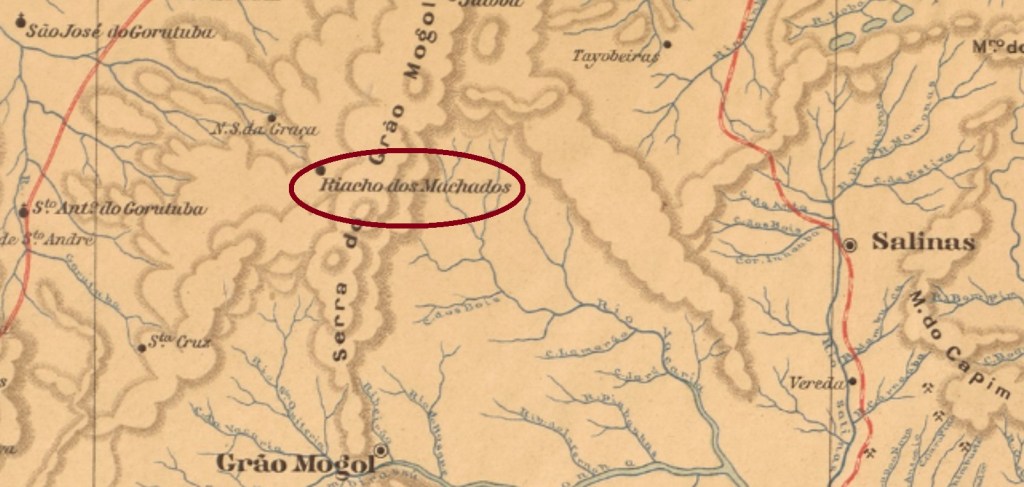
Mappa de Minas Geraes, 1910

Another name: Riacho dos Machados (1923)

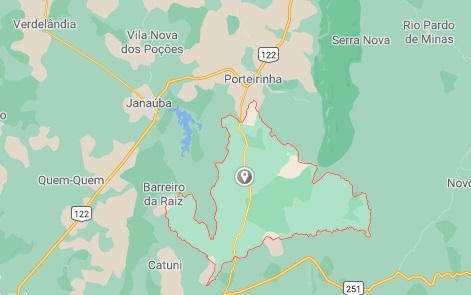
The old locality of Santo Antonio do Riacho dos Machados (= of the Machados’ Brook) was from January 1875 on a district in the municipality of Grão-Mogol, situated over 650 km north of the provincial capital Ouro Preto. In September 1923 it got the name simplified to the actual Riacho dos Machados and went in December 1938 as a district of Porteirinha. Since December 1962 is Riacho dos Machados a municipality.

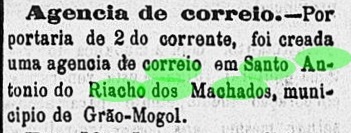
The local post office was created in July 1884, as reported by the regional press:

Liberal Mineiro, July 4, 1884

One imperial cancel has been identified: the only seen example of SMG-3040a (Coll. José A. Junges) until now is not entirely legible, presenting a double circle with the inscription (S.) ANTo. DO RIACHO D(OS MACHADOS) above, dated 1888 at the centre.

GoogleMaps

Anderer Name: Riacho dos Machados (1923)

Die alte Ortschaft Santo Antonio do Riacho dos Machados (= vom Machados’ Bach) war ab Januar 1875 ein Distrikt im Município von Grão-Mogol, der über 650 km nördlich der Provinzhauptstadt Ouro Preto entfernt lag. Im September 1923 bekam er den vereinfachten Namen Riacho dos Machados und ging im Dezember 1938 als ein Distrikt zu Porteirinha über. Seit Dezember 1962 ist Riacho dos Machados ein selbständiger Município.

Das örtliche Postamt wurde im Juli 1884 ins Leben gerufen, wie die Regionalpresse berichtet:

Liberal Mineiro, 4. Juli 1884

Ein Poststempel der Kaiserzeit wurde ermittelt: das bisher einzig gesehene Exemplar von SMG-3040a (Samml. José A. Junges) ist nicht gänzlich lesbar. Es besteht aus einem Doppelkreis mit der Inschrift (S.) ANTo. DO RIACHO D(OS MACHADOS) oben und Datum von 1888 in der Mitte.

Categories
Carimbologia S

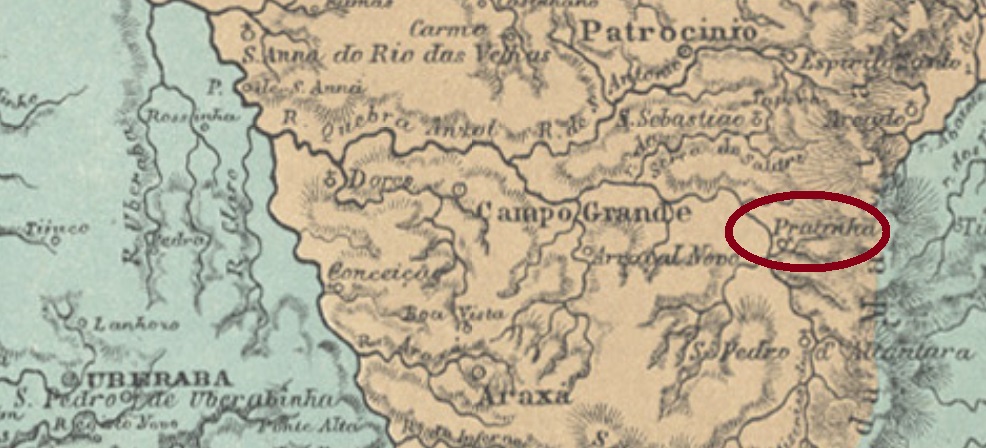
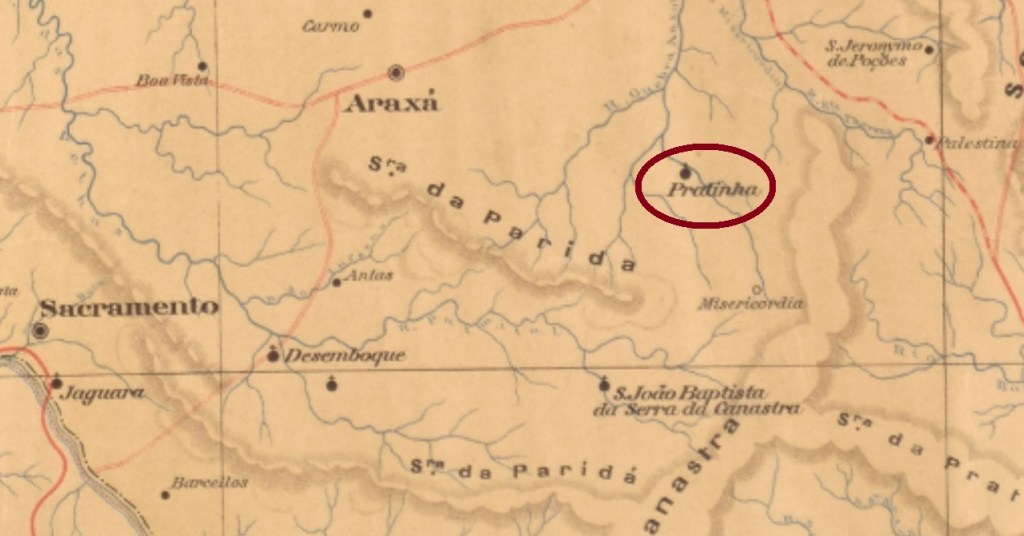
Santo Antonio da Pratinha, Minas Gerais, (SMG-2985)

Atlas do Imperio do Brasil

Another name: Pratinha (1938)

Santo Antonio da Pratinha was since May 1853 a district in the municipality of Araxá, situated almost 400 km west of the provincial capital Ouro Preto. It changed later to two other municipalities, in September 1923 to Ibiá and in December 1943 to Campos Altos, before acquiring the political emancipation in December 1948 under the toponym Pratinha, which was the official name since December 1938.

Paula Sobrinho (História Postal de Minas Gerais, Belo Horizonte, 1997) has recorded two different dates for the creation of the local post office: February 1882 and November 1884. Either the agency had been closed in-between, or one of the dates is wrong. No postal cancel from the Empire has appeared to date.

Mappa de Minas Geraes, 1910

Anderer Name: Pratinha (1938)

Santo Antonio da Pratinha war ab Mai 1853 ein Distrikt im Município von Araxá, der fast 400 km westlich der Provinzhauptstadt Ouro Preto entfernt lag. Später wechselte er zweimal die Zuständigkeit – im September 1923 zu Ibiá und im Dezember 1943 zu Campos Altos – bevor im Dezember 1948 die politische Selbständigkeit erreicht wurde: der neue Município hieß Pratinha, dieser Name war bereits seit Dezember 1938 offiziell.

Paula Sobrinho (História Postal de Minas Gerais, Belo Horizonte, 1997) lieferte zwei verschiedene Daten für die Entstehung des örtlichen Postamts: Februar 1882 and November 1884. Entweder war die Agentur zwischendurch geschlossen oder stimmt eines der Daten nicht. Kein Poststempel der Kaiserzeit war bisher zu sehen.

Categories
Carimbologia S

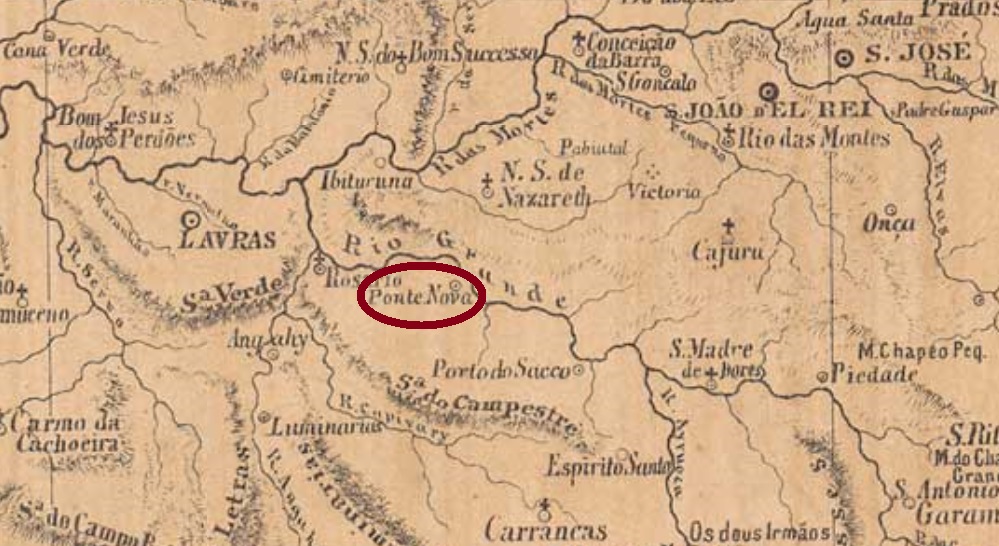
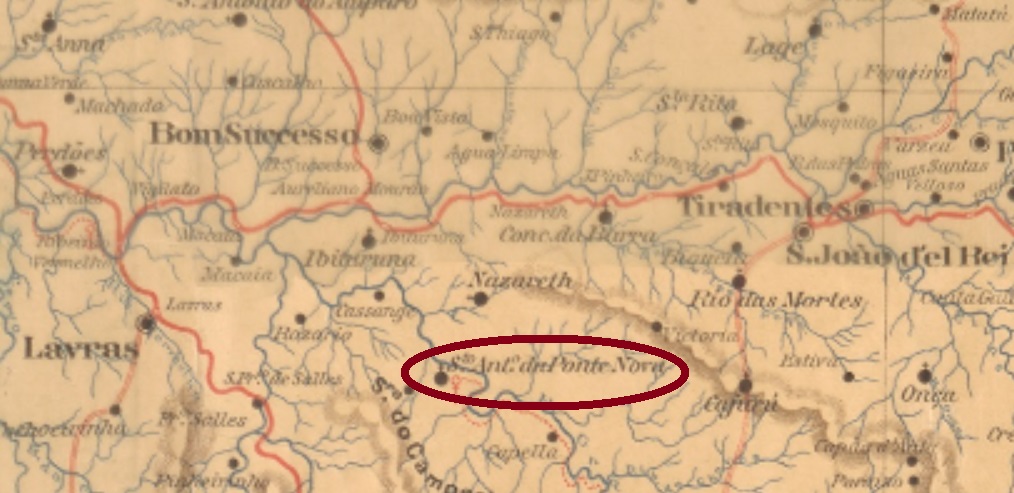
Santo Antonio da Ponte Nova, Minas Gerais (SMG-2980)

Mappa da Provincia de Minas Geraes (…) 1873

Another name: Itutinga (1924)

Santo Antonio da Ponte Nova (= of the New Bridge) was since September 1870 a district in the municipality of São João d’El Rey, situated on the Rio Grande, ca. 200 km southwest of the provincial capital Ouro Preto. In November 1880 it changed as a district to Lavras and was called Itutinga from September 1924 on. This tupi word means white waterfall. Itutinga became a district of the municipality of Itumirim in December 1943 and emancipated politically ten years later.

According to Paula Sobrinho (História Postal de Minas Gerais, Belo Horizonte, 1997), the local post office was created in October 1881. One imperial cancel is recorded: SMG-2980a (Coll. Dieter Kerkhoff) has a double circle with the inscription S. ANTONIO DA PONTE NOVA above and a diamond ornament below, formed by four small diamonds. The dates at the centre are from 1888 to 1898.

Mappa de Minas Geraes, 1910

Anderer Name: Itutinga (1924)

Santo Antonio da Ponte Nova (= der Neuen Brücke) war ab September 1870 ein Distrikt im Município von São João d’El Rey, der am Rio Grande lag, ca. 200 km südwestlich der Provinzhauptstadt Ouro Preto. Im November 1880 wechselte er als Distrikt zu Lavras und hieß ab September 1924 Itutinga. Das Wort aus der Tupi-Sprache bedeutet Weißer Wasserfall. Itutinga wurde im Dezember 1943 ein Distrikt im Município von Itumirim und erhielt zehn Jahre später seine politische Selbständigkeit.

Laut Paula Sobrinho (História Postal de Minas Gerais, Belo Horizonte, 1997) gibt es dort ein Postamt seit Oktober 1881. Ein Stempel der Kaiserzeit ist überliefert: SMG-2980a (Samml. Dieter Kerkhoff) hat einen Doppelkreis mit der Inschrift S. ANTONIO DA PONTE NOVA oben und einem Rautenornament unten, das aus vier kleinen Rauten besteht. Die Daten in der Mitte gehen von 1888 bis 1898.

Categories
Carimbologia S

Santo Antonio do Pinhal, São Paulo (SSP-1330)

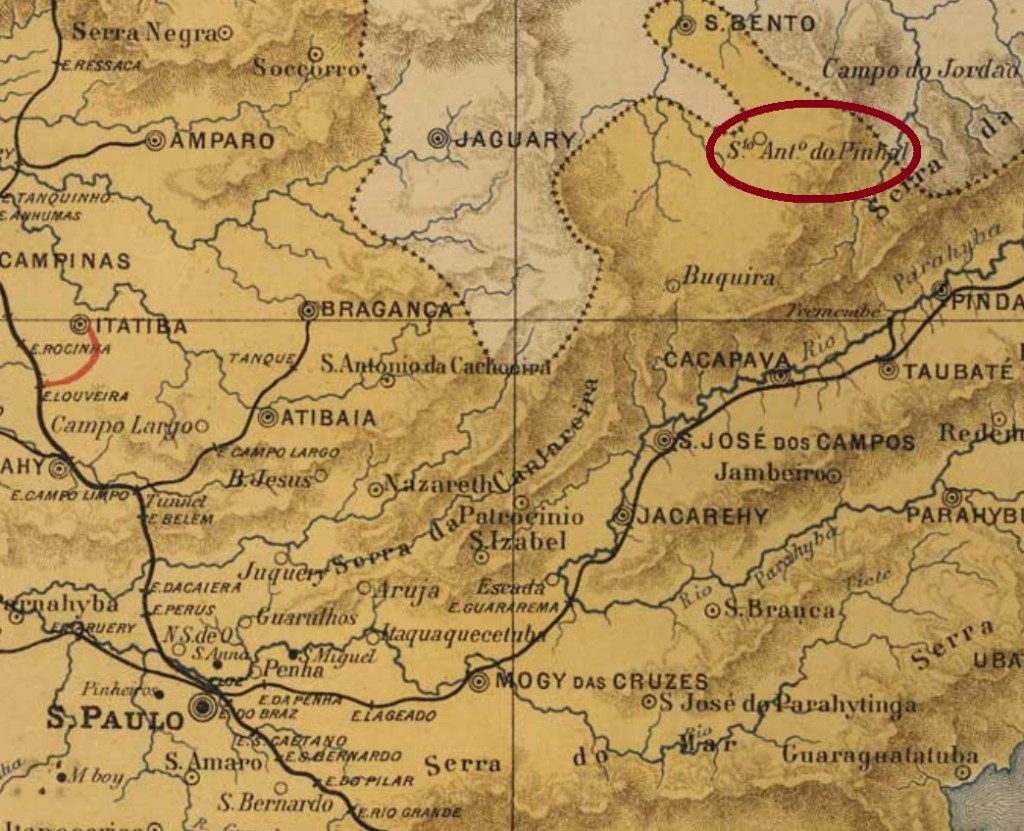
J.M. Ribeiro Lisboa: Mappa da Provincia de São Paulo, 1884

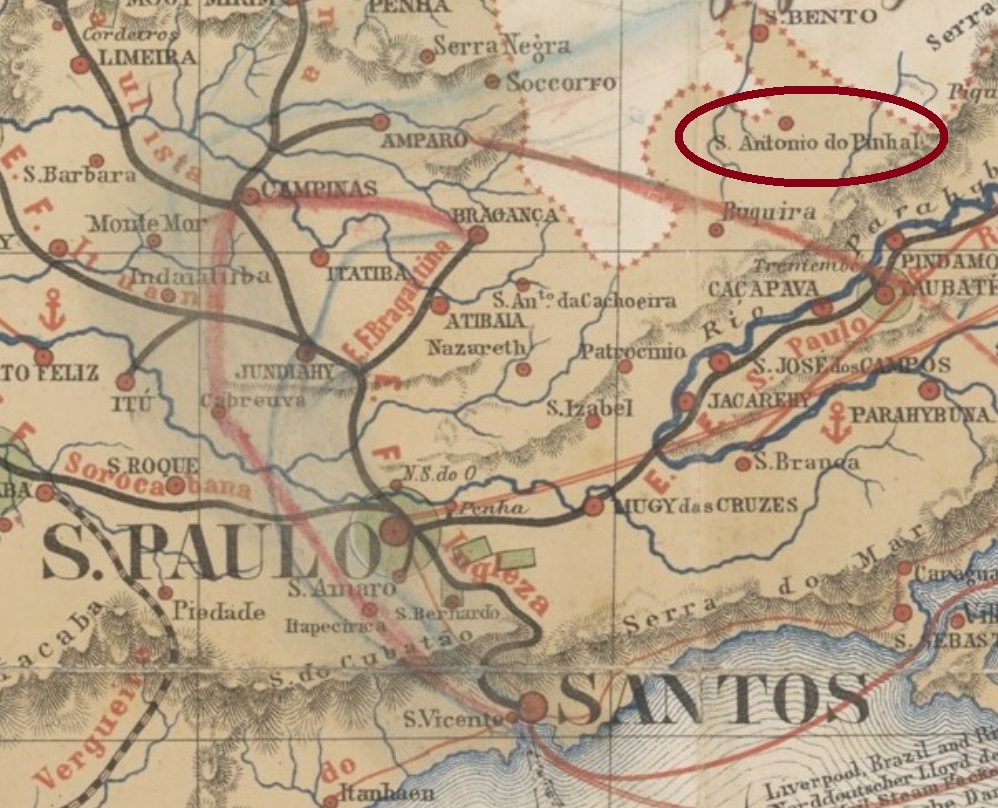
Santo Antonio do Pinhal was since March 1861 a freguesia in the municipality of S. Bento do Sapucahy, situated round 180 km northeast of the province capital São Paulo. In March 1880 it ascended to a district, which became an own municipality in February 1959.

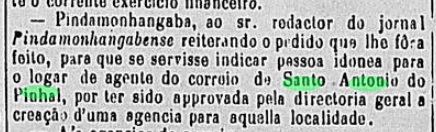
The local post office was created by December 1876, as reported by the regional press:

Correio Paulistano, December 17, 1876

One imperial cancel was found. SSP-1330a (Coll. FM) is a French-type: a double circle with the inscription S. ANTo. DO PINHAL above and the star between parentheses below. The dates at the centre were found for the period 1885-1899.

Provincia de São Paulo, 1886

Santo Antonio do Pinhal war ab März 1861 eine Freguesia im Município von S. Bento do Sapucahy, die rund 180 km nordöstlich der Provinzhauptstadt São Paulo entfernt lag. Im März 1880 stieg sie zum Distrikt auf, der im Februar 1959 ein eigenständiger Município wurde.

Das örtliche Postamt entstand bis zum Dezember 1876, wie die Regionalpresse berichtet:

Correio Paulistano, 17. Dezember 1876

Ein Poststempel der Kaiserzeit wurde gefunden. SSP-1330a (Samml. FM) ist ein „Französischer-Typus“: er hat einen Doppelkreis mit der Inschrift S. ANTo. DO PINHAL oben und den Stern zwischen Klammern unten. Die Daten in der Mitte wurden für den Zeitraum 1885-1899 ermittelt.

Categories
Carimbologia S

Santo Antonio dos Patos, Minas Gerais (SMG-3065)

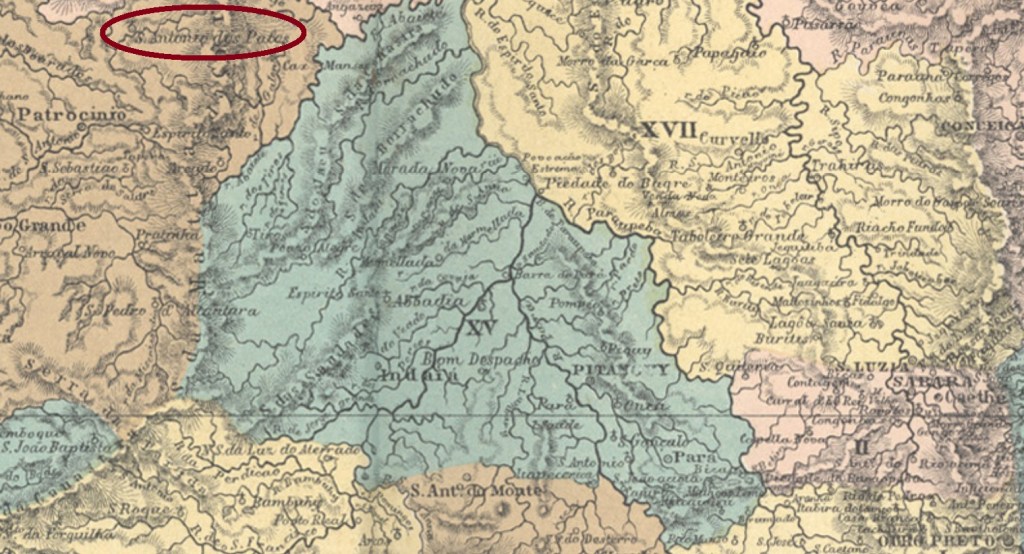
Atlas do Imperio do Brasil, 1868

Another name : Patos de Minas (1943)

See also Patos/MG (R. Koester : Carimbologia XXX)

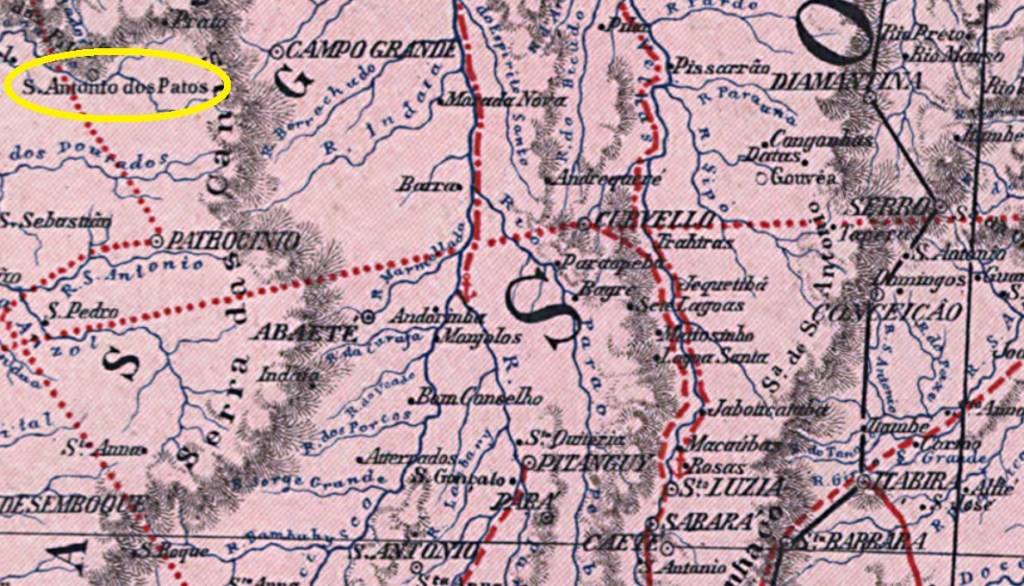
Santo Antonio dos Patos was since May 1850 a parish in the municipality of Patrocínio, situated almost 500 km northwest of the provincial capital Ouro Preto. In October 1866 it ascended to a villa, which was declared the town of Patos in May 1892. Since December 1943 the municipality is called Patos de Minas.

Both R. Koester (Carimbologia XXX) and Paula Sobrinho (História Postal de Minas Gerais, Belo Horizonte, 1997) agree in dating the agency creation in May 1871. No postal cancel of the Empire has been found for this toponym until now. For cancels with only PATOS see R. Koester’s Carimbologia XXX.

Carta da Republica dos Estados Unidos do Brazil, 1892

Anderer Name : Patos de Minas (1943)

Siehe auch Patos/MG (R. Koester : Carimbologia XXX)

Santo Antonio dos Patos war ab Mai 1850 eine Pfarrei im Município von Patrocínio, die fast 500 km nordwestlich der Provinzhauptstadt Ouro Preto entfernt lag. Im Oktober 1866 stieg sie zur Villa, die im Mai 1892 die Stadt Patos wurde. Seit Dezember 1943 heißt dieser Município Patos de Minas.

Sowohl R. Koester (Carimbologia XXX) als auch Paula Sobrinho (História Postal de Minas Gerais, Belo Horizonte, 1997) sind sich einig darüber, dass es dort seit Mai 1871 ein Postamt gibt. Kein Poststempel aus dem Kaiserreich wurde bisher mit diesem Ortsnamen gefunden. Für Stempel mit lediglich PATOS siehe R. Koesters Carimbologia XXX.

Categories
Carimbologia S

Santo Antonio do Paquequer, Rio de Janeiro (SRJ-0908)

Atlas do Imperio do Brasil, 1868

See also Theresopolis

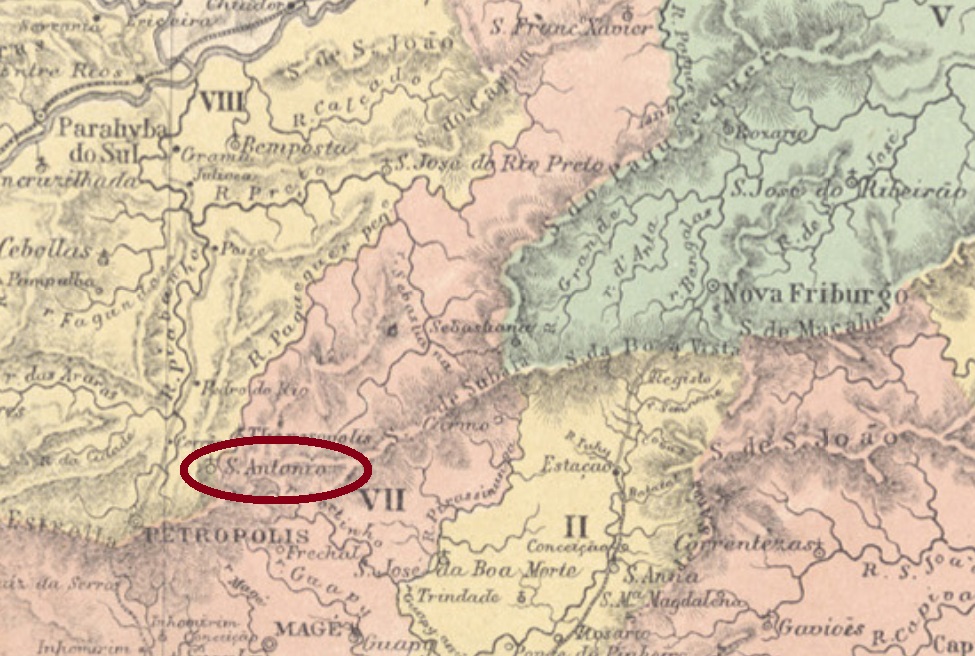
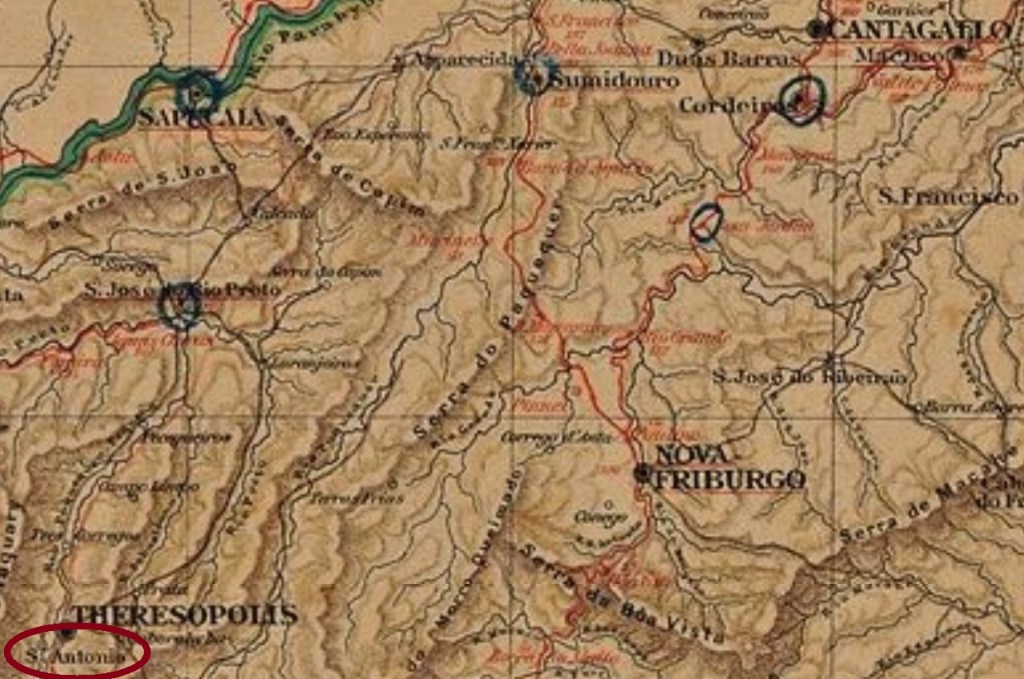
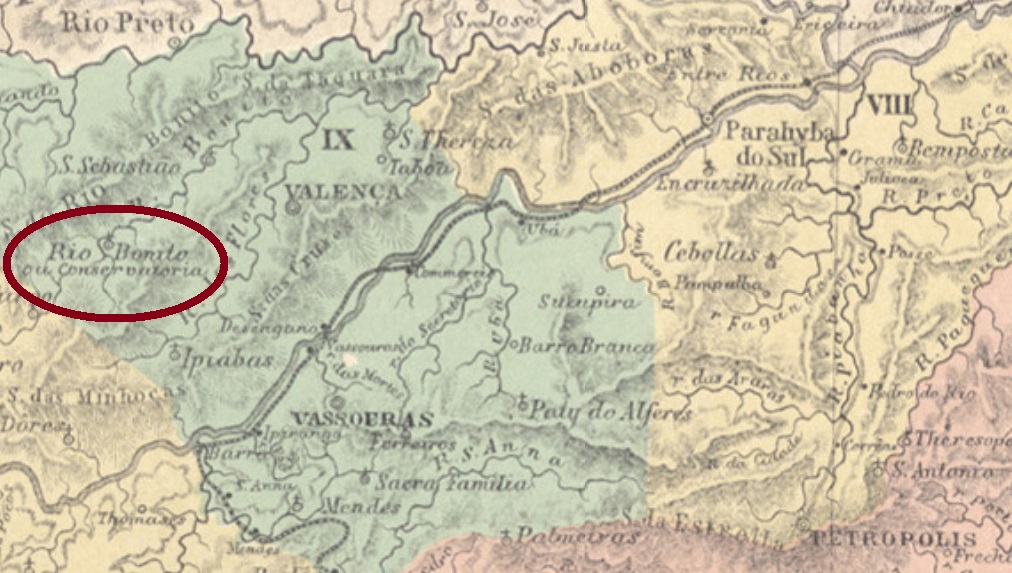
Santo Antonio do Paquequer was since October of 1855 a district of the municipality of Magé, situated round 100 km north of the imperial capital Rio de Janeiro. It ascended to a political independent villa in July 1891, which changed the toponym to Teresópolis in June 1892. The name is a tribute to the empress Teresa Cristina, the wife of D. Pedro II. Since January 1893 is Teresópolis a town.

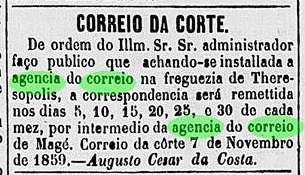
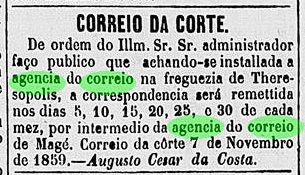
Although the toponym Teresópolis was made official only in 1892, it is evident that it was used as early as 1859, when a post office under this name was opened in Santo Antonio do Paquequer. Obviously, the future name had been planned in such an advance that the postal administration did not hesitate in applying it beforehand:

Correio da Tarde, November 8, 1859

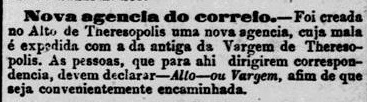
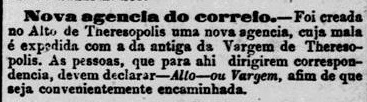
Things got more complicated in July 1862, when according to Paulo Novaes (agenciaspostais.com.br) another agency opened in Santo Antonio do Paquequer. This one closed “ca. 1864” (P. Novaes), but reopened in October 1874, under the name of Alto de Theresopolis, as reported by the Rio press:

Jornal do Commercio, October 3, 1874

Considering that the Theresopolis agency was also operating at that time, there must have been two post offices in the village. The older one, situated in the lower part (Várzea or Vargem), was called Theresopolis from the start in 1859. The later one was situated uphill and must have been the Santo Antonio do Paquequer agency of 1862 that closed two years later and reopened in 1874 under the name Alto (High) de Theresopolis. This can be ratified by the 1880 Postal Guide (Guia Postal do Imperio), which lists offices both in Alto de Theresopolis (#34) and in Theresopolis (#1137).

According to P. Novaes, both agencies are operating still nowadays. No imperial postal cancel from Santo Antonio do Paquequer has appeared until now.

Almanak Laemmert, 1892

Siehe auch Theresopolis

Santo Antonio do Paquequer war ab Oktober 1855 ein Distrikt im Município von Magé, der rund 100 km nördlich der kaiserlichen Hauptstadt Rio de Janeiro entfernt lag. Im Juli 1891 stieg er zur eigenständigen Villa, deren Namen im Juni 1892 zur aktuellen Teresópolis wechselte. Dieser Bezeichnung ist eine Hommage an die Kaiserin Teresa Cristina, die Frau des D. Pedro II. Seit Januar 1893 ist Teresópolis eine Stadt.

Obwohl der Ortsname Teresópolis erst 1892 offiziell wurde, war er offenbar bereits 1859 im Umlauf gewesen, als ein Postamt mit diesem Namen in der Gemeinde öffnete. Daraus geht hervor, dass der künftige Ortsname sehr lange im Voraus geplant war, und die Postverwaltung dadurch keine Probleme mit der frühen Verwendung hatte:

Correio da Tarde, 8. November 1859

Die Lage wurde aber im Juli 1862 komplizierter, als laut Paulo Novaes (agenciaspostais.com.br) ein anderes Postamt im Santo Antonio do Paquequer eröffnete. Dieses schloss “ca. 1864” (P. Novaes) wieder ab, um im Oktober 1874 abermals zu öffnen, nun unter dem Namen Alto de Theresopolis, wie die Rio-Presse berichtet:

Jornal do Commercio, 3. Oktober 1874

Da die Postagentur Theresopolis in der Zeit auch in Betrieb war, gab es wohl damals zwei Postämter in der Ortschaft. Das Ältere lag im unteren Ortsteil (Várzea oder Vargem) und hieß Theresopolis vom Betriebsbeginn 1859 an. Das Spätere lag im oberen Ortsteil und muss das Postamt Santo Antonio do Paquequer von 1862 sein, das zwei Jahre später geschlossen wurde und erst 1874 unter dem Namen Alto (Ober-) de Theresopolis wieder öffnete. Das kann durch den Postführer von 1880 (Guia Postal do Imperio) bestätigt werden, der beide Agenturen auflistet: Alto de Theresopolis (Nr. 34) und Theresopolis (Nr. 1137).

Beide Postämter sind heute noch im Betrieb, wie P. Novaes schreibt. Kein Poststempel aus der Kaiserzeit von Santo Antonio do Paquequer war bisher zu sehen.