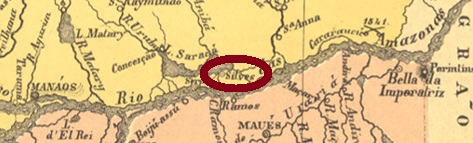
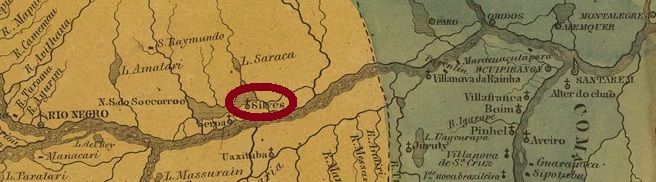
The former settlement of Sant’Anna de Saracá was founded on an island belonging to Manaus, although it is more than 180 km downstream from there. The island lies on the Urubu (Vulture) River, a tributary of the Amazon. But the river is so wide that it is called Lago de Saracá (Saracá Lake). As often happens in areas with a weak administrative structure, Silves became an autonomous Município at least four times (1833, 1925, 1935 and finally 1956). In between, the town relegated as a district three times (1922, 1930, 1938), sometimes to Itapiranga, sometimes to Itacoatiara.
As can be read in the Directory of Imperial Post Offices (Tabella das Agencias do Correio do Imperio, Rio de Janeiro, 1885), there had been a post office there since 1873, 40 years after Silves first became a villa.
Unfortunately, no Imperial postmark has yet appeared from this locality.
Villiers de l’Ile Adam: Carta (…) das Provincias do Grão Pará e Alto Amazonas, 1850
Anderer Name: Sant’Anna de Saracá
Die ehemalige Siedlung Sant’Anna de Saracá wurde auf einer Insel bei der Gemarkung Manaus gegründet, obwohl sie über 180 km von dort flussabwärts entfernt ist. Die Insel liegt zwar am Fluss Urubu (Geier), einem Nebenfluss des Amazonas. Der ist aber dort so breit, dass er Lago die Saracá (Saracá-See) genannt wird. Wie oftmals in Gegenden mit schwacher Verwaltungsstruktur passiert, wurde Silves zumindest viermal ein autonomer Município (1833, 1925, 1935 und zuletzt 1956). Zwischendurch stieg der Ort dreimal als Distrikt ab (1922, 1930, 1938), mal zu Itapiranga, mal zu Itacoatiara.
Wie im Verzeichnis der kaiserlichen Postämter (Tabella das Agencias do Correio do Imperio, Rio de Janeiro, 1885) zu lesen ist, gab es dort ein Postamt seit 1873, 40 Jahre nachdem aus Silves erstmals eine Villa wurde.
Bisher ist leider noch kein Poststempel des Kaiserreichs aus dieser Ortschaft aufgetaucht.
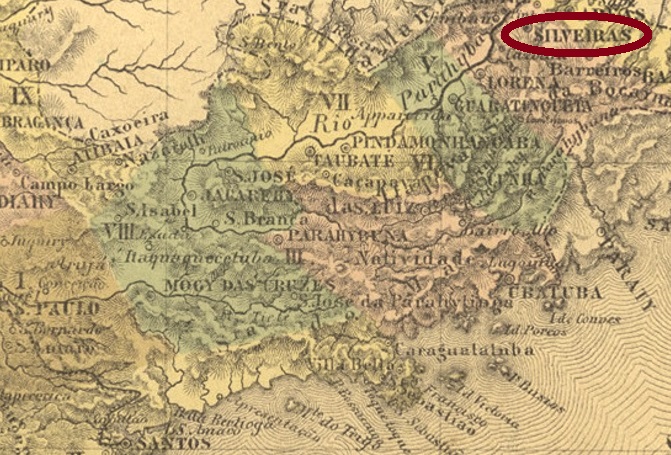
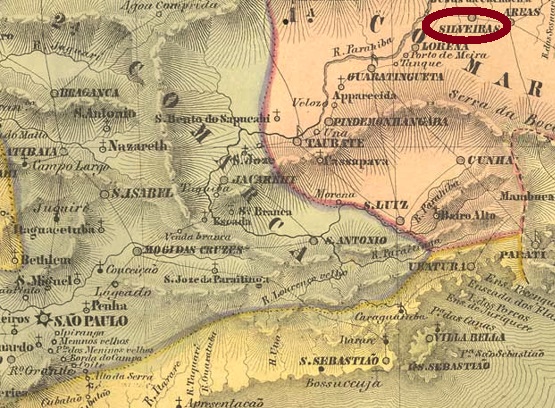
Silveiras was already a district of Lorena in December 1830, located pretty much between the source of the Paraíba do Sul River and its lower course at Cachoeira, 220 km northeast of the provincial capital São Paulo. In February 1842, the place rose to the status of vila, and in February 1864, to that of town.
Nova Monteiro writes in Administrações e Agencias Postaes do Brasil Imperio (Brasil Filatelico/RJ, 1934-5; Reprint SPP 1994-1999) that there had been a post office there since June 1847. This date will probably be a reopening, because at least one pre-philatelic postmark of this place has survived. Moreover, Silveiras was already a stop on the Rio-São Paulo postal route in 1842.
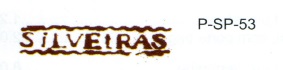
The earliest postmark is therefore SSP-2035a, which was in use around 1838, also occurs in sepia and was presented in the RHM catalogue under P-SP-53:
SSP-2035a (RHM P-SP-53) 1838
It was followed by SSP-2035b and SSP-2035c (the latter also occurs in brown), which can be seen on Bull’s-Eye issues from 1843 and were also presented in the RHM catalogue.
SSP-2035b, SSP-2035c (RHM)
Next came SSP-2035d, which is very similar to SSP-2035b. However, both the frame and the letters are larger. This postmark also appears in brown and red, was in use at least until 1866 and was shown by Paulo Ayres in Catálogo de Carimbos Brasil-Império (S. Paulo, 1937, 1942) under no. 1502:
SSP-2035d (P.A. 1502)
Two postmarks in double circle followed. SSP-2035e (Coll. José A. Junges) is a French type, with the above inscription SILVEIRAS and the star between brackets at the bottom. The dates are in the middle, between 1877 and 1885. SSP-2035f (Coll. José A. Junges) lacks the ornament at the bottom, the inscription remains at the top. Found so far for the period 1885-1888, sometimes the year is missing.
Villiers de l’Ile Adam: Carta (…) da Provincia de São Paulo, 1847
Silveiras war bereits im Dezember 1830 ein Distrikt von Lorena, der ziemlich genau zwischen der Flussquelle des Paraíba du Sul und dessen Unterlauf bei Cachoeira lag, 220 km nordöstlich der Provinzhauptstadt São Paulo entfernt. Im Februar 1842 stieg der Ort zur Vila auf, und im februar 1864 zur Stadt.
Nova Monteiro schreibt in Administrações e Agencias Postaes do Brasil Imperio (Brasil Filatelico/RJ, 1934-5; Reprint SPP 1994-1999), dass es dort seit Juni 1847 ein Postamt gab. Dieses Datum wird wohl eine Wiedereröffnung sein, denn zumindest ein Vorphila-Poststempel dieses Ortes ist überliefert. Außerdem war Silveiras 1842 bereits eine Haltestelle der Postroute Rio-São Paulo.
Der früheste Stempel ist demnach SSP-2035a, der um 1838 in Gebrauch war, auch in sepia vorkommt und im RHM-Katalog unter P-SP-53 präsentiert wurde:
SSP-2035a (RHM P-SP-53) 1838
Ihm folgten SSP-2035b und SSP-2035c (dieser kommt auch in braun vor), die auf Ochsenaugen-Ausgaben von 1843 zu sehen sind und ebenfalls im RHM-Katalog vorgestellt wurden.
SSP-2035b, SSP-2035c (RHM)
Danach kam SSP-2035d, der sehr ähnlich wir SSP-2035b ist. Allerdings sind hier sowohl der Rahmen als auch die Buchstaben größer. Dieser Poststempel kommt auch in braun und rot vor, war in Gebrauch zumindest bis 1866 und wurde durch Paulo Ayres in Catálogo de Carimbos Brasil-Império (S. Paulo, 1937, 1942) unter Nr. 1502 abgebildet:
SSP-2035d (P.A. 1502)
Es folgten zwei Poststempel in Doppelkreis. SSP-2035e (Samml. José A. Junges) ist ein französischer Typus, mit der obigen Inschrift SILVEIRAS und dem Stern zwischen Klammern unten. Daten in der Mitte zwischen 1877 und 1885. Bei SSP-2035f (Samml. José A. Junges) fehlt das Ornament unten, oben bleibt die Inschrift. Bisher gefunden für den Zeitraum 1885-1888, wobei manchmal die Jahresangabe fehlt.
Carta da Republica dos Estados Unidos do Brazil, 1892
Print edition update, on 16.10.2021
Other names: Città Nuova, Città Bianca, Val di Buia.
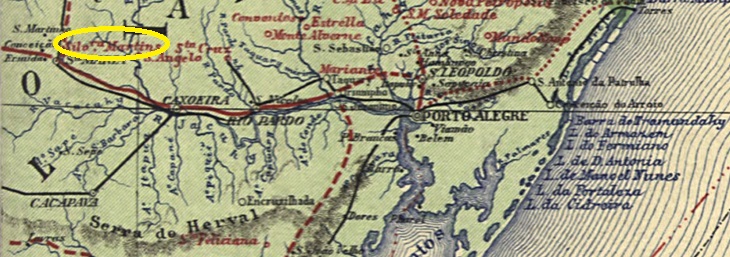
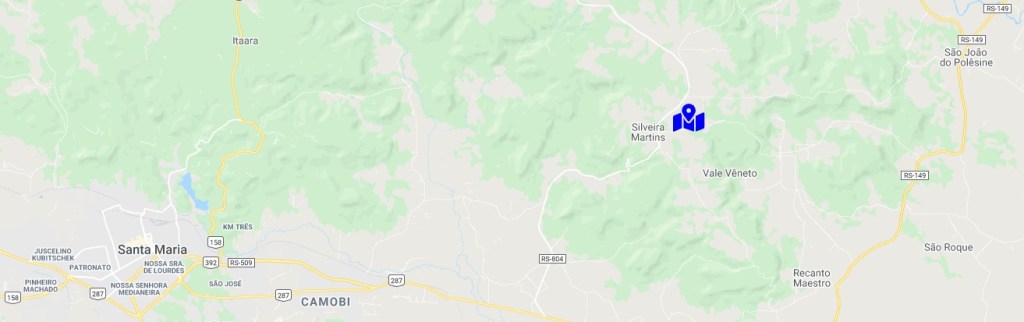
Silveira Martins was an Italian colony in the province of São Pedro do Rio Grande from 1877, over 280 km west of the capital Porto Alegre. In April 1884, it became a district of Santa Maria, and since December 1987 it has been the Município of Silveira Martins. The name celebrates Gaspar da Silveira Martins (1835-1901), a senator who had campaigned for the admission of colonists from Italy.
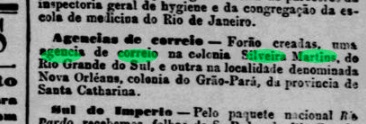
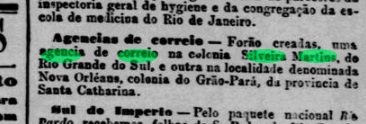
The local post office had existed since August 1888, as reported by the Rio press:
Jornal do Commercio/RJ, 20/08/1888
The imperial postmark is SRS-0430a (image from the internet): a double circle with the inscription C.S.MARTINS (Colonia Silveira Martins) above and an ornament below consisting of four converging arrowheads forming a rectangle. So far, the dates in the centre come from the period 1889-1900.
colonias.heuser.pro.br
Aktualisierung der Printausgabe, am 16.10.2021
Andere Namen: Città Nuova, Città Bianca, Val di Buia
Silveira Martins war ab 1877 eine italienische Kolonie in der Provinz São Pedro do Rio Grande, die über 280 km westlich der Hauptstadt Porto Alegre entfernt lag. Im April 1884 wurde der Ort zum Distrikt von Santa Maria, und seit Dezember 1987 ist er der Município von Silveira Martins. Der Name erinnert an Gaspar da Silveira Martins (1835-1901), einem Senator, der sich für die Aufnahme von Kolonisten aus Italien engagiert hatte.
Das örtliche Postamt gab es seit August 1888, wie die Presse aus Rio berichtete:
Jornal do Commercio/RJ, 20.08.1888
Der kaiserliche Poststempel ist SRS-0430a (Abb. aus dem Internet): ein Doppelkreis mit der Inschrift C.S.MARTINS (Colonia Silveira Martins) oben und einem Ornament unten, das aus vier konvergierenden Pfeilspitzen in Viereck besteht. Die Daten im Inneren wurden bisher für den Zeitraum 1889-1900 gefunden.
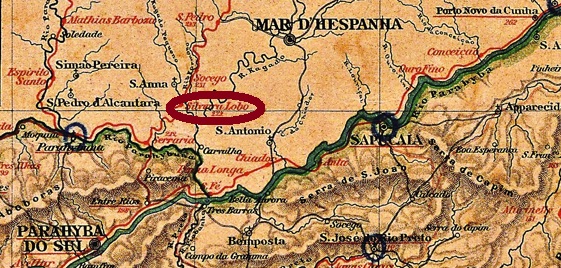
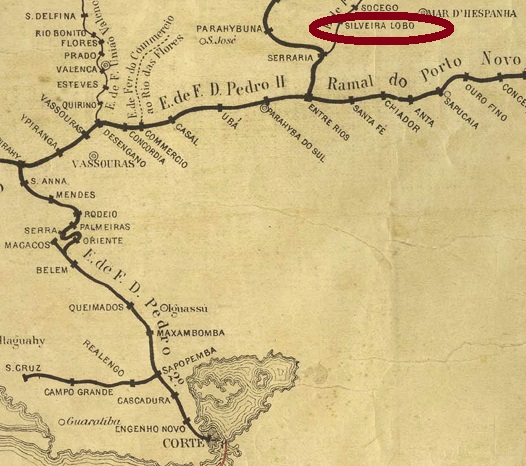
Silveira Lobo was a train station inaugurated in 1879 by the Cia. União Mineira, Serraria branch, in the Município of Mar d’Hespanha, about 250 km south of the provincial capital Ouro Preto. The station was closed in 1904 when the E.F. Leopoldina inaugurated a new station of the same name on the Caratinga Line (estacoesferroviarias.com.br). Francisco de Paula da Silveira Lobo (1826-1886) was president of the province of Minas Gerais from 1878 until his death.
Paula Sobrinho writes in História Postal de Minas Gerais (Belo Horizonte, 1997) that the station post office was created in March 1873. However, the year might be a typing error, because firstly it is 6 years before the actual station, and secondly, in 1873 Silveira Lobo, who was born in Paraíba, was not yet in Minas Gerais, but as a senator in Rio. More likely, the year 1879 would have been the start of the station post office, as noted in the Imperial Mail Register (Tabella das Agencias do Correio do Imperio, Rio de Janeiro, 1885).
Two station postmarks as a double circle and a mute cancellation were found. SMG-3120a is a French type, which also exists in blue and was already illustrated by Paulo Ayres in Catálogo de Carimbos Brasil-Império (S. Paulo, 1937, 1942) on p. 118:
SMG-3120a (P.Ayres op. cit./p. 118), 1884
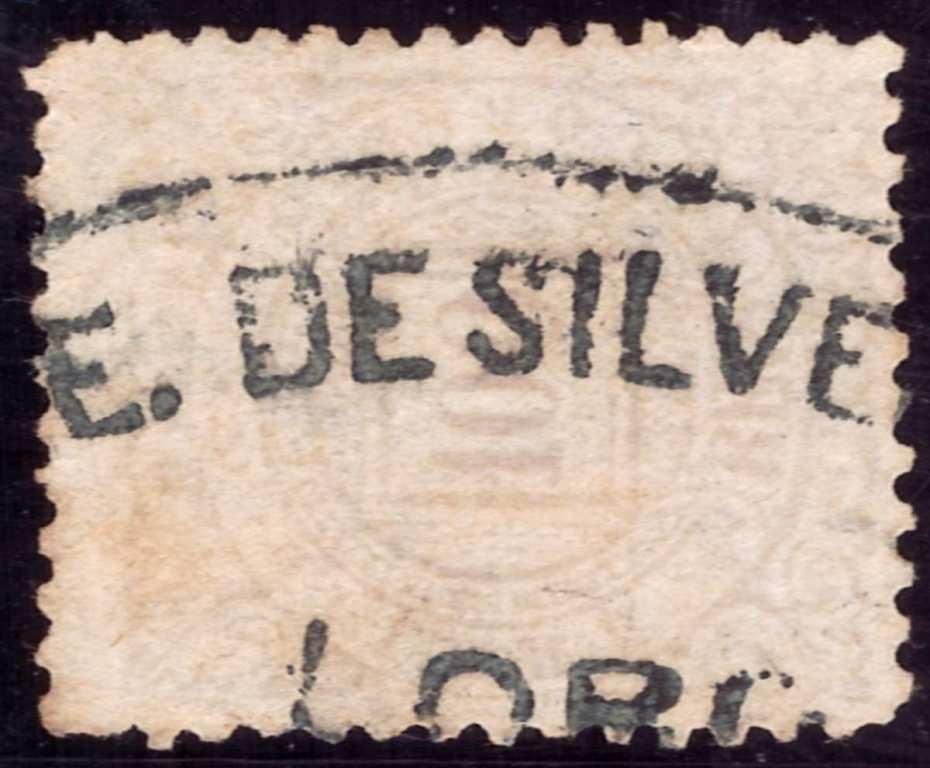
Roughly parallel to this was SMG-3120b (Coll. José A. Junges) in use: here the inscription is SILVEIRA LOBO (ESTAÇÃO). This cancel also appears in blue and green and has internal dates from 1883 to 1888.
After the release of Carimbologia S2, another station cancel has appeared. SMG-3120c (Coll. Alf Dombrowe) seems a bit archaic, but was used on a numeral issue from 1888:
SMG-3120c (AD) 1888ff
The mute cancel of the station post office was already presented to us by J. Dingler and Kl. W. Lopes in Mute Cancellations of the Brazil Empire / Carimbos Mudos do Brasil Império (Brazil Philatelic Association, Rio de Janeiro, 2000) under no. 451:
BPA 451Estações (…) do rio de Janeiro, São Paulo e Minas Geraes, 1880
Textaktualisierung vom 29.05.2022
Silveira Lobo hieß ein Bahnhof, der 1879 von der Cia. União MIneira, Serraria-Abzweigung, im Município von Mar d’Hespanha eingeweiht wurde, ca. 250 km südlich der Provinzhauptstadt Ouro Preto entfernt. Der Bahnhof wurde 1904 stillgelegt, als die E.F. Leopoldina einen neuen Bahnhof gleichen Namens in der Caratinga-Linie einweihte (estacoesferroviarias.com.br). Francisco de Paula da Silveira Lobo (1826-1886) war Präsident der Provinz Minas Gerais von 1878 bis zu seinem Tod.
Paula Sobrinho schreibt in História Postal de Minas Gerais (Belo Horizonte, 1997), dass das Bahnhofspostamt im März 1873 entstand. Die Jahresangabe könnte aber einen Tippfehler enthalten, denn erstens liegt sie 6 Jahre vor dem eigentlichen Bahnhof, und zweitens war 1873 der in Paraíba geborene Silveira Lobo noch nicht in Minas Gerais, sondern als Senator in Rio. Wahrscheinlicher wäre das Jahr 1879 als Betriebsstart des Bahnhofspostamts gewesen, wie im Verzeichnis der kaiserlichen Postämter (Tabella das Agencias do Correio do Imperio, Rio de Janeiro, 1885) vermerkt.
Zwei Bahnhofsstempel als Doppelkreis und eine „stumme“ Entwertung wurden gefunden. SMG-3120a ist ein Französischer Typus, den es auch in blau gibt und bereits durch Paulo Ayres in Catálogo de Carimbos Brasil-Império (S. Paulo, 1937, 1942) auf S. 118 abgebildet wurde:
SMG-3120a (P.Ayres op.cit. /S. 118), 1884
Etwa parallel dazu gab es SMG-3120b (Samml. José A. Junges): hier lautet die Inschrift SILVEIRA LOBO (ESTAÇÃO). Dieser Stempel kommt auch in blau und grün vor und hat innere Daten von 1883 bis 1888.
Nach dem Erscheinen von Carimbologia S2 ist ein weiterer Bahnhofsstempel aufgetaucht. SMG-3120c (Samml. Alf Dombrowe) mutet etwas archaisch an, wurde aber auf einer Zifferausgabe von 1888 verwendet:
SMG-3120c (AD) 1888ff
Der stumme Stempel des Bahnhofspostamts wurde uns bereits durch J. Dingler und Kl. W. Lopes in Mute Cancellations of the Brazil Empire / Carimbos Mudos do Brasil Império (Brazil Philatelic Association, Rio de Janeiro, 2000) unter Nr. 451 präsentiert:
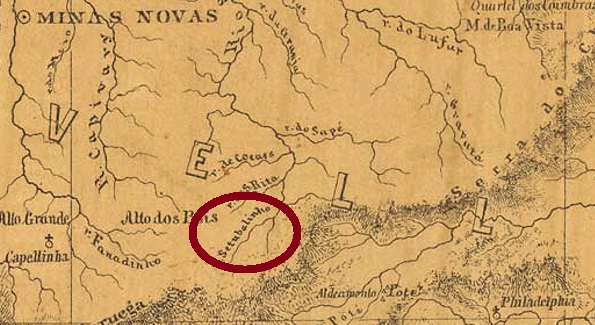
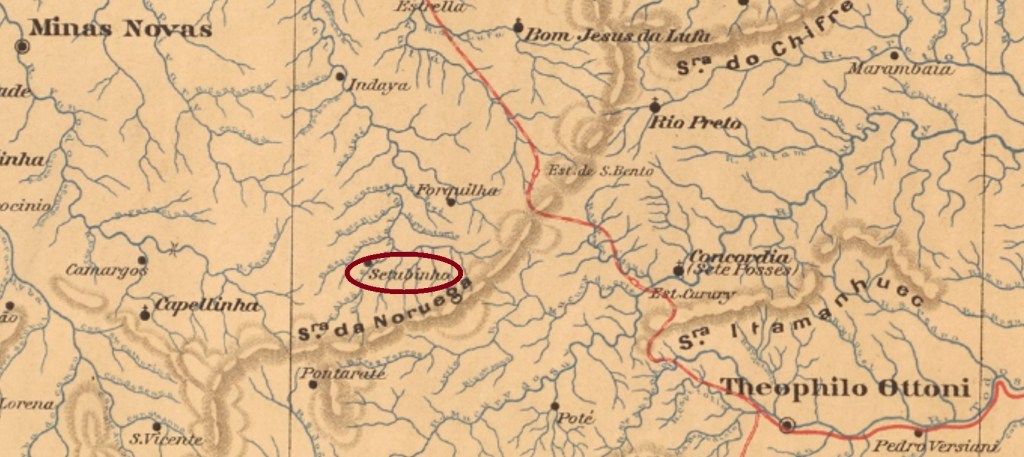
This locality was the freguesia of Santo Antonio do Setubinha near Minas Novas from November 1865 and was located on the west bank of the Setubinha River, over 500 km north of the provincial capital Ouro Preto. The place was elevated to a district in January 1889, this time in the Município of Theophilo Ottoni. In September 1923, it changed to Malacacheta and has been an independent município since December 1995.
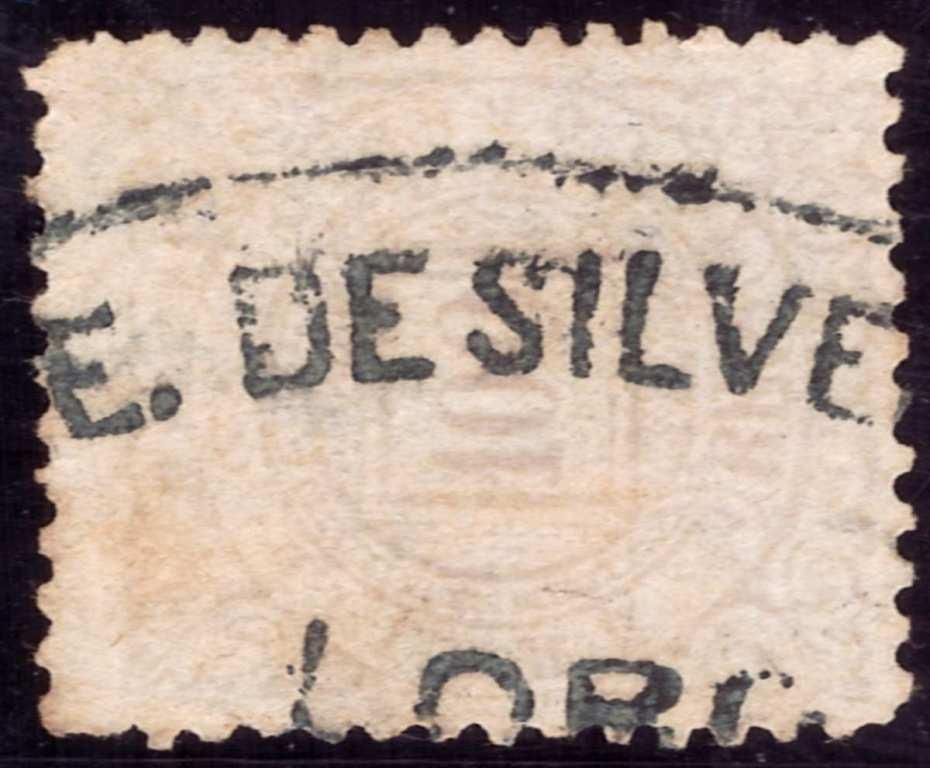
As Paula Sobrinho writes in História Postal de Minas Gerais (Belo Horizonte, 1997), there has been a post office there since July 1881. The imperial postmark is SMG-3115a (Coll. José A. Junges): a double circle with the inscriptions SETUBINHA above and (MINAS) below. The dates so far have been found within the period 1885-1901, although the year may occasionally be missing.
Estado de Minas Geraes, 1910
Anderer Name: Santo Antonio do Setubinha
Diese Ortschaft war ab November 1865 die Freguesia von Santo Antonio do Setubinha bei Minas Novas, und lag am Westufer des Flusses Setubinha, über 500 km nördlich der Provinzhauptstadt Ouro Preto entfernt. Der Ort wurde im Januar 1889 zum Distrikt erhoben, diesmal im Município von Theophilo Ottoni. Im September 1923 wechselte er zu Malacacheta und ist ein eigenständiger Município seit Dezember 1995.
Wie Paula Sobrinho in História Postal de Minas Gerais (Belo Horizonte, 1997) schreibt, gibt es dort ein Postamt seit Juli 1881. Der kaiserliche Poststempel ist SMG-3115a (Samml. José A. Junges): ein Doppelkreis mit den Inschriften SETUBINHA oben und (MINAS) unten. Die Daten wurden bisher für den Zeitraum 1885-1901, wobei die Jahresangabe gelegentlich fehlen kann.
Villiers de l’Ile Adam: Carta (…) da Provincia de Minas Geraes, 1849
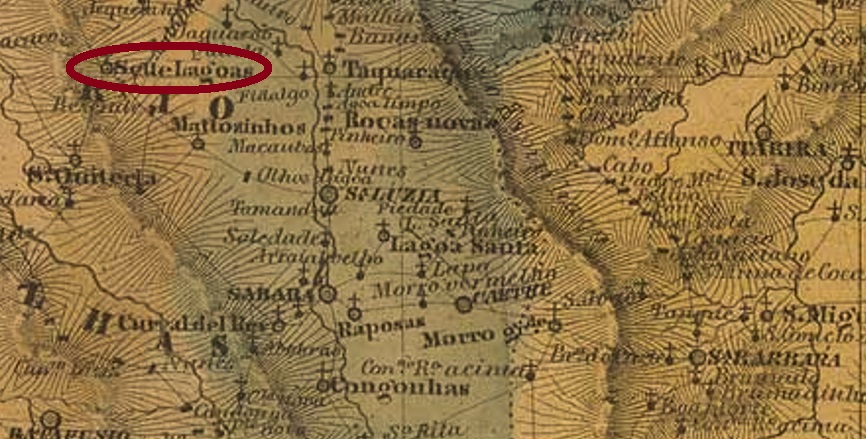
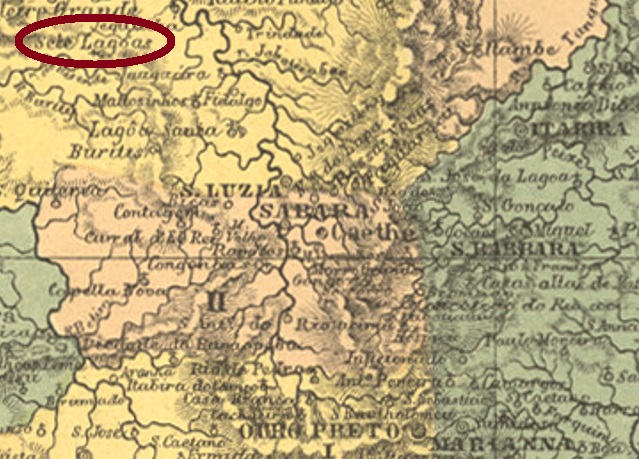
Sete Lagoas (Seven Lakes) was a freguesia of Santa Luzia from April 1841, located over 160 km northwest of the provincial capital Ouro Preto. In November 1867, it was elevated to the status of vila, and in November 1880, it became a town.
Two foundation dates for the local post office were found. Paula Sobrinho writes in História Postal de Minas Gerais (Belo Horizonte, 1997) that the date was August 1864, which is probably a reopening, as the Rio de Janeiro press had previously announced 31.12.1848:
Diario do Rio de Janeiro, 5.1.1849
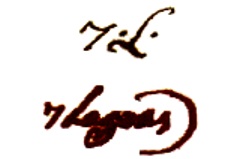
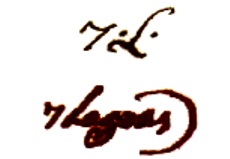
Furthermore, the Catálogo Enciclopédico RHM (São Paulo, 1999) writes that pre-philatelic covers with handwritten cancellations exist from Sete Lagoas:
(RHM)
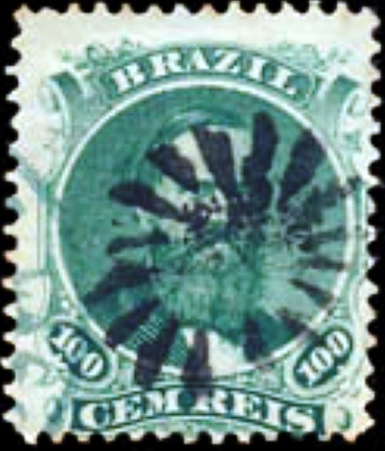
The oldest town cancel is SMG-3110a, presented in the RHM catalogue under P-MG-61, which was used on the Bulls-eye issues of 1843:
SMG-3110a (RHM P-MG-61) 1843ff
It was followed by SMG-3110b (Coll. José A. Junges): a double circle with the inscription CORREIO DE SETE LAGOAS at the top and an unfortunately poorly legible ornament at the bottom. Found also in blue, without dates on D. Pedro issues of 1866. Two very similar place stamps followed: the double circles SMG-3110c and SMG-3110d (both coll. José A. Junges) both occurs also in blue and has the above inscription SETE LAGOAS. The first has inner dates between 1883 and 1887 and has no circumflex above the O of LAGOAS. The second occurs with inner dates between 1888 and 1901 and has a circumflex above the LAGOAS-O.
In addition, three mute cancels from Sete Lagoas were found on D. Pedro issues of 1866:
1866ff (RHM)1866ff (JJ)1866ff (RHM)Atlas do Imperio do Brasil, 1868
Sete Lagoas (Sieben Seen) war ab April 1841 eine Freguesia von Santa Luzia, die über 160 km nordwestlich der Provinzhauptstadt Ouro Preto entfernt lag. Im November 1867 wurde der Ort zur Vila erhoben, und im November 1880 zur Stadt.
Zwei Gründungsdaten fürs örtliche Postamt wurde gefunden. Paula Sobrinho schreibt in História Postal de Minas Gerais (Belo Horizonte, 1997) dafür den August 1864. Das Datum dürfte eine Wiedereröffnung sein, denn in der Presse von Rio de Janeiro wurde vorher den 31.12.1848 bekannt gegeben:
Diario do Rio de Janeiro, 5.1.1849
Darüber hinaus schreibt der Catálogo Enciclopédico RHM (São Paulo, 1999), dass aus Sete Lagoas vorphila-Belege mit handschriftliche Entwertungen existieren:
(RHM)
Der älteste Ortsstempel ist SMG-3110a, der im RHM-Katalog unter P-MG-61 vorgestellt wird und auf die Ochsenaugen-Ausgaben von 1843 Verwendung fand:
SMG-3110a (RHM P-MG-61) 1843ff
Ihm folgte SMG-3110b (Samml. José A. Junges): ein Doppelkreis mit der Inschrift CORREIO DE SETE LAGOAS oben und einem leider schlecht lesbaren Ornament unten. Gefunden – auch in blau – ohne Daten auf D. Pedro Ausgaben von 1866. Es kamen danach zwei sehr ähnliche Ortsstempel: die Doppelkreise SMG-3110c und SMG-3110d (beide Samml. José A. Junges) haben beide die obige Inschrift SETE LAGOAS. Der erste weist innere Daten zwischen 1883 und 1887 auf und hat kein Zirkumflex über dem O von LAGOAS. Der zweite kommt mit inneren Daten zwischen 1888 und 1901 vor und über dem LAGOAS-O steht ein Zirkumflex.
Darüber hinaus waren drei „stumme“ Stempel aus Sete Lagoas auf D. Pedro Ausgaben von 1866 zu finden:
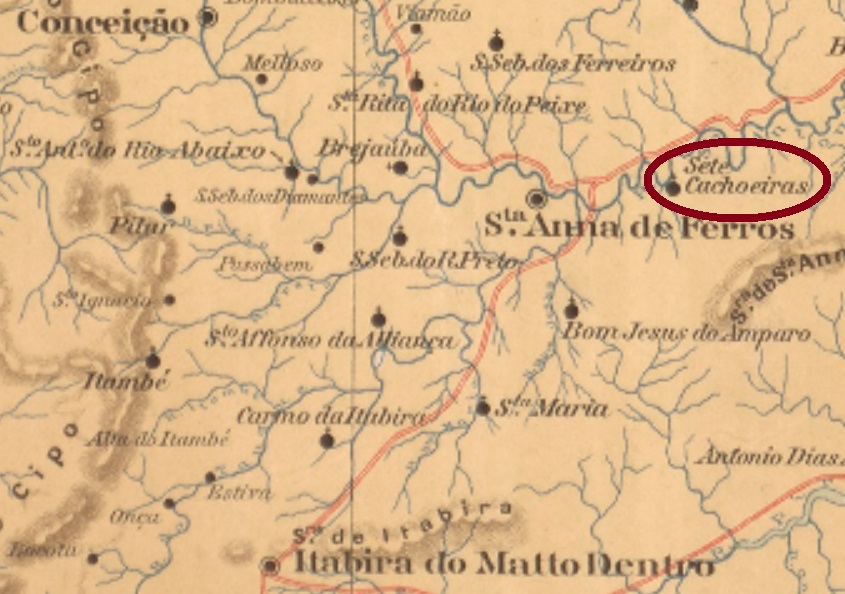
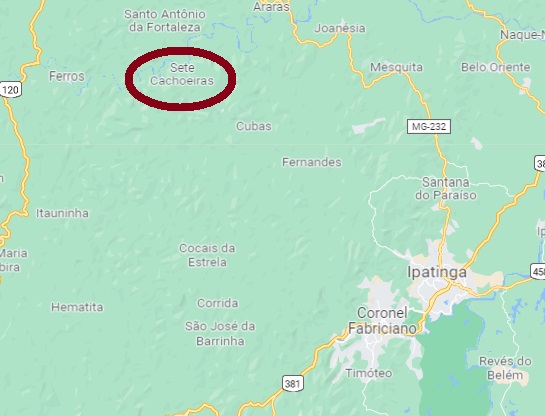
Sete Cachoeiras (Seven Waterfalls) was, as of June 1876, a district of Itabira located on the south bank of the Santo Antonio River, 250 km north of the provincial capital Ouro Preto. In September 1884, it changed to the newly founded município of Sant’Anna dos Ferros, which has only been called Ferros since September 1923. And that is how it has remained until today.
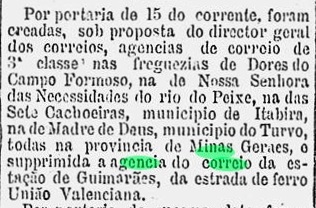
There has been a post office there since December 1881, as one can read in the Rio press:
Gazeta de Noticias/RJ, 18.12.1881
The imperial postmark from there is SMG-3105a (Coll. José A. Junges): a double circle with the inscriptions SETE CACHOEIRAS above and (MINAS) below. Dates from 1886 until 1889, in the middle.
Google Maps
Sete Cachoeiras (Sieben Wasserfälle) war ab Juni 1876 ein Distrikt von Itabira, der am Südufer des Flusses Santo Antonio lag, 250 km nördlich der Provinzhauptstadt Ouro Preto entfernt. Im September 1884 wechselte er zum neu gegründeten Município von Sant’Anna dos Ferros, der seit September 1923 nur noch Ferros heißt. Und so ist es bis heute geblieben.
Ein Postamt gibt es dort seit Dezember 1881, wie man in der Presse aus Rio lesen kann:
Gazeta de Noticias/RJ, 18.12.1881
Der kaiserliche Poststempel von dort ist SMG-3105a (Samml. José A. Junges): ein Doppelkreis mit den Inschriften SETE CACHOEIRAS oben und (MINAS) unten. Die Daten in der Mitte gehen von 1886 bis 1889.
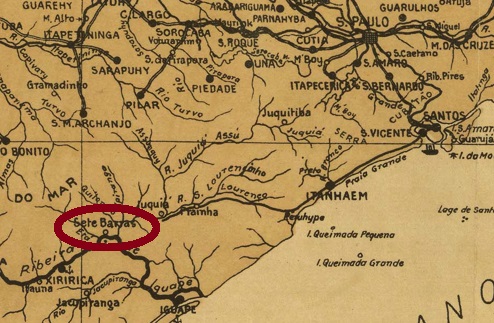
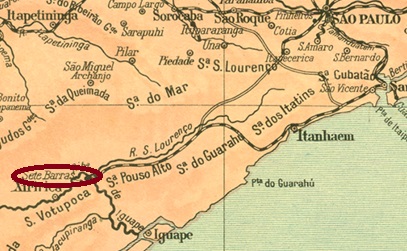
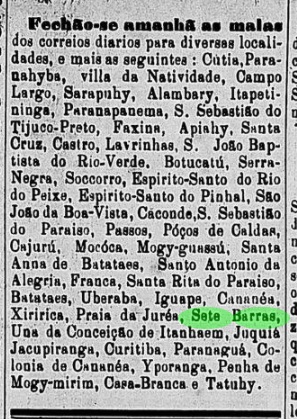
This locality was a district of Iguape as of March 1885, located on the north bank of the Ribeira de Iguape River, 200 km southwest of the provincial capital of São Paulo. Sete Barras means Seven Estuaries, and indeed the Ribeira de Iguape has seven tributaries in the area, five of them on the left bank. The district changed to Xiririca in April 1887 and to Registro in November 1944, before becoming an independent município in February 1959.
In the Imperial Mail Register (Tabella das Agencias do Correio do Imperio, Rio de Janeiro, 1885), one reads that there was a post office there from 1880. However, this could mean a reopening, because there was already a postal route through Sete Barras in March 1877, as can be read on the regional press:
Diario de São Paulo, 21.3.77
The imperial postmark is the French type SSP-1380a (Coll. Mario Celso Orsi Jr.): a double circle with the inscription SETE BARRAS above and the star between brackets below. Dates in the centre: from about 1880 to 1897.
Monteiro e Oliveira: Estado de São Paulo, 1927
Diese Ortschaft war ab März 1885 ein Distrikt von Iguape, der am Nordufer des Flusses Ribeira de Iguape lag, 200 km südwestlich der Provinzhauptstadt São Paulo entfernt. Sete Barras bedeutet Sieben Mündungen, und tatsächlich hat der Ribeira die Iguape in der Gegend sieben Zuflüsse, davon fünf am linken Ufer. Der Distrikt wechselte im April 1887 zu Xiririca und im November 1944 zu Registro, bevor er im Februar 1959 ein eigenständiger Município wurde.
Im Verzeichnis der kaiserlichen Postämter (Tabella das Agencias do Correio do Imperio, Rio de Janeiro, 1885) liest man, dass es dort ab 1880 ein Postamt gab. Diese Jahresangabe könnte allerdings eine Wiedereröffnung bedeuten, denn bereits im März 1877 gab es schon eine Postroute durch Sete Barras, wie aus der Regionalpresse hervorgeht:
Diario de São Paulo, 21.3.77
Der Ortsstempel aus der Kaiserzeit ist der Französischer Typus SSP-1380a (Samml. Mario Celso Orsi Jr.): ein Doppelkreis mit der Inschrift SETE BARRAS oben und den Stern zwischen Klammern unten. Daten in der Mitte: ab ca. 1880 bis 1897.
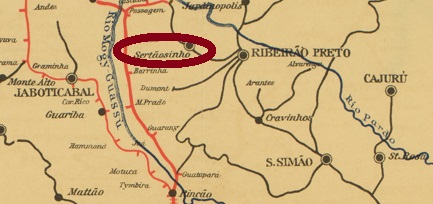
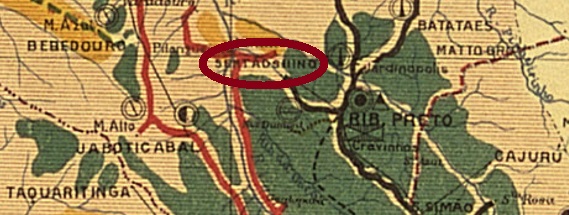
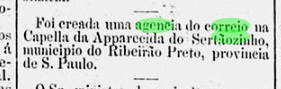
The Freguesia of Nossa Senhora da Conceição Apparecida de Sertãosinho was founded in March 1885 in the município of Ribeirão Preto, about 340 km north of the provincial capital São Paulo. In December 1896 it became a vila, and today it is the município of Sertãozinho.
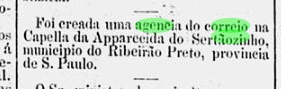
The local post office was established at the beginning of 1887, as can be seen from the Rio press:
O Paiz/RJ, 01/01/1887
Two early postmarks were found. On the double circle SSP-1375a (Coll. José A. Junges) unfortunately the left side is not visible, only (…)O DO SERTÃOZINHO, Below there is an ornament in lozenge, in the centre a date from 1889. The successor SSP-1375b (Coll. José A. Junges) has in the double circle the inscriptions SERTÃOZINHO above and (S. PAULO) below. The date inside is already from the early 20th century.
Estado de São Paulo, 1910
Textaktualisierung von 12. August 2024
Anderer Name: Apparecida do Sertãosinho
Die Freguesia von Nossa Senhora da Conceição Apparecida de Sertãosinho wurde im März 1885 im Município von Ribeirão Preto gegründet und lag rund 340 km nördlich der Provinzhauptstadt São Paulo entfernt. Im Dezember 1896 wurde daraus eine Vila, und heute ist es der Município von Sertãozinho.
Das örtliche Postamt wurde Anfang 1887 ins Leben gerufen, wie aus der Rio-Presse hervorgeht:
O Paiz/RJ, 01.01.1887
Zwei frühe Poststempel wurden gefunden. Beim Doppelkreis SSP-1375a (Samml. José A. Junges) ist leider die linke Seite nicht zu sehen, nur (…)O DO SERTÃOZINHO, Unten ist ein Ornament in Raute, in der Mitte ein Datum aus 1889. Der Nachfolger SSP-1375b (Samml. José A. Junges) hat im Doppelkreis die Inschriften SERTÃOZINHO oben und (S. PAULO) unten. Das Datum im Inneren liegt bereits im 20. Jahrhundert.
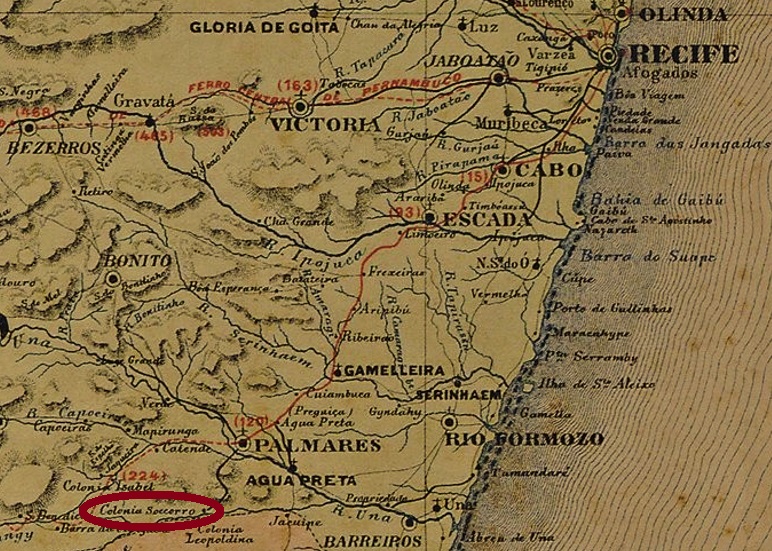
Carta Corographica da Provincia de Pernambuco, 1880
Other names: Colonia Soccorro, Sertãozinho de Baixo (1930)
See also Riacho do Matto (RPE-0720)
The amazing story of this small village near the Alagoas border in southern Pernambuco has yet to be told. Until about 1870, it was still an Indian reservation. Around that time, a dispute arose between Indians and farmers, at the end of which a land survey project was launched by the provincial government. In 1872, the dispute escalated into open conflict, and the whole area was subsequently redemarcated.
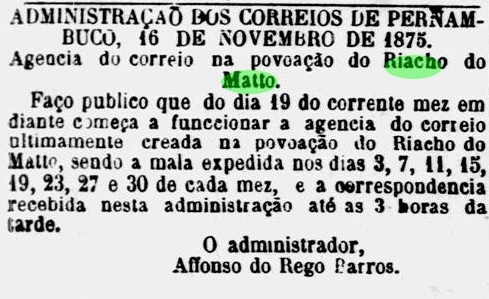
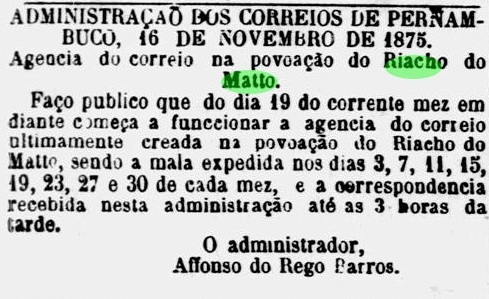
By July 1875, the Indian reservation was history, making way for an ambitious government settlement plan that included three colonies. A few months later, the new post office for Riacho do Matto was announced:
Diario de Pernambuco, 18.11.1875
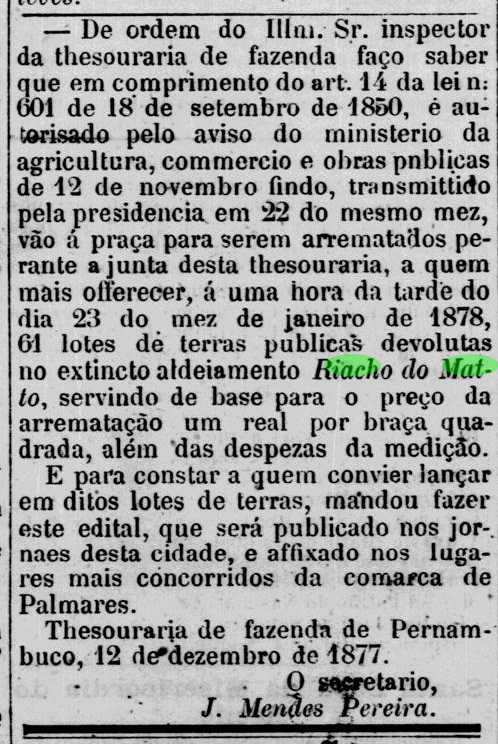
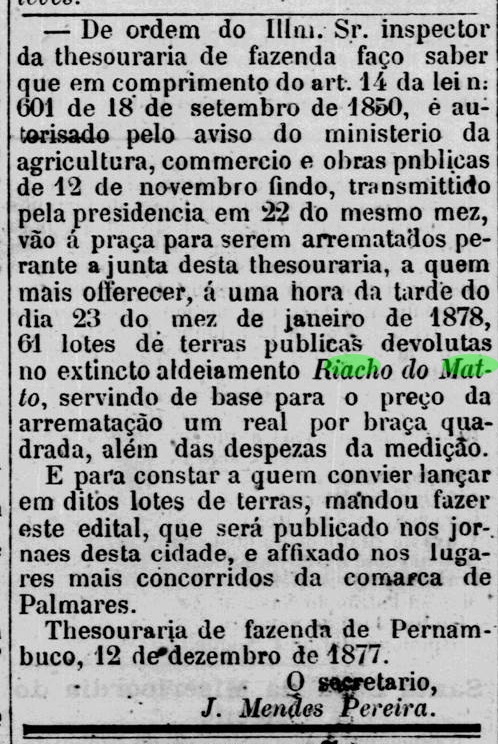
However, the land parcels were not put up for public auction until December 1877:
Diario de Pernambuco, December 16, 1877
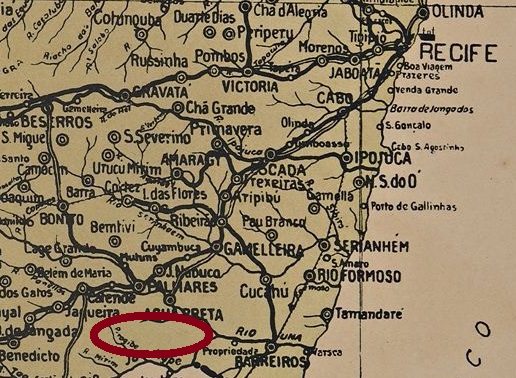
In April 1878, the first colonist train arrived at Cinco Pontas station, about 30 km away, to ceremoniously inaugurate the new colonisation of Riacho do Matto. Most of the new settlers were refugees from the drought areas in Brazil’s northeast. But they were also joined by many poor people from Recife who had been persuaded to leave the provincial capital with the prospect of a piece of land. This new colony was called Colonia Soccorro, and lay between Colonia Isabel (see also Koester, Carimbologia XII) and Colonia Leopoldina. (see map above).
Within a month, the population reached over 3,000 inhabitants, causing major problems in the social fabric of the new municipality. In the 1980s, even veterans from the region who had returned from the war against Paraguay applied to the Pernambuco government for their land parcels.
The settlement was renamed Sertãozinho in 1893 – after an old fazenda in the region – and was now under the control of the Villa of Água Preta. In 1930 it was given its current name, Sertãozinho de Baixo (= Lower Sertãozinho), and from 1938 it became a district of the newly founded Município of Maraial.
So far, no stamp from the imperial period could be found for this locality.
Arthur D. Ribeiro: Estado de Pernambuco, 1924
Andere Namen: Colonia Soccorro, Sertãozinho de Baixo (1930)
Siehe auch Riacho do Matto (RPE-0720)
Die erstaunliche Geschichte dieser kleinen Ortschaft nahe der Alagoas-Grenze im südlichen Pernambuco wurde noch nicht erzählt. Bis ca. 1870 war sie noch ein Indianerreservat. Um diese Zeit entfachte sich ein Disput zwischen Indianer und Farmern, am dessen Ende ein Landvermessungsprojekt von der Provinzregierung gestartet wurde. In 1872 eskalierte der Streit zum offenen Konflikt, und das ganze Gebiet wurde anschließend neu demarkiert.
Bis Juli 1875 war das Indianerreservat bereits Geschichte und machte Platz einem ehrgeizigen Siedlungsplan der Regierung, der drei Kolonien vorsah. Ein Paar Monate später kündigte man schon das neue Postamt für Riacho do Matto an:
Diario de Pernambuco, 18.11.1875
Die Landparzellen wurden gleichwohl erst im Dezember 1877 zur Versteigerung öffentlich ausgeschrieben:
Diario de Pernambuco, 16. Dezember 1877
In April 1878 kam der erste Kolonistenzug am ca. 30 km entfernten Bahnhof Cinco Pontas an, um die Neukolonisierung von Riacho do Matto feierlich einzuleiten. Die meisten der neuen Siedler waren Flüchtlinge aus den Dürregebieten in Brasiliens Nordosten. Dazu kamen aber auch viele Arme aus Recife, die überredet worden waren, mit der Aussicht auf ein Stück Land die Provinzhauptstadt zu verlassen. Diese neue Kolonie wurde Colonia Soccorro genannt, und lag zwischen Colonia Isabel (s.a. Koester, Carimbologia XII) und Colonia Leopoldina. (s. Karte zu Beginn des englischen Textes).
Binnen eines Monates erreichte die Bevölkerungszahl über 3.000 Einwohner, was große Probleme im sozialen Gefüge der neuen Gemeinde mit sich brachte. In den 80er Jahren haben sogar Veteranen aus der Region, die zurück aus dem Krieg gegen Paraguay zurückgekehrt waren, ihre Landesparzellen bei der Pernambuco-Regierung beantragt.
Die Siedlung wurde in 1893 in Sertãozinho umbenannt – nach einer alten Fazenda der Region – und war nun der Villa von Água Preta unterstellt. In 1930 erhielt sie nun die aktuelle Bezeichnung, Sertãozinho de Baixo (= Untere Sertãozinho), und wurde ab 1938 ein Distrikt des neu gegründeten Município von Maraial.
Bisher konnte kein Stempel aus der Kaiserzeit für diese Ortschaft gefunden werden.

















 Carimbologia