Categories
Carimbologia S

Sant’Anna dos Ferros, Minas Gerais (SMG-2790)

Atlas do Imperio do Brasil, 1868

Other names: Pau dos Ferros, Ferros (1923)

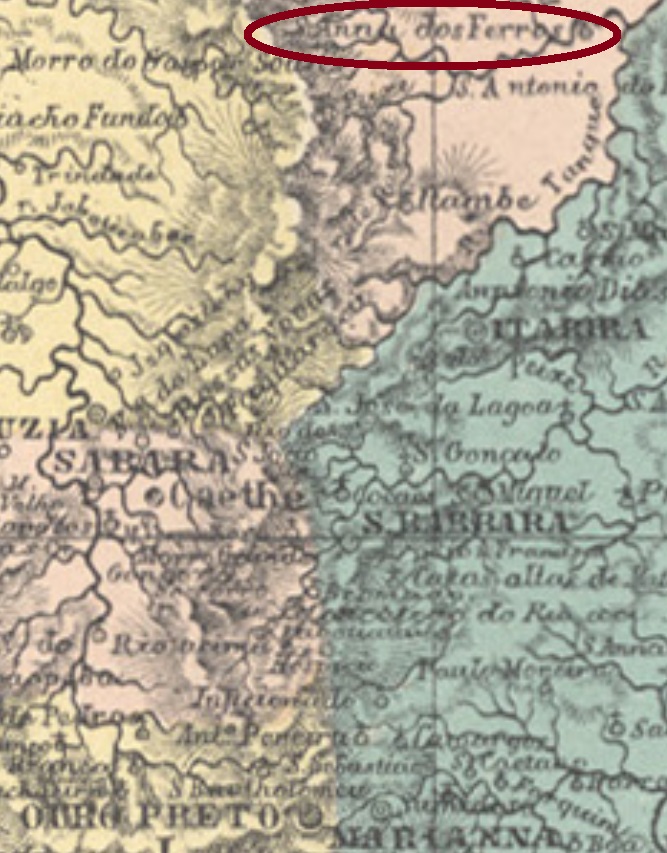
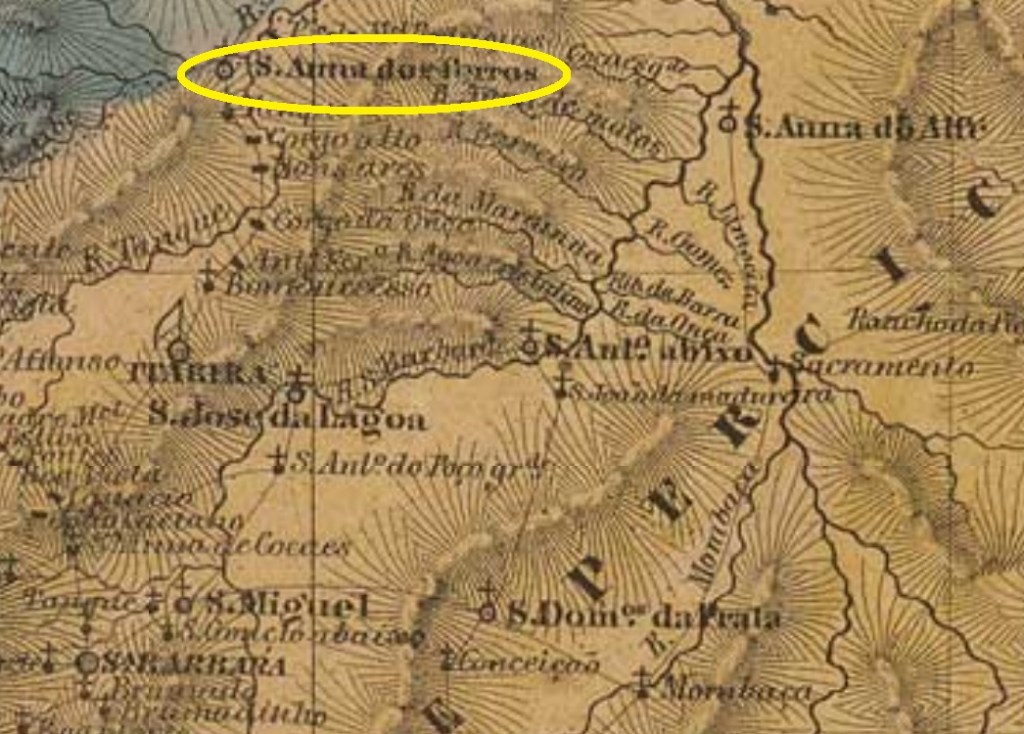
This Sant’Anna locality was since July 1832 a parish in the municipality of Caeté, situated over 200 km north of the provincial capital Ouro Preto. In September 1886 the name was changed to Ferros, and since September 1923 it has an own municipality.

According to Paula Sobrinho (História Postal de Minas Gerais, Belo Horizonte, 1997), the local post office was created in January 1876. Two imperial cancels are known, which were both already presented by Paulo Ayres (Catálogo de Carimbos Brasil-Império, S. Paulo, 1937, 1942). SMG-2790a is Ayres’ # 1591, it ocurred also in bluish green and circulated at least until 1883:

SMG-2790a , P. Ayres # 1591

It was followed by SMG-2790b, which was found within the period 1885-1890 and also appears in bluish green:

SMG-2790b
Villiers de l’Ile Adam: Charta (…) da Provincia de Minas Geraes, 1849)

Andere Namen: Pau dos Ferros, Ferros (1923)

Diese Sant’Anna-Ortschaft war ab Juli 1832 eine Pfarrei im Município von Caeté, die über 200 km nördlich der Provinzhauptstadt Ouro Preto entfernt lag. Im September 1886 wechselte der Ortsname zu Ferros, und seit September 1923 hat diese Gemeinde einen eigenen Município.

Laut Paula Sobrinho (História Postal de Minas Gerais, Belo Horizonte, 1997) gibt es dort ein Postamt seit Januar 1876. Zwei Poststempel aus der Kaiserzeit sind bekannt, beide wurden bereits durch Paulo Ayres (Catálogo de Carimbos Brasil-Império, S. Paulo, 1937, 1942) vorgestellt. SMG-2790a ist Ayres’ Nr.1591, es gibt ihn auch in blaugrün und wurde zumindest bis 1883 verwendet:

SMG-2790a, P. Ayres Nr. 1591

Sein Nachfolger war SMG-2790b, der für den Zeitraum 1885-1890 nachgewiesen wurde und auch in blaugrün vorkommt:

SMG-2790b
Categories
Carimbologia S

Sant’Anna dos Fechados, Minas Gerais (SMG-2785)

Mappa de Minas Geraes, 1910

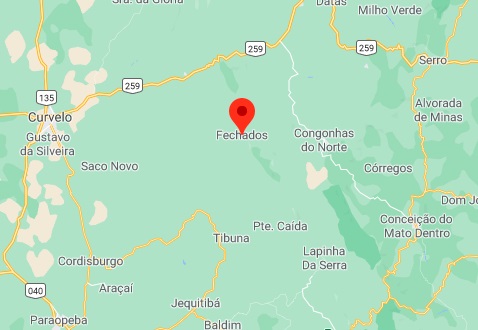
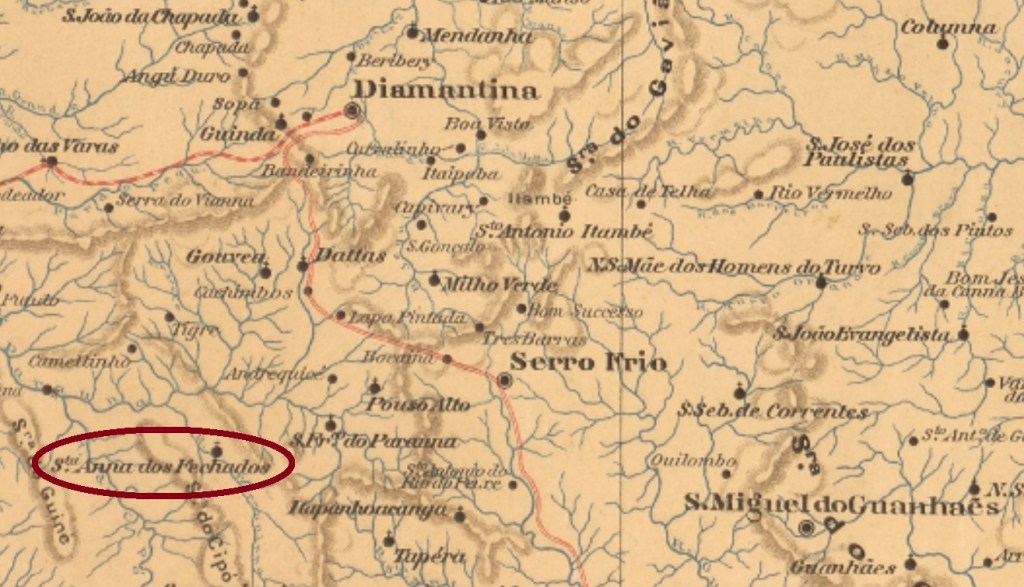
This Sant’Anna dos Fechados was also called dos Frechados or dos Feixados. Since every orthographical variant has a different meaning (fechado means closed, frechado means trespassed by arrows and feixado means bundled), the real origin of this curious toponym has to remain a mystery. Anyway, it was since October 1861 a district of the municipality of Conceição do Serro – which later was called Conceição and also Conceição do Mato Dentro – situated ca. 280 km north of the provincial capital Ouro Preto. In October 1881 the toponym was simplified to the actual Fechados, and since December 1962 it is a district of the municipality of Santana do Pirapama.

According to Paula Sobrinho (História Postal de Minas Gerais, Belo Horizonte, 1997), the local post office was created in October 1889, i.e. three weeks before the beguin of the republic, making imperial cancels very rare. The earliest known cancel, SMG-2785a (Coll. José A. Junges), has a double circle with the inscriptions S.ANNA DOS FECHADOS above and (M.GERAES) below. The date at the centre shows already the year 1891.

GoogleMaps

Diese Sant’Anna dos Fechados wurde auch dos Frechados oder dos Feixados genannt. Da aber jede Schreibweise eine andere Bedeutung hat (fechado heißt geschlossen, frechado bedeutet durch Pfeile durchbohrt, und feixado heißt gebündelt), der wahre Ursprung dieses merkwürdigen Ortsnamens wird wohl ein Rätsel bleiben. Wie es dem auch sei, der Ort war seit Oktober 1861 ein Distrikt im Município von Conceição do Serro – der später Conceição und auch Conceição do Mato Dentro genannt wurde – und lag ca. 280 km nördlich der Provinzhauptstadt Ouro Preto entfernt. Im Oktober 1881 vereinfachte man den Ortsnamen zum aktuellen Fechados, und seit Dezember 1962 ist er ein Distrikt im Município von Santana do Pirapama.

Laut Paula Sobrinho (História Postal de Minas Gerais, Belo Horizonte, 1997) entstand das örtliche Postamt im Oktober 1889 und damit drei Wochen vor Beginn der Republik, was Poststempel aus der Kaiserzeit sehr selten macht. Die früheste bekannte Abstempelung, SMG-2785a (Samml. José A. Junges), hat einen Doppelkreis mit den Inschriften S.ANNA DOS FECHADOS oben und (M.GERAES) unten. Das Datum in der Mitte stammt bereits aus dem Jahr 1891.

Categories
Carimbologia S

Sant’Anna do Deserto, Minas Gerais (SMG-2745)

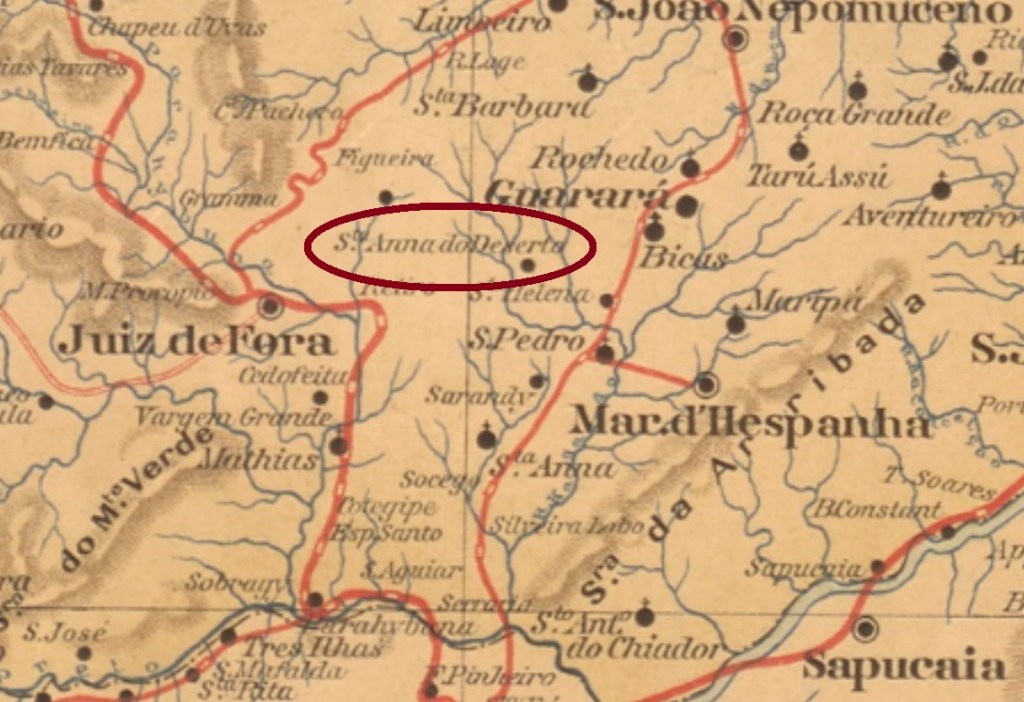
Mappa de Minas Geraes, 1910

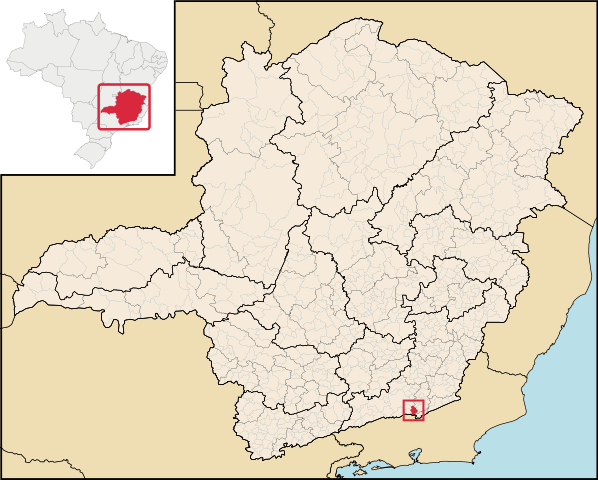
The curious name of this locality (= Holy Ann of the Desert) has often originated confusion with Sant’Anna do Desterro (= Holy Ann of the Exile), an apparently fictive name which was sometimes published in the press, in the Postal Guide of 1880, an even in official documents! The real Sant’Anna do Deserto was since June 1868 a district of the municipality of Barbacena, situated over 250 km south of the ancient province capital Ouro Preto. It belonged from August 1889 until September 1923 to Juiz de Fora; after that, to Mathias Barbosa, before becoming an own municipality in December 1953.

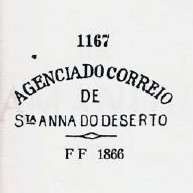
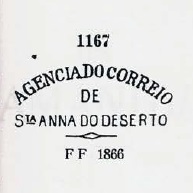
According to Paula Sobrinho (História Postal de Minas Gerais, Belo Horizonte, 1997), the local post office was created in January 1891, but this is rather a misprint or a reopening date, for two earlier cancels are known. SMG-2745a occurs in black and bluish green on D. Pedro issues of 1866 and 1876 and was already presented by Paulo Ayres (Catálogo de Carimbos Brasil-Império, S. Paulo, 1937, 1942) under #1167:

SMG-2745a (Paulo Ayres #1167)

It was followed by SMG-2745b (Coll. José A. Junges): a double circle with the inscription S.A. DO DESERTO. The sole known example shows a date from 1877 in blue green at the centre.

Since this post office is not listed in the Imperial Mail Register (Tabella das Agencias do Correio do Imperio) of 1885, it was probably closed after 1880. In this case, the date provided by Paula Sobrinho could be of its reopening.

Raphael Lorenzeto de Abreu (CC-BY 2.5)

Dieser merkwürdige Ortsname (= Heilige Anna der Wüste) hat immer wieder Verwechslung mit Sant’Anna do Desterro (= Heilige Anna der Verbannung) verursacht. Letzterer ist scheinbar fiktiv, kam aber relativ oft in der Presse, im Postführer von 1880 und sogar in Gesetzestexten vor! Die real existierende Sant’Anna do Deserto war ab Juni 1868 ein Distrikt des Município von Barbacena und lag über 250 km südlich der ehemaligen Provinzhauptstadt Ouro Preto entfernt. Sie gehörte von August 1889 bis September 1923 Juiz de Fora an; danach ging sie zu Mathias Barbosa, bevor sie ein eigener Município im Dezember 1953 wurde.

Laut Paula Sobrinho (História Postal de Minas Gerais, Belo Horizonte, 1997) gibt es dort ein Postamt erst seit Januar 1891. Diese Angabe ist aber entweder ein Druckfehler oder ein Wiedereröffnungsdatum, da zwei frühere Poststempel überliefert sind. SMG-2745a kommt in schwarz und blaugrün auf D. Pedro-Ausgaben von 1866 und 1876 und wurde bereits durch Paulo Ayres (Catálogo de Carimbos Brasil-Império, S. Paulo, 1937, 1942) unter Nr. 1167 vorgestellt:

SMG-2745a (Paulo Ayres 1167)

Ihm folgte SMG-2745b (Samml. José A. Junges): ein Doppelkreis mit der Inschrift S.A. DO DESERTO. Das einzig bekannte Exemplar trägt ein Datum aus 1877 in blaugrün in der Mitte.

Da das Verzeichnis der kaiserlichen Postämter (Tabella das Agencias do Correio do Imperio) von 1885 dieses Postamt nicht auflistet, wurde es wohl ab ca. 1880 geschlossen. Dann wäre das von Paula Sobrinho gelieferte Datum in der Tat eine Wiedereröffnungstermin.

Categories
Carimbologia S

Sant’Anna do Catú, Bahia (SBA-0825)

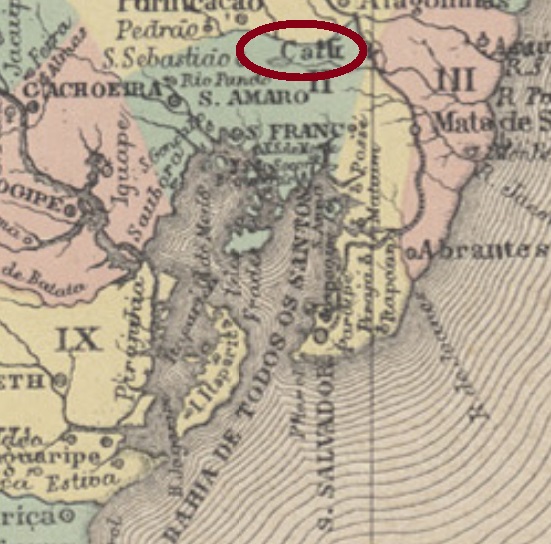
Atlas do Imperio do Brasil, 1868

See also Catú (Koester: Carimbologia X)

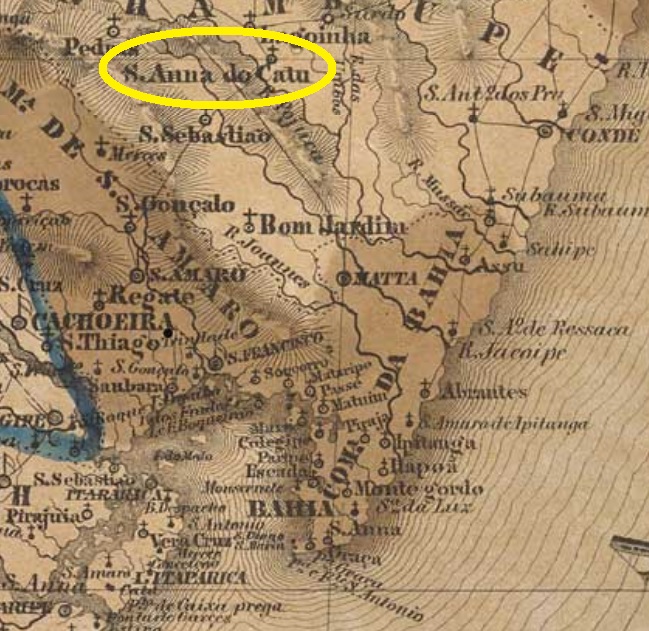
Sant’Anna do Catú was since 1796 a settlement of the Villa of São Francisco do Conde, situated almost 90 km north of the province capital Salvador da Bahia. In June 1868 it was elevated to a villa, which became a town in July 1913. From March 1931 on the municipality has the simplified name of Catu.

According to Nova Monteiro (Administrações e Agencias Postaes do Brasil Imperio, in Brasil Filatelico/RJ, 1934-5; Reprint SPP 1994-1999), the local post office was created in March 1863. One postal cancel of the Brazilian Empire was found, whose identity is not yet confirmed definitively. SBA-0825b (Coll. José A. Junges) has a double circle with the inscription S.A. DE CA(TU) above. The only known example has a date of 1884 at the centre.

Villiers de l’Ile Adam: Carta (…) da Provincia da Bahia, 1848

Siehe auch Catú (Koester: Carimbologia X)

Sant’Anna do Catú war ab 1796 eine Siedlung in der Villa von São Francisco do Conde und lag fast 90 km nördlich der Provinzhauptstadt Salvador da Bahia entfernt. Im Juni 1868 stieg sie zur Villa auf und wurde eine Stadt im Juli 1913. Seit März 1931 trägt der Município den vereinfachten Namen Catu.

Laut Nova Monteiro (Administrações e Agencias Postaes do Brasil Imperio, in Brasil Filatelico/RJ, 1934-5; Reprint SPP 1994-1999) entstand das örtliche Postamt im März 1863. Ein Poststempel des Kaiserreichs ist vorhanden, dessen Zuordnung noch nicht endgültig gesichert ist. SBA-0825b (Samml. José A. Junges) hat einen Doppelkreis mit der Inschrift S.A. DE CA(TU) oben. Das einzig bekannte Exemplar hat ein Datum aus 1884 in der Mitte.

Categories
Carimbologia S

Sant’Anna de Cataguazes, Minas Gerais (SMG-2710)

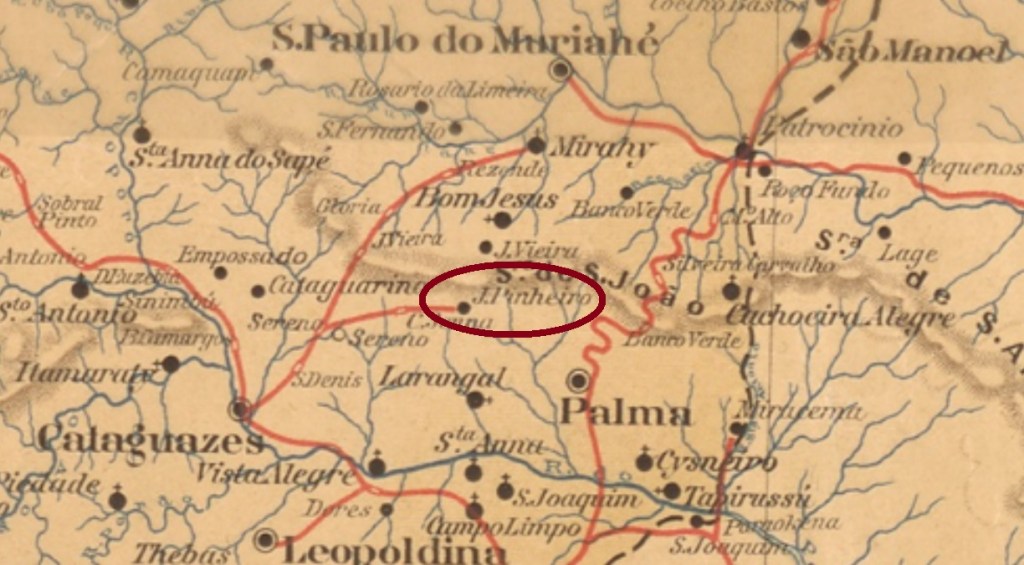
Mappa de Minas Geraes, 1910

This Sant’Anna was since October 1880 a district of the municipality of Cataguazes (today written Cataguases), situated over 200 km southeast of the province capital Ouro Preto. In 1895 a train station was built unter the name João Pinheiro. In December 1962 the locality was granted an own municipality.

According to Paula Sobrinho (História Postal de Minas Gerais, Belo Horizonte, 1997), the local post office was created in March 1885. The only known post cancel from the Empire, SMG-2710a (Coll. José A. Junges), has a double circle with the inscriptions S.ANNA DE CATAGUAZES above and (MINAS) below. The dates at the centre were found for the period 1888-1900.

Raphael Lorenzeto de Abreu (CC- BY 2.5)

Diese Sant’Anna war seit Oktober 1880 ein Distrikt im Município von Cataguazes (heute Cataguases geschrieben) und lag über 200 km südöstlich der ehemaligen Provinzhauptstadt Ouro Preto entfernt. Der dazu gehörige Bahnhof – gebaut 1895 – hieß João Pinheiro. Im Dezember 1962 stieg die Ortschaft zum Município auf.

Laut Paula Sobrinho (História Postal de Minas Gerais, Belo Horizonte, 1997) entstand das örtliche Postamt im März 1885. Der bisher einzige Poststempel aus der Kaiserzeit, SMG-2710a (Samml. José A. Junges), hat einen Doppelkreis mit den Inschriften S.ANNA DE CATAGUAZES oben und (MINAS) unten. Die Daten in der Mitte wurden für den Zeitraum 1888-1900 gefunden.

Categories
Carimbologia S

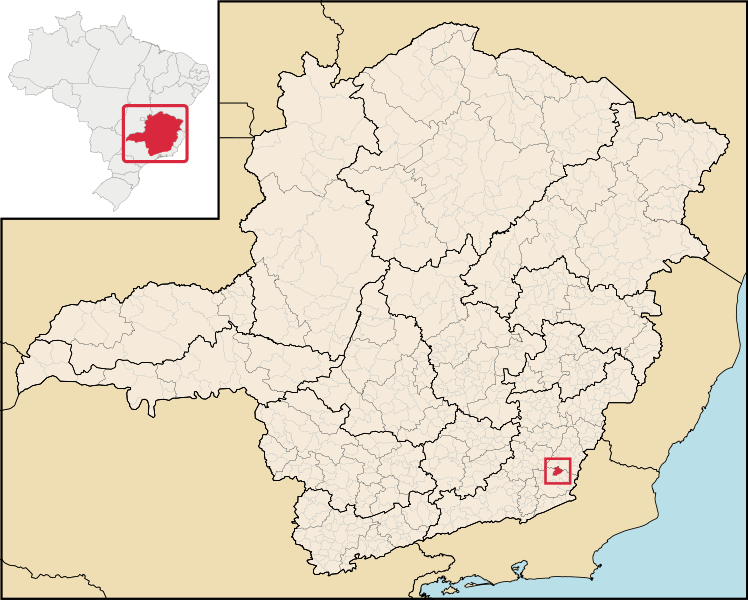
Sant’Anna de Carandahy, Minas Gerais (SMG-2708)

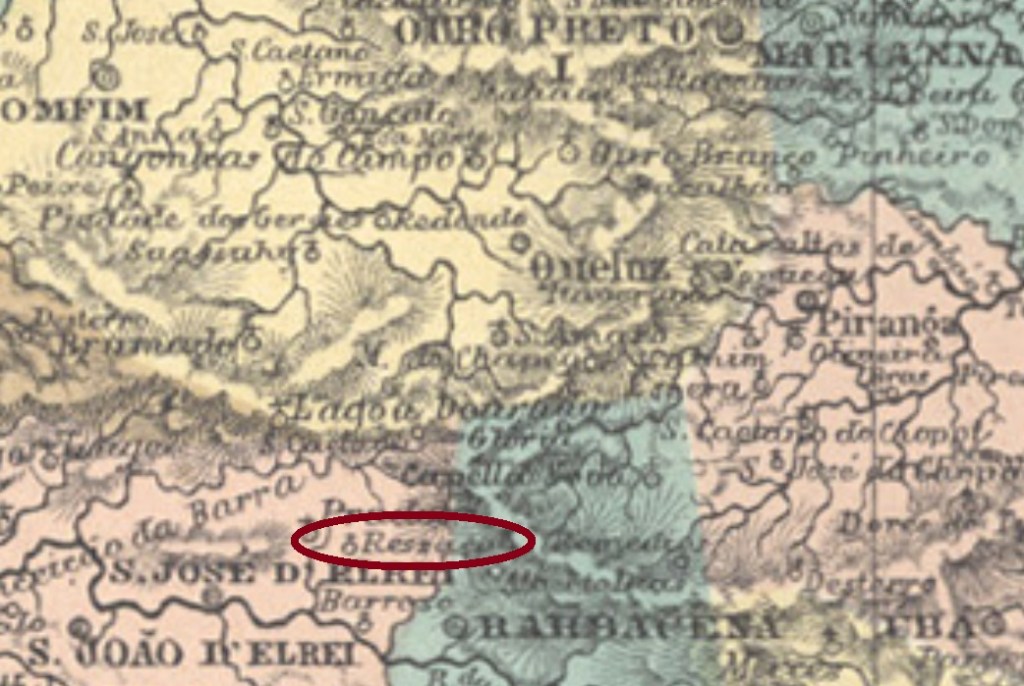
Atlas do Imperio do Brasil, 1868

Another name: Sant’Anna da Ressaca

See also: Carandahy (Koester: Carimbologia IX)

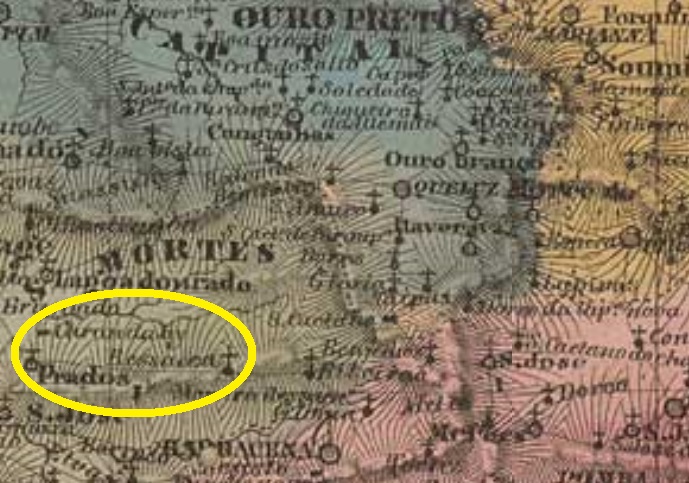
This Sant’Anna in the Minas Gerais province was since July 1872 the freguesia of Sant’Anna da Ressaca do Carandahy, in the municipality of Barbacena, situated almost 100 km south of the province capital Ouro Preto. In July 1876 it was transferred to the municipality of São José del Rey (the actual Tiradentes) and emancipated politically in September 1923 under the simplified toponym of Carandaí.

Both Reinhold Koester (Carimbologia IX) and Paula Sobrinho (História Postal de Minas Gerais, Belo Horizonte, 1997) agree in setting the creation date of the local post office in May 1875. This would mean there might exist postal cancellations still with the legend Sant’Anna da Ressaca or Sant’Anna do Carandahy. Nevertheless, none of them has appeared until now. For cancels with solely Carandahy, which occur from ca. 1885 on, see Koester’s Carimbologia IX.

Villiers de l’Ile Adam: Charta (…) da Provincia de Minas Geraes, 1849

Anderer Name: Sant’Anna da Ressaca

Siehe auch: Carandahy (Koester: Carimbologia IX)

Diese Sant’Anna in der Provinz Minas Gerais war ab Juli 1872 die Freguesia von Sant’Anna da Ressaca do Carandahy im  Município von of Barbacena und lag fast 100 km südlich der Provinzhauptstadt Ouro Preto entfernt. Im Juli 1876 wechselte sie zum Município von São José del Rey (heute: Tiradentes) und erhielt ihre politische Autonomie im September 1923 unter dem vereinfachten Ortsnamen Carandaí.

Sowohl Reinhold Koester (Carimbologia IX) als auch Paula Sobrinho (História Postal de Minas Gerais, Belo Horizonte, 1997) sind sich einig über das Entstehungsdatum des örtlichen Postamts im Mai 1875. Das würde bedeuten, es müsste noch Poststempel mit Sant’Anna da Ressaca, oder Sant’Anna de Carandahy geben. Dennoch war bisher keine davon zu sehen. Für Stempel mit lediglich Carandahy – die es ab ca. 1885 gibt – siehe Koesters Carimbologia IX.

Categories
Carimbologia S

Sant’Anna de Capivary, Minas Gerais (SMG-2740)

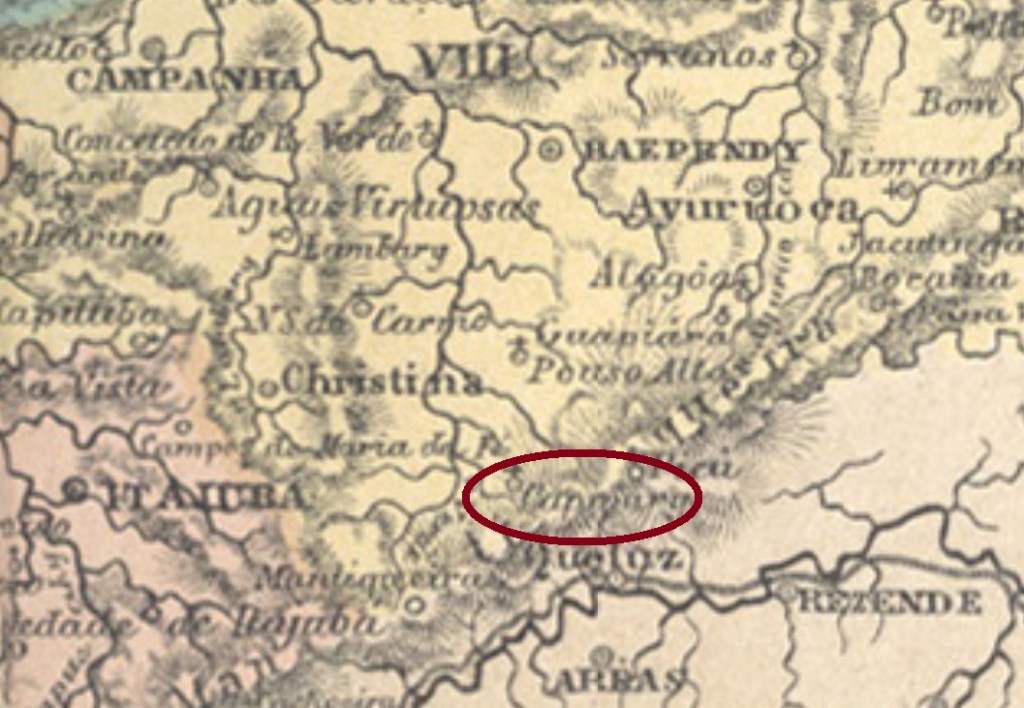
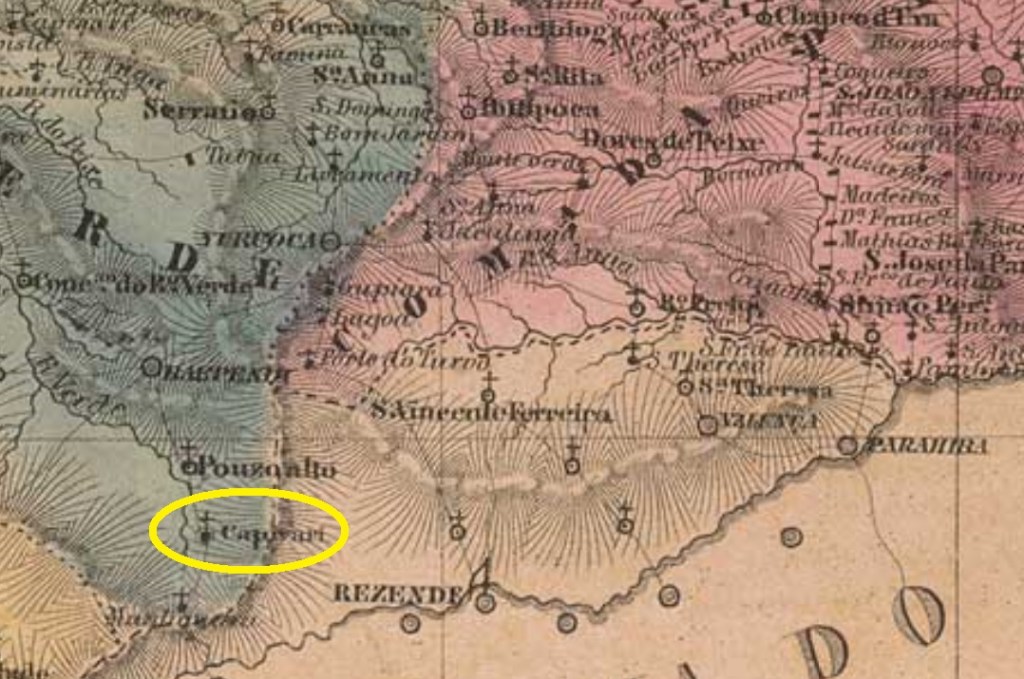
Atlas do Imperio do Brasil, 1868

This Sant’Anna in provincial Minas Gerais was since December 1874 a district of the municipality of Pouso Alto, situated over 350 km southwest of the capital Ouro Preto and whose political status has remained until our days, with remarkable steadiness. The Capivary in the name is a tupi-guarani word that means Capybara River and refers to the upper course of the river around which this mammal must have been abundant.

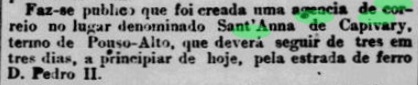
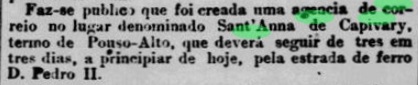
According to Paula Sobrinho (História Postal de Minas Gerais, Belo Horizonte, 1997), the local post office was created in October 1889, but this is either a reopening date or a misprint, for there exist some cancels with earlier dates. Moreover, the local post office was announced by the Rio press as early as July 1877:

Jornal do Commercio, Rio de Janeiro, July 10, 1877

 Two early cancels were found. SMG-2740a (Coll. José A. Junges) has a double circle with the inscription SANT’ANNA DE CAPIVARY above and a hashtag-like ornament below. The dates at the centre indicate the period 1879-1885. SMG-2740b (Coll. José A. Junges) can be already republican, for the sole known example is dated 1895: a double circle with the inscription SANT’ANNA DE CAPIVARY above and a diamond ornament below. Date at the centre.

Villiers de l’Ile Adam: Charta (…) da Provincia de Minas Geraes, 1849

Diese Sant’Anna in der Provinz Minas Gerais war seit Dezember 1874 ein Distrikt im Município von Pouso Alto, lag über 350 km südwestlich der Hauptstadt Ouro Preto und behielt mit bemerkenswerter Beständigkeit den Verwaltungsstatus bis heute. Das im Ortsnamen erwähnte Capivary ist ein Wort der tupi-guarani-Sprache, das Fluss der Capybaras bedeutet und darauf hinweist, dass im Flussoberlauf damals diese Säugetiere oft anzutreffen waren.

Laut Paula Sobrinho (História Postal de Minas Gerais, Belo Horizonte, 1997) entstand das örtliche Postamt im Oktober 1889, aber das ist entweder ein Wiedereröffnungsdatum oder einfach ein Druckfehler. Denn erstens sind Poststempel aus früheren Daten vorhanden, und zweitens wurde die Agentur bereits im Juli 1877 durch die Rio-Presse angekündigt:

Jornal do Commercio, Rio de Janeiro, 10. Juli 1877

Zwei frühe Poststempel wurden gefunden. SMG-2740a (Samml. José A. Junges) hat einen Doppelkreis mit der Inschrift SANT’ANNA DE CAPIVARY oben und einem Hashtag-ähnlichen Ornament unten. Die Daten in der Mitte weisen auf den Zeitraum 1879-1885 hin. SMG-2740b (Samml. José A. Junges) kann bereits republikanisch sein, da das einzige bekannte Exemplar mit 1895 datiert ist: ein Doppelkreis mit der Inschrift SANT’ANNA DE CAPIVARY oben und einer Raute unten, dazu Datum in der Mitte.

Categories
Carimbologia S

Sant’Anna dos Brejos, Bahia (SBA-0826)

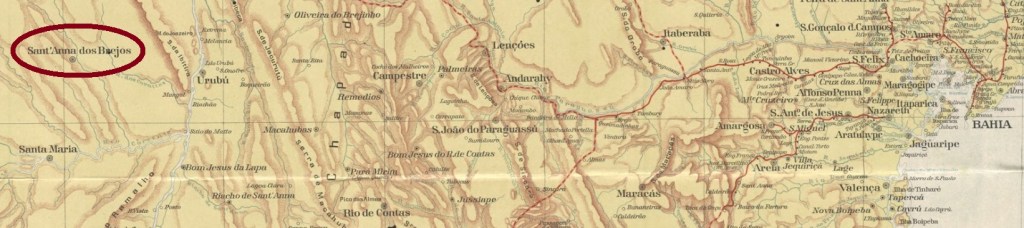
Estado da Bahia, 1913

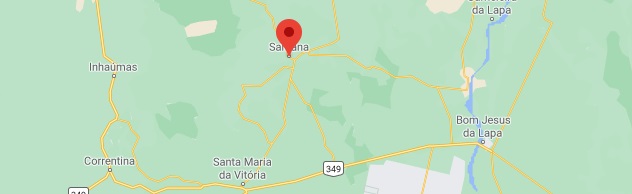
Sant’Anna dos Brejos was since May 1868 a district in the municipality of Santa Maria da Victoria, situated over 800 km west of the province capital Salvador da Bahia. In August 1890 it ascended to a villa, which became a town in April 1901. Since June 1931 this municipality is simply called Santana.

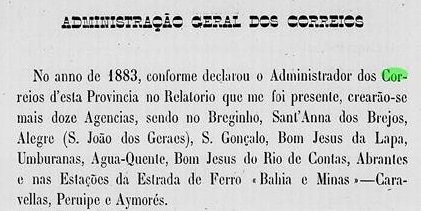
According to the Bahia Provisory Government Council Report for 1884, the local post office was created the year before:

Relatorio do Conselho Interino do Governo da Bahia, 1884

No imperial postmark has appeared until now.

Google Maps

Sant’Anna dos Brejos war seit Mai 1868 ein Distrikt im Município von Santa Maria da Victoria, der über 800 km westlich der Provinzhauptstadt Salvador da Bahia entfernt lag. Im August 1890 stieg er zu einer Villa auf, die im April 1901 eine Stadt wurde. Seit Juni 1931 trägt der Município den vereinfachten Namen Santana.

Laut dem Bericht des provisorischen Regierungsrats in Bahia für 1884 entstand das örtliche Postamt im Jahr zuvor:

Relatorio do Conselho Interino do Governo da Bahia, 1884

Kein Poststempel der Kaiserzeit konnte bisher gefunden werden.

Categories
Carimbologia S

Sant’Anna do Brejo Grande, Ceará (SCE-0315)

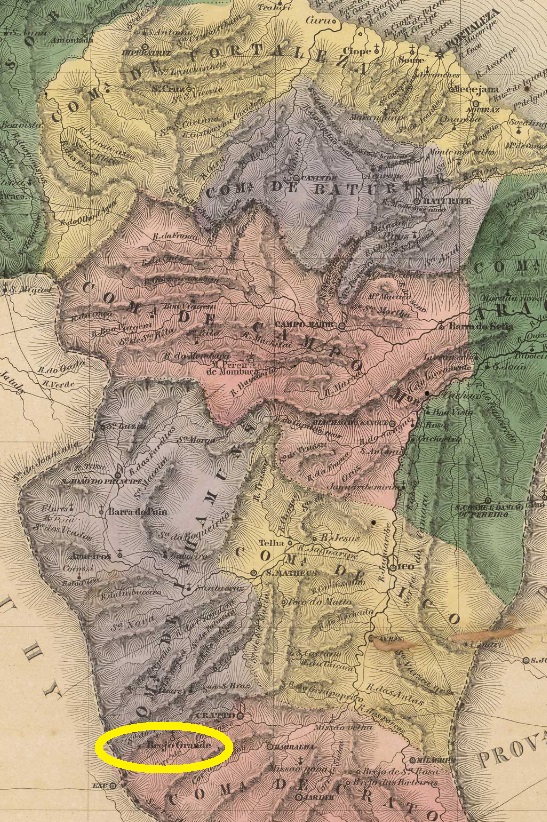
Atlas do Imperio do Brasil, 1868

Other names: Santonópole, Roquelândia, Santana do Cariri

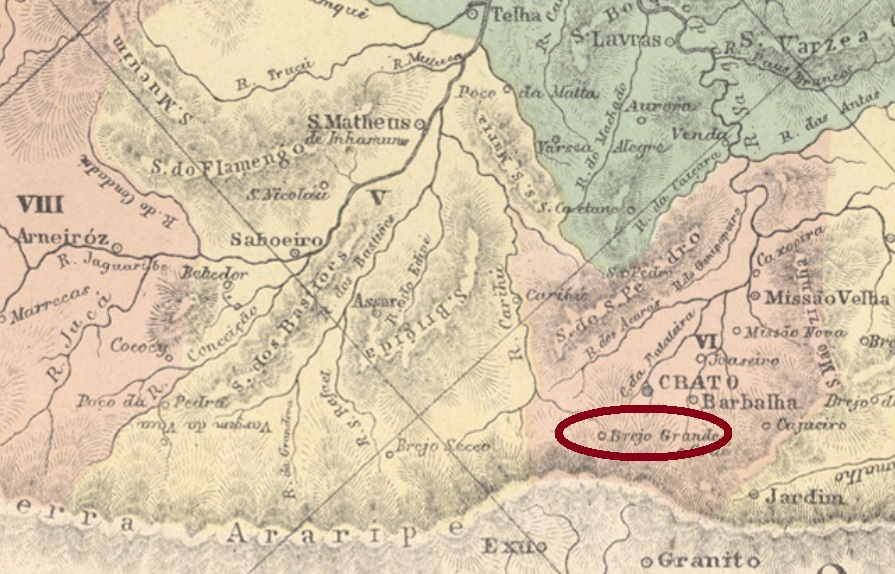
This Sant’Anna in Ceará is not the Sant’Anna do Acaraú (SCE-0310), but rather the former district of the municipality of Assaré, founded in August 1838 and situated over 500 km south of the province capital Fortaleza, near the Pernambuco border. In November 1885 it ascended to a villa, whose name changed in August 1896 to Santana de Cariri, a name which would still change twice (in December 1938 to Santonópole and in August 1963 to Roquelândia), and also return twice (in November 1951 and finally in December 1965).

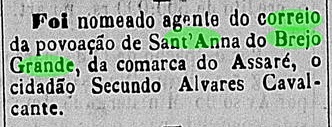
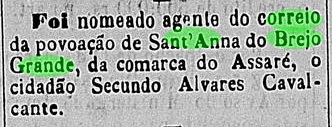
The local post office must have been created between the end of 1884 and July 1885, for it was not listed in the Imperial Mail Register (Tabella das Agencias do Correio do Imperio) of 1885, but on July 7 the postal clerk was introduced by the regional press:

Gazeta do Norte, July 7, 1885

No postal cancel from the Empire has appeared until now.

Villiers de l’Ile Adam: Carta (…) da Provincia do Ceara, 1849

Andere Namen: Santonópole, Roquelândia, Santana do Cariri

Diese Sant’Anna in der Provinz Ceará ist nicht die Sant’Anna do Acaraú (SCE-0310), sondern der ehemaliger Distrikt des Município von Assaré, der im August 1838 gegründet wurde und über 500 km weit südlich der Provinzhauptstadt Fortaleza lag, nah an der Grenze zu Pernambuco. Im November 1885 stieg er zur Villa auf, deren Name im August 1896 zu Santana de Cariri wechselte. Diese Bezeichnung würde danach zweimal geändert (im Dezember 1938 zu Santonópole und im August 1963 zu Roquelândia), um dann zweimal wieder zurück zu kehren (im November 1951 und schließlich im Dezember 1965).

Da dieses Postamt nicht im Verzeichnis der kaiserlichen Postämter (Tabella das Agencias do Correio do Imperio) von 1885 aufgelistet wurde, muss es doch kurz nach dessen Redaktionsschluss entstanden sein, da im Juli 1885 sein Postangestellter in der Regionalpresse vorgestellt wurde:

Gazeta do Norte, 7. Juli 1885

Kein Poststempel aus der Kaiserzeit ist bisher aufgetaucht.

Categories
Carimbologia S

Sant’Anna do Boquim, Sergipe (SSE-0200)

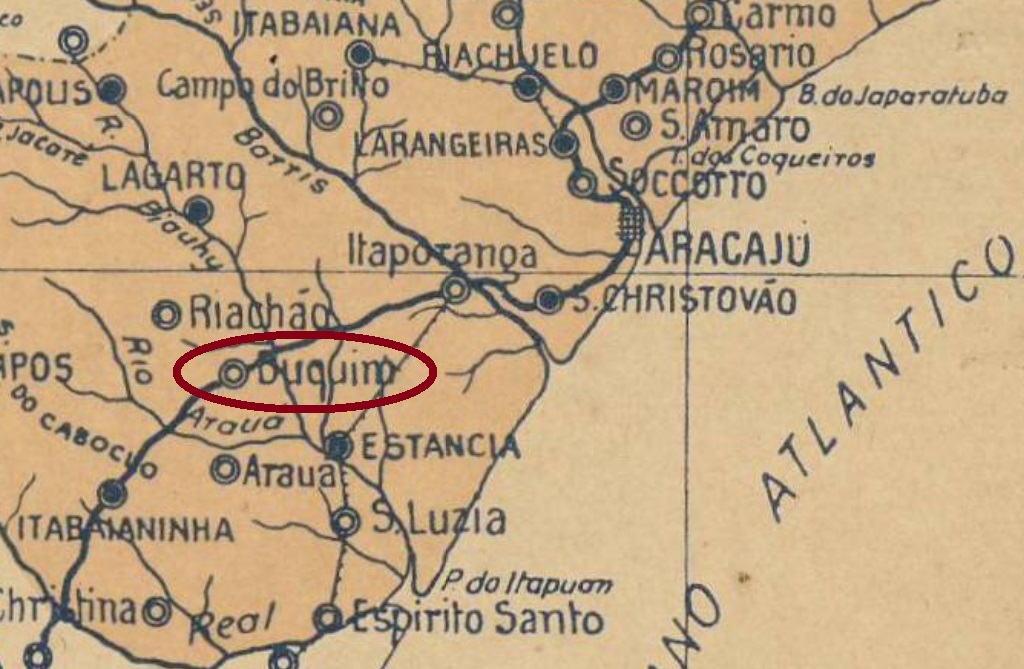
Arthur D. Ribeiro: Mappa do Estado de Sergipe, 1924

Another name: Buquim/Boquim

See also Buquim (Koester: Carimbologia VI) and Lagoa Vermelha/SE (Koester: Carimbologia XXVI)

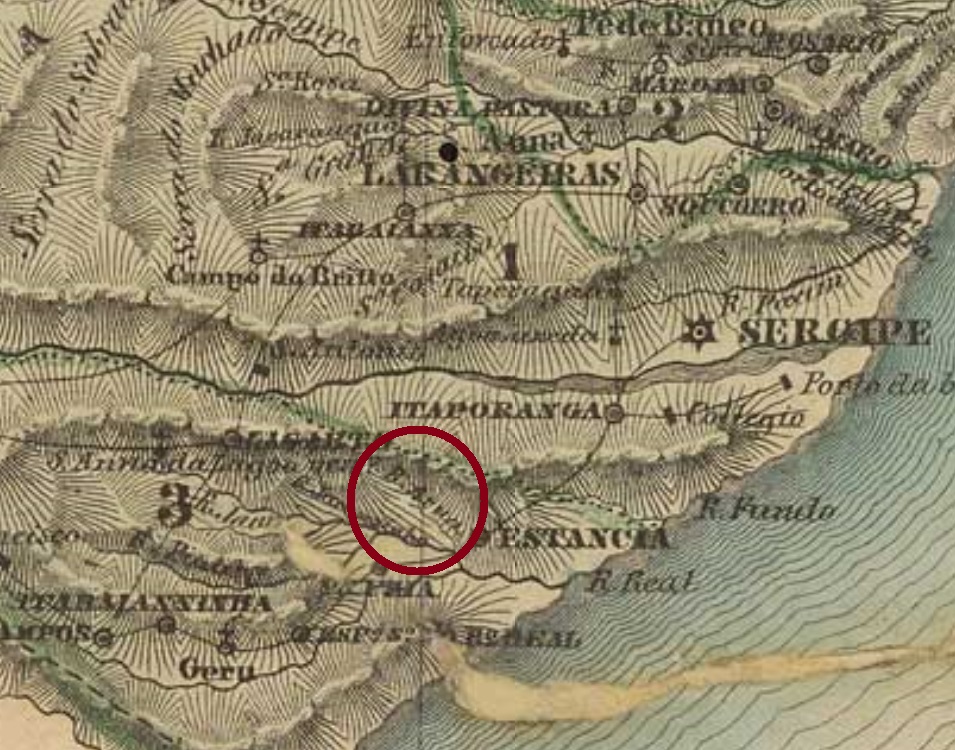
Sant’Anna do Boquim was the name of the village created in March 1870 after the relocation of Lagoa Vermelha, whose history was already told by Koester (Carimbologia VI and XXVI). The name Boquim is allegedly derivated from Boquinha da Mata (Little mouth of the forest) and refers to the woods that existed in this region, situated almost 90 km southwest of the province capital Aracaju. In October 1926 it emancipated politically and ascended to a town.

According to the Imperial Mail Register (Tabella das Agencias do Correio do Imperio) of 1885, the local post office was created in 1862. But since this year refers to the Lagoa Vermelha agency, we may suppose that the postal services were not interrupted during the village removal in 1870. No postal cancel from the Empire has appeared until now.

Villiers de L’Ile Adam: Carta (…) das Provincias de Pernambuco, Alagoas e Sergipe, 1848

Anderer Name: Buquim/Boquim

Siehe auch Buquim (Koester: Carimbologia VI) und Lagoa Vermelha/SE (Koester: Carimbologia XXVI)

Sant’Anna do Boquim hieß das Dorf, das im März 1870 nach der Umsiedlung von Lagoa Vermelha gegründet wurde, dessen Geschichte bereits von R. Koester (Carimbologia VI und XXVI) erzählt wurde. Der Name Boquim stammt angeblich von Boquinha da Mata (Kleine Waldeingang) und bezieht sich auf die Wälder der Region, die fast 90 km südwestlich von der Provinzhauptstadt Aracaju entfernt lag. Im Oktober 1926 wurde Boquim als Stadt politisch emanzipiert.

Laut Verzeichnis der kaiserlichen Postämter (Tabella das Agencias do Correio do Imperio) von 1885 entstand 1862 das örtliche Postamt. Da aber der Ort zu der Zeit noch Lagoa Vermelha hieß und woanders lag, können wir annehmen, dass die Postdienste durch den Umzug nicht unterbrochen wurden. Kein Stempel aus der Kaiserzeit wurde bisher gesichtet.