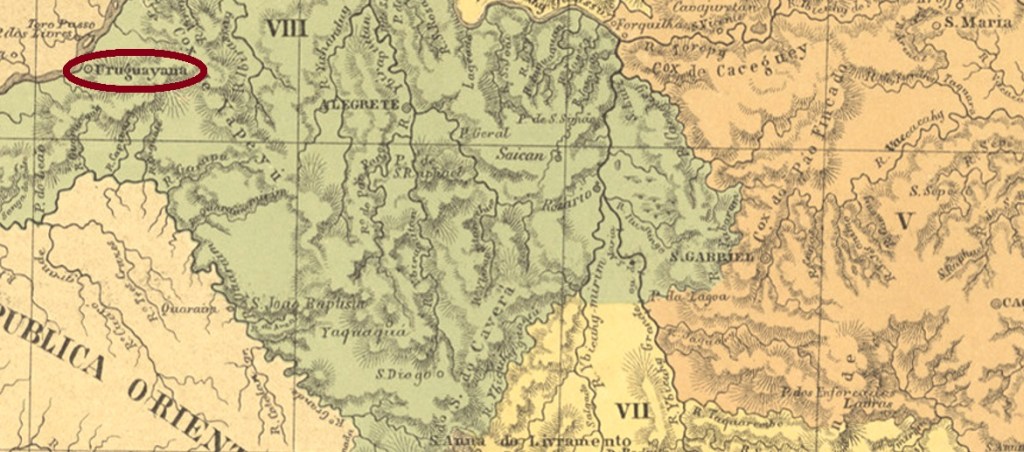
Other names: Capella do Uruguay, Sant’Anna do Uruguay
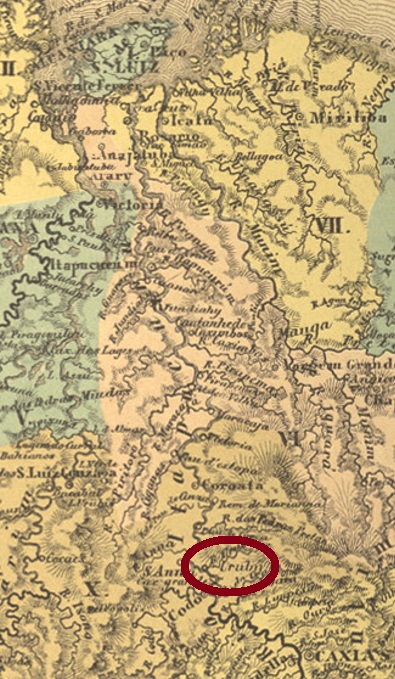
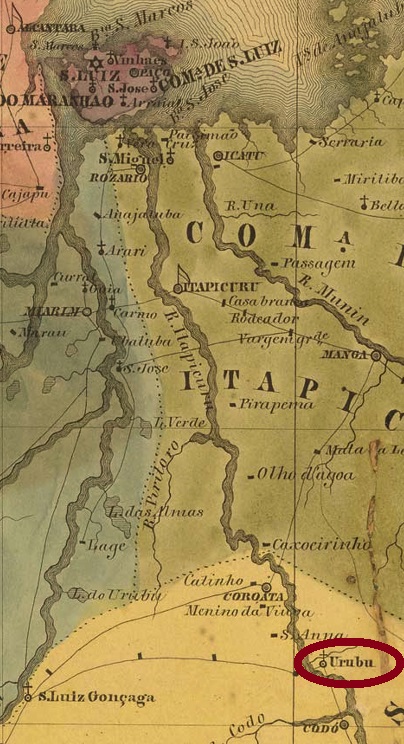
The settlement of Chapel on the Uruguay was created in February 1843 on the east bank of the Uruguay River in the Município of Alegrete, 630 km west of the provincial capital Porto Alegre. In May 1846, shortly after the end of the Farroupilha Revolution, it became a vila in its own município. Uruguaiana (as it is spelled today) has been a town since April 1874.
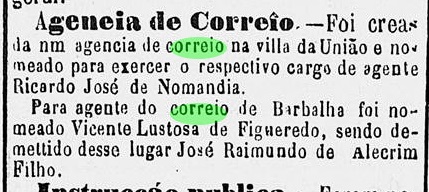
Two dates of origin for the local post office have been found. The first was in September 1847, according to the report of the Imperial Ministry:
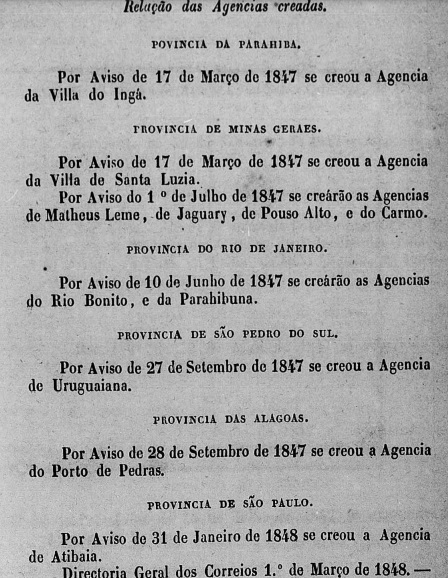
Nova Monteiro, however, writes a date of March 1848 in Administrações e Agencias Postaes do Brasil Imperio (Brasil Filatelico/RJ, 1934-5; Reprint SPP 1994-1999). Since both dates are relatively close to each other, the second could represent the operation beginning.
In August 1887, the local station was inaugurated by the Brazil Great Southern Railway. The railway line became part of Viação Férrea Rio Grande do Sul in 1920, and from 1975 until the traffic end in 1996 it belonged to Rede Ferroviária Federal S.A. (estacoesferrroviarias.com.br). It is not yet known whether a station post office was also opened, but at least one transit cancellation exists.
The earliest postmarks from Uruguayana so far are three diligencia cancels, i.e. from privately operated stagecoach services that travelled between Uruguayana, Alegrete and Sant’Anna (now Livramento).



They were followed by the double circle URS-0470e (Coll. Fuad Ferreira Fo.): a French type with the inscription URUGUAYANA above and the star between brackets below. It also exists in red and purple, the dates in the middle were found for the period 1877ff-1882.
At the beginning of the 1980s, two similar postmarks came into use as rectangles in purple with 3 lines each. URS-0470f (image from the internet) has the inscription CORREIO DE / URUGUAYA / NA (+ date), while URS-0470g (image from the internet) has the inscription CORREIO DE / URUGUAYANA / (date). At about the same time, URS-0470h (Coll. José A. Junges) also appeared in its rather untypical form as a vertical double oval. Here, too, the colour purple occurs frequently, the inscription at the top reads CORREIO DE URUGUAYANA, at the bottom one reads BRASIL between two stars each on the right and left. The dates in the middle are from the period 1884ff-1890.
The last postmarks in the 19th century are all double circles. URS-0470i (Coll. José A. Junges) has the inscription URUGUAYANA at the top and an ornament in X at the bottom. It also occurs in dark purple and bears dates between 1889 and 1891 inside. URS-0470j (Coll. José A. Junges) might already be Republican. Here the inscription at the top is the same as before, at the bottom one reads S.P. DO SUL. Dates in the middle go from 1891ff to 1901. Then there was also the Ambulante cancel for the railway line between Uruguayana and Quarahy. URS-0471a (Coll. FM) has already been shown as the Quarahy cancel QRS-0280b in Carimbologia Q-R. The dates in the centre so far go from 1889 to 1890.
A mute and a handwritten postal cancellation are still to be shown. The former has already been described by J. Dingler and K.W. Lopes in Mute Cancellations of the Brazil Empire / Carimbos Mudos do Brasil Império (Brazil Philatelic Association, Rio de Janeiro, 2000) under no. 4573:

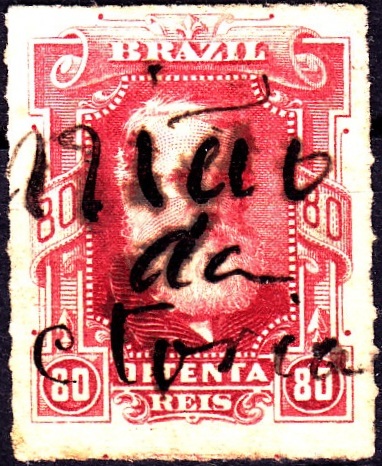
The handwritten cancellation ooriginates from the Karlheinz Wittig collection and was found on a D. Pedro issue from 1877:

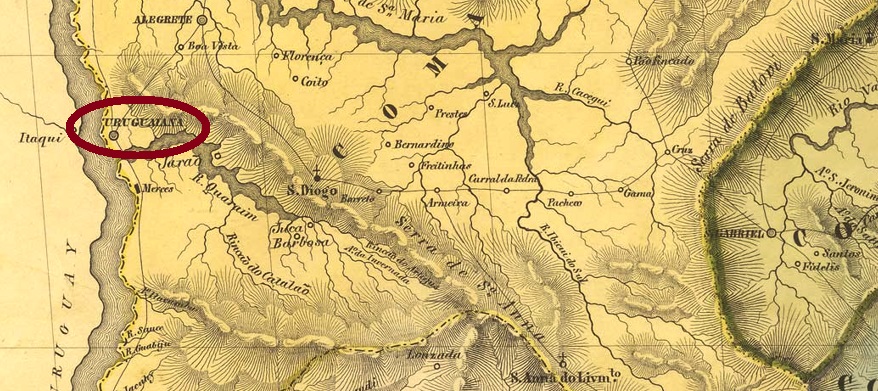
Andere Namen: Capella do Uruguay, Sant’Anna do Uruguay
Die Kapelle am Uruguay wurde im Februar 1843 am Ostufer des Flusses Uruguay im Município von Alegrete errichtet und lag 630 km westlich der Provinzhauptstadt Porto Alegre entfernt. Im Mai 1846, also kurz nach dem Ende der Farroupilha-Revolution, erfolgte der Aufstieg zur Vila im eigenen Município. Seit April 1874 ist Uruguaiana (wie es heute geschrieben wird) eine Stadt.
Zwei Entstehungsdaten fürs örtliche Postamt wurden gefunden. Erstmals im September 1847, wie im Bericht der Imperialministeriums zu lesen ist:
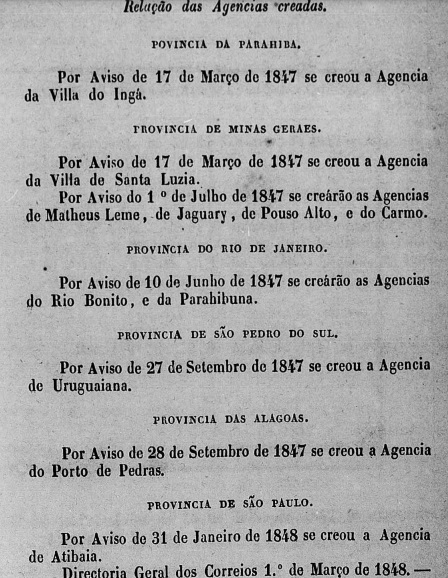
Nova Monteiro schreibt aber ein Datum aus März 1848 in Administrações e Agencias Postaes do Brasil Imperio (Brasil Filatelico/RJ, 1934-5; Reprint SPP 1994-1999). Da beide Daten relativ nah zueinander liegen, könnte das zweite den Beginn des Postbetriebs darstellen.
Im August 1887 wurde der lokale Bahnhof durch die Brazil Great Southern Railway eingeweiht. Die Bahnlinie ging 1920 zur Viação Férrea Rio Grande do Sul, von 1975 bis Betriebsende 1996 gehörte sie der Rede Ferroviária Federal S.A. (estacoesferrroviarias.com.br). Es ist noch nicht bekannt, ob es auch ein Bahnhofspostamt eröffnet wurde, aber es existiert zumindest eine Transit-Entwertung.
Die bisher frühesten Poststempel aus Uruguayana sind drei Diligencia-Entwertungen, also von privat betriebenen Postkutschendiensten, die zwischen Uruguayana, Alegrete und Sant’Anna (heute Livramento) unterwegs waren.


URS-0470c (EB) 1866ff-1877ff

Es folgte der Doppelkreis URS-0470e (Samml. Fuad Ferreira Fo.): ein französischer Typus mit der Inschrift URUGUAYANA oben und dem Stern zwischen Klammern unten. Ihn gibt es auch in rot und lila, die Daten in der Mitte wurden für den Zeitraum 1877ff-1882 gefunden.
Am Anfang der 80er Jahre kamen zwei ähnliche Poststempel als Rechteck in lila mit je 3 Zeilen im Gebrauch. URS-0470f (Abb. aus dem Internet) hat die Inschrift CORREIO DE / URUGUAYA / NA (+ Datum), während URS-0470g (Abb. aus dem Internet) die Inschrift CORREIO DE / URUGUAYANA / (Datum) trägt. Etwa zur gleichen Zeit erschien auch URS-0470h (Samml. José A. Junges) in seiner eher untypischen Form als senkrechte doppelte Oval. Auch hier kommt die Farbe lila häufig vor, die Inschrift oben lautet CORREIO DE URUGUAYANA, unten liest man BRASIL zwischen je zwei Sternen rechts und links. Die Daten in der Mitte entstammen dem Zeitraum 1884ff-1890.
Die letzten Poststempel im 19. Jahrhundert sind allesamt Doppelkreise. URS-0470i (Samml. José A. Junges) hat oben die Inschrift URUGUAYANA und unten ein Ornament in X. Er kommt auch in dunkelviolett vor und trägt Daten zwischen 1889 und 1891 im Inneren. URS-0470j (Samml. José A. Junges) dürfte bereits republikanisch sein. Hier ist die Inschrift oben gleich wie vor, unten liest man S.P. DO SUL. Daten in der Mitte 1891ff-1901. Dann gab es auch die Ambulante-Entwertung für die Bahnlinie zwischen Uruguayana und Quarahy. URS-0471a (Samml. FM) wurde bereits als der Quarahy-Stempel QRS-0280b in Carimbologia Q-R gezeigt. Die Daten in der Mitte gehen bisher von 1889 bis 1890.
Eine stumme und eine handschriftliche postalische Entwertung sind noch zu zeigen. Erstere wurde bereits durch J. Dingler und K.W. Lopes in Mute Cancellations of the Brazil Empire / Carimbos Mudos do Brasil Império (Brazil Philatelic Association, Rio de Janeiro, 2000) unter Nr. 4573 vorgestellt:

Die handschriftliche Entwertung kommt aus der Sammlung Karlheinz Wittig und wurde auf einer D. Pedro Ausgabe aus 1877 gefunden:


















 Carimbologia