Categories
Carimbologia A-B

Avellar (train station/Bahnhof), Rio de Janeiro (ARJ-0095)

Almanak Laemmert 1892

Avellar (train station/Bahnhof), Rio de Janeiro (ARJ-0095)

Other names: Parada do Barão, Est. Boa Vista, Desvio da Boa Vista, Vieira Cortez (1924)

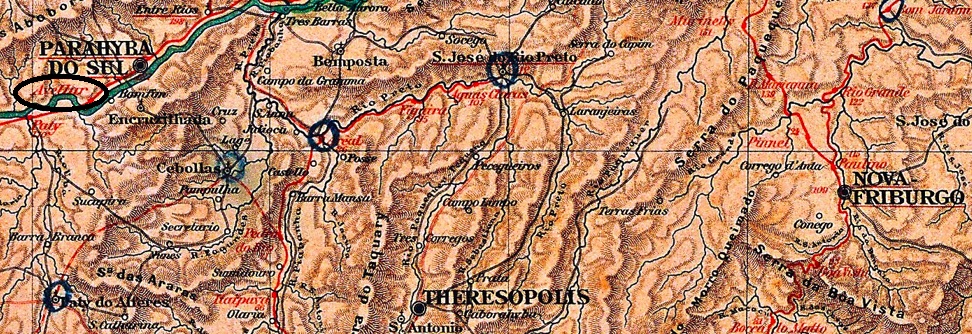
This station was inaugurated in July 1885 by the E.F. Dom Pedro II Railway Company in the Freguesia of S. Pedro and S. Paulo in the Município of Parahyba do Sul on the north bank of the river of the same name, 140 km north of the capital Rio de Janeiro. The railway line went to E.F. Central do Brasil in 1889, and from 1975 until its closure in 1996 it belonged to Rede Ferroviária Federal S.A. However, since 1924 the station was called Vieira Cortez (estacoesferroviarias.com.br), because another station called Avellar was inaugurated in March 1898, 30 km further south at Paty do Alferes. The name Avellar apparently comes from the Baron of Capivary, née Joaquim Ribeiro de Avellar (1791-1863), a large landowner of the region, while Vieira Cortez was an engineer of the E.F. Central do Brasil.
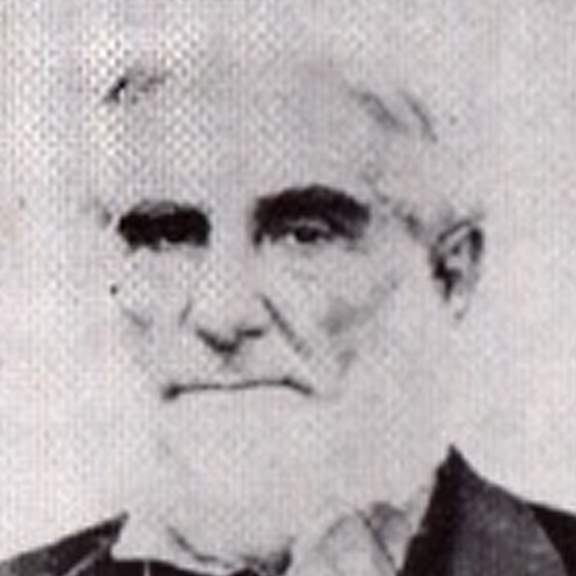
Joaquim R. de Avellar, 1st Baron of Capivary

Today the rails are still there, but the station building no longer exists:
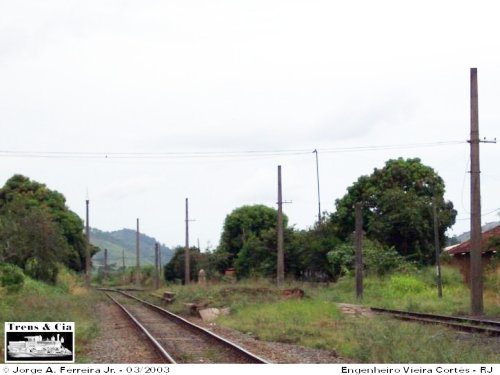
2002 (Photo Jorge A. Ferreira Jr, in estacoesferroviarias.com.br)

The station post office came into being in September 1884, according to the Rio press:
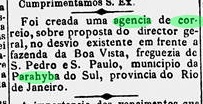
Gazeta da Tarde, 13/09/1884

The imperial postmark is ARJ-0095a (image: agenciaspostais.com.br): a double circle with the inscription AVELLAR above and an ornament in flower below, reflected horizontally. The dates in the centre go from 1889 to 1896. From Mute Cancellations of the Brazil Empire/ Carimbos Mudos do Brasil Império (Brazil Philatelic Association, Rio de Janeiro, 2000) by James Dingler and Klerman W. Lopes there also comes a mute cancellation, with no. 4265:
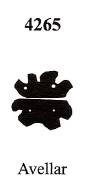
BPA 4265
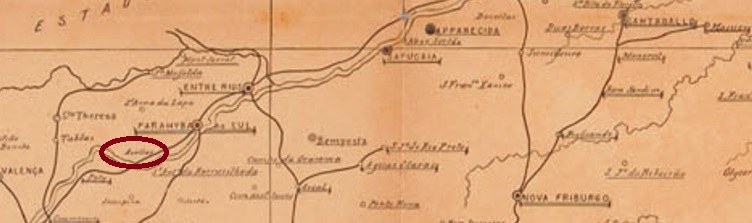
Mappa Postal do Rio de Janeiro, 1906

Andere Namen: Parada do Barão, Est. Boa Vista, Desvio da Boa Vista, Vieira Cortez (1924)

Dieser Bahnhof wurde im Juli 1885 durch die E.F. Dom Pedro II Bahngesellschaft eingeweiht und lag in der Freguesia von S. Pedro und S. Paulo im Município von Parahyba do Sul am Nordufer des gleichnamigen Flusses, 140 km nördlich der Hauptstadt Rio de Janeiro entfernt. Die Bahnlinie ging 1889 zur E.F. Central do Brasil, von 1975 bis zur Stilllegung 1996 gehörte sie der Rede Ferroviária Federal S.A. Allerdings hieß der Bahnhof seit 1924 Vieira Cortez (estacoesferroviarias.com.br), denn ein anderer Bahnhof namens Avellar wurde im März 1898 30 km weiter südlich bei Paty do Alferes eingeweiht. Der Name Avellar kommt offenbar vom Baron von Capivary, geb. Joaquim Ribeiro de Avellar (1791-1863), einem Großgrundbesitzer der Region, während Vieira Cortez ein Ingenieur der E.F. Central do Brasil war.
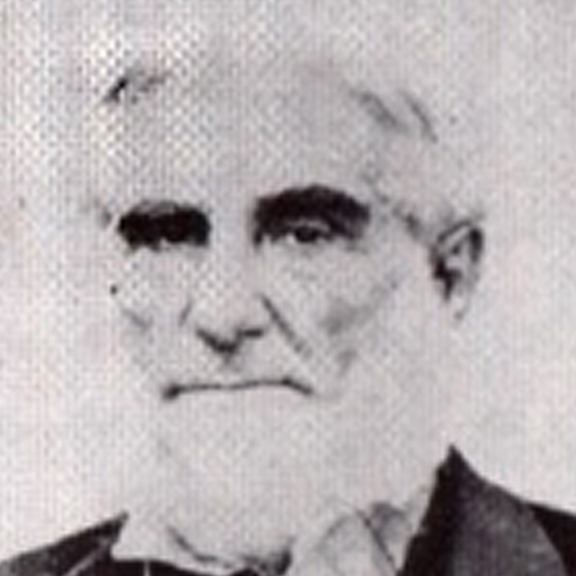
Joaquim R. de Avellar, 1. Baron von Capivary

Heute sind die Schienen noch da, doch das Bahnhofsgebäude existiert nicht mehr:
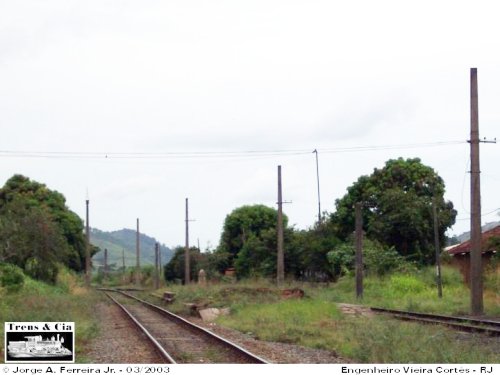
2002 (Foto Jorge A. Ferreira Jr, in estacoesferroviarias.com.br)

Das Bahnhofspostamt wurde im September 1884 ins Leben gerufen, wie die Presse aus Rio mitteilte:
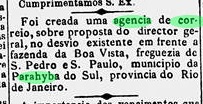
Gazeta da Tarde, 13.09.1884

Der kaiserliche Poststempel ist ARJ-0095a (Abb. agenciaspostais.com.br): ein Doppelkreis mit der Inschrift AVELLAR oben und einem Ornament in Blume unten, das sich horizontal spiegelt. Die Daten in der Mitte gehen von 1889 bis 1896. Aus Mute Cancellations of the Brazil Empire/ Carimbos Mudos do Brasil Império (Brazil Philatelic Association, Rio de Janeiro, 2000) von James Dingler und Klerman W. Lopes kommt auch eine stumme Entwertung, mit Nr. 4265:
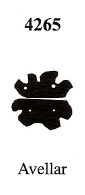
BPA 4265
Categories
Carimbologia A-B

Aveiro, Pará (APA-0025)

Atlas do Imperio do Brasil, 1868

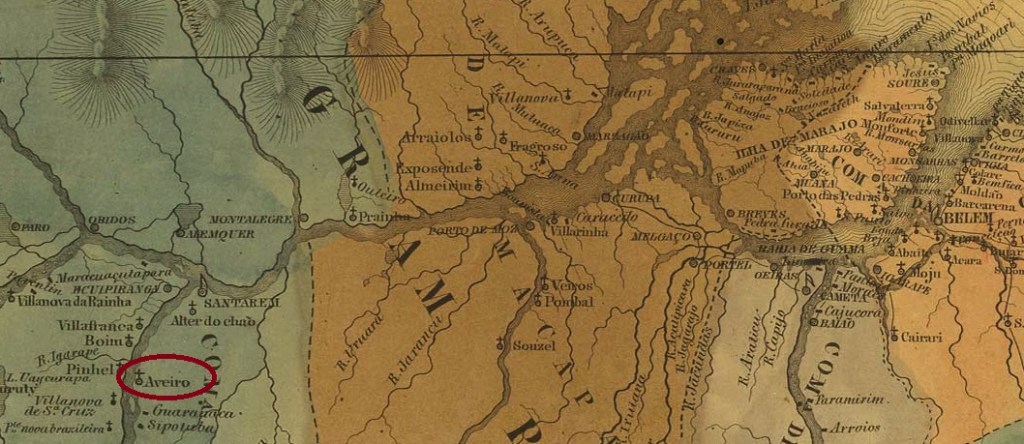
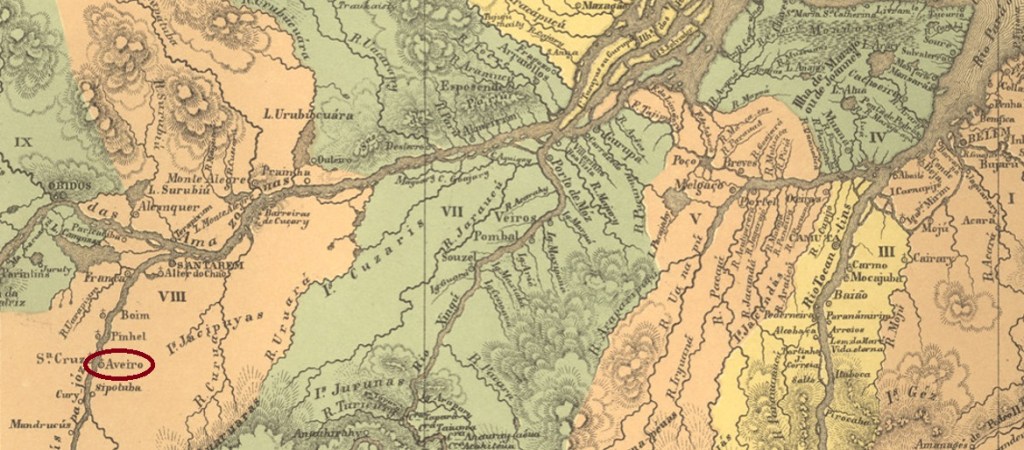
This place is said to have been a vila called N. Sra. da Conceição do Aveiro as early as 1781, located 800 km (as the crow flies) southwest of the later provincial capital Belém do Pará. However, today it still takes 1,300 km by car to get there. Vila status was lost in November 1848 when it was relegated as a freguesia in the Município of Itaituba, but returned in April 1883. In November 1930, it was again downgraded as a district – this time to the Município of Santarém. Aveiro has been an independent municipality again since December 1961. The name – like many other place names in Pará – is reminiscent of a Portuguese town.

As can be seen from the Directory of Imperial Post Offices (Tabella das Agencias do Correio do Imperio, Rio de Janeiro, 1885), there had been a post office there since 1878. Since the agency was not listed either in the Imperial Postal Guide (Guia Postal do Império) from 1880 or in the Directory of Pará Post Offices from 1881, it can be assumed that it did not start operating until around 1883. So far, no imperial postmark from Aveiro has been seen.

Villiers de l’Ile Adam: Carta (…) das Provincias do Grão Pará e Alto Amazonas, 1850
Dieser Ort soll bereits 1781 eine Vila mit Namen N. Sra. da Conceição do Aveiro gewesen sein, die 800 km (Luftlinie) südwestlich der späteren Provinzhauptstadt Belém do Pará lag. Allerdings braucht man heute noch 1.300 km mit dem Auto zu fahren, um dorthin zu kommen. Der Vila-Status ging im November 1848 mit dem Abstieg als Freguesia im Município von Itaituba verloren, kehrte aber im April 1883 zurück. Im November 1930 erfolgte erneut eine Herabstufung als Distrikt – diesmal zum Município von Santarém. Seit Dezember 1961 ist Aveiro wieder eine eigenständige Gemeinde. Der Name – wie viele andere Ortsnamen in Pará – erinnert an eine portugiesische Stadt.

Wie aus dem Verzeichnis der kaiserlichen Postämter (Tabella das Agencias do Correio do Imperio, Rio de Janeiro, 1885) entnommen wird, gab es dort ein Postamt seit 1878. Da die Agentur weder im Kaiserlichen Postführer (Guia Postal do Império) aus 1880 noch im Verzeichnis der Pará-Postämter aus dem Jahr 1881 aufgelistet wurde, ist es anzunehmen, dass sie ihren Betrieb erst ca. 1883 aufnahm. Bisher war kein kaiserlicher Poststempel aus Aveiro zu sehen.

Categories
Carimbologia A-B

Aurora (train station/Bahnhof), São Paulo (ASP-0072)

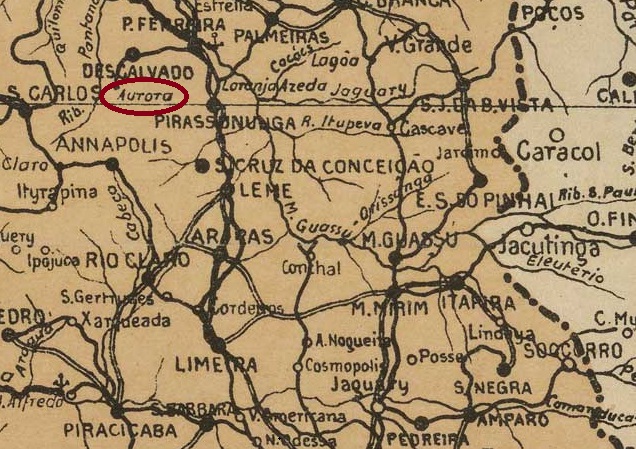
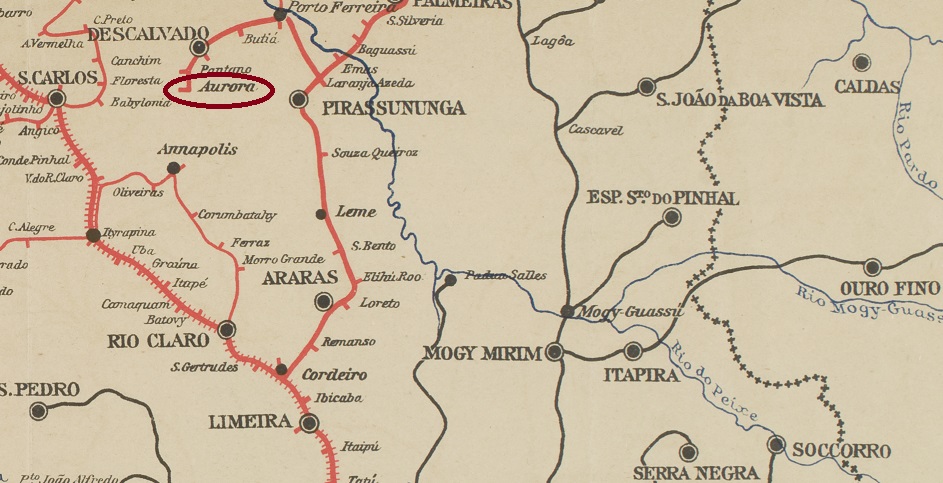
Arthur D. Ribeiro: Estado de São Pauulo, 1924

Text update on August 20, 2023

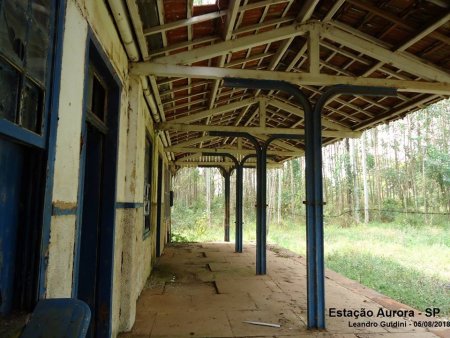
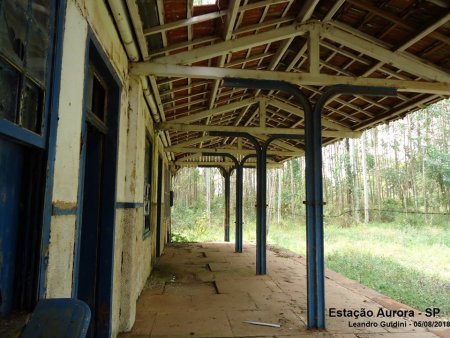
Aurora station was inaugurated in January 1889 by the E.F. Descalvadense railway company and was located south of the provincial town of Descalvado, 250 km northwest of the capital São Paulo. From 1891 until its closure in 1960, the line belonged to the Cia. Paulista de Estradas de Ferro. Today, the rails have been demolished and the station building serves as the office of an agricultural company. Aurora was the name of the wife of one of the landowners who built the railway line (estacoesferroviarias.com.br).

2018 (Photo: Leandro Ghidini, in estacoesferroviarias.com.br)

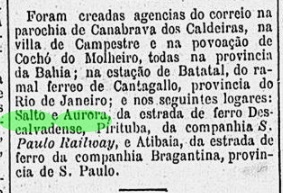
There had been a postal agency at the station since August 1889, according to the Rio press:

Gazeta de Noticias/RJ,05.08.1889

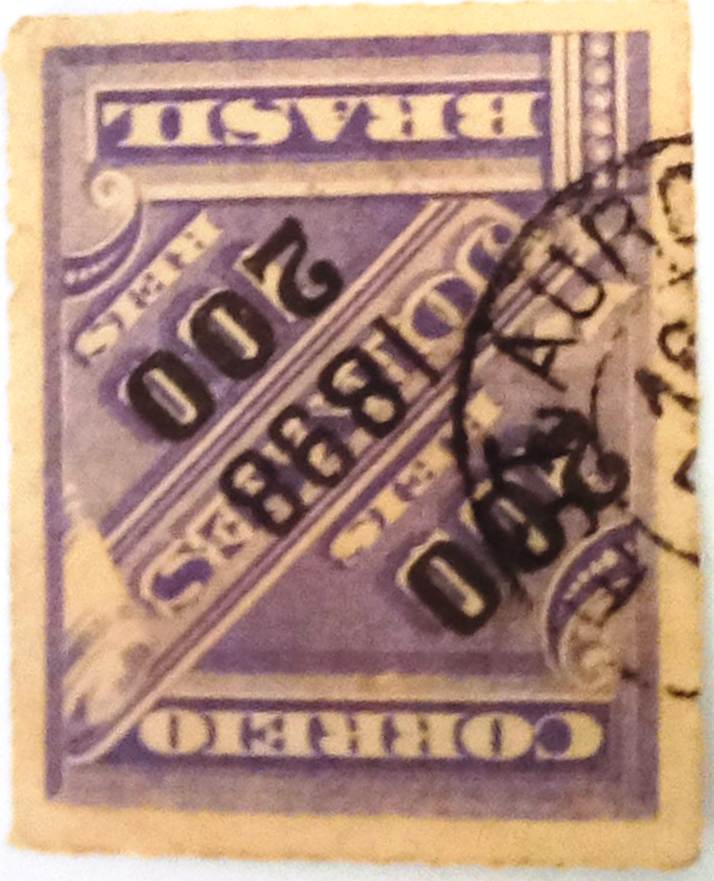
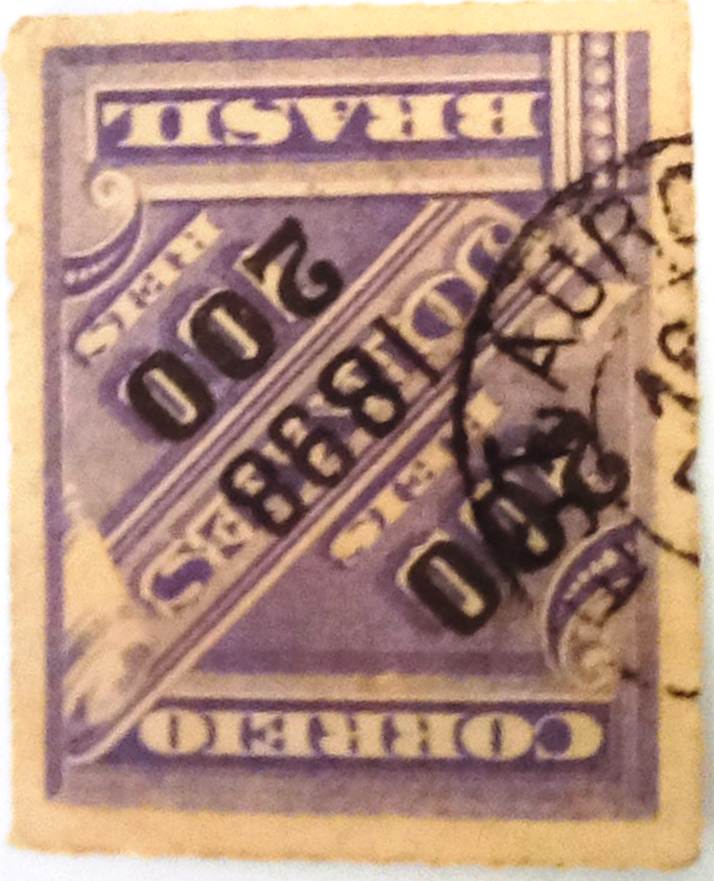
In the meantime, ASP-0072a has appeared in the Fuad Ferreira Fo. collection on a stamp of the year 1898:

ASP-0072a (FF) 1898ff
Cia. Paulista de Estradas de Ferro

Textaktualisierung am 20. August 2023

Der Bahnhof Aurora wurde im Januar 1889 durch die E.F. Descalvadense Bahngesellschaft eingeweiht und lag südlich des Provinzstädtchens Descalvado, 250 km nordwestlich der Hauptstadt São Paulo entfernt. Von 1891 bis zur Stilllegung 1960 gehörte die Strecke der Cia. Paulista de Estradas de Ferro. Heute sind die Schienen abgerissen, das Bahnhofsgebäude dient als Büro eines Landwirtschaftsbetriebs. Aurora hieß die Ehefrau eines der Großgrundbesitzer, die die Bahnlinie legen ließen (estacoesferroviarias.com.br).

2018 (Foto: Leandro Ghidini, in estacoesferroviarias.com.br)

Am Bahnhof gab es eine Postagentur seit August 1889, wie die Presse aus Rio mitteilte:

Gazeta de Noticias/RJ,05.08.1889

Inzwischen ist ASP-0072a in der Sammlung Fuad Ferreira Fo. auf einer Marke des Jahres 1898 aufgetaucht:

ASP-0072a (FF) 1898ff
Categories
Carimbologia A-B

Aureliano Mourão (train station/Bahnhof), Minas Gerais (AMG-0160)

Estado de Minas Geraes, 1910

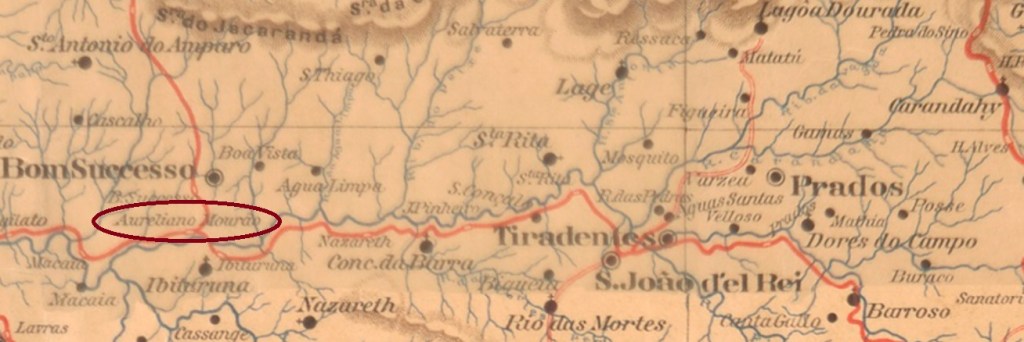
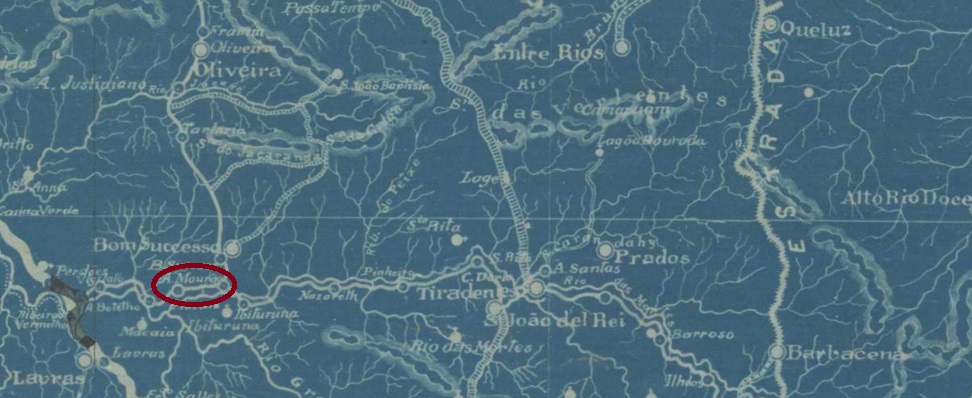
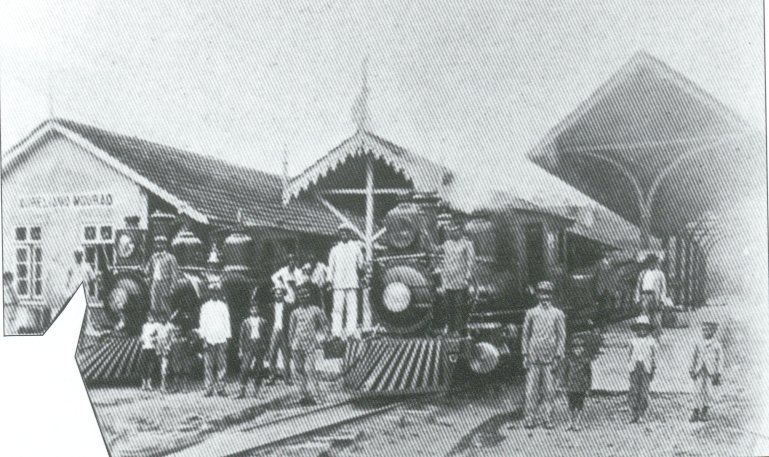
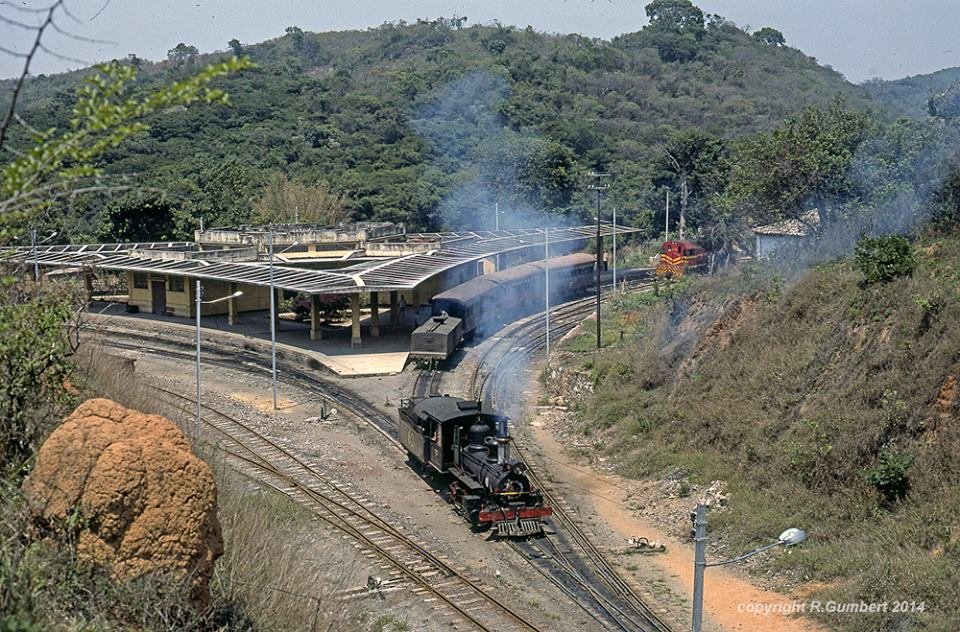
Aureliano Mourão station was inaugurated in October 1887 by the E.F. Oeste de Minas railway company (Paraopeba Line) and was located on the north bank of the Rio das Mortes in the Município of Bom Successo, 240 km southwest of the provincial capital Ouro Preto. The railway line was transferred to Rede Mineira de Viação in 1931 and to V.F. Centro-Oeste in 1965. From 1975 until its closure in 1979, it belonged to Rede Ferroviária Federal S.A. (estacoesferroviarias.com.br). Today, the rails have been removed and the station building is abandoned. The name is meant to commemorate Aureliano Marins de Carvalho Mourão, the first president of the E.F. Oeste de Minas.

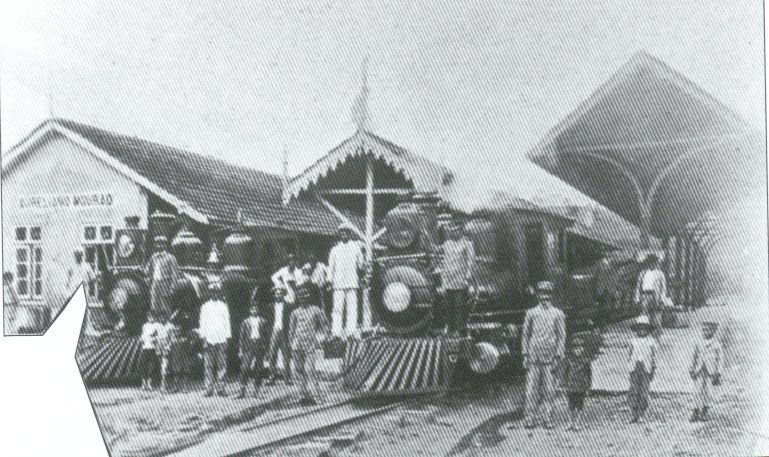
ca. 1912 (estacoesferroviarias.com.br)
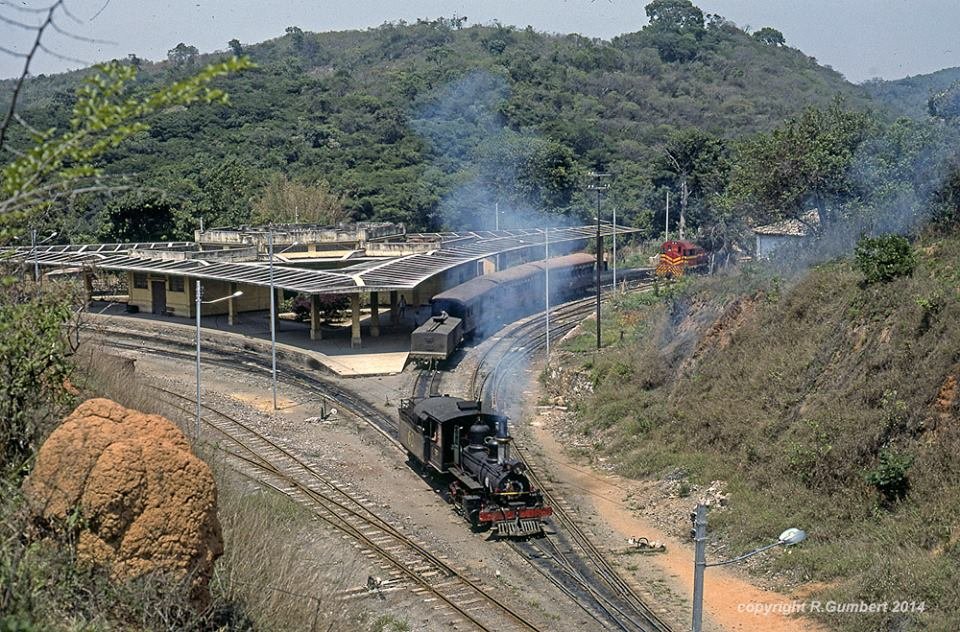
ca. 1980, Photo by R. Gumbert (estacoesferroviarias.com.br)

As Paula Sobrinho writes in História Postal de Minas Gerais (Belo Horizonte, 1997), there was a post office at the station from December 1887. The first postmark AMG-0160a was already made known by R. Koester in Carimbologia II.

AMG-0160a (RK) 1887ff
E.F. Oeste de Minas, 1917

Der Bahnhof Aureliano Mourão wurde im Oktober 1887 durch die E.F. Oeste de Minas Bahngesellschaft (Paraopeba-Linie) eingeweiht und lag am Nordufer des Rio das Mortes im Município von Bom Successo, 240 km südwestlich der Provinzhauptstadt Ouro Preto entfernt. Die Bahnlinie ging 1931 zur Rede Mineira de Viação und 1965 zur V.F. Centro-Oeste über. Von 1975 bis zur Stilllegung 1979 gehörte sie der Rede Ferroviária Federal S.A. (estacoesferroviarias.com.br). Heute sind die Schienen bereits enftfernt worden, das Bahnhofsgebäude ist verlassen. Der Name soll an Aureliano Marins de Carvalho Mourão erinnern, den ersten Präsidenten der E.F. Oeste de Minas.

ca. 1912 (estacoesferroviarias.com.br)
ca. 1980, Foto R. Gumbert (estacoesferroviarias.com.br)

Wie Paula Sobrinho in História Postal de Minas Gerais (Belo Horizonte, 1997) schreibt, gab es am Bahnhof ein Postamt ab Dezember 1887. Der erste Poststempel AMG-0160a wurde bereits durch R. Koester in Carimbologia II bekannt gemacht.

AMG-0160a (RK) 1887ff
Categories
Carimbologia A-B

Atibaia (ASP-0070) – Atibaia (train station/Bahnhof), São Paulo (ASP-0071)

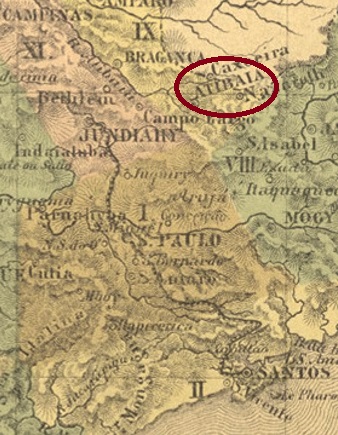
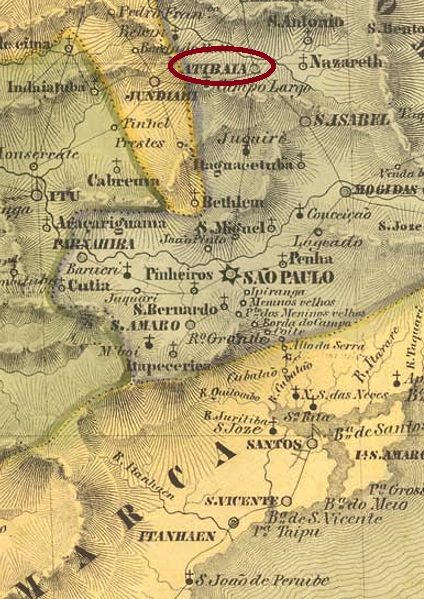
Atlas do Imperio do Brasil, 1868

The freguesia of S. João Baptista de Atibaia was founded in August 1747 on the south bank of the river Atibaia, barely 70 km north of the vila of São Paulo. The village rose to the status of vila in June 1769 and to town in April 1864.

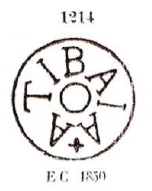
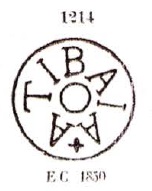
The local post office was established in January 1848, as Nova Monteiro writes in Administrações e Agencias Postaes do Brasil Imperio (Brasil Filatelico/RJ, 1934-5; Reprint SPP 1994-1999). However, this would be a reopening, as the first postmark ASP-0070a was already sighted on letters of the pre-philatelic period, as noted in the Catálogo Enciclopédico RHM (S. Paulo, 1999). The cancel is known by Paulo Ayres (Catálogo de Carimbos Brasil-Império, S. Paulo, 1937, 1942) under no. 1214:

ASP-0070a (RHM P-SP-1843, P.A. 1214) 1843ff

It was followed by two postmarks as double circles, which are very similar to each other, as both have only the inscription ATIBAIA at the top. On the earlier ASP-0070b (Image: Mario Celso Orsi Jr.) the letters are somewhat larger or thicker. It was seen with an internal date from 1878. The later ASP-0070c (Image by Luis C. Fritzen) has slimmer and smaller letters, with inner dates between 1885 and 1896.

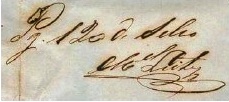
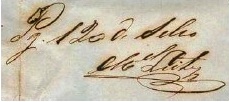
A station of the E.F. Bragantina railway company (Piracaia Line) was inaugurated there in August 1884, operated until 1967 and had its own post office from August 1889 (Boletim Postal 5/89). No postmark of this station has yet appeared. Instead, we can show two handwritten cancellations (image by Mário Celso Orsi Jr.):

1858 (MO)
1877 (MO)
illiers de l’Ile Adam: Carta (…) da Provincia de São Paulo, 1847

Die Freguesia von S. João Baptista de Atibaia entstand im August 1747 und lag am Südufer des Flusses Atibaia, knapp 70 km nördlich der Vila von São Paulo. Der Ort stieg im Juni 1769 zur Vila und im April 1864 zur Stadt auf.

Das örtliche Postamt wurde im Januar 1848 ins Leben gerufen, wie Nova Monteiro in Administrações e Agencias Postaes do Brasil Imperio (Brasil Filatelico/RJ, 1934-5; Reprint SPP 1994-1999) schreibt. Das dürfte allerdings eine Wiedereröffnung sein, da der erste Poststempel ASP-0070a schon auf Briefen der vorphilatelistischen Zeit gesichtet wurde, wie im Catálogo Enciclopédico RHM (S. Paulo, 1999) vermerkt. Der Stempel ist bekannt durch Paulo Ayres (Catálogo de Carimbos Brasil-Império, S. Paulo, 1937, 1942) unter Nr. 1214:

ASP-0070a (RHM P-SP-1843, P.A. 1214) 1843ff

Ihm folgten zwei Poststempel als Doppelkreise, die untereinander sehr ähnlich sind, da beide nur die Inschrift ATIBAIA oben tragen. Bei dem früheren ASP-0070b (Samml. Mario Celso Orsi Jr.) sind die Buchstaben etwas größer bzw. dicker. Gesichtet mit Datum aus 1878. Der spätere ASP-0070c (Samml. Luis C. Fritzen) hat schlankere und kleinere Buchstaben, mit inneren Daten zwischen 1885 und 1896.

Im August 1884 wurde dort ein Bahnhof der E.F. Bragantina Bahngesellschaft (Piracaia-Linie) eingeweiht, der bis 1967 betrieben wurde und ein eigenes Postamt ab August 1889 hatte (Boletim Postal 5/89). Noch ist kein Poststempel dieses Bahnhofs aufgetaucht. Dafür können wir zwei handschriftliche Entwertungen (Abb. Mário Celso Orsi Jr.) zeigen:

1858 (MO)
1877 (MO)
Categories
Carimbologia A-B

Aterrado, Minas Gerais, (AMG-0155)

Atlas do Imperio do Brasil, 1868

Other name: Luz (1923)

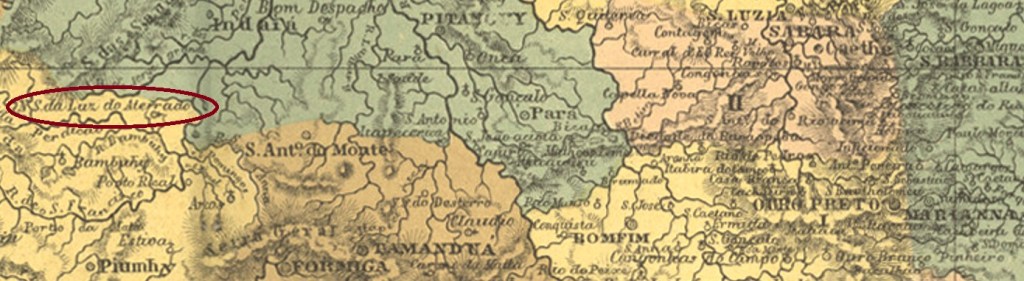
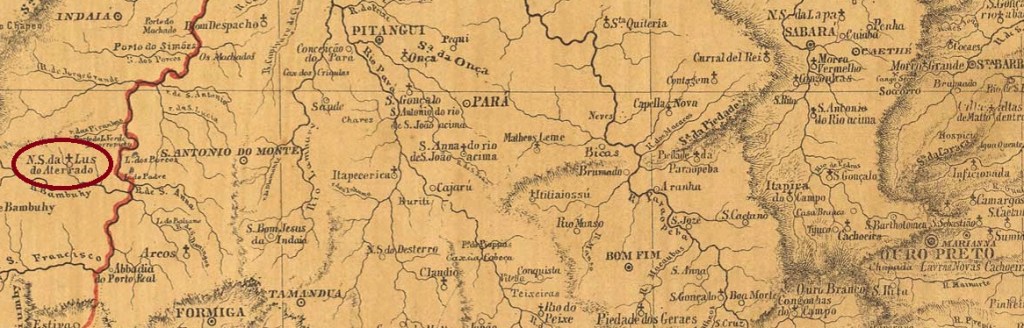
The Freguesia of N. Sra. da Luz do Aterrado was founded in May 1856 in the Município of Dores do Indayá, 290 km west of the provincial capital of Ouro Preto. Since September 1923, it has been a town in its own município, simply called Luz (Light).

Ther was a local post office since July 1884, as Paula Sobrinho writes in História Postal de Minas Gerais (Belo Horizonte, 1997). The oldest postmark so far is AMG-0155b (Coll. FM): a double circle with the inscriptions ATERRADO above and (MINAS) below. The only specimen so far bears a date from 1907 in the centre.

Provincia de Minas Gerais, 1873

Anderer Name: Luz (1923)

Die Freguesia von N. Sra. da Luz do Aterrado wurde im Mai 1856 im Município von Dores do Indayá gegründet und lag 290 km westlich der Provinzhauptstadt Ouro Preto entfernt. Seit September 1923 ist der Ort eine Stadt im eigenem Município, die einfach Luz (Licht) heißt.

Dort gab es ein Postamt seit Juli 1884, wie Paula Sobrinho in História Postal de Minas Gerais (Belo Horizonte, 1997) schreibt. Der bisher älteste Poststempel ist AMG-0155b (Samml. FM): ein Doppelkreis mit den Inschriften ATERRADO oben und (MINAS) unten. Das einzige Exemplar trägt ein Datum aus 1907 in der Mitte.

Categories
Carimbologia A-B

Atalaia, Alagoas (AAL-0025)

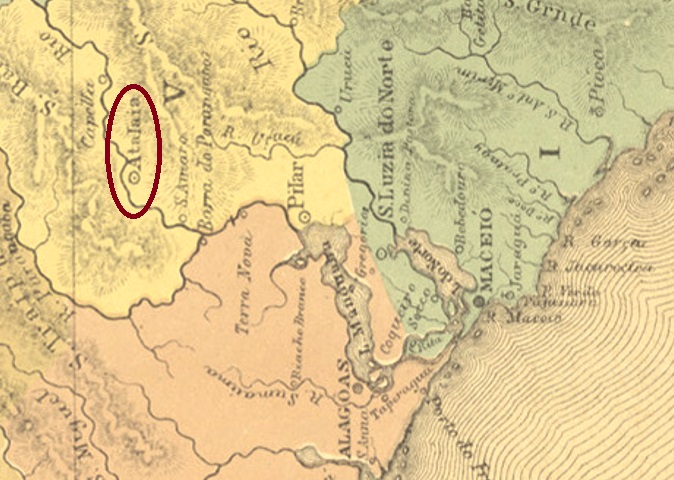
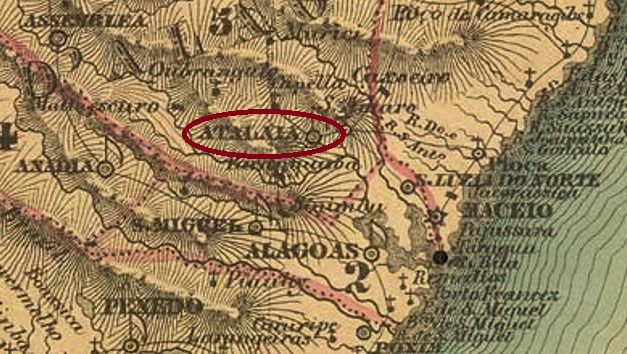
Atlas do Imperio do Brasil, 1868

Other names: Arraial dos Palmares, N. Sra. das Brotas

The history of this village began in 1692, with the foundation of Arraial dos Palmares, more than 40 km northwest of the future provincial capital Maceió. In March 1701, the Arraial was renamed N. Sra. das Brotas and in February 1764 it became a vila called Atalaia. Atalaia has been a town since March 1891.

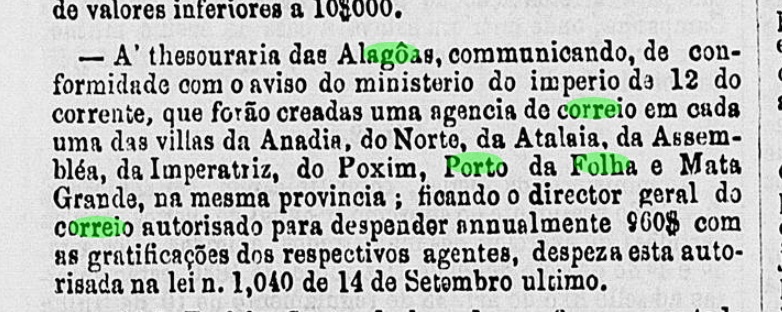
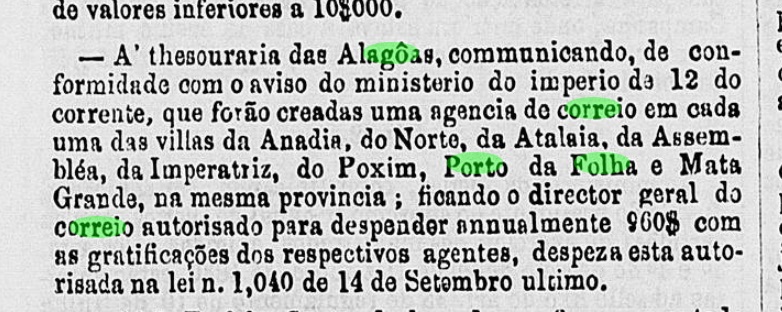
Two dates of origin for the local post office have been found. Firstly in 1845, as stated in the Directory of Imperial Post Offices (Tabella das Agencias do Correio do Imperio, Rio de Janeiro, 1885). Then again in November 1859, as published in the official press in Rio:

Boletim do Minstério do Imperio exped. 14.11.1859

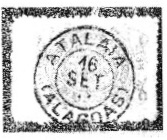
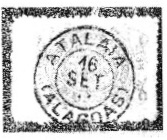
The only 19th century postmark so far is AAL-0025c, known with dates between 1890 and 1897 and already presented by R. Koester in Carimbologia II:

AAL-0025c (RK)
Villiers de l’Ile Adam: Carta (…) das Provincias de Pernambuco, Alagoas e Sergipe, 1848

Andere Namen: Arraial dos Palmares, N. Sra. das Brotas

Die Geschichte dieser Ortschaft fing 1692 an, mit der Gründung vom Arraial dos Palmares, über 40 km nordwestlich der späteren Provinzhauptstadt Maceió entfernt. Im März 1701 wurde der Arraial zu N. Sra. das Brotas umbenannt und wurde im Februar 1764 zur Vila namens Atalaia. Seit März 1891 ist Atalaia eine Stadt.

Zwei Entstehungstermine fürs örtliche Postamt wurden gefunden. Erstmals 1845, wie imVerzeichnis der kaiserlichen Postämter (Tabella das Agencias do Correio do Imperio, Rio de Janeiro, 1885) zu lesen ist. Dann wieder im November 1859, wie in der Amtspresse in Rio veröffentlicht wurde:

Boletim do Minstério do Imperio exped. 14.11.1859

Der bisher einzige Poststempel im 19. Jahrhundert ist AAL-0025c, der mit Daten zwischen 1890 und 1897 bekannt ist und bereits durch R. Koester in Carimbologia II vorgestellt wurde:

AAL-0025c (RK)
Categories
Carimbologia A-B

Assunguy de Cima, Paraná (APR-0020)

Estado do Paraná, 1896

Text update of January 1st, 2026

Another name: Açungui (1951)

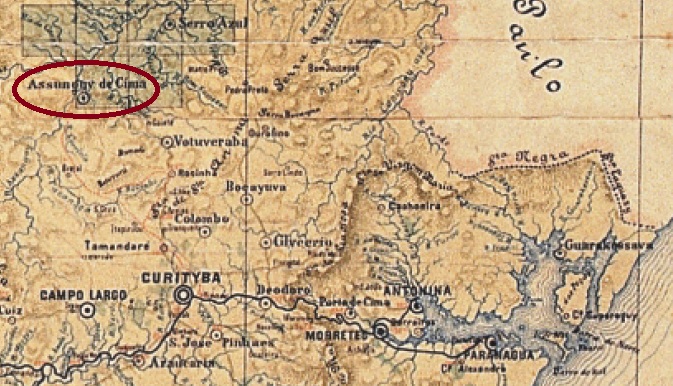
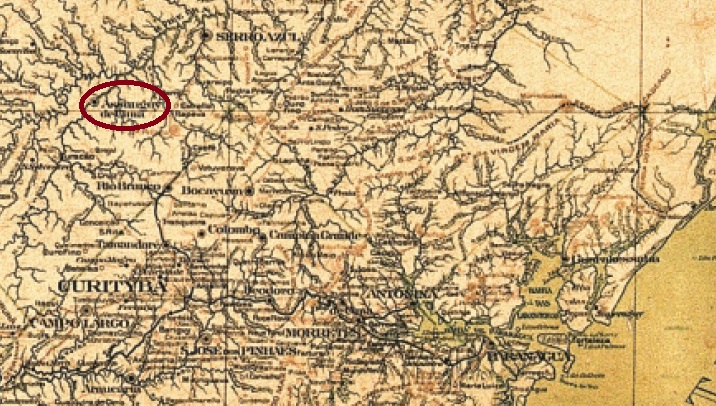
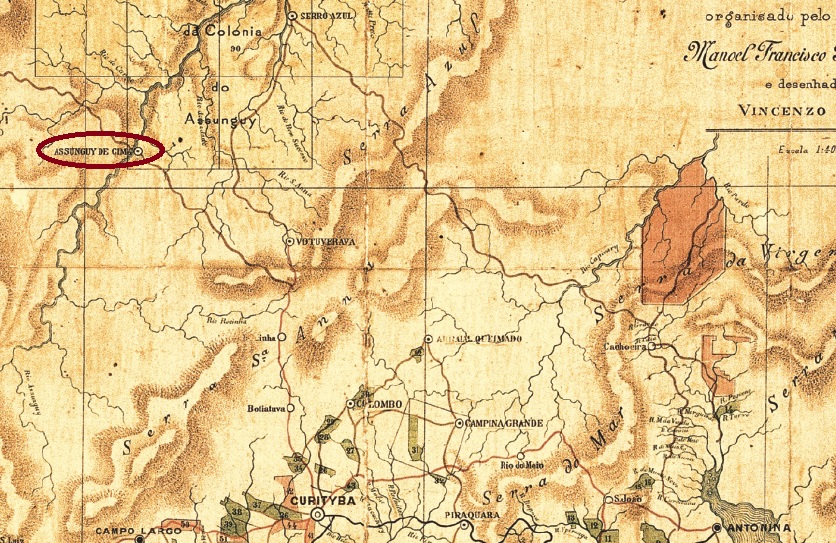
The colony of Assunguy de Cima (= Upper Assunguy) was founded in 1860 in the freguesia of Votuverava on the west bank of the Assunguy River, 70 km north of the provincial capital Curitiba. The place was declared a freguesia of N. Sra. do Amparo de Assunguy de Cima in 1876 and subsequently changed jurisdiction as a district three times: in February 1908 to the Município of Rio Branco, in October 1938 to Cerro Azul and in November 1951 to Rio Branco do Sul. This has remained until today, although the village is now written Açungui.

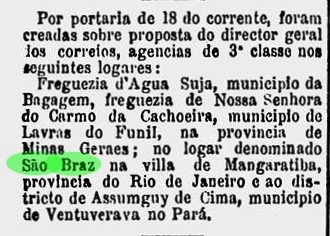
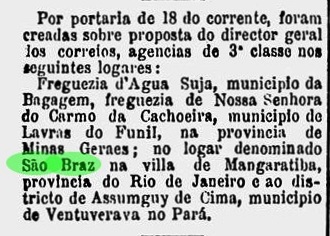
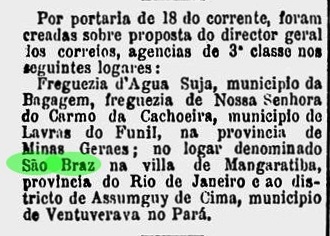
The local post office was created in February 1882, as the Rio press writes:

Gazeta de Noticias/RJ, 19.02.1882

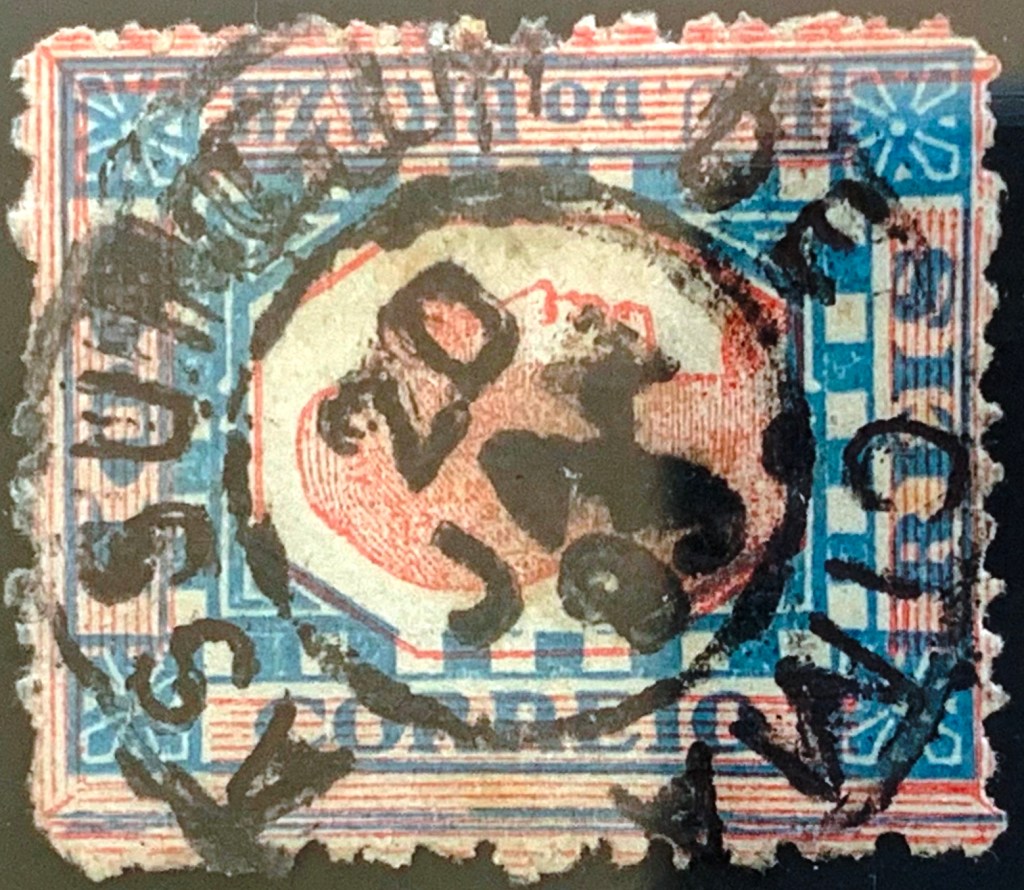
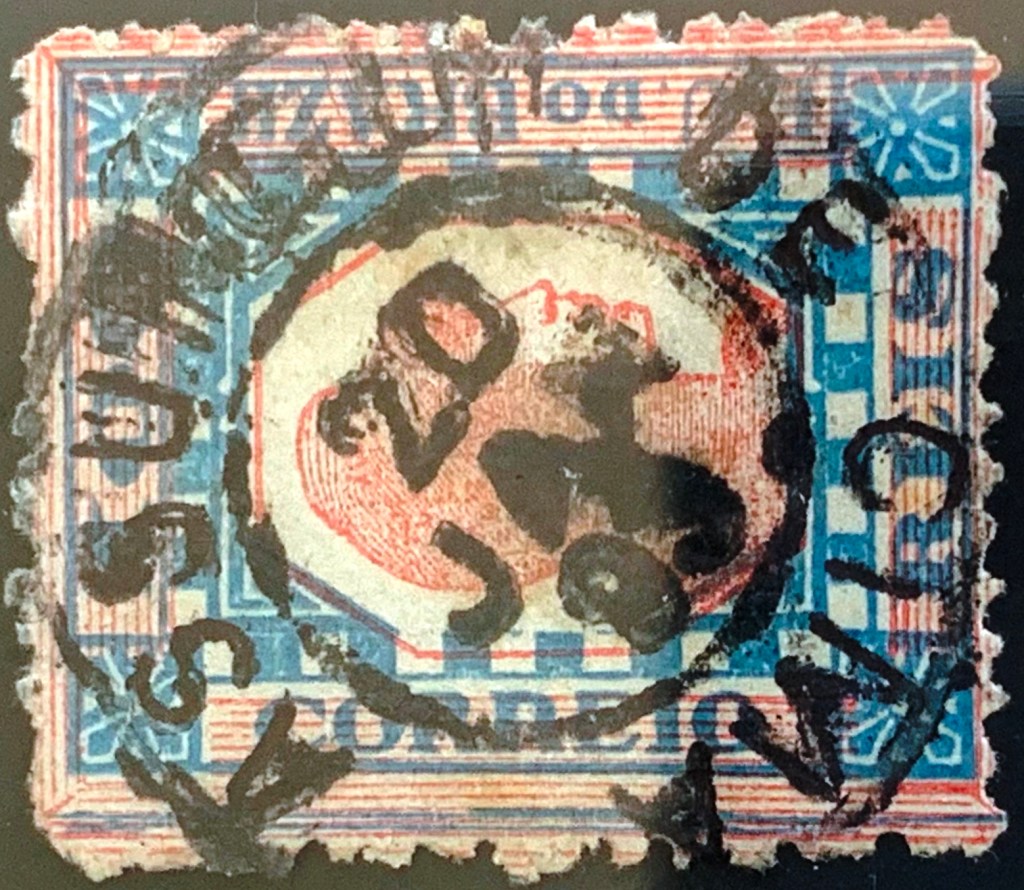
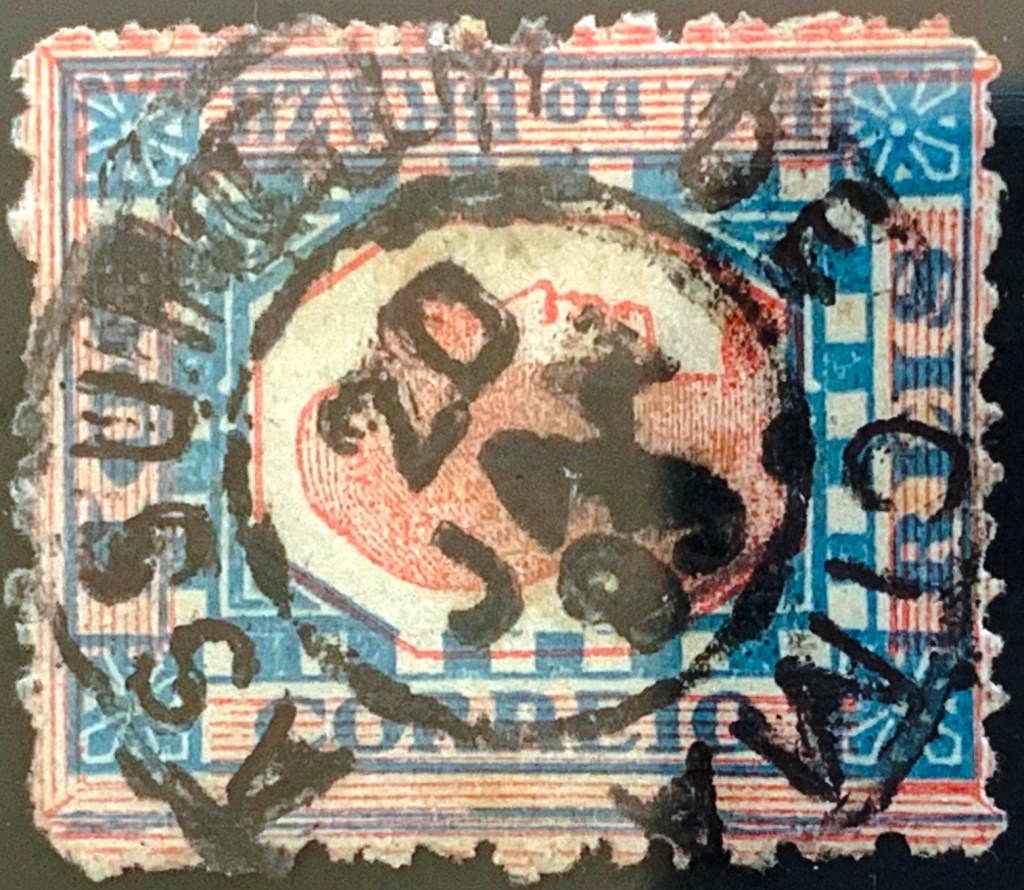
The oldest postmark to date is APR-0020a (Fig. Alexandre Andrade):

APR-0020a (AA) 1893
Estado do Paraná, 1892

Texto atualizado em 13 de janeiro de 2026

Outro nome: Açungui (1951)

A colônia de Assunguy de Cima foi fundada em 1860 na freguesia de Votuverava e estava localizada na margem oeste do rio Assunguy, 70 km ao norte da capital provincial Curitiba. O local foi declarado freguesia de N. Sra. do Amparo de Assunguy de Cima em 1876 e posteriormente mudou de jurisdição como distrito três vezes: em fevereiro de 1908 para o município de Rio Branco, em outubro de 1938 para Cerro Azul e em novembro de 1951 para Rio Branco do Sul. Foi assim que ficou até hoje, embora agora escrito Açungui.

A agência postal local foi criada em fevereiro de 1882, de acordo com a imprensa carioca:

Gazeta de Noticias/RJ, 19.02.1882

O carimbo postal mais antigo até agora é o APR-0020a (fig. Alexandre Andrade):

APR-0020a (AA) 1893
Mappa do Estado do Paraná,1922

Textaktualisierung am 13.01.2026

Anderer Name: Açungui (1951)

Die Kolonie von Assunguy de Cima (= am Oberlauf des Assunguy) wurde 1860 an der Freguesia von Votuverava gegründet und lag am Westufer des Flusses Assunguy, 70 km nördlich der Provinzhauptstadt Curitiba entfernt. Der Ort wurde 1876 zur Freguesia von N. Sra. do Amparo de Assunguy de Cima erklärt und wechselte danach als Distrikt dreimal seine Zuständigkeit: im Februar 1908 zum Município von Rio Branco, im Oktober 1938 zu Cerro Azul und im November 1951 zu Rio Branco do Sul. So ist es bis heute geblieben, wobei sich der Ort inzwischen Açungui schreibt.

Das örtliche Postamt wurde im Februar 1882 ins Leben gerufen, wie die Presse aus Rio schreibt:

Gazeta de Noticias/RJ, 19.02.1882

Der bisher ältester Poststempel ist APR-0020a (Abb. Alexandre Andrade):

APR-0020a (AA) 1893
Categories
Carimbologia A-B

Assunguy, Paraná (APR-0019)

Carta da Republica dos Estados Unidos do Brazil, 1892

Text update on January 16, 2023

Other names: Colonia do Assunguy, Nossa Senhora da Guia do Serro Azul, Cerro Azul (1929)

See also Assunguy (R. Koester: Carimbologia II) and Serro Azul (SPR-0120)

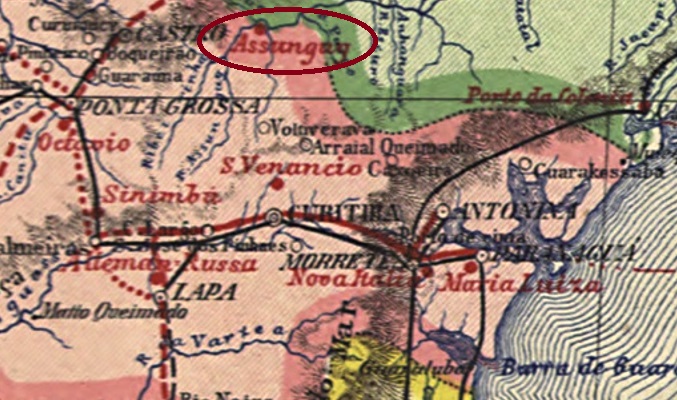
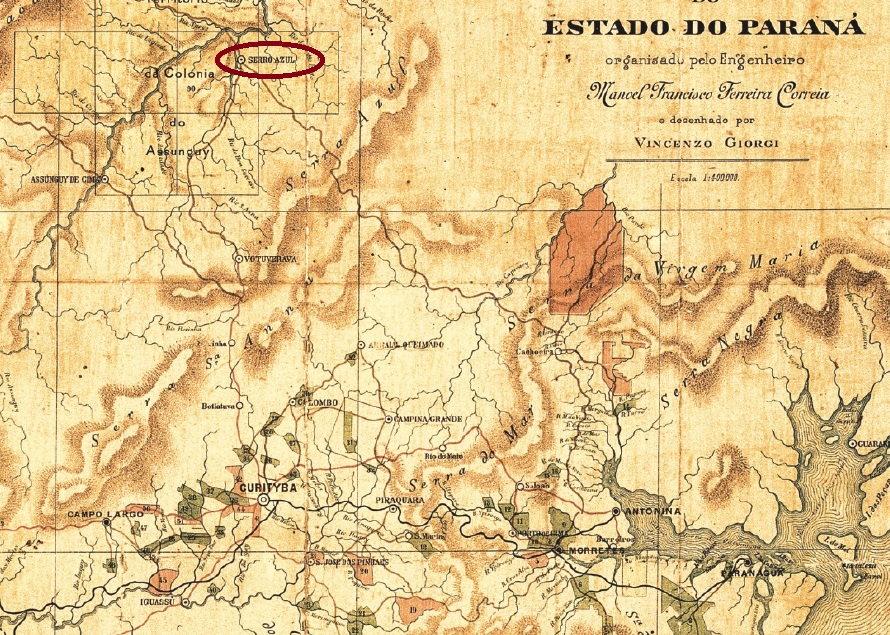
There were two villages called Assunguy in the imperial province of Paraná. This one was established around 1860, when the colony of Assunguy was founded on the east bank of the Ponta Grossa RIver, 90 km north of the provincial capital Curitiba. Assunguy is a Tupi-Guarani language term meaning Blue River. In April 1872, the village rose to become a freguesia in the município of Votuverava, in October 1882, a vila called Serro Azul, and in December 1897, a town. Since 1929, Cerro Azul – as it is now written – has been an independent município.

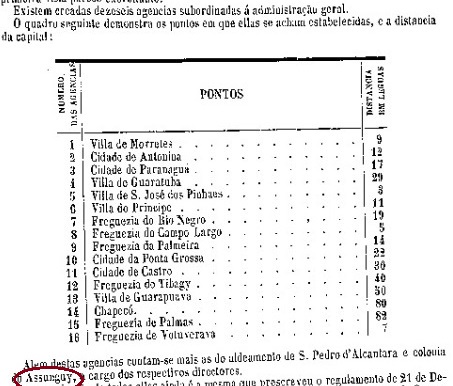
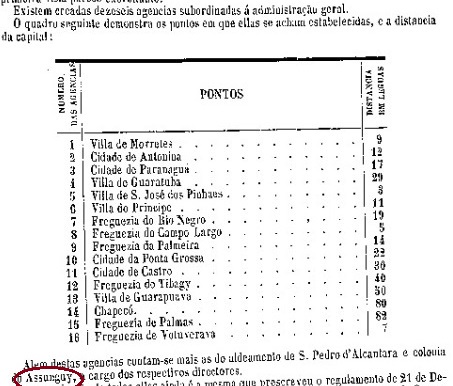
According to the Imperial Mail Register (Tabella das Agencias do Correio do Império, Rio de Janeiro, 1885), there has been a post office there since 1875. However, the Report of the President of the Province of February 1868 reveals that previously there was already a post office in that colony, managed by its director:

Report of the President of the Province of Paraná, February 1868 (p. 53)

The only postmark of the 19th century so far is APR-0019b (image: Mário Celso Orsi Jr.): a circle with the inscriptions ASSUNGUY. The only specimen found is from 1885 and does not show details of the lower arch. Later cancels from 1889 already show the name Serro Azul (see SPR-0120).

Estado do Paraná, 1892

Textaktualisierung am 16. Januar 2023

Andere Namen: Colonia do Assunguy, Nossa Senhora da Guia do Serro Azul, Cerro Azul (1929)

Siehe auch Assunguy (R. Koester: Carimbologia II) und Serro Azul (SPR-0120)

Es gab zwei Ortschaften in der kaiserlichen Provinz Paraná, die Assunguy hießen. Diese entstand um 1860, als die Kolonie Assunguy am Ostufer des Flusses Ponta Grossa gegründet wurde, 90 km nördlich der Provinzhauptstadt Curitiba entfernt. Assunguy ist ein Begriff der Tupi-Guarani Sprache und bedeutet Blauer Fluss. Im April 1872 stieg der Ort zur Freguesia im Município von Votuverava, im Oktober 1882 zur Vila namens Serro Azul und im Dezember 1897 zur Stadt. Seit 1929 ist Cerro Azul – wie man jetzt schreibt – ein eigenständiger Município.

Laut Verzeichnis der kaiserlichen Postämter (Tabella das Agencias do Correio do Imperio, Rio de Janeiro, 1885) gibt es dort ein Postamt seit 1875.

Aus dem Bericht des Provinzpräsidenten vom Februar 1868 geht jedoch hervor, dass es in dieser Kolonie bereits ein Postamt gab, das von seinem Direktor geleitet wurde:

Bericht des Präsidenten der Provinz Paraná, Februar 1868 (S. 53)

Der bisher einzige Stempel des 19. Jahrhunderts ist APR-0019b (Bild: Mário Celso Orsi Jr.): ein Kreis mit der Inschrift ASSUNGUY. Das einzige gefundene Exemplar stammt aus dem Jahr 1885 und zeigt keine Details des unteren Bogens. Spätere Stempel von 1889 zeigen bereits den Namen Serro Azul (siehe SPR-0120).

Categories
Carimbologia A-B

Assú, Rio Grande do Norte (ARN-0030)

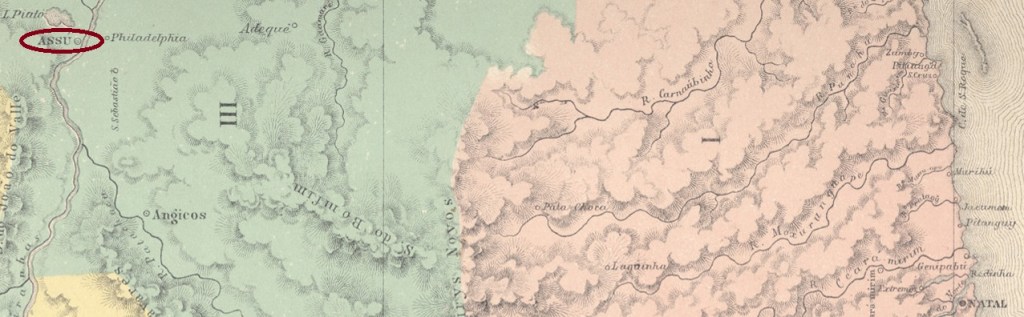
Atlas do Imperio do Brasil, 1868

Other names: Arraial de N. Sra. dos Prazeres, Vila Nova da Princesa

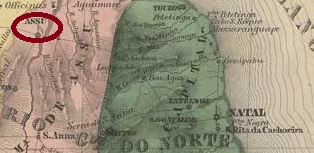
This village was founded in April 1696 under the name Arraial de N. Sa. dos Prazeres and was located on the west bank of the river Piranhas, also called Açu (large, in Tupi), 210 km west of the later provincial capital Natal. In August 1788, the place rose to vila status, with the name Villa Nova da Princesa, and since October 1845 has been the town of Assú, now spelled Açu.

As Nova Monteiro writes in Administrações e Agencias Postaes do Brasil Imperio (Brasil Filatelico/RJ, 1934-5; Reprint SPP 1994-1999), there was a post office there from April 1818, which means there could be a local postmark under Princesa. So far, however, only one 19th century postmark has been found: ARN-0030c (Coll. Roberto Assef Jr.) is a double circle with the inscription ASSÚ. It also occurs in purple and has internal dates from 1891 to at least 1894.

Villiers de l’Ile Adam: Carta (…) das Provincias do Rio Grande do Norte e Parahiba, 1848

Andere Namen: Arraial de N. Sra. dos Prazeres, Vila Nova da Princesa

Diese Ortschaft wurde im April 1696 unter dem Namen Arraial de N. Sa. dos Prazeres gegründet und lag am Westufer des Flusses Piranhas, der auch Açu (groß, in Tupi) genannt wird, 210 km westlich der späteren Provinzhauptstadt Natal entfernt. Im August 1788 stieg der Ort zur Vila-Status auf, mit Namen Villa Nova da Princesa, und ist seit Oktober 1845 die Stadt Assú, heute Açu geschrieben.

Wie Nova Monteiro in Administrações e Agencias Postaes do Brasil Imperio (Brasil Filatelico/RJ, 1934-5; Reprint SPP 1994-1999) schreibt, gab es dort ein Postamt seit April 1818. Das bedeutet, es könnte ein lokaler Poststempel unter Princesa existieren. Bisher wurde aber nur ein Stempel im 19. Jahrhundert gefunden: ARN-0030c (Samml. Roberto Assef Jr.) ist ein Doppelkreis mit der Inschrift ASSÚ. Er kommt auch in lila vor und hat innere Daten von 1891 bis mindestens 1894.