Categories
Carimbologia A-B

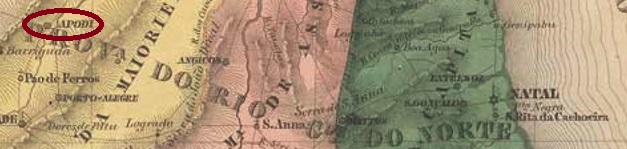
Alagoa de Baixo, Pernambuco (APE-0020)

Atlas do Imperio do Brasil, 1868

Another name: Sertânia (1943)

The freguesia called N. Sa. da Conceição da Alagoa de Baixo (Our Lady of the Immaculate Conception on the Lower Lake) has existed since May 1842, it was located near the villa of Cimbres on the Moxotó River, 300 km west of the provincial capital Recife. In May 1873, the village rose to the status of a villa, and in July 1909 it became a town, which has had the name Sertânia since December 1943.

The local post office started operations in December 1875, as reported by the regional press:

Diario de Pernambuco, 14/12/1875

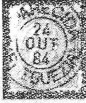
The imperial postmark is the French type APE-0020a (Coll. Marco Morel): a double circle with the inscription ALAGOA DE BAIXO above and the typical star between brackets below. There are two specimens sighted so far without date, both used on the 1885 numeral issue.

Carta Corographica da Provincia de Pernambuco, 1880

Anderer Name: Sertânia (1943)

Die Freguesia namens N. Sa. da Conceição da Alagoa de Baixo (Unsere Liebe Frau des Unbefleckten Empfängnis am Unteren See) gibt es seit Mai 1842, sie lag bei der Villa von Cimbres am Fluss Moxotó, 300 km westlich der Provinzhauptstadt Recife entfernt. Im Mai 1873 stieg die Ortschaft zur Villa und im Juli 1909 zu einer Stadt auf, die seit Dezember 1943 den Namen Sertânia trägt.

Das örtliche Postamt startete den Betrieb im Dezember 1875, wie die Regionalpresse berichtete:

Diario de Pernambuco, 14.12.1875

Der kaiserliche Poststempel ist der Französische Typ APE-0020a (Samml. Marco Morel): ein Doppelkreis mit der Inschrift ALAGOA DE BAIXO oben und dem typischen Stern zwischen Klammern unten. Es sind zwei bisher gesichtete Exemplare ohne Datum, beide auf der Ziffernausgabe aus 1885.

Categories
Carimbologia A-B

Alagoa de Ayuruoca, Minas Gerais (AMG-0060)

Atlas do Imperio do Brasil, 1868

Another name: Alagoa

The freguesia of N. Sa. do Rosario da Alagoa was founded in May 1855 at Aiuruoca, on the west bank of the river of the same name, close to the Serra do Papagaio, more than 300 km southwest of the provincial capital Ouro Preto. In September 1923, the town changed as a district of Itanhandu, and in December 1938 as a district to Itamonte. Since December 1962, Alagoa has been an independent Município.

The local post office was established in June 1887, according to the Rio press:

Diario de Noticias/RJ, 02.06.1887

So far, no postmark from the imperial period has been seen.

Provincia de Minas Geraes, 1873

Anderer Name: Alagoa

Die Freguesia von N. Sa. do Rosario da Alagoa wurde im Mai 1855 bei Aiuruoca gegründet und lag am Westufer des gleichnamigen Flusses nah an der Serra do Papagaio, über 300 km südwestlich der Provinzhauptstadt Ouro Preto entfernt. Im September 1923 wechselte der Ort als Distrikt von Itanhandu, und im Dezember 1938 als Distrikt zu Itamonte. Seit Dezember 1962 ist Alagoa ein eigenständiger Município.

Das örtliche Postamt entstand im Juni 1887, wie die Presse aus Rio mitteilte:

Diario de Noticias/RJ, 02.06.1887

Bisher war kein Poststempel aus der Kaiserzeit zu sehen.

Categories
Carimbologia A-B

Aguas Virtuosas, Minas Gerais (AMG-0050)

Atlas do Imperio do Brasil, 1868

Another name: Lambari

The Freguesia of Aguas Virtuosas de Campanha was founded in June 1850 in the Município of Campanha, located on the west bank of the river Lambari, 340 km southwest of the provincial capital Ouro Preto. In September 1901, the village emancipated itself as an independent município, which has been called Lambari since December 1930. Lambari is the indigenous general term for nearly 150 fish species of the genus Astyanax (Characidae family), which are found from Patagonia to Arizona in the Americas.

Astyanax anterior (Eigenmann, 1908, CC BY SA 4.0)

Paula Sobrinho writes in Historia Postal de Minas Gerais (Belo Horizonte, 1997) that the local post office was created in August 1859. This is confirmed by a ministerial protocol from Rio:

Expediente do Ministerio da Agricultura, 22.08.1859

The oldest postmark so far, AMG-0040a (Coll. Lelio Cimini), is unfortunately not yet clearly visible in detail:

AMG-0050a (LC) 1866ff

It was followed by AMG-0040b, which was already shown by R. Koester (Carimbologia I):

AMG-0040b (RK) 1886

Then came AMG-0040c (image from the internet), which was in circulation from 1887 to at least 1891: a double circle with the inscription AGUAS VIRTUOSAS at the top and an ornament in lozenge at the bottom, cross-cut in the middle.

Provincia de Minas Geraes, 1873

Anderer Name: Lambari

Die Freguesia von Aguas Virtuosas de Campanha wurde im Juni 1850 im Município von Campanha gegründet und lag am Westufer des Flusses Lambari, 340 km südwestlich der Provinzhauptstadt Ouro Preto entfernt. Im September 1901 emanzipiert sich der Ort als eigenständiger Município, der seit Dezember 1930 Lambari heißt. Lambari ist der indigene Allgemeinbegriff für knapp 150 Fische der Gattung Astyanax (Familie Characidae), die von Patagonien bis Arizona im amerikanischen Kontinent zu finden sind.

Astyanax anterior (Eigenmann, 1908, CC BY SA 4.0)

Paula Sobrinho schreibt in Historia Postal de Minas Gerais (Belo Horizonte, 1997), dass das örtliche Postamt im August 1859 ins Leben gerufen wurde. Das wird durch ein Ministerialprotokoll aus Rio bestätigt:

Expediente do Ministerio da Agricultura, 22.08.1859

Der bisher älteste Poststempel AMG-0040a (Samml. Lelio Cimini) ist leider bisher nicht ganz deutlich in Detail zu sehen:

AMG-0050a (Lelio Cimini) 1866ff

Ihm folgte AMG-0040b, der bereits durch R. Koester (Carimbologia I) gezeigt wurde:

AMG-0040b (RK) 1886

Danach kam AMG-0040c (Abb. aus dem Internet), der von 1887 bis mindestens 1891 im Umlauf war: ein Doppelkreis mit der Inschrift AGUAS VIRTUOSAS oben und einem Ornament in Raute unten, das in der Mitte kreuzförmig offen ist.

Categories
Carimbologia A-B

Aguas do Caxambu, Minas Gerais (AMG-0040)

Provincia de Minas Geraes, 1873

Another name: Caxambu

The beautiful word Caxambu comes from the Tupi-Guarani and is said to mean forest sounds. The freguesia of N. Sra. dos Remédios de Caxambu was founded in November 1844 in the Município of Baependy, 300 km southwest of the provincial capital Ouro Preto. In November 1875, the town’s name changed to Santa Maria das Águas de Caxambu. Since September 1901, Caxambu has been an independent município.

As Paula Sobrinho writes in História Postal de Minas Gerais (Belo Horizonte, 1997), there was a post office there since December 1871. The first postmark AMG-0040a (Coll. Fuad Ferreira Fo.) was seen only once, on a letter in connection with a handwritten cancellation:

AMG-0040a (FF) 1871ff

It was followed by AMG-0040b (image from the Internet): a double circle with the inscription AGUAS DO CAXAMBU above and an ornament in lozenge below, formed by four small lozenges. Dates in the centre: ca. 1887 to 1897.

Carta da Republica dos Estados Unidos do Brazil, 1892

Anderer Name: Caxambu

Das schöne Wort Caxambu kommt aus dem Tupi-Guarani und soll Waldgeräusch bedeuten. Die Freguesia von N. Sra. dos Remédios de Caxambu wurde im November 1844 im Município von Baependy gegründet und lag 300 km sürwestlich der Provinzhauptstadt Ouro Preto entfernt. Im November 1875 änderte sich der Ortsname zu Santa Maria das Águas de Caxambu. Seit September 1901 ist Caxambu ein eigenständiger Município.

Wie Paula Sobrinho in História Postal de Minas Gerais (Belo Horizonte, 1997) schreibt, gab es dort ein Postamt seit Dezember 1871. Der erste Poststempel AMG-0040a (Samml. Fuad Ferreira Fo.) wurde nur einmal gesehen, auf einem Brief in Verbindung mit einer handgeschriebenen Entwertung:

AMG-0040a (FF) 1871ff

Ihm folgte AMG-0040b (Abb. aus dem Internet): ein Doppelkreis mit der Inschrift AGUAS DO CAXAMBU oben und einem Ornament in Raute unten, das aus vier kleinen Rauten gebildet wird. Daten in der Mitte: ca. 1887 bis 1897.

Categories
Carimbologia A-B

Aguas de Contendas, Minas Gerais (AMG-0045)

Estado de Minas Geraes, 1910

Aguas de Contendas was a small settlement close to the south bank of the Baependi River, about 300 km southwest of the provincial capital Ouro Preto. The place gained great popularity due to the good quality of its thermal springs and became a district in the Município of Conceição do Rio Verde in December 1948.             

As Paula Sobrinho writes in História Postal de Minas Gerais (Belo Horizonte, 1997), there was a post office there from May 1887. However, in December of that year, the position there was still vacant, as a letter to the editor in the Rio Press reveals:

Gazeta de Noticias/RJ, 15.12.1887

So far, no imperial postmark has been seen.     

Google Maps

Aguas de Contendas war eine kleine Siedlung nah am Südufer des Flusses Baependi, ca. 300 km südwestlich der Provinzhauptstadt Ouro Preto gelegen. Der Ort errang große Beliebtheit durch die gute Qualität seiner Thermalquellen und wurde im Dezember 1948 ein Distrikt im Município von Conceição do Rio Verde.              

Wie Paula Sobrinho in História Postal de Minas Gerais (Belo Horizonte, 1997) schreibt, gab es dort ab Mai 1887 ein Postamt. Allerdings war im Dezember d. Js. die Stelle dort immer noch unbesetzt, wie ein Leserbrief in der Rio-Presse verrät:

Gazeta de Noticias/RJ, 15.12.1887

Bisher war kein kaiserlicher Poststempel zu sehen.     

Categories
Carimbologia A-B

Aguas Claras (train station/Bahnhof), Rio de Janeiro (ARJ-0005)

Almanak Laemmert, 1892

Aguas Claras station was inaugurated in November 1886 by the E.F. Principe do Grão-Pará railway company and was the last station on the Rio Preto branch, located before the terminus at São José do Rio Preto, 140 km north of the capital Rio de Janeiro. The railway line passed to the E.F. Leopoldina in 1890 and was closed in 1947. The station has since been restored and serves as a cultural centre for the community (estacoesferroviarias.com.br).

Ca. 1930 (Photo: Amaury T. de Menezes, in estacoesferroviarias.com.br)
2018 (Photo: Prefeitura de S. José do Vale do Rio Preto)

Aguas Claras (Bright Waters) was the name of a large-scale coffee plantation in the region around 1800 that belonged to the Souza Leite family. The engineer Guilherme Souza Leite (1850- 1918) became the Baron of Aguas Claras in 1887.

Guilherme Souza Leite (Foro: Geneall)

As Paulo Novaes writes in agenciaspostais.com.br, a post office was established at the station in October 1886. The imperial postmark is ARJ-0005a (Coll. Marcio Protzner): a double circle with the inscriptions EST. DE AGUAS CLARAS at the top and (E.F.GRĀOPARA) at the bottom. The internal dates found so far originate from the period 1886-1899.

Mappa Geographico Postal do Rio de Janeiro, 1906

Der Bahnhof Aguas Claras wurde im November 1886 durch die Bahngesellschaft E.F. Principe do Grão-Pará eingeweiht und war der letzte Bahnhof der Rio Preto Abzweigung, vor der Endstation São José do Rio Preto gelegen, 140 km nördlich der Hauptstadt Rio de Janeiro entfernt. Die Bahnlinie ging 1890 zur E.F. Leopoldina über und wurde 1947 stillgelegt. Der Bahnhof ist inzwischen restauriert und dient als Kulturzentrum der Gemeinde (estacoesferroviarias.com.br).

Ca. 1930 (Photo: Amaury T. de Menezes, in estacoesferroviarias.com.br)
2018 (Foto: Prefeitura de S. José do Vale do Rio Preto)

Aguas Claras (Helle Gewässer) hieß eine um 1800 groß angelegte Kaffeeplantage in der Region, die der Familie Souza Leite gehörte. Der Ingenieur Guilherme Souza Leite (1850- 1918) wurde 1887 der Baron von Aguas Claras.

Guilherme Souza Leite (Foro: Geneall)

Wie Paulo Novaes in agenciaspostais.com.br schreibt, entstand dort im Oktober 1886 ein Postamt. Der kaiserliche Poststempel ist ARJ-0005a (Samml. Marcio Protzner): ein Doppelkreis mit den Inschriften EST. DE AGUAS CLARAS oben und (E.F.GRĀOPARA) unten. Die inneren Daten wurden bisher für den Zeitraum 1886-1899 gefunden.

Categories
Carimbologia A-B

Aguas Bellas, Pernambuco (APE-0015)

Atlas do Imperio do Brasil, 1868

The Freguesia of N. Sra. da Conceição de Aguas Bellas was founded in January 1766 at the Vila of Buique, more than 300 km southwest of the future provincial capital Recife. It rose to the status of vila in July 1871 and to town in May 1904.

As Nova Monteiro writes in Administrações e Agencias Postaes do Brasil Imperio (Brasil Filatelico/RJ, 1934-5; Reprint SPP 1994-1999), there was a post office there since October 1862. Two postmarks were found for the 19th century, unfortunately not the oldest among them. APE-0015b (Coll. Claudio Coelho) is a French type, with the inscription AGUAS-BELLAS above and the typical star between brackets below. So far, handwritten dates in the centre go from 1885 until 1890. APE-0015c (Coll. FM) is a slightly larger double circle with the same inscription at the top, but this time without the star. One copy found, dated 1892 in the centre.

Carta Corographica da Provincia de Pernambuco, 1880

Die Freguesia von N. Sra. da Conceição de Aguas Bellas wurde im Januar 1766 bei der Vila von Buique gegründet und lag über 300 km südwestlich der späteren Provinzhauptstadt Recife entfernt. Im Juli 1871 stieg der Ort zur Vila und im Mai 1904 zur Stadt auf.

Wie Nova Monteiro in Administrações e Agencias Postaes do Brasil Imperio (Brasil Filatelico/RJ, 1934-5; Reprint SPP 1994-1999) schreibt, gab es dort ein Postamt seit Oktober 1862. Zwei Poststempel wurden fürs 19. Jahrhundert gefunden, leider nicht der älteste darunter. APE-0015b (Samml. Claudio Coelho) ist ein Französischer Typ, mit der Inschrift AGUAS-BELLAS oben und dem typischen Stern zwischen Klammern unten. Die bisherigen Exemplare tragen handgeschriebene Daten von 1885 bis 1890 in der Mitte. APE-0015c (Samml. FM) ist ein etwas größerer Doppelkreis mit derselben Inschrift oben, diesmal aber ohne den Stern. Ein Exemplar vorhanden, datiert 1892 in der Mitte.

Categories
Carimbologia A-B

Agua Suja, Minas Gerais (AMG-0035)

Estado de Minas Geraes, 1910

Another name: Romaria (1938)

The district of N. Sra. da Abbadia da Agua Suja was founded in July 1872 in the Freguesia of Carmo da Bagagem and was located on the east bank of the Bagagem River, 580 km west of the provincial capital Ouro Preto. Afterwards, the locality changed twice: in October 1882 to the município of Carmo da Bagagem and in June 1900 to Monte Carmelo, before being given the place name Romaria in December 1938. Since December 1962, Romaria has been an independent município.

The local post office was established in February 1882, as reported by the Rio press:

Gazeta de Noticias/RJ, 19.02.1882

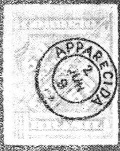
The oldest postmark so far is AMG-0035a (Coll. José L. Fevereiro): a double circle with the inscriptions AGUA SUJA and (BAGAGEM), found with internal dates between 1891 and 1894.
Google Maps

Anderer Name: Romaria (1938)

Der Distrikt von N. Sra. da Abbadia da Agua Suja wurde im Juli 1872 in der Freguesia von Carmo da Bagagem gegründet und lag am Ostufer des Flusses Bagagem, 580 km westlich der Provinzhauptstadt Ouro Preto entfernt. Danach wechselte die Ortschaft zweimal: im Oktober 1882 zum Município von Carmo da Bagagem und im Juni 1900 zu Monte Carmelo, bevor ihm im Dezember 1938 der Ortsname Romaria verpasst wurde. Seit Dezember 1962 ist Romaria ein eigenständiger Município.

Das örtliche Postamt entstand im Februar 1882, wie die Presse aus Rio berichtete:

Gazeta de Noticias/RJ, 19.02.1882

Der bisher älteste Poststempel ist AMG-0035a (Samml. José L. Fevereiro): ein Doppelkreis mit den Inschriften AGUA SUJA und (BAGAGEM), gefunden mit Daten in der Mitte zwischen 1891 und 1894.
Categories
Carimbologia A-B

Agua Quente, Bahia (ABA-0030)

Carta da Republica dos Estados Unidos do Brazil, 1892

Other names: Arraial do Morro do Fogo, Erico Cardoso (1985)

The history of the village begins in May 1843, with the foundation of the Freguesia of N. Sra. do Carmo do Morro do Fogo in the Município of Paramirim, which was located on the south bank of the Paramirim River, 560 km west of the provincial capital Salvador. Afterwards, the village received its autonomy three times: in September 1878 as Industrial Villa de Agua Quente, in May 1890 and in June 1962, as an independent Município. In between, Agua Quente became a district of Rio de Contas in June 1881 and a district of the Município of Paramirim in June 1909. Since July 1985, the municipality has had the name of its first mayor: Erico Cardoso (1918-1984).

The local post office was established in August 1881, according to the Rio press:

Jornal do Commercio/RJ, 15/08/1881

Another date of creation is probably 1883, according to the report of the provincial government council for the following year:

Relatorio do Conselho Interino do Governo, 1884

The first postmark is probably ABA-0030a (Coll. FM): a simple double circle with the above inscription AGUA QUENTE. The only specimen so far bears a date from 1890 in the centre.

Estado da Bahia, 1913

Andere Namen: Arraial do Morro do Fogo, Erico Cardoso (1985)

Die Ortsgeschichte fängt im Mai 1843 an, mit der Gründung der Freguesia von N. Sra. do Carmo do Morro do Fogo im Município von Paramirim, die am Südufer des Flusses Paramirim lag, 560 km westlich der Provinzhauptstadt Salvador entfernt. Danach erhielt der Ort seine Autonomie dreimal: im September 1878 als Industrial Villa de Agua Quente, im Mai 1890 und im Juni 1962, als eigenständiger Município. Zwischendurch wurde Agua Quente im Juni 1881 ein Distrikt von Rio de Contas und im Juni 1909 ein Distrikt vom Município von Paramirim. Seit Juli 1985 trägt die Gemeinde den Namen seines ersten Prefeito: Erico Cardoso (1918-1984).

Das örtliche Postamt wurde im August 1881 ins Leben gerufen, wie die Presse aus Rio mitteilt:

Jornal do Commercio/RJ, 15.08.1881

Ein weiterer Entstehungstermin wird vermutlich 1883 sein, laut Bericht des provinzialen Regierungsrats fürs folgende Jahr:

Relatorio do Conselho Interino do Governo, 1884

Der erste Poststempel ist vermutlich ABA-0030a (Samml. FM): ein schlichter Doppelkreis mit der obigen Inschrift AGUA QUENTE. Das bisher einzige Exemplar trägt ein Datum aus 1890 in der Mitte.

Categories
Carimbologia A-B

Agua Preta, Pernambuco (APE-0010)

Atlas do Imperio do Brasil, 1868

Text update of May 6, 2023

The freguesia of São José da Agonia da Água Preta was founded in December 1809, located on the west bank of the Una River at the Vila of Rio Formoso, 120 km southwest of the future provincial capital of Recife. It was promoted to Vila three times (March 1846, May 1869 and May 1879) and in between became a district of Barreiros (May 1853) and of Palmares (May 1873). Agua Preta has been a city since July 1895.

As can be seen from the regional press, a post office was opened there at least twice. The first post office opening must have taken place by December 1833, as a postal route to Agua Preta was active at the time:

Diario de Pernambuco, 06.12.1833

The second creation date for the post office is from September 1854:

Diario de Pernambuco, 07.10.1854

So far, no postmark has been seen from this locality in the imperial period. It is likely that this post office was closed when the Agua Preta station post office (APE-0011), located 10 km further north, was created in December 1864.
Carta Corographica da Provincia de Pernambuco, 1880

Textaktualisierung vom 6. Mai 2023

Die Freguesia von São José da Agonia da Água Preta wurde im Dezember 1809 gegründet und lag am Westufer des Flusses Una bei der Vila von Rio Formoso, 120 km südwestlich der späteren Provinzhauptstadt Recife entfernt. Der Ort stieg dreimal zur Vila auf (März 1846, Mai 1869 und Mai 1879) und wurde zwischendurch ein Distrikt von Barreiros (Mai 1853) bzw. von Palmares (Mai 1873). Seit Juli 1895 ist Agua Preta eine Stadt.

Wie aus der Regionalpresse zu entnehmen ist, wurde dort mindestens zweimal ein Postamt eröffnet. Die erste Posteröffnung muss bis Dezember 1833 stattgefunden haben, da damals eine Postroute nach Agua Preta aktiv war:

Diario de Pernambuco, 06.12.1833

Die zweite Posteröffnung ist vom September 1854:

Diario de Pernambuco, 07.10.1854

Bisher wurde kein Poststempel in der Kaiserzeit aus dieser Ortschaft gesehen. Es ist anzunehmen, dass dieses Postamt geschlossen wurde, als das 10 km weiter nördlich gelegene Bahnhofspostamt von Agua Preta (APE-0011) im Dezember 1864 in Betrieb genommen wurde.