Categories
Carimbologia Q-R

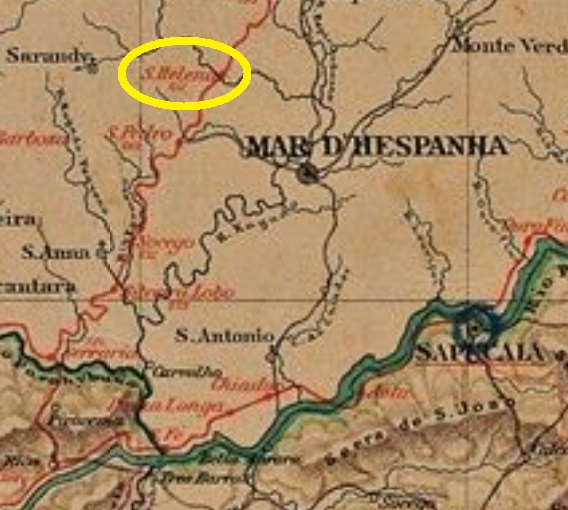
Rio do Peixe, Minas Gerais (RMG-3810)

Atlas do Imperio do Brasil, 1868

Print edition update of May 10, 2010

Other names: Dores do Rio do Peixe (see R. Koester: Carimbologia XVI), Lima Duarte (see R. Koester: Carimbologia XXVI)

There were at least four localities in the imperial Minas Gerais and other two in the São Paulo province whose names included RIO DO PEIXE (=Fish River, RdP): Espírito Santo do RdP and Penha do RdP in São Paulo; Nossa Senhora das Dores do RdP, Nossa Senhora das Necessidades do RdP (identical with RdP de Entre Rios, see RMG-3812), Santo Antonio do RdP and São Domingos de RdP, in Minas Gerais. We assume that the post office we are looking for must have the oldest creation date, in order to dispense with further specifications on its cancels. So it must refer to Nossa Senhora das Dores do Rio do Peixe, which was a district of the municipality of Barbacena since June 1859, and ascended to a villa with political autonomy, named Rio do Peixe, in October 1881. Three years later it changed again the name, to the actual Lima Duarte.

The searches for the creation date and for the cancels of this village have brought enigmatic results. We have found three different dates for this agency. Nova Monteiro (Administrações e Agências Postais do Brasil Império, 1798/1869, in Brasil Filatélico 18-21, 1934-5, Reprint SPP, 1994-9) writes June 30, 1864, which is confirmed by the press:

Correio Sergipense, July 20, 1864

On the other hand, Paula Sobrinho (História Postal de Minas Gerais, Belo Horizonte, 1997) states the office was created on September 27, 1866, which is confirmed by R. Koester (Carimbologia XVI). Finally, the Imperial Mail Register (Tabella das Agencias do Correio do Império) of 1885 lists this agency as created in 1872. If we consider that this small village (ca. 2 thousand inhabitants by 1880, according to the Imperial Mail Guide / Guia Postal do Império for the same year) was seriously involved in the Liberal Revolution of 1842, it is quite plausible that it had to close its post office more than once in the 19th century.

The local postal cancels are also challenging. A single cancel showing RIO DO PEIXE has to date appeared, which was presented by Wolfgang Maassen (Cancellations on Bull’s Eyes, in Brasilien, 140 Jahre Briefmarken, Lohmar, 1983, pp. 85 and 132) without naming the image source. Allegedly it was applied on a Bull’s Eye of 60 Réis, i.e. ca. 20 years before the opening of the earliest post office with this name. Besides, the provided image is not clear enough for verifying. For these reasons, it was not possible to present this cancel in the Carimbologia (Q-R) print edition:

W. Maassen, op.cit.

A later cancel featuring DORES DO R. DO P. and dated 1885 or 1886, was already shown by R. Koester under Dores do Rio do Peixe (Carimbologia XVI).

Villiers de l’Ile Adam, 1849

Buchtext-Aktualisierung vom 10. Mai 2010

Andere Namen: Dores do Rio do Peixe (siehe R. Koester: Carimbologia XVI), Lima Duarte (siehe R. Koester: Carimbologia XXVI)

Im brasilianischen Kaiserreich gab es mindestens vier Ortschaften in Minas Gerais und weitere zwei in der Provinz São Paulo, die RIO DO PEIXE (=Fisch-Fluss, RdP) in ihren Namen trugen: Espírito Santo do RdP und Penha do RdP in São Paulo; Nossa Senhora das Dores do RdP, Nossa Senhora das Necessidades do RdP (identisch mit RdP de Entre Rios, siehe RMG-3812), Santo Antonio do RdP und São Domingos de RdP, in Minas Gerais. Wir nehmen an, dass das hier gesuchte Postamt das älteste in dieser Liste sein soll, um weitere Bezeichnungen auf dem Stempel überflüssig zu machen. Damit wären wir auf Nossa Senhora das Dores do Rio do Peixe gekommen. Dieser war ab Juni 1859 ein Distrikt vom Município von Barbacena, der im Oktober 1881 zur Villa do Rio do Peixe mit Verwaltungsautonomie aufstieg. Drei Jahre später erhielt er den heutigen Namen Lima Duarte.

Die Suchen nach dem Postamt und nach den Stempeln erbrachten rätselhafte Ergebnisse. Allein fürs Entstehungsdatum wurden drei verschieden Angaben gefunden. Nova Monteiro (Administrações e Agências Postais do Brasil Império, 1798/1869, in Brasil Filatélico 18-21, 1934-5, Reprint SPP, 1994-9) schreibt den 30. Juni 1864, was durch die Presse bestätigt wird:

Correio Sergipense, 20. Juli 1864

Auf der anderer Seite sagt Paula Sobrinho (História Postal de Minas Gerais, Belo Horizonte, 1997), dass dieses Postamt am 27. September 1866 entstanden ist, was durch R. Koester (Carimbologia XVI) bestätigt wird. Schließlich listet das Verzeichnis der kaiserlichen Postämter (Tabella das Agencias do Correio do Império) von 1885 die Agentur mit Entstehungsjahr 1872. Wenn wir die turbulente Geschichte dieses kleinen Dorfes (ca. zweitausend Einwohner in 1880, laut Kaiserlichem Postführer / Guia Postal do Império für 1880) betrachten, das in der Liberalen Revolution von 1842 eine wichtige Rolle spielte, ist es daher fast verständlich, dass das örtliche Postamt im 19. Jahrhundert mehrmals geschlossen werden musste.

Die überlieferten Abstempelungen bringen eine weitere Herausforderung mit sich. Ein einziger Stempel mit der schlichten Angaben RIO DO PEIXE ist bisher aufgetaucht. Dieser wurde durch Wolfgang Maassen (Stempel auf Ochsenaugen, in Brasilien, 140 Jahre Briefmarken, Lohmar, 1983, S.. 85 und 132) ohne Quellenangabe fürs Bild vorgestellt. Angeblich wurde der Stempel auf ein 60 Réis-Ochsenauge aufgetragen. Dies wäre aber ca. 20 Jahre vor der Postamteröffnung geschehen. Außerdem ist die gelieferte Abbildung nicht klar genug, um bestätigt zu werden. Aus diesen Gründen war es nicht möglich, diesen Stempel in die Carimbologia (Q-R)- Printausgabe zu übernehmen:

W. Maassen, op.cit.

Eine spätere Abstempelung mit DORES DO R. DO P., datiert 1885 oder 1886, wurde bereits von R. Koester unter Dores do Rio do Peixe (Carimbologia XVI) gezeigt.

Categories
Carimbologia Q-R

Rio das Pedras (train station/Bahnhof), São Paulo (RSP-1115)

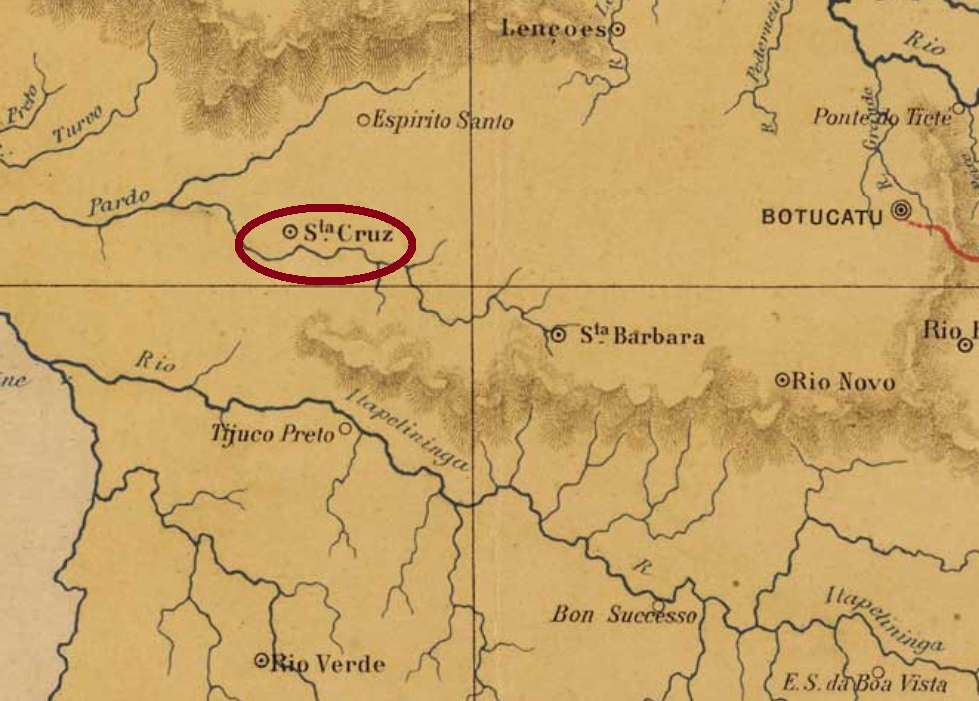
Mappa da Provincia de São Paulo, 1886

Tijuco Preto is the real name to this Rio das Pedras, a affluent to the Piracicaba River, located 160 km northwest of São Paulo. One could think the Pedras would mean Stones, as it often occurs. But the Brazilian Institute of Geography and Statistics (IBGE) tells a beautiful story about a traveller’s hostel in the ancient village, whose owner, called Pedro, had his daughters known as the PedrasSe non è vero, è ben trovato.

Pedro’s daughters gave this way the name of the Rio das Pedras train station of the Companhia Ytuana railway, inaugurated in October 1876 in the Piracicaba branch. The settlement around it grew fast, and in April 1889 the district of Bom Jesus do Rio das Pedras was founded, which was elevated to a Villa with own municipality already in July 1894. Now it is a town with ca. 35 thousand inhabitants.

The railway control passed to the Cia. União Sorocabana e Ituana (1892-1907), followed by the Sorocabana Railway (1907-1919), the Estrada de Ferro Sorocabana (1919-1971) and by the FEPASA (1971-1984). Now the rails are removed, and the station house is demolished (estacoesferroviarias.com.br). 

The station post office was created in April 1881, as reported by the press in Rio de Janeiro:

Jornal do Commercio, RJ, April 30, 1881

Only one imperial cancel is known, with dates between 1883 and 1891, which was already presented by Paulo Ayres (Catálogo de Carimbos – Brasil Imperio, São Paulo, 1937, p. 123):

Paulo Ayres. op.cit.
Companhia Paulista

Dieser Rio das Pedras heißt eigentlich Tijuco Preto und ist ein kleiner Zufluss des Rio Piracicaba, 160 km nordwestlich von São Paulo gelegen. Man könnte annehmen, die Pedras wären die Steine im Flussbett vom Tijuco Preto. Aber die brasilianische Behörde für Geografie und Statistik (IBGE) erzählt uns die nette Geschichte, nach der ein gewisser Pedro, der dort eine Herberge für Reisende führte, einige Töchter hatte, die als Pedras bekannt wurden… Se non è vero, è ben trovato.

Nach Pedros Töchtern war auch die Bahnstation Rio das Pedras genannt, die im Oktober 1876 von der Companhia Ytuana in der Piracicaba-Abzweigung eingeweiht wurde. Die folgende Besiedlung wuchs schnell, und im April 1889 wurde der Distrikt von Bom Jesus do Rio das Pedras gegründet. Fünf Jahre später, im Juli 1894 war Rio das Pedras eine Villa im eigenen Município, und heute hat es ca. 35 Tausend Einwohner.  

Die Kontrolle der Bahnlinie ging danach zu União Sorocabana e Ytuana (1892-1907) über, dann zur Sorocabana Railway (1907-1919), zur Estrada de Ferro Sorocabana (1919-1971) und schließlich zur FEPASA (1971-1984). Nun sind die Schienen ausgerissen, und das Bahnhaus gibt es auch nicht mehr. (estacoesferroviarias.com.br

Das Bahnhofspostamt entstand im April 1881, wie die Presse aus Rio de Janeiro berichtete:

Jornal do Commercio (RJ), 30. April 1881

Nur ein Stempel aus der Kaiserzeit ist bekannt. Er hat Daten zwischen 1883 und 1891 und wurde bereits durch Paulo Ayres (Catálogo de Carimbos – Brasil Imperio, São Paulo, 1937, S. 123) vorgestellt:

Paulo Ayres, op. cit.

Categories
Carimbologia Q-R

Rio de Pedras, Minas Gerais (RMG-2125)

Atlas do Imperio do Brasil, 1868

Rio de Pedras (=Stone River) was since 1846 a freguesia in central Minas Gerais, situated ca. 50 km northwest of the province capital Ouro Preto. The brook called Rio das Pedras, an affluent to the Rio das Velhas, is nowadays a water reservoir. In September 1870 the locality was elevated to a district, and in September 1923 it passed to the newly created municipality of Itabira do Campo, which is now called Itabirito. In the sixties of the 20th century Rio das Pedras was renamed Acuruí, which means stone river in the tupi-guarani language.   

According to Paula Sobrinho (História Postal de Minas Gerais, Belo Horizonte, 1997), the local post office was created in August 1883. One imperial cancel is known: RMG-2125a (Coll. José A. Junges) has a double circle with the inscription RIO DE PEDRAS above and a X-shaped ornament below, formed by four diamonds. Dates in the centre, all known exemplars were used between ca. 1886 and 1890.

Villiers de l’Ile Adam, Carta (…) da provincia de Minas Geraes, 1849

Rio de Pedras (= Fluss der Steine) war seit 1846 eine Freguesia aus dem Bezirk von Ouro Preto in Minas Gerais, etwa 50 km nordwestlich von der Provinzhauptstadt gelegen. Der kleine Fluss, der dem Ort seinen Namen gab, ist ein Zufluss des Rio das Velhas, heute ist er ein Stausee. Im September 1870 stieg die Ortschaft zum Distrikt, und im September 1923 wechselte sie zum neu gegründeten Município von Itabira do Campo, der heute Itabirito heißt. Und der alte Rio das Pedras nennt sich seit den 60er Jahren Acuruí, was Fluss der Steine in der tupi-guarani-Indianersprache bedeutet.

Laut Paula Sobrinho (História Postal de Minas Gerais, Belo Horizonte, 1997) entstand das örtliche Postamt im August 1883. Ein Stempel aus der Kaiserzeit ist überliefert: RMG-2125a (Samml. José A. Junges) hat einen Doppelkreis mit der Inschrift RIO DE PEDRAS oben und ein X-förmigen Ornament unten, das aus vier kleinen Rauten besteht. Datum in der Mitte; alle bekannten Exemplare wurden zwischen ca. 1886 und 1890 abgestempelt.

Categories
Carimbologia Q-R

Rio Pardo da Leopoldina, Minas Gerais (RMG-2155)

Atlas do Imperio do Brasil, 1868

This Rio Pardo in southern Minas Gerais is a quite short river of less than 50 km extension which flows into the Rio Pomba and gave the name to the district of Bom Jesus do Rio Pardo in April 1839. Fifteen years later, it passed to the new municipality of São Sebastião do Feijão Cru (= St. Sebastian of the Raw Bean, which later was renamed to Leopoldina, for obvious reasons). Between 1863 and 1869 it belonged to Mar d’Hespanha, before coming back to Leopoldina. Since December 1962 it has an own municipality, called Argirita, which according to the town website means silver stone in both latin and tupi-guarani.

The post office was created in July 1872, as Paula Sobrinho (História Postal de Minas Gerais, Belo Horizonte, 1997) tells us. Two early cancels are known. RMG-2155a (Coll. José A. Junges) has a double circle with the inscription RIO PARDO DA LEOPOLDINA above and a cross formed by four diamonds below, with date (between 1885 and 1890) in the centre. RMG-2155b (image from the internet) could be already republican and also shows a double circle. Now the inscriptions are RIO-P. DA LEOPOLDINA above and (MINAS) below, with the date (a sole known copy of 1897) in the centre.

Carta… da Provincia de Minas Geraes, Villiers de l’Ile Adam, 1849

Dieser Rio Pardo im südlichen Minas Gerais ist ein ziemlich kleiner Fluss, weniger als 50 km lang, der in den Rio Pomba fließt und im April 1839 seinen Namen dem Distrikt von Bom Jesus do Rio Pardo gegeben hat. Fünfzehn Jahre später ging die Ortschaftsverwaltung dem Município von São Sebastião do Feijão Cru (= Skt. Sebastian der Rohen Bohne, später aus verständlichen Gründen zu Leopoldina umbenannt) über. Zwischen 1863 und 1869 gehörte Rio Pardo zum Bezirk Mar d’Hespanha, dann kam die Gemeinde zu Leopoldina zurück. Seit Dezember 1962 ist es der Município von Argirita; das Wort soll nach offiziellen Angaben (Rathaus-Website) Silbernen Stein sowohl auf Latein als auch in der tupi-guarani-Indianersprache bedeuten.

Das örtliche Postamt stammt aus dem Juli 1872, wie uns Paula Sobrinho (História Postal de Minas Gerais, Belo Horizonte, 1997) berichtet. Zwei frühe Abstempelungen sind überliefert. RMG-2155a (Samml. José A. Junges) hat einen Doppelkreis mit der Inschrift RIO PARDO DA LEOPOLDINA oben und ein kreuzförmiges Ornament unten, das aus vier Rauten besteht, mit dem Datum (zwischen 1885 und 1890) in der Mitte. RMG-2155b (Abb. aus dem Internet) könnte bereits republikanisch sein und zeigt auch einen Doppelkreis. Nun liest man oben RIO-P. DA LEOPOLDINA und unten (MINAS), das Datum (ein einziges Exemplar aus 1897 bekannt) in der Mitte.

Categories
Carimbologia Q-R

Rio Pardo, Rio Grande do Sul (RRS-0290)

Atlas do Imperio do Brasil, 1868

The Rio Pardo in the province of São Pedro do Rio Grande in southern Brazil is an affluent to the Jacuí River, which flows into the Lagoa dos Patos through the Lake Guaíba. The freguesia of Nossa Senhora do Rosário do Rio Pardo was founded in May 1769 on the water mouth of this Pardo River. The region is now located in central Rio Grande do Sul, but at that time it was the border between Portuguese and Spanish possessions during decades of frontier wars. Thus, the new settlement played an important role not only in defending Portuguese land but also as a bridgehead for the following territorial expansion. Rio Pardo was elevated to a Villa in April 1809 and to a town in March 1846, now it is a charming tourist destination under 200 km west from the state capital Porto Alegre.

There is also here controversial data about the creation of the post office. The Catálogo Enciclopédico de Selos e História Postal do Brasil (RHM, São Paulo, 1999) states exactly October 12, 1831, whereas the Imperial Mail Register (Tabella das Agencias do Correio do Império) of 1885 lists the agency from 1838 on. But as early as September 24, 1817, a royal document (Carta Régia) signed by D. João VI ordered a regular mail service between the provinces of S. Paulo and S. Pedro, beginning in the capital São Paulo and passing through Santos, Rio Grande and Porto Alegre until the arrival in Rio Pardo. This mail line would hardly be possible without establishing post offices on the main itinerary stops. The Carta Régia in original Portuguese can be read here:

https://www2.camara.leg.br/legin/fed/carreg_sn/anterioresa1824/cartaregia-39420-24-setembro-1817-569588-publicacaooriginal-92817-pe.html

A Correio service is also referred to in this letter of September 1825 from Caxoeira (now Cachoeira do Sul) to Rio Pardo:

FM Archives

The first four known cancels (RRS-0290a to RRS-0290d) are pre-philatelic:

RRS-0290a (RHM), P-RS-19, 1832
RRS-0290b (RHM), P-RS-21, 1833-1834
RRS-0290c (RHM), P-RS-22, 1834-1835
RRS-0290d , Paulo Ayres #1549, 1842-1852

There must be at least one missing cancel from the following time, for the next cancellation, RRS-0290e (Coll. José A. Junges), in black and blue, dates between 1880 and 1886: a double circle with the inscriptions RIO PARDO above and (3) below, and date in the centre. The next cancel originates from the railway between Porto Alegre and Uruguaiana: RRS-0290f (Coll. José A. Junges) presents in green and violet a double ellipse with the inscriptions (…) DE PORTO ALEGRE above, **A URUGUAYANA** below, and RIO PARDO in the centre. Dates from 1885 on. Finally, RRS-0290g (FM) could be already republican: a double circle with the inscriptions RIO PARDO above and (S.PEDRO DO SUL) below, with the date inside. A sole copy was found, dated ca. 1893.

Villiers de L’Ile-Adam, 1847

Der Fluss Rio Pardo in der südlichen Provinz von São Pedro do Rio Grande ist ein Zufluss des Jacuí, der in die Lagoa dos Patos durch den Guaíbasee mündet. Die Freguesia de Nossa Senhora do Rosário do Rio Pardo wurde im Mai 1769 an der Mündung von diesem Rio Pardo gegründet. Die Gegend liegt ziemlich zentral im heutigen Staat Rio Grande do Sul, aber damals war sie die Grenze zwischen portugiesischen und spanischen Kolonien während Jahrzehnten des Kriegs. Darum spielte die Neusiedlung eine wichtige Rolle sowohl bei der Verteidigung der Portugiesen als auch als Brückenkopf für die folgende Landgewinnung. Rio Pardo stieg zur Villa im April 1809 und zur Stadt im März 1846 auf; nun ist es ein touristisches Städtchen unter 200 km westlich der Landeshauptstadt Porto Alegre entfernt.

Über das Entstehungsdatum des Postamtes liegen widersprüchliche Angaben vor. Der Catálogo Enciclopédico de Selos e História Postal do Brasil (RHM, São Paulo, 1999) schreibt genau den 12. Oktober 1831, während das Verzeichnis der kaiserlichen Postämter (Tabella das Agencias do Correio do Império) von 1885 gibt das Jahr 1838 an. Gleichwohl wurde bereits am 24. September 1817 ein königliches Dokument (Carta Régia) durch D. João VI unterschrieben, das die Einführung einer regulären Postlinie zwischen den Provinzen von S. Paulo and S. Pedro anordnete, die in der Provinzhauptstadt São Paulo startete, durch Santos, Rio Grande und Porto Alegre passierte und deren Ende Rio Pardo war. Diese Postlinie wäre kaum oder überhaupt nicht durchführbar ohne die Gründung von Postämtern an den wichtigsten Haltestellen. Die Carta Régia kann man im portugiesischen Original hier lesen:

https://www2.camara.leg.br/legin/fed/carreg_sn/anterioresa1824/cartaregia-39420-24-setembro-1817-569588-publicacaooriginal-92817-pe.html

Ein Correio-Dienst wird ebenfalls in diesem Brief vom September 1825 aus Caxoeira (heute: Cachoeira do Sul) nach Rio Pardo erwähnt:

Archiv FM

Die ersten vier Abstempelungen aus Rio Pardo (RRS-0290a bis RRS-0290d) stammen aus der Vorphila-Zeit:

RRS-0290a (RHM), P-RS-19, 1832
RRS-0290b (RHM), P-RS-21, 1833-1834
RRS-0290c (RHM), P-RS-22, 1834-1835
RRS-0290d, Paulo Ayres Nr. 1549, 1842-1852

Aus der folgenden Zeit muss es mindestens noch einen fehlenden Stempel geben, da die nächste Abstempelung, RRS-0290e (Samml. José A. Junges), Daten zwischen 1880 und 1886 vorweist: ein Doppelkreis mit der Inschrift RIO PARDO oben und eine (3) unten, dazu das Datum in der Mitte. Es folgt ein Stempel aus der Bahnlinie von Porto Alegre nach Uruguaiana: RRS-0290f (Samml. José A. Junges) kommt in grün und violett vor und zeigt eine doppelte Ellipse mit den Inschriften (…) DE PORTO ALEGRE oben, **A URUGUAYANA** unten, und RIO PARDO in der Mitte. Daten ab ca. 1885. Schließlich, RRS-0290g (FM) könnte bereits republikanisch sein: ein Doppelkreis mit den Inschriften RIO PARDO oben und (S.PEDRO DO SUL) unten, dazu das Datum in der Mitte. Nur ein Exemplar aus ca. 1893 gefunden.

Categories
Carimbologia Q-R

Rio Pardo, Minas Gerais (RMG-2150), Rio Pardo do Norte, Minas Gerais (RMG-2151)

Minas Geraes, 1850

Other name: Rio Pardo de Minas

The Rio Pardo in North Minas Gerais springs up between the mountains of the Serra do Espinhaço, whose northern end is called Serra Nova, and flows towards east, crossing the border to Bahia until it reaches the Atlantic Ocean in Canasvieiras. The village of the same name was created as a freguesia in 1740, ascended to a villa in October 1831 and was declared a town in July 1872. Apparently the village name has changed, some time in the late empire, to Rio Pardo do Norte, but this toponym has never been popular among the locals. Since December 1943 it is the municipality of Rio Pardo de Minas.

The Catálogo Enciclopédico de Selos e História Postal do Brasil (RHM, São Paulo, 1999) writes the creation year of the post office in 1832, whereas Paula Sobrinho (História Postal de Minas Gerais, Belo Horizonte, 1997) presents the more exact date of October 28, 1833. This last year is confirmed by the Imperial Mail Register (Tabella das Agencias do Correio do Império) of 1885.

The first cancel is a pre-philatelic one, of which Paulo Ayres (1937) presented a faulty image under #1166. Instead, RMG-2150a is easily recognizable through the peculiar form of the letter A, whose flexed central stroke makes it sometimes resemble a heart. It was used in black and red from operation start until after 1844:

RMG-2150a, HBF R11

There follows a quite rare cancel, of which just an almost illegible copy is known. RMG-2150b (Coll. José A. Junges) was found in green on a fragment of ca. 1860 and might be a “French type”, for it abbreviates SEP for a month that in Portuguese is spelled setembro. If it has a double circle, the inner one is barely visible, such as the inscription RIO PARDO above and star between parentheses below. The next cancel, RMG-2150d (Coll. José A. Junges), is quite similar, in size and form, to RMG-2150a, but now the inner stroke of letter A is horizontal, there is a dot between RIO and PARDO, and the name is surrounded by a border which appears frequently faded. Found on D. Pedro emissions of 1866. Finally, RMG-2150e (Coll. José A. Junges) appeared on stamps dated 1883-1887. It has a double circle with the inscription RIO-PARDO above, a diamond ornament below, which consists of four small diamonds, and the date inside.

An additional cancel for Rio Pardo do Norte appeared between 1886 and 1891: RMG-2151a (Coll. José A Junges) shows a double circle with the inscription RIO PARDO DO NORTE above, and the date inside.

Atlas do Império do Brasil, 1868

Anderer Name: Rio Pardo de Minas

Der Fluss Rio Pardo im Norden von Minas Gerais entspringt zwischen den Bergen der Serra do Espinhaço, an deren Nordspitze der Name Serra Nova geläufig ist. Dann fließt er Richtung Osten, kreuzt die Grenze zu Bahia und erreicht den Atlantik bei Canasvieiras. Die nach ihm benannte Ortschaft wurde in 1740 als eine Freguesia gegründet, stieg im Oktober 1831 zur Villa auf und erhielt das Stadtrecht im Juli 1872. Gegen Ende des Kaiserreichs wurde der Ortsname auf Rio Pardo do Norte umbenannt. Diese Bezeichnung wurde offenbar nicht gut von den Einheimischen aufgenommen. Seit Dezember 1943 heißt der Munizip Rio Pardo de Minas.

Der Catálogo Enciclopédico de Selos e História Postal do Brasil (RHM, São Paulo, 1999) schreibt 1832 als Entstehungsjahr fürs Postamt, während Paula Sobrinho (História Postal de Minas Gerais, Belo Horizonte, 1997) das genauere Datum 28 Oktober 1833 angibt. Letztere Jahresangabe wird vom Verzeichnis der kaiserlichen Postämter (Tabella das Agencias do Correio do Império) von 1885 bestätigt.

Die erste Entwertung stammt aus der  Vorphila-Zeit. Paulo Ayres (1937) zeigte zwar unter Nr. 1166 eine fehlerhafte Abbildung davon, dennoch ist RMG-2150a durch die charakteristische Form der Buchstabe A leicht zu erkennen. Der waagerechte Querstrich vom A ist nach unten geknickt, so dass manchmal die Mitte fast herzförmig aussieht. Der Stempel wurde  in schwarz und rot vom Betriebsbeginn bis nach 1844 benutzt:

RMG-2150a, HBF R11

Es folgte ein ziemlich seltener Stempel, wovon nur ein schwer leserliches Exemplar bekannt ist. RMG-2150b (Samml. José A. Junges) wurde in grün auf einem Fragment con ca. 1860 gefunden und konnte ein “französischer Typ” sein, denn hier wird SEP als Abkürzung für einen Monat benutzt, der auf Portugiesisch setembro geschrieben wird. Falls ein Doppelkreis vorhanden, ist der Innenkreis verschwommen, von der Inschrift RIO PARDO oben und dem Stern zwischen Klammern unten ist ebenfalls wenig zu sehen. Die nächste Entwertung, RMG-2150d (Samml. José A. Junges), ist in Größe und Form dem RMG-2150a ziemlich ähnlich, nun aber ist der Querstrich im A normal waagerecht, es gibt einen Punkt zwischen RIO und PARDO, und die Ortsbezeichnung ist mit einem oft schlecht sichtbaren Rand versehen. Gefunden auf D. Pedro-Ausgaben von 1866. Schließlich erschien RMG-2150e (Samml. José A. Junges) auf Marken mit Daten 1883 bis1887. er hat einen Doppelkreis mit der Inschrift RIO-PARDO oben, ein Ornament in Rautenform unten, das aus vier kleinen Rauten besteht, und das Datum in der Mitte.

Ein zusätzlicher Stempel für Rio Pardo do Norte erschien zwischen 1886 und 1891: RMG-2151a (Samml. José A. Junges) zeigt einen Doppelkreis mit der Inschrift RIO PARDO DO NORTE oben, mit Datum im Innenkreis.

Categories
Carimbologia Q-R

Rio Pardo, Espírito Santo (RES-0140)

Atlas do Imperio do Brasil, 1868

The freguesia of São Pedro de Alcantara do Rio Pardo was founded in July 1859 in the municipality of Cachoeiro do Itapemirim, ca. 150 km west of the capital Vitória. The Rio Pardo (= Gray River) which has given the name to the locality emerges from the hills of eastern Minas Gerais and flows towards south. In the early Brazilian republic the names Pedro and Alcantara were removed, and the new vila of 1890 was called just Rio Pardo. Since December 1943 it is the little town of Iuna, which means Black River in tupi-guarani.

According to the local press, the post office was created by September 1869:

O Estandarte, September 5, 1869

This agency, however, was closed in 1876 and reopened only in April 1882, according to Paulo Novaes (agenciaspostais.com.br). Unfortunately, no cancel from the first period has been found to date. RES-0140a (Coll. José A. Junges) is a later example and could be already republican: a double circle with RIO PARDO above and (ESP.SANTO) below, with the date in the centre. Found just once, dated 1892.

Google Maps

Die Freguesia de São Pedro de Alcantara do Rio Pardo wurde im Juli 1859 im Município von Cachoeiro do Itapemirim gegründet und lag etwa 150 km westlich von der Provinzhauptstadt Vitória. Der Rio Pardo (=grauer Fluss), der dem Ort seinen Namen gab, entspringt dem Gebirge im östlichen Minas Gerais und fließt gen Süden. In der frühen republikanischen Zeit verschwanden die Namen Pedro und Alcantara, und als die Ortschaft in 1890 zur Villa aufstieg, hieß sie lediglich Rio Pardo. Seit 1943 ist es das Städtchen Iuna, was Schwarzer Fluss in der tupi-guarani Indianersprache heißt.

Der Regionalpresse zufolge entstand das Postamt vor Ort bis September 1869:

O Estandarte, 5. September 1869

Die Agentur wurde gleichwohl in 1876 geschlossen und startete wieder erst im April 1882, laut Paulo Novaes (agenciaspostais.com.br). Leider ist bisher kein Stempel aus der ersten Betriebszeit überliefert. RES-0140a (Samml. José A. Junges) ist ein späteres Beispiel und könnte bereits republikanisch sein: hier sehen wir einen Doppelkreis mit RIO PARDO oben und (ESP.SANTO) unten, dazu das Datum in der Mitte. Nur ein Exemplar aus dem Jahr 1892 gefunden.

Categories
Carimbologia Q-R

Rio das Ostras, Rio de Janeiro (RRJ-0845)

Atlas do Imperio do Brasil, 1868

Rio das Ostras (Oysters River) was a small port at the north end of a charming bay, about 60 km away from Cabo Frio, which since 1846 belonged to the Villa of Barra de São João Baptista. It was made a Curato in 1892 and became a district of the newly created municipality of Casimiro de Abreu in March 1970, achieving the political emancipation only in April 1992.

According to Nova Monteiro, the post office was created in September 1856. The first cancel, RRJ-0845a, already presented by Paulo Ayres in 1937 under #1438, was found in black, brown and blue on stamps dated until 1883:

RRJ-0845a, P. Ayres #1438

It was followed by two cancels, very similar to each other: RRJ-0845b and RRJ-0845c (Coll. José A. Junges) have both a double circle with the inscription RIO DE OSTRAS above and the date in the centre. The former is found on stamps dated ca. 1881 until 1887, while the latter has a very tiny year indication, the sole exemplar of which was used in 1883. The last imperial cancel, RRJ-0845d (Coll. José A. Junges), is similar to his predecessors, but now the inscription letters above are bigger and there is an ornament below, formed by three diamonds in line. Found dates from 1887 on.

Google Maps

Rio das Ostras (Fluss der Austern) war ein kleiner Hafen an der Nordspitze einer lieblichen Bucht etwa 60 km nördlich von Cabo Frio gelegen, der seit 1846 der Villa da Barra de São João Baptista angehörte. In 1892 als ein Curato ernannt, wurde Rio das Ostras in März 1970 ein Distrikt des neu gegründeten Município von Casimiro de Abreu. Die politische Autonomie kam erst im April 1992, als Rio das Ostras selber ein Município wurde.

Laut Nova Monteiro stammt das Postamt aus dem September 1856. Der erste Stempel, RRJ-0845a, wurde bereits durch Paulo Ayres in 1937 unter Nr. 1438 vorgestellt. Er kommt in schwarz, braun und blau auf Marken bis 1883 vor:

RRJ-0845a, Paulo Ayres Nr. 1438

Ihm folgten zwei sehr ähnliche Stempel: RRJ-0845b und RRJ-0845c (beide Samml. José A. Junges) unterscheiden sich nur durch die wesentlich kleinere Jahresangabe beim Letzten. Sonst haben beide einen Doppelkreis mit der Inschrift RIO DE OSTRAS oben und dem Datum in der Mitte. RRJ-0845b wurde auf Marken mit Daten zwischen ca. 1881 und 1887 aufgestempelt, während vom RRJ-0845c kennen wir ein einziges Exemplar aus 1883. Der letzte Stempel der Kaiserzeit ist ähnlich wie seine Vorgänger, hat RRJ-0845d (Samml. José A. Junges) aber größere Buchstaben im Ortsnamen und ein neues Ornament unten, das aus einer Reihe von drei kleinen Rauten besteht. Gefunden mit Daten ab 1887.

Categories
Carimbologia Q-R

Rio Novo, São Paulo (RSP-1125)

Mappa da Provincia de São Paulo, 1886

Print edition update of May 2, 2020

See also: Campos Novos do Paranapanema (R. Koester: Carimbologia VIII)

There were two localities – and two post offices – called Rio Novo in the imperial province of São Paulo. The print edition of Carimbologia (Q-R) describes unfortunately the more recent one, the former São José do Rio Novo, which is now the municipality of Campos Novos Paulista. It changed the name in 1880 into Campos Novos do Paranapanema, whose post office was already presented by R. Koester in Carimbologia VIII. Further information under São José do Rio Novo (scheduled for 2021).

The older Rio Novo, about which should be spoken here, was the freguesia of Nossa Senhora das Dores do Rio Novo, created in April 1870 in the municipality of Botucatu, ca. 270 km west of the province capital. It ascended to a villa in July 1875 and to a town in May 1891, one month before it was renamed into the actual toponym Avaré. The map below shows both Rio Novo locations: The older one in red, the newer in yellow.

The Imperial Mail Register (Tabella das Agencias do Correio do Império) of 1885 lists the post office with creation date in 1875, which rather would be the year of installing this agency. An exact and earlier creation date is given by the Almanak Laemmert of 1885 among the dates for the municipality of Rio Novo:

Almanak Laemmert, 1885

Only one manuscript cancellation was found, and its attribution is uncertain. RSP-1125a (Coll. José A. Junges) was written in black on a D. Pedro emission of 1876 and could also be either from Minas Gerais (RMG-2145) or a variant of a manuscript example from Rio Negro in Paraná (RPR-0175b).

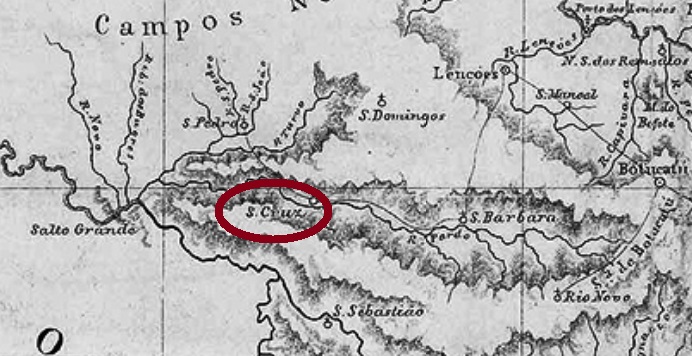
Mappa da Provincia de S. Paulo, C. Rath, 1886

Buchausgabe-Aktualisierung vom 2. Mai 2020

Siehe auch: Campos Novos do Paranapanema (R. Koester, Carimbologia VIII)

Es gab zwei Ortschaften – und daher auch zwei Postämter – in der Provinz São Paulo, die Rio Novo hießen. Leider sind in der Printausgabe der Carimbologia (Q-R) die Daten der jüngeren Alternative zu lesen, die ehemalige São José do Rio Novo, was heute den Município von Campos Novos do Paranapanema darstellt. Hierüber wurde bereits in R. Koesters Carimbologia VIII berichtet, eine Wiederaufnahme (unter São José do Rio Novo) ist für 2021 geplant.

Vom älteren Rio Novo wird also hier die Rede sein. Die alte Freguesia von Nossa Senhora das Dores do Rio Novo wurde im April 1870 im Município von Botucatu gegründet, ca. 270 km westlich von der Provinzhauptstadt São Paulo entfernt. Sie stieg zu einer Villa im Juli 1875 auf und erhielt das Stadtrecht im Mai 1891, einem Monat bevor sie den heutigen Namen Avaré erhielt. Die obere Karte zeigt beide Rio Novo-Ortschaften: die ältere in rot, die jüngere in gelb.

Das Verzeichnis der kaiserlichen Postämter (Tabella das Agencias do Correio do Império) von 1885 listet dieses Postamt mit Entstehungsjahr 1875 auf, aber dieses Jahr dürfte das von der Inbetriebnahme der Agentur sein. Ein exakteres und etwas früheres Entstehungsdatum wird bei der Beschreibung des Bezirks Rio Novo im Almanak Laemmert vom 1885 geliefert:

Almanak Laemmert, 1885

Nur eine handschriftliche Entwertung wurde gefunden, die dazu noch unsicher ist. RSP-1125a (Samml. José A. Junges) wurde in schwarz auf eine D. Pedro-Ausgabe vom 1876 geschrieben und könnte eventuell aus Minas Gerais (RMG-2145) stammen, oder auch eine Variante der handschriftliche Entwertung RPR-0175b aus Rio Negro/PR sein.

Categories
Carimbologia Q-R

Rio Novo (train station/Bahnhof), Minas Gerais (RMG-3583)

Estrada de Ferro Central do Brasil, 1890

Print edition update of July 5, 2025

See also Mariano Procopio (MMG-1570) and Fortaleza de Sant’Anna (FMG-1197)

This Rio Novo post office in imperial Minas Gerais was a station on the Estrada de Ferro D. Pedro II railway line, known as the Linha do Centro (Central Line), located just a few kilometres north of Juiz de Fora. Ralph Giesbrecht (estacoesferroviarias.com.br) writes that the station was inaugurated in November 1876. However, this date probably needs to be corrected to February 1877, as can be seen from the press in Rio de Janeiro.

Gazeta de Noticias, Rio de Janeiro, January 29, 1877

The D. Pedro II Railway Company had to change its name in November 1889 and was henceforth called Estrada de Ferro Central do Brasil. From 1975 until the end of operations in 1996, the company became Rede Ferroviária Federal S.A. In 2017, the station building still housed a cultural centre, but today it appears abandoned.

Around. 1940 (Image by Monachesi/Ferreira, on estacoesferroviarias.com.br)
In April 2024 (Google Street View)

When the railway company Cia. União Mineira opened another station called Rio Novo in the municipality of the same name (RMG-2145) in 1883, the former Rio Novo station post office in Mariano Procopio was renamed. The station itself was not renamed until around 1915.

Paula Sobrinho cites July 1881 as the year the station post office was created in História Postal de Minas Gerais (Belo Horizonte, 1977). However, as it was already listed in the imperial postal guide (Guia Postal do Império) from 1880 under number 391, this agency must have been established between 1877 and 1879. Since both the railway and postal administrations were operated from Rio de Janeiro until Juiz de Fora at that time, it was not assigned to the province of Minas Gerais here.

Guia Postal do Imperio, 1880

In the print edition of Carimbologia Q-R (2019), the only postmark is a cancellation from the railway carriage, RMG-3583a (José A. Junges collection): It has a double circle with the inscription ‘= (…) RIO NOVO =’ at the top and ‘C.’ AMB(…) at the bottom. So far, only one example from 1890 has been found. It has now been discovered that this stamp most likely originates from the Rio Novo station of the União Mineira.

Fortunately, an earlier stamp has appeared on the RHM website (oselo.com.br), which also comes in purple and is now designated RMG-3583a.

RMG-3583a (RHM) 1877ff

For postmarks with Mariano Procopio, see MMG-1570.

Estações (…) de São Paulo, Rio de Janeiro e Minas Geraes, 1880

Buchausgabe-Aktualisierung vom 5. Juli 2025

Siehe auch Mariano Procopio (MMG-1570) und Fortaleza de Sant’Anna (FMG-1197)

Dieses Postamt Rio Novo im kaiserlichen Minas Gerais war ein Bahnhof der Estrada de Ferro D. Pedro II in der sogenannten Linha do Centro (Hauptlinie) und lag nur wenige Kilometer nördlich von Juiz de Fora. Ralph Giesbrecht (estacoesferroviarias.com.br) schreibt, dass der Bahnhof im November 1876 eingeweiht wurde. Wahrscheinlich muss dieses Datum jedoch auf Februar 1877 korrigiert werden, wie aus der Presse in Rio de Janeiro zu entnehmen ist.

Gazeta de Noticias, RJ, 29. Januar 1877

Die D. Pedro II Eisenbahngesellschaft musste im November 1889 ihren Namen ändern und hieß fortan Estrada de Ferro Central do Brasil. Von 1975 bis zum Betriebsende 1996 ging die Gesellschaft in die Rede Ferroviária Federal S.A. über. Im Jahr 2017 beherbergte das Bahnhofsgebäude noch ein Kulturzentrum, aber heute scheint es verlassen zu sein.

Ca. 1940 (Abb. Monachesi/Ferreira, auf estacoesferroviarias.com.br)
Im April 2024 (Google Street View)

Da die Bahngesellschaft Cia. União Mineira 1883 einen anderen Bahnhof Rio Novo im gleichnamigen Município (RMG-2145) eröffnete, wurde das frühere Bahnhofspostamt Rio Novo in Mariano Procopio umbenannt. Der Bahnhof selbst wurde erst um 1915 umbenannt.

Paula Sobrinho nennt in História Postal de Minas Gerais (Belo Horizonte, 1977) den Juli 1881 als Entstehungsjahr des Bahnhofspostamts. Da dieses jedoch bereits im kaiserlichen Postführer (Guia Postal do Império) aus dem Jahr 1880 unter der Nummer 391 aufgeführt wurde, muss diese Agentur zwischen 1877 und 1879 errichtet worden sein. Da sowohl die Bahn- als auch die Postverwaltung bis Juiz de Fora damals von Rio de Janeiro aus betrieben wurde, wurde sie hier nicht der Provinz Minas Gerais zugeordnet.

Guia Postal do Imperio, 1880

In der Printausgabe der Carimbologia Q-R (2019) ist der einzige Poststempel eine Entwertung aus dem Bahnwaggon, RMG-3583a (Sammlung José A. Junges): Er hat einen Doppelkreis mit der Inschrift „= (…) RIO NOVO =” oben und „C.”. AMB(…) unten. Bislang wurde nur ein Exemplar aus dem Jahr 1890 gefunden. Nun stellte sich heraus, dass dieser Stempel höchstwahrscheinlich aus dem Rio Novo-Bahnhof der União Mineira stammt.

Erfreulicherweise ist dafür ein früherer Stempel auf der RHM-Website (oselo.com.br) aufgetaucht, der auch in Lila vorkommt und jetzt als RMG-3583a bezeichnet wird.

RMG-3583a (RHM) 1877ff