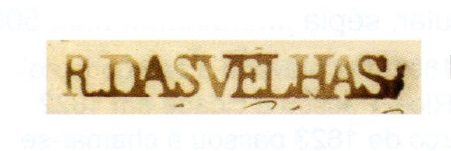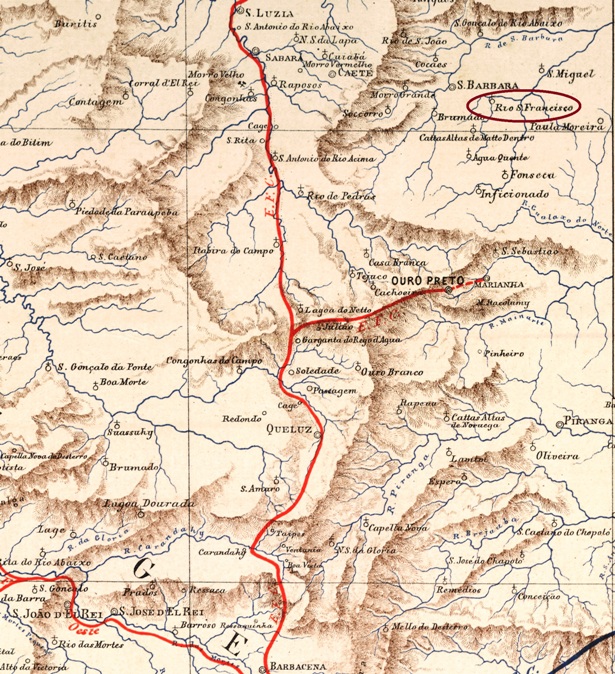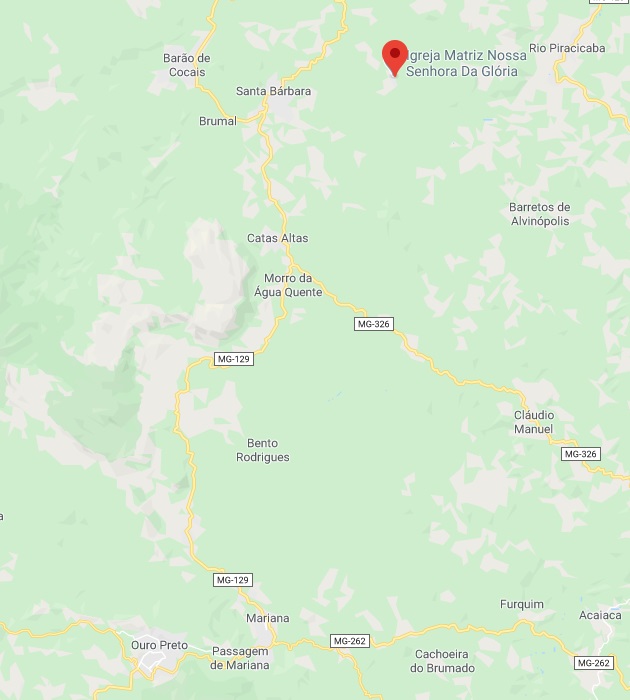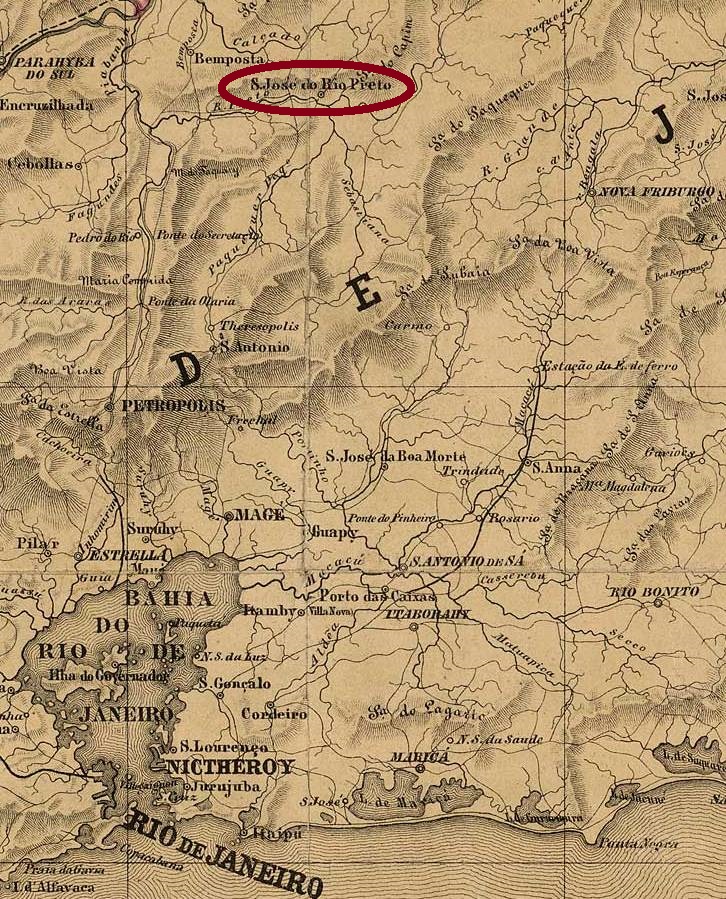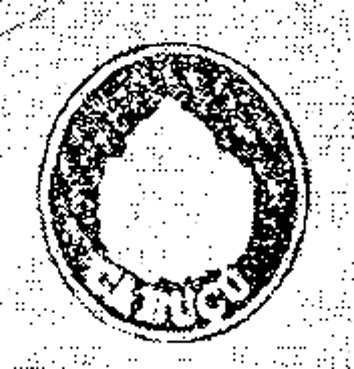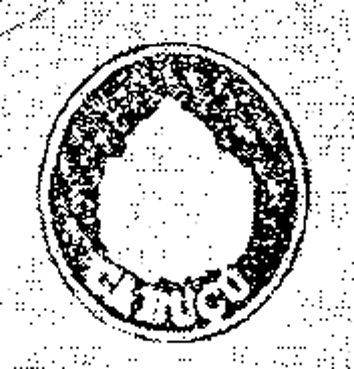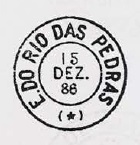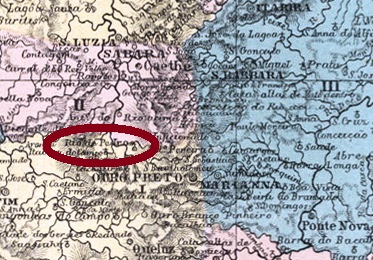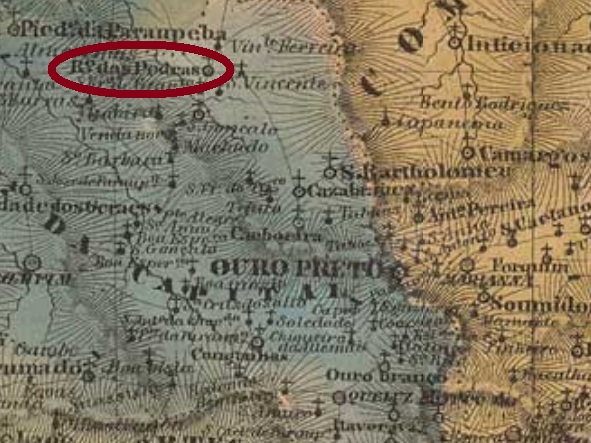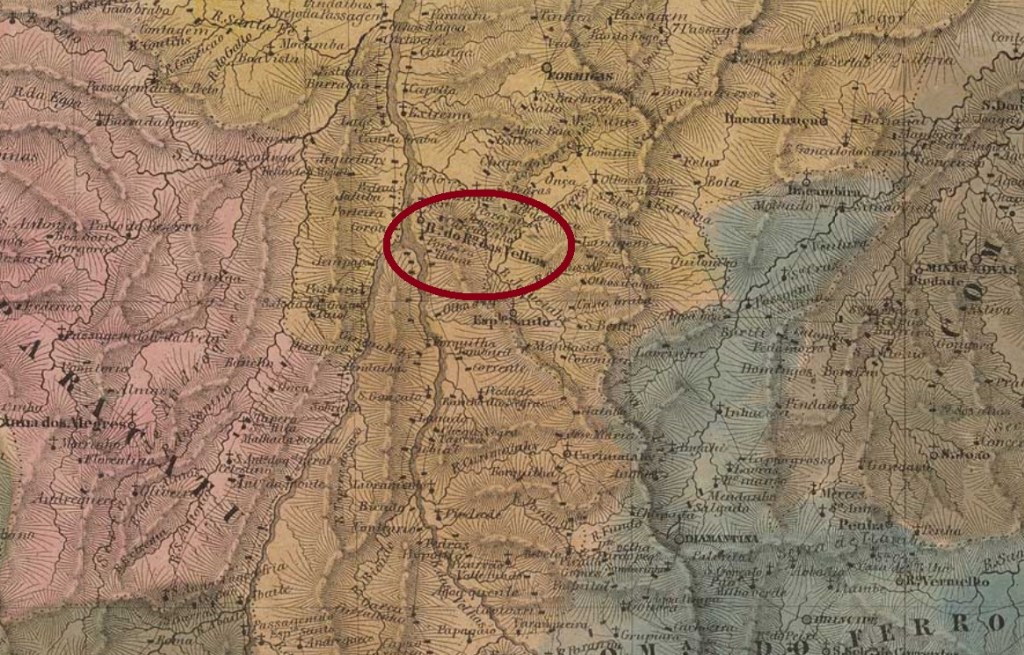
See also Acarape (Reinhold Koester: Carimbologia do Brasil Clássico I, 1961).
Redempção (today written Redenção, redemption) was the name given to the former town of Acarape in August 1889, to celebrate being the first locality that has abolished slavery in Brazil. This took place in this small Villa of the Ceará province in January 1st, 1883, located south of Fortaleza, near the Serra do Baturité. The rest of the country followed much later, on May 13, 1888.
The local post office must have been created in the first half of 1872:
Cearense, July 4, 1872
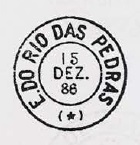
Redempção cancels from the Empire are certainly very rare, considering the high illiteracy rate (over 80 percent, according to Koester), and that the republic was proclaimed shortly after, on November 15, 1889. A single cancel was found, which might be republican, for it was used on a stamp of 1894: RCE-0267a (Coll. FM) has a double circle with inscriptions REDEMPÇÃO above, (CEARÁ) below, and the date inside.
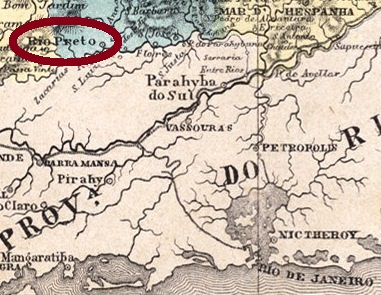
Atlas do Imperio do Brazil, 1868
Siehe auch Acarape (Reinhold Koester: Carimbologia do Brasil Clássico I, 1961)
Redempção liegt südlich von der Provinzhauptstadt Fortaleza nah an der Serra do Baturité, wird heute Redenção geschrieben und bedeutet Erlösung oder Befreiung. So wurde die bisherige Villa von Acarape im August 1889 umbenannt, um das Ereignis zu feiern, dass sie die erste Ortschaft Brasiliens war, die die Sklaverei abgeschafft hat. Dies fand am 1.1.1883 statt, und damit gut fünf Jahre vor dem Rest des Landes.
Das örtliche Postamt entstand sicherlich in der ersten Hälfte des Jahres 1872:
Cearense, 04.07.1872
Redempção-Abstempelungen aus der Kaiserzeit müssen sehr selten sein, wenn wir die hohe Analphabetismusquote der Stadt (über 80 Prozent, laut Koester) berücksichtigen, sowie die Tatsache, dass Brasilien gut drei Monate nach der Umbenennung eine Republik wurde. Der einzige bisher gefundene Stempel könnte auch republikanisch sein, da er auf eine Marke von 1894 verpasst wurde: RCE-0267a (Samml. FM) hat einen Doppelkreis mit den Inschriften REDEMPÇÃO oben und (CEARÁ) unten, dazu das Datum im Inneren.
Recreio was an E.F. Leopoldina train station of the Muriahé branch, which from 1885 on should link the Manhuassu Line to São Paulo de Muriahé, in the province of Minas Gerais. From 1975 to 1996 it belonged to the Rede Ferroviária Federal. Then it went out of service, only the railroad tracks survived. The station was inaugurated in May 1876, as noticed by the press from Rio:
Gazeta de Notícias, Rio de Janeiro, May 25, 1876
There is a controversy about when the station post office was created. Paula Sobrinho (História Postal de Minas Gerais, Belo Horizonte, 1997) states it took place on July 15, 1881, whereas the Guia Postal do Império of 1880 cites a post office at the Recreio station with agency number 386, which would lead to an earlier date:
Guia Postal do Imperio, 1880
This second hypothesis is corroborated by the presence of two early cancels and another press notice. The first cancel would be RMG-3575a (Coll. Dieter Kerkhoff), which corresponds to # 1429 by Paulo Ayres, and is found on many copies of the Dom Pedro issues from 1866 until 1878:
RMG-3575a, Paulo Ayres #1427
The second early cancel from the Recreio station, RMG-3575b (Coll. José A. Junges) has a double circle with a RECREIO inscription (above) and the date inside. On the Junges’ copy (100 Réis from the D. Pedro issue of 1877) the date was August 26, 1881, one month later than Paula Sobrinho’s given date for the office creation. Since it is quite unlikely the use of two different postal cancels at the same time in such a small office, this would be an argument for an earlier start date of this post office.
Besides, this press notice also reinforces the hypothesis of the earlier date:
O Globo, Rio de Janeiro, January 9, 1877
“From next January on, the postal services of the Capivara agency will proceed through the Recreio station of the Leopoldina Railway. This is herewith made public. Rio de Janeiro, December 27, 1876. On behalf of the General Directory of the Imperial Mail, (signed) M. M. de Mendonça.”
Considering that the postal traffic to and from the Capivara agency (now: Palma, established December 1873) was made from January 1877 on through the Recreio station, it is quite probable that the station office was created soon afterwards.
Four other Recreio cancels follow: RMG-3575c (Coll. José A. Junges) was found in blue on D. Pedro issues of 1884 (also in bisect). It only consists of a double circle with the inscription RECREIO (above). No date provided. RMG-3575d (Coll. José A. Junges) is similar to the former, but now found in black, with dates between 1884 and 1886. On RMG-3575e (Coll. José A. Junges), the date disappears again and the inner circle is completely blackened. Found on a 1885 issue. Finally, on RMG-3575f (Coll. Marcio Protzner) the double circle is somewhat larger, the inscriptions are EST. DO RECREIO above, (MINAS) below, and the date is located inside. Found until now on early republican issues.
ca.1913 (estacoesferroviarias.com.br)
Recreio war ein Bahnhof der Estrada de Ferro Leopoldina in der Provinz Minas Gerais. Die so genannte Muriahé-Abzweigung hat die Manhuassu-Linie mit São Paulo de Muriahé verbunden. Von 1975 bis 1996 gehörte die Linie der Rede Ferroviária Federal. Seit 1996 ist die Strecke stillgelegt, nur die Bahnschienen sind geblieben. Wie die Presse aus Rio damals mitteilte, wurde der Bahnhof im Mai 1876 eingeweiht:
Gazeta de Noticias, Rio de Janeiro, 25.05.1876
Über das Entstehungsdatum des Bahnhofspostamtes sind die Quellen uneinig. Paula Sobrinho (História Postal de Minas Gerais, Belo Horizonte, 1997) gibt den 15.07.1881 an, während der Guia Postal do Império von 1880 ein Postamt am Bahnhof Recreio mit Nr. 386 führt, was ein Indiz für ein früheres Datum ist:
Guia Postal do Imperio, 1880
Diese zweite Datumsalternative wird unterstützt durch das Vorhandensein von zwei frühen Stempeln und einer Pressenotiz. Der erste Stempel wäre RMG-3575a (Samml. Dieter Kerkhoff); er entspricht Nr. 1429 von Paulo Ayres und wird auf vielen Marken der Dom Pedro-Ausgaben von 1866 bis 1878 überliefert:
RMG-3575a, Paulo Ayres Nr. 1429
Der zweite frühe Stempel aus dem Recreio-Bahnhof, RMG-3575b (Samml. José A. Junges) hat einen Doppelkreis mit der Inschrift RECREIO (oben) und dem Datum in Inneren. Auf dem Exemplar der Sammlung Junges – einem 100 Réis aus der D. Pedro-Ausgabe von 1877 –ist als Datum 26. August 1881 zu lesen, gut ein Monat nach dem durch Paula Sobrinho angegebenen Enstehungsdatum. Da das Vorhandensein von zwei unterschiedlichen amtlichen Poststempeln zur gleichen Zeit in einem so kleinen Amt ziemlich unwahrscheinlich ist, wäre das ein weiterer indirekter Hinweis auf ein früheres Entstehungsdatum.
Auch diese Pressenotiz mag zur Klärung des Sachverhalts beitragen:
O Globo, Rio de Janeiro, 09.01.1877
« Vom nächsten Januar an werden die Postdienste der Agentur Capivara durch den Bahnhof Recreio auf der Estrada de Ferro Leopoldina durchgeführt. Hiermit zur allgemeinen Kenntnis bekannt gegeben. Rio de Janeiro, 27. Dezember 1876. Im Auftrag der Hofpostgeneraldirektion, (gez.) M. M. de Mendonça.“
Sollte die Post von und nach dem Postamt Capivara (heute: Palma, Postagentur seit 1873) ab Januar 1877 tatsächlich durch den Bahnhof Recreio abgewickelt worden sein, wäre es folgerichtig, dass auch hier bald darauf ein Postamt entstanden ist.
Es folgen vier weitere Recreio-Stempel: RMG-3575c (Samml. José A. Junges) ist in blauer Farbe auf einigen Dom-Pedro-Ausgaben von 1884 – auch halbiert – bekannt: ein Doppelkreis und die Inschrift RECREIO (oben), sonst nichts, auch kein Datum. RMG-3575d (Samml. José A. Junges) ist ähnlich wie vor, nun aber in Schwarz und mit Jahresdaten zwischen 1884 und 1886 anzutreffen. Bei RMG-3575e (Samml. José A. Junges) verschwindet das Datum abermals, und der Innenkreis wird komplett geschwärzt. Gefunden in einer Ausgabe aus 1885. Zuletzt, auf RMG-3575f (Samml. Marcio Protzner) ist der Doppelkreis etwas größer, die Inschriften lauten EST. DO RECREIO oben, (MINAS) unten, und das Datum steht in Inneren. Bisher auf frühen Ausgaben der Republik gefunden.
The Rebouças station of the Companhia Paulista de Estradas de Ferro was built in 1875 near Campinas. The name was a tribute to Antonio Pereira Rebouças Filho, a prominent engineer of the Cia. Paulista who died two years before.
No village existed at the beginning, except large coffee farms, and the local population has increased quite slowly. Around 1940, the locality was called Sumaré, and since 1953 it has the status of a município. The train station still exists as a culture center, but there is no traffic nowadays.
The post office at the Rebouças station was created only in December 1883, according to the press release:
Correio Paulistano, December 21, 1883
Just one cancel of the Rebouças station is known by now: RSP-1055a (image from the internet) might even be republican, for it shows the year 1895. There is a double circle with the inscriptions REBOUÇAS, above, (S. PAULO) below and the date in the inner circle.
estacoesferroviarias.com.br
Der Bahnhof Rebouças der Companhia Paulista de Estradas de Ferro wurde 1875 nahe Campinas gebaut. Der Name zollt Tribut an den Ingenieur Antonio Pereira Rebouças Filho, einen prominenten Mitarbeiter der Bahngesellschaft, der zwei Jahre zuvor verstorben war.
Bei der Gründung gab es außer riesigen Kaffeeplantagen nichts in der Umgebung, aber die Bevölkerung wuchs langsam, und um 1940 wurde die Ortschaft in Sumaré umbenannt. Seit 1953 ist Sumaré ein Município, und den Bahnhof gibt es heute noch, auch wenn kein Bahnverkehr mehr vorhanden ist. Nun beherbergt das Gebäude ein Kulturzentrum.
Eine Pressenachricht bestätigt die Entstehung des Postamts im Dezember 1883:
Correio Paulistano, 21.12.1883
Der einzige bisher überlieferte Stempel des Bahnhofs Rebouças könnte sogar bereits aus der Zeit der Republik sein: RSP-1055a (Abbildung aus dem Internet) trägt das Datum 1895. Man sieht einen Doppelkreis mit REBOUÇAS oben, (S. PAULO) unten und das Datum im Innenkreis.
Realto (or Rialto, like the famous bridge in Venice) was a tiny station of the E. F. do Bananal railway, which linked Barra Mansa in the Rio province to Bananal in São Paulo. According to Ralph Giesbrecht (estacoesferroviarias.com.br), the railroad started in Saudade near Barra Mansa in 1882, passed through Realto in 1883 but reached Bananal only in 1888. It was some 160 km long and belonged to the E.F. do Bananal until 1918, when it was undertaken by the E.F. Central do Brasil. In 1931, it was shortly controlled by E.F Oeste de Minas, returning the very same year to the Central do Brasil until 1964, when operation ended, and the station was demolished later on.
There was a post office at the station from 1883 on, says Paulo Novaes (agenciaspostais.com.br). The only imperial cancel discovered by now is RRJ-1670a (Coll. Klerman Lopes): A double circle with the inscription EST. DO REALTO (above), a star-like ornament with four legs (below) and the date inside. Cancelled in 1885.
IBGE, 1958-1960
Realto (oder Rialto, wie die berühmte Brücke in Venedig) war ein kleiner Bahnhof der Estrada de Ferro do Bananal, einer Eisenbahnstrecke, die Barra Mansa in der Provinz Rio mit Bananal in São Paulo verbunden hat. Laut Ralph Giesbrecht (estacoesferroviarias.com.br) startete die Bahnlinie in 1882 in Saudade nahe Barra Mansa, der Bahnhof Realto kann im darauf folgenden Jahr dazu, aber die Endstrecke bis Bananal wurde erst in 1888 fertig gestellt.
Die ganze Bahnstrecke war gerade 168 km lang und blieb bei der E.F. do Bananal bis 1918, als sie von der Central do Brasil übernommen wurde. In 1931 war sie kurz im Besitz der E.F. Oeste de Minas, ging aber im gleichen Jahr zurück zur Central do Brasil. In 1964 wurde der Bahnbetrieb eingestellt, und der Bahnhof wurde kurz darauf abgerissen.
Ein Postamt gab es dort schon seit 1883, laut Paulo Novaes (agenciaspostais.com.br). Der einzige bisher bekannte Stempel der Kaiserzeit ist RRJ-1670a (Samml. Klerman Lopes): ein Doppelkreis mit der Inschrift EST. DO REALTO (oben), einem sternförmigen Ornament mit vier Zacken (unten) und dem Datum im Inneren. Ein Exemplar vom Jahr 1885 ist bekannt.
Realengo was a parish located near Campo Grande on the west side of the municipality of Rio de Janeiro. This calm suburb was given some notoriety in the second half of the 19th century through the establishment of an Imperial Artillery Academy (Escola Geral Militar de Tiro). The Emperor D. Pedro II himself visited the Academy by train in 1876, two years before the building of the local station of the E. F. Dom Pedro II:
O Globo, January 18, 1876
According to Paulo Novaes (agenciaspostais.com.br), a post office was created in Realengo around 1872. The first cancel was probably RMN-2150a (Coll. José A. Junges), which was listed by Paulo Ayres as #1426:
RMN-2150a, Paulo Ayres 1426
RMN-2150b (Coll. José A. Junges) has a double circle with the inscription REALENGO in wide spaced letters (above) and the date inside. Found between 1877 and 1888, later exemplars show eventually the year in italics.
RMN-2150c (Coll. Fuad Ferreira Filho) has a double circle with the inscription REALENGO in narrow spaced letters (above), a cross-like ornament (below) and the date inside. Found between 1891 and 1896.
Revista da Semana, November 15, 1903
Realengo war eine Pfarrei nahe Campo Grande im Westen des Landkreises Rio de Janeiro. In der zweiten Hälfte des 19. Jahrhunderts wurde dem verschlafenen Vorort durch die Einrichtung einer kaiserlichen Artillerieakademie (Escola Geral Militar de Tiro) etwas Bekanntheit verliehen. Der Kaiser selbst gestattete in 1876 eine Besichtigung der Akademie; er kam mit dem Zug, zwei Jahre bevor der dortige Bahnhof der E. F. Dom Pedro II gebaut wurde:
O Globo, 18.01.1876
Laut Paulo Novaes (agenciaspostais.com.br) wurde ein Postamt in Realengo ca. 1872 errichtet. Die erste Abstempelung war vermutlich RMN-2150a (Samml. José A. Junges), aufgelistet durch Paulo Ayres unter Nr. 1426:
RMN-2150a, Paulo Ayres 1426
RMN-2150b (Samml. José A. Junges) hat einen Doppelkreis mit Inschrift REALENGO in etwas weit gereihten Buchstaben (oben) und dem Datum innen. Angetroffen zwischen 1877 und 1888, manche spätere Exemplare zeigen kursive Jahreszahlen.
RMN-2150c (Samml. Fuad Ferreira Filho) hat einen Doppelkreis mit Inschrift REALENGO in etwas eng gereihten Buchstaben (oben), einem kreuzförmigen Ornament (unten) und dem Datum innen. Bisher gefunden zwischen 1891 und 1896.
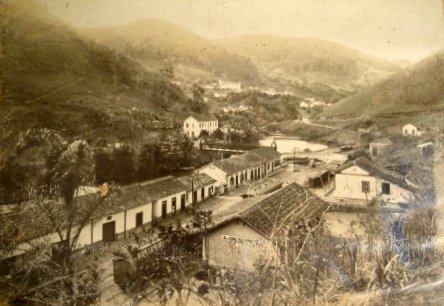
Raiz da Serra (« the root of the mountains ») was in 1856 a location near Magé, the final stop of Brazil’s first railway, before the slopes of the Serra da Estrella. The Estrada de Ferro Mauá began in 1854 in Porto Mauá at the Guanabara Bay; the name Mauá is now directly linked to its entrepreneur Irineu Evangelista de Souza (1813-1889), who was also a banker, industrialist and politician. For his achievement he was awarded the title of Baron of Mauá in 1854, and of viscount with greatness in 1874. Allegedly, “by 1867 his wealth war larger than the annual budget of the Brazilian Empire. He was called the Rothschild of the South American continent by the New York Times in 1871”. (Wikipedia)
Painting by Édouard Viennot
In the forties, the train station was renamed as Vila Inhomerim, remaining in the Município of Magé. After the beginning, the railway denomination changed to E.F. Príncipe do Grão-Pará (1888-1890), E.F. Leopoldina (1890-1975), Rede Ferroviária Federal (1975-1997), and since 1997 it is called Supervia, operating only with freight trains.
A post office was installed in 1869 (Nova Monteiro). The first cancel was probably RRJ-1325a (Coll. José A. Junges). Listed by Paulo Ayres under number 1425.
RRJ-1325a, Paulo Ayes 1425
RRJ-1325b (Coll. José A. Junges) has a double circle with the inscription RAIZ DA SERRA (above) and the date in the middle. Found between 1882 and 1890.
RRJ-1325c (Coll. José A. Junges) has a double circle with the inscription RAIZ DA SERRA (above), a new star-like ornament (below) and the date inside. Found between 1890 and 1898.
Amigos do Patrimônio, 2010
Raiz da Serra (“Wurzel des Gebirges”) war die in 1856 vor der Serra da Estrella nah an Magé gebaute Endstation von Brasiliens erster Eisenbahnlinie, die Estrada de Ferro Mauá. Diese started in 1854 in Porto Mauá, einem Hafendorf an der Bucht von Guanabara, das seinen Namen seitdem direkt mit dem Unternehmer Irineu Evangelista de Souza verbunden ist.
Souza (1813-1889) war auch Industrieller, Bankier und Politiker; für seine Leistungen wurde er gleich in 1854 als Baron de Mauá geadelt, und 20 Jahre später als Vicomte mit Grandezza. Angeblich war sein Vermögen um 1867 größer als das Gesamtbudget des brasilianischen Kaiserreichs, und in 1871 nannte ihn der New York Times den „Rothschild des südamerikanischen Kontinents“ (Wikipedia):
Gemälde von Édouard Viennot
In den 40er Jahren wurde die Station als Villa Inhomerim umbenannt, und bis heute ist sie im Município von Magé in Betrieb. Der Name der Bahngesellschaft wechselte seit der Gründung mehrmals: Estrada de Ferro Príncipe do Grão-Pará (1888-1890), E.F. Leopoldina (1890-1975), Rede Ferroviária Federal (1975-1997) und Supervia (seit 1997, nur Güterverkehr).
Ein Bahnhofspostamt wurde in 1869 in Betrieb genommen (Nova Monteiro). Der erste Stempel war wohl RRJ-1325a (Samml. José A. Junges); er wurde von Paulo Ayres unter Nr. 1425 aufgelistet.
RRJ-1325a, Paulo Ayres 1425
RRJ-1325b (Samml. José A. Junges) hat einen Doppelkreis mit Inschrift RAIZ DA SERRA (oben) und das Datum im Inneren. Anzutreffen zwischen 1882 und 1890.
RRJ-1325c (Samml. José A. Junges) hat einen Doppelkreis mit Inschrift RAIZ DA SERRA (oben), einem sternförmigen Ornament (unten) dazu und trägt das Datum innen. Zwischen 1890 und 1898 bekannt.
The origin and meaning of the name Quixeramobim have been a discussion object among scholars through centuries. Even the German botanist Carl Ph. Fr. von Martius (1794-1868) has tried to elucidate this mystery and mentioned a tupi-indian origin. But according to the Brazilian sociologist Analucia Sulina Bezerra, it seems now that the name has come from the Quixará, an ethnic group of the Tapuia-indians.
Quixeramobim was granted the status of a Villa as early as 1766, became a cidade in 1856, and on March 4, 1846 a local post office appeared, according to Nova Monteiro. If we consider that this town by 1880 had over 15 thousand inhabitants (Guia Postal do Imperio), one might wonder where all those imperial cancels are hidden.
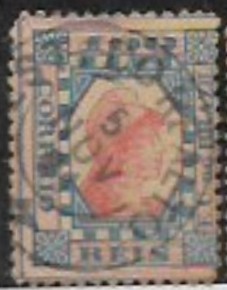
The earliest example of a Quixeramobim cancel by now is QCE-0265a (Coll. José A. Junges): a double circle with the imprint QUIXERAMOBIM (above) and a date within the inner circle. Possibly there was an ornament below, which disappeared in the copy of 1896.
A second cancel, QCE-0265b (Coll. Dieter Kerkhoff), was applied at the stamp corner, has therefore very little information and could possibly be republican. Similar to the former, but now presenting (CEARÁ) between the circles (below). Seen on a stamp issued after 1897.
Carta da Republica dos Estados Unidos do Brazil, 1892
A origem e significado do nome Quixeramobim têm sido objeto de discussão entre estudiosos ao longo dos séculos. Mesmo o famoso botânico alemão Carl Philipp Fr. Von Martius (1794-1868) tentou elucidar esse mistério, citando uma origem tupi. Mas uma explicação mais recente, da socióloga Analucia Sulina Bezerra, diz que o nome deriva de Quixará, um grupo étnico tapuia.
Quixeramobim já era vila em 1766, tornou-se cidade em 1856, e, segundo nos conta Nova Monteiro, recebeu sua agência postal em 4 de março de 1846. Se considerarmos que a cidade tinha por volta de 1880 mais de 15 mil habitantes (Guia Postal do Império) , é de se perguntar onde foram parar os carimbos imperiais de lá.
O carimbo mais antigo de Quixeramobim até agora conhecido é QCE-0265a (Col. José A. Junges): um círculo duplo com a inscrição QUIXERAMOBIM (acima) e a data dentro do círculo interno. Talvez havia também um ornamento no arco inferior, que desapareceu no exemplar de 1896.
Um segundo carimbo, QCE-0265b (Col. Dieter Kerkhoff), foi aplicado num canto do selo, portanto informa muito pouco, e possívelmente seria republicano. Semelhante ao carimbo anterior, este agora apresenta (CEARÁ) dentro do arco inferior. Encontrado num selo emitido a partir de 1897.
Sociedade Geológica e Mineralógica, 1910
Viele Wissenschaftler rätselten jahrhundertlang über Ursprung und Bedeutung des Namens Quixeramobim. Sogar der deutsche Botaniker Carl Ph. Fr. von Martius (1794-1868) versuchte, dieses Problem zu durchleuchten, indem er auf eine tupi-indianische Abstammung tippte. Wie dennoch die brasilianische Soziologin Analucia Sulina Bezerra erklärte, der Begriff kommt von Quixará, einem Indianerstamm der Tapuias.
Quixeramobim bekam den Status einer Villa bereits in 1766, in 1856 wurde sie eine cidade, aber vorher schon, seit 04.03.1846, gab es dort ein Postamt, laut Nova Monteiro. Aber wenn wir lesen, dass vor 1880 der Ort schon über 15 Tausend Einwohner hatte (Guia Postal do Império), da fragt man sich, wo alle diese kaiserlichen Abstempelungen geblieben sind.
Der bisher früheste Stempel aus Quixeramobim ist QCE-0265a (Samml. José A. Junges): ein Doppelkreis mit der Inschrift QUIXERAMOBIM (oben) und einem Datum im Innenkreis. Möglicherweise gab es eine Verzierung unten, die leider auf der Marke mit Stempeldatum 1896 nicht mehr zu sehen ist.
Eine zweite Abstempelung, QCE-0265b (Samml. Dieter Kerkhoff), hat lediglich einen Markenrand erwischt. Dadurch ist ihr Informationsgehalt gering, sie könnte auch aus der Zeit der Republik sein. Außer den Angaben der vorherigen bringt diese Abstempelung auch (CEARÁ) zwischen den Kreisen (unten). Gesehen auf einer Marke, die ab 1897 ausgegeben wurde.
The Freguesia de Jesus, Maria e José de Quixadá existed since November 1869 and belonged to the Vila de Quixeramobim. It was located on the north bank of the Riacho Sitiá, 170 km south of the provincial capital Fortaleza. In October 1870, it became a vila and in August 1889 a city.
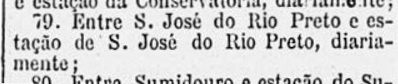
According to the Imperial Mail Register (Tabella das Agencias do Correio do Império) of 1885, the station post office opened in 1871, and was already mentioned in the press in the following year:
Pedro II, July 20, 1872
However, there had previously been a post office agency in Quixadá, which was closed in November 1847, as reported in the official press of Rio de Janeiro:
Gazeta Official/RJ, 1 December 1847
After that, there was postal traffic to and from Quixadá from at least October 1849 onwards. It is not known whether there was a post office on site.
Cearense, 15 October 1849
No cancel with imperial date has been found by now, but QCE-0260a (Coll. José A. Junges), used at the beginning of the republican period, might have circulated before 1890: a double circle with the inscription QUIXADA (above) and the date within the inner circle.
Carta da Republica dos Estados Unidos do Brazil, 1892
Atualização em 1º de janeiro de 2026
A Freguesia de Jesus, Maria e José de Quixadá existia desde novembro de 1869 e pertencia à Vila de Quixeramobim. Situava-se na margem norte do Riacho Sitiá, 170 km ao sul da capital do estado, Fortaleza. Em outubro de 1870, tornou-se vila e, em agosto de 1889, cidade.
Segundo a Tabela de Agências do Correio do Império de 1885, a agência postal de lá foi criada em 1871, e já foi mencionada na imprensa no ano seguinte:
Pedro II, 20 de julho de 1872
No entanto, já havia anteriormente uma agência postal em Quixadá, que foi fechada em novembro de 1847, conforme noticiado no jornal oficial do Rio de Janeiro:
Gazeta Oficial/RJ, 01/12/1847
Depois disso, pelo menos a partir de outubro de 1849, houve tráfego postal de e para Quixadá. Não se sabe se havia uma agência postal local.
Cearense, 15/10/1849
Ainda não surgiu um carimbo com data do império de Quixadá, mas supostamente QCE-0260a (Col. José A. Junges) deve ter circulado também antes de 1890: este carimbo mostra um duplo círculo com a inscrição QUIXADÁ (acima) e a data dentro do círculo interno.
Sociedade Geologica e Mineralogia, 1910
Textaktualisierung vom 1. Januar 2026
Die Freguesia de Jesus, Maria e José de Quixadá bestand seit November 1869 und gehörte zur Vila de Quixeramobim. Sie lag am Nordufer des Riacho Sitiá, 170 km südlich der Provinzhauptstadt Fortaleza. Im Oktober 1870 wurde sie zur Vila und im August 1889 zur Stadt.
Das Verzeichnis der kaiserlichen Postämter (Tabella das Agencias do Correio do Império) von 1885 nennt das Jahr 1871 für die Gründung des Postamts, und schon im folgenden Jahr wurde es in der Presse erwähnt:
Pedro II, 20.07.1872
Allerdings gab es bereits früher eine Postagentur in Quixadá, die im November 1847 geschlossen wurde, wie in der Amtspresse von Rio de Janeiro gemeldet wurde:
Gazeta Official/RJ, 01.12.1847
Danach gab es zumindest ab Oktober 1849 Postverkehr von und nach Quixadá. Ob es ein Postamt vor Ort gab, ist nicht bekannt.
Cearense, 15.10.1849
Bisher wurde kein Stempel aus der brasilianischen Kaiserzeit gefunden, aber vermutlich war QCE-0260a (Samml. José A. Junges), von dem ein Exemplar aus den frühen Jahren der Republik vorhanden ist, auch vor 1890 in Gebrauch: ein Doppelkreis mit der Inschrift QUIXADA (oben) und dem Datum im Innenkreis.
The parish of Nossa Senhora do Desterro de Quissaman was named after a region located south from Luanda, Angola, and which is now spelled Quiçama. Apparently, many slaves have come from there and contributed therefore for the perpetuation of their homeland’s name in Brazil. According to Paulo Novaes and Reinhold Koester, a post office was created on December 1855.
Since Reinhold Koester (Carimbologia do Brasil Clássico XXVIII, Lohmar, 1986) has already presented all cancels from this locality, it will be referred here only to those cancels which begin with Q. QRJ-0820a (Coll. José A. Junges) has a double circle with the inscription QUISSAMAN (above) and the date within the inner circle, whereas QRJ-0820b (Coll. José A. Junges) has the inscription QUISSAMÃ (above) and an ornament below. The former has exemplars founded between 1879 and 1889; the latter was used at least between 1889 and 1908.
Villiers de l’Ile Adam: Carta (…) da Provincia do Rio de Janeiro, 1850
Veja também N.S. do Desterro do Quissaman (NRJ-1205)
A paróquia de Nossa Senhora do Desterro de Quissaman foi batizada segundo uma região localizada ao sul de Luanda, Angola, e que hoje se chama Quiçama. Ao que tudo indica, houve tantos escravos vindos de lá para o nordeste fluminense, que o nome africano acabou perpetuado em solo brasileiro. Paulo Novaes e Reinhold Koester apontam a data de 24 de dezembro de 1855 para a criação da agência postal local. Quissamã foi elevado a município em 1989.
Visto que Koester já listou todos os carimbos imperiais de Quissaman (Carimbologia do Brasil Clássico XXVIII, Lohmar, 1986), só os carimbos com a inicial Q serão aqui apresentados. QRJ-0820a (Col. José A. Junges) tem um duplo círculo com a inscrição QUISSAMAN (acima) e a data dentro do círculo interno, enquanto que, em QRJ-0820b (Col. José A. Junges), o duplo círculo tem a inscrição QUISSAMÃ acima e um florão ornamental abaixo. O carimbo anterior tem exemplares datados entre 1879 e 1889; já o segundo foi utilizado pelo menos entre 1889 e 1908.
Colton & Colton: Provincia do Rio de Janeiro, 1866
Die Pfarrei Nossa Senhora do Desterro de Quissaman wurde nach einem Gebiet südlich von Luanda in Angola genannt, das heutzutage Quiçama geschrieben wird. Dorther sind wohl zahlreiche Sklaven in die Gegend nordöstlich von Rio verschleppt worden, so dass der afrikanische Heimatbegriff in Brasilien verewigt wurde. Sowohl Paulo Novaes als auch Reinhold Koester nennen als Entstehungsdatum fürs Postamt den 24.12.1855.
Da Koester bereits alle bisher bekannten Quissaman-Stempel gelistet hat (Carimbologia do Brasil Clássico XXVIII, Lohmar, 1986), wird hier nur an die Stempel erinnert, die mit Q beginnen. So hat QRJ-1020a (Samml. José A. Junges) einen Doppelkreis mit der Inschrift QUISSAMAN (oben) und das Datum im Innenkreis, während QRJ-1020b (Samml. José A. Junges) präsentiert die Schreibweise QUISSAMÃ (oben) und eine Verzierung unten. Der erste Stempel hat Exemplare zwischen den Jahren 1879 und 1889; der zweite wurde zumindest zwischen 1889 und 1908 benutzt.
The Estrada de Ferro do Norte (or E.F. D. Pedro II) was built from 1876 on and should connect São Paulo to the D. Pedro II railway near Cachoeira Paulista in 1877. According to Ralph Giesbrecht (estacoesferroviarias.com.br), a train stop was made from December 1876 on at the Fazenda Quiririm next to the north bank of the the Paraiba do Sul River near Taubaté 130 km northeast of the capital São Paulo, but until July 1885 no station house was there:
Correio Paulistano, July 15, 1885
However, it seems that it did not take long for the station building to be completed, as the station post office was announced in the Rio press in December 1886:
Gazeta de Noticias/RJ, 15 December 1886
The railway line went to E. F. Central do Brasil in 1896 and was closed in 1953. Today, neither the tracks nor the station building remain.
In 1952 (estacoesferroviarias.com.br)In January 1999 (estacoesferroviarias.com.br)
The only postmark from the 19th century to date is QSP-1050a (Fig. Mário Celso Orsi Jr.):
QSP-1050a (MO) 1895J. M. Ribeiro Lisboa: Provincia de São Paulo, 1884
Texto atualizado em 1º de janeiro de 2026
A Estrada de Ferro do Norte (ou E.F. D. Pedro II) começou a ser construída em 1876 e deveria ligar a capital provincial paulista com a E.F. D. Pedro II na altura de Cachoeira Paulista em 1877. Segundo Ralph Giesbrecht (estacoesferroviarias.com.br), havia uma parada do trem a partir de dezembro de 1876 na Fazenda Quiririm, próxima à margem norte do Paraíba do Sul no município de Taubaté, 130 km a nordeste da capital provincial São Paulo. Mas ainda em julho de 1885 o prédio da estação ferroviária ainda não estava pronto:
Correio Paulistano, 15 de julho de 1885
Aparentemente, porém, a construção não durou mais muito tempo, pois a agência dos correios correspondente foi anunciada pela imprensa do Rio em dezembro de 1886:
Gazeta de Notícias/RJ, 15/12/1886
A linha férrea foi transferida para a E. F. Central do Brasil em 1896 e desativada em 1953. Hoje, nem os trilhos nem o prédio da estação ferroviária existem mais.
Em 1952 (estacoesferroviarias.com.br)Em janeiro de 1999 (estacoesferroviarias.com.br)
O único carimbo postal do século XIX conhecido até agora é o QSP-1050a (fig. Mário Celso Orsi Jr.):
QSP-1050a (MO) 1895Google Maps
Textaktualisierung am 1. Januar 2026
Die Estrada de Ferro do Norte (oder E.F. D. Pedro II) wurde ab 1876 gebaut und sollte São Paulo mit Rio de Janeiro verbinden, was nun im Jahr 1877 in Cachoeira Paulista geschah. Nach Ralph Giesbrecht (estacoesferroviarias.com.br) sollte ab Dezember 1876 eine Haltestelle an der Fazenda Quiririm nah am Nordufer des Paraíba do Sul bei Taubaté, 130 km nordöstlich der Provinzhauptstadt São Paulo errichtet werden, die jedoch im Juli 1885 noch nicht fertig war:
Correio Paulistano, 15.07.1885
Scheinbar dauerte es aber nicht mehr lange mit dem Bahnhofsgebäude, da das dazu gehörige Postamt im Dezember 1886 durch die Presse in Rio angekündigt wurde:
Gazeta de Noticias/RJ, 15.12.1886
Die Bahnlinie ging 1896 zur E. F. Central do Brasil und wurde 1953 stillgelegt. Heute sind weder Gleise noch das Bahnhofsgebäude übrig geblieben.
Im Jahr 1952 (estacoesferroviarias.com.br)Im Januar 1999 (estacoesferroviarias.com.br)
Der bisher einzige Poststempel aus dem 19. Jahrhundert ist QSP-1050a (Abb. Mário Celso Orsi Jr.):