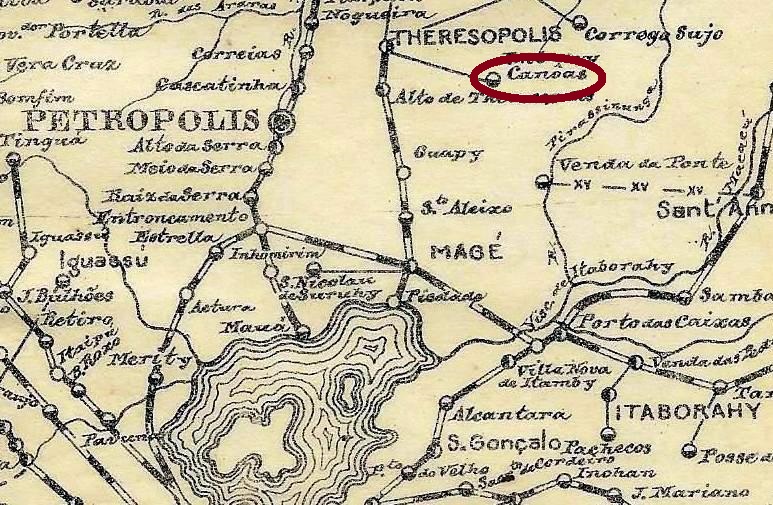
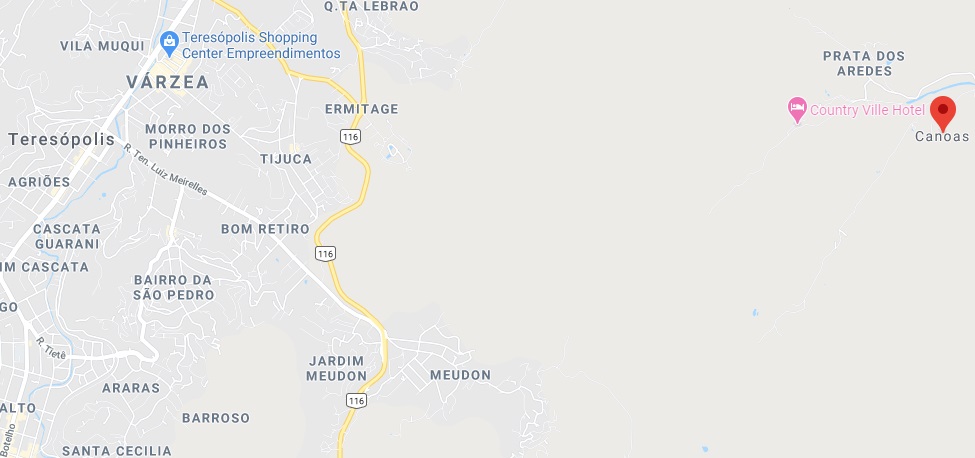
One might wonder why Rio das Canôas has ever got a post office, for it is barely visible even in detailed maps, actual or ancient. This tiny locality is hidden in a narrow valley in an eastern suburb of the touristic town Teresópolis, about 100 km north of Rio de Janeiro. Originally it belonged as a freguesia to the municipality of Magé, changing in 1891 to Santo Antonio de Paquequer and, in the next year, to Teresópolis.
The first mention about a local post office was found in the regional press of January 1884. Possibly the agency was installed the year before:
Almanak Laemmert 1884
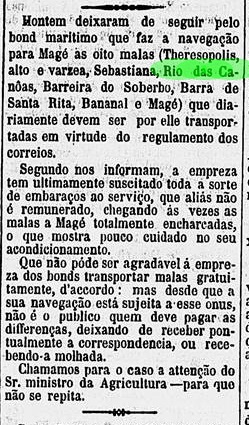
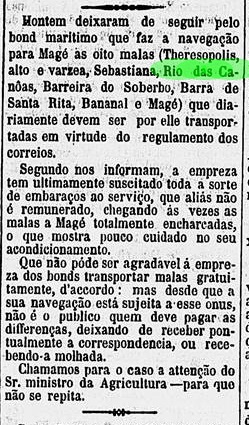
According to this mailing schedule, the mail to an from Rio das Canôas was transported three times a week through Magé. But soon serious problems have appeared on the shipway between Rio and Magé, and reclamations about damaged correspondence were made public. Since mail transportation through the Guanabara Bay had to proceed free of charge for the government, it seems that the personnel in charge has worked quite carelessly:
Diario de Noticias, November 15, 1885
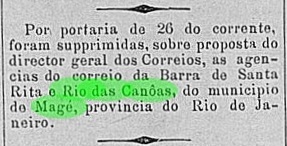
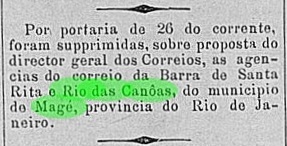
The Rio das Canôas post office had apparently no financial success and closed on February 26, 1886:
A Vanguarda, February 27, 1886
No imperial cancel of Rio das Canôas has come to light until now. Given the short operation period of such a little office, local postmarks must be very rare.
Wikimedia – OpenStreetMap
Es ist schon verwunderlich, wie Rio das Canôas zu einem eigenen Postamt kam, wenn man den Ort schon kaum auf einer detaillierten Karte findet, egal wie alt diese sein mag. Diese winzige Ortschaft liegt versteckt in einem engen Tal bei einem Vorort östlich von Teresópolis, gut 100 km nördlich von Rio de Janeiro entfernt. Ursprünglich eine unbedeutende freguesia von Magé, ging Rio das Canôas in 1891 zum neu gegründeten município von Santo Antonio de Paquequer, und im darauf folgenden Jahr zu Teresópolis.
Die bisher früheste Erwähnung eines Postamtes in Rio das Canôas findet man in der regionalen Presse in Januar 1884, so dass die Agentur möglicherweise im Jahr zuvor entstand:
Almanak Laemmert
Dem Postfahrplan nach wurden die Sendungen von und nach Rio das Canôas dreimal wöchentlich über Magé befördert. Da die Postverbindung zwischen Rio und Magé per Schiff entlang der Bucht von Guanabara alles andere als unproblematisch war, wurden bald Kundenbeschwerden über beschädigte Postsendungen veröffentlicht. Über die kostenlose Pflichtbeförderung der Post waren die Matrosen wohl nicht erfreut und ließen offenbar Sorgfalt vermissen:
Diario de Noticias, 15. November 1885
Dem kleinen Postamt in Rio das Canôas war kein finanzieller Erfolg gegönnt, es musste bereits am 26. Februar 1886 schließen:
A Vanguarda, 27. Februar 1886
Kein imperialer Stempel aus Rio das Canôas war bisher zu sehen. Bei einer so kurzen Betriebszeit eines so kleinen Orts müssen Abstempelungen von dort sehr selten sein.
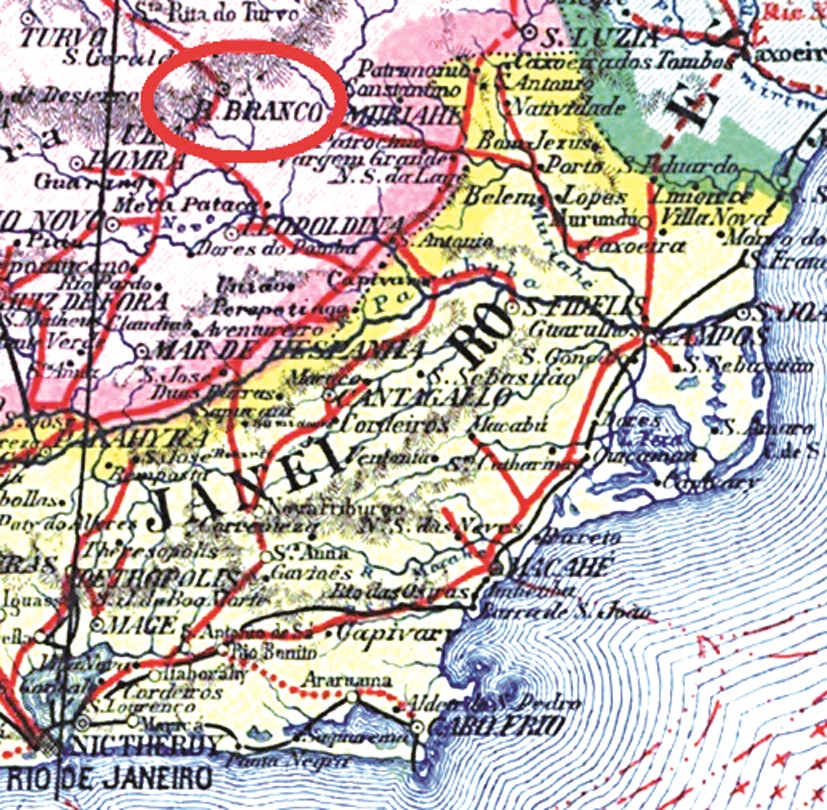
Carta da Republica dos Estados Unidos do Brazil, 1892
See also: Presídio, S. João Batista do (Koester: Carimbologia XXXII, 1992)
Other names: Presídio, Presídio de Ubá, São João Baptista do Presídio, Villa do Prezidio, Visconde do Rio Branco
The long rivalry between the neighbour towns of Visconde do Rio Branco and Ubá in southeast of Minas Gerais has historical roots. The former was originally a district of the municipality of Pomba in 1810, with the sonorous name Distrito de São João Baptista dos Índios Coropós. Eventually after that, the locality became an open prison, surrounded by woods and called S. João Baptista do Presídio, which was made a Villa in February or March 1839. Sometime later there must have been an economic decay, for in 1853 it was degraded to a district of the municipality of Ubá and therefore called Presídio de Ubá (= Ubá Prison). It recovered the old name and Villa status only in 1881, and in the following year was elevated to a town named Visconde do Rio Branco. Such measures show understandingly a wish to leave behind both names of prison and Ubá, even though José Maria da Silva Paranhos, the Viscount of Rio Branco (1819-1880), father of the famous Baron of Rio Branco, probably never visited Minas Gerais.
According to Nova Monteiro (Administrações e Agências Postaes do Brasil-Império 1798-1869), a post office was created in December 1839, but seems to have been closed by 1856, for it is absent in Guia do Correio do Brazil of 1857. A famous postal cancel from this early period was used on Bull’s Eyes and already presented by Paulo Ayres (1937) under #1601:
Paulo Ayres (1937) #1601
However, Ayres writes erroneously Villa DE Prezidio, while further research has already confirmed the correct spelling Villa DO Prezidio (see H. B. Ferreira, Catálogo Ilustrado dos Carimbos sobre os Olhos-de-Boi, 4th ed., 2017).
Apparently the post office reopened only in September 1870 (Paula Sobrinho: História Postal de Minas Gerais, Belo Horizonte, 1997). The postmarks from this period were already shown by R. Koester under Presídio (Carimbologia XXXII, Rio, 1992).
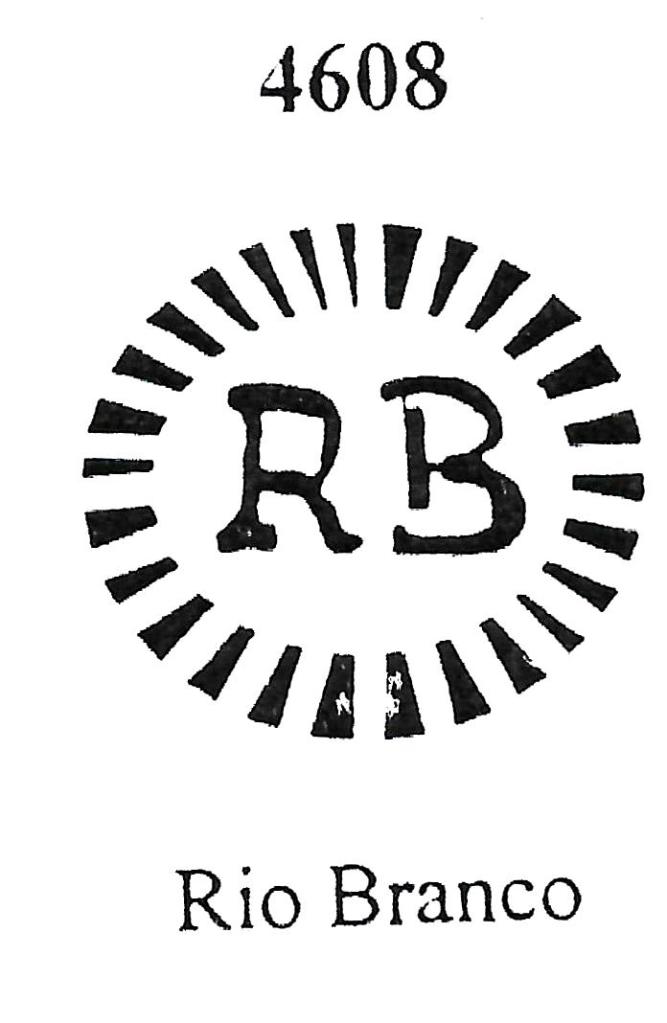
There are to date four different cancels known for Rio Branco from the late imperial period (1882-1889). RMG-2110a corresponds to Paulo Ayres’ #1110, and was used between 1882 and 1883, probably as a stopgap. This cancel was also catalogued by J.A. Dingler and K.W. Lopes (Mute Cancellations of the Brazil Empire, 1865-1889, Rio de Janeiro, 2000) under # 4608. Both images have significant differences, making their comparison interesting:
Paulo Ayres (1937) #1110Dingler/Lopes (2000) #4608
RMG-2110b (Coll. Karlheinz Wittig) is a gorgeous shell-shaped cancel, absent in Paulo Ayres: there is a bowed inscription CORREIO DO RIO BRANCO above, MINAS GERAES below, and the date in the middle. Found between 1884 and 1886 in black, blue, violet and lilac. RMG-2110c (Coll. José A. Junges) has a double circle with the inscriptions RIO BRANCO above, MINAS below, and the date in the inner circle. Found in violet and lilac from 1885 to 1886. Finally, RMG-2110d (Coll. José A. Junges) shows a double circle with bigger letters than the former. The inscriptions are RIO=BRANCO above, (MINAS) below, and date in the inner circle. Found in black and lilac from 1887 until 1892.
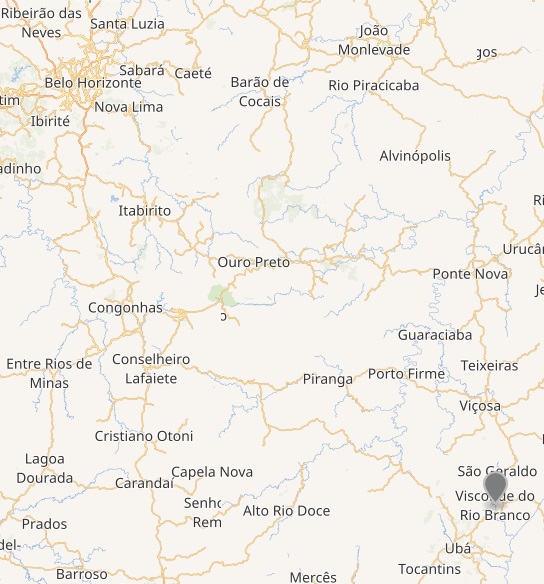
Wikimedia – OpenStreetMap
Siehe auch: Presídio, S. João Batista do (Koester, Carimbologia XXXII, 1992)
Andere Namen: Presídio, Presídio de Ubá, São João Baptista do Presídio, Villa do Prezidio, Visconde do Rio Branco
Die lange Rivalität zwischen den Nachbarstädtchen Visconde do Rio Branco und Ubá im Südosten von Minas Gerais hat eine ebenso lange Vorgeschichte. Erstes war ursprünglich (ab 1810) ein Distrikt im Município von Pomba, mit dem wohlklingenden Namen Distrito de São João Baptista dos Índios Coropós. Irgendwann danach wurde aus der Ortschaft ein offenes Gefängnis mitten im Urwald, das sich S. João Baptista do Presídio nannte, das im Februar oder März 1839 als Villa aufgewertet wurde. Aber später soll es wirtschaftlich so weit bergab gegangen sein, dass die Villa in 1853 zum Distrikt vom Nachbar Ubá degradiert wurde, unter dem – zugegeben nicht sehr schmeichelhaften – Namen Presídio de Ubá (= Ubás Gefängnis). Der Status einer Villa mit eigener Verwaltungsautonomie wurde erst in 1881 wieder erlangt, und ein Jahr später war der Ort zur Stadt Visconde do Rio Branco umbenannt. Die letzten Verwaltungsakte zeigen unmissverständlich den Wunsch, die Bezeichnungen Presídio und Ubá loszuwerden, auch wenn José Maria das Silva Paranhos (1819-1880), der Vicomte von Rio Branco und Vater des berühmten Baron von Rio Branco, womöglich niemals in Minas Gerais unterwegs war.
Laut Nova Monteiro (Administrações e Agências Postaes do Brasil-Império 1798-1869) wurde ein Postamt bereits im Dezember 1839 errichtet, das gleichwohl schon vor 1856 wieder geschlossen war, da es nicht im Guia do Correio do Brazil von 1857 aufgelistet wurde. Von dieser Frühzeit ist ein einziger Stempel überliefert, der auf Ochsenaugen zu finden ist und von Paulo Ayres (1937) unter Nr. 1601 registriert wurde:
Paulo Ayres (1937) Nr. 1601
Ayres schreibt dennoch fälschlicherweise Villa DE Prezidio, aber die spätere Forschung hat den Fehler behoben und die Schreibweise auf Villa DO Prezidio korrigiert (siehe H. B. Ferreira, Catálogo Ilustrado dos Carimbos sobre os Olhos-de-Boi, 4.. Aufl., 2017).
Das Postamt wurde wahrscheinlich erst im September 1870 (Paula Sobrinho: História Postal de Minas Gerais, Belo Horizonte, 1997) wieder eröffnet. Die Stempel aus dieser Zeit wurden bereits von R. Koester unter Presídio (Carimbologia XXXII, Rio, 1992) vorgestellt.
Es sind vier verschiedene Abstempelungen für Rio Branco aus der späteren kaiserlichen Zeit (1882-1889) bekannt. RMG-2110a entspricht Paulo Ayres’ Nr.1110, und wurde in 1882 und 1883 benutzt, wohl als Provisorium. Dieser Stempel wurde auch von J.A. Dingler and K.W. Lopes (Mute Cancellations of the Brazil Empire, 1865-1889, Rio de Janeiro, 2000) unter Nr. 4608 katalogisiert. Die Abbildungen zeigen aber wesentliche Unterschiede, so dass ein Vergleich hier interessant wird:
Paulo Ayres (1937) Nr. 1601Dingler/Lopes (2000) Nr. 4608
RMG-2110b (Samml. Karlheinz Wittig) ist ein wunderbarer Stempel in Muschelform, nicht in Paulo Ayres enthalten: da sehen wir eine gebogene Inschrift CORREIO DO RIO BRANCO oben, MINAS GERAES unten, und das Datum in der Mitte. Einzutreffen zwischen 1884 und 1886 in den Farben schwarz, blau, violett und lila. RMG-2110c (Samml. José A. Junges) hat einen Doppelkreis mit der Inschrift RIO BRANCO oben, MINAS unten und das Datum im Innenkreis. Einzutreffen in den Farben violett und lila von 1885 bis 1886. Schließlich RMG-2110d (Samml. José A. Junges) zeigt einen Doppelkreis mit etwas größere Buchstaben als vorher. Die Inschriften sind RIO=BRANCO oben und (MINAS) unten, mit Datum im Innenkreis. Einzutreffen in schwarz und lila von 1887 bis 1892.
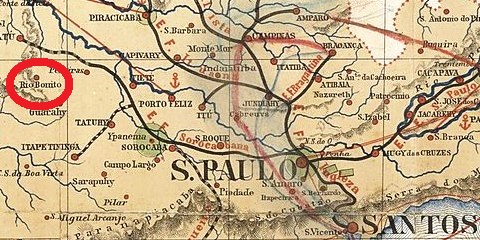
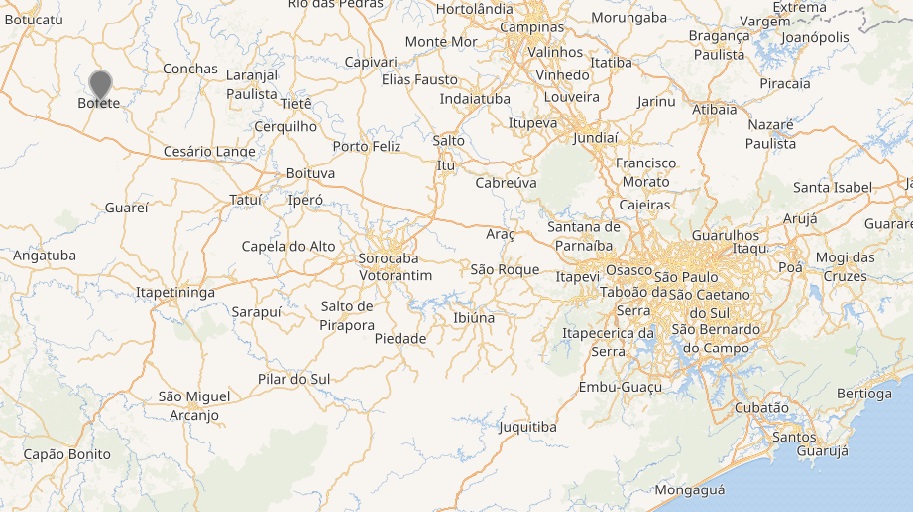
The district of Nossa Senhora da Piedade do Rio Bonito was created in February 1866 in the municipality of Botucatu, some 200 km west from São Paulo. After being elevated to a Villa in 1880 and to a Município in 1882, since December 1921 it is called Bofete. The actual toponym derives from French buffet, which in old Portuguese could also mean “trail guest house”. This suggests that the locality had lodged a groceries store for travellers.
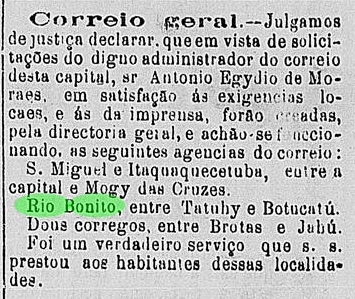
The post office was established in 1872, according to the Imperial Mail Register (Tabella das Agencias do Correio do Império) of 1885, which can be ratified by the regional press:
Diario de São Paulo, March 20, 1872
No imperial postal cancel was found to date.
Wikimedia – OpenStreetMap
Der Distrikt von Nossa Senhora da Piedade do Rio Bonito wurde im Februar 1866 gegründet und lag im Verwaltungsbezirk Botucatu knapp 200 km westlich von São Paulo entfernt. Nachdem er in 1880 zur Villa und in 1882 zu einem Município aufstieg, wurde der Ort in Bofete in 1921 umbenannt. Dieser etwas seltsam anmutende Name kommt vom französischen buffet, was im Alt-Portugiesisch auch etwa Landgasthaus bedeuten konnte. Angeblich hat der Ort früher ein Lebensmittelgeschäft für Reisende beherbergt.
Im Verzeichnis der kaiserlichen Postämter (Tabella das Agencias do Correio do Império) von 1885 wird die örtliche Poststelle mit Entstehungsjahr 1872 aufgelistet, was von der regionalen Presse bestätigt wird:
Diario de São Paulo, 20. März 1872
Kein Poststempel aus der Kaiserzeit wurde bisher gefunden.
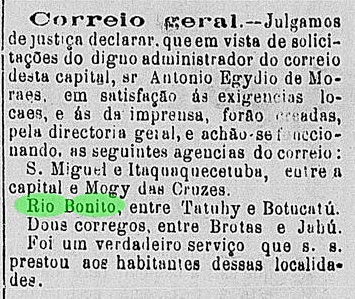
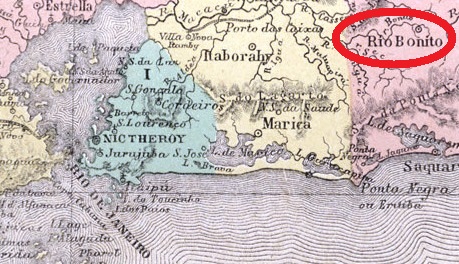
Rio Bonito was established in August 1768 as the district of Nossa Senhora da Conceição do Rio do Ouro, which belonged to Itaborahy, some 80 km east from Rio de Janeiro. In May 1846 it acquired administrative autonomy and was renamed Villa de N. Sa. da Conceição do Rio Bonito. Only in the republic, in January 1890, it was elevated to a city.
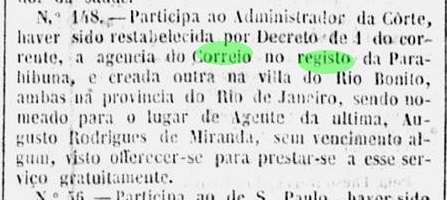
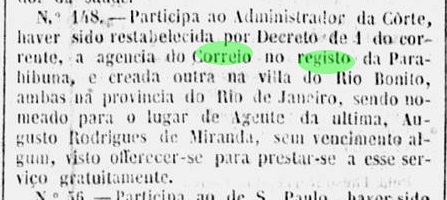
The local post office was created in June 1847, according to Nova Monteiro, which is confirmed by other sources. The first postal clerk has even worked as a volunteer:
Gazeta Official, June 25, 1847
That volunteer job has not been a good solution, for according to Paulo Novaes (agenciaspostais.com.br), the office was closed later on and reopened on February 1st 1849.
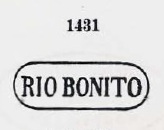
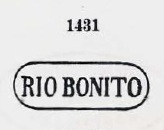
The first cancel, RRJ-0830a (image from the internet) was registered by Paulo Ayres under #1431, and was probably used from start until ca.1870:
Paulo Ayres #1431
RRJ-0830b (Coll. José A. Junges) presents a double circle with RIO BONITO (above) and the date inside. Dates from 1877 to 1885. RRJ-0830c (Coll. José A. Junges) is a variant of before, but now there is a (2) below between the circles. Dates from 1882 until 1887. RRJ-0830d (Coll. José A. Junges) also has a double circle, but now the inscription above has bigger letters and a hyphen: RIO-BONITO, and one can read below between circles (RIO DE JANEIRO). Dates between 1887 and 1891 in the inner circle. Finally, RRJ-0830e (Coll. Paulo Novaes) could be already republican, for the copies found until now have dates between 1899 and 1905: beside RIO BONITO (above) and the date in the inner circle, it shows a hollow cross in form of a X between circles below.
Wikimedia – OpenStreetMap
Rio Bonito wurde im August 1768 als der Distrikt Nossa Senhora da Conceição do Rio do Ouro gegründet. Dieser gehörte zum Itaborahy-Bezirk, etwa 80 km östlich von Rio de Janeiro gelegen. Im May 1846 erhielt er die Autonomieverwaltung eines Município und hieß fortan Villa de N. Sa. da Conceição do Rio Bonito. Später am Anfang der Republik, im Januar 1890, wurde aus Rio Bonito eine Stadt.
Das örtliche Postamt wurde laut Nova Monteiro im Juni 1847 gegründet. Diese Angabe wird durch andere Quellen bestätigt. Der erste Postangestellte von Rio Bonito hat sogar ohne Bezahlung seinen Dienst verrichtet:
Gazeta Official, 25: Juni 1847
Der freiwillige Dienst war keine ideale Lösung, denn laut Paulo Novaes (agenciaspostais.com.br) wurde das Postamt später geschlossen und eröffnete wieder am 1. Februar 1849.
Der erste Poststempel, RRJ-0830a (Abb. aus dem Internet) wurde durch Paulo Ayres unter #1431 erfasst, und war vermutlich vom Betriebsbeginn bis ca. 1870 im Gebrauch:
Paulo Ayres 1431
RRJ-0830b (Samml. José A. Junges) zeigt einen Doppelkreis mit RIO BONITO (oben) und dem Datum im Innenkreis. Daten von 1877 bis 1885. RRJ-0830c (Samml. José A. Junges) ist eine leichte Variante des Vorgängers, nun gibt es aber eine (2) unten zwischen den Kreisen. Daten von 1882 bis 1887. RRJ-0830d (Samml. José A. Junges) hat auch einen Doppelkreis, nun sind aber die Buchstaben größer und haben einen Bindestrich: RIO-BONITO, die Inskription unten zwischen den Kreisen lautet (RIO DE JANEIRO). Daten zwischen 1887 und 1891 im Innenkreis. Schließlich, RRJ-0830e (Samml. Paulo Novaes) könnte bereits republikanisch sein, da die gefundenen Exemplare nun Daten zwischen 1899 und 1905 aufweisen: außer RIO BONITO (oben) und dem Datum im Innenkreis haben wir unten zwischen den Kreisen ein hohles Kreuz in X-Form.
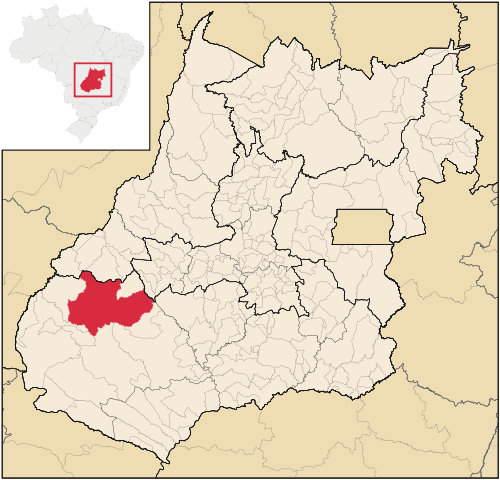
Other names: Torres do Rio Bonito, Caiapônia (1943)
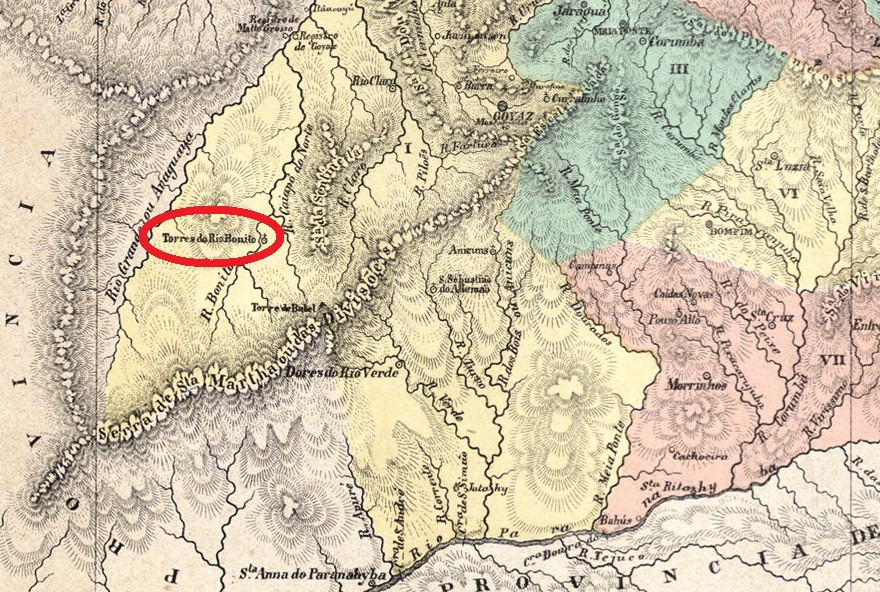
Torres do Rio Bonito was the name of a district established in 1855 in the municipality of Rio Verde in the southwest of the Goiás (originally spelled Goyaz) province. After the foundation, the locality near the main trail between the towns of Goiás and Cuiabá flourished slowly. In 1873 it emancipated from Rio Verde as the Vila do Espírito Santo de Torres do Rio Bonito, and in 1943 it became the municipality of Caiapônia, a name derivated from the Caiapó (former Cayapo do Norte) River, which flows through the region.
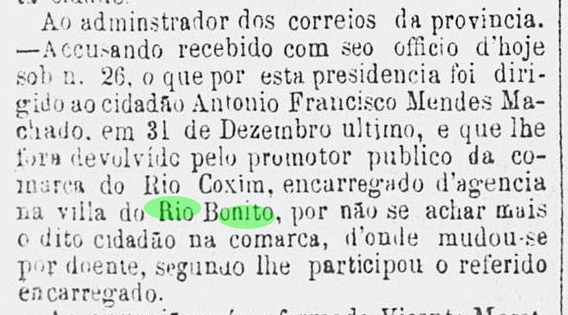
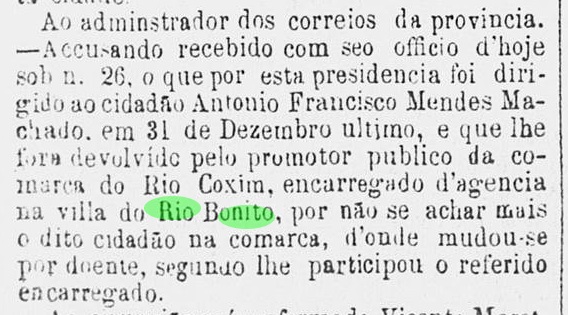
The 1885 Imperial Mail Register (Tabella das Agencias do Correio do Império) lists the postal agency with creation date of 1879, but this was probably a reopening, for already in June 1876 a Rio Bonito post office was mentioned in the regional press:
Correio Official de Goyaz, June 24, 1876
No postal cancellation from the Empire period has been found to date. Given that around 1880 the local population consisted of ca. 1,000 inhabitants – most of them illiterate – stamps with imperial cancel dates must be very rare.
Raphael Lorenzeto de Abreu (CC BY-SA)
Andere Namen: Torres do Rio Bonito, Caiapônia (1943)
Torres do Rio Bonito hieß ein im Jahr 1855 gegründeter Distrikt des Bezirks Rio Verde im Südwesten der Provinz Goiás (damals Goyaz geschrieben). Die Ortschaft lag etwa außerhalb der Urwaldroute zwischen den Provinzhauptstädten Goiás und Cuiabá und wuchs eher langsam. In 1873 erlang sie den Status einer Villa – und dazu die Verwaltungsautonomie – unter dem Namen Espírito Santo de Torres do Rio Bonito, und in 1943 wurde der Município in Caiapônia umbenannt. Die etwas seltsam anmutende Bezeichnung kommt von Caiapó (damals: Cayapo do Norte), einem Fluss der Gegend.
Im Verzeichnis der kaiserlichen Postämter (Tabella das Agencias do Correio do Império) von 1885 wird die örtliche Poststelle mit Entstehungsjahr 1879 angegeben. Es dürfte sich hier um eine Wiedereröffnung handeln, da schon in 1876 das Postamt in Rio Bonito in der regionalen Presse Erwähnung fand:
Correio Official de Goyaz, 24. Juni 1876
Bisher wurde keine postalische Abstempelung aus der Kaiserzeit gefunden. Diese dürfte auch sehr selten sein, wenn man bedenkt, dass um 1880 die Einwohnerzahl des Ortes ca. 1.000 Seelen betrug, und die allermeisten davon auch analphabetisch waren.
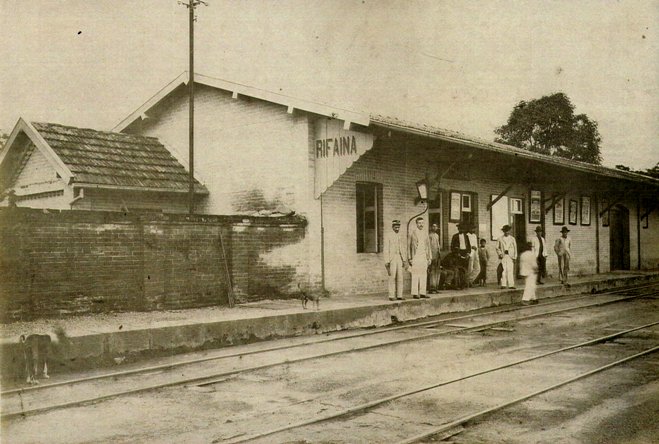
1910, in Album da Mogiana, Museu de Jundiaí (estacoesferroviarias.com.br)
Print edition update of April 4, 2020
See Santo Antonio da Rifaina (RSP-1605)
In the print edition of Carimbologia (Q-R) a post office for the train station of Rifaina (RSP-1100) was mentioned (allegedly created “ca. 09/1888”). This could not be confirmed and is probably wrong. The local post office was created in 1876 and will be presented at Santo Antonio da Rifaina (RSP-1605).
Buchtext-Aktualisierung vom 4. April 2020
Siehe Santo Antonio da Rifaina (RSP-1605)
In der Druckausgabe von Carimbologia (Q-R) wurde ein Bahnhofspostamt in Rifaina (RSP-1100) erwähnt (angeblich „ca. 09/1888“ entstanden). Diese Angaben konnten nicht bestätigt werden und sind wohl falsch. Das örtliche Postamt stammt aus dem Jahr 1876 und wird unter Santo Antonio da Rifaina (RSP-1605) vorgestellt.
See also: Ribeirão Branco (RSP-1085), Ribeirão Preto (RSP-1095)
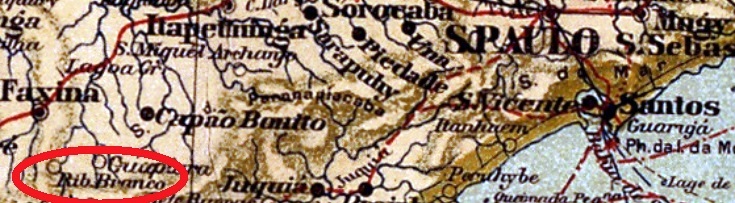
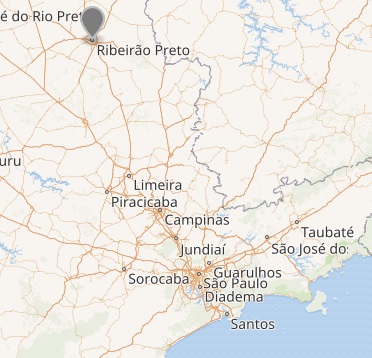
The tiny land settlement called Ribeirão Preto, some 300 km west from São Paulo, belonged to the parish of Santo Antonio da Boa Vista, in the municipality of Faxina, (also called Itapeva da Faxina). In March 1883, this Ribeirão Preto was renamed as the district of Bom Jesus do Ribeirão Branco. Probably this change was caused by the foundation, two years before, of the Villa of Ribeirão Preto (RSP-1095) in north São Paulo, the former Villa de Entre-Rios, which was developing quite fast.
The post office was created on June 25, 1881, still under the denomination Ribeirão Preto:
Correio Paulistano, June 28, 1881
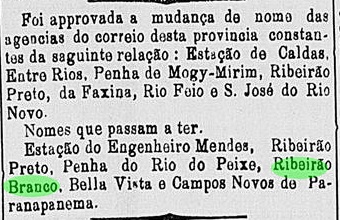
In September 1886, the postal administration announced the name change of six offices in the province. The former Ribeirão Preto da Faxina was renamed Ribeirão Branco, three and a half years after the district name change, whereas Entre-Rios turned into Ribeirão Preto (RSP-1095), more than five years after this toponymic change!
Correio Paulistano, September 14, 1886
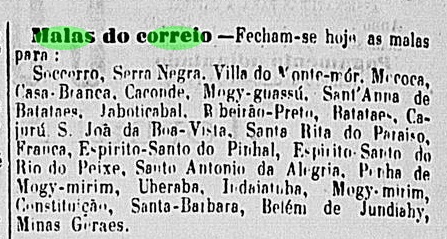
If we presume that the postal cancels of both agencies also switched at the same time, we could conclude that all Ribeirão Preto cancels before September 1886 refer to RSP-1097, while after that date they are related to RSP-1095. Unfortunately, this is not the case, for two reasons. The post office RSP-1095 was established ca. 1875 under the name Ribeirão Preto and kept this denomination at least until 1879, when the village was renamed to Entre-Rios. Since Reinhold Koester (Carimbologia XVII) tells us that postmarks with ENTRE-RIOS appeared between 1882 and 1884, there are possibly old RSP-1095 Ribeirão Preto cancels with date until ca. 1881. The second reason: the later RSP-1095a cancel has dates from 1885 on, i.e. it was already applied before the official return of the old postal name there. In conclusion, to be absolutely sure about which Ribeirão Preto cancel we deal with, we need more information in every case. This research has not come to an end.
The new Ribeirão Branco remained under Faxina until June 1892, when it became a Villa. Later in the 20th century, it was again degraded as a Faxina district, to acquire the definitive emancipation in November 1944.
No early cancels from Ribeirão Preto (Faxina) have been found to date.
Wikipedia (CC BY-SA)
Siehe auch: Ribeirão Branco (RSP-1085), Ribeirão Preto (RSP-1095)
Die kleine Siedlung namens Ribeirão Preto lag ungefähr 300 km westlich von der Provinzhauptstadt São Paulo entfernt und gehörte der Pfarrei Santo Antonio da Boa Vista, die wiederum dem Município von Faxina (oder auch: Itapeva da Faxina) untergeordnet war. Im März 1883 wurde aus diesem Ribeirão Preto der Distrikt Ribeirão Branco. Womöglich wurde die Namensänderung durch die zwei Jahre zuvor im Norden der Provinz gegründete – und seitdem rasch wachsende – Villa de Ribeirão Preto (RSP-1095), vorher Villa de Entre-Rios und ehemals wieder Ribeirão Preto, verursacht.
Das lokale Postamt entstand am 25. Juni 1881, noch unter der Bezeichnung Ribeirão Preto:
Correio Paulistano, 28. Juni 1881
Im September 1886 hat die provinziale Postverwaltung die Namensänderung von gleich sechs Postagenturen angekündigt. Das bisherige Postamt Ribeirão Preto da Faxina hieß fortan – also dreieinhalb Jahre nach der Ortsumbenennung – Ribeirão Branco, während aus der Postagentur Entre-Rios diejenige aus Ribeirão Preto wurde, über fünf Jahre nach dem offiziellen Wechsel des Ortsnamens!
Correio Paulistano 14. September 1886
Wenn wir davon ausgehen, dass auch bei den Poststempeln der Namenswechsel etwa zeitgleich stattgefunden haben mag, würde daraus zwangsläufig folgen, dass alle Ribeirão Preto-Stempel mit Datum bis September 1886 RSP-1097 zuzuordnen sind, während die Stempel mit späteren Daten zu RSP-1095 gehören. Leider sieht die Wirklichkeit anders aus, aus zwei Gründen. Erstens entstand das Postamt RSP-1095 ca. 1875 unter den Ortsnamen Ribeirão Preto und blieb so mindestens bis 1879, als diese Ortschaft in Entre-Rios umbenannt wurde. Da aber Reinhold Koester (Carimbologia XVII) uns berichtet, dass Entwertungen mit ENTRE-RIOS etwa zwischen 1882 und 1884 erschienen sind, bedeutet das, dass alte RSP-1095-Stempel mit RIBEIRÃO PRETO mit Datum bis ca. 1881 existieren können. Der zweite Grund: die spätere RSP-1095a-Entwertung (s. dort) hat Daten ab 1885, also bereits aus der Zeit vor der offiziellen Wiederherstellung des alten Postnamens. Fazit: um absolut sicher zu sein, um welchen Ribeirão-Preto-Stempel es sich jeweils handelt, brauchen wir mehr Information von Fall zu Fall. Hier ist die Forschungsarbeit längst nicht zu Ende.
Ribeirão Branco blieb unter der Faxina-Verwaltung bis Juni 1892, als der Ort zu einer Villa aufstieg. Später im 20. Jahrhundert wurde ihm der niedrigere Distrikt-Status wieder verpasst, bis die endgültige politische Emanzipierung im November 1944 stattfand.
Bisher wurde keine frühe Abstempelung von Ribeirão Preto (Faxina) gefunden.
See also: Entre-Rios/SP (Koester: Carimbologia XVII), Ribeirão Branco/SP (RSP-1085)
About disambiguation between RSP-1095 and RSP-1097 see Ribeirão Preto (Faxina, São Paulo (RSP-1097)
The district of São Sebastião do Ribeirão Preto was founded in April 1870 in the municipality of São Simão over 300 km northwest from São Paulo. It must have experienced from the beginning a steady and fast economical growth, because one year later it became a Villa with own municipality. A toponymic change to Entre-Rios in 1879 raised the immediate protest of the population, and two years later the old denomination returned. In April 1889, before the end of the empire, Ribeirão Preto was declared a city.
Until now it has been impossible to find the exact creation date of the local postal agency. Since the earliest press mention about it came into light in August 1875, we may suppose the post office was installed shortly before:
Correio Paulistano, August 15, 1875
The train station was built in November 1883 by the Cia. Mogyana railway, and placed about 3 km away from the village. According to the 1885 Imperial Mail Register (Tabella das Agencias do Correio do Império), the station post office was created in 1884.
Reinhold Koester (Carimbologia do Brasil Clássico XVII) describes a local postal cancel under the name of Entre-Rios, which circulated between 1882 and 1884, i.e. long after the locality was called Ribeirão Preto again. Indeed, the official comeback for the original name of the post office took place only in 1886:
Correio Paulistano, September 14, 1886
Nonetheless, a Ribeirão Preto cancel (RSP-1095a, Coll. José A. Junges) was already used in 1885, i.e. while the post office has been still named Entre-Rios. It has a double circle with the inscription RIBEIRÃO PRETO above, cross-form leaf ornament below and the date inside. Used until 1888. A later variant, RSP-1095b (Coll. José A. Junges) has been slightly modified and can be found until 1890.
No cancel from the train station could be found to date. And certainly there is also a Ribeirão Preto postmark from the early period (1875-1881) still to discover.
Zur Unterscheidung zwischen RSP-1095 und RSP-1097 siehe Ribeirão Preto (Faxina), São Paulo (RSP-1097).
Der Distrikt von São Sebastião do Ribeirão Preto wurde im April 1870 etwa 300 km nordwestlich von São Paulo im Bezirksgebiet von São Simão gegründet. Danach muss die Ortschaft einen raschen Fortschritt erlebt haben, denn bereits ein Jahr später kam die politische Emanzipierung, und aus Ribeirão Preto wurde eine Villa. Eine Namensänderung zu Entre-Rios in 1879 führte zum heftigen Widerstand der Bevölkerung, zwei Jahre danach war die alte Ortsbezeichnung wieder rehabilitiert. Im April 1889, kurz vor der Ausrufung der Republik, bekam Ribeirão Preto den Status einer Stadt.
Bisher konnten wir nicht das genaue Datum für die Entstehung des örtlichen Postamts ermitteln. Da aber diesbezüglich die früheste Erwähnung in der Presse vom August 1875 stammt, darf man annehmen, dass die Agentur kurz davor installiert wurde:
Correio Paulistano, 15. August 1875
Der Bahnhof wurde im November 1883 durch die Cia. Mogyana Eisenbahngesellschaft gebaut und lag etwa 3 km südlich von der Ortsmitte entfernt. Laut Tabelle der kaiserlichen Postämter vom 1885 (Tabella das Agencias do Correio do Império), entstand das Bahnhofspostamt in 1884.
Reinhold Koester (Carimbologia do Brasil Clássico XVII) schreibt über eine örtliche Abstempelung mit dem Namen Entre-Rios, die zwischen 1882 und 1884 im Gebrauch war, d. h. lange Zeit nachdem der Ort wieder Ribeirão Preto hieß. Tatsächlich wurde die alte offizielle Bezeichnung fürs Postamt erst in 1886 wieder hergestellt:
Correio Paulistano, 14. September 1886
Nichtsdestotrotz wurde ein Stempel von Ribeirão Preto (RSP-1095a, Samml. José A. Junges) schon in 1885 gebraucht, zu einer Zeit also, als das Postamt noch Entre-Rios hieß. Der Stempel hat einen Doppelkreis mit der Inschrift RIBEIRÃO PRETO oben, einem kreuzförmigen Blattornament unten, dazu das Datum im Innenkreis. Im Gebrauch bis 1888. Eine spätere Variante, RSP-1095b (Samml. José A. Junges) wurde leicht verändert und war bis 1890 zu finden.
Kein Bahnhofsstempel der Kaiserzeit wurde bisher gefunden. Ein Stempel aus der Frühzeit (1875-1881) von Ribeirão Preto bleibt ebenfalls unentdeckt.
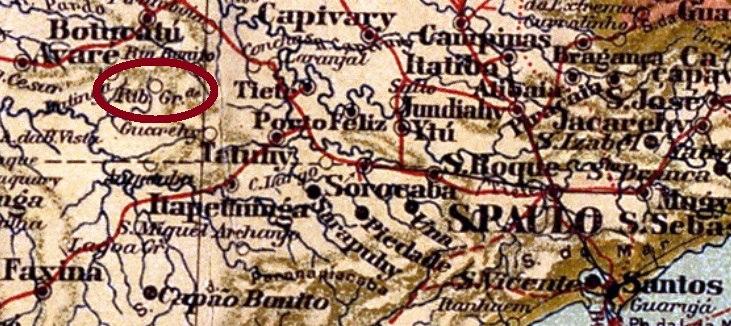
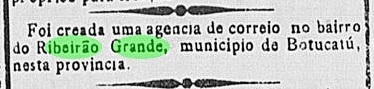
Ribeirão Grande was a small village near the Serra de Botucatu, about 200 km west from São Paulo, in the municipality of Botucatu. The district of Senhor Bom Jesus do Ribeirão Grande was created in November 1880. Eight years later, the local post office was announced:
Correio Paulistano, October 28. 1888
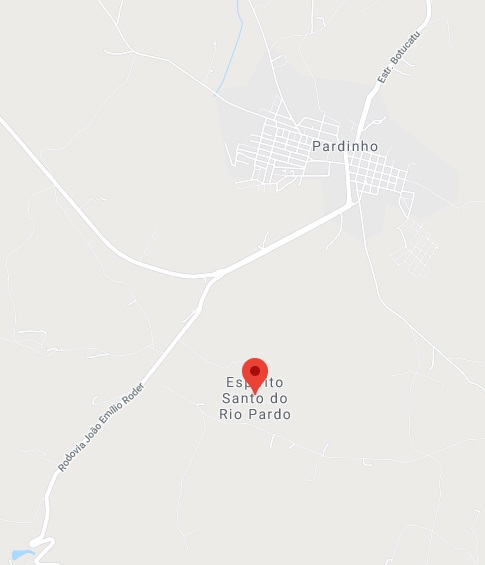
However, this locality was not destined for prosperity. By 1910 the post office was already closed, and Ribeirão Grande went for good into the district of Espírito Santo do Rio Pardo, a flourishing neighbour village that became the municipality of Pardinho in 1938. Since then, the name Ribeirão Grande disappeared. Supposedly it might be the quarter now called Espírito Santo do Rio Pardo, south of Pardinho (see map below).
Now imperial postmark has been found to date. Whenever existent, it must be very rare.
Google Maps
Ribeirão Grande war ein Weiler nahe der Serra de Botucatu, etwa 200 km westlich von São Paulo im Município von Botucatu gelegen. Der Distrikt von Senhor Bom Jesus do Ribeirão Grande wurde im November 1880 gegründet. Acht Jahre später wurde das örtliche Postamt in der Presse angekündigt:
Correio Paulistano, 28. Oktober 1888
Dennoch war der Ortschaft kein Gedeihen gegönnt, denn vor 1910 wurde das Postamt wieder geschlossen, und dann ging die Ortsverwaltung von Ribeirão Grande in den Nachbardistrikt von Espírito Santo do Rio Pardo über. Dieser Distrikt wurde schließlich im Jahr 1938 der Município von Pardinho. Heute sucht man Ribeirão Grande auf der Karte vergebens, vermutlich wurde der heutige Espírito Santo do Rio Pardo daraus, ein Vorort südlich von Pardinho (siehe Karte oben).
Keine Abstempelung der Kaiserzeit wurde bisher gefunden. Sie muss sehr selten sein, sofern es sie noch gibt.
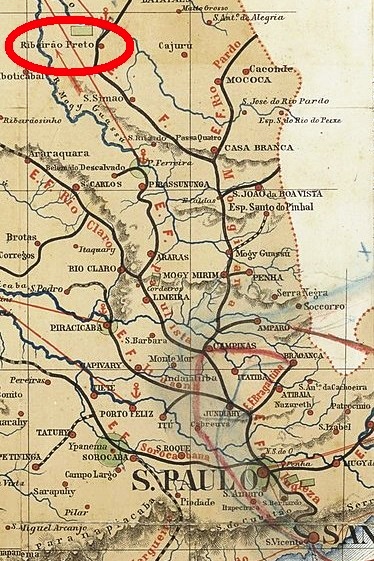
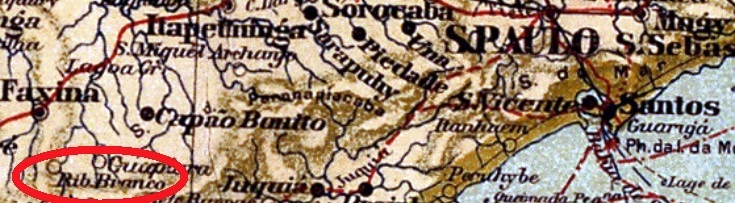
Ribeirão Branco means actually White Brook, but the ancient name of this locality was the opposite: Ribeirão Preto (= Black Brook)! Since there was another important town in the province of São Paulo with this same toponymy (RSP-1095), and given that even the provincial press eventually mixed up both places, we have to distinguish them with care.
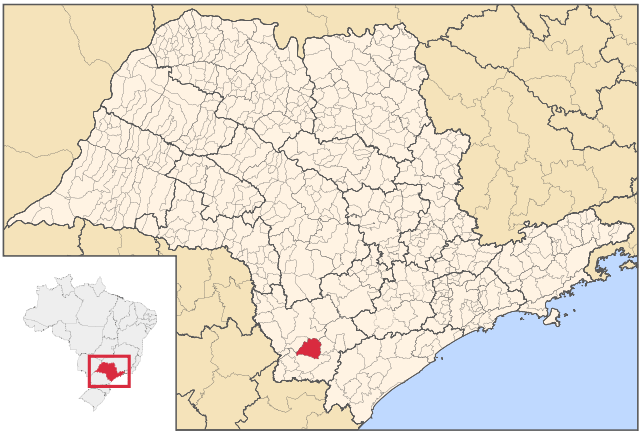
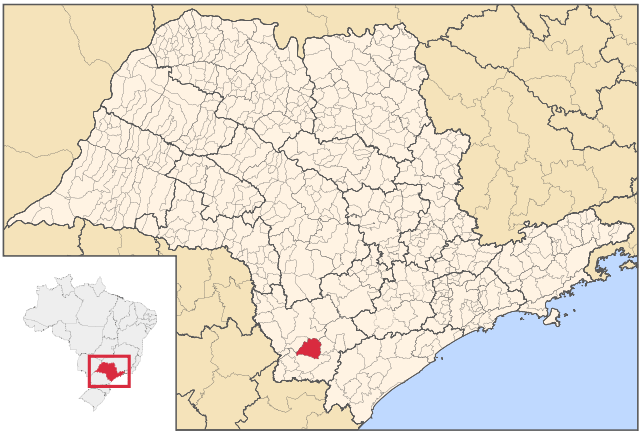
At the beginning there was the tiny land settlement called Ribeirão Preto, some 300 km west from São Paulo, which belonged to the parish of Santo Antonio da Boa Vista, in the municipality of Faxina, this one also called Itapeva da Faxina. In March 1883, this Ribeirão Preto was renamed as the district of Bom Jesus do Ribeirão Branco. Probably this change was caused by the foundation, two years before, of the Villa of Ribeirão Preto (RSP-1095) in north São Paulo, the former Villa de Entre-Rios, which was developing quite fast.
The new Ribeirão Branco remained under Faxina until June 1892, when it became a Villa. Later in the 20th century, it was again degraded as a Faxina district, to acquire the definitive emancipation in November 1944.
The post office was created on June 25, 1881, still under the denomination Ribeirão Preto:
Correio Paulistano, June 28, 1881
The cancels from this early period will be presented (whenever available) under Ribeirão Preto (Faxina), RSP-1097.
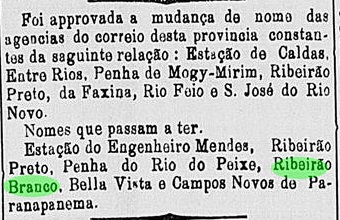
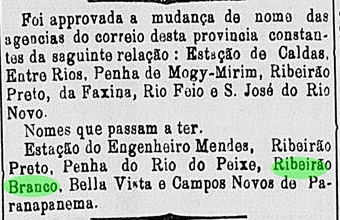
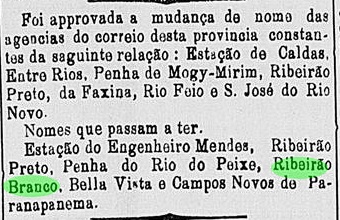
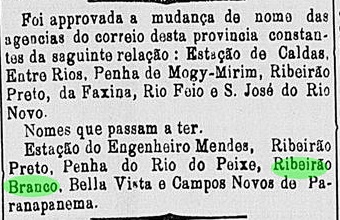
In September 1886, the postal administration announced the name change of six offices in the province. The former Ribeirão Preto da Faxina was renamed Ribeirão Branco, three and a half years after the district name change, whereas Entre-Rios turned into Ribeirão Preto, more than five years after this toponymic change!
Correio Paulistano, September, 14, 1886
About disambiguation between RSP-1095 and RSP-1097 see Ribeirão Preto (Faxina), São Paulo (RSP-1097).
There is a single cancel known under Ribeirão Branco: RSP-1085a (Coll. José A. Junges) has a double circle with RIBEIRÃO BRANCO (above), of which the swung dash is found exactly between the letters A and O, an ornament in clubs-like cross (below), and the date inside. Copies found used between 1887 and 1897.
Wikipedia CC BY-SA
Buchtext-Korrektur vom 3.April 2020
Eigentlich bedeutet Ribeirão Branco etwa Weißbach, dennoch hieß diese Ortschaft ganz früh genau im Gegenteil Ribeirão Preto, also etwa Schwarzenbach! Da es in der Provinz São Paulo einen weiteren und wichtigeren Ort mit denselben Namen gab (RSP-1095), und wenn man feststellt, dass damals sogar die Provinzpresse beide Gemeinden gelegentlich verwechselte, ist bei der Begriffserklärung besondere Vorsicht geboten.
Zu Beginn gab es eine kleine Siedlung namens Ribeirão Preto ungefähr 300 km westlich von der Provinzhauptstadt São Paulo entfernt, die der Pfarrei Santo Antonio da Boa Vista gehörte, die wiederum dem Município von Faxina (oder auch: Itapeva da Faxina) untergeordnet war. Im März 1883 wurde aus diesem Ribeirão Preto der Distrikt Ribeirão Branco. Womöglich wurde die Namensänderung durch die zwei Jahre zuvor im Norden der Provinz gegründete – und seitdem rasch wachsende – Villa de Ribeirão Preto (RSP-1095), ehemals Villa de Entre-Rios, verursacht.
Ribeirão Branco blieb unter der Faxina-Verwaltung bis Juni 1892, als der Ort zu einer Villa aufstieg. Später im 20. Jahrhundert wurde ihm der niedrigere Distrikt-Status wieder verpasst, bis die endgültige politische Emanzipierung im November 1944 stattfand.
Das lokale Postamt entstand am 25. Juni 1881, noch unter der Bezeichnung Ribeirão Preto:
Correio Paulistano, 28. Juni 1881
Falls sie überhaupt auffindbar sind, werden die Poststempel dieser früheren Zeit unter Ribeirão Preto (Faxina), RSP-1097, beschrieben.
Im September 1886 hat die provinziale Postverwaltung die Namensänderung von gleich sechs Postagenturen angekündigt. Das bisherige Postamt Ribeirão Preto da Faxina hieß fortan – also dreieinhalb Jahre nach der Ortsumbenennung – Ribeirão Branco, während aus der Postagentur Entre-Rios diejenige mit Namen Ribeirão Preto wurde, über fünf Jahre nach dem offiziellen Wechsel des Ortsnamens!
Correio Paulistano, 14. September 1886
Zur Unterscheidung zwischen RSP-1095 und RSP-1097 siehe Ribeirão Preto (Faxina), São Paulo (RSP-1097).
Ein einziger Stempel aus Ribeirão Branco ist bisher überliefert: RSP-1085a (Samml. José A. Junges) hat einen Doppelkreis mit der Inschrift RIBEIRÃO BRANCO (oben), wovon die Tilde genau zwischen den Buchstaben A und O platziert ist, dazu sieht man eine Verzierung in Kreuzform (unten), und das Datum im Innenkreis. Die Exemplare davon tragen Daten zwischen 1887 und 1897.














 Carimbologia