Categories
Carimbologia E-G

Geremoabo, Bahia (GBA-0380)

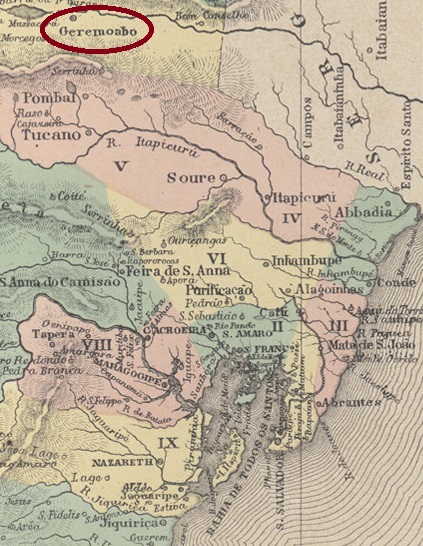
Atlas do Imperio do Brasil, 1868

The Freguesia de S. João Baptista de Geremoabo do Sertão de Cima, which had existed since 1718, belonged to the Vila de Itapicuru and was located on the north bank of the Vaza-Barris, 380 kilometres north of the provincial capital Salvador da Bahia. In October 1831, it was elevated to a Vila and in July 1925 to a town, which has been spelt Jeremoabo since December 1943. The name from the Tupi language is said to mean pumpkin plantation.

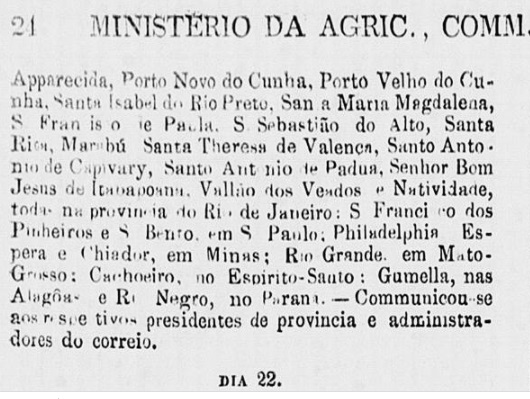
As the Rio press reported, there had been a post office in the town since April 1861:

Correio Mercantil/RJ, 11/05/1861 rep. of April 23

Another post office opening was reported in 1866, as can be seen from the list of imperial post offices (Tabella das Agencias do Correio do Imperio, Rio de Janeiro, 1885).

No imperial postmarks from Geremoabo have yet been found.
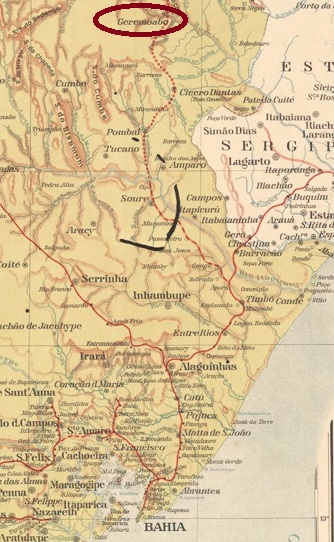
Estado da Bahia, 1913

Die seit 1718 bestehende Freguesia de S. João Baptista de Geremoabo do Sertão de Cima gehörte zur Vila de Itapicuru und lag am Nordufer des Vaza-Barris, 380 km nördlich der Provinzhauptstadt Salvador da Bahia. Im Oktober 1831 erfolgte die Erhebung zur Vila und im Juli 1925 zur Stadt, die seit Dezember 1943 Jeremoabo geschrieben wird. Der Name aus der Tupi-Sprache soll Kürbisplantage bedeuten.

Wie die Presse aus Rio berichtete, gab es seit April 1861 ein Postamt am Ort:

Correio Mercantil/RJ, 11.05.1861 (Protokoll des 23.04.)

Eine weitere Eröffnung fand 1866 statt, wie aus dem Verzeichnis der kaiserlichen Postämter (Tabella das Agencias do Correio do Imperio, Rio de Janeiro, 1885) hervorgeht.

Bisher wurden keine kaiserlichen Poststempel von Geremoabo gefunden.
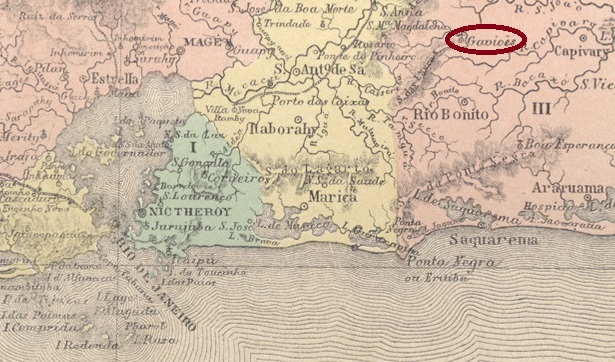
Categories
Carimbologia E-G

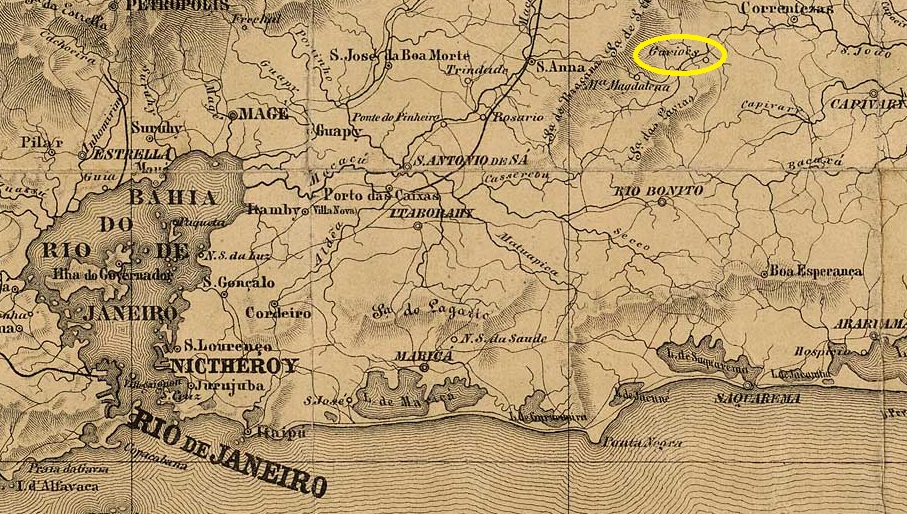
Gaviões, Rio de Janeiro (GRJ-0570)

Atlas do Imperio do Brasil, 1868

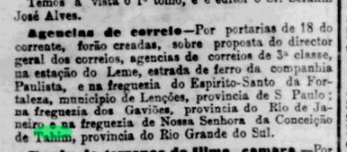
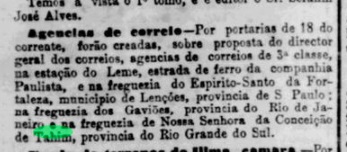
The Curato de N. Sra. da Conceição dos Gaviões had been in existence since July 1860. It belonged to the Vila de Capivary and was located 120 kilometres north-east of the capital Rio de Janeiro. In January 1877, it was transferred to the Vila de Sant’Anna de Macacu and became a Freguesia da Vila de Capivary in December 1880. Since December 1943, Gaviões has been a distrito in the Município de Silva Jardim.

The regional press reported that there had been a post office in the village since June 1883:

Jornal do Commercio, 19/06/1883

The imperial postmark is GRJ-0570a (fig. R. Koester in Carimbologia XX):

GRJ-0570a (RK) 1888
Laemmert: Provincia do Rio de Janeiro, 1866

Seit Juli 1860 gab es den Curato de N. Sra. da Conceição dos Gaviões. Er gehörte zur Vila de Capivary und lag 120 km nordöstlich der Hauptstadt Rio de Janeiro. Im Januar 1877 wechselte sie zur Vila de Sant’Anna de Macacu und wurde im Dezember 1880 eine Freguesia da Vila de Capivary. Seit Dezember 1943 ist Gaviões ein Distrito im Município de Silva Jardim.

Wie die regionale Presse berichtete, gab es seit Juni 1883 ein Postamt im Ort:

Jornal do Commercio, 19.06.1883

Der kaiserliche Poststempel ist GRJ-0570a (Abb. R. Koester in Carimbologia XX):

GRJ-0570a (RK) 1888
Categories
Carimbologia E-G

Garopaba, Santa Catarina (GSC-0100)

Atlas do Imperio do Brasil, 1868

Text update of March 7, 2025

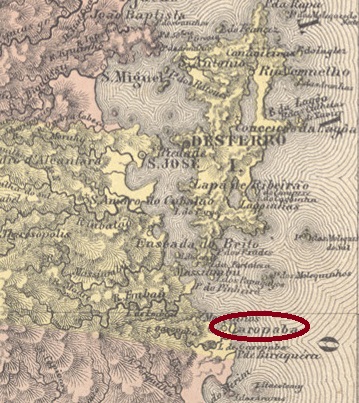
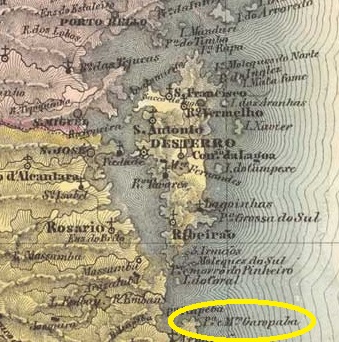
The Freguesia de S. Joaquim de Garopaba was founded in May 1846 and belonged to the Vila de S. José, 80 kilometres south of the provincial capital Desterro (now Florianópolis). In April 1877 it was elevated to the status of a vila, but lost this status in 1923 when it became a distrito of the município de Imbituba. In December 1930, Garopaba became a distrito of the município de Palhoça and has only been an independent município again since December 1961.

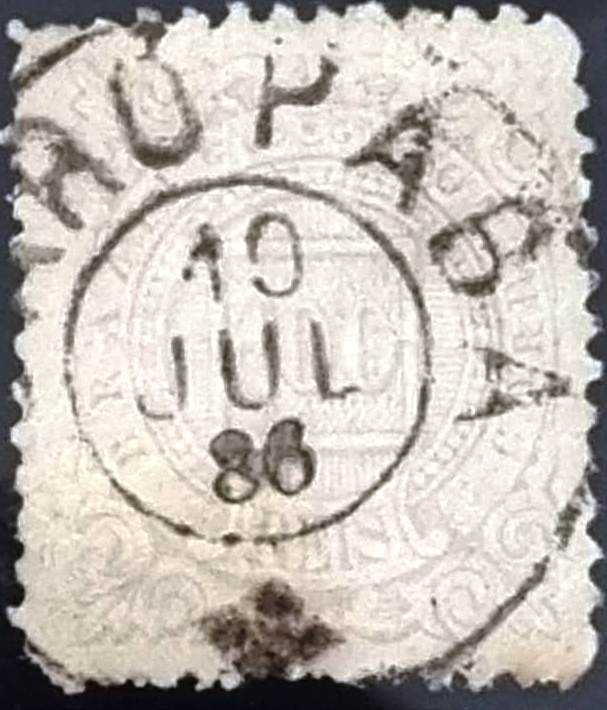
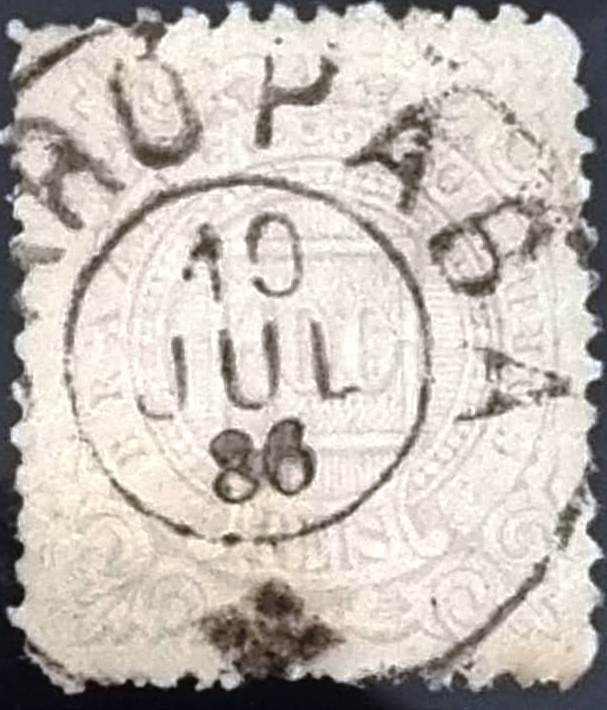
As Luiz C. Fritzen writes in Agências Postais da Província de Santa Catharina durante o Império Brasileiro (Boletim AFSC no 56, Florianópolis, 2007), there was a post office there since April 1875. The oldest postmark to date is GSC-0100a (Marcio Duarte Collection):

GSC-0100a (MD) 1886

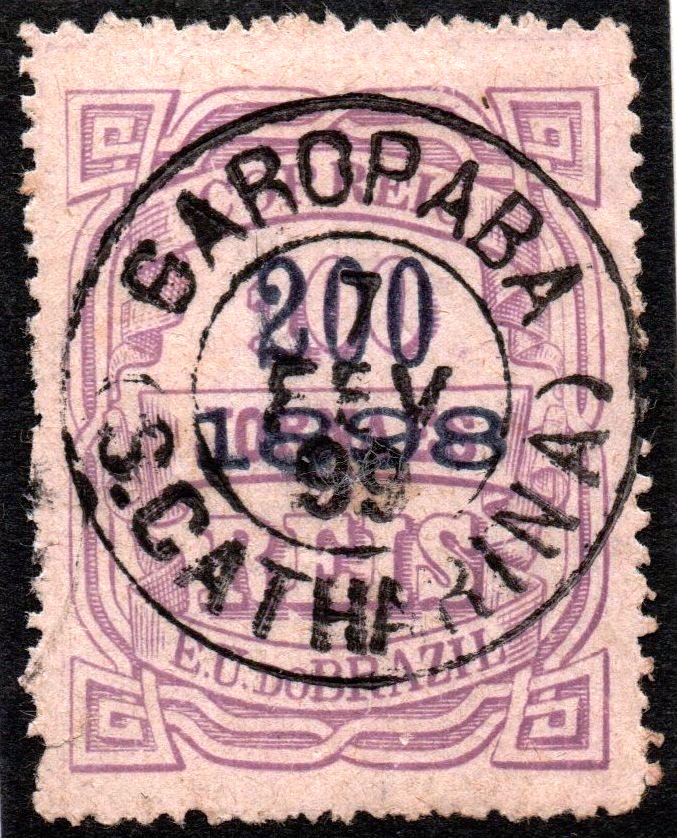
This was followed by GSC-0100b (José Junges collection):

GSC-0100b (JJ) 1899
Villiers de l’Ile Adam: Carta (…) da Provincia de Santa Catharina, 1848

Textaktualisierung am 7. März 2025

Die Freguesia de S. Joaquim de Garopaba wurde im Mai 1846 gegründet und gehörte zur Vila de S. José, 80 km südlich der Provinzhauptstadt Desterro (heute Florianópolis). Im April 1877 wurde es zur Vila erhoben, verlor diesen Status aber 1923, als es ein Distrito des Município de Imbituba wurde. Im Dezember 1930 wechselte Garopaba als Distrito zum Município de Palhoça und ist erst seit Dezember 1961 wieder ein eigenständiges Município.

Wie Luiz C. Fritzen in Agências Postais da Província de Santa Catharina durante o Império Brasileiro (Boletim AFSC no 56, Florianópolis, 2007) schreibt, gab es dort ein Postamt seit April 1875. Der bisher älteste Poststempel ist GSC-0100a (Samml. Marcio Duarte):

GSC-0100a (MD) 1886

Es folgte GSC-0100b (Samml. José Junges):

GSC-0100b (JJ) 1899

Categories
Carimbologia E-G

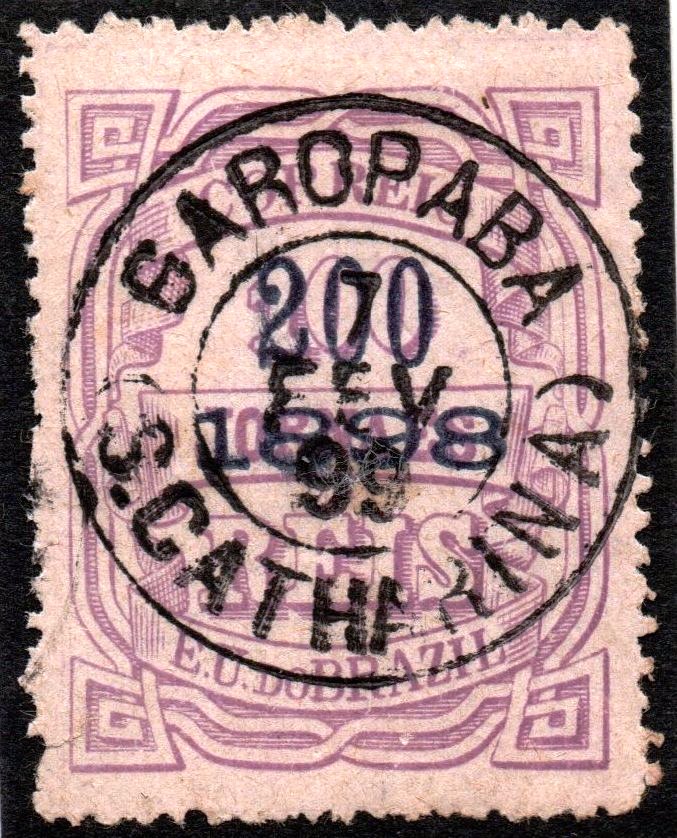
Garimpo das Canoas, Minas Gerais (GMG-1215)

C. D. Rath: Provincia de São Paulo, 1886

Other names: Claraval (1953)

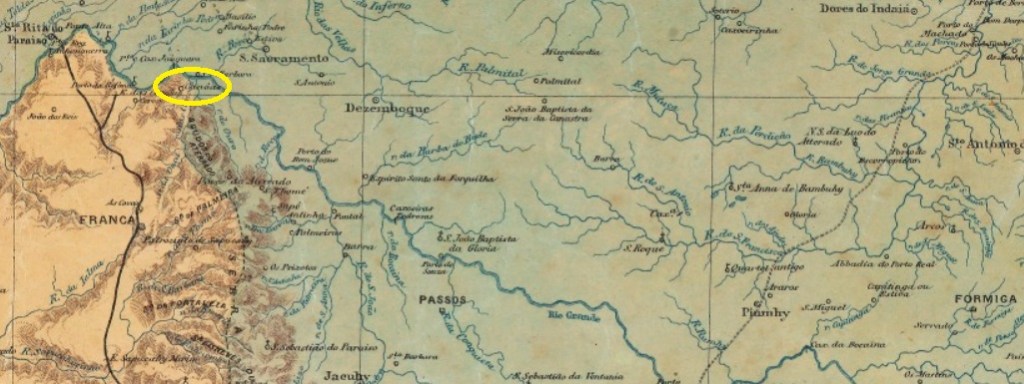
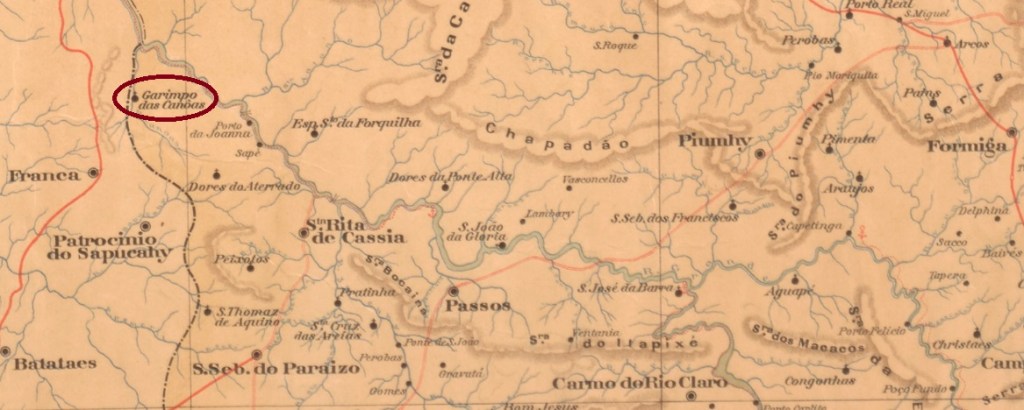
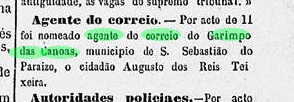
Garimpo das Canoas (Gold Diggers on the Canoas River) was a district of the Vila de S. Sebastião do Paraíso from October 1866, located on the east bank of the Canoas River on the provincial border with São Paulo, 540 kilometres west of the capital Ouro Preto. In August 1881, the village became the Freguesia do Divino Espirito Santo do Garimpo das Canoas. This remained the case until September 1923, when it became a district in the Município de Ibiraci. Since December 1953, the village has been the Município de Claraval.

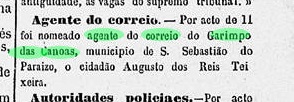
In História Postal de Minas Gerais (Belo Horizonte, 1997), Paula Sobrinho gives two creation dates for the local post office: August 1880 and May 1881. If this is correct, it would mean that the post office did not start operations at least once. However, since no Garimpo das Canoas post office is listed in the directory of imperial post offices (Tabella das Agencias do Correio do Imperio, Rio de Janeiro, 1885), both dates are probably irrelevant. On the other hand, a third date in August 1888 is mentioned by R. Koester in Carimbologia XX, and also confirmed by the regional press:

A União, 15/09/1888

No imperial postmark from Garimpo das Canoas has yet been found.

Estado de Minas Geraes, 1910

Andere Namen: Claraval (1953)

Garimpo das Canoas (Goldgräber am Fluss Canoas) war seit Oktober 1866 ein Distrikt der Vila de S. Sebastião do Paraíso und lag am Ostufer des Canoas an der Provinzgrenze zu São Paulo, 540 km westlich der Hauptstadt Ouro Preto. Im August 1881 wurde der Ort zur Freguesia do Divino Espirito Santo do Garimpo das Canoas. Dies blieb so bis September 1923, als der Ort ein Distrito im Município de Ibiraci wurde. Seit Dezember 1953 ist der Ort der Município de Claraval.

Paula Sobrinho gibt in História Postal de Minas Gerais (Belo Horizonte, 1997) zwei Gründungsdaten für das örtliche Postamt an: August 1880 und Mai 1881. Wenn diese Angaben stimmen, bedeutet dies, dass das Postamt mindestens einmal nicht eröffnet werden konnte. Da aber im Verzeichnis der kaiserlichen Postämter (Tabella das Agencias do Correio do Imperio, Rio de Janeiro, 1885) kein Postamt Garimpo das Canoas verzeichnet ist, dürften beide Daten ohne Bedeutung sein. Dagegen wird ein drittes Datum im August 1888 von R. Koester in Carimbologia XX auch von der regionalen Presse bestätigt:

A União, 15.09.1888

Bisher wurde kein kaiserlicher Poststempel aus Garimpo das Canoas gefunden.

Categories
Carimbologia E-G

Garanhuns (GPE-0280) – Garanhuns (train station/Bahnhof), Pernambuco (GPE-0281)

Atlas do Imperio do Brasil, 1868

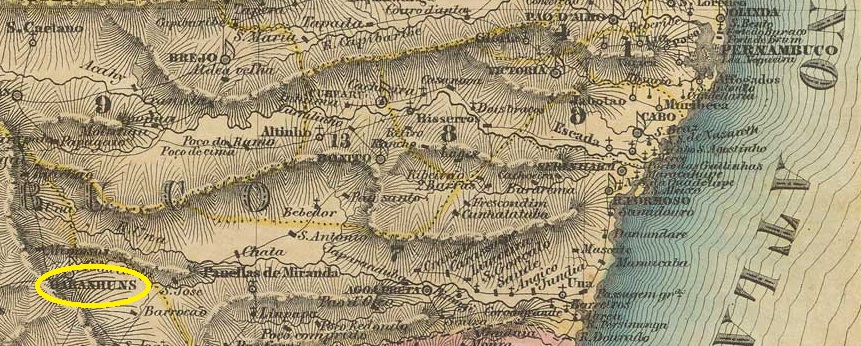
Santo Antonio de Garanhuns had been a freguesia since August 1800, a vila since March 1811 and a town since February 1874, located 230 kilometres southwest of the capital Recife.

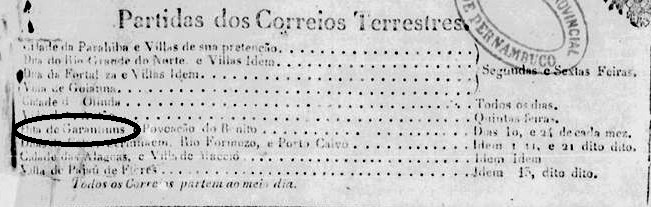
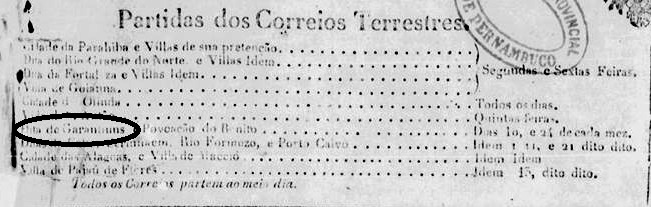
As Nova Monteiro writes in Administrações e Agencias Postaes do Brasil Imperio (Brasil Filatelico/RJ, 1934-5; reprint SPP 1994-1999), there had been a post office there since March 1829. The list of imperial post offices (Tabella das Agencias do Correio do Imperio, Rio de Janeiro, 1885) gives the year 1840, but this is probably a mistake, as there was still a regular postal route (Correio Terrestre) to Garanhuns and Bonito twice a month in January 1840:

Diario de Pernambuco, 02/01/1840

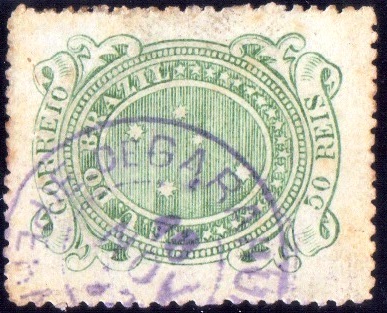
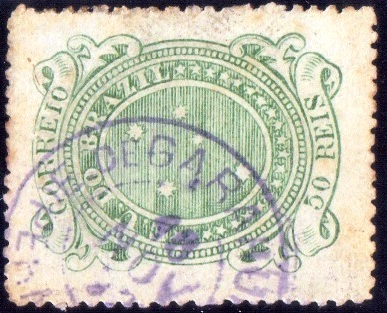
The oldest postmark to date is the French type GPE-0280b (fig. R. Koester in Carimbologia XX):

GPE-0280b (RK) 1887ff-1889

In September 1887, a railway station of the E.F. Recife ao S. Francisco railway company (Garanhuns Branch) was opened locally. Subsequently, there was daily mail traffic to and from Garanhuns, and the post office was moved there at the latest after the beginning of the Republic, as the postmark GPE-0281a (illus. Rodrigo Baldassare) shows:

GPE-0281a (RB) 1892-1896
Villiers de l’Ile Adam: Carta (…) das Provincias de Pernambuco, Alagoas e Sergipe, 1848

Seit August 1800 war Santo Antonio de Garanhuns eine Freguesia, seit März 1811 eine Vila und seit Februar 1874 eine Stadt, 230 km südwestlich der Hauptstadt Recife gelegen.

Wie Nova Monteiro in Administrações e Agencias Postaes do Brasil Imperio (Brasil Filatelico/RJ, 1934-5; Reprint SPP 1994-1999) schreibt, gab es dort seit März 1829 ein Postamt. Das Verzeichnis der kaiserlichen Postämter (Tabella das Agencias do Correio do Imperio, Rio de Janeiro, 1885) gibt das Jahr 1840 an, was aber ein Irrtum sein dürfte, denn noch im Januar 1840 gab es zweimal im Monat eine regelmäßige Postroute (Correio Terrestre) nach Garanhuns und Bonito:

Diario de Pernambuco, 02.01.1840

Der bisher älteste Poststempel ist der französische Typ GPE-0280b (Abb. R. Koester in Carimbologia XX):

GPE-0280b (RK) 1887ff-1889

Im September 1887 wurde vor Ort ein Bahnhof der Eisenbahngesellschaft E.F. Recife ao S. Francisco (Abzweig Garanhuns) eröffnet. In der Folge gab es täglichen Postverkehr von und nach Garanhuns, und spätestens nach Beginn der Republik wurde das Postamt dorthin verlegt, wie der Poststempel GPE-0281a (Abb. Rodrigo Baldassare) zeigt:

GPE-0281a (RB) 1892-1896
Categories
Carimbologia E-G

Gamelleira (train station/Bahnhof), Pernambuco (GPE-0765)

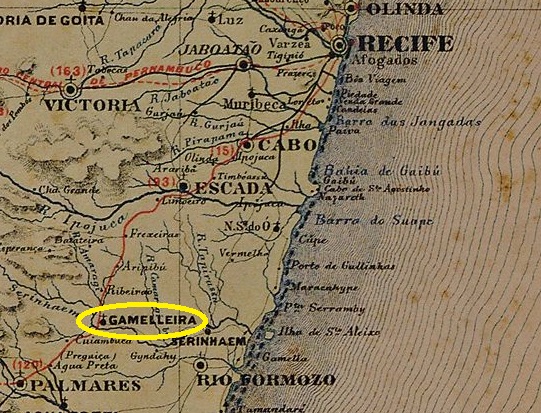
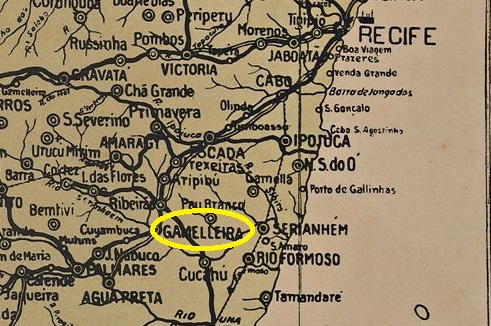
Carta Corographica da Provincia de Pernambuco, 1880

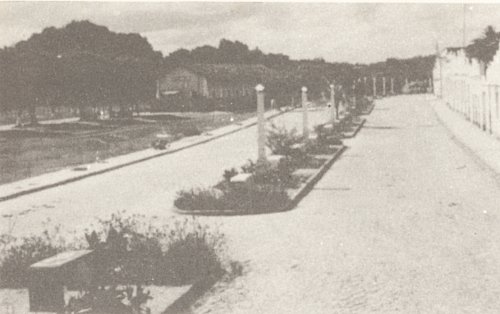
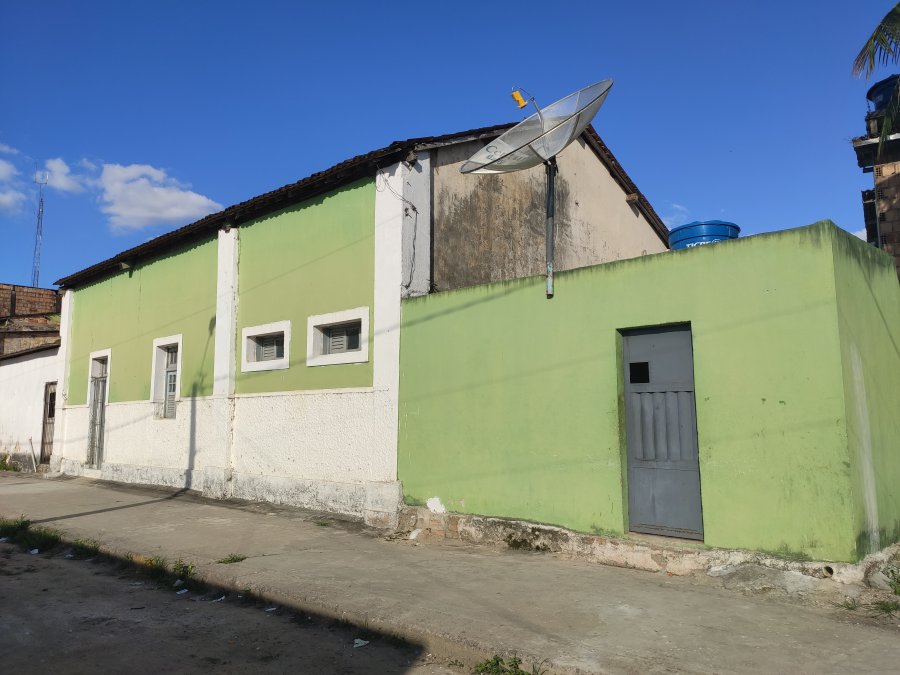
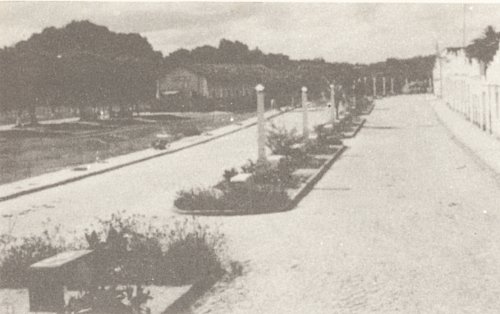
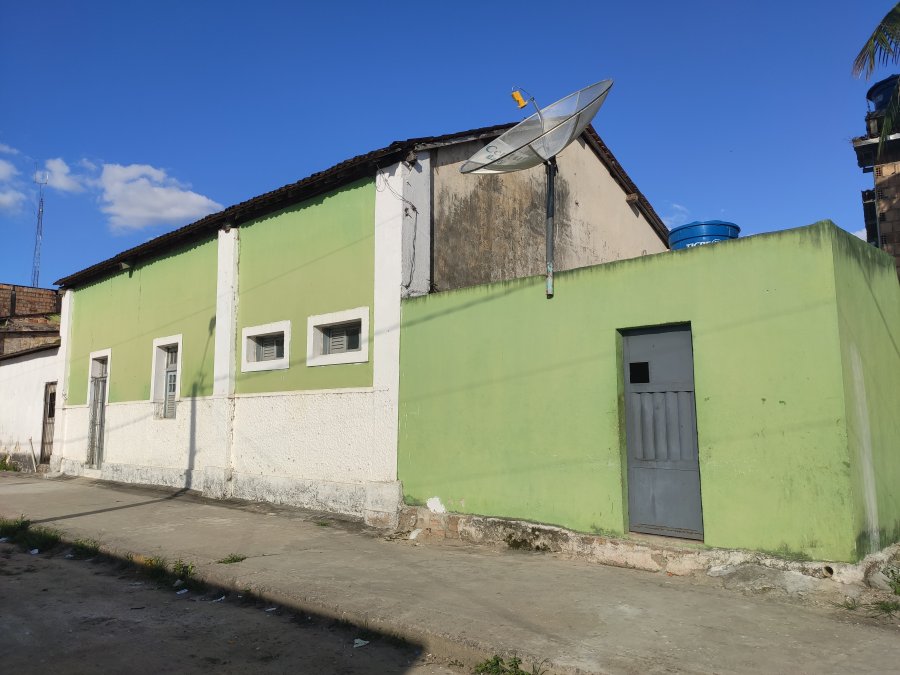
Gamelleira station was opened in May 1862 by the railway company E.F. do Recife ao S. Francisco (main line) in the Município de Serinhaém on the west bank of the river of the same name, 95 km south-west of the provincial capital Recife. The railway line was transferred to Great Western in 1901 and to Rede Ferroviaria do Nordeste in 1950 and was owned by Rede Ferroviária Federal S.A. from 1975 until it was closed in 1996 (estacoesferroviarias.com.br). Today the tracks are still there, the station building serves as a residential building.

Around 1950 (IBGE)
In November 2020 (Photo: Rodrigo Henrique, on estacoesferroviarias.com.br)

The settlement around the railway station grew rapidly and became a freguesia in June 1867 and a vila five years later.

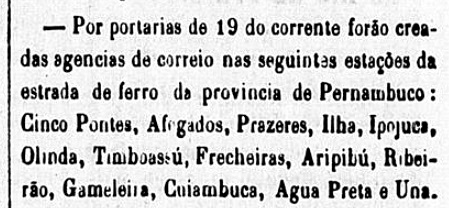
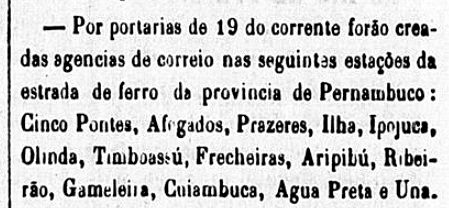
According to the Rio press, there had been a post office at the railway station since December 1864:

Constitucional/RJ, 24/12/1864

R. Koester shows in Carimbologia XX handwritten postmarks from around 1880 from this station:

1876ff-1882ff (RK)

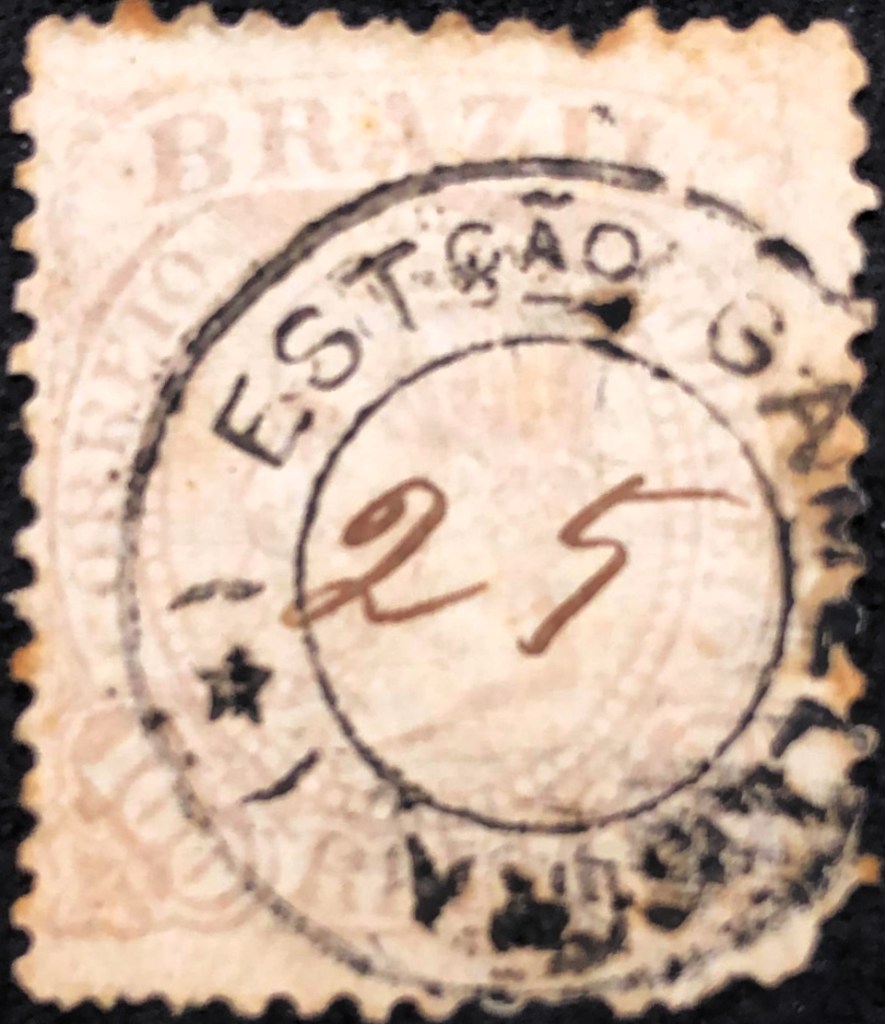
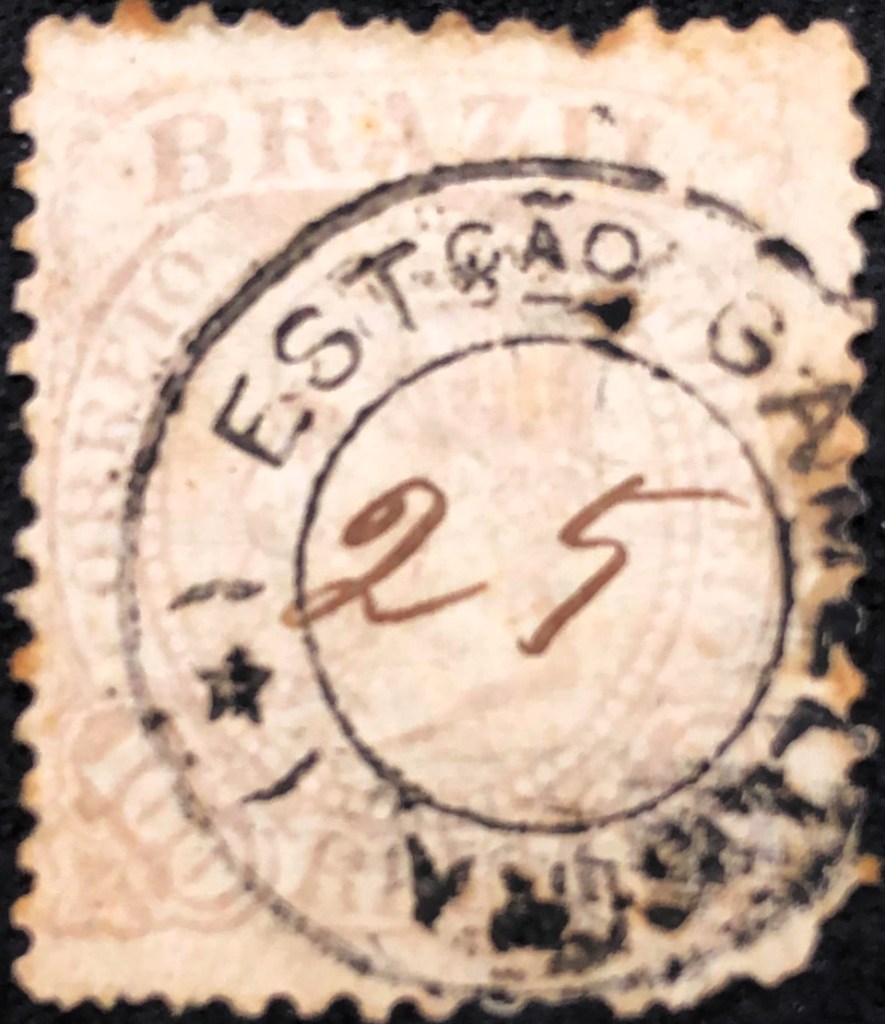
The oldest postmark to date is the French type GPE-0765a (ill. Marco Morel):

GPE-0765a (ME) 1883ff-1889

Another handwritten cancellation dates from the early days of the Republic, this time from the Fuad Ferreira Fo. collection:

1891 (FF)
Arthur D. Ribeiro: Estado de Pernambuco, 1924

Der Bahnhof Gamelleira wurde im Mai 1862 von der Eisenbahngesellschaft E.F. do Recife ao S. Francisco (Hauptstrecke) eröffnet und lag im Município de Serinhaém am Westufer des gleichnamigen Flusses, 95 km südwestlich der Provinzhauptstadt Recife. Die Bahnlinie ging 1901 an die Great Western und 1950 an die Rede Ferroviaria do Nordeste über und war von 1975 bis zu ihrer Stilllegung 1996 im Besitz der Rede Ferroviária Federal S.A. (estacoesferroviarias.com.br). Heute sind die Gleise noch vorhanden, das Bahnhofsgebäude dient als Wohnhaus.

Um 1950 (IBGE)
Im November 2020 (Foto: Rodrigo Henrique, auf estacoesferroviarias.com.br)

Die Siedlung um den Bahnhof wuchs schnell und wurde im Juni 1867 zur Freguesia und fünf Jahre später zur Vila.

Wie die Presse von Rio schreibt, gab es seit Dezember 1864 ein Postamt am Bahnhof:

Constitucional/RJ, 24.12.1864

R. Koester zeigt in Carimbologia XX handschriftliche Stempel von ca. 1880 von diesem Bahnhof:

1876ff-1882ff (RK)

Der bisher älteste Stempel ist der französische Typ GPE-0765a (Abb. Marco Morel):

GPE-0765a (ME) 1883ff-1889

Aus der Anfangszeit der Republik stammt eine weitere handschriftliche Entwertung, diesmal aus der Sammlung Fuad Ferreira Fo:

1891 (FF)
Categories
Carimbologia E-G

Gamella, Alagoas (GAL-0065)

Carta Corographica da Provincia de Pernambuco, 1880

Other names: Villa Izabel, Maragogy (1876)

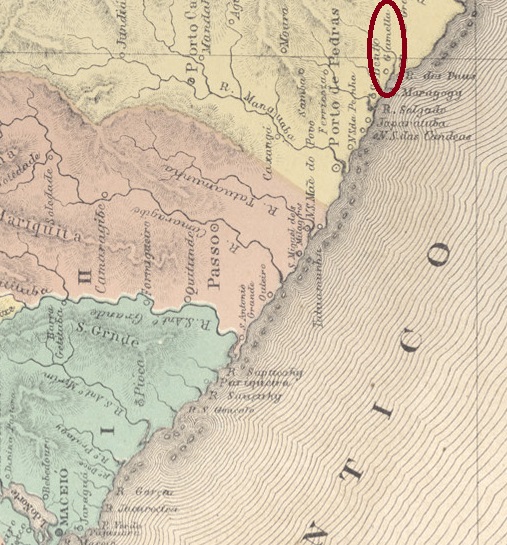
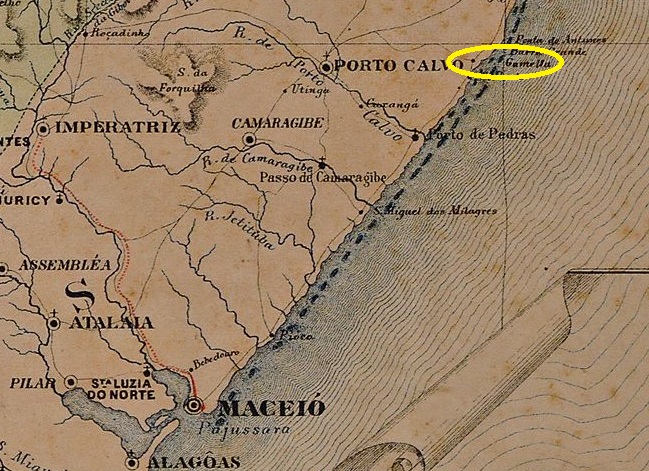
Gamela was an idyllic beachside settlement of the Vila de Porto Calvo near the provincial border with Pernambuco, 130 kilometres north-east of the capital Maceió. In April 1875, the village was renamed Villa Izabel, but in July 1876 it was renamed Vila de São Bento de Maragogy, which became the town of Maragogi in May 1892.

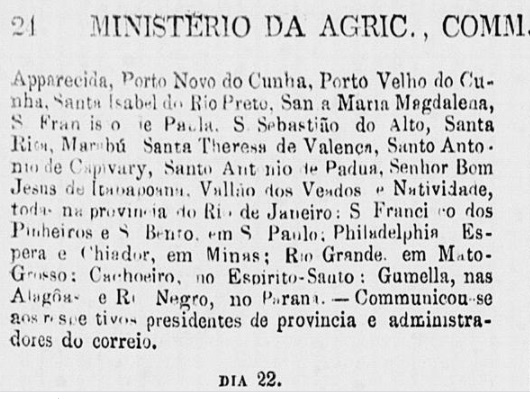
As Aureo G. Santos writes in Agências de Correio Criadas e Suprimidas 1851, 1855, 1856 e 1857 (Brasil Filatélico 181, Rio de Janeiro, 1977), there had been a post office there since December 1855, which was closed in June 1861, as can be seen from the minutes of the imperial ministry:

Expediente do Ministerio do Imperio, 21.06.1861

The postal agency was reopened in October 1876, as Aldo Cardoso reports in Contribuição para a História dos Correios de Alagoas (Maceió, 1969). If the postmarks were delivered on time, there were imperial postmarks with the place name Villa Isabel for 10 months.

Postmarks with Gamela have not yet been found, postmarks with Maragogy will be listed under MAL-0110.

Atlas do Imperio do Brasil, 1868

Andere Namen: Villa Izabel, Maragogy (1876)

Gamela war eine idyllisch am Strand gelegene Siedlung der Vila de Porto Calvo nahe der Provinzgrenze zu Pernambuco, 130 km nordöstlich der Hauptstadt Maceió. Im April 1875 wurde der Ort in Villa Izabel umbenannt, aber bereits im Juli 1876 erfolgte die Umbenennung in Vila de São Bento de Maragogy, aus der im Mai 1892 die Stadt Maragogi wurde.

Wie Aureo G. Santos in Agências de Correio Criadas e Suprimidas 1851, 1855, 1856 e 1857 (Brasil Filatélico 181, Rio de Janeiro, 1977) schreibt, gab es dort seit Dezember 1855 ein Postamt, das im Juni 1861 geschlossen wurde, wie aus den Protokollen des kaiserlichen Ministeriums hervorgeht:

Expediente do Ministerio do Imperio, 21.06.1861

Die Postagentur wurde im Oktober 1876 wieder eröffnet, wie Aldo Cardoso in Contribuição para a História dos Correios de Alagoas (Maceió, 1969) berichtet. Wenn die Poststempel rechtzeitig geliefert wurden, gab es also 10 Monate lang kaiserliche Stempel mit dem Ortsnamen Villa Isabel.

Stempel mit Gamela wurden bisher nicht gefunden, Stempel mit Maragogy werden unter MAL-0110 geführt.

Categories
Carimbologia E-G

Gameleira, Maranhão (GMA-0335)

Atlas do Imperio do Brasil, 1868

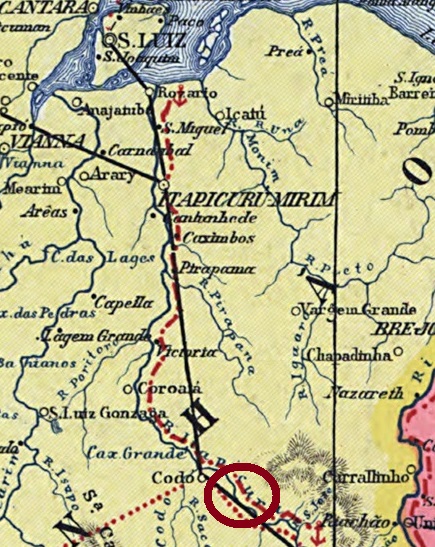
This Gameleira (also spelt Gamelleiras) in the imperial province of Maranhão is another place that no longer exists today. It was a landing stage on the north bank of the Itapecuru, probably at the mouth of the Gameleira above Codó, 310 kilometres south of the provincial capital of São Luís. Presumably there was a fazenda there in the 19th century whose owner was politically powerful enough to establish a post station at the harbour of his fazenda. The area later became known for the creation of a quilombo (refuge for escaped slaves) and is now part of the rural suburb of Bom Jesus near Codó.

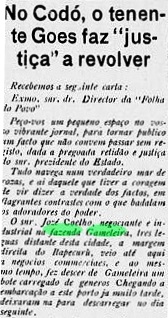
Reinhold Koester writes in Carimbologia XX that there had been a post office there since October 1886. It was closed after 1894. A Fazenda Gameleira is last mentioned in the regional press in November 1923.

Folha do Povo, 01.11.1923

No imperial postmark from Gameleira has yet been found in Maranhão. It should be very rare.

Carta da Republica dos Estados Unidos do Brazil, 1892

Diese Gameleira (auch Gamelleiras geschrieben) in der kaiserlichen Provinz Maranhão ist ein weiterer Ort, der heute nicht mehr existiert. Sie war eine Anlegestelle am Nordufer des Itapecuru, wahrscheinlich an der Mündung des Gameleira oberhalb von Codó, 310 km südlich der Provinzhauptstadt São Luís. Vermutlich befand sich dort im 19. Jahrhundert eine Fazenda, deren Besitzer politisch mächtig genug war, um eine Poststation am Hafen seiner Fazenda zu errichten. Später wurde die Gegend durch die Entstehung eines Quilombos (Zufluchtsort für entflohene Sklaven) bekannt und gehört heute zum ländlichen Vorort Bom Jesus bei Codó.

Reinhold Koester schreibt in Carimbologia XX, dass es dort seit Oktober 1886 ein Postamt gab. Nach 1894 wurde es geschlossen. Eine Fazenda Gameleira wird in der regionalen Presse zuletzt im November 1923 erwähnt.

Folha do Povo, 01.11.1923

Bisher wurde noch kein kaiserlicher Poststempel aus Gameleira in Maranhão gefunden. Er dürfte sehr selten sein.


Categories
Carimbologia E-G

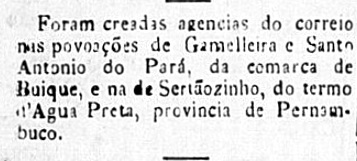
Gameleira de Buique, Pernambuco (GPE-0275)

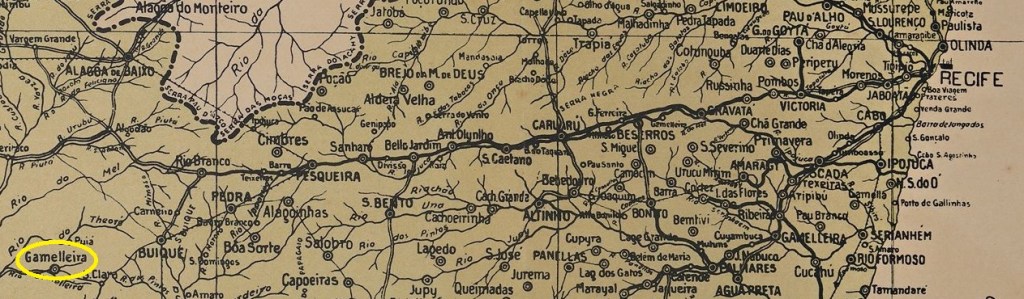
Arthur D. Ribeiro: Estado de Pernambuco, 1924
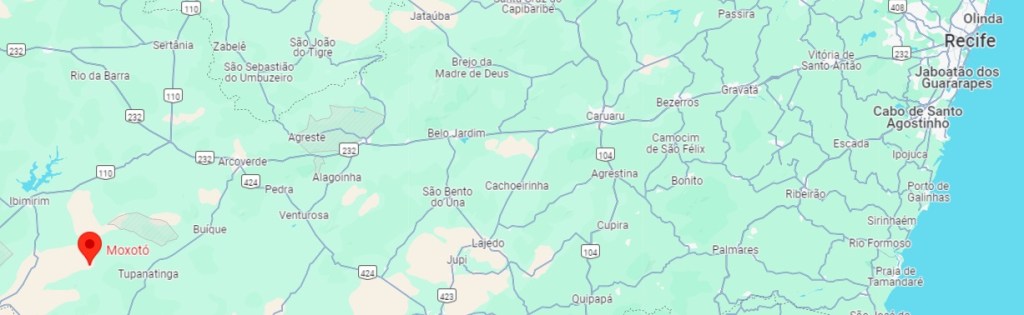
Other names: Moxotó (1928)

Gameleira was a settlement in Vila Nova de Buíque, 320 kilometres west of the provincial capital Recife. It became a Distrito in January 1893 and the Município de Moxotó in September 1928. It lost this status in December 1948 when it became a distrito of the Município de Inajá. Since December 1963, Moxotó has been a distrito in the Município de Ibimirim.

R. Koester writes in Carimbologia XX that there had been a post office there since July 1885. This is confirmed by the press in Rio:

Diario do Brazil/RJ, 21/07/1885

The imperial postmark is GPE-0275a (fig. R. Koester, op. cit.):

GPE-0275a (RK) 1891
Google Maps

Andere Namen: Moxotó (1928)

Gameleira war eine Siedlung in Vila Nova de Buíque, 320 km westlich der Provinzhauptstadt Recife. Im Januar 1893 wurde es zum Distrito und im September 1928 zum Município de Moxotó. Diesen Status verlor es im Dezember 1948, als es ein Distrito des Município de Inajá wurde. Seit Dezember 1963 ist Moxotó ein Distrito im Município de Ibimirim.

R. Koester schreibt in Carimbologia XX, dass es dort seit Juli 1885 ein Postamt gab. Dies wird von der Presse in Rio bestätigt:

Diario do Brazil/RJ, 21.07.1885

Der kaiserliche Poststempel ist GPE-0275a (Abb. R. Koester, op. cit.):

GPE-0275a (RK) 1891
Categories
Carimbologia E-G

Gama, Maranhão (GMA-0123)

Atlas do Imperio do Brasil, 1868

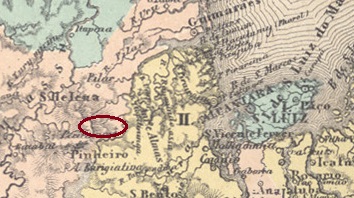
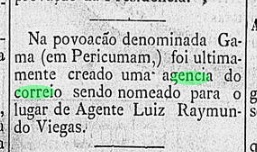
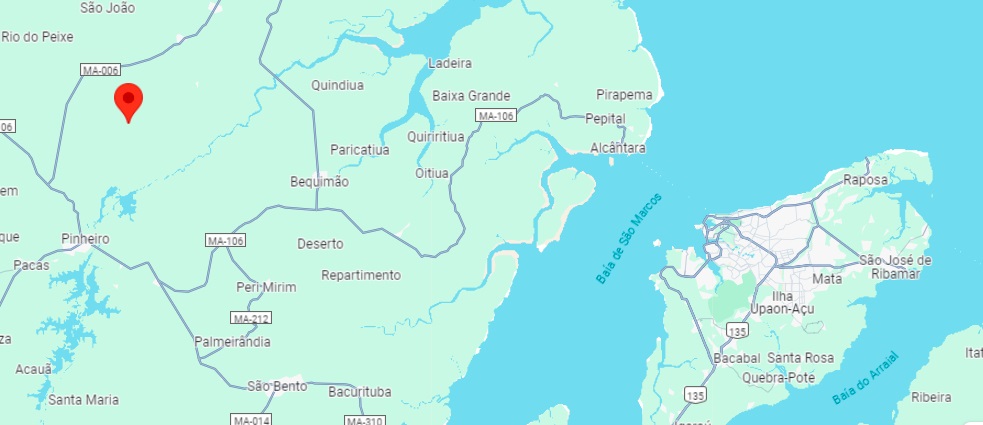
Gama is another place in the Empire of Brazil that has now disappeared from the map. From July 1866, S. Joaquim do Gama was a settlement in the Distrito de Pericuman, which at the time belonged to Vila de Pinheiro and was located on the west bank of the Pericumã, around 150 kilometres west of the provincial capital of São Luís do Maranhão. Around 1890, Gama itself became a district, but lost this status again in 1919 at the latest. Gama was probably once a fazenda that was unable to keep pace with the changing times.

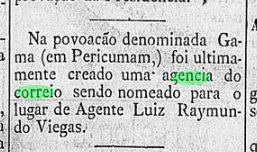
Even if there is no explanation for this today, there was a post office in the village around 1881, as reported in the regional press.

Pacotilha, 17.05.1881

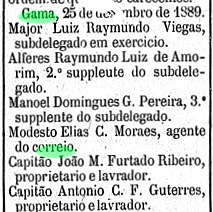
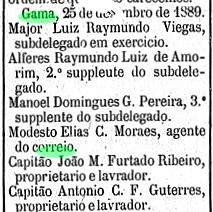
The agency was active at least by the end of the empire:

Pacotilha, 09.01.1890

After that, every trace of postal activity is lost. No postmark from this town has been found to date, and it is probably very rare.

GoogleMaps

Gama ist ein weiterer Ort im Kaiserreich Brasilien, der heute von der Landkarte verschwunden ist. Seit Juli 1866 war S. Joaquim do Gama eine Siedlung im Distrito de Pericuman, die damals zur Vila de Pinheiro gehörte und am Westufer des Pericumã lag, etwa 150 km westlich der Provinzhauptstadt São Luís do Maranhão. Um 1890 wurde Gama selbst zum Distrikt, verlor diesen Status aber spätestens 1919 wieder. Vermutlich war Gama früher eine Fazenda, die mit dem Wandel der Zeit nicht Schritt halten konnte.

Auch wenn es heute keine Erklärung mehr dafür gibt, gab es um 1881 ein Postamt am Ort, wie die regionale Presse berichtete.

Pacotilha, 17.05.1881

Die Agentur war bis zum Ende des Kaiserreichs aktiv:

Pacotilha, 09.01.1890

Danach verliert sich jede Spur einer postalischen Tätigkeit. Bis heute wurde kein kaiserlicher Poststempel aus diesem Ort gefunden, er dürfte sehr selten sein.