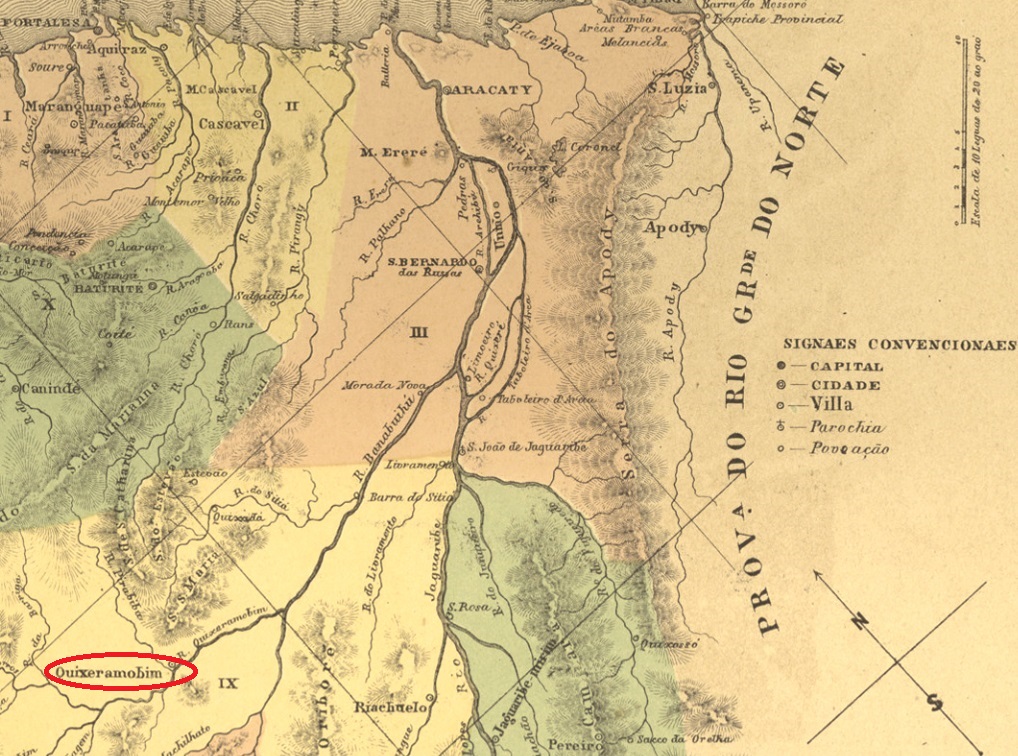
The origin and meaning of the name Quixeramobim have been a discussion object among scholars through centuries. Even the German botanist Carl Ph. Fr. von Martius (1794-1868) has tried to elucidate this mystery and mentioned a tupi-indian origin. But according to the Brazilian sociologist Analucia Sulina Bezerra, it seems now that the name has come from the Quixará, an ethnic group of the Tapuia-indians.
Quixeramobim was granted the status of a Villa as early as 1766, became a cidade in 1856, and on March 4, 1846 a local post office appeared, according to Nova Monteiro. If we consider that this town by 1880 had over 15 thousand inhabitants (Guia Postal do Imperio), one might wonder where all those imperial cancels are hidden.
The earliest example of a Quixeramobim cancel by now is QCE-0265a (Coll. José A. Junges): a double circle with the imprint QUIXERAMOBIM (above) and a date within the inner circle. Possibly there was an ornament below, which disappeared in the copy of 1896.
A second cancel, QCE-0265b (Coll. Dieter Kerkhoff), was applied at the stamp corner, has therefore very little information and could possibly be republican. Similar to the former, but now presenting (CEARÁ) between the circles (below). Seen on a stamp issued after 1897.
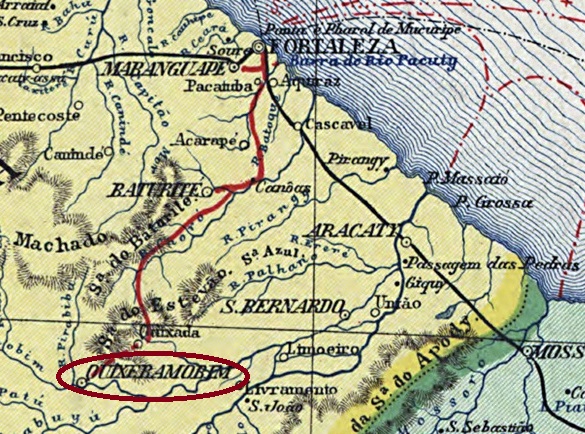
A origem e significado do nome Quixeramobim têm sido objeto de discussão entre estudiosos ao longo dos séculos. Mesmo o famoso botânico alemão Carl Philipp Fr. Von Martius (1794-1868) tentou elucidar esse mistério, citando uma origem tupi. Mas uma explicação mais recente, da socióloga Analucia Sulina Bezerra, diz que o nome deriva de Quixará, um grupo étnico tapuia.
Quixeramobim já era vila em 1766, tornou-se cidade em 1856, e, segundo nos conta Nova Monteiro, recebeu sua agência postal em 4 de março de 1846. Se considerarmos que a cidade tinha por volta de 1880 mais de 15 mil habitantes (Guia Postal do Império) , é de se perguntar onde foram parar os carimbos imperiais de lá.
O carimbo mais antigo de Quixeramobim até agora conhecido é QCE-0265a (Col. José A. Junges): um círculo duplo com a inscrição QUIXERAMOBIM (acima) e a data dentro do círculo interno. Talvez havia também um ornamento no arco inferior, que desapareceu no exemplar de 1896.
Um segundo carimbo, QCE-0265b (Col. Dieter Kerkhoff), foi aplicado num canto do selo, portanto informa muito pouco, e possívelmente seria republicano. Semelhante ao carimbo anterior, este agora apresenta (CEARÁ) dentro do arco inferior. Encontrado num selo emitido a partir de 1897.
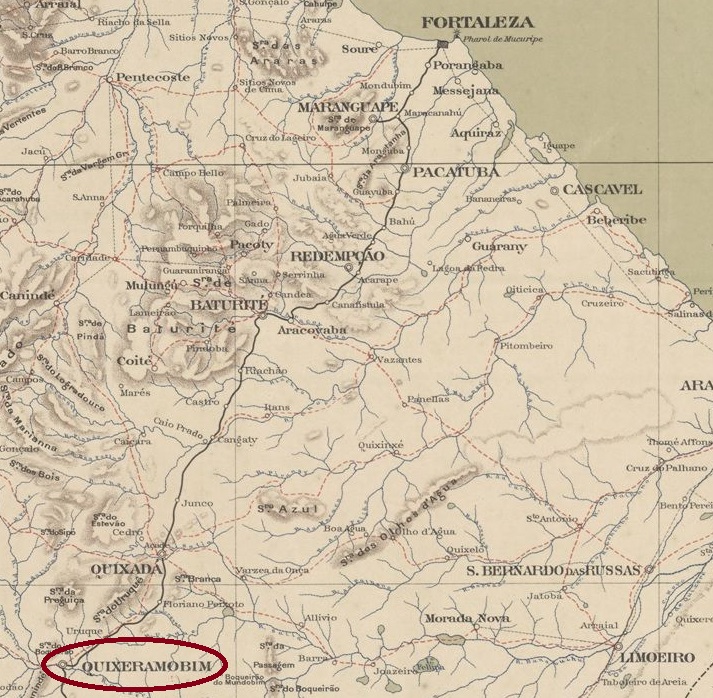
Viele Wissenschaftler rätselten jahrhundertlang über Ursprung und Bedeutung des Namens Quixeramobim. Sogar der deutsche Botaniker Carl Ph. Fr. von Martius (1794-1868) versuchte, dieses Problem zu durchleuchten, indem er auf eine tupi-indianische Abstammung tippte. Wie dennoch die brasilianische Soziologin Analucia Sulina Bezerra erklärte, der Begriff kommt von Quixará, einem Indianerstamm der Tapuias.
Quixeramobim bekam den Status einer Villa bereits in 1766, in 1856 wurde sie eine cidade, aber vorher schon, seit 04.03.1846, gab es dort ein Postamt, laut Nova Monteiro. Aber wenn wir lesen, dass vor 1880 der Ort schon über 15 Tausend Einwohner hatte (Guia Postal do Império), da fragt man sich, wo alle diese kaiserlichen Abstempelungen geblieben sind.
Der bisher früheste Stempel aus Quixeramobim ist QCE-0265a (Samml. José A. Junges): ein Doppelkreis mit der Inschrift QUIXERAMOBIM (oben) und einem Datum im Innenkreis. Möglicherweise gab es eine Verzierung unten, die leider auf der Marke mit Stempeldatum 1896 nicht mehr zu sehen ist.
Eine zweite Abstempelung, QCE-0265b (Samml. Dieter Kerkhoff), hat lediglich einen Markenrand erwischt. Dadurch ist ihr Informationsgehalt gering, sie könnte auch aus der Zeit der Republik sein. Außer den Angaben der vorherigen bringt diese Abstempelung auch (CEARÁ) zwischen den Kreisen (unten). Gesehen auf einer Marke, die ab 1897 ausgegeben wurde.

 Carimbologia