
Other names: Capela da Borda do Campo, Igreja Nova
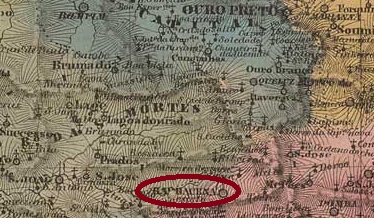
The freguesia of N. Sa. da Piedade da Borda do Campo was created by royal decree in 1725, located 130 km south of the Capitania capital Vila Rica (later: Ouro Preto). Between 1748 and 1752 (sources disagree), the parish moved to the neighbouring Igreja Nova, which at that time belonged to the Vilas of S. José and S. João d’El-Rei. Then, in August 1791, the ascension to a vila took place, called Barbacena, as the then governor of the Capitania of Minas Gerais was the Vicomte de Barbacena. Its name in turn came from a small town in the upper Alentejo in Portugal (662 inhabitants in 2011). Barbacena has been a town in Minas Gerais since March 1840.
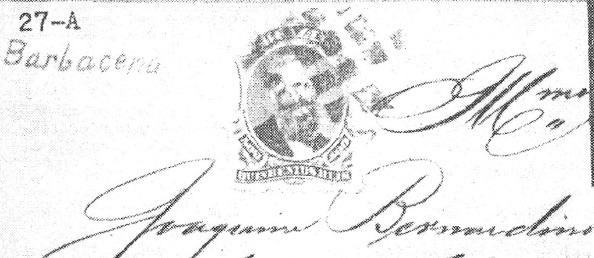
Four dates have been found for the creation of the local post office, a sure indication that it was closed in between. First in May 1809, as Paula Sobrinho writes in História Postal de Minas Gerais (Belo Horizonte, 1997). Then in March 1829, as one can read in Nova Monteiro’s Administrações e Agencias Postaes do Brasil Imperio (Brasil Filatelico/RJ, 1934-5; Reprint SPP 1994-1999). Then again in October 1833, as noted both in the Postal Report (Relatorio Postal) for 1887 and in the Directory of Imperial Post Offices (Tabella das Agencias do Correio do Imperio, Rio de Janeiro, 1885). And finally in June 1838, as Paula Sobrinho (op. cit.) also noted.
The first postmark is BMG-0220a, which also occurs in sepia and was used between 1818 and at least 1843. A frameless variant of this cancel is also said to exist. However, all illustrations so far show clear remnants of the cancel frame. The postmark became known through the RHM catalogue, under P-MG-09:

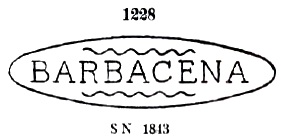
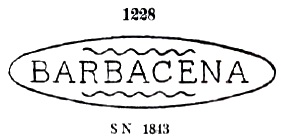
It was followed by BMG-0220b, in use around 1843, also occurring in sepia and listed both in the Paulo Ayres’s Catálogo de Carimbos Brasil-Império (S. Paulo, 1937, 1942) under no. 1228 and in the RHM catalogue as well:
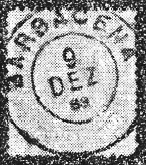
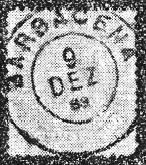
The next three postmarks are double circles, as presented by R. Koester in Carimbologia III:


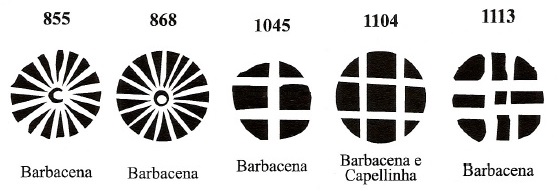
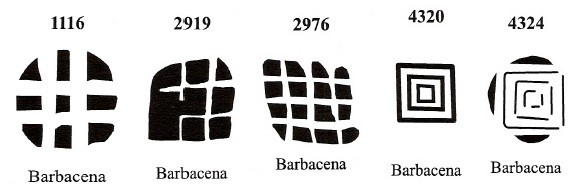
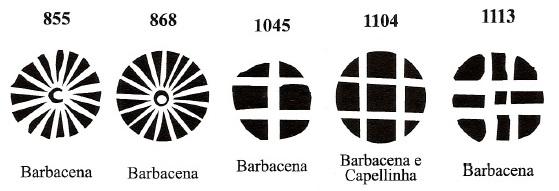
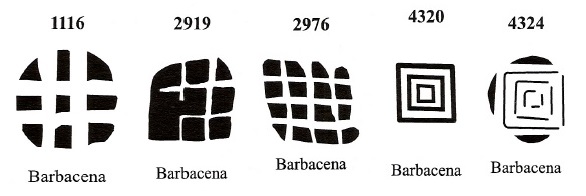
In Mute Cancellations of the Brazil Empire / Carimbos Mudos do Brasil Império (Brazil Philatelic Association, Rio de Janeiro, 2000) James Dingler and Klerman W. Lopes presented ten mute cancellations from the imperial Barbacena:
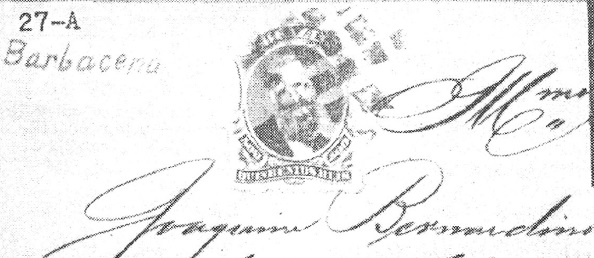
Another mute cancellation was shown by R. Koester (op. cit.):
Andere Namen: Capela da Borda do Campo, Igreja Nova
Die Freguesia von N. Sa. da Piedade da Borda do Campo entstand 1725 durch königliche Verfügung und lag 130 km südlich der Capitania-Hauptstadt Vila Rica (später: Ouro Preto). Zwischen 1748 und 1752 (die Quellen sind sich nicht einig) wechselte die Pfarrei zur benachbarten Igreja Nova, die damals den Vilas von S. José und S. João d’El-Rei angehörte. Im August 1791 erfolgte dann der Aufstieg zu einer Vila, die Barbacena hieß, da der damalige Gouverneur der Capitania von Minas Gerais der Vicomte de Barbacena war. Sein Name wiederum kam von einer kleinen Gemeinde am oberen Alentejo in Portugal (662 Einwohner im Jahr 2011). Seit März 1840 ist Barbacena in Minas Gerais eine Stadt.
Es wurden vier Daten für die Entstehung des örtlichen Postamts gefunden, ein sicheres Indiz dafür, dass es zwischendurch geschlossen war. Erstmals im Mai 1809, wie Paula Sobrinho in História Postal de Minas Gerais (Belo Horizonte, 1997) schreibt. Dann im März 1829, wie man im Nova Monteiros Administrações e Agencias Postaes do Brasil Imperio (Brasil Filatelico/RJ, 1934-5; Reprint SPP 1994-1999) lesen kann. Dann wieder im Oktober 1833, wie sowohl im Postbericht (Relatorio Postal) für 1887 als auch im Verzeichnis der kaiserlichen Postämter (Tabella das Agencias do Correio do Imperio, Rio de Janeiro, 1885) vermerkt. Und schließlich im Juni 1838, wie Paula Sobrinho (op. cit.) ebenfalls notierte.
Der erste Poststempel ist BMG-0220a, der auch in sepia vorkommt und zwischen 1818 und mindestens 1843 verwendet wurde. Von diesem Stempel soll auch eine rahmenlose Variante vorkommen. Allerdings zeigen bisher alle Abbildungen deutliche Reste des Stempelrahmens. Bekannt wurde der Poststempel durch den RHM-Katalog, unter P-MG-09:

Ihm folgte BMG-0220b, der wohl um 1843 in Gebrauch war, auch in sepia vorkommt und sowohl im Paulo Ayres Catálogo de Carimbos Brasil-Império (S. Paulo, 1937, 1942) unter Nr. 1228 als auch im RHM-Katalog aufgelistet wurde:
Die nächsten drei Poststempel sind Doppelkreise, die allesamt durch R. Koester in Carimbologia III vorgestellt wurden:


In Mute Cancellations of the Brazil Empire / Carimbos Mudos do Brasil Império (Brazil Philatelic Association, Rio de Janeiro, 2000) haben James Dingler und Klerman W. Lopes zehn stumme Abstempelungen aus dem kaiserlichen Barbacena präsentiert :
Eine weitere stumme Entwertung zeigte R. Koester (op. cit.):

 Carimbologia