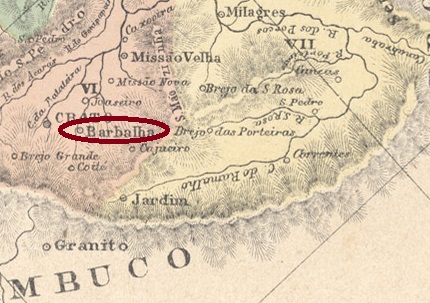
The parish of Santo Antonio da Barbalha was founded in August 1838 and was located near the Vila of Crato, 500 km south of the provincial capital Fortaleza. The place rose to the status of vila in August 1846 and town in August 1876.
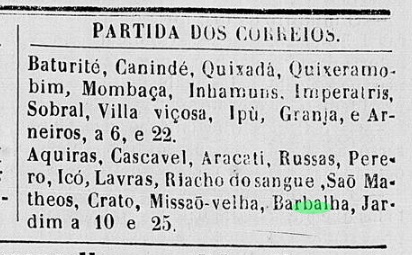
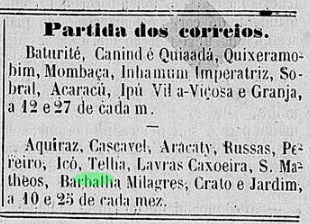
As Nova Monteiro writes in Administrações e Agencias Postaes do Brasil Imperio (Brasil Filatelico/RJ, 1934-5; Reprint SPP 1994-1999), there was a post office there since August 1866, but regional press reports postal routes had passed through Barbalha even before that date, at least between October 1849 and April 1865:
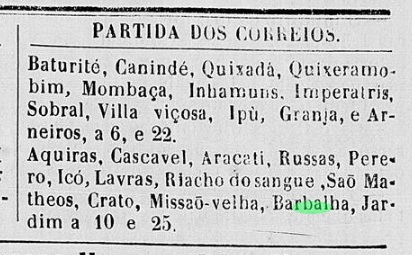
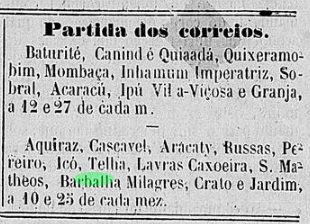
Since it is hard to imagine an honorary post office clerk at work for over 15 years, it could well be that a post office has operated there, however.
The only imperial postmark from Barbalha so far is BCE-0040a, already shown by Paulo Ayres in Catálogo de Carimbos Brasil-Império, (S. Paulo, 1937, 1942):

Later, BCE-0040c (fig. from the internet) also appeared: a double circle with the inscriptions BARBALHO (sic!) above and (CEARÁ) below. The dates so far come from the period 1902-1903.
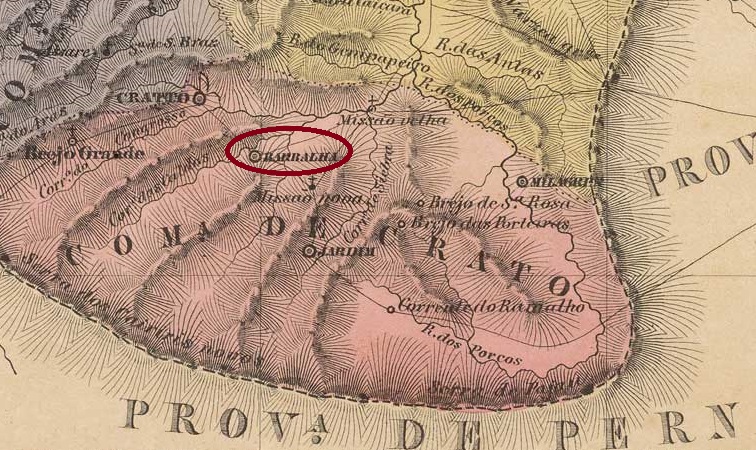
Die Pfarrei von Santo Antonio da Barbalha wurde im August 1838 gegründet und lag bei der Vila von Crato, 500 km südlich der Provinzhauptstadt Fortaleza entfernt. Der Ort stieg im August 1846 zur Vila und im August 1876 zur Stadt auf.
Wie Nova Monteiro in Administrações e Agencias Postaes do Brasil Imperio (Brasil Filatelico/RJ, 1934-5; Reprint SPP 1994-1999) schreibt, gab es ein Postamt dort seit August 1866. In der Regionalpresse liest man aber, dass Postrouten durch Barbalha schon vorher, zumindest zwischen Oktober 1849 und April 1865 gingen:
Da es ein Ehrenamt als Postangestellter über 15 Jahre lang schwer vorstellbar ist, könnte es gut sein, dass ein Postamt dort wie auch immer betrieben wurde.
Der bisher einzige kaiserliche Poststempel aus Barbalha ist BCE-0040a, der bereits durch Paulo Ayres in Catálogo de Carimbos Brasil-Império, (S. Paulo, 1937, 1942) gezeigt wurde:

Später erschien auch BCE-0040c (Abb. aus dem Internet): ein Doppelkreis mit den Inschriften BARBALHO (sic!) oben und (CEARÁ) unten. Die Daten kommen bisher aus dem Zeitraum 1902-1903.

 Carimbologia