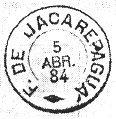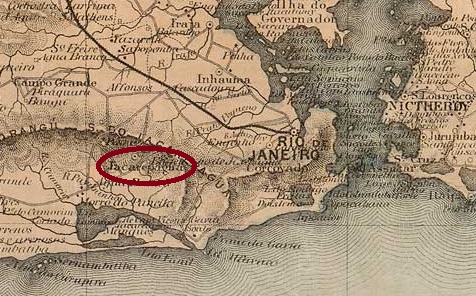
The Freguesia de N. Sra. de Loreto de Jacarepaguá, located 30 kilometres west of the capital Rio de Janeiro and since July 1981 an administrative district (Região Administrativa) of the Município do Rio de Janeiro, has been documented since 1661. The place name comes from the Tupi-guarani and means bay of crocodiles.
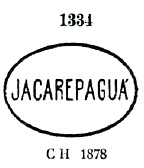
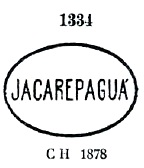
According to the list of imperial post offices (Tabella das Agencias do Correio do Imperio, Rio de Janeiro, 1885), there had been a post office there since 1878, which was closed around 1937 according to P. Novaes (agenciaspostais.com.br). The oldest postmark is JMN-2315a, which was given the no. 1334 by P. Ayres in Catálogo de Carimbos Brasil-Império (S. Paulo, 1937, 1942):
This was followed by the double circle JMN-2315b (fig. R. Koester, in Carimbologia XXV):
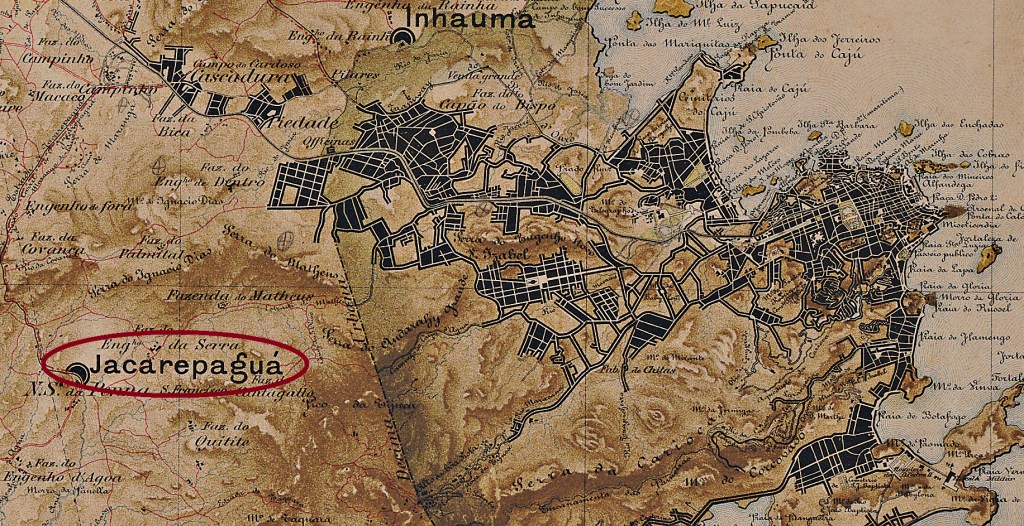
Seit 1661 ist die Freguesia de N. Sra. de Loreto de Jacarepaguá, 30 km westlich der Hauptstadt Rio de Janeiro gelegen und seit Juli 1981 ein Verwaltungsbezirk (Região Administrativa) des Município do Rio de Janeiro, bezeugt. Der Ortsname kommt aus dem Tupi-guarani und bedeutet Bucht der Krokodile.
Wie aus dem Verzeichnis der kaiserlichen Postämter (Tabella das Agencias do Correio do Imperio, Rio de Janeiro, 1885) hervorgeht, gab es dort seit 1878 ein Postamt, das nach P. Novaes (agenciaspostais.com.br) um 1937 geschlossen wurde. Der älteste Poststempel ist JMN-2315a, der von P. Ayres in Catálogo de Carimbos Brasil-Império (S. Paulo, 1937, 1942) die Nr. 1334 erhielt:
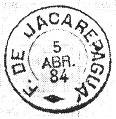
Es folgte der Doppelkreis JMN-2315b (Abb. R. Koester, in Carimbologia XXV):