The district of N. Sra. da Abbadia da Agua Suja was founded in July 1872 in the Freguesia of Carmo da Bagagem and was located on the east bank of the Bagagem River, 580 km west of the provincial capital Ouro Preto. Afterwards, the locality changed twice: in October 1882 to the município of Carmo da Bagagem and in June 1900 to Monte Carmelo, before being given the place name Romaria in December 1938. Since December 1962, Romaria has been an independent município.
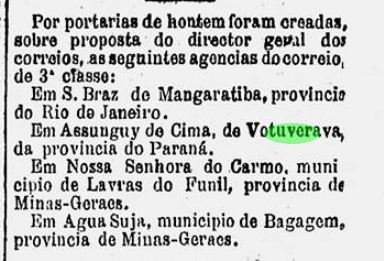
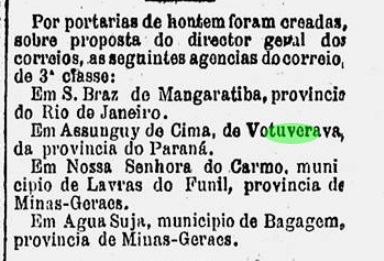
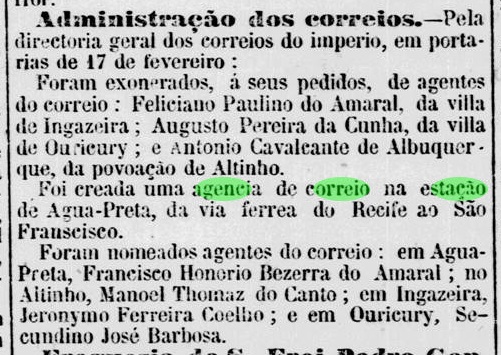
The local post office was established in February 1882, as reported by the Rio press:
Gazeta de Noticias/RJ, 19.02.1882
The oldest postmark so far is AMG-0035a (Coll. José L. Fevereiro): a double circle with the inscriptions AGUA SUJA and (BAGAGEM), found with internal dates between 1891 and 1894.
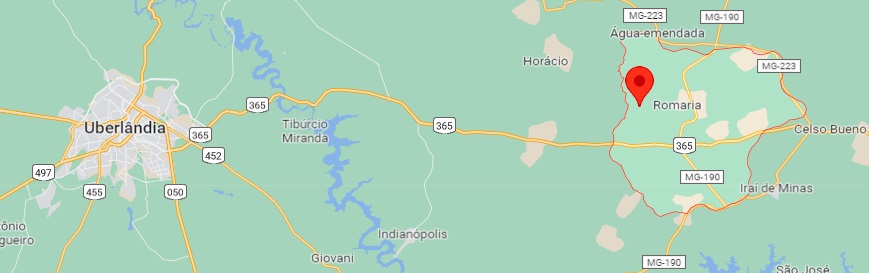
Google Maps
Anderer Name: Romaria (1938)
Der Distrikt von N. Sra. da Abbadia da Agua Suja wurde im Juli 1872 in der Freguesia von Carmo da Bagagem gegründet und lag am Ostufer des Flusses Bagagem, 580 km westlich der Provinzhauptstadt Ouro Preto entfernt. Danach wechselte die Ortschaft zweimal: im Oktober 1882 zum Município von Carmo da Bagagem und im Juni 1900 zu Monte Carmelo, bevor ihm im Dezember 1938 der Ortsname Romaria verpasst wurde. Seit Dezember 1962 ist Romaria ein eigenständiger Município.
Das örtliche Postamt entstand im Februar 1882, wie die Presse aus Rio berichtete:
Gazeta de Noticias/RJ, 19.02.1882
Der bisher älteste Poststempel ist AMG-0035a (Samml. José L. Fevereiro): ein Doppelkreis mit den Inschriften AGUA SUJA und (BAGAGEM), gefunden mit Daten in der Mitte zwischen 1891 und 1894.
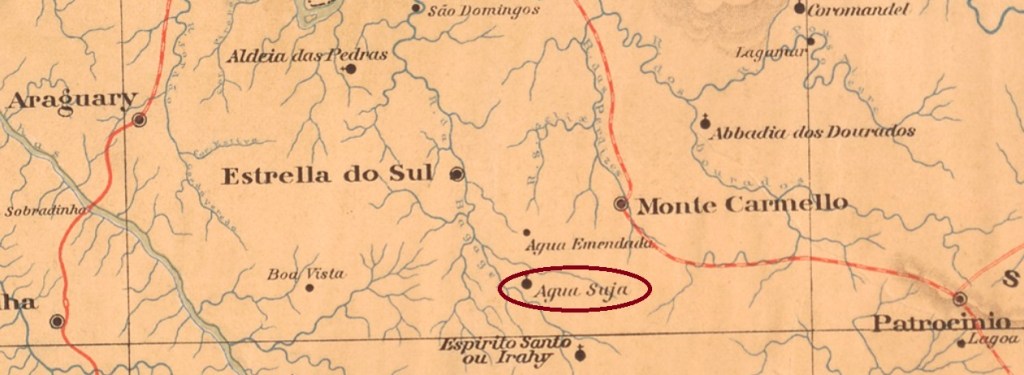
Carta da Republica dos Estados Unidos do Brazil, 1892
Other names: Arraial do Morro do Fogo, Erico Cardoso (1985)
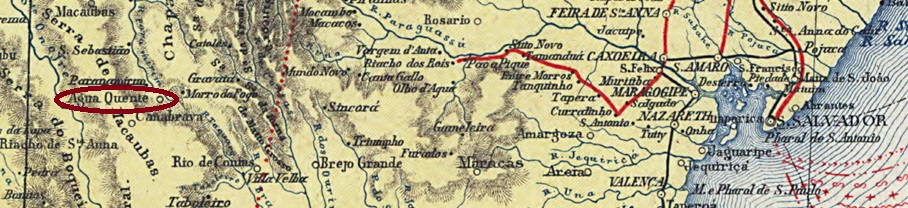
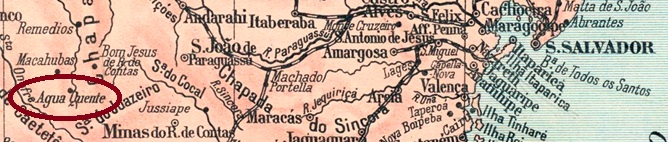
The history of the village begins in May 1843, with the foundation of the Freguesia of N. Sra. do Carmo do Morro do Fogo in the Município of Paramirim, which was located on the south bank of the Paramirim River, 560 km west of the provincial capital Salvador. Afterwards, the village received its autonomy three times: in September 1878 as Industrial Villa de Agua Quente, in May 1890 and in June 1962, as an independent Município. In between, Agua Quente became a district of Rio de Contas in June 1881 and a district of the Município of Paramirim in June 1909. Since July 1985, the municipality has had the name of its first mayor: Erico Cardoso (1918-1984).
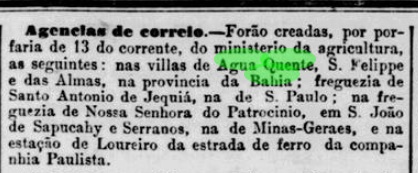
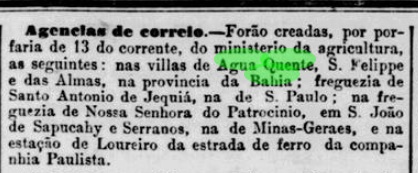
The local post office was established in August 1881, according to the Rio press:
Jornal do Commercio/RJ, 15/08/1881
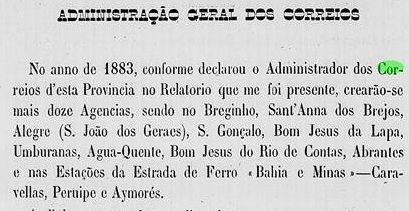
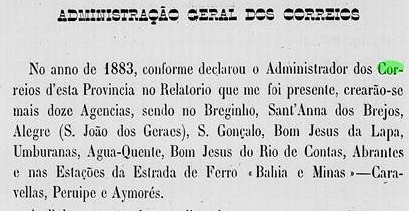
Another date of creation is probably 1883, according to the report of the provincial government council for the following year:
Relatorio do Conselho Interino do Governo, 1884
The first postmark is probably ABA-0030a (Coll. FM): a simple double circle with the above inscription AGUA QUENTE. The only specimen so far bears a date from 1890 in the centre.
Estado da Bahia, 1913
Andere Namen: Arraial do Morro do Fogo, Erico Cardoso (1985)
Die Ortsgeschichte fängt im Mai 1843 an, mit der Gründung der Freguesia von N. Sra. do Carmo do Morro do Fogo im Município von Paramirim, die am Südufer des Flusses Paramirim lag, 560 km westlich der Provinzhauptstadt Salvador entfernt. Danach erhielt der Ort seine Autonomie dreimal: im September 1878 als Industrial Villa de Agua Quente, im Mai 1890 und im Juni 1962, als eigenständiger Município. Zwischendurch wurde Agua Quente im Juni 1881 ein Distrikt von Rio de Contas und im Juni 1909 ein Distrikt vom Município von Paramirim. Seit Juli 1985 trägt die Gemeinde den Namen seines ersten Prefeito: Erico Cardoso (1918-1984).
Das örtliche Postamt wurde im August 1881 ins Leben gerufen, wie die Presse aus Rio mitteilt:
Jornal do Commercio/RJ, 15.08.1881
Ein weiterer Entstehungstermin wird vermutlich 1883 sein, laut Bericht des provinzialen Regierungsrats fürs folgende Jahr:
Relatorio do Conselho Interino do Governo, 1884
Der erste Poststempel ist vermutlich ABA-0030a (Samml. FM): ein schlichter Doppelkreis mit der obigen Inschrift AGUA QUENTE. Das bisher einzige Exemplar trägt ein Datum aus 1890 in der Mitte.
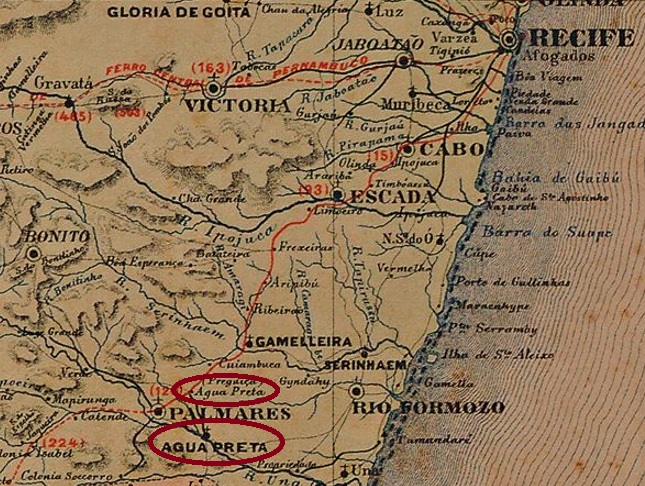
The freguesia of São José da Agonia da Água Preta was founded in December 1809, located on the west bank of the Una River at the Vila of Rio Formoso, 120 km southwest of the future provincial capital of Recife. It was promoted to Vila three times (March 1846, May 1869 and May 1879) and in between became a district of Barreiros (May 1853) and of Palmares (May 1873). Agua Preta has been a city since July 1895.
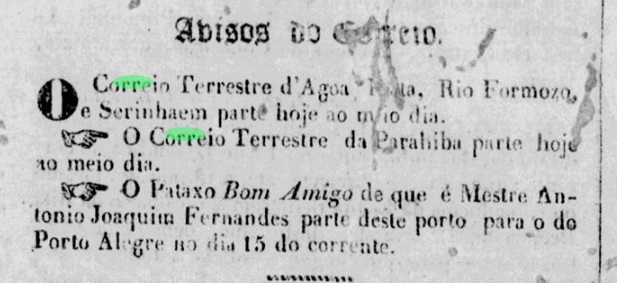
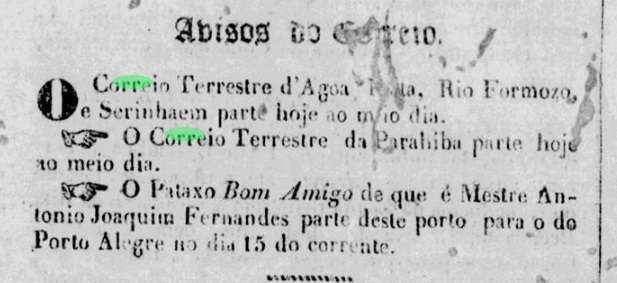
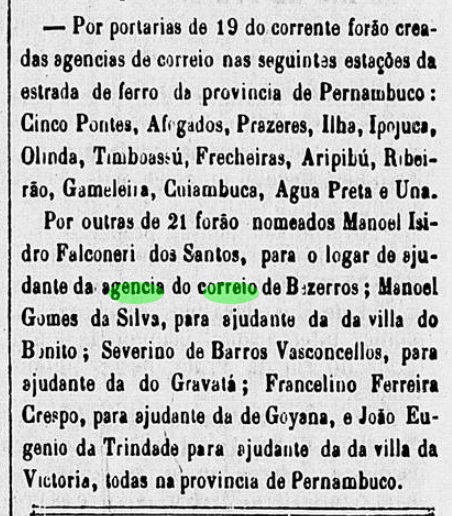
As can be seen from the regional press, a post office was opened there at least twice. The first post office opening must have taken place by December 1833, as a postal route to Agua Preta was active at the time:
Diario de Pernambuco, 06.12.1833
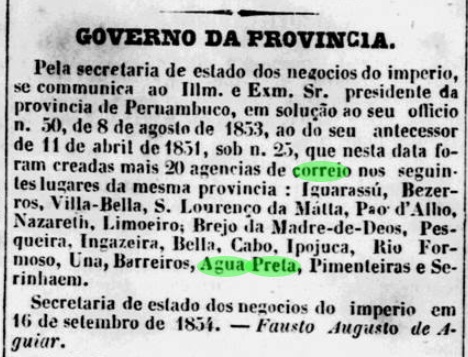
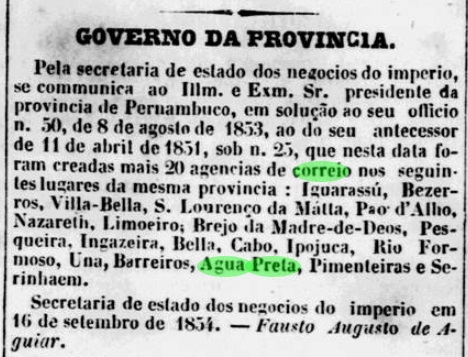
The second creation date for the post office is from September 1854:
Diario de Pernambuco, 07.10.1854
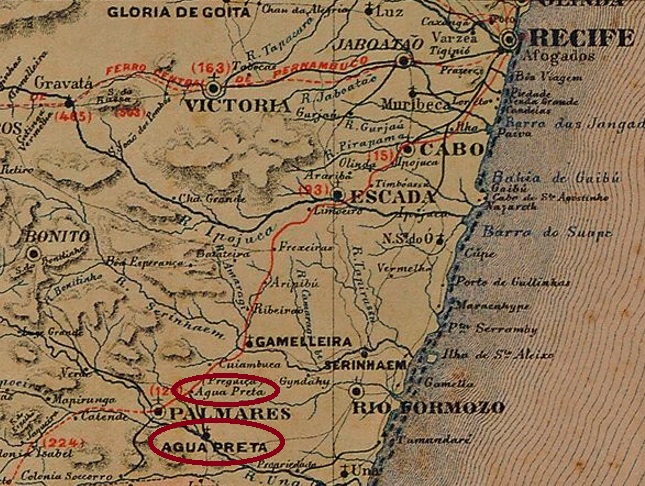
So far, no postmark has been seen from this locality in the imperial period. It is likely that this post office was closed when the Agua Preta station post office (APE-0011), located 10 km further north, was created in December 1864.
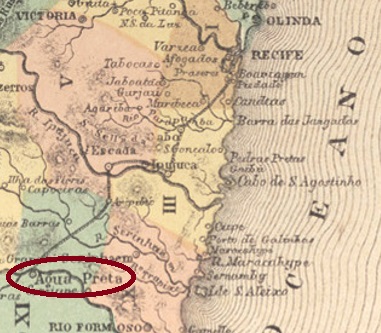
Carta Corographica da Provincia de Pernambuco, 1880
Textaktualisierung vom 6. Mai 2023
Die Freguesia von São José da Agonia da Água Preta wurde im Dezember 1809 gegründet und lag am Westufer des Flusses Una bei der Vila von Rio Formoso, 120 km südwestlich der späteren Provinzhauptstadt Recife entfernt. Der Ort stieg dreimal zur Vila auf (März 1846, Mai 1869 und Mai 1879) und wurde zwischendurch ein Distrikt von Barreiros (Mai 1853) bzw. von Palmares (Mai 1873). Seit Juli 1895 ist Agua Preta eine Stadt.
Wie aus der Regionalpresse zu entnehmen ist, wurde dort mindestens zweimal ein Postamt eröffnet. Die erste Posteröffnung muss bis Dezember 1833 stattgefunden haben, da damals eine Postroute nach Agua Preta aktiv war:
Diario de Pernambuco, 06.12.1833
Die zweite Posteröffnung ist vom September 1854:
Diario de Pernambuco, 07.10.1854
Bisher wurde kein Poststempel in der Kaiserzeit aus dieser Ortschaft gesehen. Es ist anzunehmen, dass dieses Postamt geschlossen wurde, als das 10 km weiter nördlich gelegene Bahnhofspostamt von Agua Preta (APE-0011) im Dezember 1864 in Betrieb genommen wurde.
Carta Corographica da Provincia de Pernambuco, 1880
Another name: Joaquim Nabuco (1892)
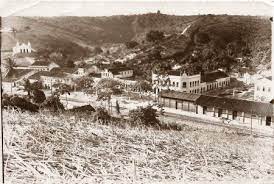
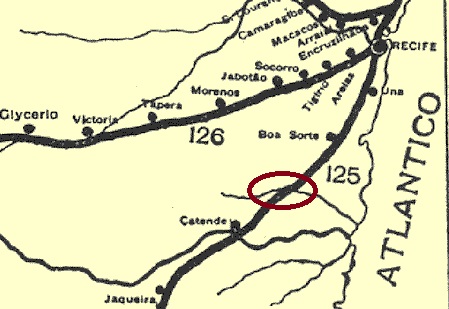
Agua Preta station was inaugurated in September 1862 by the E.F. de Recife ao São Francisco railway company and was located 110 km southwest of Recife, and about 10 km north of the Vila of Agua Preta. The railway line changed hands in 1901 to the Great Western, and in 1950 to the Rede Ferroviária do Nordeste; from 1975 until its closure in 1996 it belonged to the Rede Ferroviária Federal (estacoesferroviarias.com.br).
Photo: estacoesferroviarias.com.br
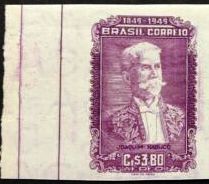
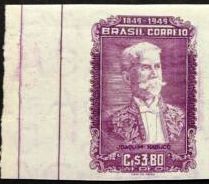
The settlement around the station continued to grow and in November 1892 became the district of Joaquim Nabuco, now in the Município of Palmares. Since December 1953, Joaquim Nabuco has been an independent município. The name commemorates the Recife-born lawyer, politician, historian and journalist (1849-1910).
Scott C77, Michel 745
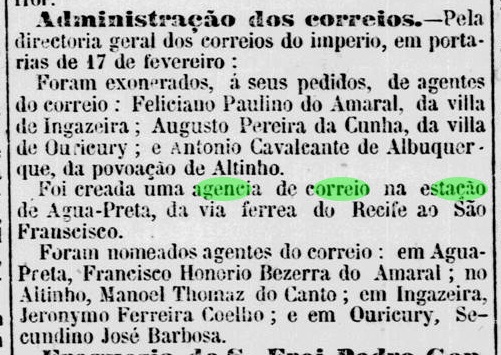
Two dates of origin for the station post office have been found. First in December 1864, as reported by the Press as Rio:
Constitucional/RJ, 24.12.1864
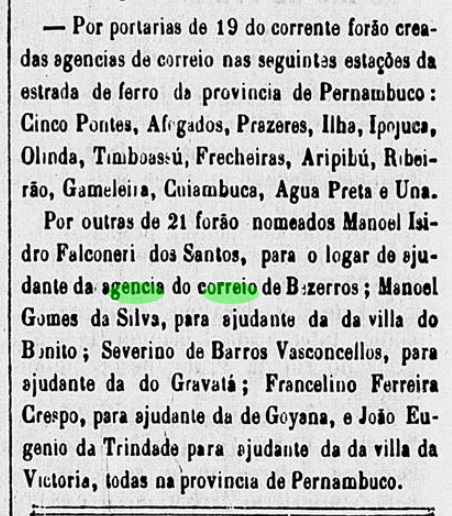
Then again in February 1873, as reported by the regional press:
Diario de Pernambuco, 05.03.1873
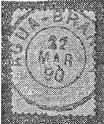
Two postmarks were found for the 19th century, unfortunately not the oldest of them. APE-0011b (image from the internet) is a French type, a double circle with the inscription EST. DA AGUA-PRETA at the top and the typical star between brackets at the bottom. The dates in the centre (between 1884 and 1888) were written by hand. APE-0011c (Coll. Paulo Renato Risi) is also a double circle, now has the inscription AGUA-PRETA at the top and (E) at the bottom. The only specimen so far is light blue, dated 1894 in the centre.
IBGE, 1898
Anderer Name: Joaquim Nabuco (1892)
Der Bahnhof Agua Preta wurde im September 1862 durch die E.F. de Recife ao São Francisco-Bahngesellschaft eingeweiht und lag 110 km südwestlich von Recife, sowie ca. 10 km nördlich der Vila von Agua Preta. Die Bahnlinie wechselte 1901 zur Great Western und 1950 zur Rede Ferroviária do Nordeste; von 1975 bis zur Stilllegung 1996 gehörte sie der Rede Ferroviária Federal (estacoesferroviarias.com.br).
Foto: estacoesferroviarias.com.br
Die Siedlung um den Bahnhof wuchs weiter und wurde im November 1892 zum Distrikt von Joaquim Nabuco, nun im Município von Palmares. Seit Dezember 1953 ist Joaquim Nabuco ein eigenständiger Município. Der Name erinnert an den in Recife geborenen Juristen, Politiker, Historiker und Journalist (1849-1910).
Scott C77, Michel 745
Zwei Entstehungsdaten fürs Bahnhofspostamt wurden gefunden. Erstmals im Dezember 1864, wie die Presse aus Rio mitteilte:
Constitucional/RJ, 24.12.1864
Dann nochmals im Februar 1873, wie aus der Regionalpresse hervorgeht:
Diario de Pernambuco, 05.03.1873
Zwei Poststempel wurden für das 19. Jahrhundert gefunden, leider nicht der älteste. APE-0011b (Abb. aus dem Internet) ist ein Französischer Typus, ein Doppelkreis mit der Inschrift EST. DA AGUA-PRETA oben und dem typischen Stern zwischen Klammern unten. Die Daten in der Mitte (zwischen 1884 und 1888) wurden mit der Hand eingetragen. APE-0011c (Samml. Paulo Renato Risi) ist ebenfalls ein Doppelkreis, hat nun oben die Inschrift AGUA-PRETA und unten (E). Das bisher einzige Exemplar ist hellblau, datiert 1894 in der Mitte.
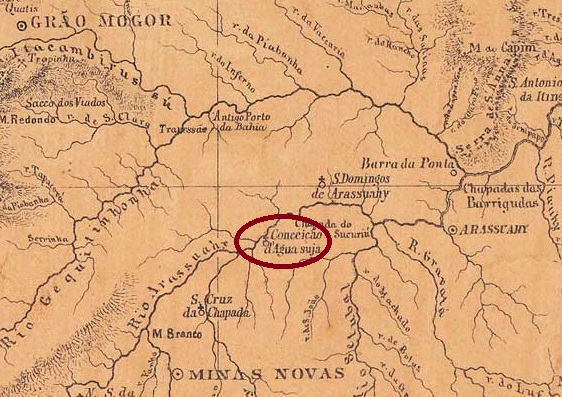
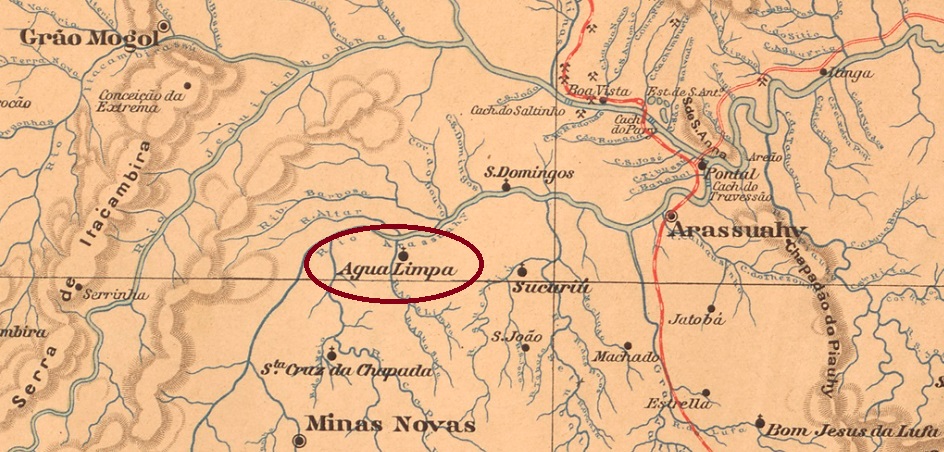
The former Freguesia of N. Sra. da Conceição da Água Suja was founded in September 1870 in the Município of Minas Novas and was located at the mouth of the stream Água Suja (Dirty Waters) in the Araçuaí River, 530 km north of the provincial capital Ouro Preto. The authorities apparently did not like the place name, so in November 1887 it was changed to Água Limpa (Clean Waters). The stream kept its old name until today. The village was then called Berilo in September 1923 and has been an independent município since December 1962.
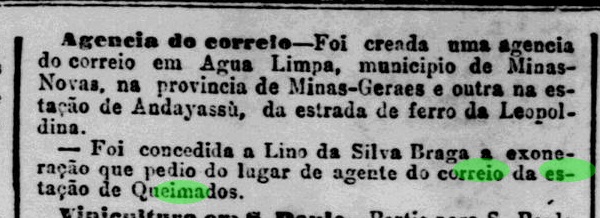
Two dates of origin were found for the local post office. The first was in August 1888, according to the Rio Press:
Jornal do Commercio/RJ 11.08.1888
The second date is given by Paula Sobrinho in História Postal de Minas Gerais (Belo Horizonte, 1997) exactly two years later and may therefore be a transcription error. So far, no imperial postmark from this locality could be identified with certainty.
Estado de Minas Geraes, 1910
Andere Namen: Água Suja, Berilo (1923)
Die frühere Freguesia von N. Sra. da Conceição da Água Suja wurde im September 1870 im Município von Minas Novas gegründet und lag an der Mündung des Bachs Água Suja (Schmutziges Gewässer) in den Araçuaí-Fluss, 530 km nördlich der Provinzhauptstadt Ouro Preto entfernt. Der Ortsname gefiel der Obrigkeit offenbar nicht, also wurde daraus im November 1887 die Freguesia von Água Limpa (Sauberes Gewässer). Dabei behielt der Bach den alten Namen bis heute. Die Ortschaft hieß dann ab September 1923 Berilo und ist seit Dezember 1962 ein eigenständiger Município.
Zwei Entstehungsdaten wurden fürs örtliche Postamt gefunden. Erstmals im August 1888, wie aus der Rio-Presse hervorgeht:
Jornal do Commercio/RJ 11.08.1888
Das zweite Datum wird von Paula Sobrinho in História Postal de Minas Gerais (Belo Horizonte, 1997) exakt zwei Jahre später angegeben und darf somit ein Abschreibfehler sein. Bisher konnte kein kaiserlicher Poststempel aus dieser Ortschaft mit Sicherheit identifiziert werden.
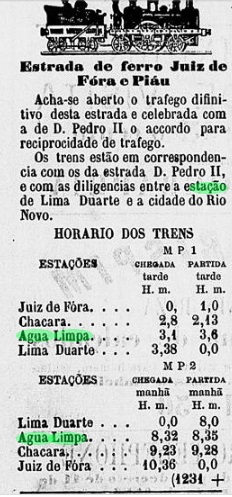
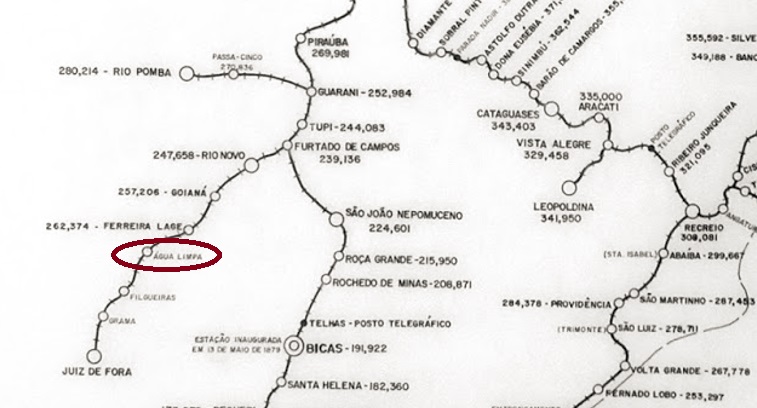
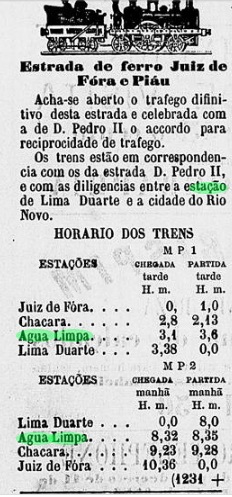
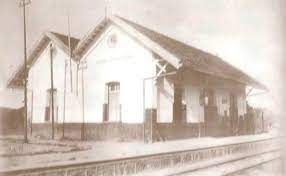
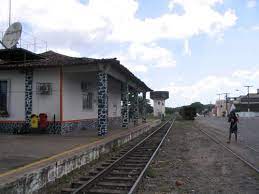
This station presents a bit of a mystery. What is certain is that it was inaugurated at the end of 1884 by the E.F. de Juiz de Fora a Piau railway company and was located about 180 km south of the provincial capital Ouro Preto. This was also announced in the regional press at the time:
Pharol, 25.11.1884
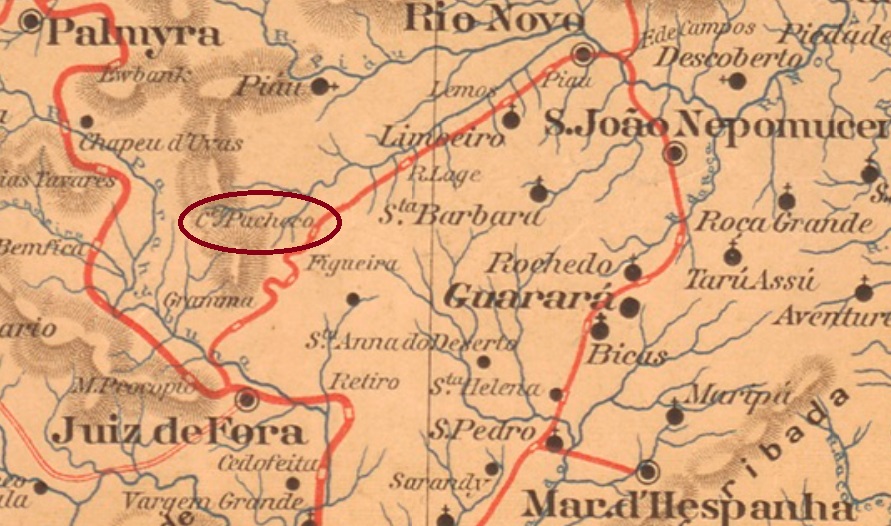
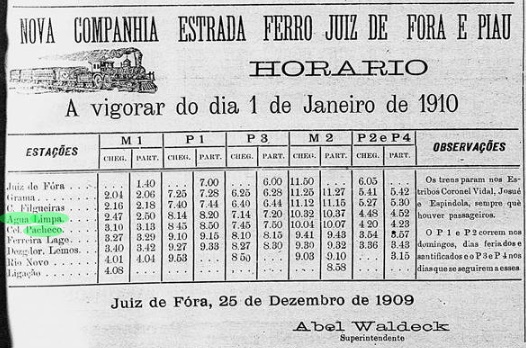
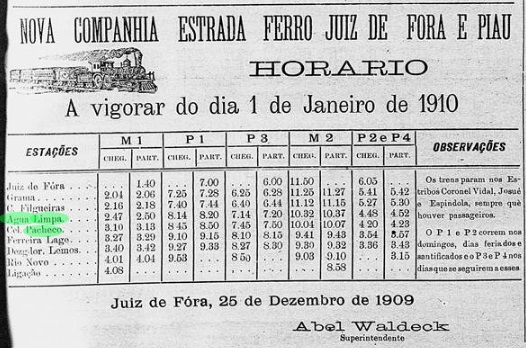
One reads in estacoesferroviarias.com.br that the station was renamed Coronel Pacheco, and this can also be seen on the Minas map of 1910 (see above). However, there were both names for neighbouring stations at that time, as the train timetable of January 1910 reveals:
Pharol, 04.01.1910
The only plausible explanation would be that the former Lima Duarte station was initially renamed Coronel Pacheco (there had been another village called Lima Duarte in Minas Gerais since October 1884, formerly called Dores do Rio do Peixe and located west of Juiz de Fora), but soon disappeared, so that the former Agua Limpa station now became Coronel Pacheco. Colonel José Manoel Pacheco (1840-1914) was a large landowner in the region who co-founded the railway company and was thus practically set as the station’s name giver. The station has also been in the Município of Coronel Pacheco since December 1962. The railway line passed to E.F. Leopoldina between 1884 and 1913 and remained so until the end of operations in 1974.
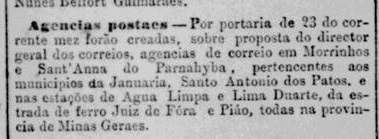
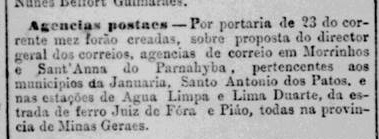
A station post office existed from April 1885, according to the Rio de Janeiro press release:
Jornal do Commercio/RJ 24.04.1885
No imperial postmark from this station has yet appeared.
E.F. Leopoldina
Anderer Name: Coronel Pacheco (ca. 1905)
Dieser Bahnhof stellt ein kleines Rätsel dar. Sicher ist, dass er Ende 1884 durch die E.F. de Juiz de Fora a Piau-Bahngesellschaft eingeweiht wurde und ca. 180 km südlich der Provinzhauptstadt Ouro Preto lag. So wurde auch damals in der Regionalpresse bekannt gegeben:
Pharol, 25.11.1884
Allerdings liest man in estacoesferroviarias.com.br, dass der Bahnhof zu Coronel Pacheco umbenannt wurde, und so kann man auch auf der Minas-Karte von 1910 (s.o.) sehen. Nun aber gab es damals wohl beide Namen für benachbarte Bahnhöfe, wie der Zugfahrplan von Januar 1910 verrät:
Pharol, 04.01.1910
Die einzige plausible Erklärung dafür wäre, dass der frühere Bahnhof Lima Duarte zunächst zu Coronel Pacheco umbenannt wurde (es gab seit Oktober 1884 eine weitere Ortschaft namens Lima Duarte in Minas Gerais, die früher Dores do Rio do Peixe hieß und westlich von Juiz de Fora lag), aber bald verschwand, so dass der frühere Bahnhof Agua Limpa nun zu Coronel Pacheco wurde. Der Oberst José Manoel Pacheco (1840-1914) war ein Großgrundbesitzer der Region, der die Bahngesellschaft mitgegründet hat und dadurch als Bahnhofsnamensgeber praktisch gesetzt wurde. Der Bahnhof liegt seit Dezember 1962 auch im Município von Coronel Pacheco. Die Bahnlinie ging zwischen 1884 und 1913 zu E.F. Leopoldina über und blieb so bis zum Betriebsende 1974.
Ein Bahnhofspostamt gab es seit April 1885, wie aus der Pressemitteilung von Rio de Janeiro hervorgeht:
Jornal do Commercio/RJ 24.04.1885
Bisher ist kein kaiserlicher Poststempel aus diesem Bahnhof aufgetaucht.
Carta da Republica dos Estados Unidos do Brazil, 1892
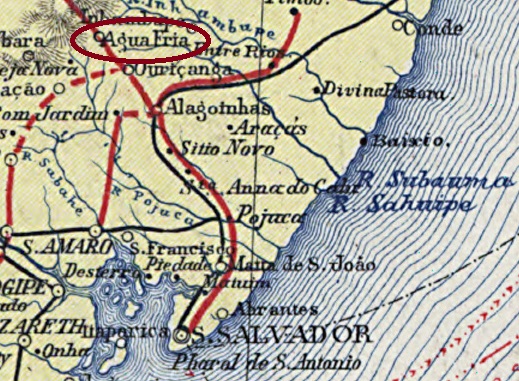
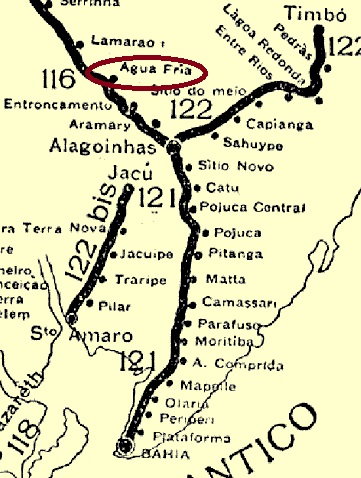
The Freguesia of São João Baptista da Agua Fria (Cold Water) was founded as early as April 1718, it belonged to the Vila of Cachoeira and was located over 150 km north of the capital Salvador da Bahia. In 1727, it was elevated to the status of Vila, but lost its autonomy at the beginning of the 19th century and finally became a district in the Município of Purificação dos Campos in May 1842. In August 1895, Agua Fria transferred as a district to the Município of Irará and emancipated itself in July 1962.
The local railway station was inaugurated in November 1880 by the E.F. da Bahia ao São Francisco. Afterwards, the line changed hands many times: in 1909 to the Cia. Viação Geral da Bahia, in 1911 to the Cie. de Chemins der Fer Fédéraux de l’Est Brésilien, in 1935 to the Viação Férrea Federal Leste Brasileiro, in 1975 to the Rede Ferroviária Federal until the end of operations in 1996. The rails are still there, but the station is now a ruin.
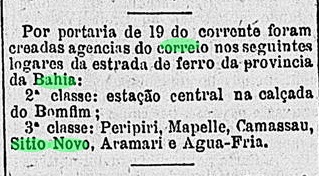
There had been a station post office there since April 1881, as the Rio press reports:
Gazeta de Noticias/RJ, 21.04.1881
No imperial postmark has yet been seen from this station.
Please note: this blog will return ca. 29 August, after a vacation break.
IBGE, 1898
Die Freguesia von São João Baptista da Agua Fria (Kaltes Wasser) wurde bereits im April 1718 gegründet, sie gehörte der Vila von Cachoeira und lag über 150 km nördlich der Hauptstadt Salvador da Bahia entfernt. 1727 wurde der Ort zur Vila erhoben, verlor aber am Anfang des 19 Jahrhunderts seine Eigenständigkeit und wurde schließlich im Mai 1842 zu einem Distrikt im Município von Purificação dos Campos. Im August 1895 wechselte Agua Fria als Distrkt zum Município von Irará und emanzipierte sich im Juli 1962.
Der Ortsbahnhof wurde im November 1880 durch die E.F. da Bahia ao São Francisco eingeweiht. Danach wechselte die Linie oft den Besitzer: 1909 zur Cia. Viação Geral da Bahia, 1911 zur Cie. de Chemins der Fer Fédéraux de l’Est Brésilien, 1935 zur Viação Férrea Federal Leste Brasileiro, 1975 bis Betriebsende 1996 zur Rede Ferroviária Federal. Die Schienen sind noch da, aber der Bahnhof ist jetzt eine Ruine.
Ein Bahnhofspostamt gab es dort seit April 1881, wie die Presse aus Rio berichtet:
Gazeta de Noticias/RJ, 21.04.1881
Bisher ist noch kein kaiserlicher Poststempel aus diesem Bahnhof zu sehen.
Bitte beachten: Dieser Blog macht Urlaub bis ca. 29.8.
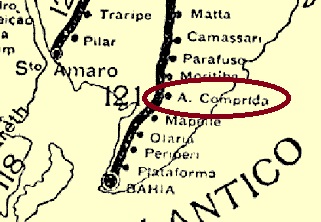
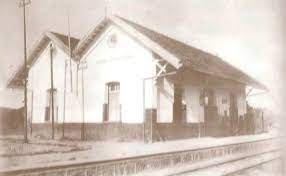
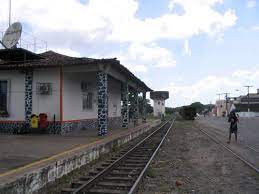
The Água Comprida station (then spelled Cumprida) was inaugurated in September 1860 by the E.F. da Bahia ao São Francisco railway company, located near Salvador da Bahia, 30 km north of the city centre. The railway line (Feira de Sant’Anna branch) changed hands several times: in 1909 to the Cia. Viação Geral da Bahia, in 1911 to the Cie. de Chemins of the Fer Fédéraux de l’Est Brésilien, in 1935 to the Viação Férrea Federal Leste Brasileiro, in 1957 to the Rede Ferroviária Federal S.A. and in 1996 to the Ferrovia Centro-Atlântica. The rails are still there today, and there are plans to reconnect the station with the capital.
estacoesferroviarias.com.brPhoto: Simões Filho (estacoesferroviarias.com.br)
Around the station, the settlement continued to grow; it was elevated to the status of a district in December 1953 and received political autonomy in November 1961 as the Município of Simões Filho. The name commemorates a journalist and politician (1886-1957) who was born in the area.
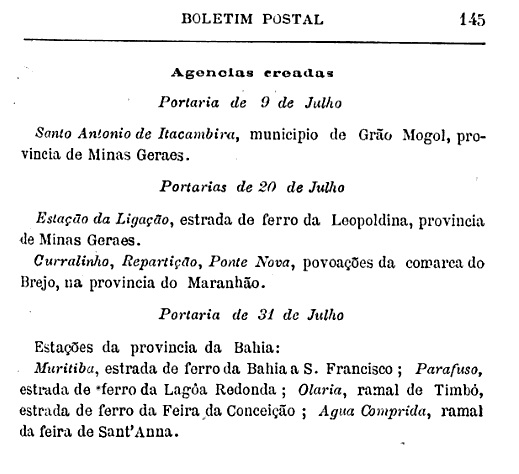
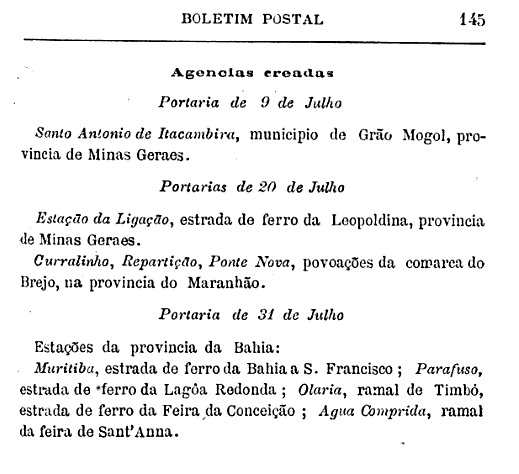
The station post office did not come into being until July 1889, as reported by the Brazilian Mail:
Boletim Postal No. 4, August 1889
The earliest postmark is probably ABA-0020a (Coll. Claudio Coelho): a double circle with the inscription AGUA CUMPRIDA at the top. The only specimen so far bears a date from 1890 inside.
Estado da Bahia, 1913
Anderer Name: Simões Filho (est.)
Der Bahnhof Água Comprida (damals Cumprida geschrieben) wurde im September 1860 durch die E.F. da Bahia ao São Francisco Bahngesellschaft eingeweiht und lag bei Salvador da Bahia, 30 km nördlich der Stadtmitte entfernt. Die Bahnlinie (Feira de Sant’Anna-Abzweigung) wechselte mehrmals den Besitzer: 1909 zur Cia. Viação Geral da Bahia, 1911 zur Cie. de Chemins der Fer Fédéraux de l’Est Brésilien, 1935 zur Viação Férrea Federal Leste Brasileiro, 1957 zur Rede Ferroviária Federal S.A. und 1996 zur Ferrovia Centro-Atlântica. Die Schienen sind heute noch da, und es gibt Pläne, den Bahnhof wieder mit der Hauptstadt zu verbinden.
estacoesferroviarias.com.brFoto Simões Filho (estacoesferroviarias.com.br)
Rund um den Bahnhof wuchs die Siedlung weiter, sie wurde im Dezember 1953 zum Distrikt erhoben und bekam die politische Autonomie im November 1961 als Município von Simões Filho. Der Name erinnert an einen Journalisten und Politiker (1886-1957), der in der Gegend geboren wurde.
Das Bahnhofspostamt entstand erst im Juli 1889, wie der Boletim Postal Nr. 4 berichtet:
Boletim Postal Nr. 4, August 1889
Der früheste Poststempel ist wohl ABA-0020a (Samml. Claudio Coelho): ein Doppelkreis mit der Inschrift AGUA CUMPRIDA oben. Das bisher einzige Exemplar trägt ein Datum aus 1890 im Inneren.
Villiers de l’Ile Adam: Carta (…) da Provincia de São Paulo, 1847
Other names: N. Sra. do Patrocinio do Capivari de Cima, Monte-Mor
See also Monte-Mor (R. Koester: Carimbologia XXVII)
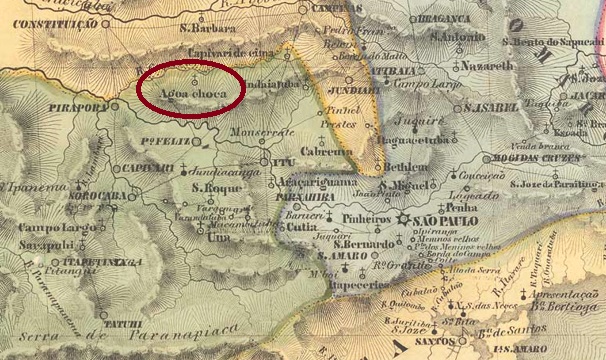
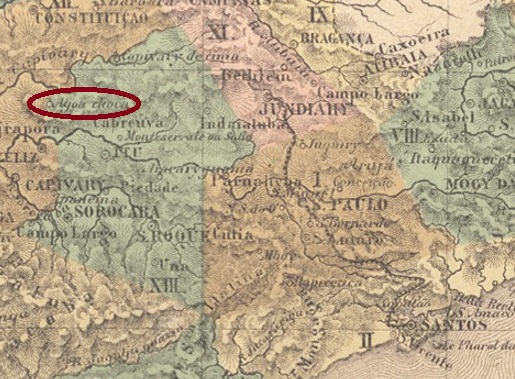
Around 1829, the settlement of N. Sra. do Patrocínio do Capivari de Cima was established, situated on the northern bank of the Capivari River, 120 km northwest of the future provincial capital São Paulo. In August 1832, the place was elevated to a freguesia with the strange name of Agua Choca (Rotten Water), which belonged to the Município of Itu. It was not until March 1871 that the name was changed again, this time as Vila of Monte-Mor (Big Mountain).
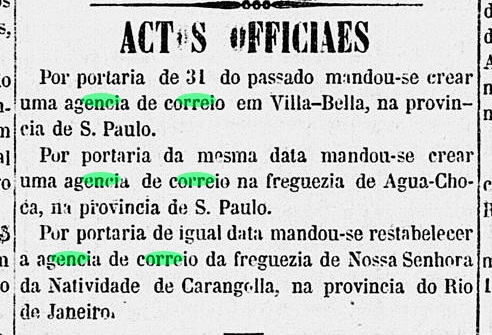
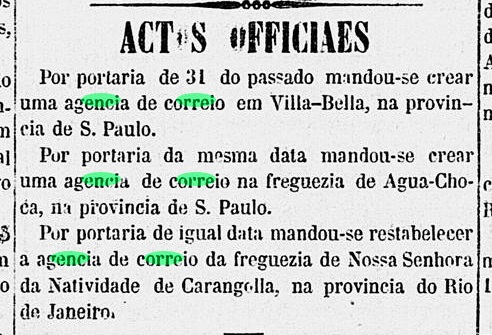
Two years of origin were found for the local post office. Firstly in 1854, as found out by philatelist Mario Celso Orsi Jr. Then in March 1865, as reported by the Rio press:
Correio Mercantil/RJ, 02.04.1865
So far no imperial postmark has been seen under this place name. For postmarks with Monte-Mor see Koester, Carimbologia XXVII.
Atlas do Imperio do Brasil, 1868
Andere Namen: N. Sra. do Patrocinio do Capivari de Cima, Monte-Mor
Siehe auch Monte-Mor (R. Koester: Carimbologia XXVII)
Um 1829 entstand die Siedlung von N. Sra. do Patrocínio do Capivari de Cima, die am Nordufer des Flusses Capivari lag, 120 km nordwestlich der künftigen Provinzhauptstadt São Paulo entfernt. Im August 1832 wurde der Ort zu einer Freguesia erhoben, die den merkwürdigen Namen Agua Choca (Verfaultes Wasser) trug und dem Município von Itu angehörte. Erst im März 1871 wurde der Name wieder geändert, diesmal als Vila von Monte-Mor (Großer Berg).
Zwei Entstehungsjahre wurden fürs örtliche Postamt gefunden. Erstmals 1854, wie vom Philatelisten Mario Celso Orsi Jr. Ermittelt. Dann im März 1865, wie die Presse aus Rio mitteilte:
Correio Mercantil/RJ, 02.04.1865
Bisher war kein kaiserlicher Poststempel unter diesem Ortsnamen zu sehen. Für Stempel mit Monte-Mor siehe Koester, Carimbologia XXVII.
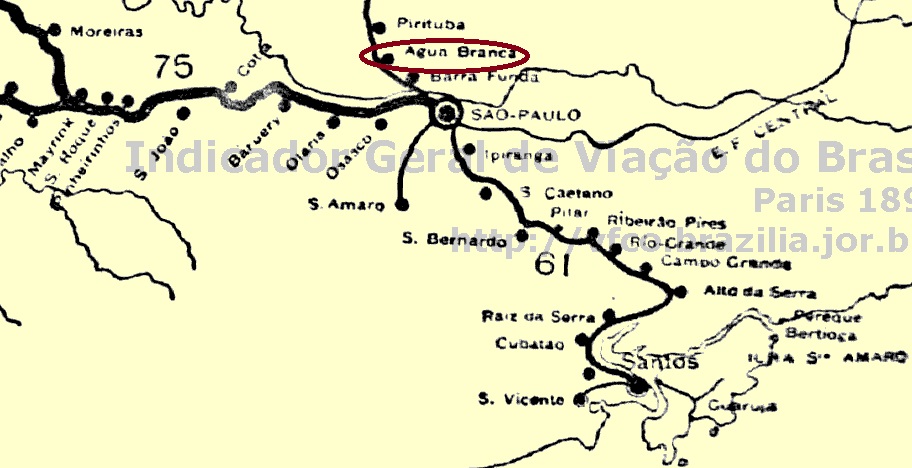
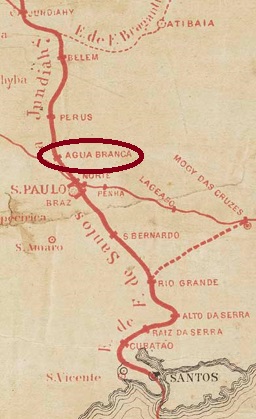
The Água Branca station was inaugurated in February 1867 by the São Paulo Railway and was located on the main line in the Município of São Paulo, 7 km northwest of the city centre. The line changed hands several times: in 1948 to E.F. Santos a Jundiaí, in 1975 to Rede Ferroviária Federal, in 1984 to Cia. Brasileira de Trens Urbanos (CBTU) in 1984 and Cia. Paulista de Trens Metropolitanos (CPTM) in 1994 until today. So, the station remains in operation to this day.
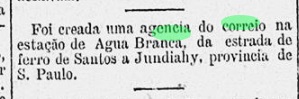
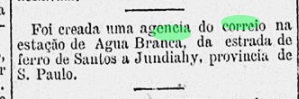
The station post office came into being in July 1887, according to the Rio press:
Gazeta de Noticias/RJ, 07.07.1887
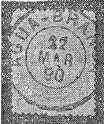
The imperial postmark is probably this one, as illustrated by R. Koester in Carimbologia I (1961):
ASP-0005a (RK) 1890Estações (…) de RJ, SP e MG, 1880
Der Bahnhof Água Branca wurde im Februar 1867 durch die São Paulo Railway eingeweiht und lag auf der Hauptlinie im Município von São Paulo, 7 km nordwestlich der Stadtmitte entfernt. Die Linie wechselte mehrmals den Besitzer: 1948 zur E.F. Santos a Jundiaí, 1975 zur Rede Ferroviária Federal, 1984 zur Cia. Brasileira de Trens Urbanos (CBTU) und 1994 bis heute zur Cia. Paulista de Trens Metropolitanos (CPTM). Also bleibt der Bahnhof bis heute in Betrieb.
Das Bahnhofspostamt entstand im Juli 1887, wie die Presse aus Rio mitteilte:
Gazeta de Noticias/RJ, 07.07.1887
Der kaiserliche Poststempel ist wahrscheinlich dieser, wie durch R. Koester in Carimbologia I (1961) abgebildet:



 Carimbologia