Categories
Carimbologia S

Santo Antonio de Itacambira, Minas Gerais (SMG-2995)

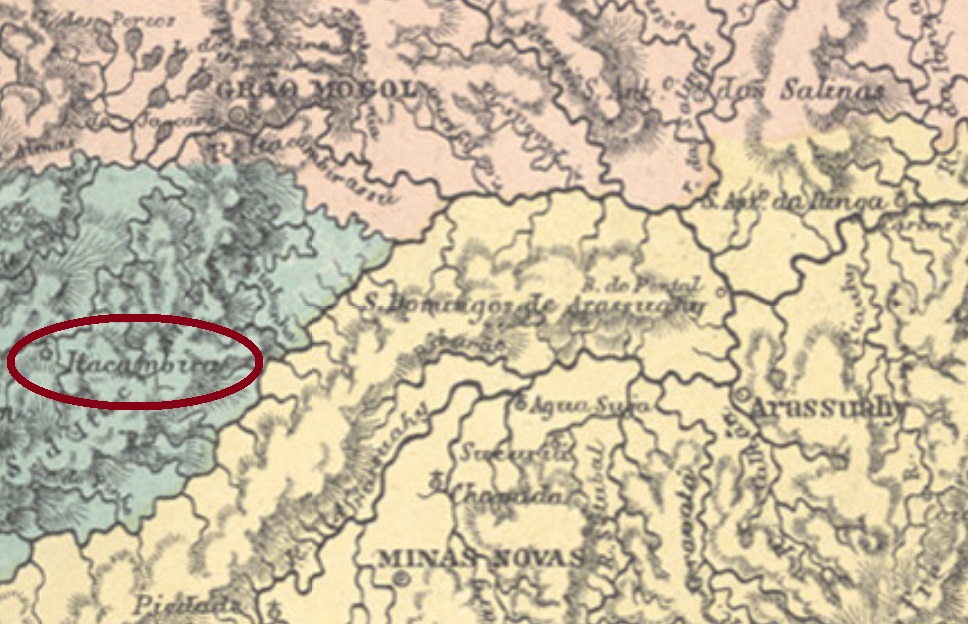
Atlas do Imperio do Brasil, 1868

Other names: Santo Antonio do Itacambirussu (1840), Itacambira (1923)

Santo Antonio de Itacambira was a freguesia which belonged at its foundation in March 1813 to Grão-Mogol, situated over 500 km north of the province capital Ouro Preto. In April 1840 the name changed to a pompous Santo Antonio do Itacambirussu da Serra do Grão-Mogol. Only in September 1923 the toponym became a simple Itacambira, which was elevated to a town in own municipality in December 1962. The tupi word itacambira means allegedly sharp stone from the dense forest.

According to Paula Sobrinho (História Postal de Minas Gerais, Belo Horizonte, 1997), the local post office was created in July 1889, as reported by the Rio press:
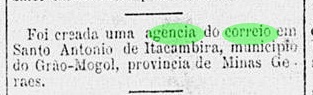
Gazeta de Notícias, RJ, July 11, 1889

Cancels dated before the end of the Empire on November 15 must be very rare, but we have found two later obliterations from the Márcio Protzner collection. SMG-2995a is a manuscript one. Here one can read Itacambira and the date of July 27, 1898, but maybe the postal clerk had written the whole toponym. SMG-2995b is probably a republican cancel, for it was found with a date of 1903. The double circle has the inscriptions S. ANT. DE ITACAMBIRA above and (MINAS) below, with date at the centre.
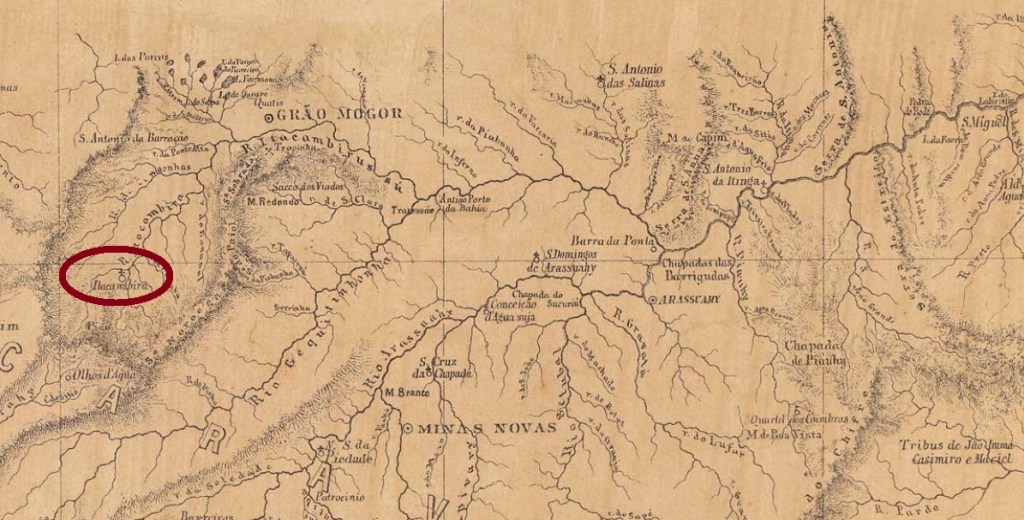
Provincia de Minas Geraes, 1873

Andere Namen: Santo Antonio do Itacambirussu (1840), Itacambira (1923)

Santo Antonio de Itacambira war seit der Gründung im März 1813 eine Freguesia von Grão-Mogol, die über 500 km nördlich der späteren Provinzhauptstadt Ouro Preto lag. Im April 1840 wechselte der Name zu einem bombastischen Santo Antonio do Itacambirussu da Serra do Grão-Mogol. Erst im September 1923 wurde der Ortsname zu Itacambira vereinfacht, und der Ort wurde im Dezember 1962 zur Stadt erklärt. Das Wort itacambira kommt aus der Tupi-Sprache und soll spitzer Stein aus dem Dickicht bedeuten.

Wie Paula Sobrinho berichtet (História Postal de Minas Gerais, Belo Horizonte, 1997), gibt es dort ein Postamt seit Juli 1889. Dies bestätigt die Presse aus Rio:
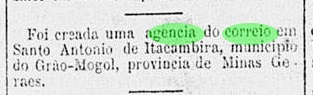
Gazeta de Notícias, RJ, 11. Juli 1889

Stempel mit Daten bis zum Ende des Kaiserreichs am 15. November müssen sehr selten sein. Wir haben lediglich zwei spätere Entwertungen gefunden, beide aus der Sammlung Márcio Protzner. SMG-2995a ist eine handschriftliche Entwertung. Hier kann man Itacambira und das Datum vom 27. Juli, 1898 lesen, wobei der Postangestellter den gesamten Ortsnamen geschrieben haben mag. SMG-2995b ist wahrscheinlich bereits ein Stempel der Republik, da er im Jahr 1903 verwendet wurde. Der Doppelkreis hat die Inschriften S. ANT. DE ITACAMBIRA oben und (MINAS) unten, dazu das Datum in der Mitte.
Categories
Carimbologia S

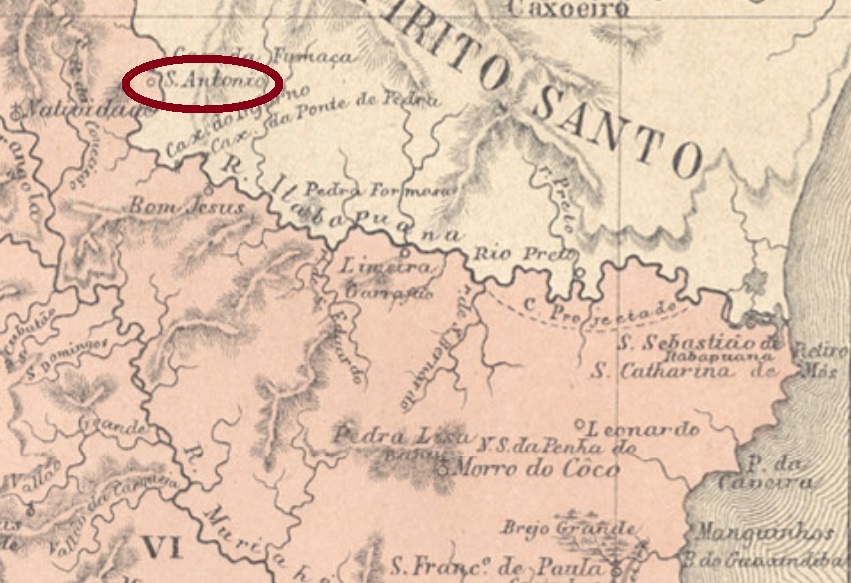
Santo Antonio de Itabapoanna, Rio de Janeiro (SRJ-2245)

Atlas do Imperio do Brasil, 1868

Another name: Calheiros (1938)

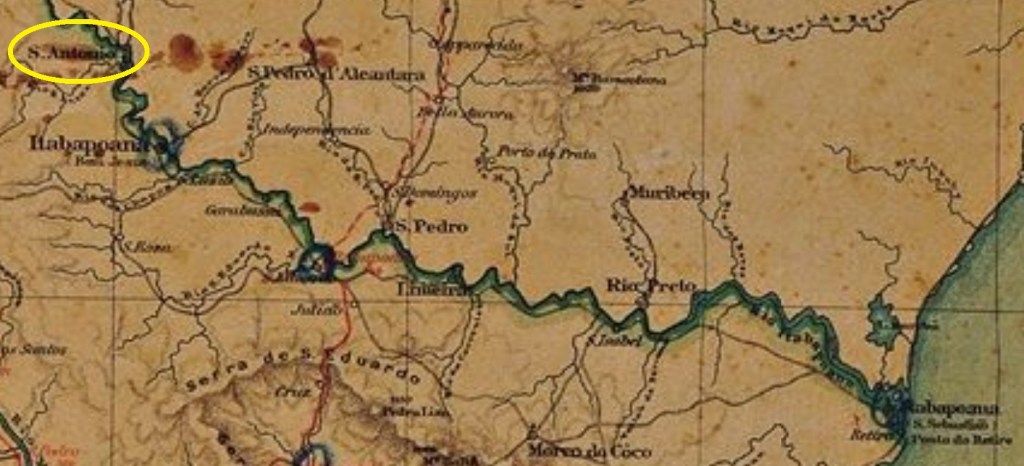
Santo Antonio do Itabapoanna was since November 1890 a freguesia of Bom Jesus do Itabapoanna, situated on the west bank of the Itabapoanna River (that separated the Rio de Janeiro and the Espírito Santo provinces), almost 350 km northeast of the imperial capital Rio de Janeiro. From May 1892 until December 1938 it was transferred to the municipality of Itaperuna, before coming back to Bom Jesus, now under the actual toponym Calheiros.

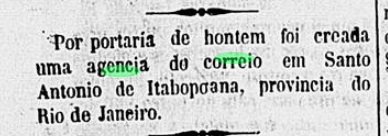
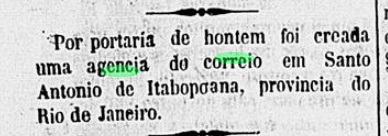
According to Paulo Novaes (agenciaspostais.com.br), the local post office was created in January 1885, as confirmed by the Rio press:

Brazil, RJ, January 23, 1885

One early cancel has been found. SRJ-2245a (Coll. FM) has a double circle with the inscription S. ANT. DA ITABAPOANNA above and a Maltese cross below. The only seen example has a date of 1892 at the centre.

Almanak Laemmert, 1892

Anderer Name: Calheiros (1938)

Santo Antonio do Itabapoanna war ab November 1890 eine Freguesia im Município von Bom Jesus do Itabapoanna, die am Westufer des Flusses Itabapoanna (der die Provinzen Rio de Janeiro und Espírito Santo von einander trennte) lag, fast 350 km nordöstlich der kaiserlichen Hauptstadt Rio de Janeiro entfernt. Zwischen Mai 1892 bis Dezember 1938 gehörte sie zu Itaperuna, danach ging sie zu Bom Jesus zurück, nun unter dem aktuellen Ortsnamen Calheiros.

Wie Paulo Novaes (agenciaspostais.com.br) berichtet, entstand das örtliche Postamt bereits im Januar 1885, wie durch die Rio-Presse bestätigt werden kann:

Brazil, RJ, 23. Januar 1885

Nur ein früher Stempel wurde gefunden. SRJ-2245a (Samml. FM) hat einen Doppelkreis mit der Inschrift S. ANT. DA ITABAPOANNA oben und einem Malteser Kreuz unten. Das bisher einzige gesichtete Exemplar trägt ein Datum von 1892 in der Mitte.

Categories
Carimbologia S

Santo Antonio de Imbituva, Paraná (SPR-0205)

Mappa do Estado do Paraná, 1892

Other names: Campo do Cupim, Imbituva (1929)

See also Cupim (R. Koster: Carimbologia XV)

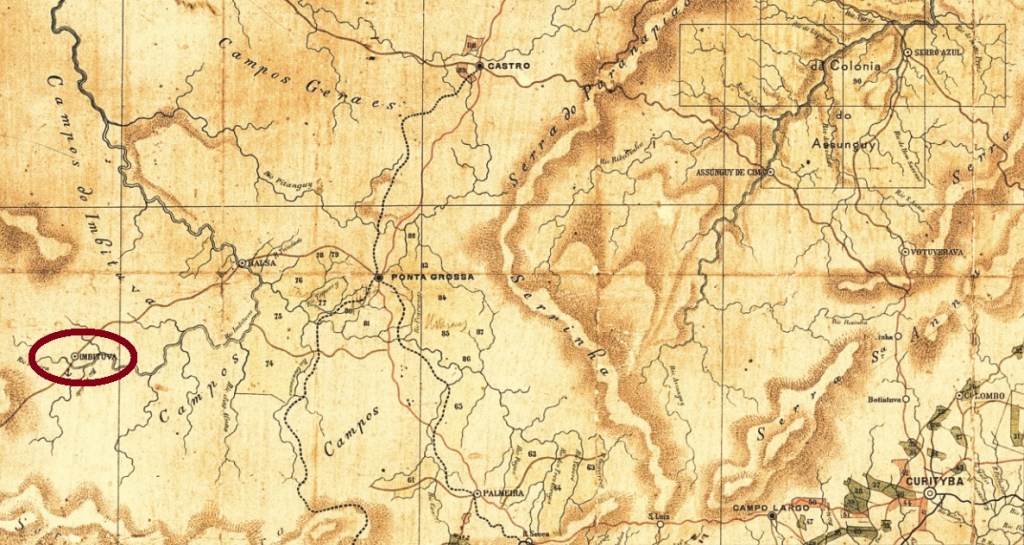
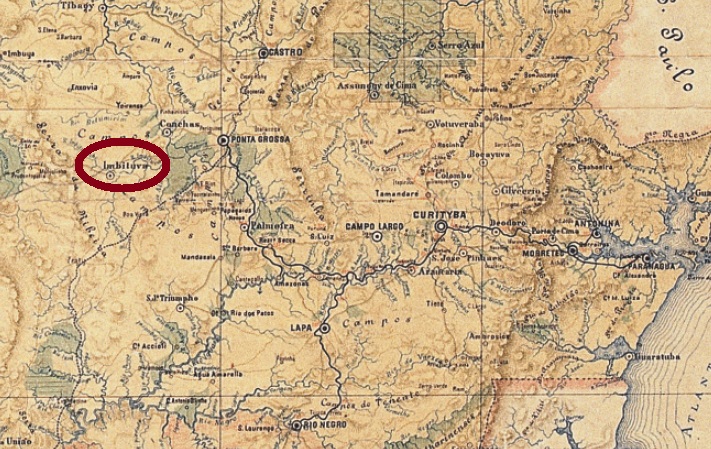
Santo Antonio de Imbituva was since March 1881 a villa in the Paraná province, situated 170 km west of the capital Curitiba. According to the Brazilian Institute of Geography and Statistics (IBGE), the freguesia had been founded in February 1876 under the name of Cupim (portuguese for termite) in the municipality of Ponta Grossa, after the settlement Campo do Cupim (=termite field), which was quite an important stop on the cattle trail from South Brazil to Sorocaba. In April 1910 the local was declared a town, which simplified the name to Imbituva in April 1929.

TheImperial Mail Register (Tabella das Agencias do Correio do Imperio) of 1885 lists this post office still under the toponym Cupim, as created in 1874. This means there was a postal agency there before the freguesia was founded. No cancel under Santo Antonio de Imbituva was seen until now. For cancels featuring Cupim see Koester (Carimbologia XV).

Mappa do Estado do Paraná, 1896

Andere Namen: Campo do Cupim, Imbituva (1929)

Siehe auch Cupim (R. Koster: Carimbologia XV)

Santo Antonio de Imbituva war ab März 1881 eine Villa in der Provinz Paraná, die 170 km westlich der Hauptstadt Curitiba lag. Laut dem brasilianischen Institut für Geografie and Statistik (IBGE) wurde die Freguesia im Februar 1876 unter dem Ortsnamen Cupim (portugiesisch für Termite) im Município von Ponta Grossa gegründet, nach der Siedlung Campo do Cupim (=Termitenfeld), einer wichtigen Haltestelle auf dem Viehtransportweg vom Süden Brasiliens nach Sorocaba. Im April 1910 stieg der Ort zur Stadt auf, die seit April 1929 den vereinfachten Namen Imbituva trägt.

Das Verzeichnis der kaiserlichen Postämter (Tabella das Agencias do Correio do Imperio) von 1885 listet dieses Amt immer noch unter dem Ortsnamen Cupim auf, mit Gründungsdatum 1874. Also gab es dort ein Postamt noch bevor die Freguesia errichtet wurde. Kein Stempel mit der Legende Santo Antonio de Imbituva wurde bisher gesichtet. Für Abstempelungen mit Cupim siehe Koester (Carimbologia XV).

Categories
Carimbologia S

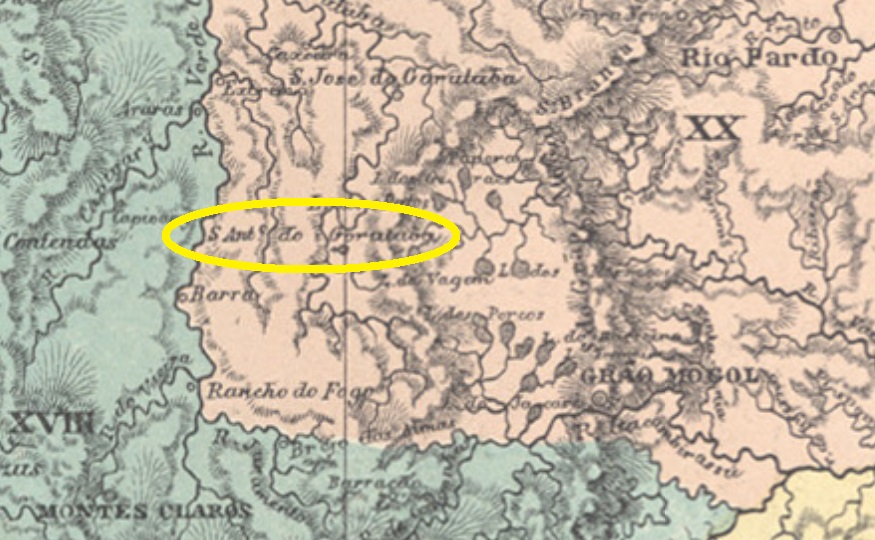
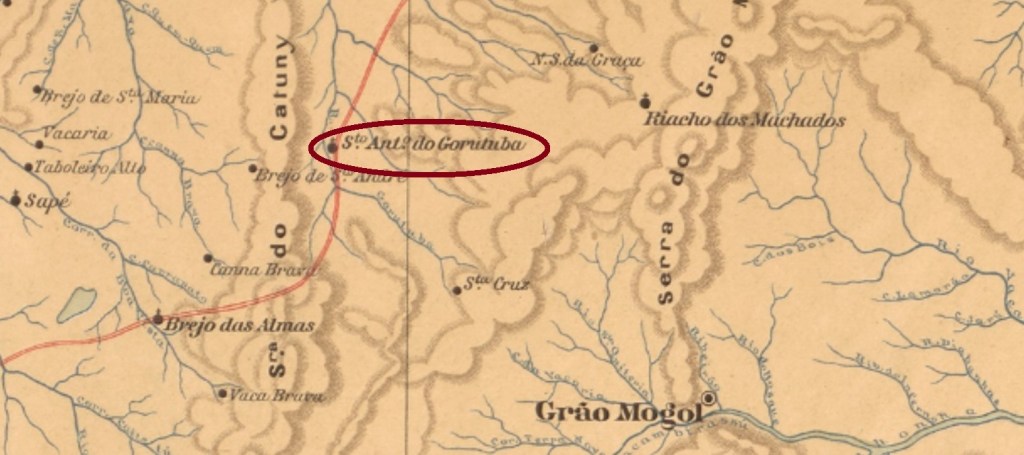
Santo Antonio do Gorutuba, Minas Gerais, (SMG-3030)

Atlas do Imperio do Brasil, 1868

Other names: Santo André (1923), Catuni (1943)

Santo Antonio do Gorutuba was since December 1874 a freguesia in the municipality of Grão-Mogol, situated on the west bank of the Gorutuba (plenty of stones, in tupi guarani) River, over 600 km north of the province capital Ouro Preto. In September 1923 the toponym changed to Santo André, and in December 1943, to Catuni, which allegedly means good water in the indian language. Catuni is since February 1964 a district of the municipality of Francisco Sá.

According to Paula Sobrinho (História Postal de Minas Gerais, Belo Horizonte, 1997), the local post office was created in April 1885. Only one cancel from the Empire was seen, whose left side is unfortunately missing. SMG-2030a (Coll. José A. Junges) has a double circle with the inscriptions (S.A. DO) GORUTUBA above and (MINAS) below. The date at the centre of the sole exmaple shows the year 1888.

Estado de Minas Geraes, 1910

Andere Namen: Santo André (1923), Catuni (1943)

Santo Antonio do Gorutuba war ab Dezember 1874 eine Freguesia im Município von Grão-Mogol, die am Westufer des Flusses Gorutuba (viele Steine, auf Tupi-guarani) lag, über 600 km nördlich der Provinzhauptstadt Ouro Preto entfernt. Im September 1923 änderte sich der Ortsname zu Santo André, und im Dezember 1943 zu Catuni, d.h. angeblich Gutes Gewässer in der Indianersprache. Catuni ist seit Februar 1964 ein Distrikt im Município von Francisco Sá.

Wie Paula Sobrinho (História Postal de Minas Gerais, Belo Horizonte, 1997) berichtet, gibt es dort ein Postamt seit April 1885. Nur ein Stempel des Kaiserreichs wurde gefunden, dessen linke Seite leider nicht zu sehen ist. SMG-2030a (Samml. José A. Junges) hat einen Doppelkreis mit den Inschriften (S.A. DO) GORUTUBA oben und (MINAS) unten. Das Datum in der Mitte des einzigen Exemplars zeigt das Jahr 1888.

Categories
Carimbologia S

Santo Antonio do Glória, Minas Gerais (SMG-3025)

Atlas do Imperio do Brasil, 1868

Why Santo Antonio DO Glória, but not DA Glória as before? Because this one is named after the Glória River, an affluent to the Muriaé. The locality was from December 1874 on a district in the municipality of São Paulo de Muriaé, situated ca. 200 km southeast of the province capital Ouro Preto, and has changed three times since then: to Glória (1938), Miradouro (1943) and to the actual Vieiras (1953).

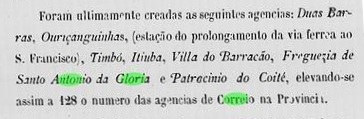
According to Paula Sobrinho (História Postal de Minas Gerais, Belo Horizonte, 1997), the local post office was created in September 1889, six weeks before the end of the empire. No wonder that no imperial postal cancel has been found. This must be very rare.

Provincia de Minas Geraes, 1873

Warum Santo Antonio DO Glória, aber nicht DA Glória, wie die vorherige Ortschaft? Weil diese nach dem Fluss Glória benannt wurde, einem Zufluss des Muriaé. Dieser Ort war ab Dezember 1874 ein Distrikt im Município von São Paulo de Muriaé, der ca. 200 km südöstlich der Provinzhauptstadt Ouro Preto entfernt lag, und wechselte seine Zuständigkeit seitdem dreimal: zu Glória (1938), Miradouro (1943) und schließlich bis heute zu Vieiras (1953).

Wie Paula Sobrinho (História Postal de Minas Gerais, Belo Horizonte, 1997) berichtet, gibt es dort ein Postamt seit September 1889, sechs Wochen vor dem Ende des Kaiserreichs. Kein Wunder, dass bisher kein imperialer Poststempel gesehen wurde. Dieser muss sehr selten sein.

Categories
Carimbologia S

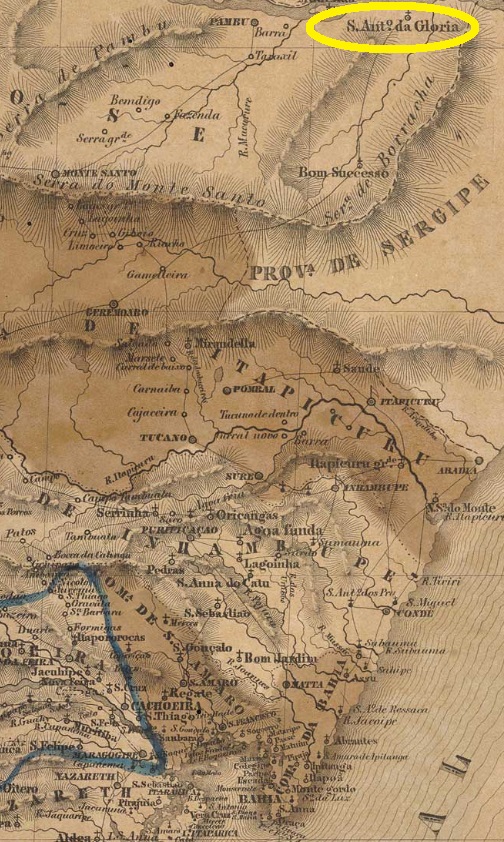
Santo Antonio da Gloria, Bahia (SBA-0690)

Villiers de l’Ile Adam: Carta (…) da Provincia da Bahia, 1848

Other names: Santo Antonio da Glória do Curral dos Bois, Glória (1931)

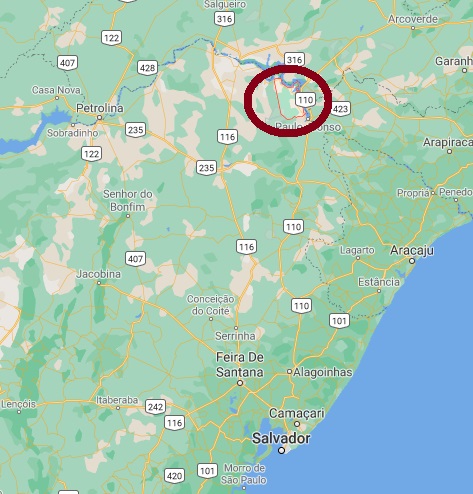
The former Santo Antonio da Gloria do Curral dos Bois (= St. Anthony of the Glory of the Oxen Corral) ascended in April 1842 to a district in the municipality of Jeremoabo, situated on the South bank of the São Francisco River, almost 500 km north of the province capital Salvador da Bahia. In May 1886 it was declared the Villa and municipality of Santo Antonio da Glória, which has since June 1931 the name simplified to Glória.

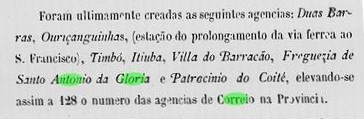
According to the Bahia Government report for 1887, the local post office was created one year before:

Relatorio do Conselho Interino do Governo da Bahia, 1887

No imperial post cancel has appeared until now.

Google Maps

Andere Namen: Santo Antonio da Glória do Curral dos Bois, Glória (1931)

Der ehemalige Ort Santo Antonio da Gloria do Curral dos Bois (= St. Antonius zur Ehre des Ochsenkorrals) stieg im April 1842 zu einem Distrikt im Município von Jeremoabo, der am Südufer des Flusses São Francisco lag, fast 500 km nördlich der Provinzhauptstadt Salvador da Bahia. Im Mai 1886 wurde daraus die Villa und Município von Santo Antonio da Glória, dessen Name ab Juni 1931 die vereinfachte Form Glória annahm.

Laut dem Präsidialbericht für die Provinz Bahia des Jahres 1887 entstand das örtliche Postamt ein Jahr zuvor:

Relatorio do Conselho Interino do Governo da Bahia, 1887

Kein Poststempel der Kaiserzeit war bisher zu sehen.

Categories
Carimbologia S

Santo Antonio da Encruzilhada, Rio de Janeiro (SRJ-1550)

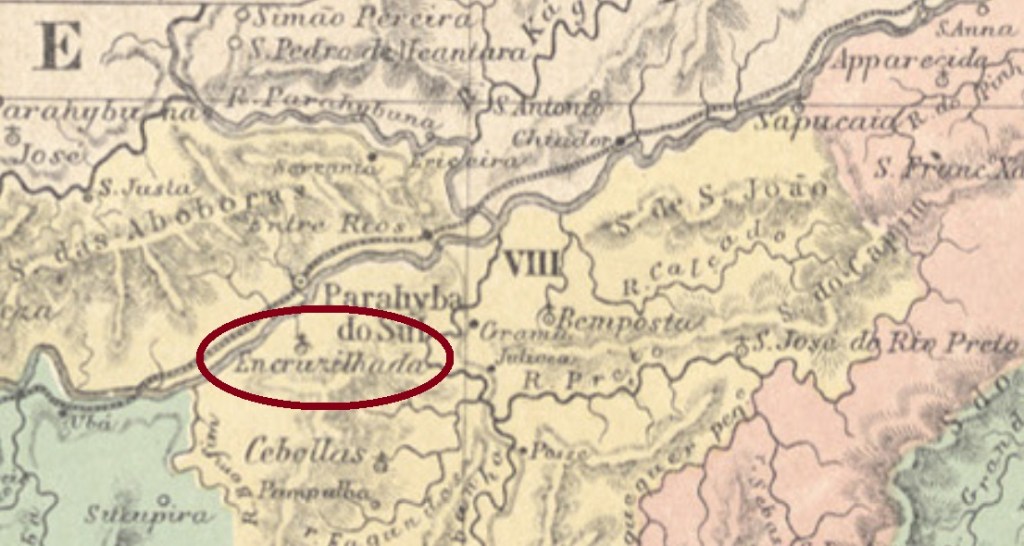
Atlas do Imperio do Brasil, 1868

Other names: Encruzilhada, Salutaris (1943)

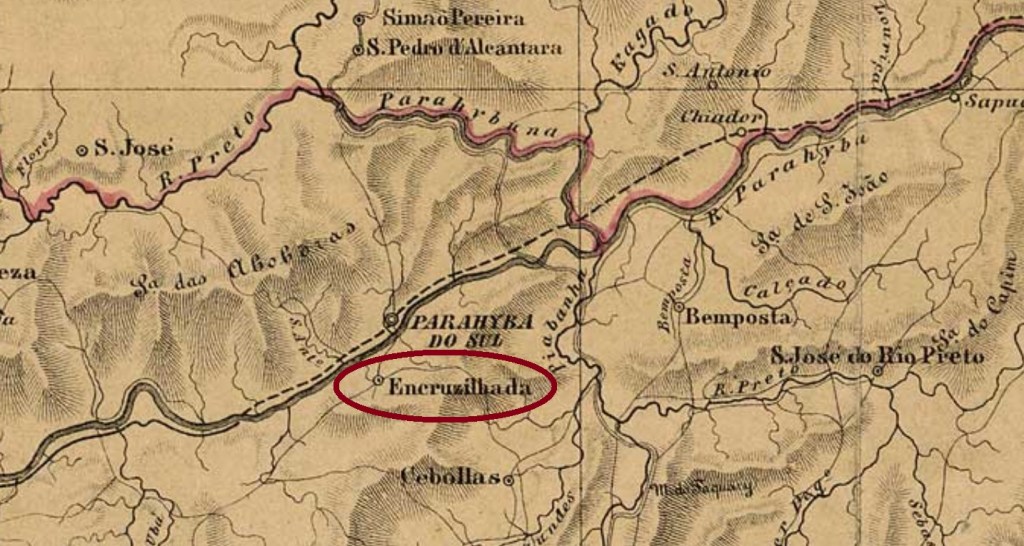
The district of Santo Antonio dos Pobres da Encruzilhada (= St. Anthony of the Poor at the Road Crossing) was established in October 1855 in the municipality of Paraíba do Sul, on the south bank of the homonymous river, round 150 km north of the imperial capital Rio de Janeiro. This adminstrative status has remained until our days, although the toponym has changed twice since then: in December 1938 to Encruzilhada, and five years later, to Salutaris.

According to Paulo Novaes (agenciaspostais.com.br), the local post office was created in October 1876. One imperial cancel was found: SRJ-1550a (Coll. José A. Junges) has a double circle with the inscription S. ANTO. DA ENCRUZILHADA above and a black dot below. The dates at the centre were found for the period 1889-1892.

Almanak Laemmert, 1866

Andere Namen: Encruzilhada, Salutaris (1943)

Der Distrikt von Santo Antonio dos Pobres da Encruzilhada (= Hl. Antonius der Armen an der Wegekreuzung) wurde im Oktober 1855 im Município von Paraíba do Sul am Südufer des gleichnamigen Flusses gegründet und lag knapp 150 km nördlich der kaiserlichen Hauptstadt Rio de Janeiro entfernt. Dieser Verwaltungsstatus ist bis heute unverändert geblieben, obwohl der Ortsname in der Zwischenzeit zweimal gewechselt wurde: im Dezember 1938 zu Encruzilhada, und fünf Jahre später zu Salutaris.

Wie Paulo Novaes schreibt (agenciaspostais.com.br), gibt es dort ein Postamt seit Oktober 1876. Ein Stempel der Kaiserzeit ist vorhanden: SRJ-1550a (Samml. José A. Junges) hat einen Doppelkreis mit der Inschrift S. ANTO. DA ENCRUZILHADA oben und ein schwarzer Punkt unten. Die Daten in der Mitte wurden bisher für den Zeitraum 1889-1892 ermittelt.

Categories
Carimbologia S

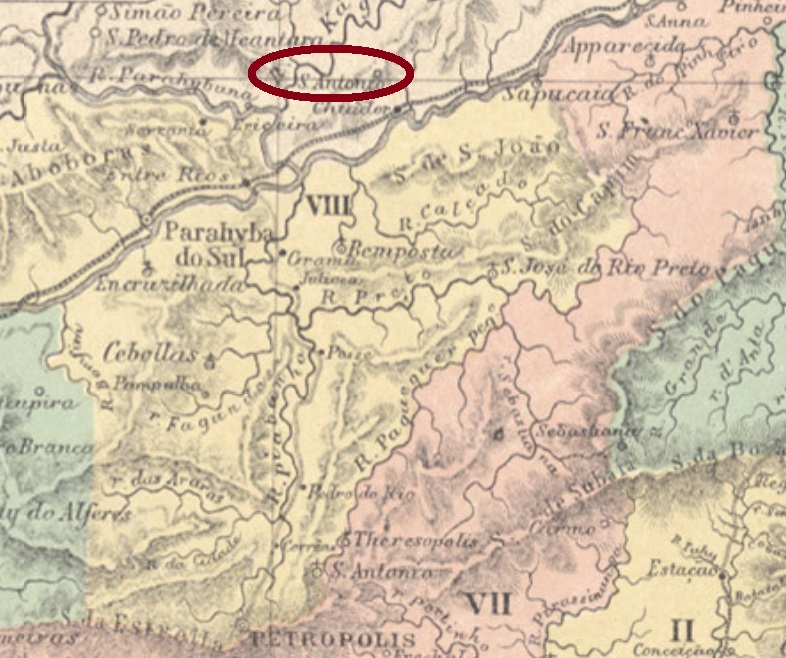
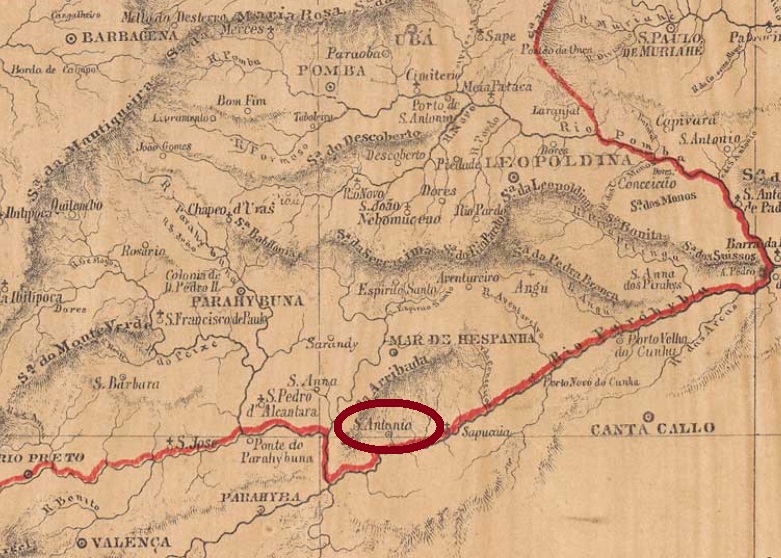
Santo Antonio do Chiador, Minas Gerais (SMG-3020)

Atlas do Imperio do Brasil, 1868

Another name: Chiador (1938)

This Santo Antonio was since January 1880 a district of the municipality of Mar d’Hespanha, situated ca. 300 km south of the province capital Ouro Preto. In December 1938 the name was simplified to Chiador, and the locality emancipated as a municipality in December 1953.

According to Paula Sobrinho (História Postal de Minas Gerais, Belo Horizonte, 1997) the local post office was created in May 1880. One imperial cancel could be found. SMG-3020a (Coll. José A. Junges) occurs in black and violet and has a double circle with the inscription S. ANTONIO DO CHIADOR above and a diamond ornament below, which consists of four small diamonds. The dates at the centre were found for the period 1885-1892.

Provincia de Minas Geraes, 1873

Anderer Name: Chiador (1938)

Dieser Santo Antonio war ab Januar 1880 ein Distrikt im Município von Mar d’Hespanha, der ca. 300 km südlich der Provinzhauptstadt Ouro Preto entfernt lag. Im Dezember 1938 wurde der Name zu Chiador vereinfacht, und die Ortschaft wurde ein eigenständiger Município im Dezember 1953.

Paula Sobrinho schreibt in seiner História Postal de Minas Gerais (Belo Horizonte, 1997), es gibt dort seit Mai 1880 ein Postamt. Ein Stempel der Kaiserzeit war auch zu finden. SMG-3020a (Samml. José A. Junges) kommt in schwarz und violett vor und zeigt einen Doppelkreis mit der Inschrift S. ANTONIO DO CHIADOR oben und einem Ornament in Rautenform unten, das aus vier kleinen Rauten besteht. Die Daten in der Mitte wurden für den Zeitraum 1885-1892 gefunden.

Categories
Carimbologia S

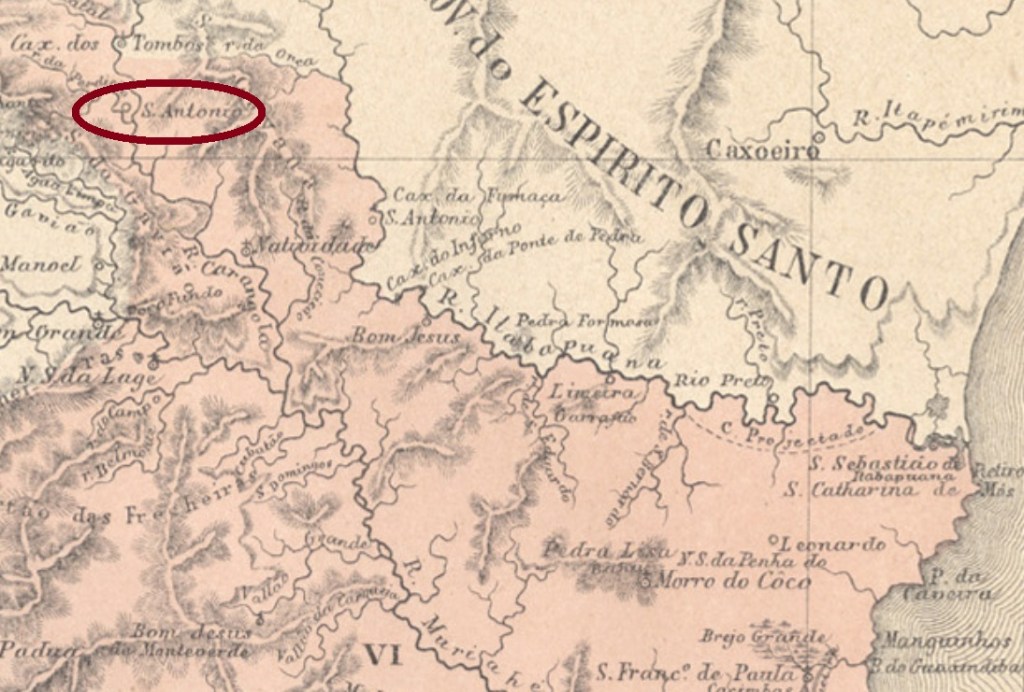
Santo Antonio do Carangola, Minas Gerais (SMG-3018) – Santo Antonio do Carangola (train station/Bahnhof), Rio de Janeiro (SRJ-0907)

Atlas do Imperio do Brasil, 1868

Other names: Santo Antonio de Porciúncula, Porciúncula (1938)

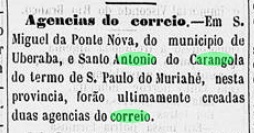
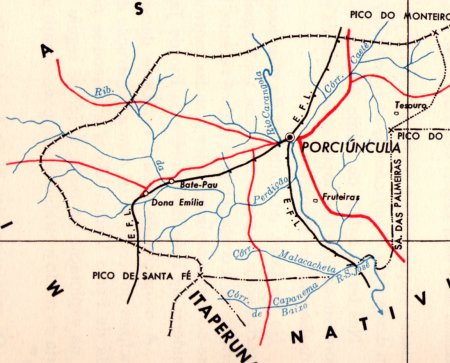
This is a very singular case of a locality which apparently had changed the province to profit from a train station, that also had its own post office. Its history began in April 1847, when the district of Santo Antonio do Carangola was founded in the municipality of São Paulo do Muriaé, Minas Gerais province, over 250 km southeast of the capital Ouro Preto. The location quite near the provincial border to Rio de Janeiro and the railroad run in the late 19th century must have caused considerable political tension in the region. So the village switched in November 1885 to the municipality of Itaperuna, now in the Rio province, and seven months later a train station was installed there by the Estrada de Ferro do Carangola. In November 1926 the toponym changed to Santo Antonio de Porciúncula, which had the name simplified to Ponciúncula in December 1938. Since June 1947 has Porciúncula an own municipality. The name is a tribute to the medical doctor José Tomás da Porciúncula (1854-1901), the first Rio de Janeiro governor elected after the republican strike.

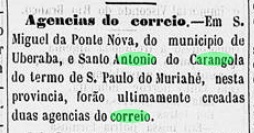
The local post office was created in September 1881, still in the Minas Gerais province, as reported by the press:

A Provincia de Minas, October 2, 1881

One postal cancel from this early period was found: SMG-3018a (Coll. José A. Junges) has a double circle with the inscription S. ANTONIO DO CARANGOLA above and a diamond ornament below, formed by four small diamonds. It was used from the beginning until at least 1887, i.e. already in the Rio province. The later cancels were probably originated from the train station, although no concrete reference has been found yet. SRJ-0907a (Coll. José A. Junges) has a double circle with the imprint S. ANTONIO DO CARANGOLLA above and an ornament in x-form below, dated 1888-89 at the centre. SRJ-0907b (image from the internet) could be already republican, for it was found dated 1892-1893 at the centre. In the double circle the inscription is now written S. ANTO. DO CARANGOLA, and the ornament below is a Maltese cross.

estacoesferroviarias.com.br

Andere Namen: Santo Antonio de Porciúncula, Porciúncula (1938)

Hier haben wir mit einem merkwürdigen Fall zu tun: eine Ortschaft wechselt die Provinzzugehörigkeit, um von einem Bahnhof – mit eigenem Postamt – zu profitieren. Die Geschichte beginnt im April 1847, mit der Distriktgründung von Santo Antonio do Carangola im Município von São Paulo do Muriaé der Provinz Minas Gerais, über 250 km südöstlich der Hauptstadt Ouro Preto entfernt. Die Lage nahe an der Provinzgrenze zu Rio de Janeiro und die rasche Expansion des Bahnschienennetzes im späten 19. Jahrhundert haben offenbar einen großen politischen Druck in der Region erzeugt. Also wechselte die Ortschaft im November 1885 zum Município von Itaperuna, nun in die Provinz Rio de Janeiro, und schon sieben Monate später ein Bahnhof war dort durch die Estrada de Ferro do Carangola eingeweiht. Im November 1926 wechselte der Ortsname zu Santo Antonio de Porciúncula, der wiederum im Dezember 1938 zu Ponciúncula verinfacht wurde. Seit Juni 1947 hat Porciúncula einen eigenen Município. Der Name soll an den Arzt und Politiker José Tomás da Porciúncula (1854-1901) erinnern, den ersten gewählten Gouverneur des Staates Rio de Janeiro nach dem Putsch, der die Republik mit sich brachte.

Das örtliche Postamt entstand im September 1881, noch in der Provinz Minas Gerais, wie die Regionalpresse berichtet:

A Provincia de Minas, 2. Oktober 1881

Ein Poststempel dieser Frühzeit ist vorhanden: SMG-3018a (Samml. José A. Junges) hat einen Doppelkreis mit der Inschrift S. ANTONIO DO CARANGOLA oben und einem Ornament in Rautenform unten, das aus vier kleinen Rauten besteht. Er wurde vom Betriebsbeginn bis mindestens 1887 verwendet, also innerhalb der Zeit in der Provinz Rio. Die beiden folgenden Stempel sind wohl aus der Bahnhofsagentur, obwohl keine konkreten Angaben dazu zu lesen sind. SRJ-0907a (Samml. José A. Junges) hat einen Doppelkreis mit S. ANTONIO DO CARANGOLLA oben und einem x-förmigen Ornament unten, datiert 1888-89 in der Mitte. SRJ-0907b (Abb. aus dem Internet) könnte bereits republikanisch sein, da beide Exemplare mit 1892-1893 in die Mitte datiert wurden. Im Doppelkreis lautet die Inschrift nun S. ANTO. DO CARANGOLA, und das untere Ornament ist ein Malteser Kreuz.

Categories
Carimbologia S

Santo Antonio de Capivary, Rio de Janeiro (SRJ-0895)

Atlas do Imperio do Brasil, 1868

Other names: Parado, Lídice (1943)

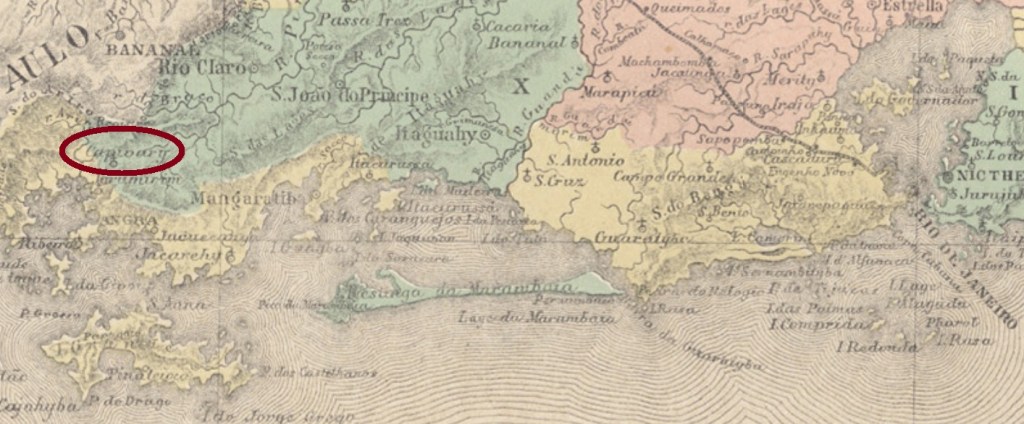
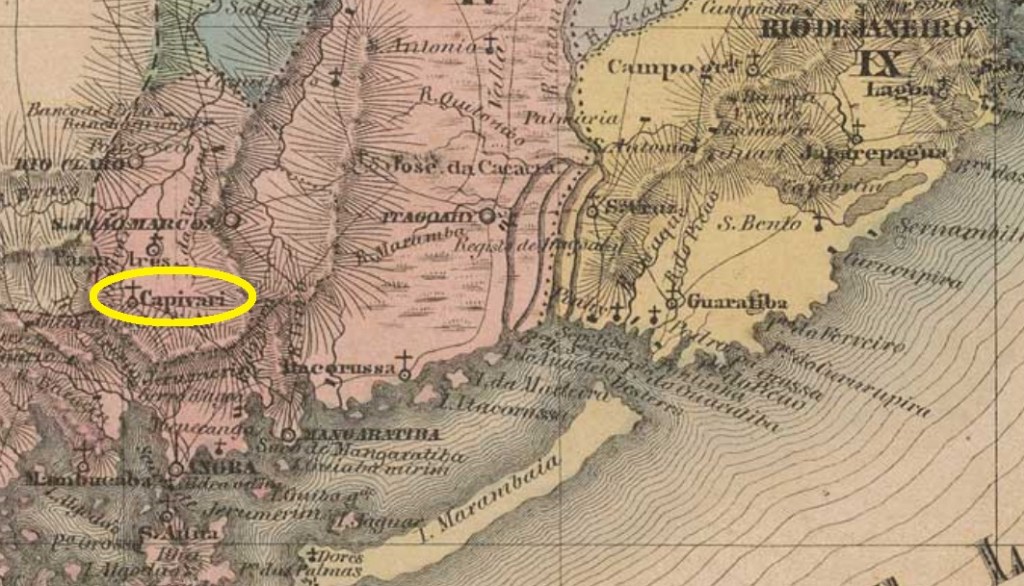
Santo Antonio de Capivary – which should not be confounded with the other Capivary (now Silva Jardim) in the Rio de Janeiro province – was a former freguesia in the municipality of Rio Claro, situated over 150 km west of the imperial capital.  In December 1938 the toponym changed to Parado and five years later, to Lídice. This actual name is a tribute to the small town Lidice, now in the Czech Republic, whose male population was executed by the nazi occupants on June 10, 1942.

We have found no less than four different years for the creation of the local post office. The 1859 report of the Directoria Geral dos Correios states it took place in 1854. Nova Monteiro (Administrações e Agencias Postaes do Brasil Imperio, in Brasil Filatelico/RJ, 1934-5; Reprint SPP 1994-1999) lists the agency from June 1855 on. Paulo Novaes (agenciaspostais.com.br) writes October 1861 and finally, the Imperial Mail Register (Tabella das Agencias do Correio do Imperio) of 1885 states this office was created in 1868. Probably the agency has been closed a couple of times in-between.

Only one early cancel was found, which is most probably not the earliest one. SRJ-0895b (Coll. Paulo Novaes) has a double circle with the inscription S. A. DE CAPIVARY above and the date inside. A sole example was found, dated 1897.

Villiers de l’Ile Adam: Carta (…) da Provincia do Rio de Janeiro, 1850

Andere Namen: Parado, Lídice (1943)

Santo Antonio de Capivary – nicht mit dem anderen Capivary (heute Silva Jardim) in der Provinz Rio de Janeiro zu verwechseln – war eine ehemalige Freguesia im Município von Rio Claro, die über 150 km westlich der kaiserlichen Hauptstadt Rio de Janeiro lag.  Im Dezember 1938 wechselte der Ortsname zu Parado und fünf Jahre später, zu Lídice. Diese aktuelle Bezeichnung ist eine Hommage an den kleinen böhmischen Dorf  Lidice, heute in der Tschechischen Republik, dessen Männerpopulation am 10. Juni 1942 von der Nazi-Besatzung hingerichtet wurde.

Nicht weniger als vier verschiedene Jahre wurden für das örtliche Postamt gefunden. Der Bericht der Directoria Geral dos Correios für 1859 nennt dafür das Jahr 1854. Nova Monteiro (Administrações e Agencias Postaes do Brasil Imperio, in Brasil Filatelico/RJ, 1934-5; Reprint SPP 1994-1999) listet die Agentur ab Juni 1855 auf. Paulo Novaes (agenciaspostais.com.br) schreibt Oktober 1861, und schließlich behauptet das Verzeichnis der kaiserlichen Postämter (Tabella das Agencias do Correio do Imperio) von 1885, das Postamt gibt es seit 1868. Wahrscheinlich blieb die Agentur einige Male zwischendurch geschlossen.

Ein einziger früher Stempel wurde gefunden, der wohl eher nicht der Älteste ist. SRJ-0895b (Samml. Paulo Novaes) hat einen Doppelkreis mit der Inschrift S. A. DE CAPIVARY oben und dem Datum in der Mitte. Das einzige vorhandene Exemplar trägt ein Datum von 1897.