Categories
Carimbologia S

Santo Amaro, Bahia (SBA-0680)

Atlas do Imperio do Brasil, 1868

Another name: Nossa Senhora da Purificação e Santo Amaro

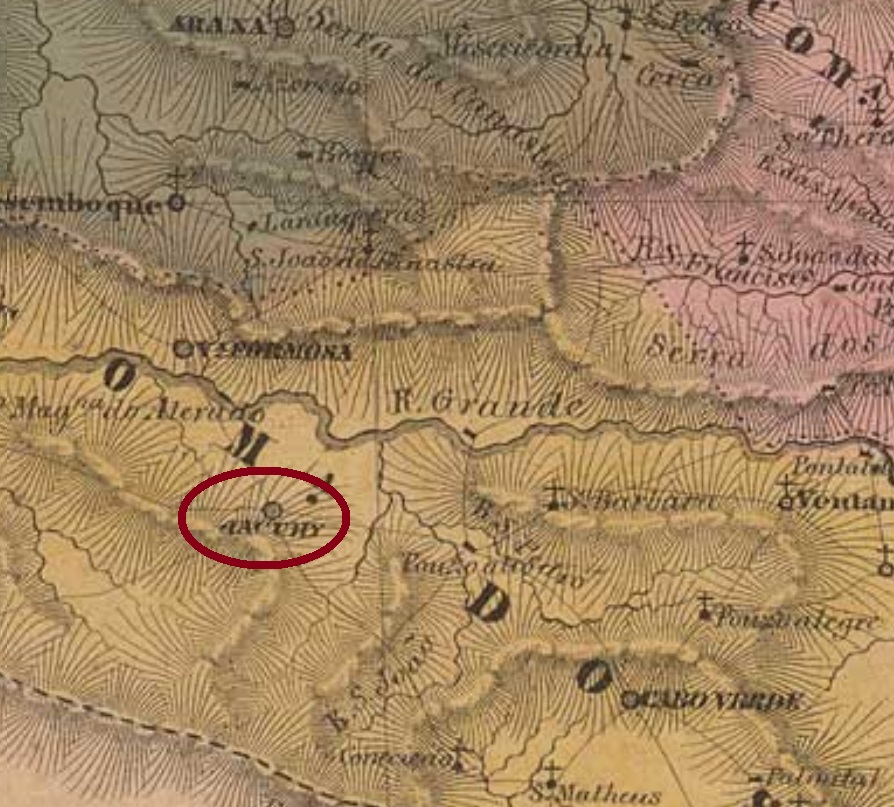
This Santo Amaro is a quite old locality in Brazilian terms. It was already in January 1727 the Villa de Nossa Senhora da Purificação e Santo Amaro (= Our Lady of the Purification and St. Amaro), situated at the north end of the All Saints Bay, round 80 km away from the provincial capital Salvador da Bahia. Since March 1837 it is the town of Santo Amaro.

There are two different dates for the creation of the postal office. Consequently, it must have been closed in the meantime. Nova Monteiro (Administrações e Agencias Postaes do Brasil Imperio, in Brasil Filatelico/RJ, 1934-5; Reprint SPP 1994-1999) writes May 1832, while the Imperial Mail Register (Tabella das Agencias do Correio do Imperio) of 1885 lists the agency from 1855 on. The three cancels which were found belong apparently to the first period. SBA-0680a was already presented by the RHM catalogue and can be found around 1835:

SBA-0680a (RHM)

The following cancels SBA-0680b and SBA-0680c were used from the thirties until the Bull-Eyes era (1843ff), as depicted by Henrique B. Ferreira (Catálogo ilustrado dos carimbos sobre os olhos-de-boi, Porto Alegre, 2017):

SBA-0680b
SBA-0680c

Later cancels are still to be identified through disambiguation among further Santo Amaro localities in other Brazilian provinces.

Villiers de l’Ile Adam, Carta (…) da Provincia da Bahia, 1848

Anderer Name: Nossa Senhora da Purificação e Santo Amaro

Dieser Santo Amaro ist für brasilianische Verhältnisse eine ziemlich alte Ortschaft. Bereits im Januar 1727 stand die Villa de Nossa Senhora da Purificação e Santo Amaro (= Unsere Liebe Frau der Purifikation und St. Amaro) an der Nordspitze der Allerheiligenbucht, rund 80 km von der Provinzhauptstadt Salvador da Bahia entfernt. Seit März 1837 ist es eine Stadt, die den vereinfachten Namen Santo Amaro trägt.

Zwei verschiedene Daten zur Entstehung des Postamtes sind überliefert. Also war dieses in der Zwischenzeit mal geschlossen. Nova Monteiro (Administrações e Agencias Postaes do Brasil Imperio, in Brasil Filatelico/RJ, 1934-5; Reprint SPP 1994-1999) schreibt dafür den Mai 1832, während das Verzeichnis der kaiserlichen Postämter (Tabella das Agencias do Correio do Imperio) von 1885 listet die Agentur ab 1855 auf. Die drei Stempel, die man zweifelsfrei dieser Ortschaft zuordnen kann, stammen wohl alle aus der ersten Betriebszeit. SBA-0680a wurde bereits durch den RHM-Katalog vorgestellt und kommt in der Vorphila-Zeit vor:

SBA-0680a (RHM)

Die folgenden Stempel SBA-0680b and SBA-0680c waren ab den 30er-Jahren bis zur Zeit der Ochsenaugen (1843ff) in Gebrauch, wie von Henrique B. Ferreira in seinem Catálogo ilustrado dos carimbos sobre os olhos-de-boi (Porto Alegre, 2017) abgebildet:

SBA-0680b
SBA-0680c

Spätere Entwertungen konnten noch nicht zweifelsfrei unter weiteren Santo Amaro-Ortschaften in anderen Provinzen ermittelt werden.

Categories
Carimbologia S

Santíssimo Coração de Jesus, Minas Gerais (SMG-2955)

Atlas do Imperio do Brasil, 1868

Other names: Inconfidência, Coração de Jesus (1928)

Santíssimo Coração de Jesus (=Jesus’ Holiest Heart) was since July 1832 a district in the municipality of Montes Claros, situated round 550 km north of the provincial capital Ouro Preto. In August 1911 it ascended to a Villa named Inconfidência, as a tribute to the Minas Conjuration, a movement that planned the Brazilian independence from Portugal in the late 18th century. In September 1925 the locality was declared a town, which changed the name to Coração de Jesus three years later.

According to Paula Sobrinho (História Postal de Minas Gerais, Belo Horizonte, 1997), the local post office was created in September 1877. One imperial cancel is known: SMG-2955a (Coll. José A. Junges) has a double circle with the inscriptions S.S. CORAÇÃO DE JESUS above and (MINAS) below. The dates at the centre were found for the period 1889-1894.

Carta da República dos Estados Unidos do Brazil, 1892

Andere Namen: Inconfidência, Coração de Jesus (1928)

Santíssimo Coração de Jesus (= Heiligstes Herz Jesus’) war ab Juli 1832 ein Distrikt im Município von Montes Claros, der rund 550 km nördlich der Provinzhauptstadt Ouro Preto entfernt lag. Im August 1911 wurde daraus eine Villa namens Inconfidência, nach der Inconfidência Mineira, eine Beschwörung in der Provinz Minas Gerais am Ende des 18. Jahrhunderts, die die Unabhängigkeit Brasiliens anstrebte. Im September 1925 wurde die Ortschaft eine Stadt, deren Name drei Jahre später zu Coração de Jesus wechselte.

Wie Paula Sobrinho in seiner História Postal de Minas Gerais (Belo Horizonte, 1997) berichtet, gibt es dort ein Postamt seit September 1877. Ein Stempel der Kaiserzeit ist überliefert: SMG-2955a (Samml. José A. Junges) hat einen Doppelkreis mit den Inschriften S.S. CORAÇÃO DE JESUS oben und (MINAS) unten. Die Daten in der Mitte wurden bisher für den Zeitraum 1889-1894 gefunden.

Categories
Carimbologia S

Santíssima Trindade, Santa Catarina (SSC-0240)

Carta do Estado de Santa Catharina, 1907

Another name: Trindade (1938)

The district of Santissima Trindade (=Holiest Trinity) was created in March 1853 in the municipality of the provincial capital Desterro on the Santa Catharina Island. In March 1938 the name was simplified to Trindade, which is since December 1943 an urban quarter of the capital Florianópolis. This new name was given to Desterro as a tribute to Brazil’s second president, the Marshall Floriano Peixoto (1839-1895), who had ordered a sanguinary combat to the local revolutionists in 1894.

The local post office was created in March 1884, as reported by the local press:

Jornal do Commercio, March 14, 1884

 No imperial cancel has been found until now.

GoogleMaps

Anderer Name: Trindade (1938)

Der Distrikt von Santissima Trindade (=Heiligste Dreifaltigkeit) wurde im März 1853 im Município der Provinzhauptstadt Desterro auf der Insel Santa Catharina gegründet. Im März 1938 wurde der Name zu Trindade vereinfacht, seit Dezember 1943 ein Teil der Stadt Florianópolis. Der neue Name von Desterro war eine Hommage an Brasiliens zweiten Präsidenten, den Marschall Floriano Peixoto (1839-1895), der eine blutige Bekämpfung der Revolutionäre auf der Insel beim Aufstand von 1894 befohlen hatte.

Das örtliche Postamt gibt es seit März 1884, wie die Lokalpresse berichtet:

Jornal do Commercio, 14. März 1884

Kein Stempel der Kaiserzeit war bisher zu finden.

Categories
Carimbologia S

Santarém, Pará (SPA-0235)

Atlas do Imperio do Brasil, 1868

Santarém is a very old location in Pará, situated over thousand km west of the province capital Belém. It was declared a villa already in June 1755 and ascended to a town as soon as October 1848.

According to Nova Monteiro (Administrações e Agencias Postaes do Brasil Imperio, in Brasil Filatelico/RJ, 1934-5; Reprint SPP 1994-1999), the local post office exists since March 1829. Three postmarks and one manuscript cancellation were found, of which one is still uncertain. SPA-0235a occurs also in red at least from the numeral issues of 1850 until 1855 and was already presented by Paulo Ayres in his Catálogo de Carimbos Brasil-Império (S. Paulo, 1937, 1942) under # 1488:

SPA-0235a, P.Ayres 1488

SPA-0235b (Coll. José A. Junges) is the manuscript cancellation, which can be found on numeral issues of 1844 until ca. 1855:

SPA-0235b (JJ)

SPA-0235c (image from the internet) has an uncertain attribution, for it could also refer to the Santarém in the Bahia province (SBA-0675). It shows a double circle with the inscription SANTAREM above and (I) below. Found on a stamp dated 1884. And SPA-0235d (coll. José A. Junges) could be already republican, for it was found with a date of 1890: a double circle with the inscriptions SANTAREM above and (PARÁ) below.

Villiers de l’Ile Adam, Carta (…) da Provincia da Bahia, 1850

Santarém ist eine für brasilianische Verhältnisse sehr alte Ortschaft in der Provinz Pará, die über tausend km westlich der Provinzhauptstadt Belém entfernt liegt. Sie wurde eine Villa im Juni 1755 und stieg zur Stadt bereits im Oktober 1848 auf.

Laut Nova Monteiro (Administrações e Agencias Postaes do Brasil Imperio, in Brasil Filatelico/RJ, 1934-5; Reprint SPP 1994-1999) existiert das örtliche Postamt seit März 1829. Drei Stempel und eine handschriftliche Entwertung wurden gefunden, wobei bei einem der Stempel die Zuordnung noch unsicher ist. SPA-0235a kommt auch in rot vor und wurde zumindest seit den Ziffernausgaben von 1850 bis ca. 1855 verwendet, er wurde bereits durch Paulo Ayres in seinem Catálogo de Carimbos Brasil-Império (S. Paulo, 1937, 1942) unter Nr.1488 vorgestellt:

SPA-0235a, P.Ayres Nr. 1488

SPA-0235b (Samml. José A. Junges) ist die Handentwertung, die auf den Ziffernausgaben von 1844 (Inclinados) bis ca. 1855 vorkommt:

SPA-0235b (JJ)

SPA-0235c (Abb. aus dem Internet) könnte auch aus dem anderen Santarém in der Provinz Bahia sein (SBA-0675). Hier gibt es einen Doppelkreis mit der Inschrift SANTAREM oben und eine (I) unten. Gefunden mit Datum 1884 auf einer Marke. SPA-0235d (Samml. José A. Junges) könnte bereits republikanisch sein, denn er wurde auf einer Marke mit Datum 1890 gefunden: ein Doppelkreis mit den Inschriften SANTAREM oben und (PARÁ) unten.

Categories
Carimbologia S

Santarém, Bahia (SBA-0675)

Atlas do Imperio do Brasil, 1868

Other names: Santo André de Santarém, Serinhaém, Ituberá (1944)

This Santarém in the Bahia province was already a villa in September 1758 and kept this status until August 1909, when it ascended to a town. It was located on the Serinhaem (now Santarém) River, some 170 km south of the provincial capital Salvador. In December 1943 the municipality was renamed Serinhaem, but this name lasted only six months, changing to the actual Ituberá in June 1944, probably due to the existence of another Serinhaem in Pernambuco.

According to Nova Monteiro (Administrações e Agencias Postaes do Brasil Imperio, in Brasil Filatelico/RJ, 1934-5; Reprint SPP 1994-1999), the local post office was created in March 1863. Three early cancels were found, the second of which still awaits confirmation, for it could also refer to the other Santarém in the Pará province. SBA-0675a (Coll. José A. Junges) was seen only partially on a single D. Pedro issue of 1866: it has a double circle with an inscription containing SANTAREM in quite irregular capital letters. SBA-0675b (Coll. José A. Junges) imitates a French-style cancel: a double circle with the inscription SANTAREM above and a star between parentheses below, dated 1885 at the centre. SBA-0675c (image from the internet) is similar to the former, but here both letters and star are bigger, the parentheses seem to have disappeared.

Villiers de l’Ila Adam: Carta (…) da Provincia da Bahia, 1848

Andere Namen: Santo André de Santarém, Serinhaém, Ituberá (1944)

Dieses Santarém in der Provinz Bahia war bereits eine Villa im September 1758 und blieb so bis August 1909, als daraus eine Stadt wurde. Der Ort lag am Fluss Serinhaem (heute Santarém), etwa 170 km südlich der Provinzhauptstadt Salvador entfernt. Im December 1943 der Município bekam den Namen Serinhaém verpasst, aber schon sechs Monate später, im Juni 1944, wechselte der Ortsname wieder, zum aktuellen Ituberá, wohl um Verwechslungen mit dem Serinhaém in Pernambuco zu vermeiden.

Wie Nova Monteiro (Administrações e Agencias Postaes do Brasil Imperio, in Brasil Filatelico/RJ, 1934-5; Reprint SPP 1994-1999) berichtet, entstand das örtliche Postamt im März 1863. Drei frühe Stempel waren zu finden, wobei der zweite noch nicht endgültig bestätigt ist, da dieser auch dem Santarém in der Provinz Pará zugewiesen werden könnte. SBA-0675a (Samml. José A. Junges) wurde leider nur einmal und unvollständig gesehen, auf einer D. Pedro-Ausgabe von 1866: der Stempel besteht aus einem Doppelkreis mit einer Inschrift, die SANTAREM in ziemlich unregelmäßigen Großbuchstaben enthält. SBA-0675b (Samml. José A. Junges) macht einem Stempel französischen Typs nach: ein Doppelkreis mit der Inschrift SANTAREM oben und einem Stern zwischen Klammern unten, dazu ein Datum aus 1885 in der Mitte. SBA-0675c (Abb. aus dem Internet) ist ähnlich wie zuvor, doch hier sind Buchstaben und Stern größer, und die Klammern unten scheinen verschwunden zu sein.

Categories
Carimbologia S

Sant’Anna do Ypanema, Alagoas (SAL-0230)

Atlas do Imperio do Brasil, 1868

Sant’Anna do Ypanema was since February 1836 a district in the municipality of Traipu, situated on the north bank of the Panema River, over 200 km west of the province capital Alagoas (now Marechal Deodoro). In April 1875 it ascended to a villa.

According to the Imperial Mail Register (Tabella das Agencias do Correio do Imperio) of 1885, the local post office was created in July 1869, although Aldo Cardoso (Contribuição para a História dos Correios de Alagoas, Maceió, 1969) asserts it took place in September 1870. Only one imperial cancel was found: SAL-0230a (Coll. Karlheinz Wittig) has a double circle with the inscription YPANEMA above and STA. ANNA below. The dates at the centre originate from the period 1886-1891.

Villiers de l’Ile Adam, Carta (…) das Provincias de Pernambuco, Alagoas und Sergipe, 1848

Sant’Anna do Ypanema war ab Februar 1836 ein Distrikt im Município von Traipu, der am Nordufer des Flusses Panema lag, über 200 km westlich der Provinzhauptstadt Alagoas (heute Marechal Deodoro) entfernt. Im April 1875 stieg er zur Villa auf.

Laut Verzeichnis der kaiserlichen Postämter (Tabella das Agencias do Correio do Imperio) von 1885 entstand das örtliche Postamt im Juli 1869, obwohl Aldo Cardoso (Contribuição para a História dos Correios de Alagoas, Maceió, 1969) behauptet, dies fand erst im September 1870 statt. Nur ein Stempel der Kaiserzeit war zu finden: SAL-0230a (Samml. Karlheinz Wittig) hat einen Doppelkreis mit der Inschrift YPANEMA oben und STA. ANNA unten. Die Daten in der Mitte entstammen dem Zeitraum 1886-1891.

Categories
Carimbologia S

Sant’Anna da Vargem Grande, São Paulo (SSP-1263)

C. Rath: Provincia de São Paulo, 1886

Another name: Vargem Grande do Sul (1944)

Sant’Anna da Vargem Grande was from February 1888 on a district in the municipality of São João da Boa Vista, situated round 250 km north of the provincial capital São Paulo. In December 1921 it was elevated to an own municipality, which since November 1944 is called Vargem Grande do Sul.

According to the regional press, the local post office was created around the end of 1886:

Correio Paulistano, January 9, 1887

One early cancel was found: SSP-1263a (Coll. José Junges) has a double circle with the inscription S. ANNA DA V. GRANDE above and a black circle ornament below, which is cut by a cross inside. It was used at least until 1897.

Raphael Lorenzeto de Abreu, CC- BY 2.5

Anderer Name: Vargem Grande do Sul (1944)

Sant’Anna da Vargem Grande war ab Februar 1888 ein Distrikt im Município von São João da Boa Vista, der rund 250 km nördlich der Provinzhauptstadt São Paulo entfernt lag. Im Dezember 1921 stieg er zum eigenen Município auf, der seit November 1944 Vargem Grande do Sul heißt.

Laut einer Meldung aus der Regionalpresse wird das örtliche Postamt wohl gegen Ende 1886 entstanden sein:

Correio Paulistano, 9. Januar 9, 1887

Ein früher Stempel war noch zu finden: SSP-1263a (Samml. José Junges) hat einen Doppelkreis mit der Inschrift S. ANNA DA V. GRANDE oben und einen schwarzen Kreis unten, der in der Mitte kreuzförmig beschnitten wird. Die Daten in der Mitte weisen auf einen Nutzungszeitraum bis mindestens 1897 auf.

Categories
Carimbologia S

Sant’Anna da Vargem, Minas Gerais (SMG-2700)

Mappa de Minas Geraes, 1910

Other names: Sant’Anna da Vargem Grande, Mombuca

The following Sant’Anna of the Minas Gerais province was since November 1873 a district in the municipality of Três Pontas, situated over 300 km southwest of the province capital Ouro Preto. In September 1923 the name changed to Mombuca, a tupi-guarani word that designates a kind of honey bee, but exactly one year later the old toponym returned. Since December 1962 has Santana da Vargem an own municipality.

According to Paula Sobrinho (História Postal de Minas Gerais, Belo Horizonte, 1997), there is a local post office since June 1879. The only early cancel found until now is SMG-2700a (image from the internet): a double circle with the inscription SANT’ANNA DA VARGEM above and a cross ornament below, of which every wing is a leaflet. The dates at the centre were found for the period 1895-1899.

Raphael Lorenzeto de Abreu (CC-BY 2.5)

Andere Namen: Sant’Anna da Vargem Grande, Mombuca

Die nächste Sant’Anna in der Provinz Minas Gerais war ab November 1873 ein Distrikt im Município von Três Pontas, der über 300 km südestlich der Provinzhauptstadt Ouro Preto entfernt lag. Im September 1923 wechselte der Ortsname zu Mombuca. Dieses Wort der Tupi-guarani-Sprache nennt eine Sorte Honigbiene. Dennoch kehrte gleich ein Jahr später der alte Name zurück. Seit Dezember 1962 hat Santana da Vargem ein eigenes Município.

Wie Paula Sobrinho in seiner História Postal de Minas Gerais (Belo Horizonte, 1997) schreibt, gibt es dort ein Postamt seit Juni 1879. Der einzige frühe Stempel, der bisher aufgetaucht ist, SMG-2700a (Abb. aus dem Internet), hat einen Doppelkreis mit der Inschrift SANT’ANNA DA VARGEM oben und ein kreuzförmiges Ornament unten, bei dem alle Flügel aus Blättchen bestehen. Die Daten in der Mitte kommen aus dem Zeitraum 1895-1899.

Categories
Carimbologia S

Sant’Anna dos Tocos, Rio de Janeiro (SRJ-2170)

Atlas do Imperio do Brasil, 1868

Other names: Senhor Bom Jesus do Ribeirão de Sant’Anna, Salto, Pirangaí (1943)

Sant’Anna dos Tocos was since 1830 a curato named Senhor Bom Jesus do Ribeirão de Sant’Anna in the municipality of Resende, situated on the Paraiba do Sul River, over 200 km west of the imperial capital Rio de Janeiro. In March 1843 it was made the district of Sant’Anna dos Tocos, which has since then changed twice the name: in December 1938 to Salto and in December 1943 to Pirangaí. This tupi-guarani word means red clay river.

The village disappeared in 1961, when it was inundated by the Represa do Funil Barrier Lake, and was rebuilt in the place which now is the Pirangaí quarter of the municipality of Resende. Images of the old Sant’Anna dos Tocos can be seen here:

According to Nova Monteiro (Administrações e Agencias Postaes do Brasil Imperio, in Brasil Filatelico/RJ, 1934-5; Reprint SPP 1994-1999), the local post office was created in May 1868. Three Empire cancels were found, the earliest of which, SRJ-2170a,  has been already presented by Paulo Ayres in his Catálogo de Carimbos Brasil-Império, S. Paulo, 1937, 1942, under #1447:

SRJ-2170a, P. Ayres 1447, 1868ff

 It was followed by SRJ-2170b (Coll. Karlheinz Wittig): a double circle with the inscription SANT’ANNA DOS TOCOS above and a diamond ornament below. The dates at the centre were found for the period 1887-1890. Far more common is SRJ-2170c (image from the internet), which circulated from 1888 to 1903 and presented in the double circle the inscription S. ANNA DOS TOCOS above and a horizontal hashtag ornament below.

Villiers de l’Ile Adam: Carta (…) da Provincia do Rio de Janeiro. 1850

Andere Namen: Senhor Bom Jesus do Ribeirão de Sant’Anna, Salto, Pirangaí (1943)

Sant’Anna dos Tocos war ab 1830 ein Curato aus dem Município von Resende, der Senhor Bom Jesus do Ribeirão de Sant’Anna hieß und am Fluss Paraiba do Sul lag, über 200 km westlich der kaiserlichen Hauptstadt Rio de Janeiro entfernt lag. Im März 1843 wurde daraus der Distrikt von Sant’Anna dos Tocos, der seitdem den Namen zwimal gewechselt hat: im Dezember 1938 zu Salto und im Dezember 1943 zu Pirangaí. Dieses Wort aus der tupi-guarani-Sprache bedeutet Roter-Lehm-Fluss.

Die ursprüngliche Ortschaft wurde 1961 überschwemmt, als der Represa do Funil-Staudamm gebaut  wurde, und musste woanders wieder angesiedelt werden. Heute ist Pirangaí ein Stadtteil von Resende. Bilder aus der frühen Sant’Anna dos Tocos sind hier zu sehen:

Laut Nova Monteiro (Administrações e Agencias Postaes do Brasil Imperio, in Brasil Filatelico/RJ, 1934-5; Reprint SPP 1994-1999) entstand das örtliche Postamt im Mai 1868. Drei Stempel der Kaiserzeit sind bekannt. Der früheste darunter, SRJ-2170a, wurde bereits durch Paulo Ayres in seinem Catálogo de Carimbos Brasil-Império, S. Paulo, 1937, 1942, unter Nr. 1447 veröffentlicht:

SRJ-2170a, P. Ayres 1447, 1868ff

 Ihm folgte SRJ-2170b (Samml. Karlheinz Wittig): ein Doppelkreis mit der Inschrift SANT’ANNA DOS TOCOS oben und einem rautenförmigen Ornament unten. Die Daten in der Mitte weisen auf den Zeitraum 1887-1890 auf. Viel häufiger anzutreffen ist SRJ-2170c (Abb. aus dem Internet), der zwischen 1888 und 1903 im Gebrauch war. Er zeigt im Doppelkreis oben die Inschrift S. ANNA DOS TOCOS und unten ein Hashtag-ähnliches Ornament.

Categories
Carimbologia S

Sant’Anna do Sapucahy, Minas Gerais (SMG-2730)

Atlas do Imperio do Brasil, 1868

Another Sant’Anna in the Minas Gerais province! This one was since April 1838 a district in the municipality of Pouso Alegre, situated over 400 km southwest of the province capital Ouro Preto. In August 1911 it emancipated under the name of Silvianópolis, a tribute to Francisco Silviano Brandão (1848-1902), a native of Sant’Anna do Sapucahy who was the president of the Minas Gerais state between 1898 and 1902.

According to Paula Sobrinho (História Postal de Minas Gerais, Belo Horizonte, 1997), the local post office was created in October 1873. One postmark from the Empire was found. SMG-2730a occurs also in red with dates between 1883 and at least 1900, and was already presented by Paulo Ayres in his Catálogo de Carimbos Brasil-Império, S. Paulo, 1937, 1942 under # 1632:

SMG-2730a (P. Ayres #1632)
Villiers de l’Ile Adam: Carta (…) da Provincia de Minas Geraes, 1849

Und schon wieder eine Sant’Anna aus der Provinz Minas Gerais! Diese war ab April 1838 ein Distrikt im Município von Pouso Alegre und lag über 400 km südwestlich der Provinzhauptstadt Ouro Preto entfernt. Im August 1911 stieg sie zum eigenen Município auf und hieß fortan Silvianópolis. Der Name ist eine Hommage an Francisco Silviano Brandão (1848-1902), einen Sohn der Ortschaft, der zwischen 1898 und 1902 Präsident des Staates Minas Gerais war.

Laut Paula Sobrinho (História Postal de Minas Gerais, Belo Horizonte, 1997) gibt es dort ein Postamt seit Oktober 1873. Ein Stempel aus dem Kaiserreich konnte gefunden werden. SMG-2730a kommt mit Daten zwischen 1883 und zumindest 1900 – auch in rot – vor und wurde bereits durch Paulo Ayres in seinem Catálogo de Carimbos Brasil-Império, S. Paulo, 1937, 1942 under # 1632 vorgestellt:
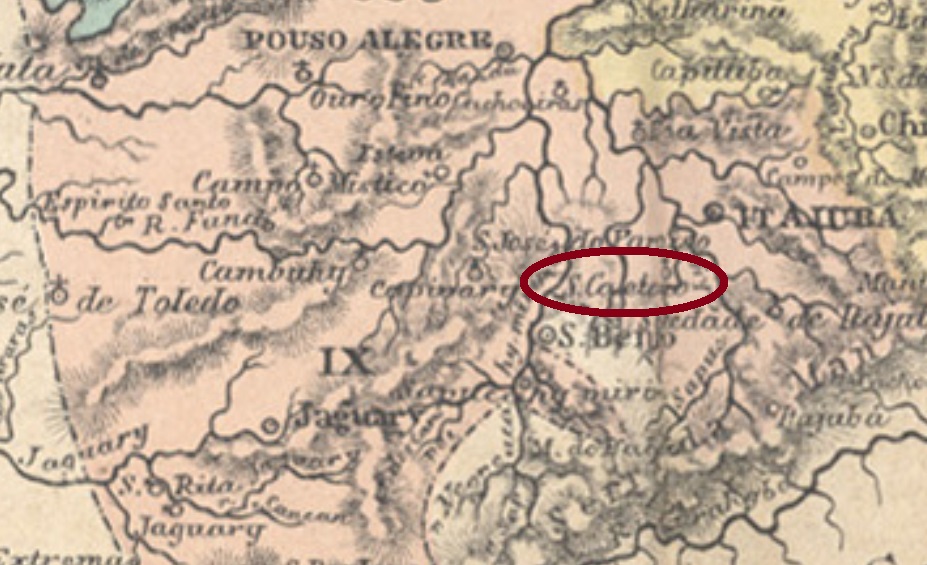
SMG-2730a (P. Ayres Nr. 1632)