Print Edition Update of April 13, 2020
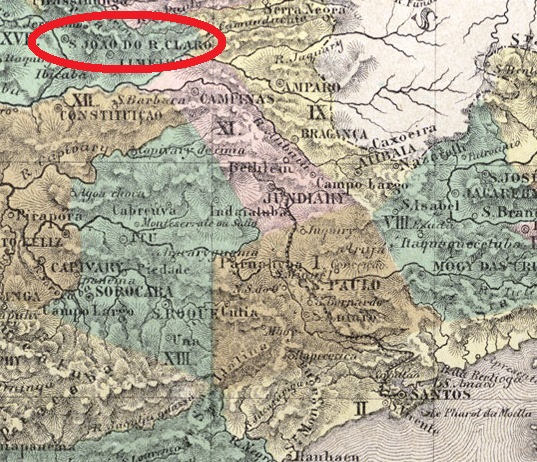
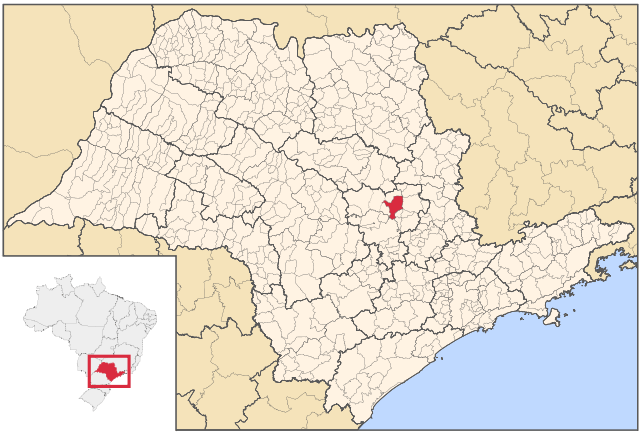
The district of São João Baptista do Rio Claro was established in December 1830 in the municipality of Piracicaba, some 180 km northwest from São Paulo. In March 1842 it passed under administrative control of the new municipality of Nossa Senhora das Dores de Tatuibi, which is called Limeira since 1863. The political emancipation came in March 1845, and in April 1857 São João do Rio Claro was declared a city. Finally, in 1905 the toponym was simplified to Rio Claro.
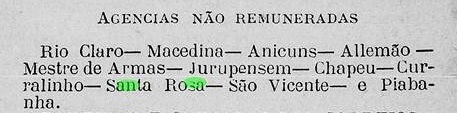
There are two dates for the creation of the post office. Nova Monteiro (Administrações e Agências Postaes do Brasil Império, 1798/1869, in Brasil Filatélico 18-21, 1934-5) writes September 1st, 1838, while the Imperial Mail Register (Tabella das Agencias do Correio do Império) of 1885 lists this agency as established in 1854. Possibly both dates are correct, if we assume that the office was temporarily closed in the meantime.
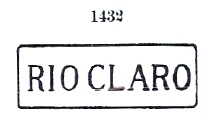
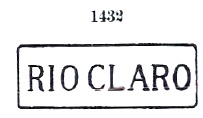
Contrary to the print edition, here all cancels featuring Rio Claro/SP and São João (or simply S.J.) do Rio Claro will be listed. Since they refer to the same locality under almost the same name, keeping them together would help avoiding confusion. RSP-1110a is doubtless the earliest postmark, found in black and brown on stamps and covers until 1856, as registered by Paulo Ayres (Catálogo de Carimbos: Brasil Império, São Paulo, 1937) under # 1432, and by Henrique B. Ferreira (Catálogo ilustrado dos carimbos sobre os olhos-de-boi, Porto Alegre, 2017) under #R4:
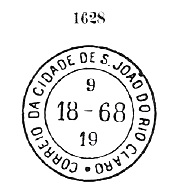
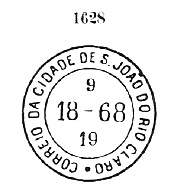
RSP-1110b, the next cancel, was certainly made after April 1857, for it mentions, in black and blue, CIDADE (town) DE S. JOÃO DO RIO CLARO. Dates found until 1873, listed in Paulo Ayres under #1628:
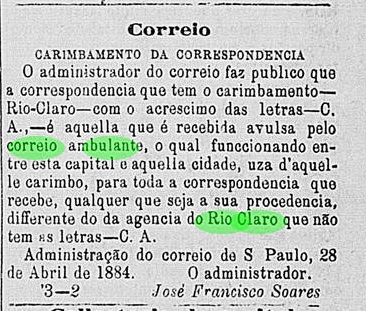
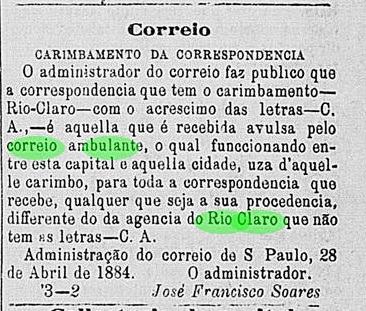
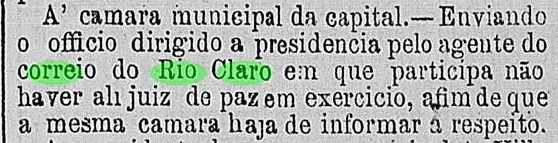
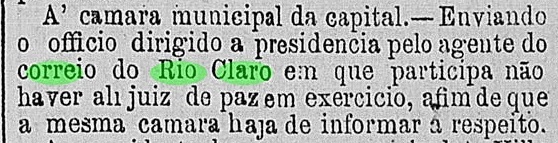
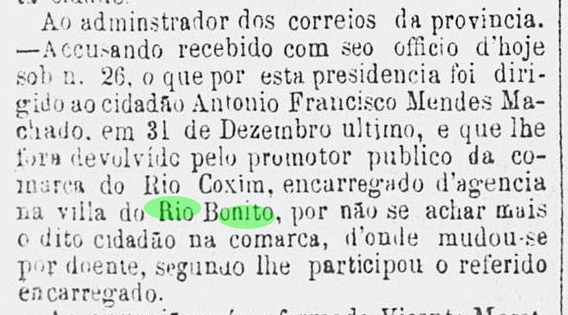
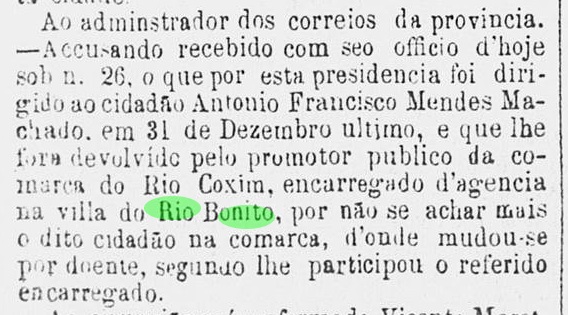
RSP-1110c (image from the internet) was found on a newspaper stamp issued in 1889, but is most probably earlier, for it is a French-type, showing the small double circle with the inscriptions RIO CLARO (above) and the typical star between parenthesis (below), and the date in the inner circle. RSP-1110d (Coll. José A. Junges) has a bigger double circle as before, with RIO CLARO above and (C.A.) below, also date in the inner circle. C.A. means Correio Ambulante, i.e. the cancel was used in the Rio Claro-São Paulo line of the Companhia Paulista railroad. According to Ralph Giesbrecht (estacoesferroviarias.com.br), the Rio Claro train station was built in August 1876, so is the cancel from a later date. Copies found cancelled between 1884 and 1888 and a Provincial Mail press release confirm this:
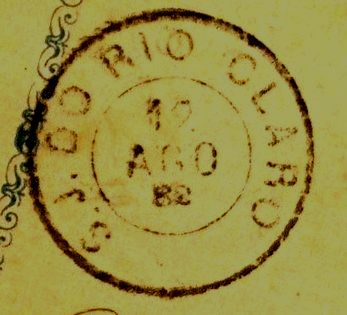
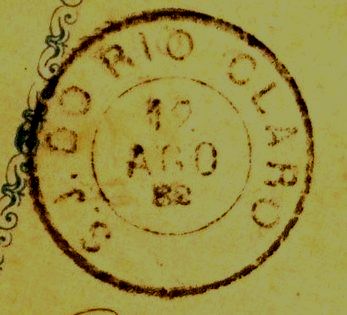
The exemplars found for RSP-1110e were cancelled between 1878 and 1890. Since this postmark does not appear in Carimbologia (Q-R) because it refers to S.J. DO RIO CLARO, it is shown here (image from the internet):
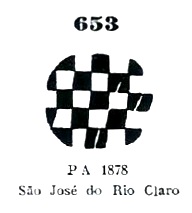
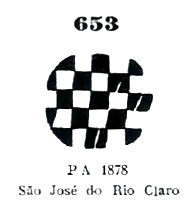
Paulo Ayres (op.cit. 1937) also lists two mute cancellations from Rio Claro, both found on D. Pedro emissions of 1878. The first one is #653, erroneously attributed to “São José do Rio Claro”, which is now a municipality from Mato Grosso established as a district as late as 1976.
José A. Junges has a letter to Naples, Italy, with a D. Pedro emission of 1866 (RHM 29, Scott 60), cancelled with P.A. 653 together with RSP-1110b and dated April 29, 1873. He also owns a fragment with a bisected D. Pedro emission of 1881 (RHM 50, Scott 81), cancelled with P.A. 653 together with RSP-1110e and dated January 4, 1884:
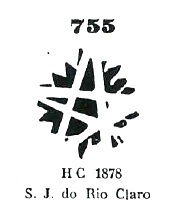
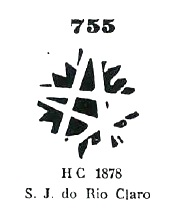
The second mute postmark listed by Paulo Ayres is #755, found on a stamp (Coll. Karlheinz Wittig) from the D. Pedro emission of 1878:
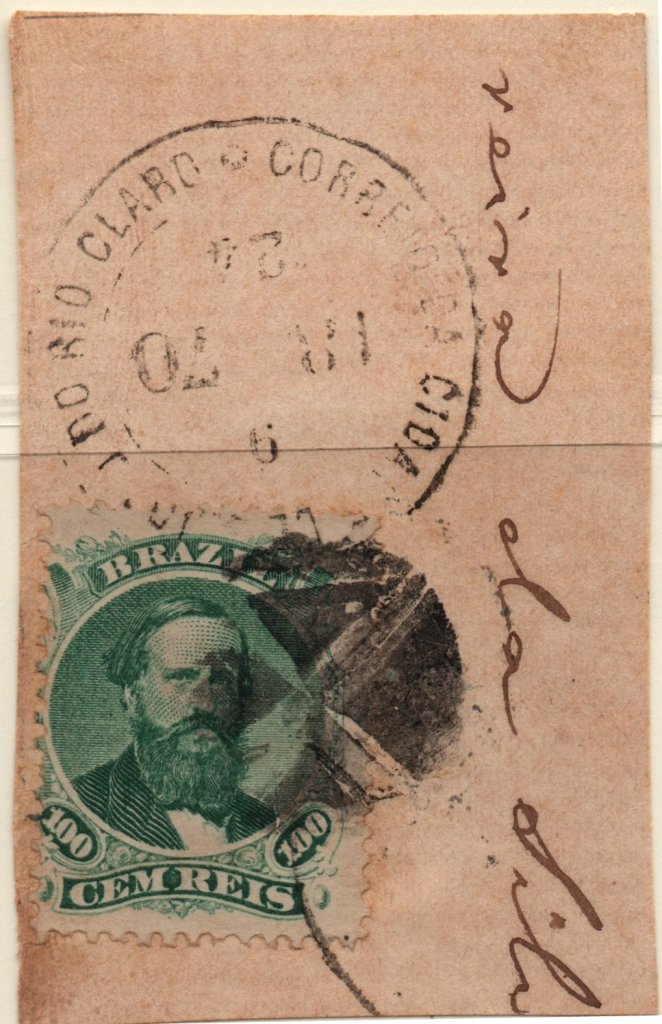
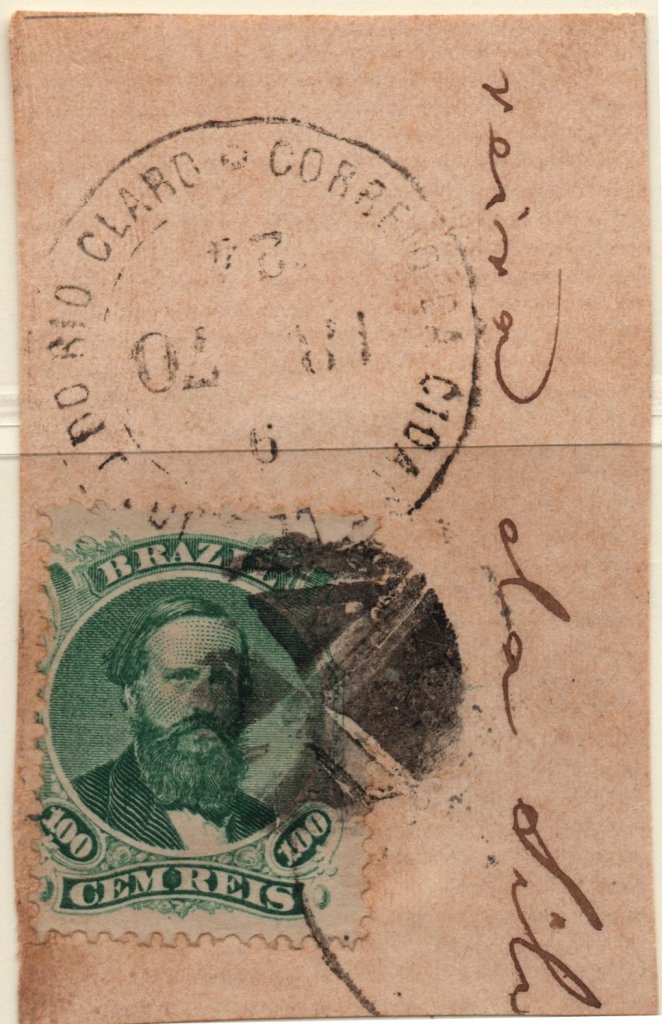
But there is probably a third mute cancel from Rio Claro/SP, unlisted in Paulo Ayres but catalogued in Dingler/Lopes (Mute Cancellations of the Brazil Empire, BPA, Rio, 2000) without local attribution, under # 1956:

This postmark was found on a fragment with a D. Pedro emission of 1866, together with RSP-1110b and dated September 24, 1870 (Coll. José A. Junges):
Buchtext-Aktualisierung vom 13. April 2020
Der Distrikt von São João Baptista do Rio Claro wurde im Dezember 1830 im Verwaltungsbezirk Piracicaba gegründet, etwa 180 km nordwestlich von São Paulo. Im März 1842 ging er zum neu gegründeten Município von Nossa Senhora das Dores de Tatuibi über, der seit 1863 Limeira heißt. Die politische Emanzipierung fand in März 1845 statt, und im April 1857 stieg São João do Rio Claro zur Stadt auf. Schließlich wurde in 1905 der Ortsname zu Rio Claro vereinfacht.
Es sind zwei verschiedene Daten für die Entstehung des Postamtes überliefert. Nova Monteiro (Administrações e Agências Postaes do Brasil Império, 1798/1869, in Brasil Filatélico 18-21, 1934-5) schreibt den 1. September 1838, während das Verzeichnis der kaiserlichen Postämter (Tabella das Agencias do Correio do Império) von 1885 die Agentur mit Entstehungsjahr von 1854 auflistet. Möglicherweise sind beide Angabe korrekt, falls das Postamt zwischendurch für eine Weile geschlossen hatte.
Im Gegensatz zur gedruckten Ausgabe werden hier alle Stempel mit Rio Claro/SP und São João (oder einfach S.J.) do Rio Claro besprochen. Dadurch dass sich beide Bezeichnungen auf dieselbe Ortschaft unter fast denselben Ortsnamen beziehen, würde diese Zusammenlegung eventuell Verwechslungen vermeiden. RSP-1110a is ohne Zweifel die früheste Abstempelung, einzutreffen in schwarz und braun auf Stempeln und Ganzsachen bis 1856, wie durch Paulo Ayres (Catálogo de Carimbos: Brasil Império, São Paulo, 1937) unter Nr. 1432 registriert, sowie auch durch Henrique B. Ferreira (Catálogo ilustrado dos carimbos sobre os olhos-de-boi, Porto Alegre, 2017) unter Nr. R4:
Der nächste Stempel, RSP-1110b, wurde sicherlich nach April 1857 angewendet, da er die Angabe CIDADE (Stadt) DE S. JOÃO DO RIO CLARO in schwarz oder blau enthält. Daten gefunden bis 1873, aufgelistet in Paulo Ayres unter Nr. 1628:
RSP-1110c (Abb. aus dem Internet) wurde als einziges Exemplar auf einer Zeitungsmarkea gefunden, die in 1889 ausgegeben wurde, ist aber höchstwahrscheinlich auch früher anzutreffen. Es ist ein “französischer Typ”, zeigt also den kleinen Doppelkreis mit der Inschrift RIO CLARO (oben) und den typischen Stern zwischen Klammern (unten), sowie das Datum im Innenkreis. RSP-1110d (Samml. José A. Junges) hat einen größeren Doppelkreis als sein Vorgänger, mit RIO CLARO oben und auch mit (C.A.) unten, dazu das Datum im Innenkreis. C.A. bedeutet Correio Ambulante; demnach wurde der Stempel auf der Bahnstrecke Rio Claro-São Paulo der Eisenbahngesellschaft Companhia Paulista benutzt. Laut Ralph Giesbrecht (estacoesferroviarias.com.br) wurde der Bahnhof Rio Claro im August 1876 gebaut, dann ist der Stempel später entstanden. Dies wurde durch Stempeldaten zwischen 1884 und 1888 sowie durch folgende Presseankündigung der provinzialischen Postverwaltung bestätigt:
Die gefundenen Exemplare von RSP-1110e wurden zwischen 1878 und 1890 abgestempelt. Da diese Entwertung nicht im Heft Carimbologia (Q-R) zu finden ist, weil sie den Ortsnamen S.J. DO RIO CLARO trägt, wird sie hier vorgestellt (Abb. aus dem Internet):
Paulo Ayres (op. cit. 1937) zeigt auch zwei stummen Stempel aus Rio Claro, beide auf die D. Pedro-Ausgaben von 1878 angewendet. Der erste Stempel trägt Nr. 653 und wird irrtümlicherweise “São José do Rio Claro” zugeordnet. Dieser ist ein Município aus Mato Grosso, der erst in 1976 als Distrikt gegründet wurde.
José A. Junges besitzt einen Brief nach Neapel, Italien, mit einer D. Pedro-Ausgabe von 1866 (MiNr/RHM 29), die durch P.A. 653 entwertet wurde, und vom Stempel RSP-1110b mit Datum 29. April 1873 begleitet wird. Auch von Junges stammt ein Fragment mit einer diagonal halbierten D. Pedro-Ausgabe von 1881 (MiNr/RHM 50), die durch P.A. 653 entwertet wurde, und vom Stempel RSP-1110e mit Datum 4. Januar 1884 begleitet wird:
Der zweite durch Paulo Ayres aufgelistete stumme Stempel hat die Nr. 755 und wurde auf einer Marke (Samml. Karlheinz Wittig) aus der D. Pedro-Ausgabe von 1878 aufgefunden:
Es gibt wahrscheinlich einen dritten stummen Stempel aus Rio Claro/SP, der nicht im Paulo Ayres enthalten ist, wohl aber durch Dingler/Lopes (Mute Cancellations of the Brazil Empire, BPA, Rio, 2000) ohne örtliche Zuordnung unter Nr. 1956 aufgelistet wurde:

Diese Abstempelung wurde auf einem Fragment mit einer D. Pedro-Ausgabe von 1866 gefunden, begleitet vom RSP-1110b und datiert 24. September 1870 (Samml. José A. Junges):








 Carimbologia