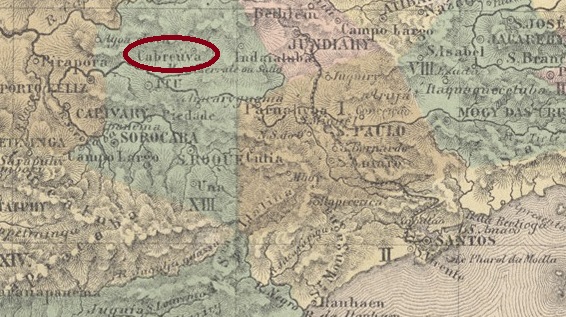
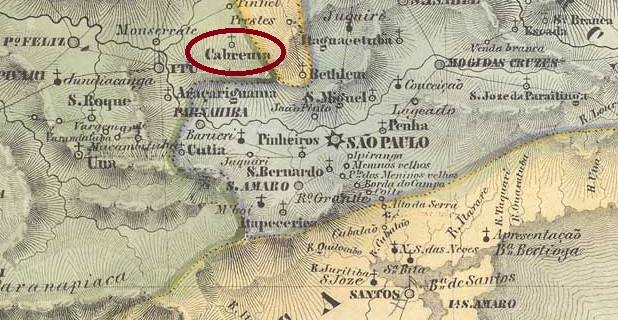
The Freguesia de N. Sra. da Piedade de Cabreuva was founded in December 1830 and was located on the east bank of the Tietê in the Município of Itu, about 80 km from the provincial capital of São Paulo. It became a villa in March 1859 and a town in December 1906.
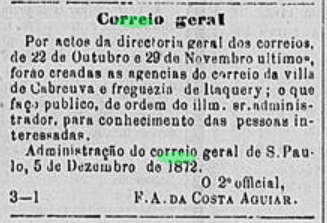
The local post office was created in October 1872, according to the regional press:
Diario de São Paulo, 06.12.1872
Two double-circle postmarks from the imperial period were found. CSP-0205a (Coll. Níkolas T. Moura) bears the inscription CABRIUVA at the top, with an inside date of 1876. The French type CSP-0205b (ill. Mário Celso Orsi Jr.) bears the inscription CABREUVA above and the typical star in brackets below. The dates in the centre have so far been found for the period 1888-1901.
Villiers de l’Ile Adam: Carta (…) da Provincia de São Paulo, 1847
Die Freguesia de N. Sra. da Piedade de Cabreuva wurde im Dezember 1830 gegründet und lag am Ostufer des Tietê im Município von Itu, etwa 80 km von der Provinzhauptstadt São Paulo entfernt. Im März 1859 wurde es zur Villa und im Dezember 1906 zur Stadt.
Das örtliche Postamt wurde im Oktober 1872 ins Leben gerufen, wie die regionale Presse berichtet:
Diario de São Paulo, 06.12.1872
Es wurden zwei Doppelkreis-Poststempel aus der Kaiserzeit gefunden. CSP-0205a (Samml. Níkolas T. Moura) trägt oben die Inschrift CABRIUVA und innen ein Datum aus 1876. Der französische Typ CSP-0205b (Abb. Mário Celso Orsi Jr.) trägt oben die Inschrift CABREUVA und unten den typischen Stern in Klammern. Die Jahreszahlen in der Mitte wurden bisher für den Zeitraum 1888-1901 gefunden.
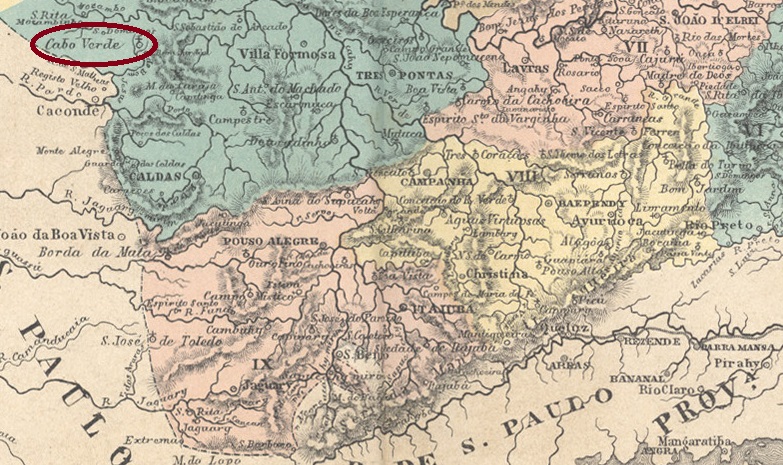
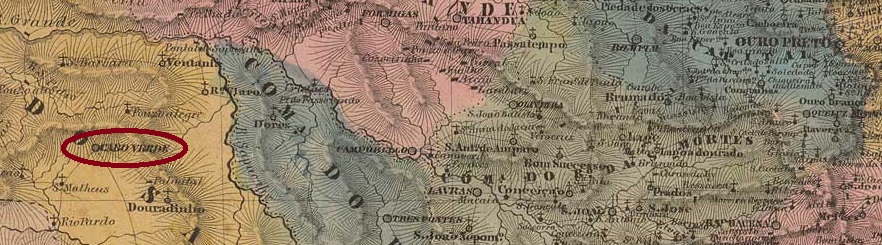
At its foundation in 1766, this Arraial was called Nossa Senhora da Assunção and was situated 470 km south of the later provincial capital Ouro Preto, close to the border with São Paulo. Around 1768, Cabo Verde was declared a freguesia, which was placed under the município of Jacuhy around 1829. In March 1846, Cabo Verde became a villa, only to be downgraded to freguesia again four years later, this time to the município of Caldas. In October 1866, the status as a villa was regained and in November 1877 Cabo Verde became a town.
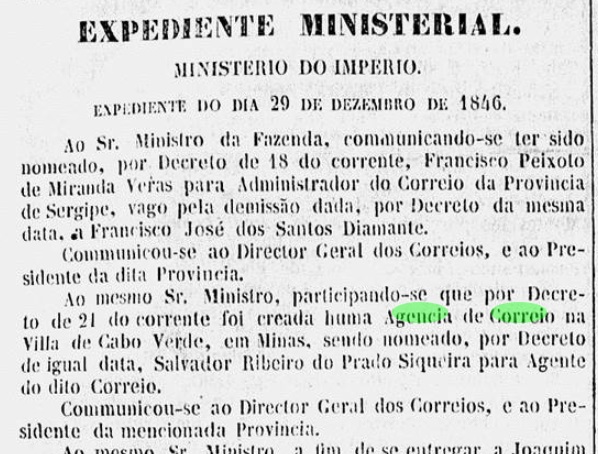
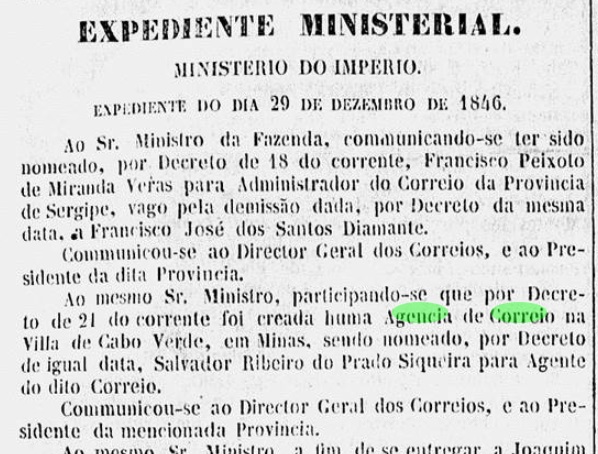
Two foundation dates were also found for the local post office. The first in December 1846, according to the capital’s press:
Gazeta Official/RJ, 08.01.1847
The agency was closed in December 1855, according to Aureo G. Santos (Agências de Correio Criadas e Suprimidas 1851, 1855, 1856 e 1857, in Brasil Filatélico 181, Rio de Janeiro, 1977), but was reopened a year later, as indicated in the Directory of Imperial Post Offices (Tabella das Agencias do Correio do Imperio, Rio de Janeiro, 1885).
Aureo Santos (Brasil Filatélico 181)
The oldest postmark so far is CMG-0425b (image from the Internet), which was previously seen with internal data from 1887 to 1897. This double circle has the inscription CABO=VERDE at the top. Below is a diamond ornament consisting of four small diamonds.
Villiers del’Ile Adam: Carta (…) da Provincia de Minas Geraes, 1849
Textaktualisierung am 9. Juli 2023
Anderer Name: N. Sra. de Assunção
Bei der Gründung 1766 hieß dieser Arraial Nossa Senhora da Assunção und lag 470 km südlich der späteren Provinzhauptstadt Ouro Preto, nahe der Grenze zur Provinz São Paulo. Um 1768 wurde Cabo Verde zur Freguesia ernannt, die um 1829 dem Município von Jacuhy unterstellt wurde. Im März 1846 wurde Cabo Verde zur Villa, um vier Jahre später wieder zur Freguesia herabgestuft zu werden, diesmal zum Município von Caldas. Im Oktober 1866 wurde der Status als Villa wiedererlangt und im November 1877 wurde Cabo Verde eine Stadt.
Auch für das örtliche Postamt wurden zwei Gründungsdaten gefunden. Die erste im Dezember 1846, wie aus der Presse der Hauptstadt hervorgeht:
Gazeta Official/RJ, 08.01.1847
Die Agentur wurde im Dezember 1855 geschlossen, so Aureo G. Santos (Agências de Correio Criadas e Suprimidas 1851, 1855, 1856 e 1857, in Brasil Filatélico 181, Rio de Janeiro, 1977), wurde aber ein Jahr später wieder eröffnet, wie im Verzeichnis der kaiserlichen Postämter (Tabella das Agencias do Correio do Imperio, Rio de Janeiro, 1885) angegeben.
Aureo Santos (Brasil Filatélico 181)
Der bisher älteste Poststempel ist CMG-0425b (Abb. aus dem Internet), der bisher mit internen Daten von 1887 bis 1897 zu sehen war. In diesem Doppelkreis steht oben die Inschrift CABO=VERDE. Unten befindet sich ein Rauten-Ornament aus vier kleinen Rauten.
Other names: Cabo de Sto. Agostinho, Santo Agostinho do Cabo
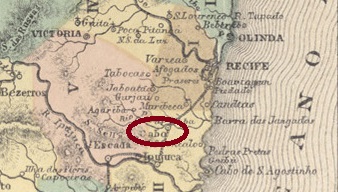
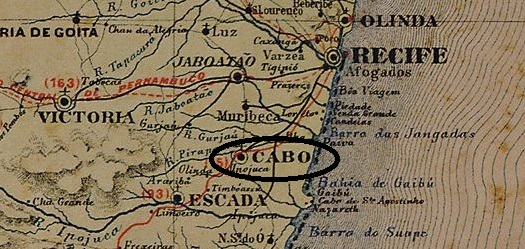
The Freguesia of Cabo de Santo Agostinho was founded in September 1662 and was located on the south bank of the Pirapama, a good 30 km south of the later provincial capital of Recife. The place was declared a villa in November 1811, but was demoted to the Freguesia of Recife in March 1846 and only regained its political autonomy in July 1877, now as the town of Santo Agostinho do Cabo. Around 1910, the original place name Cabo de Santo Agostinho returned.
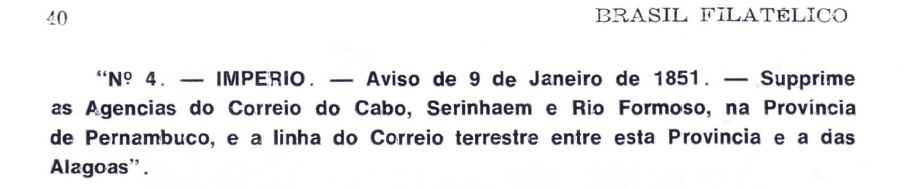
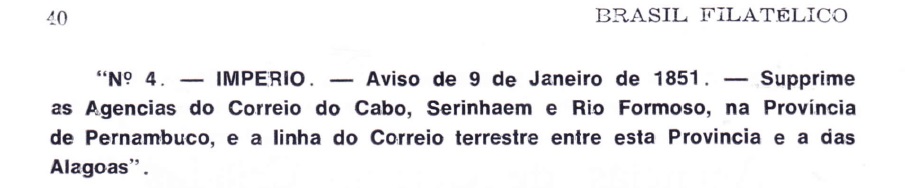
Again, two foundation dates for the local post office were found. Once in March 1829, as Nova Monteiro writes in Administrações e Agencias Postaes do Brasil Imperio (Brasil Filatelico/RJ, 1934-5; reprint SPP 1994-1999). In January 1851, the agency was closed, as registered by Aureo G. Santos (Agências de Correio Criadas e Suprimidas 1851, 1855, 1856 e 1857, in Brasil Filatélico 181, Rio de Janeiro, 1977):
Aureo G. Santos (op. cit.)
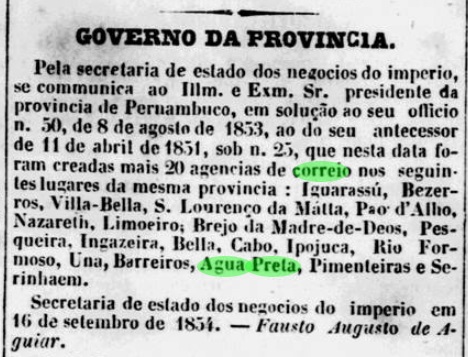
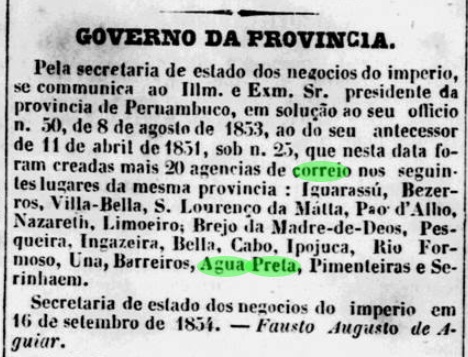
The post office reopened in September 1854, as reported in the regional press:
Diario de Pernambuco, 07.10.1854
The oldest postmark so far is the French type CPE-0145c (Coll. Marco Morel), which was already seen with internal data from about 1884 until around 1887. It was followed by the somewhat larger double circle CPE-0145d (Coll. Luís C. Fritzen), which shows only CABO at the top and whose only copy bears a date of 1891 in the centre.
Carta Corographica da Provincia de Pernambuco, 1880
Andere Namen: Cabo de Sto. Agostinho, Santo Agostinho do Cabo
Die Freguesia von Cabo de Santo Agostinho wurde im September 1662 gegründet und lag am Südufer des Pirapama, gut 30 km südlich der späteren Provinzhauptstadt Recife. Der Ort wurde im November 1811 zur Villa erklärt, im März 1846 jedoch zur Freguesia von Recife degradiert und erhielt erst im Juli 1877 seine politische Autonomie zurück, nun als Stadt Santo Agostinho do Cabo. Um 1910 kehrte der ursprüngliche Ortsname Cabo de Santo Agostinho zurück.
Auch hier wurden zwei Gründungsdaten für das örtliche Postamt gefunden. Einmal im März 1829, wie Nova Monteiro in Administrações e Agencias Postaes do Brasil Imperio (Brasil Filatelico/RJ, 1934-5; Nachdruck SPP 1994-1999) schreibt. Im Januar 1851 wurde die Agentur geschlossen, wie Aureo G. Santos (Agências de Correio Criadas e Suprimidas 1851, 1855, 1856 e 1857, in Brasil Filatélico 181, Rio de Janeiro, 1977) registrierte:
Aureo G. Santos (op. cit.)
Dann eröffnete das Postamt wieder im September 1854, wie die regionale Presse berichtete:
Diario de Pernambuco, 07.10.1854
Der bisher älteste Poststempel ist der französische Typ CPE-0145c (Samml. Marco Morel), der schon von ca. 1884 bis um 1887 mit inneren Daten zu sehen war. Ihm folgte der etwas größere Doppelkreis CPE-0145d (Samml. Luís C. Fritzen), der oben nur CABO zeigt und dessen einziges Exemplar ein Datum von 1891 in der Mitte trägt.
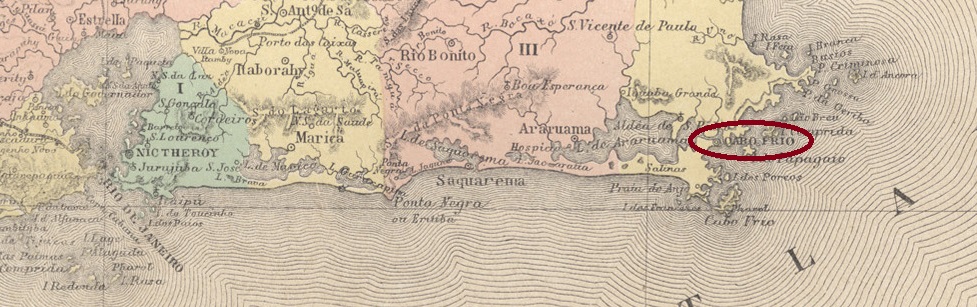
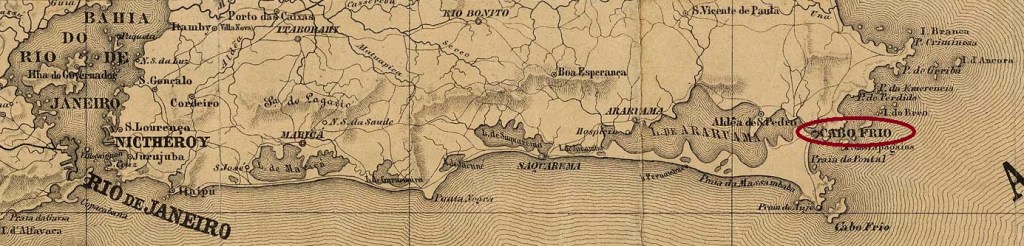
This is believed to be one of the oldest towns in Brazil, founded as Santa Helena do Cabo Frio in November 1615, shortly after the French invaders were defeated after decades of occupation. Curiously, Cabo Frio did not become a freguesia until much later (1678).
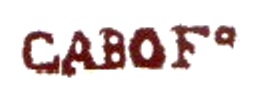
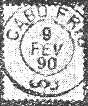
Two foundation dates have been found for the local post office. First in April 1827, as Nova Monteiro writes in Administrações e Agencias Postaes do Brasil Imperio (Brasil Filatelico/RJ, 1934-5; reprinted by SPP 1994-1999). Then in 1829, as shown in the Directory of Imperial Post Offices (Tabella das Agencias do Correio do Imperio, Rio de Janeiro, 1885). The oldest stamp CRJ-0215a, which also exists in sepia and is already illustrated in the RHM catalogue under P-RJ-003, is from the pre-philatelic period:
CRJ-0215a (RHM P-RJ-003) also sepia
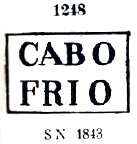
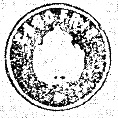
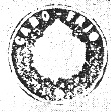
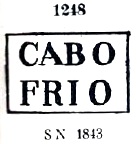
It was followed by CRJ-0215b, which also occurs in red, brown, blue and green, was used between about 1843 and 1882 and is known by Paulo Ayres (Catálogo de Carimbos Brasil-Império, S. Paulo, 1937, 1942) with no. 1248:
CRJ-0215b (P.A. 1248) 1843ff-1882ff
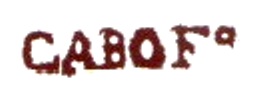
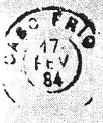
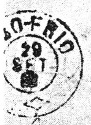
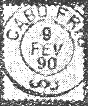
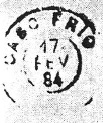
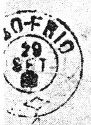
This was followed by three stamps as double circles, already presented by R. Koester in Carimbologia VII:
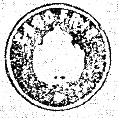
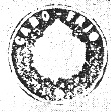
Two postmarks with the imperial seal are also known from Cabo Frio, also by R. Koester:
CRJ-0215f (RK)CRJ-0215g (RK)
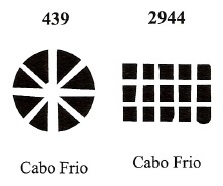
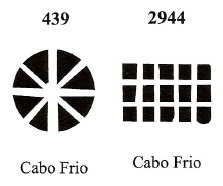
More recently, James Dingler and Klerman W. Lopes have registered two mute cancellations from Cabo Frio in Mute Cancellations of the Brazil Empire / Carimbos Mudos do Brasil Império (Brazil Philatelic Association, Rio de Janeiro, 2000) with numbers 439 and 2944:
BPA 439, 2944Almanak Laemmert, 1866
Anderer Name: Santa Helena
Es wird angenommen, dass dies eine der ältesten Städte Brasiliens ist, gegründet als Santa Helena do Cabo Frio im November 1615, kurz nachdem die französischen Invasoren nach jahrzehntelanger Besetzung besiegt worden waren. Merkwürdigerweise wurde Cabo Frio erst viel später (1678) eine Freguesia.
Für das örtliche Postamt wurden zwei Gründungsdaten gefunden. Zuerst im April 1827, wie Nova Monteiro in Administrações e Agencias Postaes do Brasil Imperio (Brasil Filatelico/RJ, 1934-5; Nachdruck SPP 1994-1999) schreibt. Dann 1829, wie aus dem Verzeichnis der kaiserlichen Postämter (Tabella das Agencias do Correio do Imperio, Rio de Janeiro, 1885) hervorgeht. Aus der Vor-Philatelie stammt der älteste Stempel CRJ-0215a, der auch in Sepia existiert und bereits im RHM-Katalog unter P-RJ-003 abgebildet ist:
CRJ-0215a (RHM P-RJ-003) auch sepia
Ihm folgte CRJ-0215b, der auch in rot, braun, blau und grün vorkommt, zwischen ca. 1843 und 1882 verwendet wurde und durch Paulo Ayres (Catálogo de Carimbos Brasil-Império, S. Paulo, 1937, 1942) mit Nr. 1248 bekannt ist:
CRJ-0215b (P.A. 1248) 1843ff-1882ff
Danach folgten drei Stempel als Doppelkreise, die R. Koester bereits in Carimbologia VII vorgestellt hat:
Aus Cabo Frio sind auch zwei Poststempel mit dem kaiserlichen Siegel bekannt, ebenfalls von R. Koester:
CRJ-0215f (RK)CRJ-0215g (RK)
Zuletzt haben James Dingler und Klerman W. Lopes zwei stumme Abstempelungen von Cabo Frio in Mute Cancellations of the Brazil Empire / Carimbos Mudos do Brasil Império (Brazil Philatelic Association, Rio de Janeiro, 2000) mit den Nummern 439 und 2944 registriert:
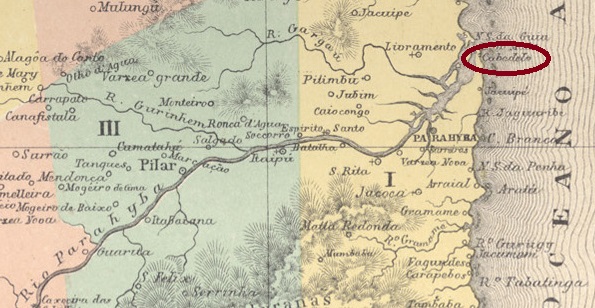
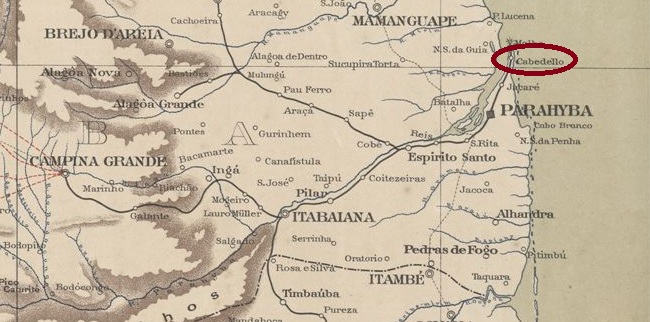
The history of the village begins in 1584 with the construction of the fortress of Santa Catarina at the tip of the peninsula, 15 km north of the later provincial capital Parahyba (now João Pessoa). 60 years later, the fortress was taken by Dutch corsairs, who named it Margareta. After the liberation, the population of the place grew slowly, and Cabedello probably became a district of Parahyba only at the end of the 19th century. The place was the most important commercial port in the province.
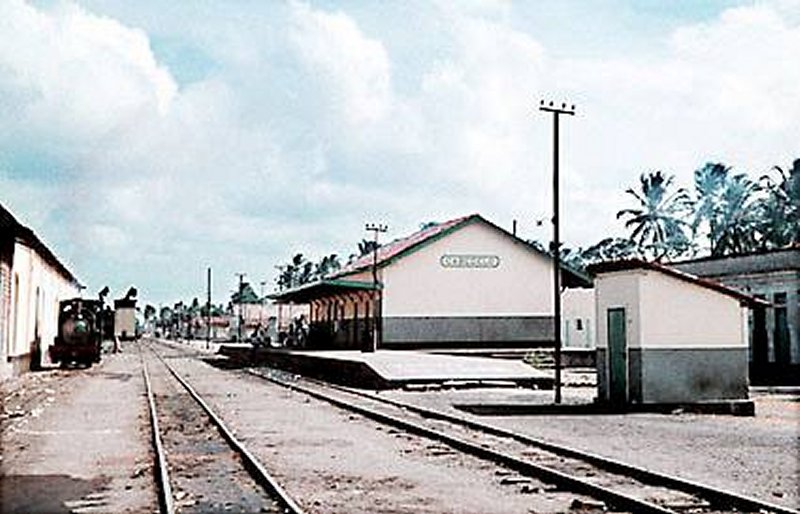
The inauguration of the railway station at the end of the Cabedello line by the E.F. Conde d’Eu railway company in March 1889 changed the situation: in March Cabedello became a município. This status was lost in November 1928, but returned in December 1956, when Cabedelo (as it is now written) became the smallest and least populous município in the state of Paraíba.
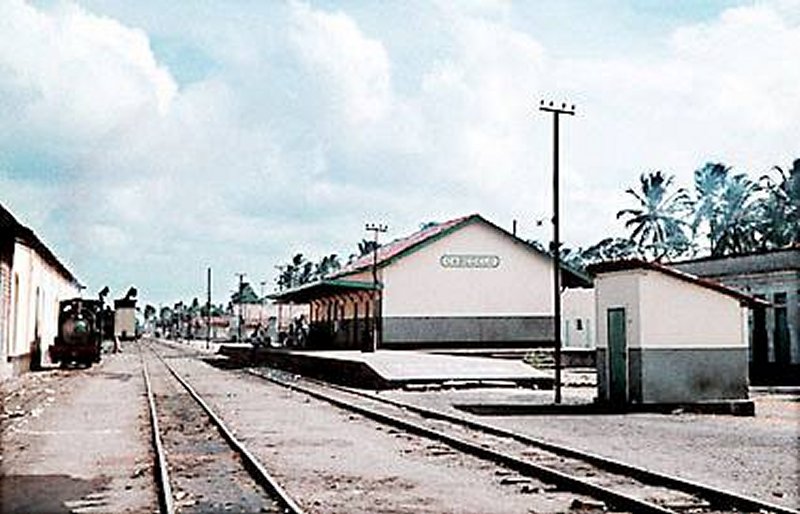
Cabedello station, around 1970 (estacoesferroviarias.com.br)
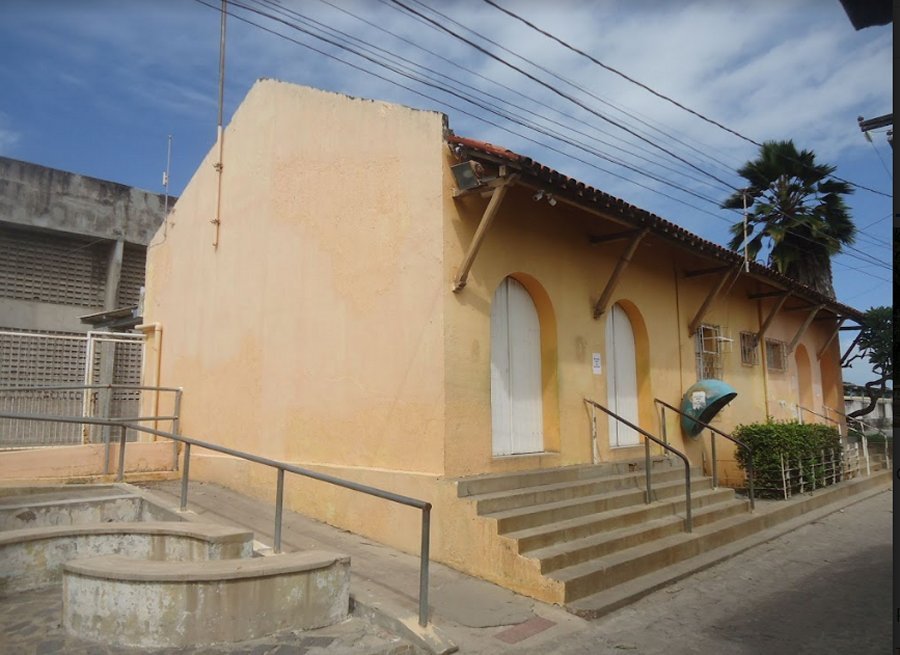
The railway line went to the Great Western Railway in 1901, to Rede Ferroviária do Nordeste in 1950, to Rede Ferroviária Federal in 1975, and since 1997 has belonged to Cia. Brasileira de Transportes Urbanos (CBTU).
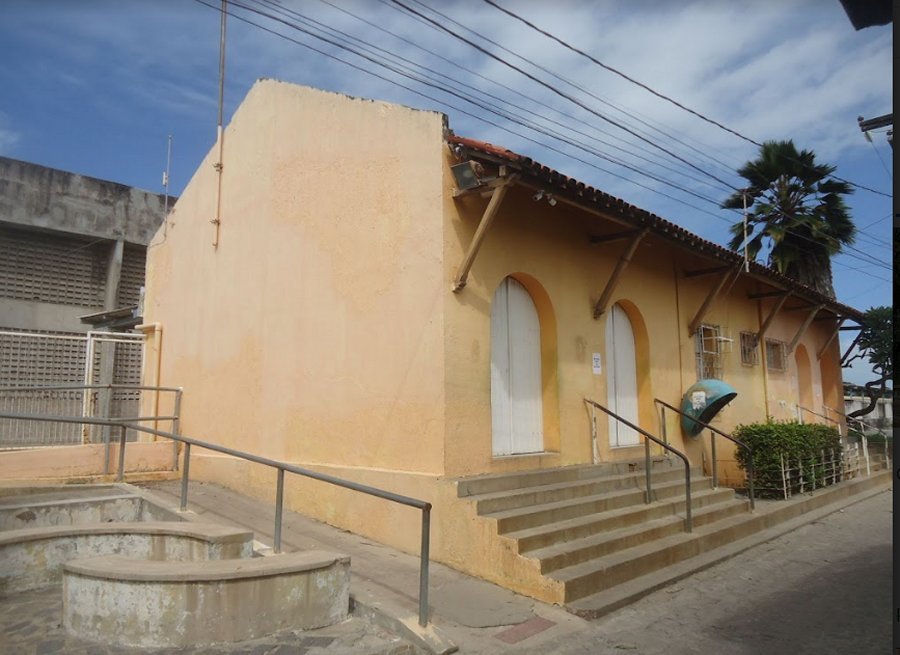
Cabedello station, 2021 (Photo: Rodrigo Henrique in estacoesferroviarias.com.br)
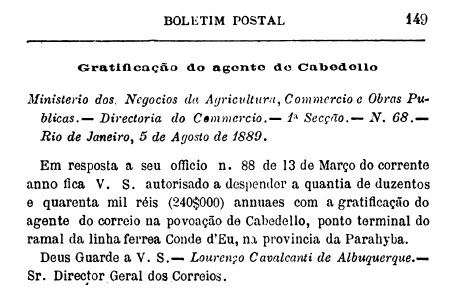
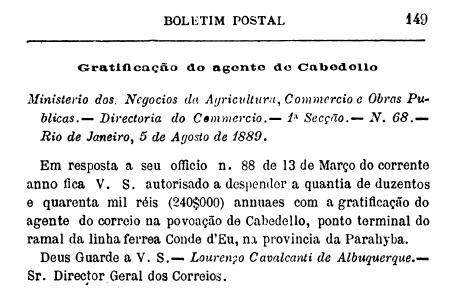
R. Koester writes in Carimbologia VII that the station post office was created in August 1889. This is not quite correct: on 5 August 1889, a letter from the postal administration in Rio went to the provincial administration in Parahyba. It was a reply to an enquiry made in March of that year about how the postal agent was to be remunerated.
Boletim Postal V, September 1889
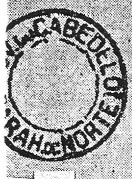
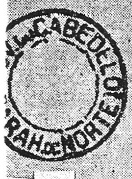
Accordingly, the decision to establish a postal agency in Cabedello must have been made earlier – and its commissioning later. The oldest postmark is BPB-0075a and was already shown in R. Koester’s Carimbologia VII:
BPB-0075a (RK)Sociedade Geologica e Mineralogica, 1910
Anderer Name: Margareta
Die Geschichte des Ortes beginnt 1584 mit dem Bau der Festung Santa Catarina an der Spitze der Halbinsel, 15 km nördlich der späteren Provinzhauptstadt Parahyba (heute João Pessoa). 60 Jahre später wurde die Festung von holländischen Korsaren eingenommen, die sie Margareta nannten. Nach der Befreiung wuchs die Bevölkerung des Ortes nur langsam, und wahrscheinlich wurde Cabedello erst Ende des 19. Jahrhunderts zu einem Distrikt von Parahyba. Der Ort war der wichtigste Handelshafen der Provinz.
Mit der Einweihung des Bahnhofs am Ende der Abzweigung Cabedello durch die Eisenbahngesellschaft E.F. Conde d’Eu im März 1889 änderte sich die Situation: Im März wurde Cabedello zu einem Município. Dieser Status ging im November 1928 verloren, kehrte aber im Dezember 1956 wieder zurück, als Cabedelo (wie es jetzt geschrieben wird) das kleinste und bevölkerungsärmste Município im Bundesstaat Paraíba wurde.
Bahnhof Cabedello, um 1970 (estacoesferroviarias.com.br)
Die Bahnlinie ging 1901 an die Great Western Railway, 1950 an die Rede Ferroviária do Nordeste, 1975 an die Rede Ferroviária Federal und gehört seit 1997 der Cia. Brasileira de Transportes Urbanos (CBTU).
Bahnhof Cabedello, 2021 (Foto: Rodrigo Henrique in estacoesferroviarias.com.br)
R. Koester schreibt in Carimbologia VII, dass das Bahnhofspostamt im August 1889 gegründet wurde. Das ist nicht ganz richtig: Am 5. August 1889 ging ein Schreiben der Postverwaltung in Rio an die Provinzverwaltung nach Parahyba. Es handelte sich um eine Antwort auf eine Anfrage vom März d.J., wie der Postagent zu entlohnen sei.
Boletim Postal V, September 1889
Demnach muss die Entscheidung für eine Postagentur in Cabedello früher gefallen sein – und ihre Inbetriebnahme später. Der älteste Poststempel ist BPB-0075a und wurde bereits in R. Koesters Carimbologia VII gezeigt:
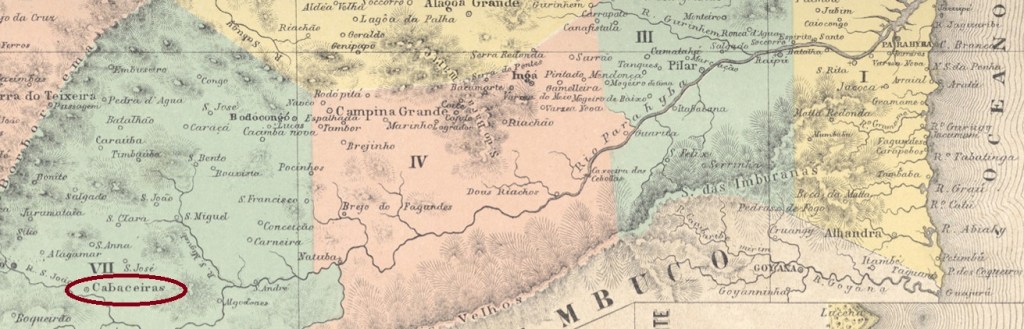
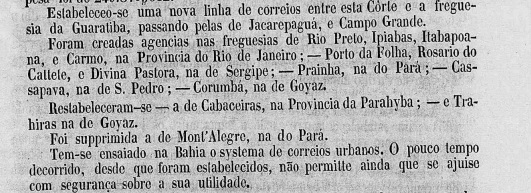
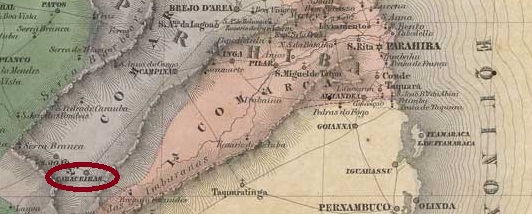
The Freguesia de N. Sra. da Conceição das Cabaceiras was founded in August 1833 and was located near Villa Nova da Rainha (today: Campina Grande) on the north bank of the Parahyba, 200 km west of the provincial capital Parahyba do Norte (today: João Pessoa). In June 1835, the place became Vila Federal de Cabaceiras, and since February 1870, the abbreviated place name Vila (or town) de Cabaceiras has been in use.
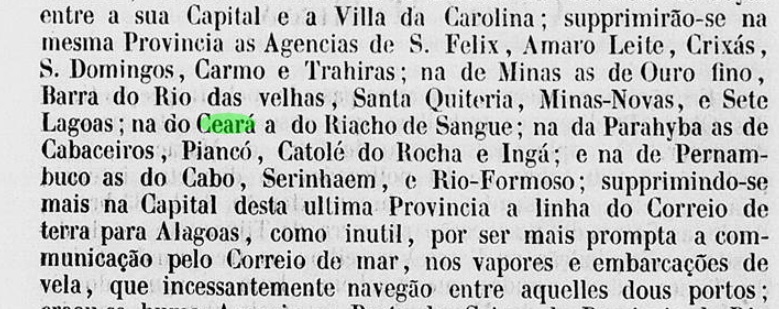
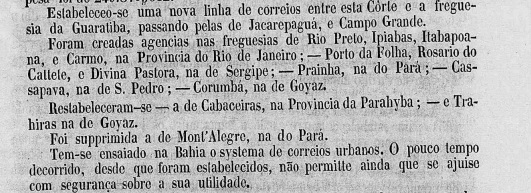
In January 1836, it was decided to establish a local post office, as Nova Monteiro writes in Administrações e Agencias Postaes do Brasil Imperio (Brasil Filatelico/RJ, 1934-5; reprint SPP 1994-1999). The agency was closed around 1850, but reopened about three years later – according to reports from the imperial ministry:
Relatorio do Ministerio do Imperio/1850Relatorio do Ministerio do Imperio/1853
The only imperial postmark so far is CPB-0070b (Fig. Jorge L. Pedreira): a double circle with the inscription CABACEIRAS at the top and internal dates from 1881 to 1892.
Villiers de l’Ile Adam: Carta (…) das Provincias do Rio Grande do Norte e Parahiba, 1848
Die Freguesia de N. Sra. da Conceição das Cabaceiras wurde im August 1833 gegründet und lag bei Villa Nova da Rainha (heute: Campina Grande) am Nordufer des Parahyba, 200 km westlich der Provinzhauptstadt Parahyba do Norte (heute: João Pessoa). Im Juni 1835 wurde der Ort zur Vila Federal de Cabaceiras, und seit Februar 1870 ist der abgekürzte Ortsname Vila (oder Stadt) de Cabaceiras gebräuchlich.
Im Januar 1836 wurde die Einrichtung eines örtlichen Postamtes beschlossen, wie Nova Monteiro in Administrações e Agencias Postaes do Brasil Imperio (Brasil Filatelico/RJ, 1934-5; Nachdruck SPP 1994-1999) schreibt. Die Agentur wurde um 1850 geschlossen, aber etwa drei Jahre später – nach Berichten des kaiserlichen Ministeriums – wieder eröffnet:
Relatorio do Ministerio do Imperio/1850Relatorio do Ministerio do Imperio/1853
Der bisher einzige kaiserliche Poststempel ist CPB-0070b (Abb. Jorge L. Pedreira): ein Doppelkreis mit der Inschrift CABACEIRAS oben und inneren Daten von 1881 bis 1892.
Villiers de l’Ile Adam: Carta (…) da Provincia do Maranhão, 1850
Another name: Burity de Ignacia Vaz.
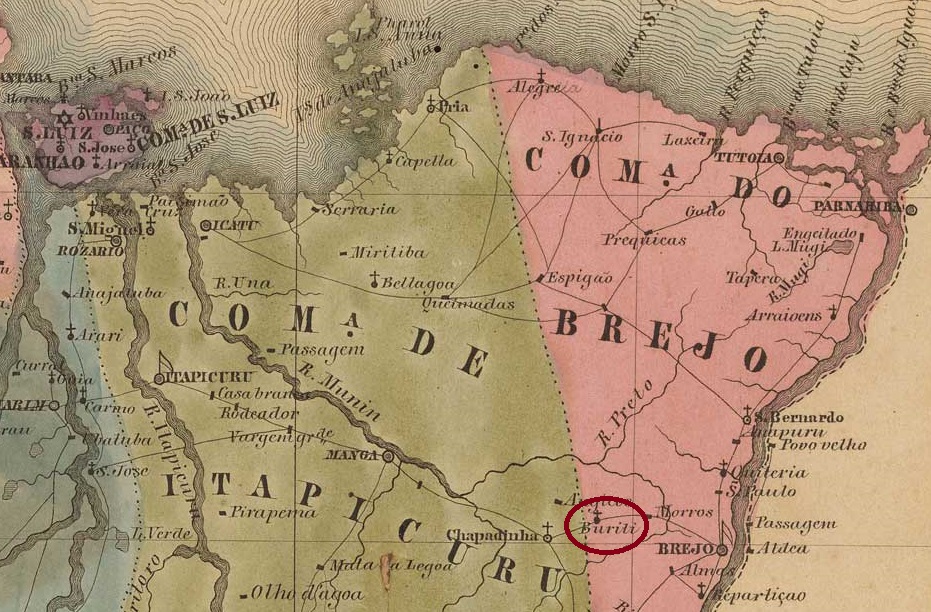
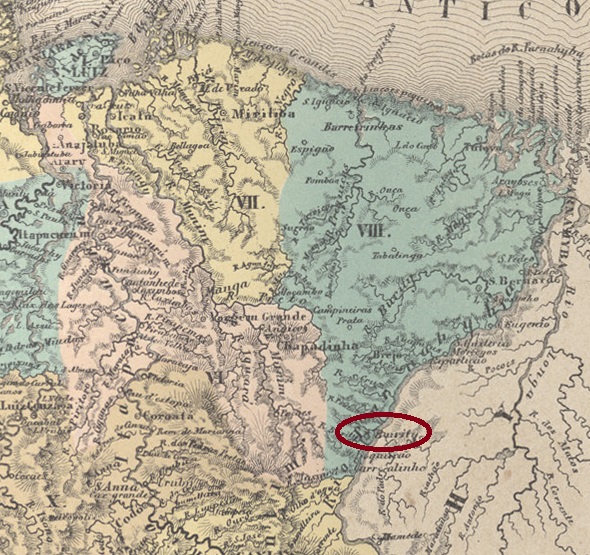
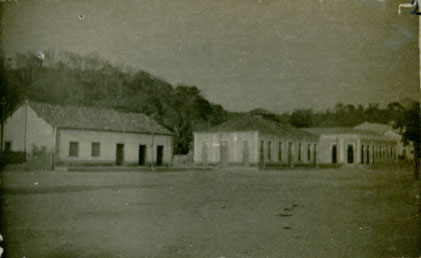
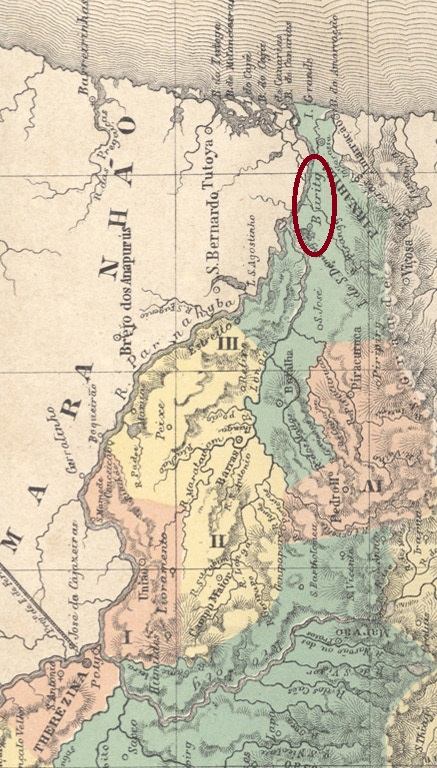
The Freguesia called N. Sra. de Sant’Anna do Burity was founded in October 1843 south of the Vila of Brejo, 320 km southeast of the provincial capital São Luís do Maranhão. In April 1888 it became a vila, which in 1933 was named Burity de Ignacia Vaz, in memory of the first large landowner in the region. Since December 1938, it has been a town called Buriti.
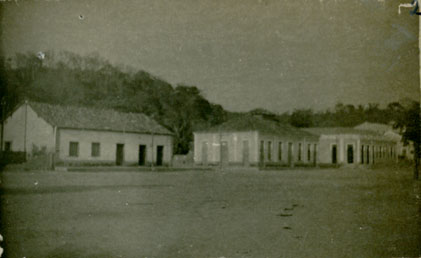
Burity Post Office (left), ca. 1950 (IBGE)
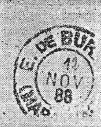
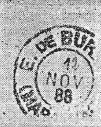
As R. Koester writes in Carimbologia VI, there was a post office there since August 1879. The only postmark from the imperial period so far is BMA-0060a, already presented by Koester (op. cit.):
BMA-0060a (RK) 1888Atlas do Imperio do Brasil, 1868
Anderer Name: Burity de Ignacia Vaz
Die Freguesia de N. Sra. de Sant’Anna do Burity wurde im Oktober 1843 gegründet und lag südlich der Vila de Brejo, 320 km südöstlich der Provinzhauptstadt São Luís do Maranhão. Im April 1888 wurde es zu einer Vila, die 1933 den Namen Burity de Ignacia Vaz erhielt, in Erinnerung an die erste Großgrundbesitzerin der Region. Seit Dezember 1938 ist es die Stadt Buriti.
Postamt Burity (links), ca. 1950 (IBGE)
Wie R. Koester in Carimbologia VI schreibt, gab es dort ein Postamt seit August 1879. Der bisher einzige Poststempel aus der Kaiserzeit ist BMA-0060a, der bereits von Koester (op. cit.) vorgestellt wurde:
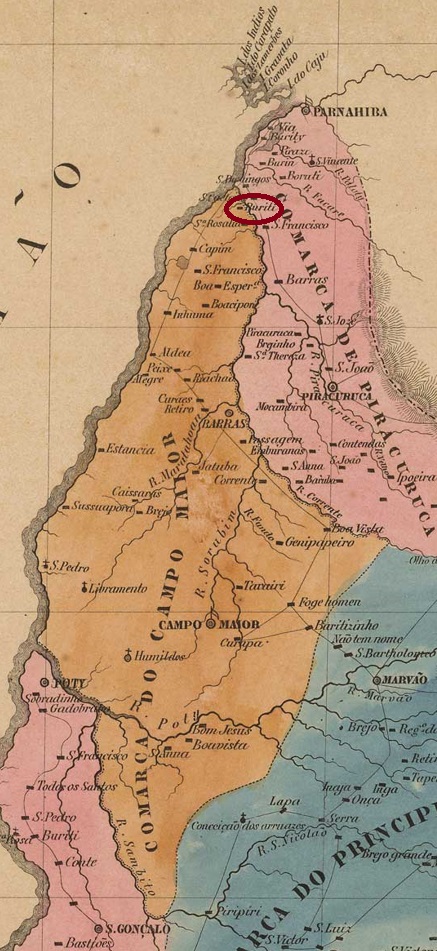
The Freguesia de N. Sa. dos Remedios de Burity dos Lopes was founded in June 1864 on the east bank of the river Longá in the Município of Parnaíba, 300 km north of the provincial capital Teresina. It was elevated to the status of a villa in August 1890 and was given the name Baixo Longá in June 1897. In July 1911, the old place name Buriti dos Lopes returned. After a good two years (June 1931 to September 1933) as a district of Parnaíba, Burity dos Lopes became an independent município again. The name commemorates the first Portuguese settler, Francisco Lopes.
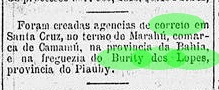
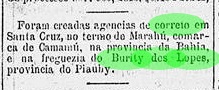
Two foundation dates were found for the local post office. The first one in October 1884, as the Rio press wrote:
Gazeta de Noticias/RJ, 05.10.1884
Then again in 1885, as stated in the regional press:
A Imprensa, 07.09.1885
No imperial postmark of Burity dos Lopes has been found so far.
Villiers de l’Ile Adam: Carta (…) da Provinica do Piauhy, 1850
Anderer Name: Baixo Longá
Die Freguesia de N. Sa. dos Remedios de Burity dos Lopes wurde im Juni 1864 gegründet und lag am Ostufer des Flusses Longá im Município von Parnaíba, 300 km nördlich der Provinzhauptstadt Teresina. Im August 1890 wurde sie zur Vila erhoben und erhielt im Juni 1897 den Namen Baixo Longá. Im Juli 1911 kehrte der alte Ortsname Buriti dos Lopes zurück. Nach gut zwei Jahren (Juni 1931 bis September 1933) als Distrikt von Parnaíba wurde Burity dos Lopes wieder ein eigenständiges Município. Der Name erinnert an den ersten portugiesischen Siedler, Francisco Lopes.
Für das örtliche Postamt wurden zwei Entstehungsdaten gefunden. Die erste im Oktober 1884, wie die Presse in Rio schrieb:
Gazeta de Noticias/RJ, 05.10.1884
Dann wieder 1885, wie aus der regionalen Presse hervorgeht:
A Imprensa, 07.09.1885
Bisher wurde kein kaiserlicher Poststempel von Burity dos Lopes gefunden.
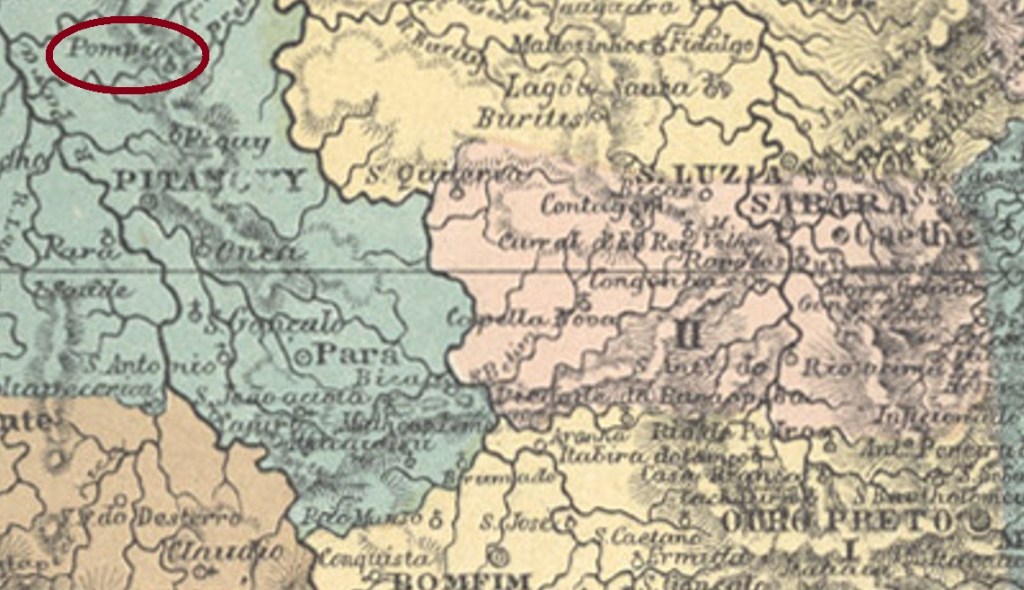
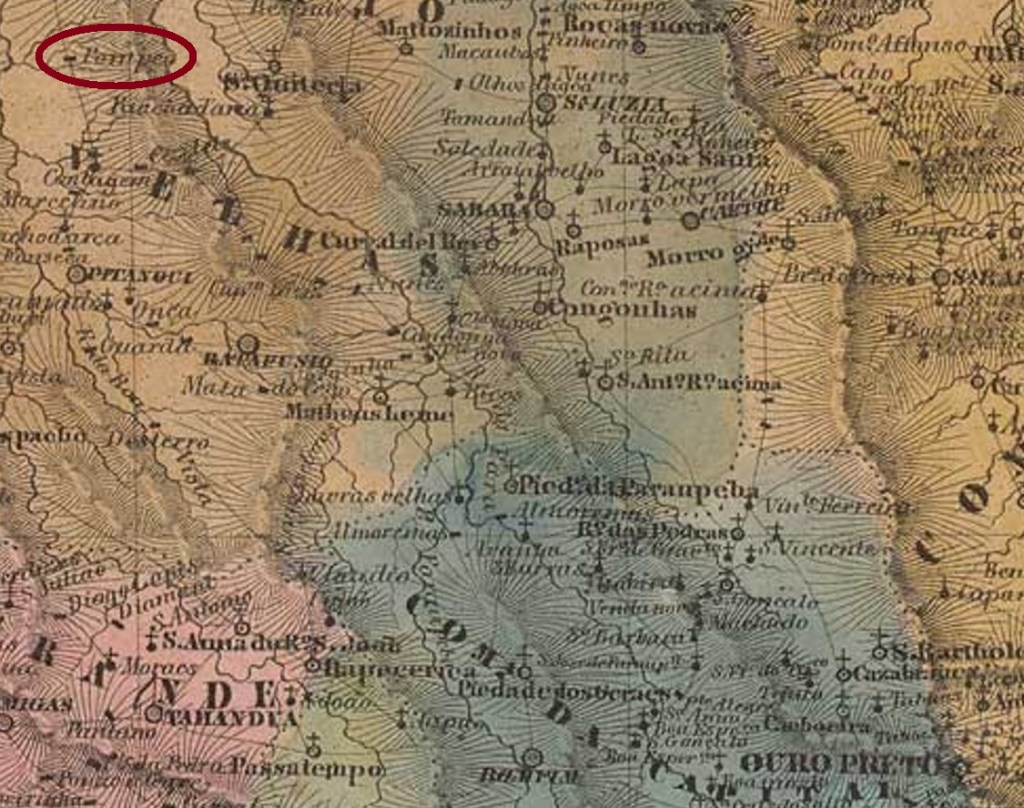
The history of this place begins in March 1841, when the district of N. Sra. da Conceição do Pompéu was founded in the município of Pitangui, 260 km northwest of the provincial capital Ouro Preto. It was elevated to freguesia status in November 1866. In November 1923, it was renamed as the district of Pompéu, which has been an independent município since December 1938. The place name Burity da Estrada (Burity palm by the road), adopted after a fazenda, remained nevertheless for a long time, as one can notice through the postmarks.
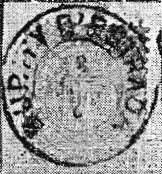
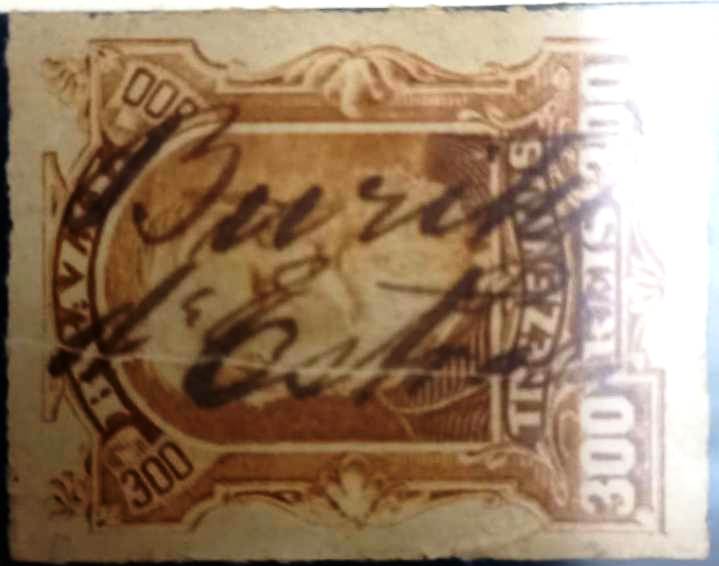
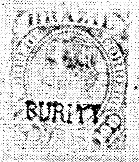
As Paula Sobrinho writes in História Postal de Minas Gerais (Belo Horizonte, 1997), there was a post office there from October 1880. Two postmarks were found for the Empire, both described by R. Koester (Carimbologia VI):
BMG-0420a (RK) 1883ffBMG-0420b (RK) 1888ff-1915
Before that there was a handwritten cancellation (Coll. Fuad Ferreira Fo.), a sure indication that the first postmark was long in waiting:
1880ff-1882 (FF)Villiers de l’Ile Adam: Carta (…) da Provincia de Minas Geraes, 1849
Andere Namen: Conceição do Pompéu, Pompéu
Die Geschichte dieses Ortes beginnt im März 1841, als die Siedlung N. Sra. da Conceição do Pompéu im município von Pitangui, 260 km nordwestlich der Provinzhauptstadt Ouro Preto, gegründet wurde. Im November 1866 erfolgte die Erhebung zur Freguesia. Im November 1923 fand eine Umbenennung als Distrikt von Pompéu statt, und seit Dezember 1938 ist Pompéu ein eigenständiges Município. Der nach einer Fazenda übernommene Ortsname Burity da Estrada (Burity-Palme an der Straße) blieb dennoch lange erhalten, wie man bei den Poststempeln sieht.
Wie Paula Sobrinho in História Postal de Minas Gerais (Belo Horizonte, 1997) schreibt, gab es dort seit Oktober 1880 ein Postamt. Für das Kaiserreich wurden zwei Poststempel gefunden, die beide von R. Koester (Carimbologia VI) beschrieben wurden:
BMG-0420a (RK) 1883ffBMG-0420b (RK) 1888ff-1915
Davor gab es eine handschriftliche Entwertung (Samml. Fuad Ferreira Fo.), ein sicheres Indiz dafür, dass der erste Poststempel lange auf sich warten ließ:
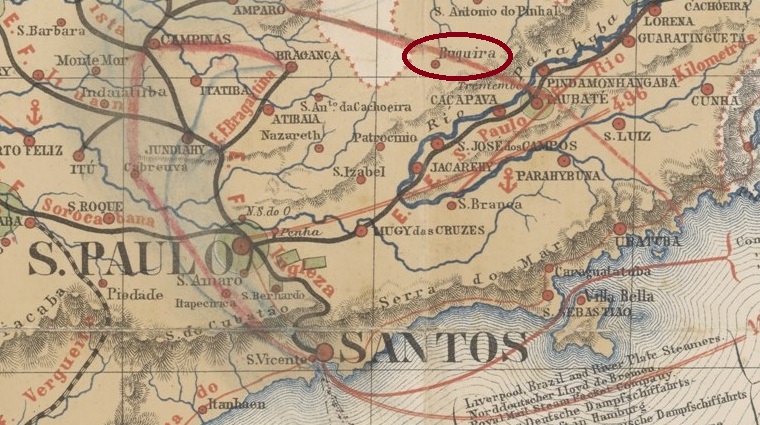
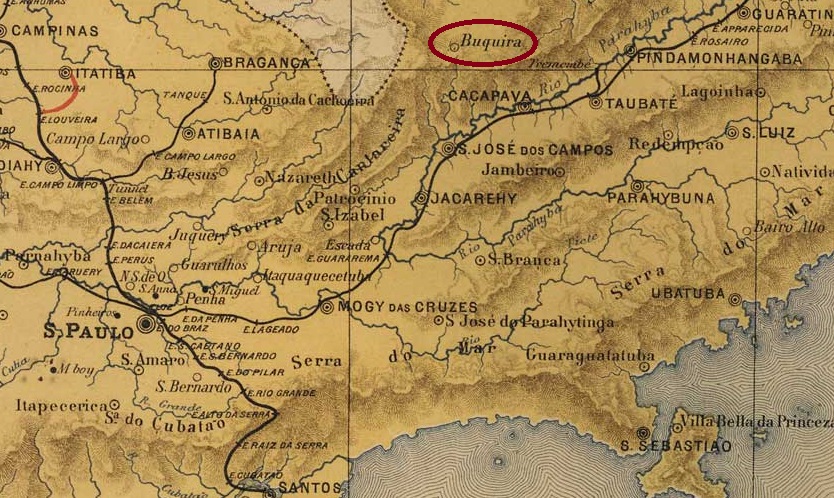
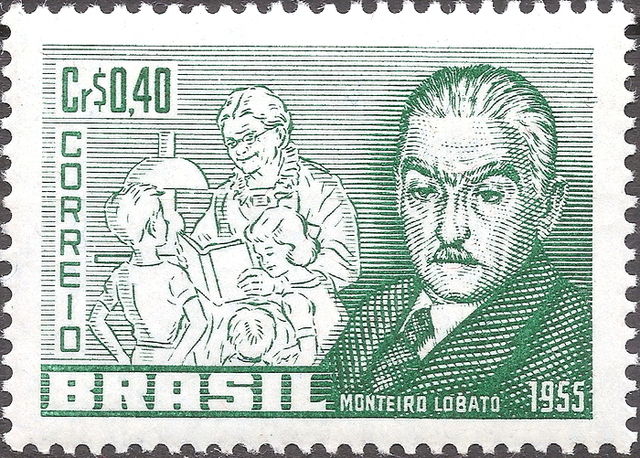
The freguesia of N. Sa. da Piedade do Buquira was founded in April 1857 in the Município of Taubaté on the left bank of the Buquira, 130 km northeast of the provincial capital of São Paulo. It then changed jurisdiction twice: to Caçapava in April 1866 and to S. José dos Campos in July 1867. In April 1880 it became a vila. After a good four years as a district of S. José dos Campos (May 1844 to December 1948), its status as a vila returned, now as the município of Monteiro Lobato. The name commemorates José Bento Monteiro Lobato (1882-1948), a writer whose family owned a fazenda there.
MiNr. 885/Scott 829/RHM C-370
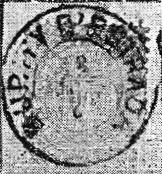
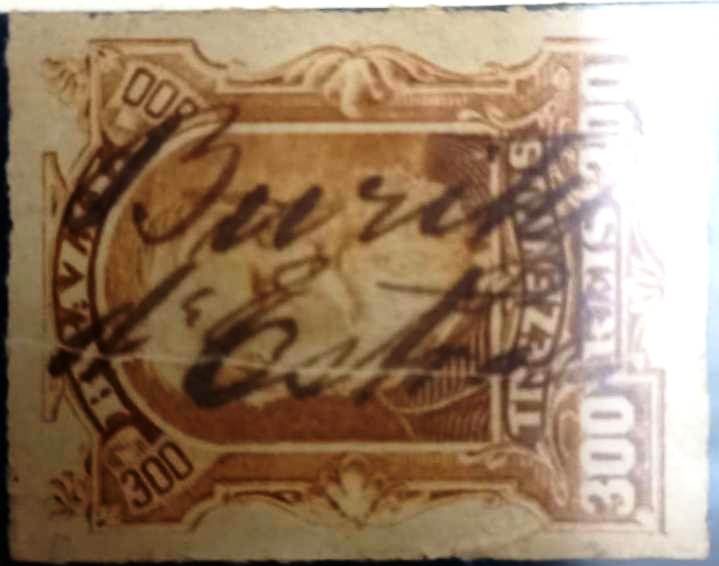
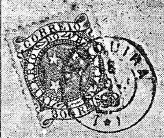
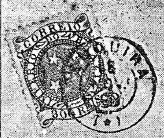
According to the Directory of Imperial Post Offices (Tabella das Agencias do Correio do Imperio, Rio de Janeiro, 1885), there had been a post office there since 1879. The only imperial postmark so far is the French type BSP-0195a, with dates between 1881 and 1903, already shown by R. Koester in Carimbologia VI:
BSP-0195a (RK) 1881-1903J. M. Ribeiro Lisboa: Provincia de São Paulo, 1884
Anderer Name: Monteiro Lobato (1948)
Die Freguesia von N. Sa. da Piedade do Buquira wurde im April 1857 gegründet und lag im Município von Taubaté am linken Ufer des Buquira, 130 km nordöstlich der Provinzhauptstadt São Paulo. Danach wechselte sie zweimal die Zuständigkeit: im April 1866 nach Caçapava und im Juli 1867 nach S. José dos Campos. Im April 1880 wurde es zur Vila. Nach gut vier Jahren als Distrikt von S. José dos Campos (Mai 1844 bis Dezember 1948) kehrte der Status als Vila zurück, nun als Município von Monteiro Lobato. Der Name erinnert an José Bento Monteiro Lobato (1882-1948), einen Schriftsteller, dessen Familie dort eine Fazenda besaß.
MiNr. 885/Scott 829/RHM C-370
Nach dem Verzeichnis der kaiserlichen Postämter (Tabella das Agencias do Correio do Imperio, Rio de Janeiro, 1885) gab es dort seit 1879 ein Postamt. Der einzige kaiserliche Poststempel ist bisher der französische Typ BSP-0195a, mit Daten zwischen 1881 und 1903, der bereits von R. Koester in Carimbologia VI gezeigt wurde:





 Carimbologia