Categories
Carimbologia Q-R

Riacho Fundo, Minas Gerais (RMG-2105)

Atlas do Imperio do Brasil, 1868

Santo Antonio do Riacho Fundo was a district of the municipality of Conceição do Mato Dentro (later Conceição do Serro) in Minas Gerais until 1911, when it passed to Santa Luzia. In 1938 it became a district of Jaboticatubas, emancipating with an own municipality in 1962.

Paula Sobrinho (História Postal de Minas Gerais, Belo Horizonte, 1997) has found two dates for the creation of the post office: October 23, 1879 (apud Relatório dos Correios of 1890) and November 23, 1889 (according to the Boletim Postal), and states that the first mail agent was nominated only in July 1894.

Further research in the regional press could confirm neither a creation in 1879 nor the 1894 first agent. Already in 1891, a postal agent was nominated for Riacho Fundo:

A Ordem, December 5, 1891

He was possibly not the first one, for the earliest note on the creation of the post office dates back to 1889:

Jornal do Commercio, Rio de Janeiro, October 25, 1889

Since no earlier record neither a cancel from the Empire period have been found to date, possibly the year 1879 in Relatório dos Correios (1890) would be a misprint. And a Riacho Fundo cancel with date before November 15, 1889 must be very rare, if it exists.

Wikimedia – Open Street Map

Santo Antonio do Riacho Fundo war bis 1911 ein Distrikt der Gemeinde (Município) Conceição do Mato Dentro (später: Conceição do Serro) in Minas Gerais. Danach gehörte dieser Ort zu Santa Luzia bis 1938, als er ein Distrikt von Jaboticatubas wurde, bevor er 1962 eigenständig und ein eigener Município wurde.

Paula Sobrinho (História Postal de Minas Gerais, Belo Horizonte, 1997) nannte gleich zwei Daten für die Entstehung des dortigen Postamtes: den 23.10.1879 (apud Relatório dos Correios von 1890) und den 23.11.1889 (laut Boletim Postal) und schrieb, der erste Postangestellte wurde erst im Juli 1894 eingesetzt.

Eine Suche in der Regionalpresse konnte weder die Entstehung in 1879 noch den ersten Agenten in 1894 bestätigen. Allerdings wurde ein Postangestellter bereits in 1891 dorthin abkommandiert:

A Ordem, 5. Dezember 1891

Dieser war vermutlich nicht der erste, da über die Entstehung eines Postamtes in Riacho Fundo schon im Jahr 1889 berichtet wurde:

Jornal do Commercio, Rio de Janeiro, 25. Oktober 1889

Die Suche nach einem früheren Datum fürs Postamt hat bisher kein Ergebnis gebracht. Daher könnte es sein, dass die Jahresangabe 1879 im Relatório dos Correios (1890) einen Druckfehler hat. Und ein Stempel aus Riacho Fundo mit Datum vor dem 15. November 1889 muss sehr selten sein, sofern existent.

Categories
Carimbologia Q-R

Riacho Doce, Pernambuco (RPE-0500)

Arthur Duarte Ribeiro: Mapa do Estado de Pernambuco, 1924

The old locality named Nossa Senhora da Conceição do Riacho Doce was a district of the municipality of Brejo da Madre de Deus, which was a Villa from 1833 on. Since 1892 it is a northern district to Caruaru, the most important town in the Pernambuco hinterland, near the Capibaribe River. In the last two centuries, it switched frequently its name between Riacho Doce and Carapotós (or Coropotós, or also Caropotós). The coropotós were an Indian tribe of this region, who also named an affluent of the Capibaribe River. Actually, one can find both villages Riacho Doce and Carapotós side by side on the map, to rise the toponymic confusion. (See map below)

A postal office was created on April 16, 1885:

Jornal de Recife, April 24, 1885

The only imperial cancel of Riacho Doce found to date is quite doubtful, for RPE-0500a (Coll. José A. Junges) shows barely one third of the total cancel surface, and another cancel (from Brum/PE, cancelled May 5, 1885) was applied at least twice on the same stamp. There is a double circle with a legible RIAC inscription, but no further indication.

Google Maps

Die alte Ortschaft Nossa Senhora da Conceição do Riacho Doce war früher ein Distrikt der Gemeinde Brejo da Madre de Deus, und diese seit 1833 eine Villa. Seit 1892 ist Riacho Doce ein Distrikt nah am Fluss Capibaribe im Norden von Caruaru, der zweitwichtigsten Stadt im Pernambuco. In den letzten beiden Jahrhunderten hat diese Gemeinde immer wieder den Namen gewechselt, von Riacho Doce nach Carapotós (ou Coropotós, oder auch Caropotós) und zurück. Die Coropotós waren ein Indianerstamm im Nordosten Brasiliens, die auch einem kleinen Fluss den Namen gaben, der in den Capibaribe fließt. Heutzutage findet man sowohl den Ort Riacho Doce als auch Carapotós neben einander auf der Karte, was die Verwirrung größer macht (siehe oben).

Das dortige Postamt entstand am 16. April 1885:

Jornal de Recife, 24. April 1885

Der einzige bisher gefundene kaiserliche Stempel von Riacho Doce ist ziemlich zweifelhaft, da RPE-0500a (Samml. José A. Junges) lediglich knapp einen Drittel seiner Gesamtfläche auf der Marke hat, die wiederum mindestens zweimal einen Stempel aufweist, der woanders verpasst wurde: in Brum/PE in Mai 1885. Man sieht hier einen Doppelkreis mit der Inschrift RIAC, sonst nichts.

Categories
Carimbologia Q-R

Riacho, Espírito Santo (RES-0130)

Atlas do Imperio do Brasil, 1868

Other names: Campos do Riacho, Vila do Riacho.

This small village with such a humble name has a remarkably long history for Brazilian standards. It began in 1557 as the Aldeia do Campos do Riacho, became an Intendência in 1828, was declared a district of Santa Cruz in 1848, was elevated to a Villa with own municipality in 1891 and returned in 1931 until now as a district of Santa Cruz, which is today called Aracruz.

The search for a date for the creation of the post office has been unsuccessful. Paulo Novaes (agenciaspostais.com.br) writes only ca. 1886, but it might also be the beginning of 1887, as the regional press reports:

A Provinica do Espirito Santo, April 14, 1887

No imperial cancellation has been found so far.

Wikimedia – Open Street Map

Andere Namen: Campos do Riacho, Vila do Riacho.

Der unscheinbare Name dieser kleinen Ortschaft lässt nicht vermuten, dass sie für brasilianische Verhältnisse ganz schön alt ist. Ihre Geschichte begann bereits 1557 mit der Gründung der Aldeia do Campos do Riacho. In 1828 bekam sie eine eigene Intendência (Ortsverwaltung), dann wurde sie in 1848 ein Distrikt von Santa Cruz (heute: Aracruz), und in 1891 wurde sie sogar eine Villa mit dem Status eines Município. Aber in 1931 kehrte sie dann doch zurück als Distrikt von Santa Cruz.

Ein genaues Datum fürs Postamt konnte bisher nicht ermittelt werden. Paulo Novaes (agenciaspostais.com.br) schreibt dazu lediglich ca. 1886, aber es könnte auch Anfang 1887 gewesen sein, wie man von der Regionalpresse erfahren kann:

A Provincia do Espirito Santo, 14. April 1887

Keine kaiserliche Abstempelung wurde bisher gefunden.

Categories
Carimbologia Q-R

Riacho da Casa Nova, Bahia (RBA-0595)

Atlas do Imperio do Brasil, 1868

Other name: Casa Nova

A riacho is a small rio, i.e. a brook, whereas a riachão is supposed to be a bigger riacho, but not so big as a real river. These shades are meaningful in Brazil, a land with huge rivers but also with streams that eventually disappear during drought periods in the Northeast.

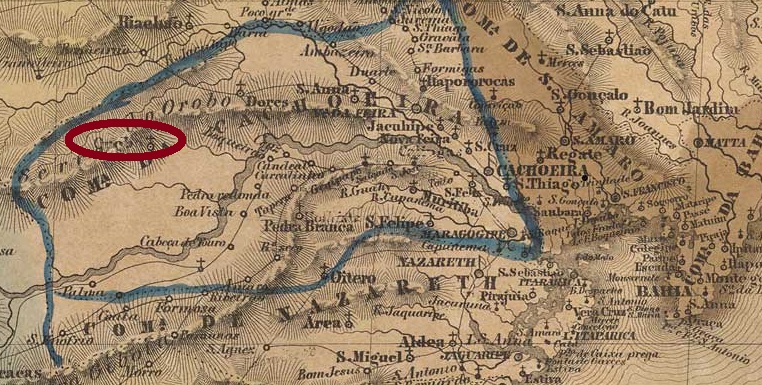
The district of São José do Riacho da Casa Nova was established 1873 in the municipality of Remanso de Pilão Arcado (see RBA-0800). It became the Município of São José da Casa Nova in 1879 and simplified the toponymy to Casa Nova in 1931. Originally, Casa Nova was not the famous Italian seducer, but a riacho, an affluent to the São Francisco River, which has given its name to the locality. Since 1976, the original village was relocated due to the flood by the Sobradinho barrage of the São Francisco, just like the old towns of Remanso, Pilão Arcado and Sento Sé (see actual map below).

The Bahia Interim Government Council reports in 1877 the creation of a post office in Casa Nova the year before:

Relatorio do Conselho Interino do Governo da Bahia, 1877

This information can be confirmed by the regional press:

O Monitor, November 30, 1876

We are looking forward to seeing the first imperial cancel from this post office.

Wikimedia – Open Street Map

Anderer Name: Casa Nova

Ein riacho ist ein kleiner rio, also ein Bach, während ein riachão zwar ein größer riacho sein sollte, allerdings nicht so groß wie ein richtiger Fluss. Diese Abstufungen ergeben ihren Sinn in einem Land wie Brasilien, mit gigantischen Strömen aber auch mit kleinen Wasserwegen, die während der Dürreperioden im Nordosten des Landes eventuell verschwinden können.

Der Distrikt von São José do Riacho da Casa Nova entstand 1873 innerhalb der Gemeindeverwaltung von Remanso de Pilão Arcado (s. a. RBA-0800). In 1879 wurde daraus ein eigener município, São José da Casa Nova, der in 1931 seinen Namen in Casa Nova vereinfachte. Und Casa Nova war nicht der berüchtigte venezianischer Verführer, sondern eben ein Nebenfluss des Rio São Francisco, der seinen Namen der Ortschaft gab. In 1976 ein von der brasilianischen Militärdiktatur gebauter Staudamm bei Sobradinho am São Francisco überflutete die ganze Region und siedelte dabei mindestens vier historische Gemeinden um: Pilão Arcado, Remanso, Sento Sé und auch Casa Nova (s. aktuelle Karte oben).
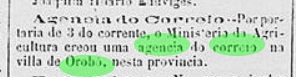
Der Bericht des Provisorischen Regierungsrates für 1877 in Bahia erwähnte ein im Jahr zuvor entstandenes Postamt:

Relatorio do Conselho Interino do Governo da Bahia, 1877

Das wiederum wird von der Regionalpresse bestätigt:

O Monitor, 30. November 1876

Wir freuen uns schon auf den ersten kaiserlichen Stempel von Riacho da Casa Nova. Hoffentlich überstand er die Überflutung.

Categories
Carimbologia Q-R

Riachão de Jacuípe, Bahia, (RBA-0590)

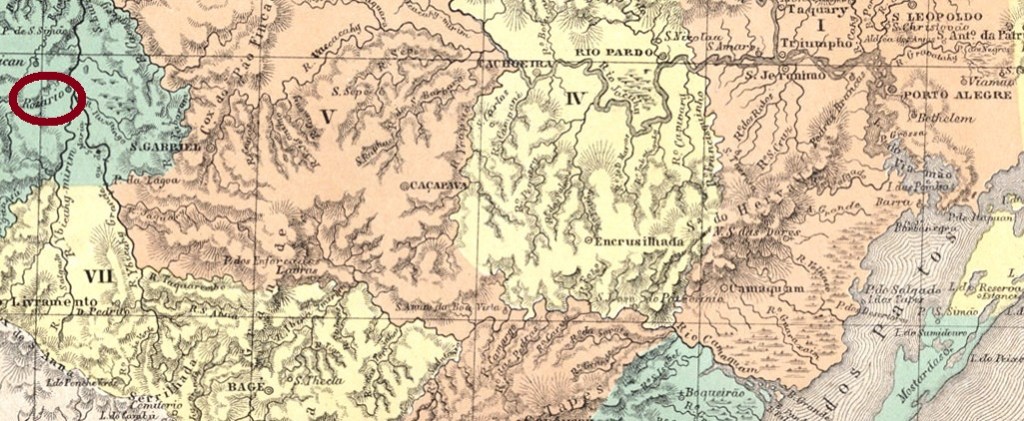
Carta da República dos Estados Unidos do Brasil, 1892

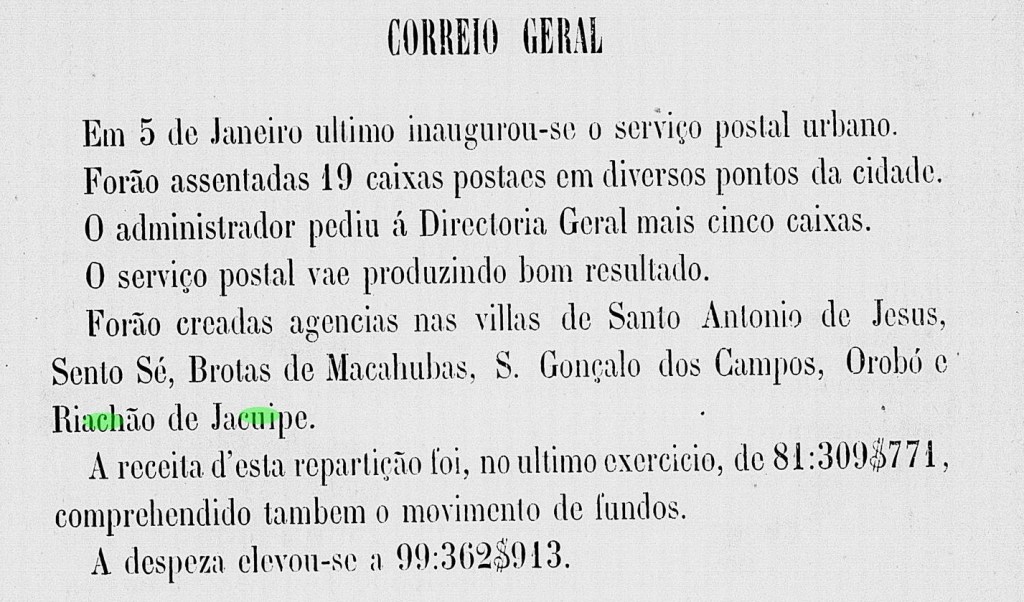
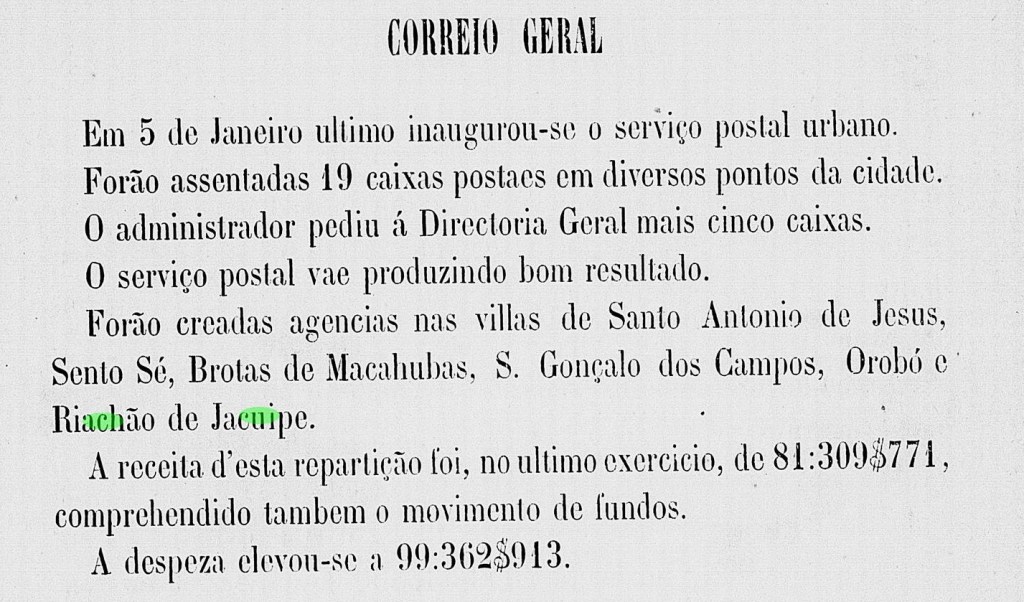
Riachão do Jacuípe is a town of some 35 thousand inhabitants on the Jacuípe River about 200 km northwest of Salvador da Bahia. It was the parish of Nossa Senhora da Conceição do Riachão de Jacuípe (founded 1847), that became a Vila in 1878. According to the Bahia Provisory Government Report for 1881, a post office had been recently created at that time:

Relatório dos Trabalhos do Conselho Interino do Governo da Bahia, 1881

RBA-0590a (Coll. José A. Junges) is the only imperial cancel found to date: a double circle with the inscription RIACHÃO DE JACUIPE above and the date in the inner circle. A single copy found for 1890.
Wikimedia – Open Street Map

Riachão do Jacuípe ist eine kleine Stadt mit ca. 35 tausend Einwohnern am Fluss Jacuípe etwa 200 km nordwestlich der Landeshauptstadt Salvador da Bahia. Sie war früher die Pfarrei Nossa Senhora da Conceição do Riachão de Jacuípe (gegründet 1847), dann wurde sie eine Vila in 1878. Der Bericht des Provisorischen Rats an der Regierung von Bahia für 1881 erwähnt ein kurz davor entstandenes Postamt der Vila:

Relatório dos Trabalhos do Conselho Interino do Governo da Bahia, 1881

RBA-0590a (Samml. José A. Junges) bleibt bisher die einzige kaiserliche Abstempelung von dort: ein Doppelkreis mit der Inschrift RIACHÃO DE JACUIPE oben und dem Datum im Innenkreis. Ein einziges Exemplar aus dem Jahr 1890 gefunden.

Categories
Carimbologia Q-R

Riachão, Sergipe (RSE-0135)

Atlas do Império do Brasil, 1868

Riachão do Dantas is nowadays a town of ca. 20 thousand inhabitants 100 km west of the state capital Aracaju. The former Freguesia de Nossa Senhora do Amparo do Riachão was twice a district of Lagarto, in 1855 and 1865, and was elevated to the villa status in 1864 and 1870, before acquiring an own municipality in December 1943.

Nova Monteiro dated the creation of the post office on October 22, 1864. Thus, the only available cancel to date from there, RSE-0135a (Coll. José A. Junges) is sure not the earliest. It shows a double circle with the inscriptions RIACHÃO above and (SERGIPE) below, else than the date within the inner circle. A single copy of 1895 was found, which might be republican.

Wikimedia – Open Street Map

Heute ist Riachão do Dantas ein Städtchen mit ca. 20 tausend Einwohnern etwa 100 km westlich von der Landeshauptstadt Aracaju. Die frühere Freguesia de Nossa Senhora do Amparo do Riachão war zweimal ein Distrikt von Lagarto, in 1855 und in 1865, und stieg ebenfalls zweimal zur Villa auf, in 1864 und 1870, bevor sie den Status eines Município in Dezember 1943 erlang.

Nova Monteiro gibt den 22. Oktober 1864 als Entstehungsdatum fürs Postamt an. Der bisher einzige überlieferte Stempel von dort, RSE-0135a (Samml. José A. Junges), ist daher bestimmt nicht der älteste, da er mit 1895 datiert ist, und dadurch republikanisch sein könnte: er zeigt einen Doppelkreis mit den Inschriften RIACHÃO oben und (SERGIPE) unten, dazu das Datum im Innenkreis.

Categories
Carimbologia Q-R

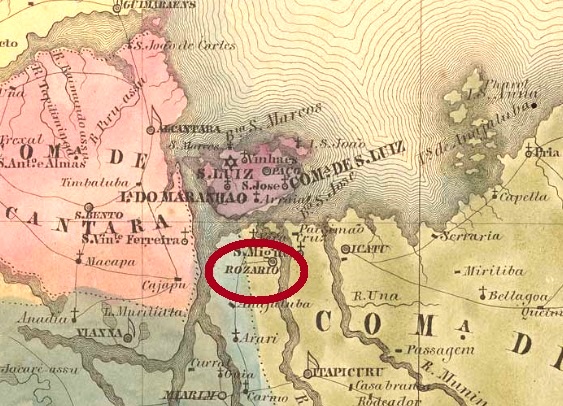
Riachão, Maranhão (RMA-0210)

Atlas do Imperio do Brasil, 1868

The history of the actual Riachão began around 1813, as a district of Carolina, located about 800 km south of the provincial capital São Luis. In 1833 Riachão reached its autonomy, at first as a Villa, now as a town with own municipality.

The post office was created in June 1856:

Publicador Maranhense, July 24, 1856

By now no cancellation from the imperial period was found.

CC BY-SA

Riachão ist heute ein Município etwa 800 km südlich von der Maranhão-Hauptstadt São Luís. Seine Geschichte begann in 1813, als ein Distrikt von Carolina. Bereits in 1833 ist der Ort als Villa aufgestiegen, und seitdem erhielt er seine Autonomie.

Das lokale Postamt entstand in Juni 1856:

Publicador Maranhense, 24. Juli 1856

Bisher wurde kein Stempel aus der Kaiserzeit gefunden.

Categories
Carimbologia Q-R

Retiro (train station/Bahnhof), Rio de Janeiro (RRJ-2033)

Estrada de Ferro Leopoldina, 1898

Text update of August 1, 2024

This small railway station is now located near Itaperuna in the north-east of the state of Rio de Janeiro and was built in October 1884 by the E.F. Carangola railway company. In 1890 it belonged for a few months to the Cia. Barão de Araruama for a few months and then became the property of Estrada de Ferro Leopoldina, where it remained in operation until 1973. In the 1940s it was renamed Retiro do Muriaé and today the station building serves as a cultural centre.

According to Paulo Novaes (agenciaspostais.com.br), the post office was only opened in August 1888. And after that there was apparently not much more to do, as the railway keeper himself was employed as a postal worker:

Jornal do Commercio, November 23, 1888

The oldest cancel from this station is RRJ-2033a (image: Felipe Piccinini).

RRJ-2033a (FP) 1891
In 2016 (Júlio E. Alves)

Textaktualisierung am 1. August 2024

Dieser kleine Bahnhof liegt heute bei Itaperuna im Nordosten des Bundesstaates Rio de Janeiro und wurde im Oktober 1884 von der Eisenbahngesellschaft E.F. Carangola erbaut. 1890 gehörte er für einige Monate der Cia. Barão de Araruama und ging dann in den Besitz der Estrada de Ferro Leopoldina über, wo sie bis 1973 in Betrieb blieb. In den 1940er Jahren wurde er in Retiro do Muriaé umbenannt und heute dient das Bahnhofsgebäude als Kulturzentrum.

Laut Paulo Novaes (agenciaspostais.com.br) wurde das Postamt erst im August 1888 eröffnet. Und danach gab es anscheinend nicht mehr viel zu tun, denn der Bahnwärter selbst wurde als Postangestellter angestellt:

Jornal do Commercio, 23. November, 1888

Der älteste Stempel dieser Station ist RRJ-2033a (Bild: Felipe Piccinini).

RRJ-2033a (FP) 1891
Categories
Carimbologia Q-R

Retiro (train station/Bahnhof), Minas Gerais (RMG-3580)

Estrada de Ferro Central do Brasil, 1890

Print edition update of May 14, 2021

The Retiro station of the E.F. Dom Pedro II railway southeast from Juiz de Fora started operations on December 30, 1875, according to R. Giesbrecht (estacoesferroviarias.com.br). Paula Sobrinho (História Postal de Minas Gerais, Belo Horizonte, 1997) tells us that the postal agency was created almost 6 years later, on July 15, 1881. However, after the publishing of Carimbologia (Q-R) in Fall 2019, evidence for an earlier date to this post office has appeared:

O Globo, Rio de Janeiro, February 24, 1877

“The post offices of the Bemfica and Retiro stations of the E. F. D. Pedro II started their operation yesterday…” This means that, among all four localities with this name in the Brazilian Empire, this Retiro station in Minas Gerais has undoubtedly the oldest post office. Therefore, at least the two manuscript cancels originally attributed to the Retiro near Pouso Alegre (former RMG-2100a and RMG-2100b) should now rather correspond to RMG-3580. They will be listed here out of the chronological order.

So is RMG-3580a (agenciaspostais.com.br) the latest imperial cancel from this station: a double circle with inscriptions RETIRO (ESTAÇÃO) and dates from 1885 to 1893 inside.

Of the handwritten cancels, RMG-3580b (Coll. José A. Junges), the former RMG-2100a, presents the word Retiro written once or twice with black ink in thick line. No dates, with presumed use between 1880-1. RMG-3580c (Coll. José A. Junges), which was the previous RMG-2100b, shows the word Retiro, this time with the full date on the stamp (at least three copies from 1884), now in minor writing, and brown colour.

And now what seems to be the oldest cancel from this station post office: RMG-3580d (Col. Constantino Papazoglu), found in a D. Pedro issue of 1876:

RMG-3580d (Coll. C. Papazoglu) 1877ff

In 1915 (Albino Esteves: Álbum de Juiz de Fora)

Buchtext-Aktualisierung vom 4.05.2021

Der Bahnhof Retiro der Estrada de Ferro D. Pedro II südöstlich von Juiz de Fora wurde nach R. Giesbrecht (estacoesferroviarias.com.br) am 30. Dezember 1875 in Betrieb genommen. Laut Paula Sobrinho (História Postal de Minas Gerais, Belo Horizonte, 1997) kam das Postamt erst knapp 6 Jahre später, am 15. Juli 1881, dazu. Nach dem Erscheinen von Carimbologia (Q-R) im Herbst 2019 ist dennoch der Beweis für ein früheres Entstehungsdatum dieses Postamtes zutage gekommen:

O Globo, 24 Februar, 1877

“Gestern haben die Postämter der Bahnhöfe Bemfica und Retiro der E. F. D. Pedro II ihre Arbeit aufgenommen…” Das bedeutet, dass unter allen vier Retiro-Postämtern im kaiserlichen Brasilien dieses bei Juiz de Fora sicher das älteste ist. Daher müssen die beiden handschriftlichen Entwertungen, die ursprünglich Retiro bei Pouso Alegre zugeordnet waren (RMG-2100a and RMG-2100b), nun wohl dem Retiro-Bahnhof bei Juiz de Fora (RMG-3580) gehören. Sie werden fortan hier zu finden sein, ohne Rücksicht auf die chronologische Folge.

Nun ist RMG-3580a (agenciaspostais.com.br) wohl die späteste kaiserliche Entwertung des Bahnhofes: ein Doppelkreis mit Inschrift RETIRO (ESTAÇÃO) and dem jeweiligen Datum (zwischen 1885 und 1893) innen.

Von den handschriftlichen Entwertungen zeigt RMG-3580b (Samml. José A. Junges), der ehemalige RMG-2100a, das Wort Retiro, das ein- oder zweimal mit schwarzer Tinte in dicker Linie geschrieben wurde. Keine Daten, mit vermutlicher Verwendung zwischen 1880-81. RMG-3580c (Samml. José A. Junges), das vorherige RMG-2100b, zeigt das Wort Retiro, diesmal mit dem vollen Datum auf der Briefmarke (mindestens drei Exemplare von 1884), jetzt in kleiner Schrift und brauner Farbe.

Und nun, was der älteste Stempel dieses Bahnhofspostamt zu sein scheint: RMG-3580d (Col. Constantino Papazoglu), gefunden in einer D. Pedro-Ausgabe von 1876:

RMG-3580d (Coll .C. Papazoglu) 1877ff

Categories
Carimbologia Q-R

Retiro (Pouso Alegre), Minas Gerais (RMG-2100)

Mappa de Minas Geraes, 1910

Text update of March 14, 2020

There are at least two Turvo (i.e. Muddy) Rivers in Minas Gerais. The smaller one is a tributary stream to the Sapucaí River near Pouso Alegre in the southern state region, which has named the actual Turvolandia, the former Freguesia de Nossa Senhora da Piedade do Retiro. This town is still today pretty tiny, with some 5 thousand inhabitants, and stays slightly aside off the main road between Ouro Preto and São Paulo. Therefore, one might wonder why it has received an own post office during the Empire. This took place in December 1879 (Paula Sobrinho).

Since it is now clear that the Retiro station post office of the D. Pedro II railway near Juiz de Fora (RMG-3580) is older than this one, both early manuscript cancellations attributed before to RMG-2100 in Carimbologia (Q-R), RMG-2100a and RMG-2100b, will now be found under new numbers there.

A resting Retiro cancel, RMG-2100c (Coll. José A. Junges), shows a double circle, the inscription RETIRO between both circles, and the date inside. One single copy with year 1884 was found. 

A later Retiro cancel with inscription N.S. DO RETIRO was already reported by R. Koester (Carimbologia do Brasil Clássico XXVIII, Lohmar, 1986).

Raphael Lorenzeto de Abreu (CC BY-SA)

Textaktualisierung vom 14.03.2020

Es gibt mindestens zwei Flüsse in Minas Gerais, die Turvo (=Trüb) heißen. Der kleiner von beiden ist ein Zufluss des Sapucaí bei Pouso Alegre im Süden des Staates und hat seinen Namen dem Städtchen Turvolândia gegeben, der alten Freguesia de Nossa Senhora da Piedade do Retiro. Dieser Ort ist noch heute mit gut fünftausend Einwohnern ziemlich klein und liegt etwas abseits der Hauptstraße zwischen Ouro Preto und São Paulo. Dadurch wundert man sich, wieso ausgerechnet hier ein kaiserliches Postamt errichtet wurde. Dieses fand in Dezember 1879 statt (Paula Sobrinho).

Seitdem festgestellt wurde, dass das Bahnhofspostamt Retiro der Bahnlinie E.F. D. Pedro II bei Juiz de Fora (RMG-3580) noch älter ist, müssen die beiden handschriftlichen Entwertungen, die laut Carimbologia (Q-R) bisher hier aufgelistet waren (RMG-2100a und RMG-2100b), nun dort unter neuer Bezeichnung untergebracht werden.

Die verbliebene Retiro-Entwertung, RMG-2100c (Samml. José A. Junges), hat einen Doppelkreis mit der Inschrift RETIRO oben und dem Datum im Innenkreis. Ein einziges im Jahr 1884 verwendetes Exemplar ist bekannt.

Darüber hinaus hat R. Koester bereits eine spätere Retiro-Abstempelung vorgestellt, diesmal mit der Inschrift N.S. DO RETIRO (Carimbologia do Brasil Clássico XXVIII, Lohmar, 1986).