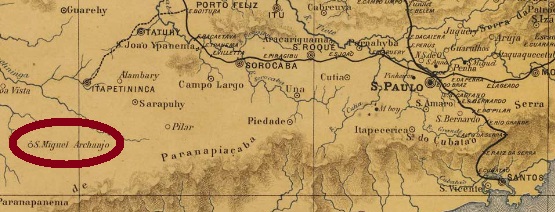
J. M. Ribeiro Lisboa: Provincia de São Paulo, 1884
See also São Miguel Archanjo (SSP-1210)
Fazenda Velha (Old Estate) was a settlement of the Vila de Itapetininga on the south bank of the Rio Turvo, a good 180 kilometres west of the provincial capital of São Paulo. In May 1877, the village was given its present name of São Miguel Archanjo when it became a freguesia. Since April 1889, São Miguel Arcanjo (as it is spelt today) has been an independent município.
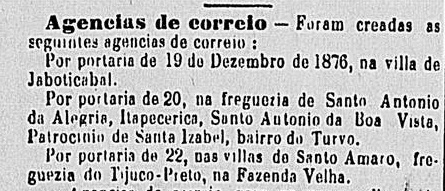
According to the list of imperial post offices (Tabella das Agencias do Correio do Imperio, Rio de Janeiro, 1885), there had been a post office there since 1876, when the town’s name was still Fazenda Velha. This is confirmed by the regional press:
Correio Paulistano, 05.01.1877
So far, no imperial postmark with Fazenda Velha has appeared. For cancels with São Miguel Archanjo see SSP-1210.
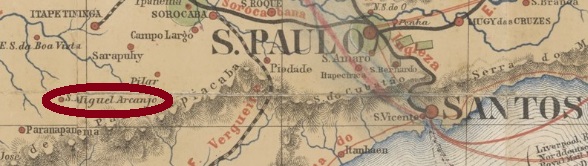
Provincia de São Paulo, 1886
Siehe auch São Miguel Archanjo (SSP-1210)
Fazenda Velha (Altes Landgut) war eine Siedlung der Vila de Itapetininga am Südufer des Rio Turvo, gut 180 km westlich der Provinzhauptstadt São Paulo. Im Mai 1877 erhielt der Ort seinen heutigen Namen São Miguel Archanjo, als er eine Freguesia wurde. Seit April 1889 ist São Miguel Arcanjo (wie es heute geschrieben wird) ein eigenständiges Município.
Wie aus dem Verzeichnis der kaiserlichen Postämter (Tabella das Agencias do Correio do Imperio, Rio de Janeiro, 1885) hervorgeht, gab es dort seit 1876 ein Postamt, als der Ortsname noch Fazenda Velha lautete. Dies wird durch die regionale Presse bestätigt:
Correio Paulistano, 05.01.1877
Bisher ist kein kaiserlicher Poststempel mit Fazenda Velha aufgetaucht. Für Poststempel mit São Miguel Archanjo siehe SSP-1210.
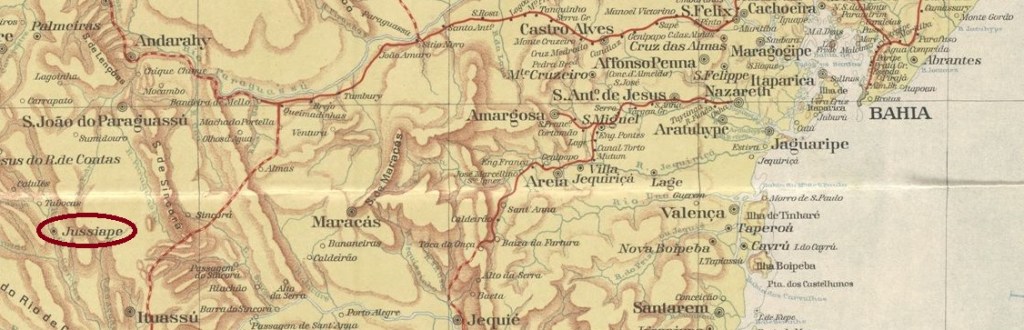
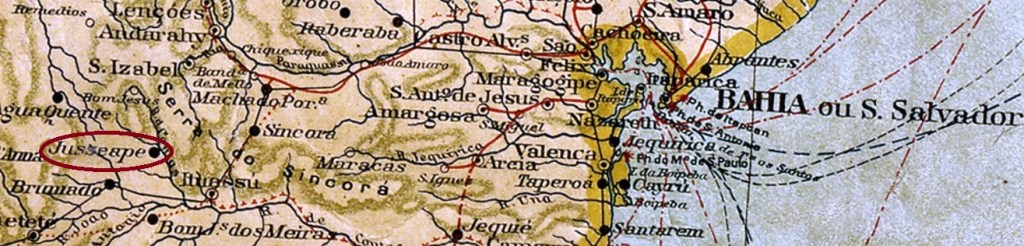
Fazenda do Gado was a settlement of the Vila de Sta. Izabel do Paraguaçu on the east bank of the Rio de Contas, 530 kilometres west of the provincial capital Salvador da Bahia. In July 1876, it was incorporated into the Vila de Brejo Grande as a freguesia and downgraded to Distrito do Gado around 1889. It was promoted again to Vila de Jussiape in October 1890, and in June 1920 it was again downgraded to Distrito in the Município de Barra da Estiva, and was not reclassified as Município de Jussiape until July 1962.
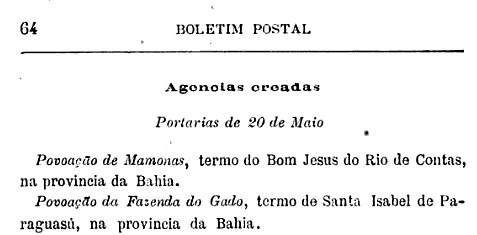
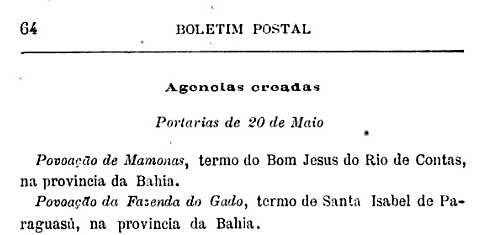
As can be seen from the postal bulletin (Boletim Postal) of 1889, there had been a post office there since May 1889.
Boletim Postal No. 2, June/1889
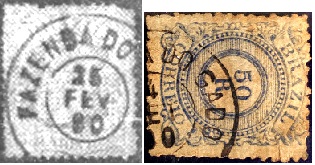
The only postmark from the 19th century to date is FBA-0355a (Fig. R. Koester in Carimbologia XIX – Alexandre Andrade):
FBA-0355a (RK-AA) 1890Nappa Geral do Brazil, 1911
Andere Namen: Gado, Jussiape (1890)
Fazenda do Gado war eine Siedlung der Vila de Sta. Izabel do Paraguaçu am Ostufer des Rio de Contas, 530 km westlich der Provinzhauptstadt Salvador da Bahia. Im Juli 1876 wurde sie als Freguesia in die Vila de Brejo Grande eingegliedert und um 1889 zum Distrito do Gado herabgestuft. Ein Wiederaufstieg als Vila de Jussiape erfolgte im Oktober 1890. Im Juni 1920 erfolgte die erneute Herabstufung als Distrito im Município de Barra da Estiva, die Wiederaufstufung als Município de Jussiape erfolgte erst im Juli 1962.
Wie aus dem Postbulletin (Boletim Postal) von 1889 hervorgeht, gab es dort seit Mai 1889 ein Postamt.
Boletim Postal Nr. 2, Juni/1889
Der bisher einzige Poststempel aus dem 19. Jahrhundert ist FBA-0355a (Abb. R. Koester in Carimbologia XIX – Alexandre Andrade):
Villiers de l’Ile Adam: Carta (…) da Provincia de São Paulo, 1847
Other names: Sant’Anna, Itapeva da Faxina, Itapeva (1938)
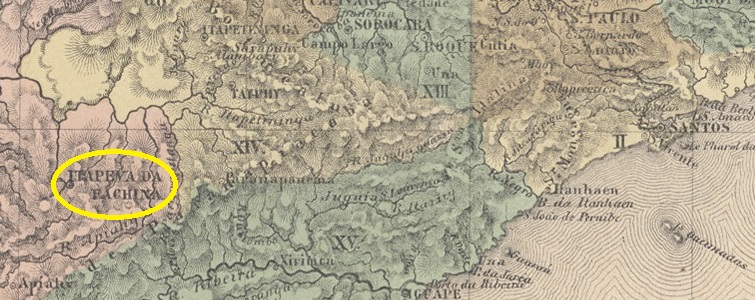
The beautiful Indian word Itapeva means yellow stone, while the less charming Faxina is traditionally translated as bundle of brushwood and is used in modern-day Brazil when there is a lot of cleaning and tidying up to do. However, the origin of the place probably goes back to a certain Facchina family, who are said to have run a resting place for drovers (tropeiros) there in the 18th century. In any case, the Freguesia de Itapeva de (or do) Faxina was founded in June 1766. It belonged to the Vila de Sorocaba and was located on the east bank of the Taquary, 290 kilometres west of the future provincial capital of São Paulo. Three years later it was elevated to Vila de Sant’Anna da Faxina, which was renamed Itapeva da Faxina in March 1838 and declared Cidade de Faxina in July 1861. The município has been called Itapeva again since November 1938.
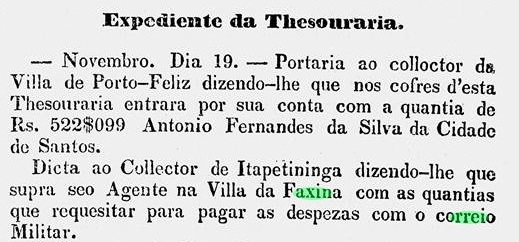
Two creation dates have been found for the local post office. Once in April 1828, as Nova Monteiro writes in Administrações e Agencias Postaes do Brasil Imperio (Brasil Filatelico/RJ, 1934-5; reprint SPP 1994-1999). Then again in 1844, as can be seen from the Directory of Imperial Post Offices (Tabella das Agencias do Correio do Imperio, Rio de Janeiro, 1885). Between the two periods of operation, a military postal courier was also active on the São Paulo-Curitiba route, as can be seen from the regional press:
A Phenix, 26/02/1840
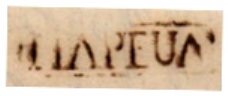
So far, seven Faxina or Itapeva postmarks have been found for the 19th century, starting with the pre-philatelic ISP-1665a (fig. Mário Celso Orsi Jr.), which is registered in the RHM catalogue under P-SP-14:
ISP-1665a (MO, RHM P-SP-14) 1833-1836ff
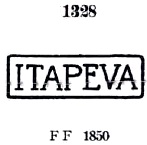
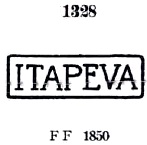
It was followed by ISP-1665b, known through P. Ayres’s Catálogo de Carimbos Brasil-Império (S. Paulo, 1937, 1942) under no. 1328:
ISP-1665b (P.A. 1328) 1843ff-1864
A later variant is ISP-1665c (illus. Mário Celso Orsi Jr.):
ISP-1665c (MO) 1866ff-1877ff
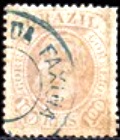
All Faxina cancels are circular, starting with FSP-0530a (fig. Mario Celso Orsi Jr.):
FSP-0530a (MO) 1877-1891
The French type FSP-0530b (illustration from the Internet) was also used at about the same time:
FSP-0530b (EB) 1880-1889
In the meantime, the rare ISP-1715a also appeared (ill. Mario Celso Orsi Jr.):
ISP-1715a (MO) 1883ff
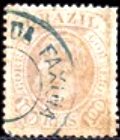
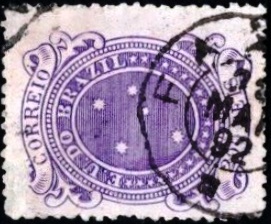
FSP-0530c (image from the Internet) is probably already republican:
FSP-0530c (EB) 1890-1895Atlas do Imperio do Brasil, 1868
Andere Namen: Sant’Anna, Itapeva da Faxina, Itapeva (1938)
Das schöne indianische Wort Itapeva bedeutet gelber Stein, während das weniger charmante Faxina traditionell mit Reisigbündel übersetzt wird und im heutigen Brasilien verwendet wird, wenn es viel zu putzen und aufzuräumen gibt. Der Ursprung des Ortes geht jedoch vermutlich auf eine bestimmte Familie Facchina zurück, die hier im 18. Jahrhundert eine Raststätte für Viehtreiber (Tropeiros) betrieben haben soll. Jedenfalls wurde im Juni 1766 die Freguesia de Itapeva de (oder do) Faxina gegründet. Sie gehörte zur Vila de Sorocaba und lag am Ostufer des Taquary, 290 km westlich der späteren Provinzhauptstadt São Paulo. Drei Jahre später erfolgte die Erhebung zur Vila de Sant’Anna da Faxina, die im März 1838 in Itapeva da Faxina umbenannt und im Juli 1861 zur Cidade de Faxina erklärt wurde. Seit November 1938 heißt der Município wieder Itapeva.
Für das örtliche Postamt wurden zwei Gründungsdaten gefunden. Einmal im April 1828, wie Nova Monteiro in Administrações e Agencias Postaes do Brasil Imperio (Brasil Filatelico/RJ, 1934-5; Reprint SPP 1994-1999) schreibt. Dann wieder 1844, wie aus dem Verzeichnis der kaiserlichen Postämter (Tabella das Agencias do Correio do Imperio, Rio de Janeiro, 1885) hervorgeht. Zwischen den beiden Betriebsperioden war auch ein militärischer Postkurier auf der Strecke São Paulo-Curitiba aktiv, wie aus der regionalen Presse hervorgeht:
A Phenix, 26.02.1840
Bisher wurden sieben Faxina- bzw. Itapeva-Poststempel für das 19. Jahrhundert gefunden, beginnend mit dem vorphilatelistischen ISP-1665a (Abb. Mário Celso Orsi Jr.), der im RHM-Katalog unter P-SP-14 registriert ist:
ISP-1665a (MO, RHM P-SP-14) 1833-1836ff
Ihm folgte ISP-1665b, bekannt durch P. Ayres’ Catálogo de Carimbos Brasil-Império (S. Paulo, 1937, 1942) unter Nr. 1328:
ISP-1665b (P.A. 1328) 1843ff-1864
Eine spätere Variante ist ISP-1665c (Abb. Mário Celso Orsi Jr.):
ISP-1665c (MO) 1866ff-1877ff
Alle Stempel von Faxina sind kreisförmig, beginnend mit FSP-0530a (Abb. Mario Celso Orsi Jr.):
FSP-0530a (MO) 1877-1891
Etwa zur gleichen Zeit wurde auch der französische Typ FSP-0530b (Abb. aus dem Internet) verwendet:
FSP-0530b (EB) 1880-1889
Zwischenzeitlich tauchte auch der seltene ISP-1715a auf (Abb. Mario Celso Orsi Jr.):
ISP-1715a (MO) 1883ff
FSP-0530c (Abb. aus dem Internet) dürfte bereits republikanisch sein:
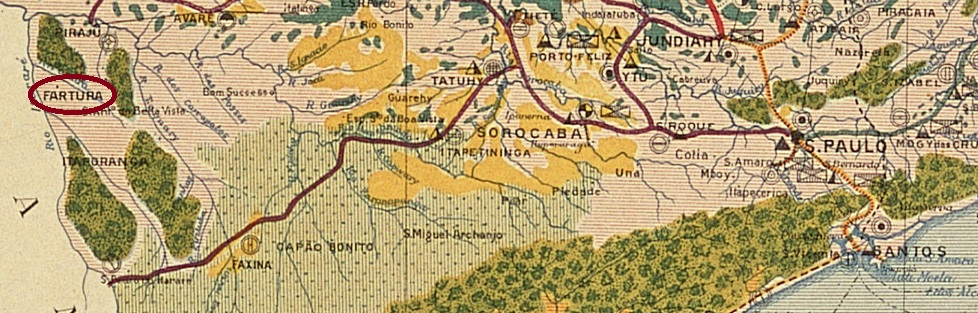
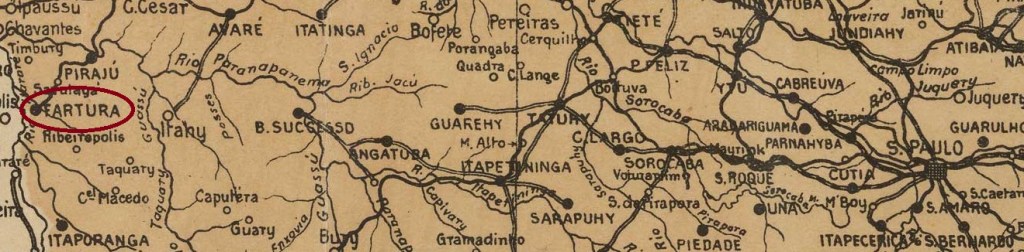
The chapel N. Sra. das Dores de Fartura was built in 1870 and belonged to the Vila de S. Sebastião do Tijuco Preto, near the provincial border with Paraná, 350 kilometres west of the capital São Paulo. In February 1884, the village became a freguesia of the Vila de S. João Baptista do Rio Verde and in March 1891 it was elevated to an independent Vila.
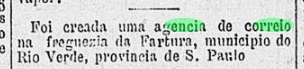
According to the regional press, there had been a post office since June 1884:
Gazeta de Noticias, 18/06/1884
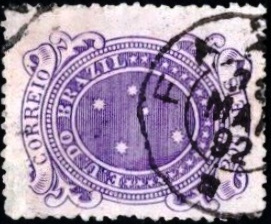
The oldest postmark to date is the double circle FSP-0525a (coll. Djalma Lacalendola):
FSP-0525a (DL) 1894Arthur D. Ribeiro: Estado de São Paulo, 1924
Die Kapelle N. Sra. das Dores de Fartura wurde 1870 errichtet und gehörte zur Vila de S. Sebastião do Tijuco Preto, nahe der Provinzgrenze zu Paraná, 350 km westlich der Hauptstadt São Paulo. Im Februar 1884 wurde der Ort eine Freguesia der Vila de S. João Baptista do Rio Verde und im März 1891 wurde er zur eigenständigen Vila erhoben.
Wie aus der regionalen Presse hervorgeht, gab es seit Juni 1884 ein Postamt:
Gazeta de Noticias, 18.06.1884
Der bisher älteste Poststempel ist der Doppelkreis FSP-0525a (Samml. Djalma Lacalendola):
Carta da Republica dos Estados Unidos do Brazil, 1892
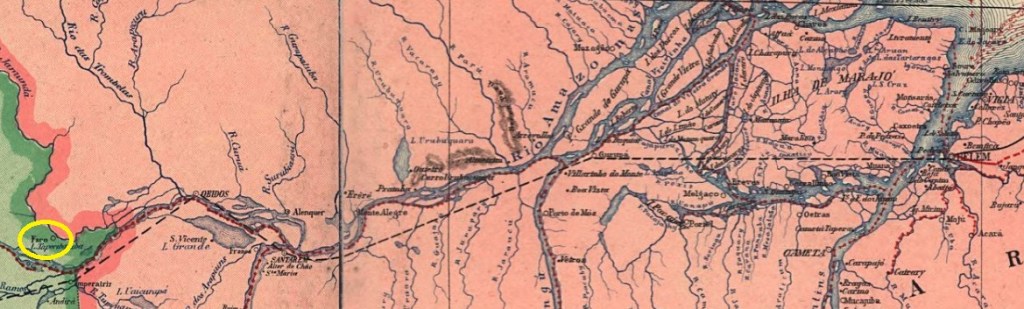
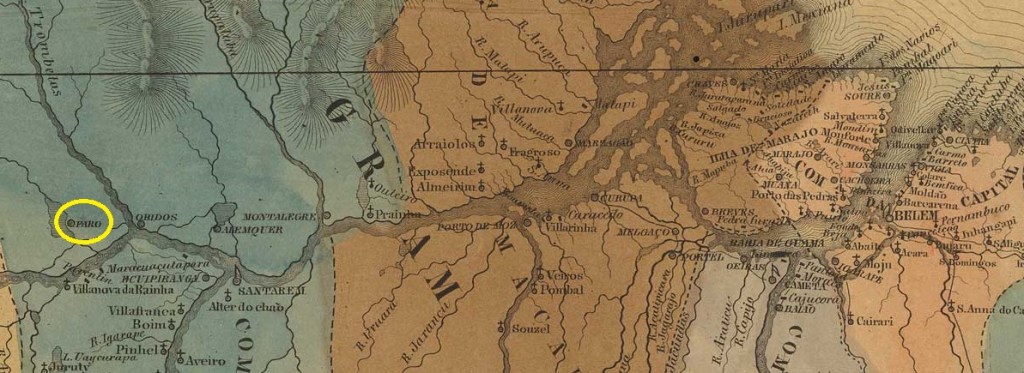
The former Indian settlement was looked after by the Capuchins of the Mission N. Sra. da Piedade at the confluence of the Paracatu and Nhamundá rivers near the current state border between Pará and Amazonas. The village was declared Vila de S. João Baptista do Faro as early as 1758. In April 1865, the town was moved further south, where the Nhamundá flows into the Amazon, over 1,500 kilometres west of the provincial capital Belém do Pará. Faro has been a city since July 1895, and the journey to Belém still takes over 30 hours by boat and bus.
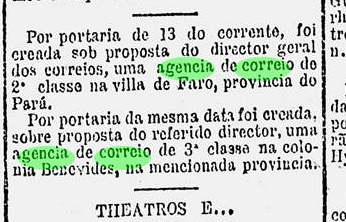
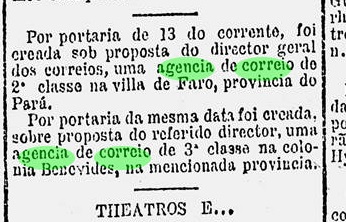
The local post office was opened in January 1882, as reported by the press in Rio:
Gazeta de Noticias/RJ, 14.01.1882
We have not yet seen an imperial postmark from Faro in Pará.
Villiers de l’Ile Adam: Carta (…) das Provincias do Grão Pará e Alto Amazonas, 1850
Die ehemalige Indianersiedlung wurde von den Kapuzinern der Mission N. Sra. da Piedade am Zusammenfluss der Flüsse Paracatu und Nhamundá nahe der heutigen Staatsgrenze zwischen Pará und Amazonas betreut. Bereits 1758 wurde der Ort zur Vila de S. João Baptista do Faro erklärt. Im April 1865 wurde der Ort weiter nach Süden verlegt, wo der Nhamundá in den Amazonas mündet, über 1.500 km westlich der Provinzhauptstadt Belém do Pará. Seit Juli 1895 ist Faro eine Stadt, die Reise nach Belém dauert auch heute noch mit Schiff und Bus über 30 Stunden.
Das örtliche Postamt wurde im Januar 1882 eröffnet, wie die Presse in Rio berichtete:
Gazeta de Noticias/RJ, 14.01.1882
Bisher haben wir noch keinen kaiserlichen Poststempel aus Faro in Pará gesehen.
Other names: Bairro da Capelinha, Farias, Ibiti, Monte Alegre do Sul (1948)
See also Farias (FSP-0520)
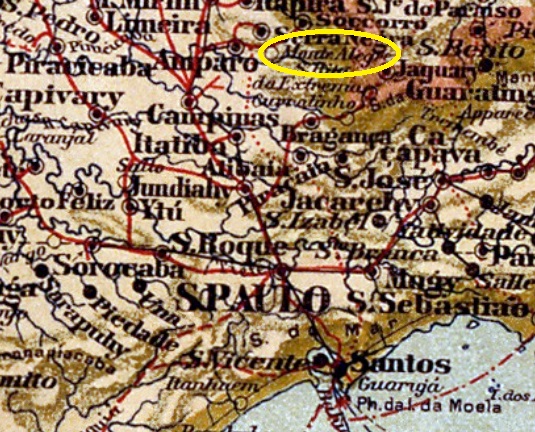
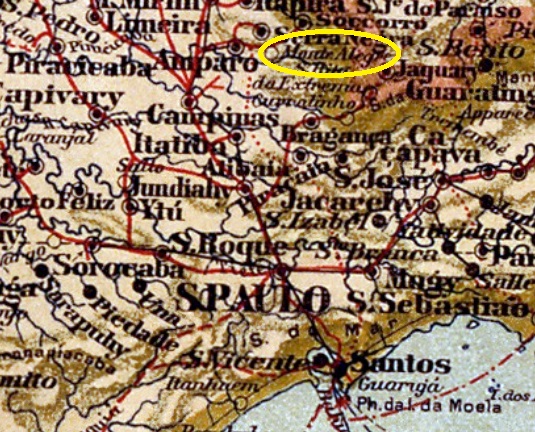
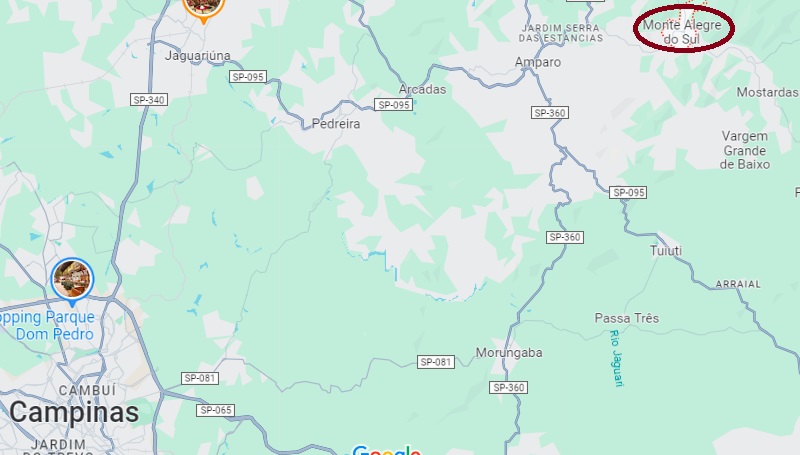
Around 1874, the settlement of Bairro dos Farias, which belonged to Vila do Amparo, appeared on the south bank of the Camanducaia, 130 kilometres north of the state capital São Paulo. In March 1887, it was elevated to the Freguesia de Bom Jesus do Monte Alegre. The place name was later changed twice, probably to avoid confusion with Monte Alegre in Minas Gerais: in November 1944 to Ibiti and in December to Monte Alegre do Sul, when this place was elevated to Município.
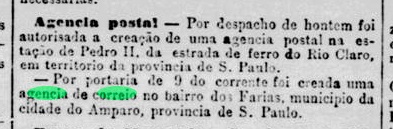
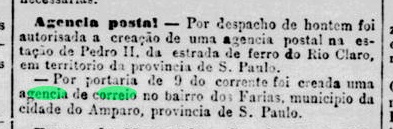
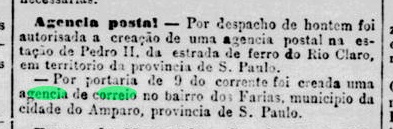
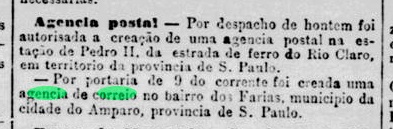
As the Rio de Janeiro press reported, there had been a post office there since December 1886:
Jornal do Commercio/RJ, 11/12/1886
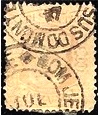
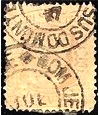
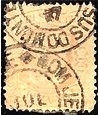
Two completely different postmarks from the imperial era are known from the Bairro de Farias. FSP-0520a (fig. R. Koester, in Carimbologia XIX) bears the inscription EST, which cannot be the abbreviation for Estação (railway station), as the railway station there was only opened in March 1890. It is an estafeta (relay), which was still in use when the town was already called Bom Jesus do Monte Alegre.
FSP-0520a (RK) 1887
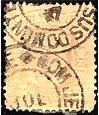
BSP-1837a (fig. by Mário Celso Orsi Jr.) is the oldest known postmark with the place name Bom Jesus do Monte Alegre. The only example was used in July 1887.
BSP-1837a (MO) 1887Google Maps
Andere Namen: Bairro da Capelinha, Farias, Ibiti, Monte Alegre do Sul (1948)
Siehe auch Farias (FSP-0520)
Um 1874 entstand am Südufer des Camanducaia, 130 km nördlich der Landeshauptstadt São Paulo, die zur Vila do Amparo gehörende Siedlung Bairro dos Farias. Im März 1887 wurde sie zur Freguesia de Bom Jesus do Monte Alegre erhoben. Später wurde der Ortsname zweimal geändert, wahrscheinlich um Verwechslungen mit Monte Alegre in Minas Gerais zu vermeiden: im November 1944 in Ibiti und im Dezember in Monte Alegre do Sul, als dieser Ort zum Município erhoben wurde.
Wie die Presse von Rio de Janeiro berichtete, gab es dort seit Dezember 1886 ein Postamt:
Jornal do Commercio/RJ, 11.12.1886
Aus dem Bairro de Farias sind zwei völlig unterschiedliche Poststempel aus der Kaiserzeit bekannt. FSP-0520a (Abb. R. Koester, in Carimbologia XIX) trägt die Inschrift EST, was hier nicht die Abkürzung für Estação (Bahnhof) sein kann, da der dortige Bahnhof erst im März 1890 eröffnet wurde. Es handelt sich um eine Estafeta (Stafette), die auch noch verwendet wurde, als der Ort bereits Bom Jesus do Monte Alegre hieß.
FSP-0520a (RK) 1887
BSP-1837a (Abb. Mário Celso Orsi Jr.) ist der älteste bekannte Poststempel mit dem Ortsnamen Bom Jesus do Monte Alegre. Das einzige Exemplar wurde im Juli 1887 verwendet.
Other names: Bairro da Capelinha, Monte Alegre, Ibiti, Monte Alegre do Sul (1948)
See also Bom Jesus do Monte Alegre (BSP-1837)
Around 1874, the settlement of Bairro dos Farias, which belonged to Vila do Amparo, had developed on the south bank of the Camanducaia, 130 kilometres north of the state capital São Paulo. In March 1887, it was elevated to the Freguesia de Bom Jesus do Monte Alegre. The place name was later changed twice, probably to avoid confusion with Monte Alegre in Minas Gerais: in November 1944 to Ibiti and in December to Monte Alegre do Sul, when this place was elevated to Município.
As the Rio de Janeiro press reported, there had been a post office there since December 1886:
Jornal do Commercio/RJ, 11/12/1886
Two completely different postmarks from the imperial era are known from the Bairro de Farias. FSP-0520a (fig. R. Koester, in Carimbologia XIX) bears the inscription EST, which cannot be the abbreviation for Estação (railway station), as the railway station there was only opened in March 1890. It is an estafeta (relay), which was still in use when the town was already called Bom Jesus do Monte Alegre.
FSP-0520a (RK) 1887
BSP-1837a (fig. by Mário Celso Orsi Jr.) is the oldest known postmark with the place name Bom Jesus do Monte Alegre. The only example was used in July 1887.
BSP-1837a (MO) 1887Google Maps
Andere Namen: Bairro da Capelinha, Monte Alegre, Ibiti, Monte Alegre do Sul (1948)
Siehe auch Bom Jesus do Monte Alegre (BSP-1837)
Um 1874 entstand am Südufer des Camanducaia, 130 km nördlich der Landeshauptstadt São Paulo, die zur Vila do Amparo gehörende Siedlung Bairro dos Farias. Im März 1887 wurde sie zur Freguesia de Bom Jesus do Monte Alegre erhoben. Später wurde der Ortsname zweimal geändert, wahrscheinlich um Verwechslungen mit Monte Alegre in Minas Gerais zu vermeiden: im November 1944 in Ibiti und im Dezember in Monte Alegre do Sul, als dieser Ort zum Município erhoben wurde.
Wie die Presse von Rio de Janeiro berichtete, gab es dort seit Dezember 1886 ein Postamt:
Jornal do Commercio/RJ, 11.12.1886
Aus dem Bairro de Farias sind zwei völlig unterschiedliche Poststempel aus der Kaiserzeit bekannt. FSP-0520a (Abb. R. Koester, in Carimbologia XIX) trägt die Inschrift EST, was hier nicht die Abkürzung für Estação (Bahnhof) sein kann, da der dortige Bahnhof erst im März 1890 eröffnet wurde. Es handelt sich um eine Estafeta (Stafette), die auch noch verwendet wurde, als der Ort bereits Bom Jesus do Monte Alegre hieß.
FSP-0520a (RK) 1887
BSP-1837a (Abb. Mário Celso Orsi Jr.) ist der älteste bekannte Poststempel mit dem Ortsnamen Bom Jesus do Monte Alegre. Das einzige Exemplar wurde im Juli 1887 verwendet.
Other names: Est. Sant’Anna, Desembargador Faria Lemos, Ferreira Lage
See also Faria Lemos (Est. E.F. Leopoldina, FMG-1170), Ferreira Lage (Est., FMG-1175)
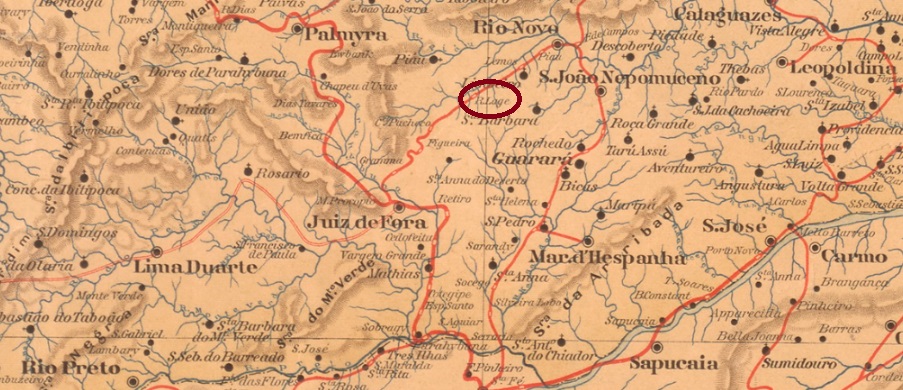
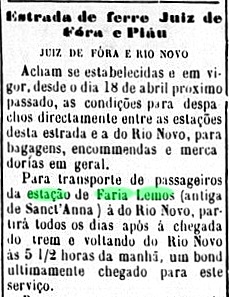
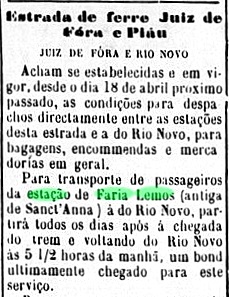
The second Faria Lemos station in the imperial province of Minas Gerais was opened in 1884 as Sant’Anna station by the railway company E.F. Juiz de Fora e Piau in the Município de Juiz de Fora, 230 km south of the provincial capital Ouro Preto. By 1887, the station was renamed Faria Lemos Station:
Pharol, 03/05/1887
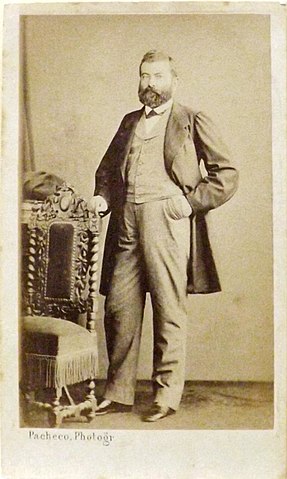
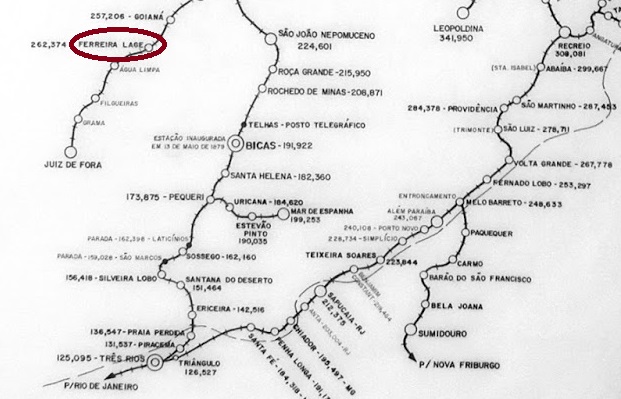
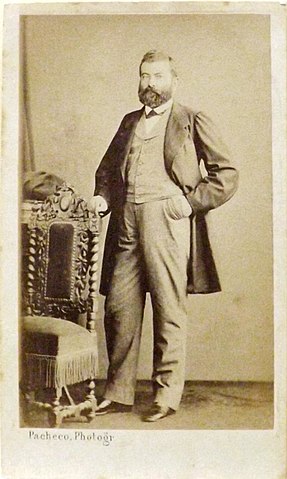
In 1888, the railway line was purchased by the 1974 E.F. Leopoldina and remained in its possession until it was closed in 1974. As the Leopoldina company already owned a Faria Lemos station (FMG-1170), the other station had to be renamed Ferreira Lage again, this time in honour of the entrepreneur Mariano Procópio Ferreira Lage (1821-1872), who had co-financed the E.F. Juiz de Fora e Piau.
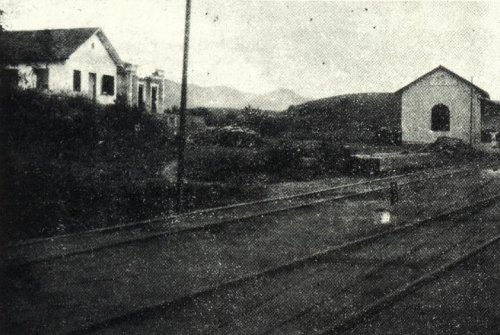
Mariano Procópio Ferreira Lage (Wikipedia)Est. Ferreira Lage 1915 (Photo: Abilio Esteves, in Album de Juiz de Fora)
Today, neither the tracks nor the station building exist.
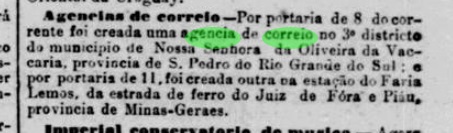
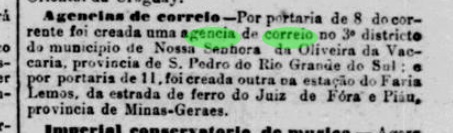
According to the Rio press, there was a post office at the station from October 1887:
Jornal do Commercio/RJ, 12/10/1887
No imperial postmarks under Faria Lemos have yet been found from this railway station. They must be very rare, if at all.
Estrada de Ferro Leopoldina
Andere Namen: Est. Sant’Anna, Desembargador Faria Lemos, Ferreira Lage
Siehe auch Faria Lemos (Est. E.F. Leopoldina, FMG-1170), Ferreira Lage (Est., FMG-1175)
Der zweite Bahnhof Faria Lemos in der kaiserlichen Provinz Minas Gerais wurde 1884 als Bahnhof Sant’Anna von der Eisenbahngesellschaft E.F. Juiz de Fora e Piau eröffnet und lag im Município de Juiz de Fora, 230 km südlich der Provinzhauptstadt Ouro Preto. Um 1887 wurde die Station in Faria Lemos Station umbenannt:
Pharol, 03.05.1887
1888 wurde die Bahnlinie von der 1974 E.F. Leopoldina gekauft und blieb bis zu ihrer Stilllegung 1974 in deren Besitz. Da die Gesellschaft Leopoldina bereits eine Station Faria Lemos (FMG-1170) besaß, musste die Station erneut umbenannt werden, diesmal zu Ehren des Unternehmers Mariano Procópio Ferreira Lage (1821-1872), der die E.F. Juiz de Fora e Piau mitfinanziert hatte.
Mariano Procópio Ferreira Lage (Wikipedia)Est. Ferreira Lage 1915 (Foto: Abilio Esteves, im Album de Juiz de Fora)
Heute existieren weder die Gleise noch das Bahnhofsgebäude.
Wie der Presse von Rio zu entnehmen ist, befand sich seit Oktober 1887 ein Postamt am Bahnhof:
Jornal do Commercio/RJ, 12.10.1887
Bisher wurden keine kaiserlichen Poststempel unter Faria Lemos von diesem Bahnhof gefunden. Sie müssen, wenn überhaupt, sehr selten sein.
See also Faria Lemos (Est E.F. Juiz de Fora a Piau, FMG-0970)
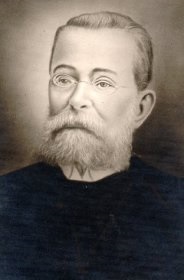
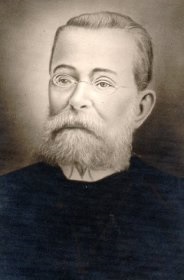
In the imperial province of Minas Gerais there were two railway stations in honour of Francisco de Faria Lemos (1828-1904), the provincial president from 1886-7.
Faria Lemos (Supremo Tribunal Federal)
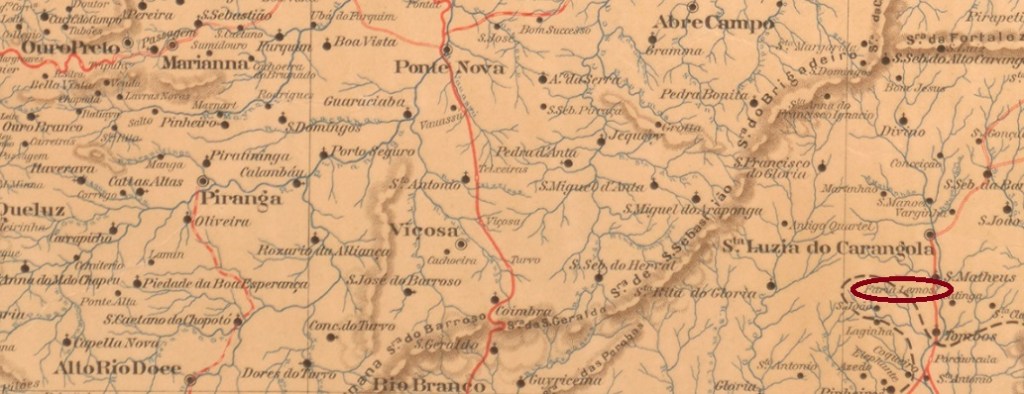
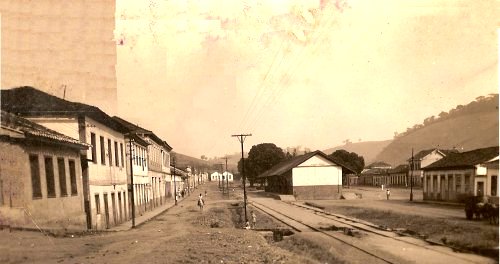
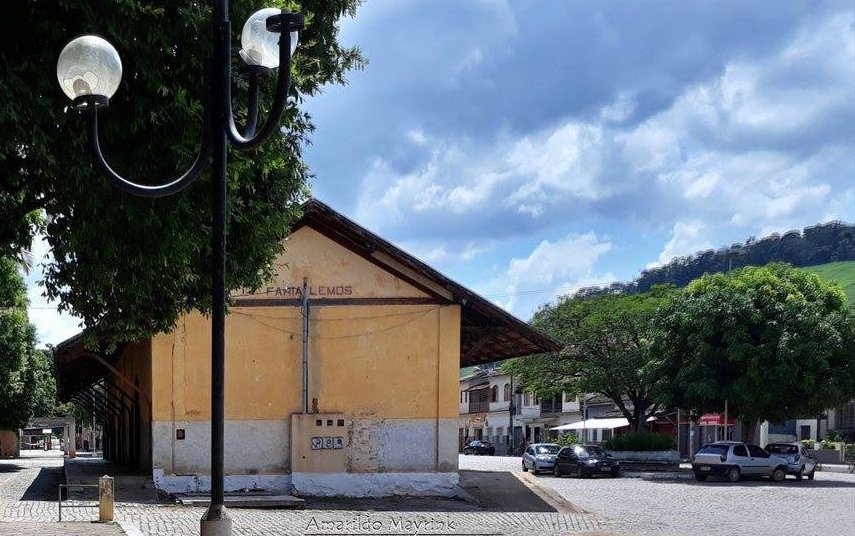
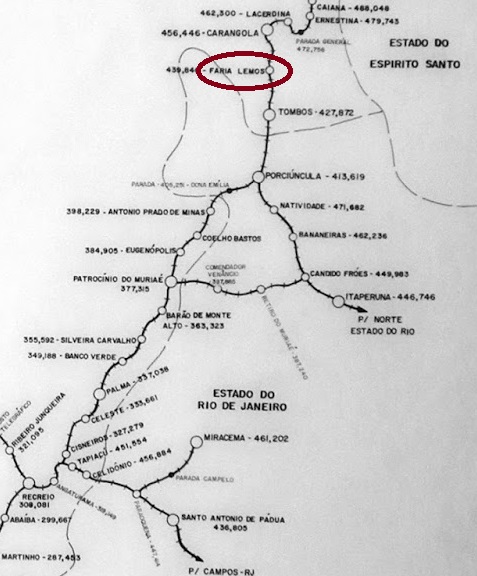
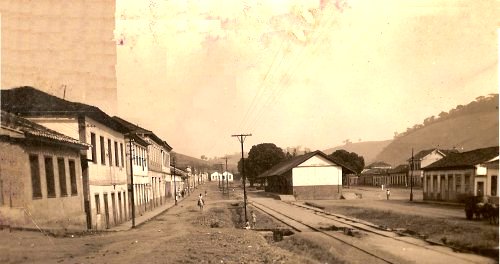
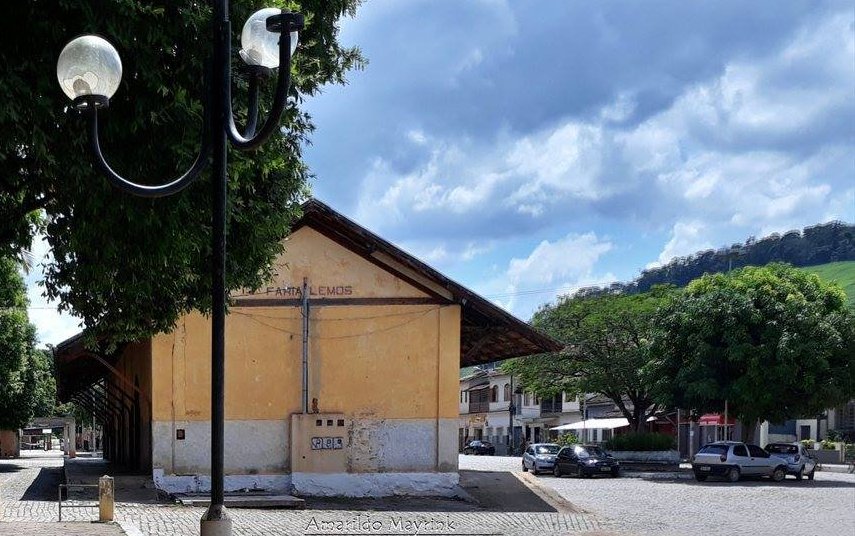
This station was opened in June 1887 by the E.F. Leopoldina (Manhuaçu line) in the Município de Carangola on the south bank of the São Mateus, 260 km east of the provincial capital Ouro Preto. The line belonged to Rede Ferroviária Federal S.A. (estacoesferroviarias.com.br) from 1975 until its closure in 1977. Today, the tracks have disappeared and the station building houses the municipality’s tourist office.
Around 1960 (estacoesferroviarias.com.br)2019 (Photo: Amarildo Mayrink, on estacoesferroviarias.com.br)
The area around the station became a distrito in September 1890 and the Município de Faria Lemos in December 1953.
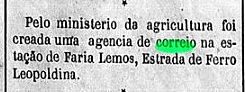
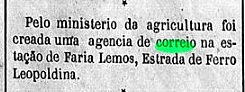
According to the Rio press, there had been a post office at the station since February 1888:
Gazeta Nacional/RJ, 17/02/1888
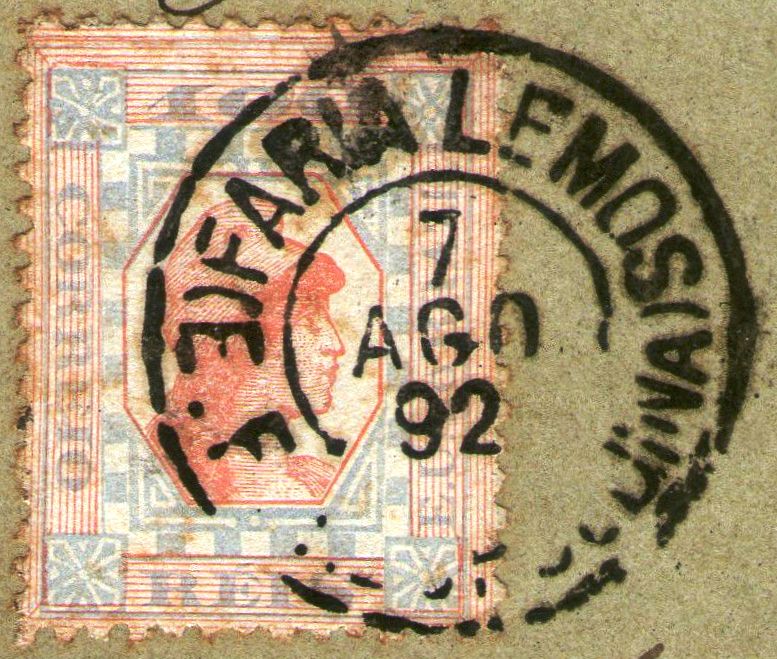
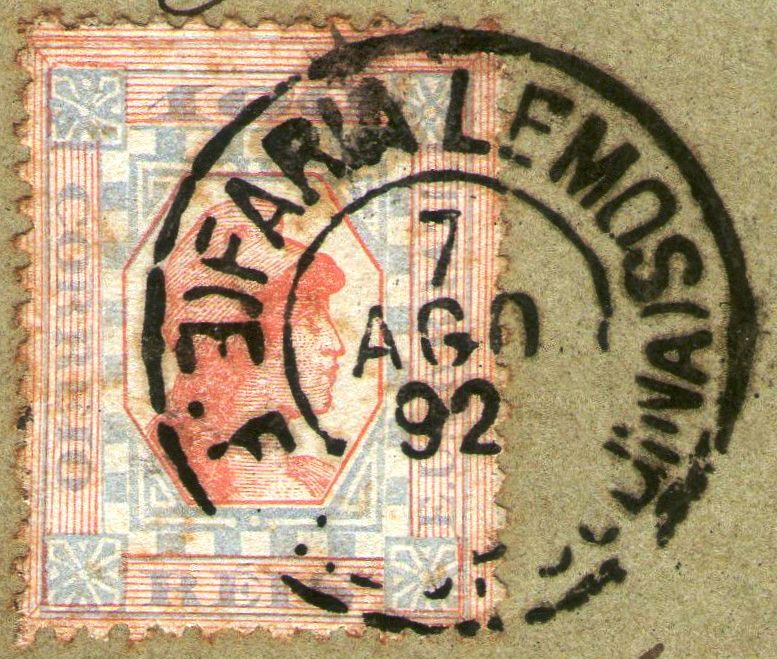
The imperial postmark is FMG-1170a (illustration by Claudio Coelho):
FMG-1170a (CC) 1888-1894ffEstrada de Ferro Leopoldina
Andere Namen: Desembargador Faria Lemos
Siehe auch Faria Lemos (Est E.F. Juiz de Fora a Piau, FMG-0970)
In der kaiserlichen Provinz Minas Gerais gab es zwei Bahnhöfe zu Ehren von Francisco de Faria Lemos (1828-1904), dem Provinzpräsidenten von 1886-7.
Faria Lemos (Supremo Tribunal Federal)
Dieser Bahnhof wurde im Juni 1887 von der E.F. Leopoldina (Manhuaçu-Linie) eröffnet und lag im Município de Carangola am Südufer des São Mateus, 260 km östlich der Provinzhauptstadt Ouro Preto. Die Strecke gehörte von 1975 bis zu ihrer Stilllegung 1977 der Rede Ferroviária Federal S.A. (estacoesferroviarias.com.br). Heute sind die Gleise verschwunden, das Bahnhofsgebäude beherbergt das Tourismusbüro der Gemeinde.
Um 1960 (estacoesferroviarias.com.br)2019 (Foto: Amarildo Mayrink, auf estacoesferroviarias.com.br)
Das Gebiet um den Bahnhof wurde im September 1890 zum Distrito und im Dezember 1953 zum Município de Faria Lemos.
Wie der Presse von Rio zu entnehmen ist, gab es am Bahnhof seit Februar 1888 ein Postamt:
Gazeta Nacional/RJ, 17.02.1888
Der kaiserliche Poststempel ist FMG-1170a (Abb. Claudio Coelho):
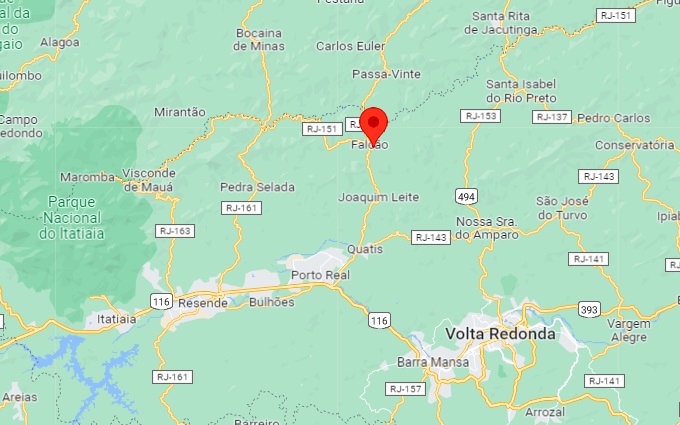
This locality originally belonged to the Freguesia of São Joaquim in the Vila of Barra Mansa and was close to the provincial border with Minas Gerais, 170 km northwest of the capital Rio de Janeiro. In November 1919, it became a district, which has belonged to the newly created Município of Quatis from January 1991 on.
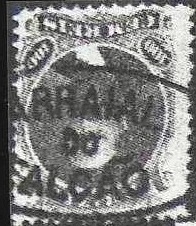
As Paulo Novaes writes in agenciaspostais.com.br, there was a post office there since December 1873. The first postmark is ARJ-0075a, already known through R. Koester in Carimbologia XIX:
ARJ-0075a (RK) 1873ff
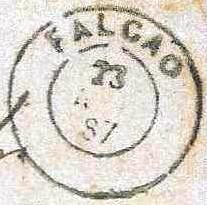
It was followed by FRJ-0075b (agenciaspostais.com.br): a plain double circle with the inscription FALCAO above and internal dates from 1885 to 1893.
FRJ-0075b (PN) 1885-1893Google Maps
Dieser Ortschaft gehörte ursprünglich der Freguesia von São Joaquim in der Vila von Barra Mansa und lag nah an der Provinzgrenze zu Minas Gerais, 170 km nordwestlich der Hauptstadt Rio de Janeiro entfernt. Im November 1919 wurde daraus ein Distrikt, der seit Januar 1991 dem neu gegründeten Município von Quatis gehört.
Wie Paulo Novaes in agenciaspostais.com.br schreibt, gab es dort ein Postamt seit Dezember 1873. Der erste Poststempel ist ARJ-0075a, der bereits durch R. Koester in Carimbologia XIX bekannt ist:
ARJ-0075a (RK) 1873ff
Ihm folgte FRJ-0075b (agenciaspostais.com.br): ein einfacher Doppelkreis mit der obigen Inschrift FALCAO und inneren Daten von 1885 bis 1893.



















 Carimbologia