Other names: Divisa Vermelha, Campos Gerais (1901)
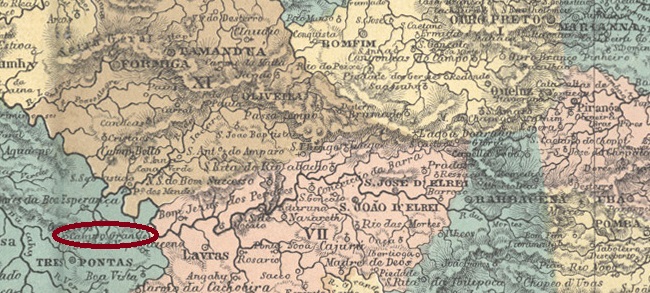
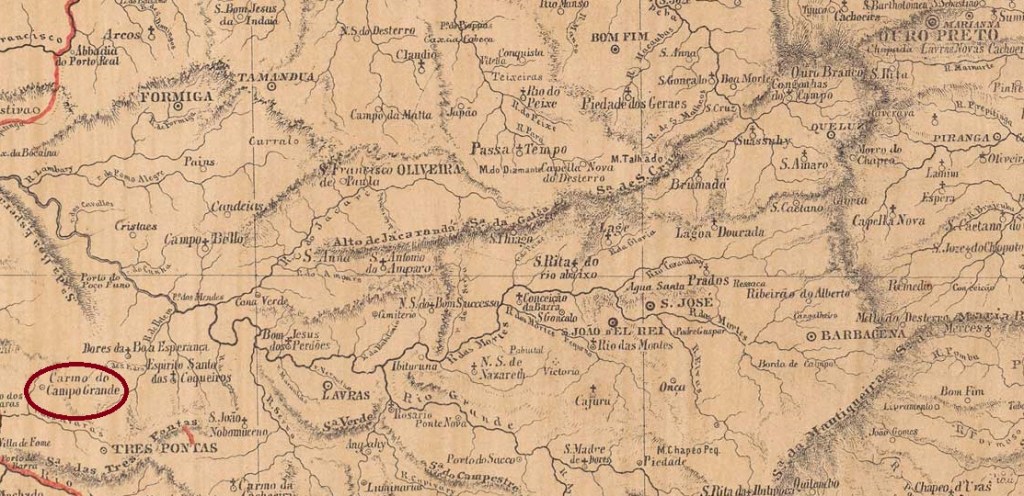
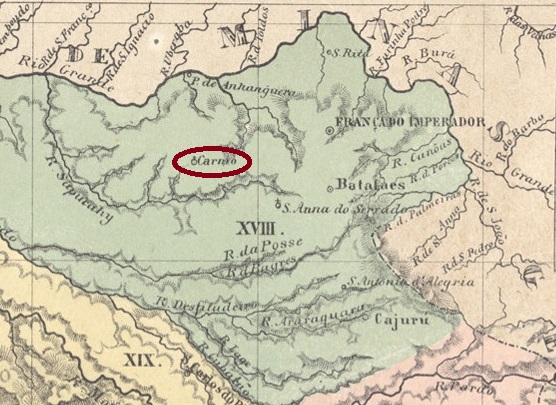
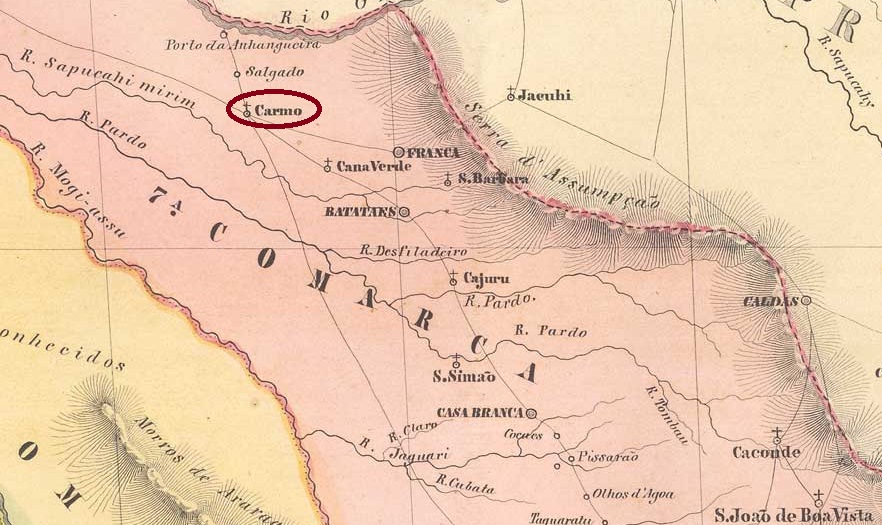
N. Sra. do Carmo do Campo Grande was a district of the Vila de Três Pontas from around 1841, located on the Córrego da Divisa, kilometres from the provincial capital of Ouro Preto. In September 1870 it became a freguesia and in September 1901 a vila with the name Campos Gerais. Campos Gerais has been a town since September 1915.
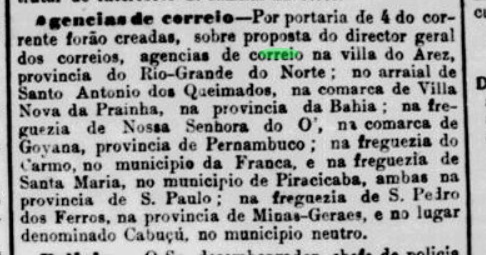
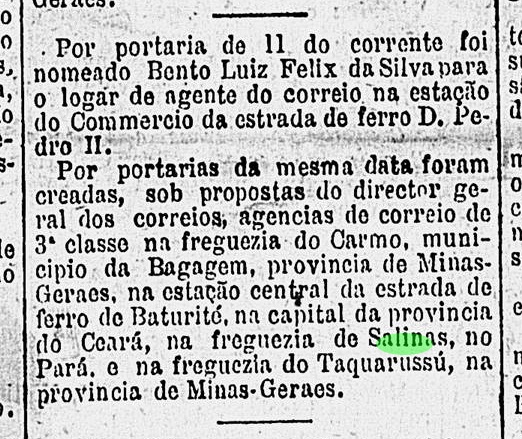
The establishment of a local post office was decided in October 1883, as reported by Paula Sobrinho in História Postal de Minas Gerais (Belo Horizonte, 1997) and R. Koester (Carimbologia IX). However, as the agency is not listed in the directory of imperial post offices (Tabella das Agencias do Correio do Império, Rio de Janeiro, 1885), it was probably not put into operation until later.
No imperial postmarks from Carmo do Campo Grande have yet been found.
Provincia de Minas Geraes, 1873
Andere Namen: Divisa Vermelha, Campos Gerais (1901)
N. Sra. do Carmo do Campo Grande war seit etwa 1841 ein Bezirk der Vila de Três Pontas, gelegen am Córrego da Divisa, km von der Provinzhauptstadt Ouro Preto entfernt. Im September 1870 wurde es zur Freguesia und im September 1901 zur Vila mit dem Namen Campos Gerais erhoben. Seit September 1915 ist Campos Gerais eine Stadt.
Die Einrichtung eines örtlichen Postamtes wurde im Oktober 1883 beschlossen, wie Paula Sobrinho in História Postal de Minas Gerais (Belo Horizonte, 1997) und R. Koester (Carimbologia IX) berichten. Da die Agentur jedoch nicht im Verzeichnis der kaiserlichen Postämter (Tabella das Agencias do Correio do Império, Rio de Janeiro, 1885) aufgeführt ist, wurde sie wahrscheinlich erst später in Betrieb genommen. Bisher wurden keine kaiserlichen Poststempel von Carmo do Campo Grande gefunden.
Other names: Arraial Novo de N. Sra. do Carmo da Ponte de Terra, Carmo do Paranahyba (1876)
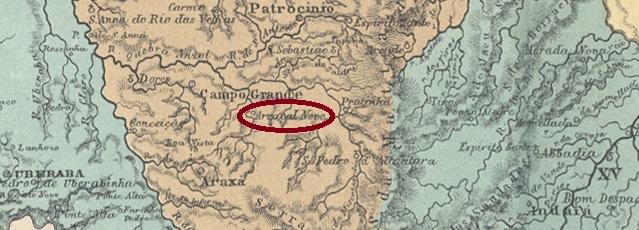
The old Freguesia do Arraial Novo de N. Sra. do Carmo da Ponte de Terra was founded in March 1846, belonged to the Vila de Araxá and was located on the east bank of the Paranaíba, 440 km northwest of the provincial capital Ouro Preto. Elevated to Vila in September 1848, it was downgraded to Freguesia in October 1870, this time under the shorter place name N. Sra. do Carmo do Arraial Novo. It was re-elevated to vila in December 1873, renamed Vila de Carmo do Paranahyba in July 1876, and became a town in October 1887.
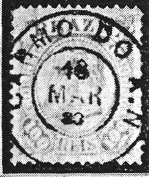
Again, Paula Sobrinho (História Postal de Minas Gerais, Belo Horizonte, 1997) and R. Koester (Carimbologia IX) agree that there was a post office since October 1873. The first postmark CMG-0660a also comes from the latter:
CMG-0660a (RK) 1877-1883
It was followed by the double circle with ornament below CMG-0660b, which was mentioned without illustration by R. Koester (op.cit.), one copy, dated 1886.
Later postmarks bear the place name Carmo do Paranahyba. All copies found so far have republican dates.
Viliers de l’Ile Adam: Carta (…) da Provincia de Minas Geraes, 1849
Andere Namen: Arraial Novo de N. Sra. do Carmo da Ponte de Terra, Carmo do Paranahyba (1876)
Die alte Freguesia do Arraial Novo de N. Sra. do Carmo da Ponte de Terra wurde im März 1846 gegründet, gehörte zur Vila de Araxá und lag am Ostufer des Paranaíba, 440 km nordwestlich der Provinzhauptstadt Ouro Preto. Im September 1848 zur Vila erhoben, wurde sie im Oktober 1870 zur Freguesia herabgestuft, diesmal unter dem kürzeren Ortsnamen N. Sra. do Carmo do Arraial Novo. Die Wiedererhebung zur Vila erfolgte im Dezember 1873, die Umbenennung in Vila de Carmo do Paranahyba im Juli 1876, und seit Oktober 1887 ist der Ort eine Stadt.
Auch hier sind sich Paula Sobrinho (História Postal de Minas Gerais, Belo Horizonte, 1997) und R. Koester (Carimbologia IX) einig, dass es seit Oktober 1873 ein Postamt gab. Von letzterem stammt auch der erste Poststempel CMG-0660a:
CMG-0660a (RK) 1877-1883
Ihm folgte der Doppelkreis mit Ornament unten CMG-0660b, dessen Exemplar aus 1886 von R. Koester (op.cit.) ohne Abbildung erwähnt wurde.
Spätere Poststempel tragen die Ortsbezeichnung Carmo do Paranahyba. Alle bisher gesehenen Exemplare haben Daten aus der Republik.
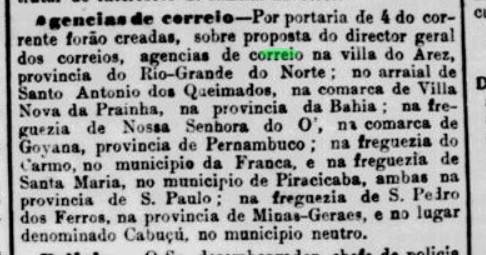
The settlement originated around 1810 in the area of Vila Franca do Imperador on the west bank of the Rio do Carmo, 410 km north of the later provincial capital São Paulo. In February 1847 it became the Freguesia de N. Sra. do Carmo da Franca do Imperador, in March 1885 a Vila in the Município de Carmo da Franca and in June 1895 a town, which has been called Ituverava since September 1899. The name from the Tupi-Guarani recalls the beautiful waterfall of the Carmo there.
As the Rio press reported, there had been a post office there since May 1882:
Jornal do Commercio/RJ, 06.05.1882
The oldest postmark so far is CSP-0320a, already known throughy R. Koester (Carimbologia IX):
CSP-0320a (RK) 1886
The cancel CSP-0315a (illustration from the internet) with the inscription CARMO DE FRANCA probably appeared in the early Republic:
CSP-0315a (EB) 1896Villiers de l’Ile Adam: Carta (..) da Provincia de S. Paulo, 1847
Andere Namen: Carmo de Franca, Ituverava (1899)
Die Siedlung entstand um 1810 im Gebiet der Vila Franca do Imperador am Westufer des Rio do Carmo, 410 km nördlich der späteren Provinzhauptstadt São Paulo. Im Februar 1847 wurde es die Freguesia de N. Sra. do Carmo da Franca do Imperador, im März 1885 eine Vila im Município de Carmo da Franca und im Juni 1895 eine Stadt, die seit September 1899 Ituverava heißt. Der Name aus dem Tupi-Guarani erinnert an den dortigen schönen Wasserfall des Carmo.
Wie die Presse in Rio berichtete, gab es dort seit Mai 1882 ein Postamt:
Jornal do Commercio/RJ, 06.05.1882
Der bisher älteste Poststempel ist CSP-0320a, bereits bekannt durch R. Koester (Carimbologia IX):
CSP-0320a (RK) 1886
Der Stempel CSP-0315a (Abbildung aus dem Internet) mit der Inschrift CARMO DE FRANCA erschien vermutlich in der frühen Republik:
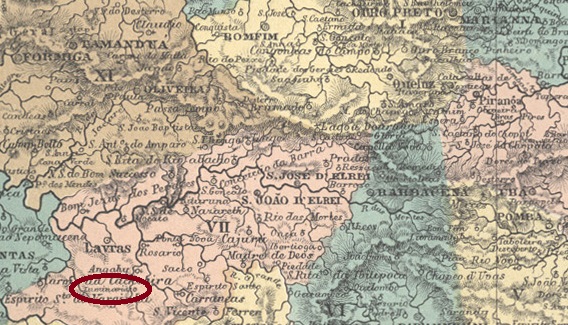
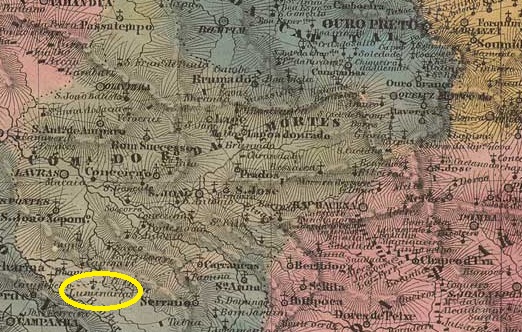
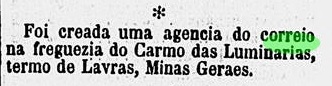
The Freguesia de N. Sra. do Carmo das Luminarias was founded in November 1873 in the area of Vila de Lavras on the east bank of the Ingaí, 280 km southwest of the provincial capital Ouro Preto. In September 1923, the place name was changed to Luminárias and in December 1943, the place was assigned as a district to the newly founded Município de Itumirim. Since December 1948, Luminárias has been an independent Município. The name is derived from the surrounding Luminárias Mountains.
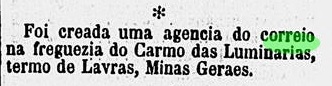
Again, Paula Sobrinho (História Postal de Minas Gerais, Belo Horizonte, 1997) and R. Koester (Carimbologia IX) agree that there was a post office there since January 1886. This is also confirmed by the press in Rio:
Diario de Noticias/RJ, 13.01.1886
So far, no imperial postmark from Carmo das Luminárias has been found.
Villiers de l’Ile Adam: Carta (…) da Provincia de Minas Geraes, 1849
Andere Namen: Luminarias (1923)
Die Freguesia de N. Sra. do Carmo das Luminarias wurde im November 1873 im Gebiet der Vila de Lavras am Ostufer des Ingaí, 280 km südwestlich der Provinzhauptstadt Ouro Preto, gegründet. Im September 1923 wurde der Ortsname in Luminárias geändert und im Dezember 1943 wurde der Ort als Distrikt dem neu gegründeten Município de Itumirim zugeordnet. Seit Dezember 1948 ist Luminárias ein unabhängiges Município. Der Name leitet sich von den umliegenden Luminárias-Bergen ab.
Auch hier sind sich Paula Sobrinho (História Postal de Minas Gerais, Belo Horizonte, 1997) und R. Koester (Carimbologia IX) einig, dass es dort seit Januar 1886 ein Postamt gab. Dies wird auch von der Presse in Rio bestätigt:
Diario de Noticias/RJ, 13.01.1886
Bisher wurde kein kaiserlicher Poststempel aus Carmo das Luminárias gefunden.
The old chapel of Carmo de Cacunda was located in the area of Vila de Itabira on the west bank of the Tanque River, 150 km north of the provincial capital Ouro Preto. It became the district of N. Sra. do Carmo in 1846 and a freguesia in September 1870. Since December 1938, the place has borne the name Senhora do Carmo.
As Paula Sobrinho writes in História Postal de Minas Gerais (Belo Horizonte, 1997), there was a post office there from August 1881. So far, there are no known imperial postmarks from Carmo de Itabira.
Provincia de Minas Geraes, 1873
Andere Namen: Carmo da Cacunda, Senhora do Carmo
Die alte Kapelle Carmo da Cacunda lag in der Gegend von Vila de Itabira am Westufer des Flusses Tanque, 150 km nördlich der Provinzhauptstadt Ouro Preto. Es wurde 1846 zum Bezirk N. Sra. do Carmo und im September 1870 zur Freguesia. Seit Dezember 1938 trägt der Ort den Namen Senhora do Carmo.
Wie Paula Sobrinho in der História Postal de Minas Gerais (Belo Horizonte, 1997) schreibt, gab es dort seit August 1881 ein Postamt. Bisher sind keine kaiserlichen Poststempel aus Carmo de Itabira bekannt.
Other names: N. Sa. do Carmo dos Tocos, Carmo da Escaramuça dos Ciganos, Paraguaçu (1911)
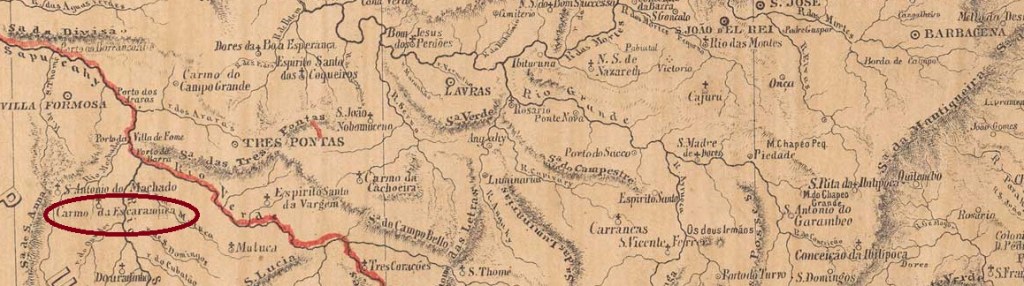
The village was a curato of the Vila de Sto Antonio do Machado around 1828, near the west bank of the Sapucaí, 390 km southwest of the provincial capital Ouro Preto. In March 1840 it became the Freguesia de N. Sra. do Carmo da Escaramuça and in August 1911 the Município de Paraguaçu.
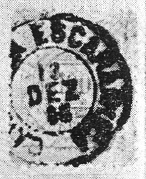
Again, Paula Sobrinho (História Postal de Minas Gerais, Belo Horizonte, 1997) and R. Koester (Carimbologia IX) agree on the February 1872 foundation date for the local post office. Accordingly, there must have been another postmark before CMG-0640b (Fig.: R. Koester):
CMG-0640b (RK) 1887-1898ffProvincia de Minas Geraes, 1873
Andere Namen: N. Sa. do Carmo dos Tocos, Carmo da Escaramuça dos Ciganos, Paraguaçu (1911)
Der Ort war um 1828 ein Curato der Vila de Sto Antonio do Machado, nahe dem Westufer des Sapucaí, 390 km südwestlich der Provinzhauptstadt Ouro Preto. Im März 1840 wurde es zur Freguesia de N. Sra. do Carmo da Escaramuça und im August 1911 zum Município de Paraguaçu.
Auch hier sind sich Paula Sobrinho (História Postal de Minas Gerais, Belo Horizonte, 1997) und R. Koester (Carimbologia IX) über das Gründungsdatum im Februar 1872 für das örtliche Postamt einig. Demnach muss es vor CMG-0640b (Abb.: R. Koester) noch einen anderen Poststempel gegeben haben:
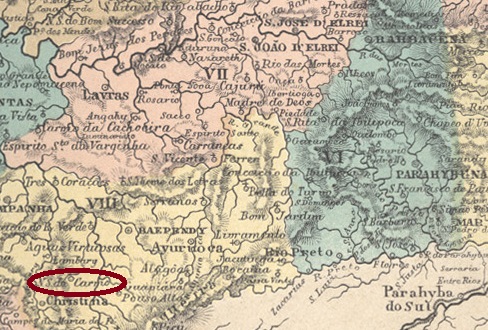
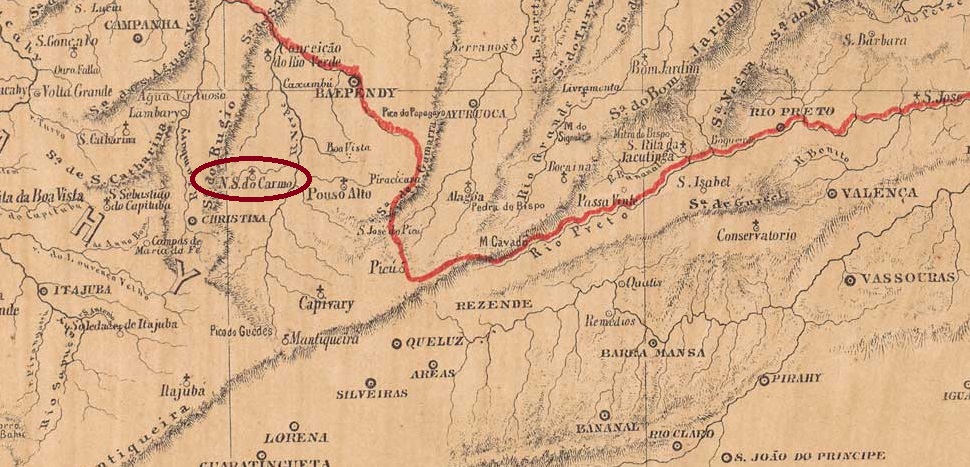
Other names: Carmo do Pouso Alto, Silvestre Ferraz, Carmo de Minas (1953)
The locality of Carmo do Pouso Alto was founded in July 1832, belonged to the Vila de Christina and was located on the Rio Verde, 350 km southwest of the provincial capital Ouro Preto. In October 1882 it became the Freguesia de N. Sra do Carmo do Rio Verde and changed its name in September 1901 to Silvestre Ferraz, now Município. Since December 1953 it has been called Município de Carmo de Minas.
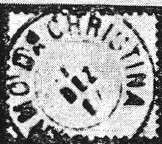
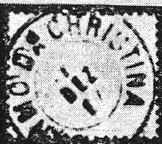
Paula Sobrinho in Historia Postal de Minas Gerais and R. Koester in Carimbologia IX agree that there was a post office there since July 1847. However, no postmark with the place name Carmo do Pouso Alto has been found so far. The oldest postmark CMG-0635a (fig. R. Koester) bears the place name Carmo da Christina and is dated from 1885 to 1889:
CMG-0635a (RK) 1885-1889
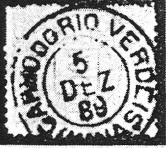
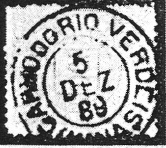
It was followed by CMG-0690a (Fig. R. Koester), now with the place name Carmo do Rio Verde:
CMG-0690a (RK) 1889-1890ffProvincia de Minas Geraes, 1873
Andere Namen: Carmo do Pouso Alto, Silvestre Ferraz, Carmo de Minas (1953)
Die Gemeinde Carmo do Pouso Alto wurde im Juli 1832 gegründet, gehörte zur Vila de Christina und lag am Rio Verde, 350 km südwestlich der Provinzhauptstadt Ouro Preto. Im Oktober 1882 wurde es zur Freguesia de N. Sra do Carmo do Rio Verde und änderte seinen Namen im September 1901 in Silvestre Ferraz, nun Município. Seit Dezember 1953 heißt sie Município de Carmo de Minas.
Paula Sobrinho in Historia Postal de Minas Gerais und R. Koester in Carimbologia IX sind sich einig, dass es dort seit Juli 1847 ein Postamt gab. Allerdings wurde bisher kein Poststempel mit dem Ortsnamen Carmo do Pouso Alto gefunden. Der älteste Poststempel CMG-0635a (Abb. R. Koester) trägt den Ortsnamen Carmo da Christina und ist von 1885 bis 1889 datiert:
CMG-0635a (RK) 1885-1889
Ihm folgte CMG-0690a (Abb. R. Koester), nun mit der Ortsbezeichnung Carmo do Rio Verde:
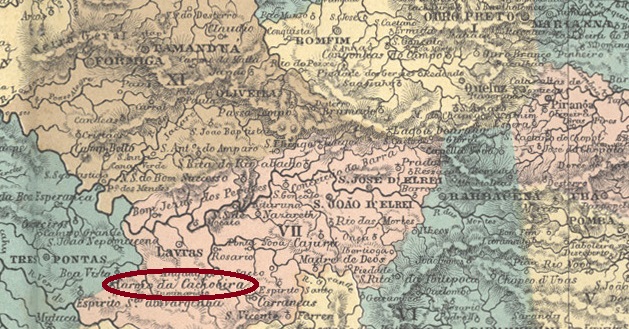
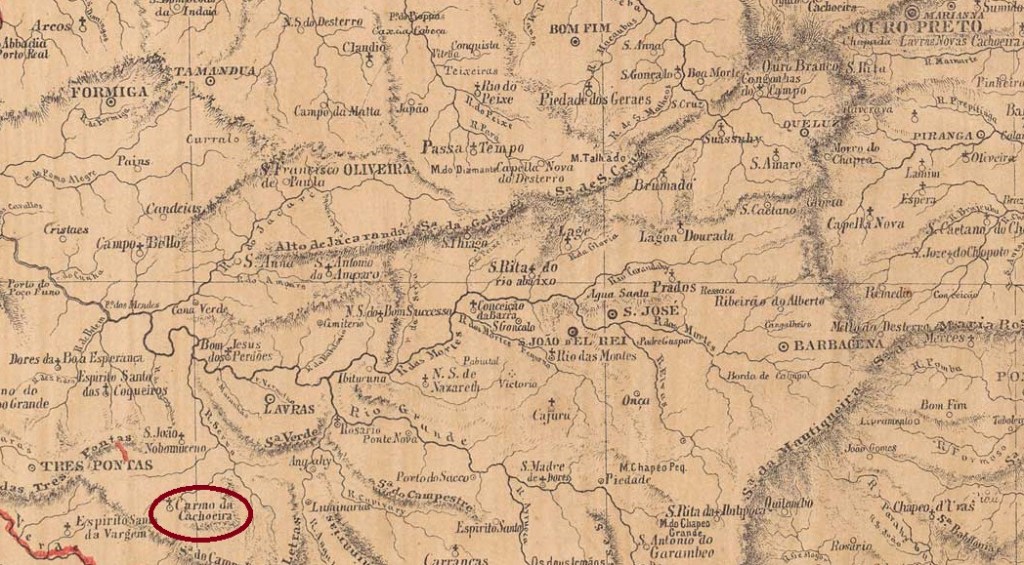
The Freguesia de Cachoeira do Carmo da Boa Vista was founded in July 1857 and was located on the west bank of the Ribeirão do Salto near Vila de Três Pontas, 300 km southwest of the provincial capital Ouro Preto. In December 1873, it was renamed N. Sra do Carmo da Cachoeira and in July 1881, it was incorporated as a district into the Município Varginha. Since December 1938, Carmo da Cachoeira has been an independent município.
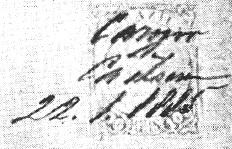
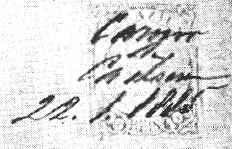
Paula Sobrinho in História Postal de Minas Gerais (Belo Horizonte, 1997) and R. Koester in Carimbologia IX agree that there was a post office there since February 1882. Only the postmark was apparently not delivered in time, because as late as 1885 the stamps were cancelled by hand:
1885 (Fig. R. Koester, op. cit.)
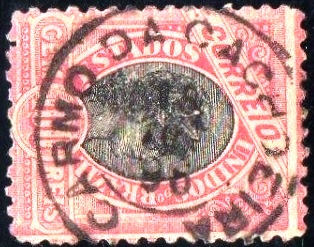
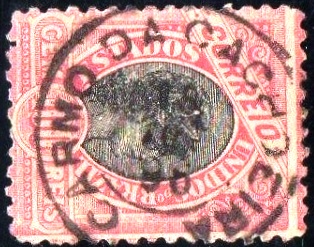
The only 19th century postmark so far is CMG-0630a (fig. from the internet) and shows dates from 1889 to 1897:
CMG-0630a (EB) 1889-1897Provincia de Minas Geraes, 1873
Textaktualisierung am 14. November 2023
Andere Namen: Cachoeira do Carmo da Boa Vista
Die Freguesia de Cachoeira do Carmo da Boa Vista wurde im Juli 1857 gegründet und lag am Westufer des Ribeirão do Salto bei Vila de Três Pontas, 300 km südwestlich der Provinzhauptstadt Ouro Preto. Im Dezember 1873 wurde es in N. Sra do Carmo da Cachoeira umbenannt und im Juli 1881 als Distrikt in das Município Varginha eingegliedert. Seit Dezember 1938 ist Carmo da Cachoeira ein unabhängiges Município.
Paula Sobrinho in História Postal de Minas Gerais (Belo Horizonte, 1997) und R. Koester in Carimbologia IX sind sich einig, dass es dort seit Februar 1882 ein Postamt gab. Nur der Poststempel wurde anscheinend nicht rechtzeitig geliefert, denn noch 1885 wurden die Briefmarken handschriftlich entwertet:
1885 (Abb. R. Koester, a.a.O.)
Der bisher einzige Poststempel aus dem 19. Jahrhundert ist CMG-0630a (Abb. aus dem Internet) und zeigt Daten von 1889 bis 1897:
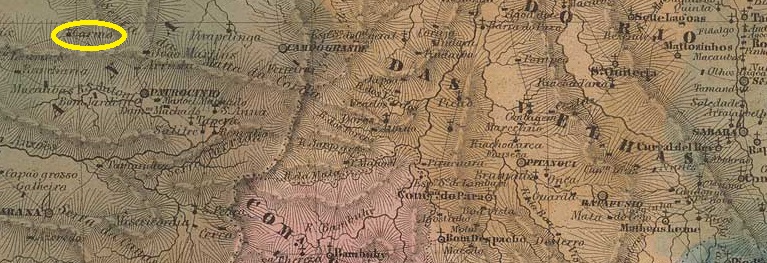
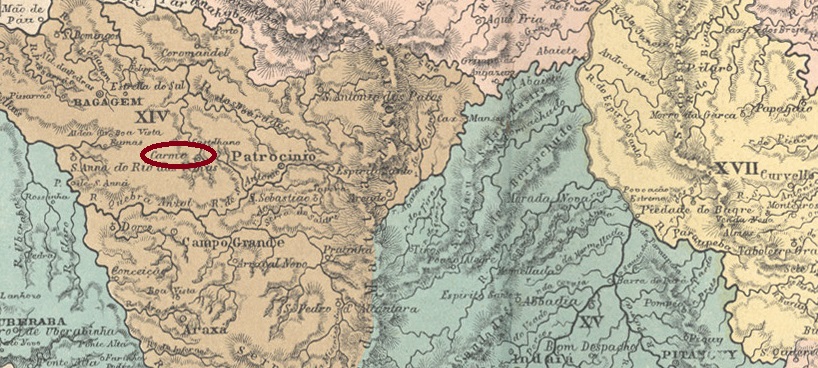
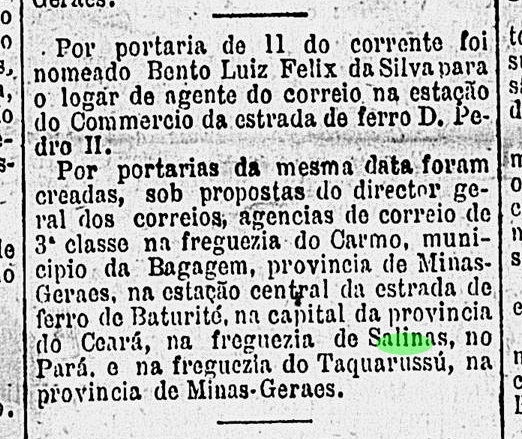
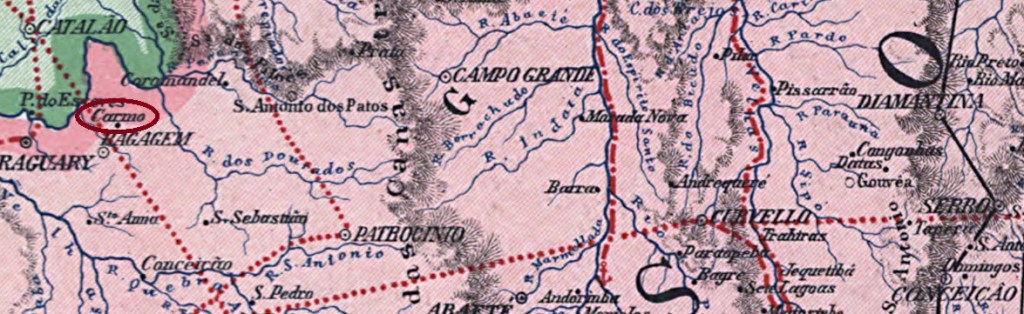
The settlement of Arraial de N. Sra. do Carmo was established around 1840 on the territory of the Vila da Bagagem, 580 km northwest of the provincial capital of Ouro Preto. In September 1870 it became a freguesia, in October 1882 a vila and in May 1892 a town, which has borne the name Monte Carmelo since June 1900.
Reinhold Koester (Carimbologia IX) and Paula Sobrinho (História Postal de Minas Gerais, Belo Horizonte, 1997) agree that there was a post office since September 1882. This is also confirmed by the press in Rio:
Gazeta de Noticias/RJ, 15.09.1882
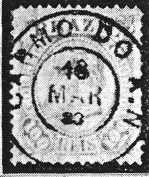
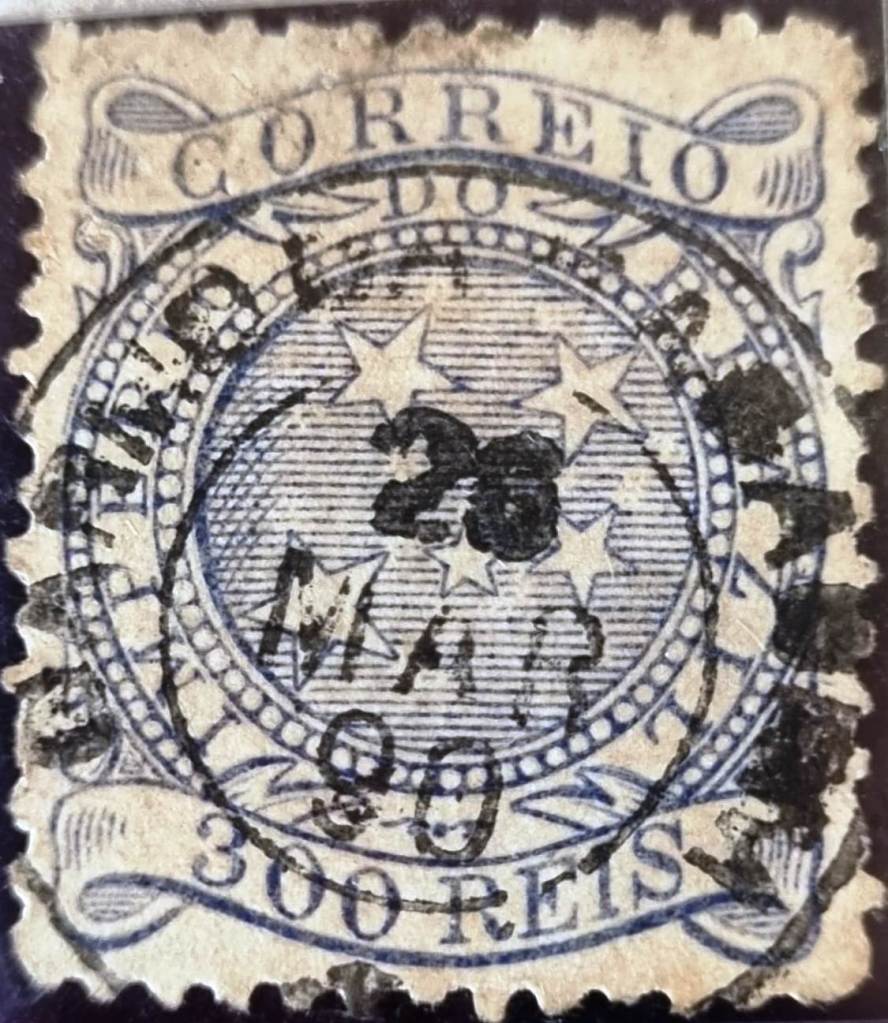
The oldest postmark to date is CMG-0625a (image: Márcio Duarte):
CMG-0625a (MD) 1890Carta da Republica dos Estados Unidos do Brazil, 1892
Textaktualisierung am 3. April 2024
Andere Namen: Monte Carmelo (1900)
Die Siedlung Arraial de N. Sra. do Carmo entstand um 1840 auf dem Gebiet der Vila da Bagagem, 580 km nordwestlich der Provinzhauptstadt Ouro Preto. Im September 1870 wurde es zur Freguesia, im Oktober 1882 zur Vila und im Mai 1892 zur Stadt, die seit Juni 1900 den Namen Monte Carmelo trägt.
Reinhold Koester (Carimbologia IX) und Paula Sobrinho (História Postal de Minas Gerais, Belo Horizonte, 1997) sind sich einig, dass es seit September 1882 ein Postamt gab. Dies wird auch von der Presse in Rio bestätigt:
Gazeta de Noticias/RJ, 15.09.1882
Der bisher älteste Stempel ist CMG-0625a (Bild: Márcio Duarte):
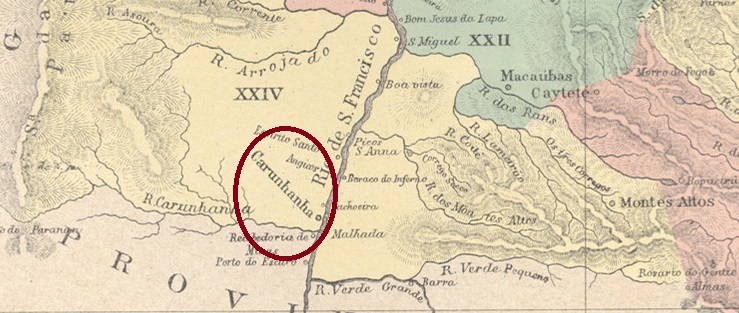
The name Carinhanha (or Carunhanha) is of Indian origin and means frog hole.
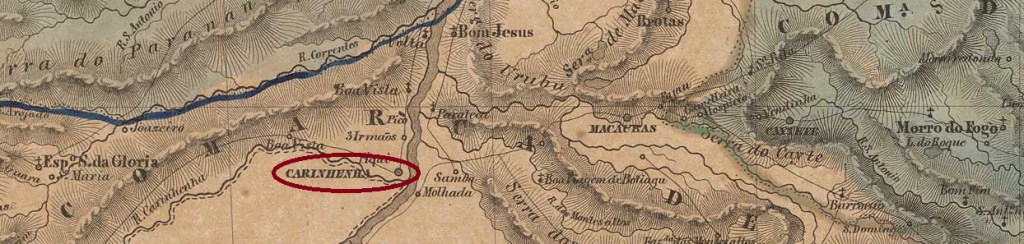
The Freguesia de S. José da Carinhanha was founded in August 1806, belonged to the Vila da Barra do Rio Grande and was located on the mouth of the river with the same name on the west bank of the São Francisco, then in the Capitania of Pernambuco. When it became a vila in April 1832, it was already in the imperial province of Bahia. Since August 1909, Carinhanha has been a town.
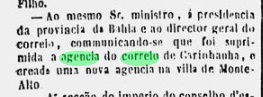
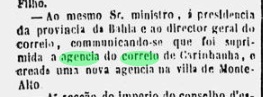
During the imperial period alone, there were three periods of operation for the local post office. The first began in December 1836, as Nova Monteiro writes in Administrações e Agencias Postaes do Brasil Imperio (Brasil Filatelico/RJ, 1934-5; Reprint SPP 1994-1999), and ended in May 1852, as reported by the Rio press:
Diario do Rio de Janeiro, 26.05.1852
The second establishment of the postal agency must have taken place before 1854, as shown in the 1859 report of the Imperial Ministry. Since the post office is still mentioned in an official bulletin in July 1861, it must have been closed later. The third period of operation probably began in 1866, as shown in the Directory of Imperial Post Offices (Tabella das Agencias do Correio do Imperio, Rio de Janeiro, 1885).
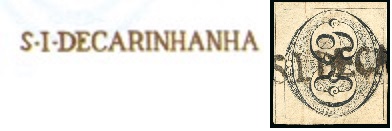
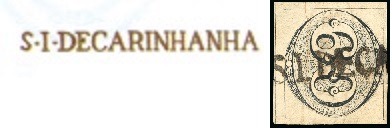
The oldest cancel so far is CBA-0260a and dates from the first period of operation, as it was found on Bull’s-Eye issues from 1843:
CBA-0260a (RHM, recte David Feldman Auctions) 1843ff
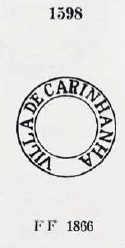
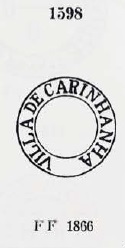
CBA-0260b appeared around 1866, listed in Paulo Ayres’s Catálogo de Carimbos Brasil-Império (S. Paulo, 1937, 1942) as no. 1598
CBA-0260b (P.A. 1598) 1866ff
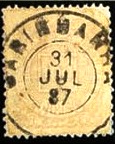
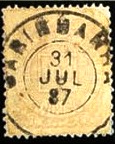
In the 1980s the double circle CBA-0260c (Fig. Felipe Piccinini) appeared:
CBA-0260c (FP) 1885ff-1887Villiers de l’Ile Adam: Carta (…) da Provincia da Bahia, 1848
Andere Namen: Carunhanha
Der Name Carinhanha oder Carunhanha ist indianischen Ursprungs und bedeutet Froschloch.
Die Freguesia de S. José da Carinhanha wurde im August 1806 gegründet, gehörte zur Vila da Barra do Rio Grande und lag an der Mündung des gleichnamigen Flusses am Westufer des São Francisco, damals noch in der Capitania von Pernambuco. Als es im April 1832 zur Vila wurde, lag es bereits in der kaiserlichen Provinz Bahia. Seit August 1909 ist Carinhanha eine Stadt.
Allein in der Kaiserzeit gab es drei Betriebsperioden für das örtliche Postamt. Die erste begann im Dezember 1836, wie Nova Monteiro in Administrações e Agencias Postaes do Brasil Imperio (Brasil Filatelico/RJ, 1934-5; Reprint SPP 1994-1999) schreibt, und endete im Mai 1852, wie die Presse von Rio berichtete:
Diario do Rio de Janeiro, 26.05.1852
Die zweite Gründung der Postagentur muss vor 1854 stattgefunden haben, wie aus einem Bericht des Reichsministeriums von 1859 hervorgeht. Da das Postamt noch im Juli 1861 in einem amtlichen Bulletin erwähnt wird, muss es später geschlossen worden sein. Die dritte Betriebsperiode begann vermutlich 1866, wie aus dem Verzeichnis der kaiserlichen Postämter (Tabella das Agencias do Correio do Imperio, Rio de Janeiro, 1885) hervorgeht.
Der bisher älteste Stempel ist CBA-0260a und stammt aus der ersten Betriebsperiode, da er auf Ochsenaugen-Ausgaben von 1843 gefunden wurde:
CBA-0260a (RHM, recte David Feldman Auktionen) 1843ff
Um 1866 erschien CBA-0260b, der in Paulo Ayres‘ Catálogo de Carimbos Brasil-Império (S. Paulo, 1937, 1942) unter der Nr. 1598 geführt wird.
CBA-0260b (P.A. 1598) 1866ff
In den 80er Jahren kam der Doppelkreis CBA-0260c (Abb. Felipe Piccinini) hinzu:



 Carimbologia