See also S. Francisco de Paula dos Pinheiros (SSP-1565)
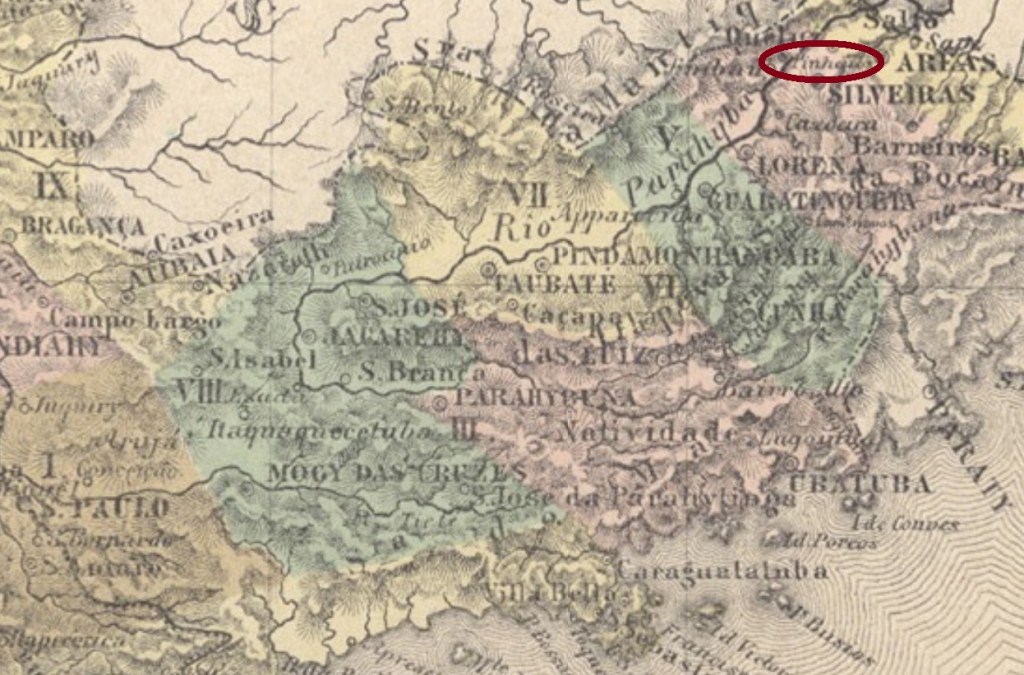
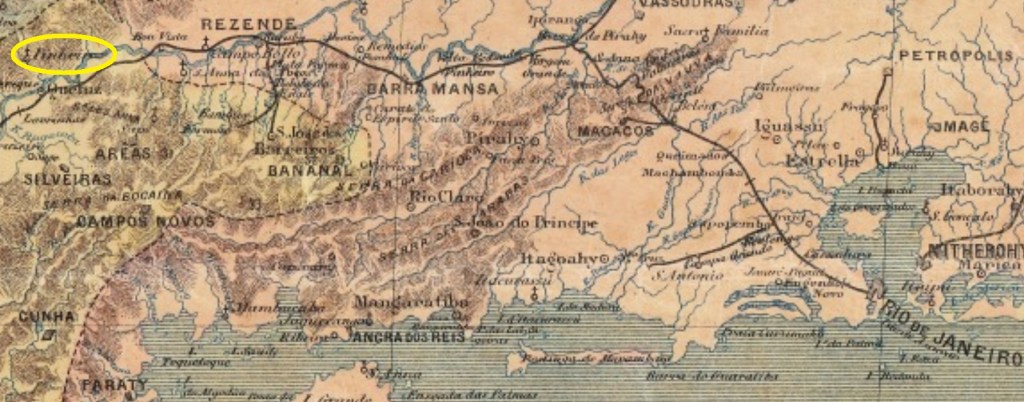
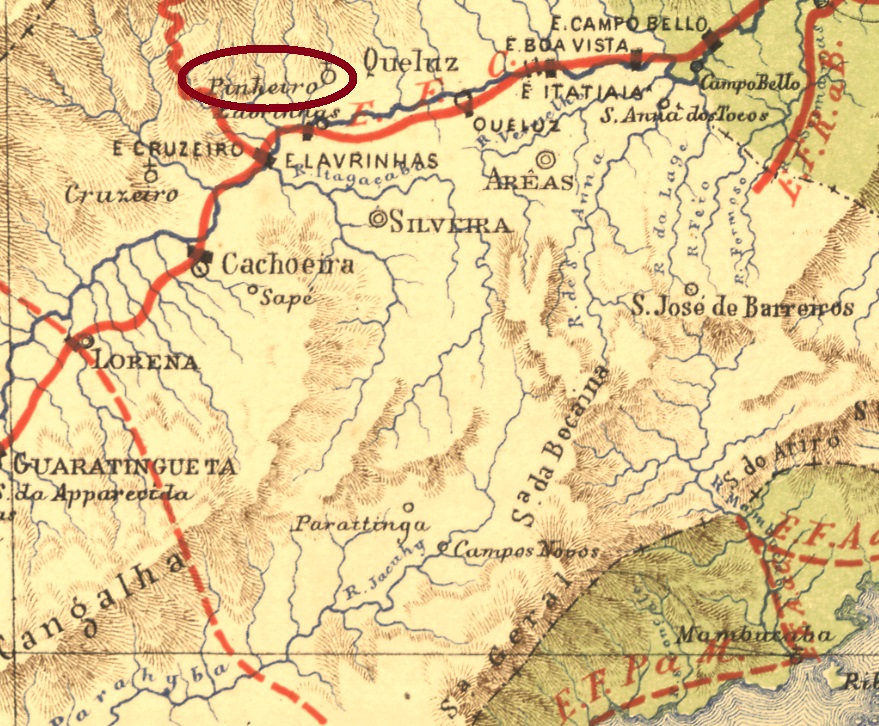
São Francisco de Paula dos Pinheiros was from March 1846 on a freguesia located in the municipality of Queluz, about 230 km northeast of the provincial capital of São Paulo. The village arose twice to a municipality, in December 1917 and in September 1937. It then descended twice to a district: in May 1934 and in November 1944, most recently in the municipality of Lavrinhas. Time seems to have stopped here: in 1880 there were more than 2.7 thousand people living there, in 2010 there were just 2,000 inhabitants on place.
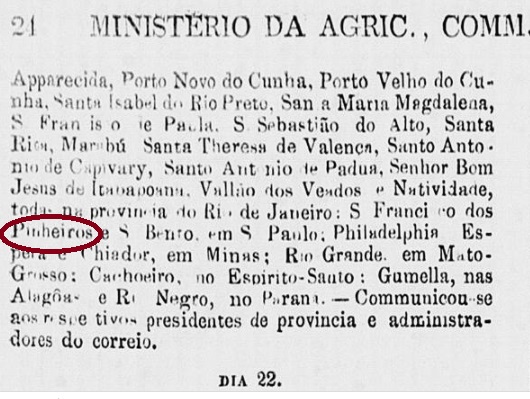
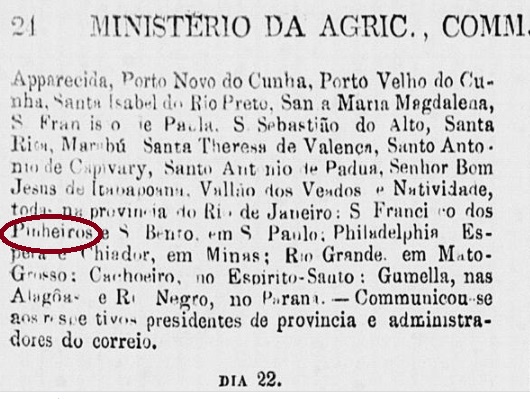
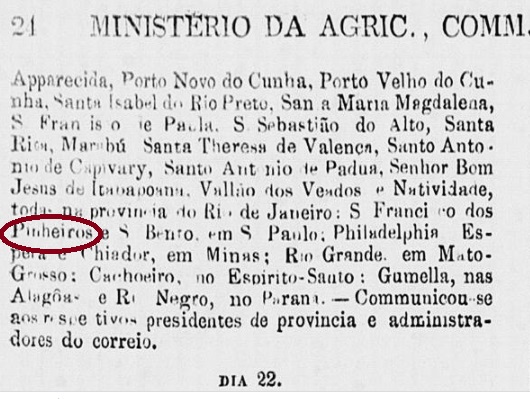
This ups and downs were reflected in the postal system. Nova Monteiro (Administrações e Agencias Postaes do Brasil Imperio, in Brasil Filatelico/RJ, 1934-5; Reprint SPP 1994-1999) reports a post office creation in September 1860. But as early as June 1861, the locality was on a list of deleted postal agencies:
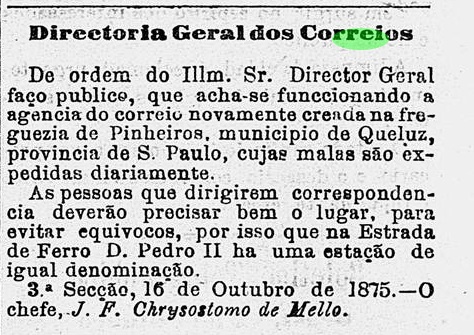
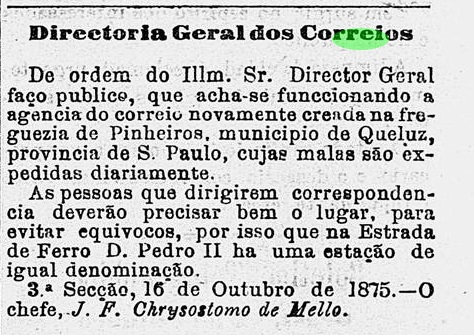
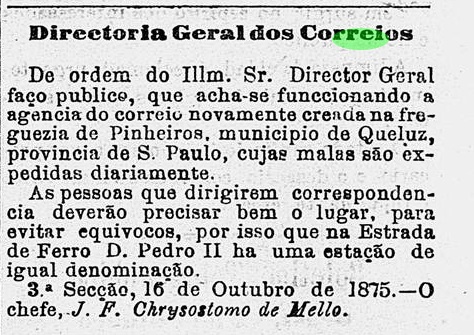
It was some time before the office reopened, as Pinheiros did not reappear in reports on postal routes until November 1867. However, the agency was closed again sometime in the early 1870s. In October 1875, the Rio de Janeiro press reported that it had reopened once more:
The oldest postmark to date is PSP-0940a (Amaury Possidente collection), which is still awaiting final confirmation:

All other postmarks date from the final period of operation of the Imperial Agency, beginning with PSP-0940b (José A. Junges collection):

This was followed by PSP-0940c (image by Claudio Coelho), without the lower ornament and with a larger inner circle:

Towards the end of the Empire, the French type PSP-0940d also appeared (Fig. Felipe Piccinini):

In Mute Cancellations of the Brazil Empire / Carimbos Mudos do Brasil Império (Brazil Philatelic Association, Rio de Janeiro, 2000), James Dingler and Klerman W. Lopes attributed a silent postmark bearing the number 1361 to Pinheiros station in Rio de Janeiro (PRJ-1845). An example of this comes from R. Assef Jr. However, this postmark could be identical to one from Pinheiros in São Paulo, which R. Koester showed in Carimbologia XXXI:

Koester (op. cit.) also showed another silent postmark from Pinheiros/SP:

Veja também S. Francisco de Paula dos Pinheiros (SSP-1565)
São Francisco de Paula dos Pinheiros foi uma freguesia localizada no município de Queluz, cerca de 230 km a nordeste da capital paulista. A localidade foi elevada por duas vezes a município, em dezembro de 1917 e em setembro de 1937. Em seguida, desceu duas vezes para distrito: em maio de 1934 e em novembro de 1944, mais recentemente no município de Lavrinhas. O tempo parece ter parado por aqui: em 1880 havia mais de 2,7 mil pessoas vivendo lá, em 2010 havia apenas 2.000 habitantes no local.
Esses altos e baixos foram refletidos no sistema postal. Nova Monteiro (Administrações e Agencias Postaes do Brasil Imperio, em Brasil Filatelico/RJ, 1934-5; Reimpressão SPP 1994-1999) relata uma criação dos Correios em setembro de 1860. Mas já em junho de 1861, a localidade constava numa lista de agências postais extintas:
Demorou mais algum tempo até a reabertura, pois só em novembro de 1867 Pinheiros voltou a aparecer nas notícias sobre rotas postais. No entanto, a agência foi fechada novamente em algum momento no início da década de 1870. Em outubro de 1875, a imprensa do Rio de Janeiro noticiou uma nova reabertura:
O carimbo postal mais antigo até o momento é o PSP-0940a (Coleção Amaury Possidente), que ainda aguarda sua confirmação definitiva:

Todos os demais carimbos postais datam do último período de funcionamento da agência imperial, começando com o PSP-0940b (Coleção José A. Junges):

Seguiu-se o PSP-0940c (imagem: Claudio Coelho), sem ornamento inferior e com círculo interno maior:

Perto do fim do Império, surgiu também o tipo francês PSP-0940d (Ilustração de Felipe Piccinini):

James Dingler e Klerman W. Lopes, em Mute Cancellations of the Brazil Empire / Carimbos Mudos do Brasil Império (Clube Filatélico do Brasil, Rio de Janeiro, 2000), atribuíram um carimbo postal mudo com o número 1361 à estação de Pinheiros, no Rio de Janeiro (PRJ-1845). Um exemplar dele foi mostrado por R. Assef Jr. No entanto, esse carimbo poderia ser idêntico a um de Pinheiros, em São Paulo, que R. Koester apresentou em Carimbologia XXXI:

Koester (op. cit.) também apresentou outro carimbo postal mudo de Pinheiros/SP:

Siehe auch S. Francisco de Paula dos Pinheiros (SSP-1565)
São Francisco de Paula dos Pinheiros war ab März 1846 eine Freguesia im Município von Queluz, ca. 230 km nordöstlich der Provinzhauptstadt São Paulo gelegen. Der Ort stieg zweimal zum Município auf, im Dezember 1917 und im September 1937. Und stieg anschließend zweimal zum Distrikt ab: im Mai 1934 und im November 1944, zuletzt im Município von Lavrinhas. Hier scheint die Zeit stehen geblieben zu sein: 1880 lebten dort über 2,7 tausend Menschen, im Jahre 2010 waren gerade 2.000 Einwohner dort gemeldet.
Dieses Auf und Ab spiegelte sich im Postwesen wider. Nova Monteiro (Administrações e Agencias Postaes do Brasil Imperio, in Brasil Filatelico/RJ, 1934-5; Reprint SPP 1994-1999) berichtet, das dortige Postamt eröffnete im September 1860. Aber bereits im Juni 1861 stand dieser Ort auf einer Liste von gelöschten Postagenturen:
Es dauerte noch eine Weile bis zur Neueröffnung, denn erst im November 1867 war Pinheiros wieder in Meldungen über Postrouten zu lesen. Allerdings wurde die Agentur irgendwann zu Beginn der 1870er Jahre wieder geschlossen. Im Oktober 1875 wurde in der Presse von Rio de Janeiro eine erneute Wiedereröffnung gemeldet:
Der bisher älteste Poststempel ist PSP-0940a (Sammlg. Amaury Possidente), der noch auf seine endgültige Bestätigung wartet:

Alle weiteren Poststempel stammen aus der letzten Betriebsperiode der kaiserlichen Agentur, beginnend mit PSP-0940b (Sammlg. José A. Junges):

Es folgte PSP-0940c (CC), ohne unteres Ornament, und mit größerem Innenkreis:

Gegen Ende des Kaiserreichs erschien auch der französische Typ PSP-0940d (Abb. Felipe Piccinini):

James Dingler und Klerman W. Lopes haben in Mute Cancellations of the Brazil Empire / Carimbos Mudos do Brasil Império (Brazil Philatelic Association, Rio de Janeiro, 2000) einen stummen Poststempel mit der Nummer 1361 dem Pinheiros-Bahnhof in Rio de Janeiro (PRJ-1845) zugeordnet. Ein Beispiel hierfür stammt von R. Assef Jr. Dieser Stempel könnte jedoch identisch mit einem aus Pinheiros in São Paulo sein, den R. Koester in Carimbologia XXXI zeigte:

Koester (op. cit.) zeigte auch einen weiteren stummen Poststempel aus Pinheiros/SP:


 Carimbologia