Categories
Carimbologia T-Z

Thomazes, Rio de Janeiro (TRJ-1610)

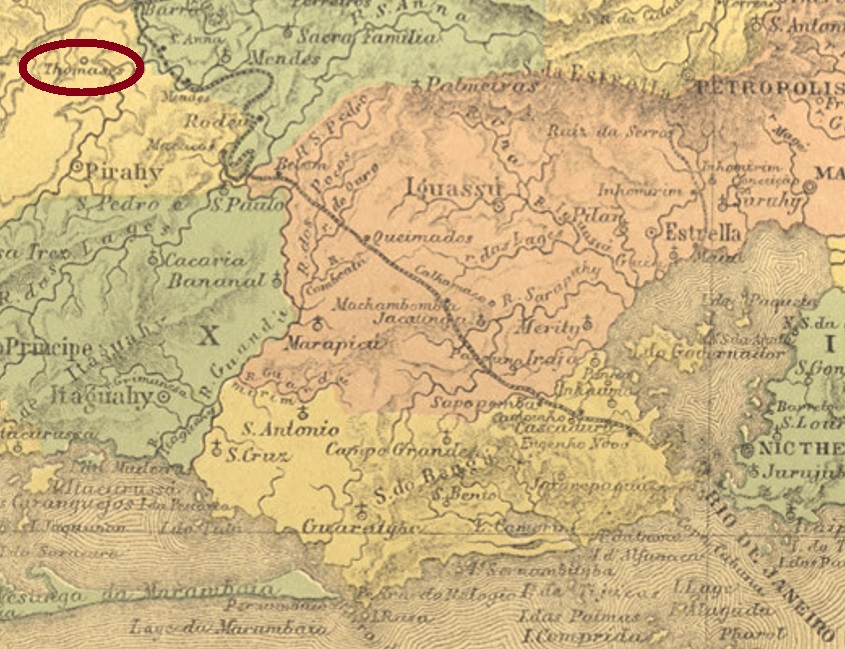
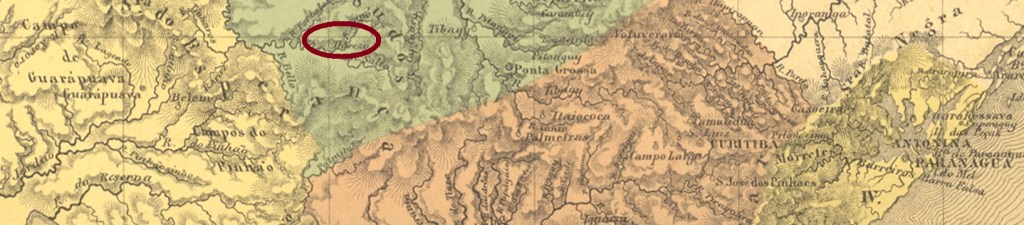
Atlas do Imperio do Brasil, 1868

The Arraial (settlement) of S. João Baptista e S. José dos Thomazes was established around 1830 in the Município of Pirahy and was located close to the left bank of the Pirahy River, about 110 km northwest of the capital Rio de Janeiro. The name is said to remember the first large landowning family, Thomaz da Silva. The short prosperity of this village came to an end at the beginning of the 20th century with the decadence of coffee cultivation in the province of Rio de Janeiro. Today the village has disappeared, its original territory now belonging to the Santanésia district near Piraí.

The local post office was established in 1877, as noted in the Directory of Imperial Post Offices (Tabella das Agencias do Correio do Imperio, Rio de Janeiro, 1885). The commissioning of the agency may have taken place in April or May of that year, as a notice published in the Rio press reveals:
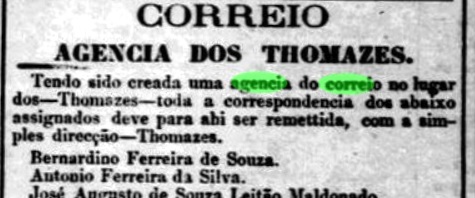
Jornal do Commercio, 15 May 1877

Three postmarks survive for the 19th century, beginning with TRJ-1610a, which was already made known by Paulo Ayres in Catálogo de Carimbos Brasil-Império (S. Paulo, 1937, 1942), under No. 1308: 
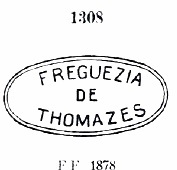
TRJ-1610a (P.A. 1308) 1877ff

The place name is misleading: as far as actual research shows, Thomazes never rose to freguesia status. It was followed by TRJ-1610b (Coll. Fuad Ferreira Fo.): a French-type postmark with the inscription THOMAZES at the top and the typical star between brackets at the bottom, dated 1886-1889 in the middle. Next came TRJ-1610c (Coll. Karlheinz Wittig): a double circle with the inscription THOMAZES at the top and an ornament as an eight-petalled flower at the bottom. Dates in the centre, between 1890 and at least 1894.
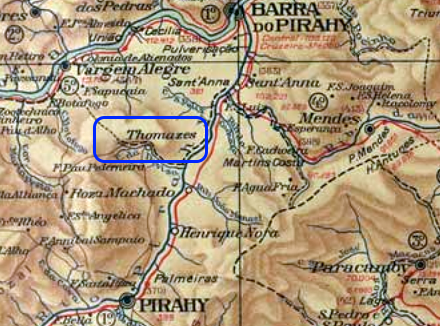
agenciaspostais.com.br

Der Arraial (Siedlung) von S. João Baptista e S. José dos Thomazes entstand um 1830 im Município von Pirahy und lag nah am linken Ufer des Flusses Pirahy, ca. 110 km nordwestlich der Hauptstadt Rio de Janeiro entfernt. Der Name soll an die erste Großgrundbesitzerfamilie Thomaz da Silva erinnern. Der kurze Wohlstand dieser Ortschaft fand sein Ende Anfang des 20. Jahrhunderts mit der Dekadenz des Kaffeeanbaus in der Provinz Rio de Janeiro. Heute ist der Ort verschwunden, sein ursprüngliches Gebiet gehört nun dem Distrikt Santanésia bei Piraí.

Das örtliche Postamt entstand 1877, wie im Verzeichnis der kaiserlichen Postämter (Tabella das Agencias do Correio do Imperio, Rio de Janeiro, 1885) vermerkt. Die Inbetriebnahme der Agentur dürfte im April oder Mai des Jahres stattgefunden haben, wie eine in der Rio-Presse abgegebene Mitteilung verrät:
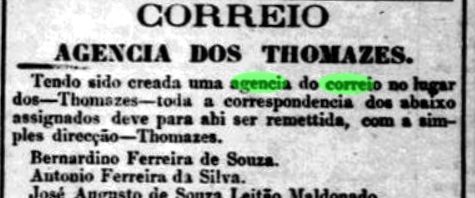
Jornal do Commercio, 15. Mai 1877

Drei Poststempel sind für den 19. Jahrhundert überliefert, beginnend mit TRJ-1610a, der bereits durch Paulo Ayres in Catálogo de Carimbos Brasil-Império, (S. Paulo, 1937, 1942) unter Nr. 1308 bekannt ist: 
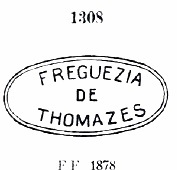
TRJ-1610a (P.A. 1308) 1877ff

Die Ortsbezeichnung ist irreführend: soweit die bisherigen Recherchen ergeben, stieg Thomazes niemals zur Freguesia auf. Ihm folgte TRJ-1610b (Samml. Fuad Ferreira Fo.): ein Poststempel im französischen Typus, mit der Inschirft THOMAZES oben und dem typischen Stern zwischen Klammern unten, datiert 1886-1889 in der Mitte. Danach kam TRJ-1610c (Samml. Karlheinz Wittig): ein Doppelkreis mit der Inschrift THOMAZES oben und einem Ornament als achtblättrige Blume unten. Daten in der Mitte zwischen 1890 und mindestens 1894.
Categories
Carimbologia T-Z

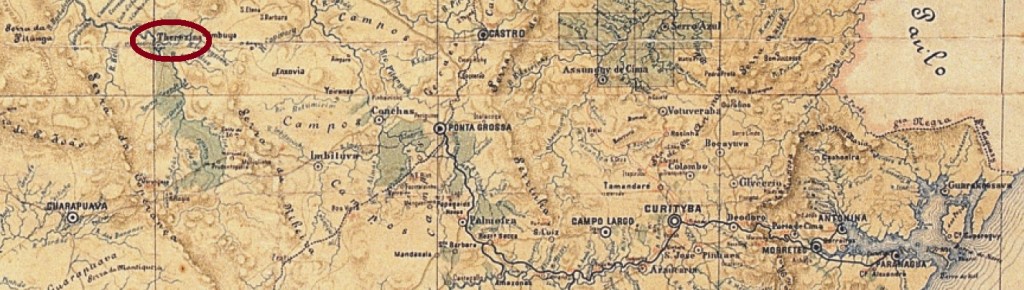
Therezina, Paraná (TPR-0220)

Atlas do Imperio do Brasil, 1868

Other names: Colonia Thereza, Teresa Cristina (ca. 1940)

This other village in honour of the Empress Teresa Cristina was a French colony founded by the doctor Jean-Maurice Faivre (1795-1858) from 1847 onwards, located on the east bank of the Ivahy River, 270 km west of the provincial capital Curitiba. The place was to become a socialist community according to the dream of its founder. In April 1871, it became the Freguesia of Santa Theresa de Therezina in the Município of Guarapuava. And it stayed that way until March 1921, when the place was transferred as a district to the newly founded Município of Reserva. Around 1940 the place name changed back to Teresa Cristina and since November 1954 it has been a district in the Município of Candido de Abreu.

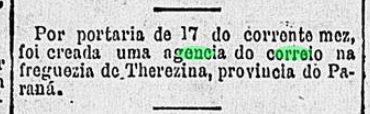
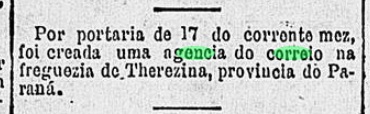
The local post office was created in September 1883, as reported by the Rio press:

Gazeta de Notícias/RJ, 20/09/1883

The imperial postmark is TPR-0220a (Coll. José A. Junges): a double circle with the inscriptions THEREZINA above and PARANA below. The only existing specimen so far bears a date from 1886 in its centre.

Estado do Paraná, 1896

Andere Namen: Colonia Thereza, Teresa Cristina (ca. 1940)

Diese andere Ortschaft zu Ehren der Kaiserin Theresa Cristina war ab 1847 eine französische Kolonie, die vom Arzt Jean-Maurice Faivre (1795-1858) gegründet wurde und am Ostufer des Flusses Ivahy lag, 270 km westlich der Provinzhauptstadt Curitiba entfernt. Der Ort sollte eine sozialistische Gemeinde nach dem Traum seines Gründers werden. Im April 1871 wurde daraus die Freguesia von Santa Theresa de Therezina im Município von Guarapuava. Und so blieb es bis März 1921, als der Ort als Distrikt zum neu gegründeten Município von Reserva überging. Um 1940 wechselte der Ortsname zurück zu Teresa Cristina und ist seit November 1954 ein Distrikt im Município von Candido de Abreu.

Das örtliche Postamt gab es seit September 1883, wie die Presse aus Rio meldete:

Gazeta de Notícias/RJ, 20.09.1883

Der kaiserliche Poststempel ist TPR-0220a (Samml. José A. Junges): ein Doppelkreis mit den Inschriften THEREZINA oben und PARANA unten. Das bisher einzig vorhandene Exemplar trägt ein Datum aus 1886 in seiner Mitte.

Categories
Carimbologia Q-R

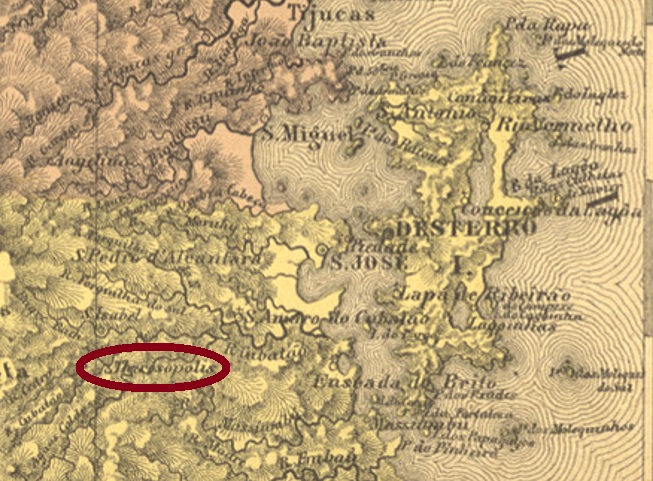
Theresopolis, Santa Catarina (TSC-0255)

Atlas do Imperio do Brasil, 1868

Other names: Colonia Theresopolis, Queçaba, Águas Mornas (1961)

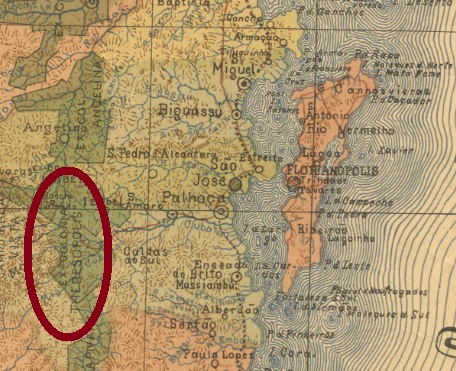
The other Theresopolis in Imperial Brazil was a German colony on the north bank of the Cubatão River from June 1860, located about 40 km southwest of the provincial capital Desterro (now Florianópolis). In June 1869, it became a district from Palhoça, which was renamed Queçaba in December 1943. The word from the Tupi-guarani language is said to mean resting place. In June 1958, Queçaba changed to the newly created Município of Santo Amaro da Imperatriz, and in December 1961 it received administrative autonomy as the Município of Águas Mornas (Lukewarm Waters).

There was a post office there since 1881, as listed in the Directory of Imperial Post Offices (Tabella das Agencias do Correio do Imperio, Rio de Janeiro, 1885). The imperial postmark is TSC-0255a (Coll. José A. Junges): a double circle with the inscriptions THERESOPOLIS above and (STA CATH.) below. The dates in the centre go from about 1881 to at least 1890.

Estado de Santa Catharina, 1907

Andere Namen: Colonia Theresopolis, Queçaba, Águas Mornas (1961)

Der andere Theresopolis im kaiserlichen Brasilien war ab Juni 1860 eine deutsche Kolonie am Nordufer des Flusses Cubatão, die ca. 40 km südwestlich der Provinzhauptstadt Desterro (heute Florianópolis) entfernt lag. Im Juni 1869 wurde daraus ein Distrikt bei Palhoça, der im Dezember 1943 zu Queçaba umbenannt wurde. Das Wort aus der Tupi-guarani Sprache soll Ruhestätte bedeuten. Im Juni 1958 wechselte Queçaba zum neu entstandenen Município von Santo Amaro da Imperatriz und erhielt im Dezember 1961 die Verwaltungsautonomie als Município von Águas Mornas (Lauwarme Gewässer).

Dort gab es ein Postamt seit 1881, wie im Verzeichnis der kaiserlichen Postämter (Tabella das Agencias do Correio do Imperio, Rio de Janeiro, 1885) aufgelistet. Der kaiserliche Ortsstempel ist TSC-0255a (Samml. José A. Junges): ein Doppelkreis mit den Inschriften THERESOPOLIS oben und (STA CATH.) unten. Daten in der Mitte von ca. 1881 bis mindestens 1890.

Categories
Carimbologia T-Z

Theresopolis (TRJ-2275) – Varzea de Theresopolis, Rio de Janeiro (VRJ-2275)

Atlas do Imperio do Brasil, 1868

Other names: Santo Antonio do Paquequer, Vargem de Theresopolis

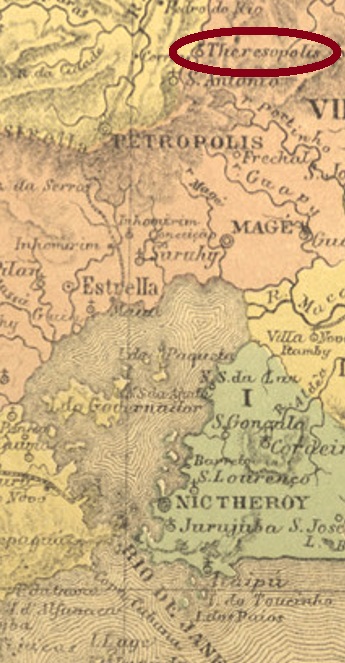
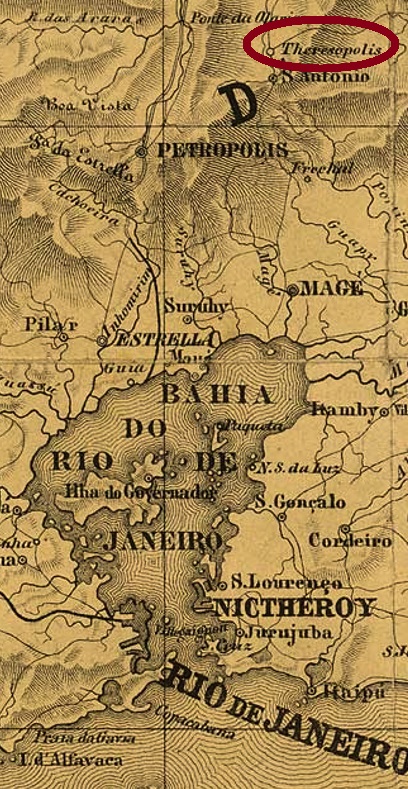
This village became the district of Santo Antonio do Paquequer near Magé in October 1855 and was located on the Paquequer River, barely 100 km north of the capital Rio de Janeiro. Around this time, the place name Theresopolis came into use – a homage to Empress Theresa Christina (1822-1889), the wife of D. Pedro II – although the official change of place name did not take place until May 1892 and thus already in the Republic. The place had already been a vila since July 1891 and became a town in January 1893.

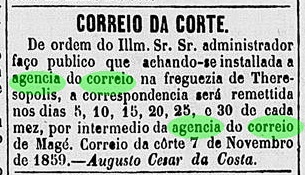
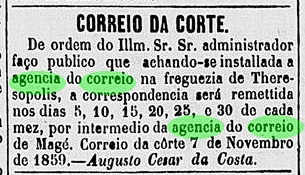
Two foundation dates for the local post office have been found. The first one in September 1859, as Nova Monteiro writes in Administrações e Agencias Postaes do Brasil Imperio (Brasil Filatelico/RJ, 1934-5; Reprint SPP 1994-1999). The post operation probably only began in November of that year, as reported in the Rio press – under the place name Theresopolis:

Correio da Tarde, 8 November 1859

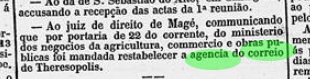
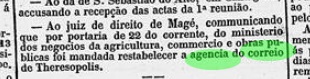
According to Paulo Novaes (agenciaspostais.com.br), the agency was closed in June 1861. It reopened as early as April 1862:

Correio Mercantil, 11.05.1862

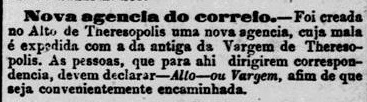
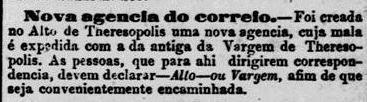
In the upper part of the town, another post office was opened in October 1874 under the name Alto de Theresopolis (ARJ-2450). The press announcement at the time seemed to foreshadow that there would be confusion between the two local agencies:

Jornal do Commercio/RJ, 03.10.1874

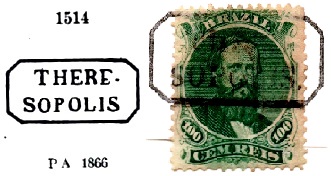
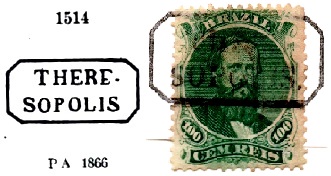
The confusion was probably the reason for changing the name of the old post office to Várzea de Theresopolis (Lower Theresopolis) towards the end of the Empire. Curiously, there seems to be no town stamp with the official name Santo Antonio do Paquequer. The oldest postmark so far is TRJ-2275a, which was found with dates between ca. 1866 and ca. 1883 and can already be seen in the Catálogo de Carimbos Brasil-Império (S. Paulo, 1937, 1942) by Paulo Ayres under no. 1514. However, the dot after the last letter is missing in the catalogue picture, as can be seen from the example (Coll. José A. Junges):

TRJ-2275a (P.A. 1514 recte/JJ)

It was followed by VRJ-2275a (Coll. José A. Junges): a double circle with the inscription VARZEA DE THERESOPOLIS at the top and an ornament as an eight-petal flower at the bottom. Dates in the centre exist from 1886 to 1888.

Almanak Laemmert, 1866

Andere Namen: Santo Antonio do Paquequer, Vargem de Theresopolis

Diese Ortschaft wurde ab Oktober 1855 der Distrikt von Santo Antonio do Paquequer bei Magé und lag am Fluss Paquequer, knapp 100 km nördlich der Hauptstadt Rio de Janeiro entfernt. Um diese Zeit kam auch der Ortsname Theresopolis zu Gebrauch – eine Hommage an die Kaiserin Theresa Christina (1822-1889), die Frau von D. Pedro II – obwohl der offizielle Ortsnamenswechsel erst im Mai 1892 und damit schon in der Republik stattfand. Da war der Ort bereits seit Juli 1891 eine Vila, und wurde im Januar 1893 eine Stadt.

Zwei Gründungsdaten fürs örtliche Postamt sind überliefert. Erstmals im September 1859, wie Nova Monteiro in Administrações e Agencias Postaes do Brasil Imperio (Brasil Filatelico/RJ, 1934-5; Reprint SPP 1994-1999) schreibt. Der eigentliche Betrieb begann wohl erst im November des Jahres, wie die Presse aus Rio – unter der Ortsbezeichnung Theresopolis – berichtet:

Correio da Tarde, 8. November 1859

Laut Paulo Novaes (agenciaspostais.com.br) wurde die Agentur im Juni 1861 geschlossen. Die Wiedereröffnung fand bereits im April 1862 statt:

Correio Mercantil, 11.05.1862

Im oberen Ortsteil wurde im Oktober 1874 ein weiteres Postamt unter dem Namen Alto de Theresopolis (ARJ-2450) eröffnet. Die damalige Presseankündigung schien zu ahnen, dass es Verwechslungen zwischen beiden Agenturen vor Ort geben würde:

Jornal do Commercio/RJ, 03.10.1874

Die Verwechslungen waren gegen Ende des Kaiserreichs wohl der Anlass zur Namensänderung des alten Postamts zu Várzea de Theresopolis (Unterer Theresopolis). Merkwürdigerweise scheint es keinen Ortsstempel mit dem offiziellen Namen Santo Antonio do Paquequer zu geben. Der bisher älteste Poststempel ist TRJ-2275a, der bisher mit Daten zwischen ca. 1866 und ca. 1883 gefunden wurde und bereits im Catálogo de Carimbos Brasil-Império (S. Paulo, 1937, 1942) von Paulo Ayres unter der Nr. 1514 zu sehen ist. Allerdings fehlte im Katalogbild der Punkt nach dem letzten Buchstaben, wie man aus dem Beispiel (Samml. José A. Junges) sehen kann:

TRJ-2275a (P.A. 1514 recte/JJ)

Ihm folgte VRJ-2275a (Samml. José A. Junges): ein Doppelkreis mit der Inschrift VARZEA DE THERESOPOLIS oben und einem Ornament als achtblättrige Blume unten. Daten in der Mitte von 1886 bis 1888.

Categories
Carimbologia T-Z

Theophilo Ottoni, Minas Gerais (TMG-3190)

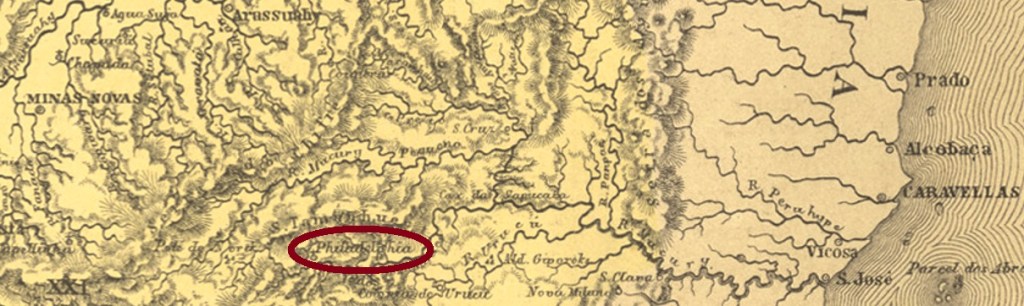
Provincia de Minas Geraes, 1873

See also Philadelphia (R. Koester: Carimbologia XXXI)

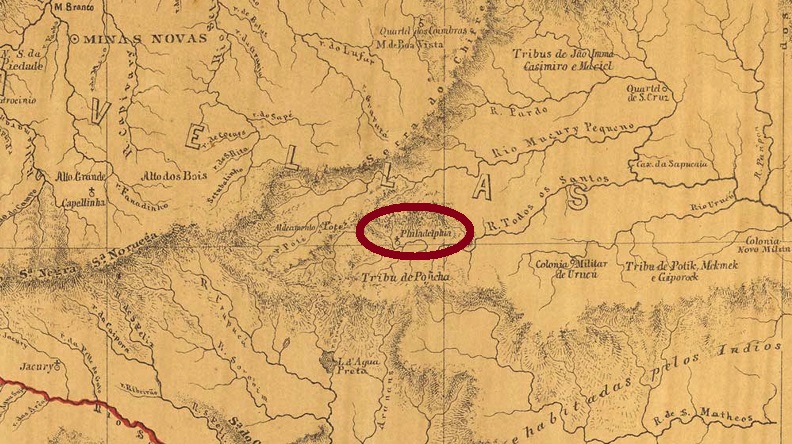
The history of this locality begins in September 1853 with the founding of the colony of Philadelphia by the journalist, merchant and congressman Teophilo Benedicto Ottoni (1807-1869). He dreamed of building a city based on the symbolic example of its US counterpart in the northeast of Minas Gerais, about 480 km northeast of the provincial capital Ouro Preto. In July 1857, this became the Freguesia of Nossa Senhora da Conceição de Nova Philadelphia in the Município of Minas Novas. In November 1878, the place rose to become a vila with the name of its then deceased founder.

The local post office was established in February 1857, as Reinhold Koester, Nova Monteiro (Administrações e Agencias Postaes do Brasil Imperio, in Brasil Filatelico/RJ, 1934-5; Reprint SPP 1994-1999) and Paula Sobrinho (História Postal de Minas Gerais, Belo Horizonte, 1997) reported. The first local postmarks still bear the inscription PHILADELPHIA and were used at least until 1879, as R. Koester writes in Carimbologia XXXI. TMG-3190a (Coll. José A. Junges) is probably the first cancel with the later place name: a double circle with the inscription TEOPHILO=OTTONI above and an ornament in lozenge below, formed by four small lozenges. It also exists in blue, green and lilac; the dates in the middle were found for the period 1882 to 1907.

Atlas do Imperio do Brasil, 1868

Siehe auch Philadelphia (R. Koester: Carimbologia XXXI)

Die Geschichte dieser Ortschaft beginnt im September 1853 mit der Gründung der Kolonie Philadelphia durch den Journalisten, Händler und Abgeordneter Teophilo Benedicto Ottoni (1807-1869). Er träumte davon, eine Stadt nach dem symbolischen Beispiel des US-Pendants im Nordosten von Minas Gerais zu bauen, ca. 480 km nordöstlich der Provinzhauptstadt Ouro Preto entfernt. Im Juli 1857 wurde daraus die Freguesia von Nossa Senhora da Conceição de Nova Philadelphia im Município von Minas Novas. Im November 1878 stieg der Ort zu einer Vila mit dem Namen ihres inzwischen verstorbenen Gründers auf.

Das örtliche Postamt wurde im Februar 1857 ins Leben gerufen, wie Reinhold Koester, Nova Monteiro (Administrações e Agencias Postaes do Brasil Imperio, in Brasil Filatelico/RJ, 1934-5; Reprint SPP 1994-1999) und Paula Sobrinho (História Postal de Minas Gerais, Belo Horizonte, 1997) übereinstimmend berichten. Die ersten lokalen Poststempel tragen noch die Inschrift PHILADELPHIA und wurden zumindest bis 1879 verwendet, wie R. Koester in Carimbologia XXXI schreibt. TMG-3190a (Samml. José A. Junges) ist wohl der erste Stempel mit dem späteren Ortsnamen: ein Doppelkreis mit der Inschrift TEOPHILO=OTTONI oben und einem Ornament in Raute unten, das aus vier kleinen Rauten gebildet wird. Es gibt ihn auch in blau, grün und lila; die Daten in der Mitte wurden für den Zeitraum 1882 bis 1907 gefunden.

Categories
Carimbologia T-Z

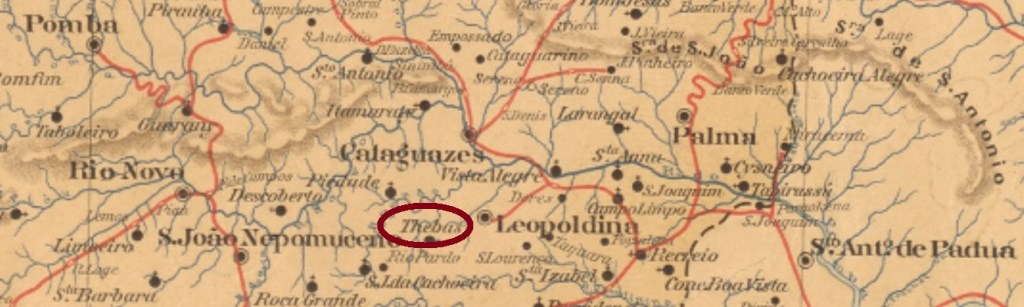
Thebas, Minas Gerais (TMG-3185)

Estado de Minas Geraes, 1910

Another name: Santo Antonio dos Thebas.

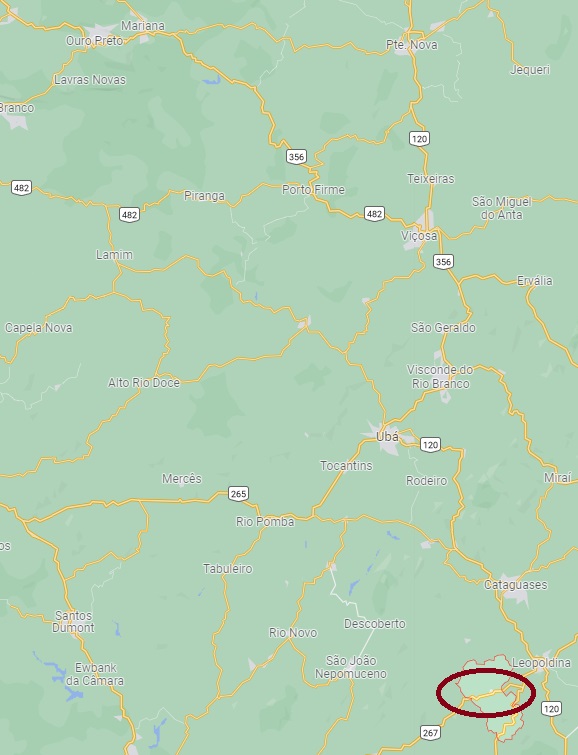
This village was a district of Leopoldina since October 1881, located below the Serra do Rio Pardo, almost 270 km southeast of the provincial capital Ouro Preto. And it has remained so until today, also in terms of population (about 2,000 inhabitants).

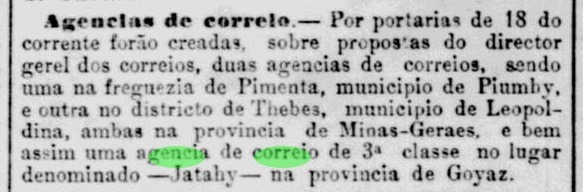
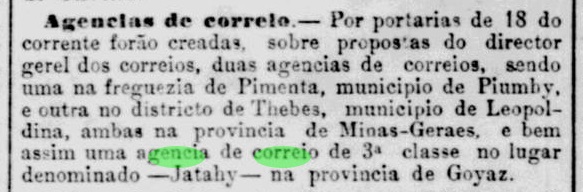
The local post office was established in August 1881, as Paula Sobrinho writes in História Postal de Mians Gerais (Belo Horizonte, 1997), which is also confirmed by the press from Rio de Janeiro.

Jornal do Commercio/RJ, 20 August 1881

The imperial postmark is TMG-3185a (Coll. José A. Junges): a double circle – which also exists in lilac – with the inscriptions THEBAS above and (MINAS) below. The dates in the middle were found for the period 1888-1901.

Google Maps

Anderer Name: Santo Antonio dos Thebas

Diese Ortschaft war seit Oktober 1881 ein Distrikt von Leopoldina, der unterhalb der Serra do Rio Pardo lag, knapp 270 km südöstlich der Provinzhauptstadt Ouro Preto entfernt. Und so ist es bis heute geblieben, auch was die Bevölkerungszahl betrifft (ca. 2.000 Einwohner).

Das örtliche Postamt entstand im August 1881, wie Paula Sobrinho in História Postal de Mians Gerais (Belo Horizonte, 1997) schreibt, was auch durch die Presse aus Rio de Janeiro bestätigt wird.

Jornal do Commercio/RJ, 20. August 1881

Der kaiserliche Poststempel ist TMG-3185a (Samml. José A. Junges): ein Doppelkreis – den es auch in lila gibt – mit den Inschriften THEBAS oben und (MINAS) unten. Die Daten in der Mitte wurde für den Zeitraum 1888-1901 gefunden.

Categories
Carimbologia T-Z

Teutonia, Rio Grande do Sul (TRS-0450)

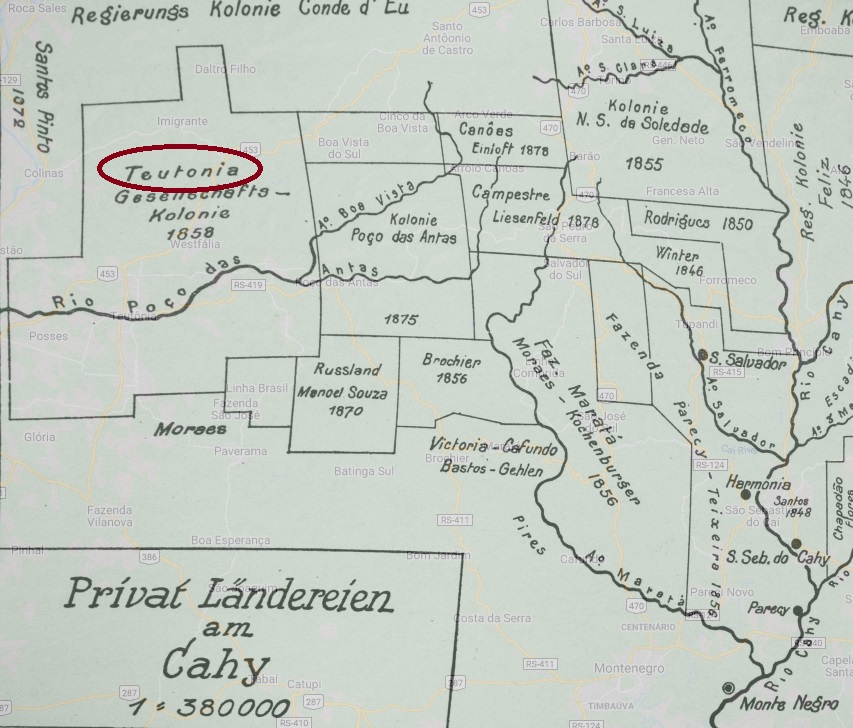
colonias.heuser.pro.br

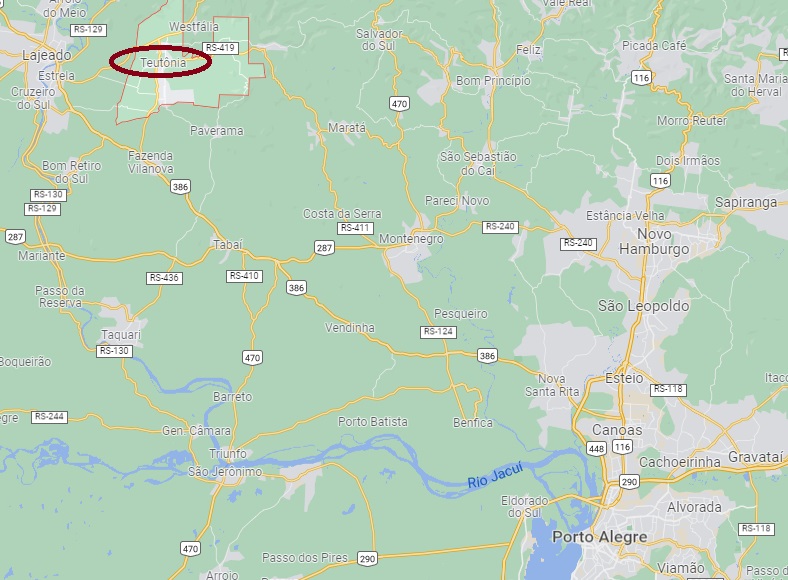
As the name suggests, Teutonia was from 1858 a German colony in the Município of Taquary, located just under 110 km northwest of the provincial capital Porto Alegre. In May 1876, the place changed to the newly founded municipality of Estrella, and since October 1981, Teutônia (now with ô) has been an independent Município.

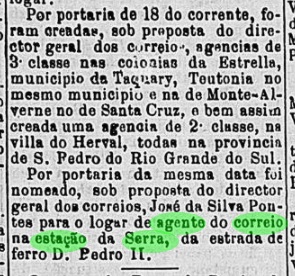
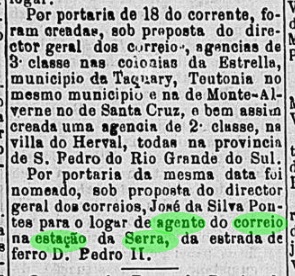
The local post office was established in October 1882, as reported by the Rio press:

Gazeta da Tarde/RJ, 19/10/1882

The imperial postmark is TRS-0450a (Coll. José A. Junges): a double circle with the inscription TEUTONIA above and an ornament in lozenge below, formed by four three-leaved branches. The cancel also occurs in violet and shows dates from 1884 to 1901 inside.

Google Maps

Wie der Name schon verrät, war Teutonia seit 1858 eine deutsche Kolonie im Município von Taquary, knapp 110 km nordwestlich der Provinzhauptstadt Porto Alegre gelegen. Im Mai 1876 wechselte der Ort zur neu gegründeten Gemeinde Estrella, und seit Oktober 1981 ist Teutônia – nun mit ô geschrieben – ein eigenständiger Município.

Das lokale Postamt entstand im Oktober 1882, wie die Presse aus Rio berichtete:

Gazeta da Tarde/RJ, 19.10.1882

Der kaiserliche Poststempel ist TRS-0450a (Samml. José A. Junges): ein Doppelkreis mit der Inschrift TEUTONIA oben und einem Ornament in Raute unten, das aus vier dreiblättrigen Zweigen gebildet wird. Der Stempel kommt auch in violett vor und zeigt im Inneren Daten von 1884 bis 1901.

Categories
Carimbologia T-Z

Telha, Ceará (TCE-0370)

Atlas do Imperio do Brasil, 1868

See also Iguatu (R. Koester: Carimbologia XXII)

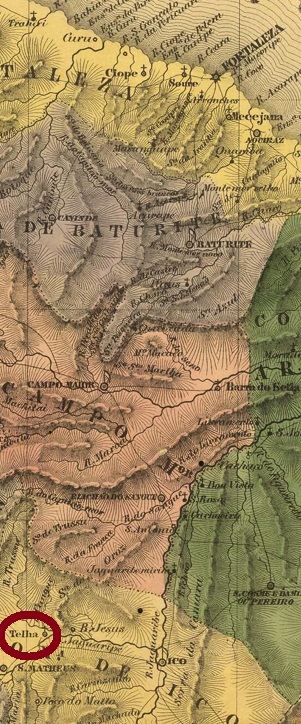
This locality was the district of N. Sa. Sant’Anna da Telha from October 1831, situated on the west bank of the Jaguaribe near Icó, 360 km south of the provincial capital Fortaleza. It became a vila in November 1851 and a town in August 1874 and has been called Iguatu since October 1883.

According to Nova Monteiro (Administrações e Agencias Postaes do Brasil Imperio, in Brasil Filatelico/RJ, 1934-5; Reprint SPP 1994-1999), there was a post office in Telha from August 1866. Unfortunately, no postmark has been seen under this name yet. For cancellations with IGUATU see R. Koester’s Carimbologia XXII.

Villiers de l’Ile Adam: Carta (…) da Provincia do Ceará, 1849

Siehe auch Iguatu (R. Koester: Carimbologia XXII)

Diese Ortschaft war seit Oktober 1831 der Distrikt von N. Sa. Sant’Anna da Telha, der am Westufer des Jaguaribe bei Icó lag, 360 km südlich der Provinzhauptstadt Fortaleza entfernt. Im November 1851 erfolgte der Aufstieg zur Vila und im August 1874 zu einer Stadt, die seit Oktober 1883 Iguatu heißt.

Laut Nova Monteiro (Administrações e Agencias Postaes do Brasil Imperio, in Brasil Filatelico/RJ, 1934-5; Reprint SPP 1994-1999) gab es in Telha ein Postamt ab August 1866. Leider war bisher kein Poststempel unter diesem Ortsnamen zu sehen. Für Entwertungen mit IGUATU siehe R. Koesters Carimbologia XXII.

Categories
Carimbologia T-Z

Tejuco, Minas Gerais (TMG-3740)

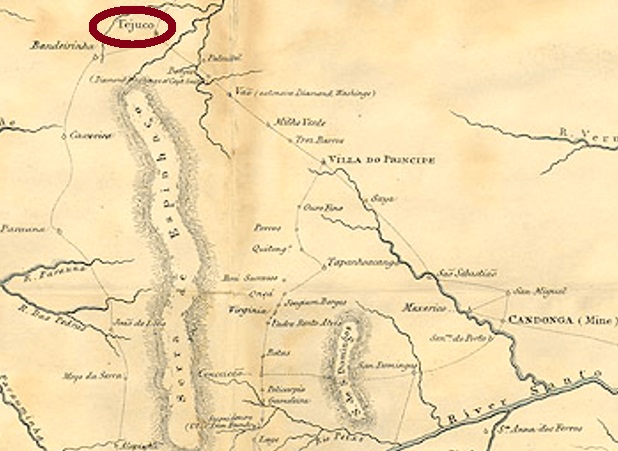
Provincia de Minas Geraes, 1835

See also Diamantina (R. Koester: Carimbologia XVI)

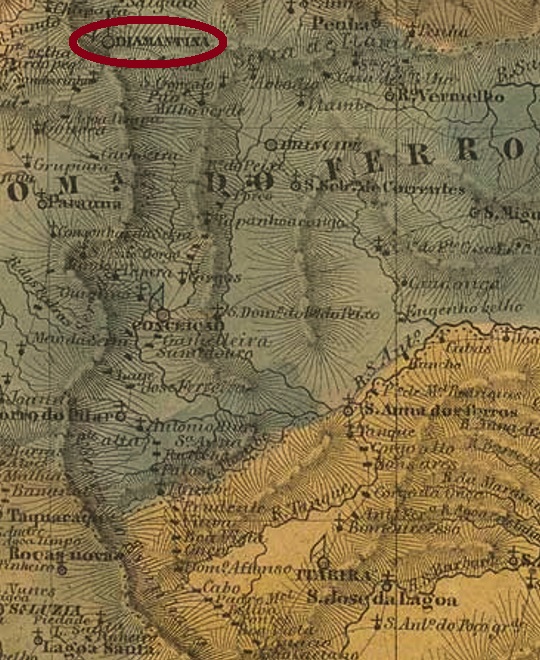
Arraial do Tejuco already existed from about 1729, it was a settlement of gold and diamond seekers located 380 km north of the future provincial capital of Ouro Preto. By royal decree (Alvará Régio), the place was promoted to freguesia in October 1819. In October 1831, already after Brazil’s independence, it became the Vila of Diamantina.

No less than four dates of creation of the local post office have been found, two of them by Paula Sobrinho in História Postal de Minas Gerais (Belo Horizonte, 1997): first in May 1809, then again in October 1833. Nova Monteiro in Administrações e Agencias Postaes do Brasil Imperio (Brasil Filatelico/RJ, 1934-5; reprint SPP 1994-1999) provided a date for the intermediate period, in March 1829. Finally, Reinhold Koester (Carimbologia XVI) writes October 1839, a sure indication of an eventful postal history of this place.

A single postmark from Tejuco was found and registered by the RHM catalogue under P-MG-64:

TMG-3740a (RHM P-MG-64) 1827-1834

Later town postmarks already bear the inscription DIAMANTINA and can be seen on R. Koester’s Carimbologia XVI.

Villiers de l’Ile Adam: Carta (…) da Provincia de Minas Geraes, 1849

Siehe auch Diamantina (R. Koester: Carimbologia XVI)

Den Arraial do Tejuco gab es bereits ab ca. 1729, er war eine Siedlung von Gold- und Diamantensuchern, die 380 km nördlich der künftigen Provinzhauptstadt Ouro Preto entfernt lag. Durch königliche Verfügung (Alvará Régio) stieg der Ort im Oktober 1819 zur Freguesia auf. Im Oktober 1831, also bereits nach Brasiliens Unabhängigkeit, wurde daraus die Vila von Diamantina.

Es wurden nicht weniger als vier Gründungsdaten fürs örtliche Postamt gefunden, zwei davon durch Paula Sobrinho in História Postal de Minas Gerais (Belo Horizonte, 1997) überliefert: erstmals im Mai 1809, dann wieder im Oktober 1833. Nova Monteiro lieferte im Administrações e Agencias Postaes do Brasil Imperio (in Brasil Filatelico/RJ, 1934-5; Reprint SPP 1994-1999) ein Datum für die Zwischenzeit, im März 1829. Und schließlich schreibt Reinhold Koester (Carimbologia XVI) noch den Oktober 1839. Ein sicheres Indiz für eine bewegte Postgeschichte dieses Orts.

Ein einziger Poststempel aus Tejuco wurde gefunden und durch den RHM-Katalog unter P-MG-64 registriert:

TMG-3740a (RHM P-MG-64) 1827-1834

Spätere Ortsstempel tragen bereits die Inschrift DIAMANTINA und sind unter R. Koesters Carimbologia XVI zu sehen.

Categories
Carimbologia T-Z

Teixeira, Paraíba (TPB-0250)

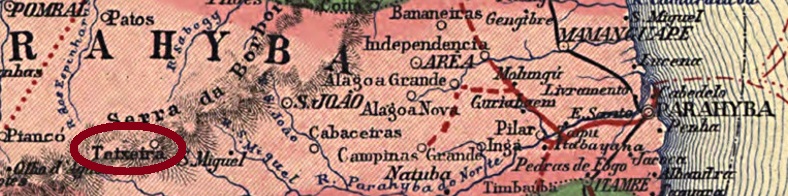
Carta da Republica dos Estados Unidos do Brazil, 1892

Another name: Serra do Teixeira

The district of Serra do Teixeira was created in October 1857 in the Município of Patos, 300 km west of the provincial capital of Parahyba do Norte (now João Pessoa). In August 1859, it became a vila, downgraded as a district of Patos in November 1871 and restored in September 1874.

There had been a post office there since January 1862, as Nova Monteiro writes in Administrações e Agencias Postaes do Brasil Imperio (in Brasil Filatelico/RJ, 1934-5; reprint SPP 1994-1999). This is confirmed by the provincial president’s report of May 1862:

Relatório do Presidente da Provincia, May 1862

Only one postmark of the imperial period was found, certainly not the oldest. TPB-0250b (Coll. José A. Junges) is a plain double circle with the inscription TEIXEIRA at the top. The only specimen bears a date from 1888 in the centre.

Atlas do Imperio do Brasil, 1868

Anderer Name: Serra do Teixeira

Der Distrikt von Serra do Teixeira entstand im Oktober 1857 im Município von Patos und lag 300 km westlich der Provinzhauptstadt Parahyba do Norte (heute João Pessoa) entfernt. Im August 1859 wurde daraus eine Vila, die im November 1871 als Distrikt von Patos herabgestuft und im September 1874 wiederhergestellt wurde.

Es gab dort ein Postamt seit Januar 1862, wie Nova Monteiro in Administrações e Agencias Postaes do Brasil Imperio (in Brasil Filatelico/RJ, 1934-5; Reprint SPP 1994-1999) schreibt. Das wird durch den Bericht des Provinzpräsidenten vom Mai 1862 bestätigt:

Relatório do Presidente da Provincia, Mai 1862

Nur ein Poststempel der Kaiserzeit wurde gefunden, sicher nicht der älteste. TPB-0250b (Samml. José A. Junges) ist ein schlichter Doppelkreis mit der Inschrift TEIXEIRA oben. Das einzige Exemplar trägt ein Datum aus 1888 in der Mitte.