Categories
Carimbologia A-B

Aracati/Aracaty, Ceará (ACE-0020)

Atlas do Imperio do Brasil, 1868

Other names: S. José do Porto dos Barcos, Cruz das Almas

The former freguesia of Santa Cruz do Aracaty was originally called S. José do Porto dos Barcos and later also Cruz das Almas (Cross of Souls) and was located on the east bank of the Jaguaribe River, 150 km southeast of the later provincial capital Fortaleza. The place rose to the status of vila in April 1747 and town in December 1842.

There were apparently three periods of operation for the local post office. It is not known when the post office first opened, but it was probably by April 1831, when the local postmaster was mentioned in the Pernambuco press:

Diario de Pernambuco, 17.06.1831

The first period of operation ended around 1851, for at the beginning of 1852, the post office was already closed, as a note from the regional press tells us:

Cearense, 10.02.1852

As Nova Monteiro writes in Administrações e Agencias Postaes do Brasil Imperio (Brasil Filatelico/RJ, 1934-5; Reprint SPP 1994-1999), the agency reopened in February 1852. The third creation of the post office is said to have taken place in 1872, as noted in the Directory of Imperial Post Offices (Tabella das Agencias do Correio do Imperio, Rio de Janeiro, 1885). However, this reopening could not be confirmed anywhere, it is possibly a printing error.

Three postmarks and one handwritten cancellation were found for the Empire. Firstly ACE-0020a, which was used at least between 1832 and 1844 and is known by Paulo Ayres (Catálogo de Carimbos Brasil-Império, S. Paulo, 1937, 1942) under no. 1127:

ACE-0020a (P.A. 1127) 1832-1844ff

P. Ayres (op. cit.) also showed ACE-0020b, now under no. 1202. This cnacel was also used in blue from 1866:

ACE-0020b (P.A. 1202)

The last imperial postmark is ACE-0020c, which was presented to us by R. Koester in Carimbologia II:

ACE-0020c (RK) 1888-1890

Koester also showed the handwritten cancellation from Aracaty, which was probably used between ACE-0020a and ACE-0020b:

1850ff (RK)
Villiers de l’Ile Adam: Carta (…) da Provincia do Ceara, 1849

Andere Namen: S. José do Porto dos Barcos, Cruz das Almas

Die frühere Freguesia von Santa Cruz do Aracaty hieß ursprünglich S. José do Porto dos Barcos und später auch Cruz das Almas (Kreuz der Seelen) und lag am Ostufer des Flusses Jaguaribe, 150 km südöstlich der späteren Provinzhauptstadt Fortaleza entfernt. Der Ort stieg im April 1747 zur Vila und im Dezember 1842 zur Stadt auf.

Es gab mindestens drei Betriebsperioden fürs örtliche Postamt. Wann die Postagentur erstmals eröffnete ist nicht bekannt, aber es dürfte vor April 1831 sein, als der dortige Postverwalter in der Presse aus Pernambuco erwähnt wurde:

Diario de Pernambuco, 17.06.1831

Die erste Betriebsperiode endete um 1851, denn am Anfang 1852 war das Postamt schon geschlossen, wie eine Notiz der Regionalpresse uns mitteilt:

Cearense, 10.02.1852

Wie Nova Monteiro in Administrações e Agencias Postaes do Brasil Imperio (Brasil Filatelico/RJ, 1934-5; Reprint SPP 1994-1999) schreibt, eröfnete die Agentur im Februar 1852 wieder. Die dritte Entstehung des Postamts soll 1872 stattgefunden haben, wie im Verzeichnis der kaiserlichen Postämter (Tabella das Agencias do Correio do Imperio, Rio de Janeiro, 1885) vermerkt. Allerdings konnte diese Wiedereröffnung nirgends bestätigt werden, es handelt sich hier möglicherweise um einen Druckfehler.

Drei Poststempel und eine handschriftliche Entwertung wurden fürs Kaiserreich gefunden. Zuerst ACE-0020a, der zumindest zwischen 1832 und 1844 verwendet wurde und durch Paulo Ayres (Catálogo de Carimbos Brasil-Império, S. Paulo, 1937, 1942) unter Nr. 1127 bekannt ist:

ACE-0020a (P.A. 1127) 1832-1844ff

P. Ayres (op. cit.) zeigte auch ACE-0020b, diesmal unter der Nr. 1202. Dieser Stempel wurde ab 1866 auch in blau gebraucht:

ACE-0020b (P.A. 1202)

Der letzte kaiserliche Poststempel ist ACE-0020c, der uns durch R. Koester in  Carimbologia II vorgestellt wurde:

ACE-0020c (RK) 1888-1890

Koester zeigte auch die handschriftliche Entwertung aus Aracaty, die wohl zwischen ACE-0020a und ACE-0020b verwendet wurde:

1850ff (RK)
Categories
Carimbologia A-B

Araçariguama, São Paulo (ASP-0045)

Villiers de l’Ile Adam: Carta (…) da Provincia de São Paulo, 1847

The beautiful Indian word Araçariguama means meeting place of the Araçaris. Araçari is a bird of the toucan family (Ramphastidae), such as the black-throated aracari:

Pteroglopssus aracari (Linnaeus 1758, photo Andrew Newberry, CC BY-SA 2.0).

The Freguesia of N. Sra. da Penha de Araçariguama was founded in 1701 in the Vila of Sant’Anna de Parnahyba and was located close to the south bank of the river Tietê, a good 50 km west of the later provincial capital of São Paulo. The town changed to the Município of S. Roque in February 1844, became a Vila in April 1874 and a town in December 1906. Then there came its downgrading as a District of S. Roque in May 1934, before regaining Município status in December 1991.

The local post office was created in 1875, as shown in the Directory of Imperial Post Offices (Tabella das Agencias do Correio do Imperio, Rio de Janeiro, 1885). The only postmark in the Empire so far is ASP-0045b (Fig. Mario Celso Orsi Jr.) a double circle with the inscription ARAÇARIGUAMA at the top. The internal dates go from 1889 to 1899.

Atlas do Imperio do Brasil, 1868

Das schöne Indianerwort Araçariguama bedeutet Treffpunkt der Araçaris. Araçari ist ein Vogel der Familie der Tukane (Ramphastidae), wie z.B. der Schwarzkehlarassari:

Pteroglopssus aracari (Linnaeus 1758, Foto Andrew Newberry, CC BY-SA 2.0)

Die Freguesia von N. Sra. da Penha de Araçariguama wurde 1701 in der Vila von Sant’Anna de Parnahyba gegründet und lag nah am Südufer des Flusses Tietê, gut 50 km westlich der späteren Provinzhauptstadt São Paulo. Der Ort wechselte im Februar 1844 zum Município von S. Roque, wurde Vila im April 1874 und Stadt im Dezember 1906. Dann kam im Mai 1934 die Herabstufung als Distrikt von S. Roque, bevor der Município-Status im Dezember 1991 wieder erlangt wurde.

Das örtliche Postamt entstand 1875, wie aus dem Verzeichnis der kaiserlichen Postämter (Tabella das Agencias do Correio do Imperio, Rio de Janeiro, 1885) hervorgeht. Der bisher einzige Poststempel im Kaiserreich ist ASP-0045b (Abb. Mario Celso Orsi Jr.) ein Doppelkreis mit der Inschrift ARAÇARIGUAMA oben. Die inneren Daten gehen von 1889 bis 1899.

Categories
Carimbologia A-B

Aquiraz, Ceará (ACE-0015)

Villiers de l’Ile Adam: Carta (…) da Provincia do Ceara, 1849

Aquiraz was the first vila of the Capitania of Ceará, founded by Royal Decree (Ordem Régia) of February 1699, and was also the capital of this Capitania between 1713 and 1810. The place name has its origin in the Tupi language and is said to mean waters that lie further. The villa of S. José do Ribamar de Aquiraz was located on the east bank of the Pacoti River, over 30 km southeast of the later provincial capital Fortaleza. Aquiraz has been a town since July 1915.

Two periods of operation for the local post office have been recorded, although it has not yet been possible to find out when the first period began. It ended in March 1847, according to the Rio Official Press:

Gazeta Official/RJ, 24.03.1847

The second creation of the postal agency took place around June 1872, as the Directory of the Imperial Post Offices (Tabella das Agencias do Correio do Imperio, Rio de Janeiro, 1885) reveals. This is confirmed by the regional press:

Cearense, 04.07.1872

Two imperial postmarks were found, unfortunately not the oldest ones. ACE-0015b (image from the internet) is a simple double circle with the above inscription AQUIRAZ. The only specimen bears a date from 1890 in the centre. ACE-0015c was already presented to us by Paulo Ayres in Catálogo de Carimbos Brasil-Império (S. Paulo, 1937, 1942) on p. 145:

ACE-0015c (P.A. p. 145)
Atlas do Imperio do Brasil, 1868

Aquiraz war die erste Vila der Capitania von Ceará, gegründet durch Königliche Verfügung (Ordem Régia) vom Februar 1699, und war auch die Hauptstadt dieser Capitania zwischen 1713 und 1810. Der Ortsname hat den Ursprung in der Tupi-Sprache und soll etwa Gewässer, die weit entfernt liegen bedeuten. Die Villa von S. José do Ribamar de Aquiraz lag am Ostufer des Flusses Pacoti, gut 30 km südöstlich der späteren Provinzhauptstadt Fortaleza entfernt. Seit Juli 1915 ist Aquiraz eine Stadt.

Zwei Betriebsperioden fürs örtliche Postamt sind überliefert, wobei es noch nicht möglich war, herauszufinden, wann die erste Periode begann. Sie endete im März 1847, wie die Amtspresse aus Rio mitteilte:

Gazeta Official/RJ, 24.03.1847

Die zweite Entstehung der Postagentur fand um Juni 1872 statt, wie das Verzeichnis der kaiserlichen Postämter (Tabella das Agencias do Correio do Imperio, Rio de Janeiro, 1885) verrät. Das wird durch die Regionalpresse bestätigt:

Cearense, 04.07.1872

Zwei kaiserliche Poststempel wurden gefunden, leider nicht der älteste. ACE-0015b (Abb. aus dem Internet) ist ein einfacher Doppelkreis mit der obigen Inschrift AQUIRAZ. Das einzige Exemplar trägt ein Datum aus 1890 in der Mitte. ACE-0015c wurde uns bereit durch Paulo Ayres in Catálogo de Carimbos Brasil-Império (S. Paulo, 1937, 1942) auf S. 145 vorgestellt:

ACE-0015c (P. A. S. 145)

Categories
Carimbologia A-B

Aquidaban, Sergipe (ASE-0005)

Arthur D. Ribeiro: Estado de Sergipe, 1924

Other names: Sant’Anna do Cemitério, Aquidabã

This locality was the former Freguesia of Sant’Anna do Cemitério (Saint Anne of the Cemetery) from April 1872, belonging to the Município of Propriá and located 100 km north of the provincial capital Aracaju. Exactly ten years later, villa status was obtained under the name Aquidaban, which means fertile land between rivers in Tupi. Since 1938, Aquidabã, as it is written today, has been a town.

So far, the date of origin for the local post office has not been found, but it must have been from 1885 onwards, because the agency was not listed in the Directory of Imperial Post Offices (Tabella das Agencias do Correio do Imperio, Rio de Janeiro, 1885). Nor was there an imperial postmark from this place.

Estado da Bahia, 1913

Andere Namen: Sant’Anna do Cemitério, Aquidabã

Diese Ortschaft war ab April 1872 die frühere Freguesia von Sant’Anna do Cemitério (Heilige Anna vom Friedhof), die dem Município von Propriá angehörte und 100 km nördlich der Provinzhauptstadt Aracaju entfernt lag. Genau zehn Jahre später wurde der Villa-Status unter dem Namen Aquidaban erlangt; das Tupi-Wort soll fruchtbares Land zwischen Flüssen bedeuten. Seit 1938 ist Aquidabã, wie man es heute schreibt, eine Stadt.

Bisher wurde das Entstehungsdatum fürs örtliche Postamt nicht gefunden, dürfte aber ab 1885 gewesen sein, denn die Agentur wurde nicht im Verzeichnis der kaiserlichen Postämter (Tabella das Agencias do Correio do Imperio, Rio de Janeiro, 1885) aufgelistet. Ebenso wenig war ein kaiserlicher Poststempel aus diesem Ort zu sehen.

Categories
Carimbologia A-B

Apparecida, São Paulo (ASP-0035)

Villiers de l’Ile Adam: Carta (…) da Provincia de São Paulo, 1847

Another name: Aparecida do Norte (1928)

The history of this village is inseparable from an alleged miracle that took place in 1717. Three fishermen retrieved the headless statue of a black Madonna from the Paraíba do Sul River in their net; they fished out the missing head when they subsequently cast the net.  Today, Aparecida do Norte is Brazil’s most important pilgrimage site, and the apparition of the Virgin Mary is also a national shrine.

The administrative history of the place is less spectacular and rather testifies to economic poverty. The freguesia of Apparecida e Roseira was created in March 1842 in the município of Guaratinguetá and was located on the south bank of the Paraíba do Sul River, 170 km northeast of the provincial capital of São Paulo. It lost its freguesia status twice: in March 1844 and in February 1882. In between, it was promoted to freguesia in April 1880. In April 1891, it became a district under the name of Capela de Aparecida, and it received município status under the name of Aparecida do Norte in December 1928.

As can be read in the Directory of Imperial Post Offices (Tabella das Agencias do Correio do Imperio, Rio de Janeiro, 1885), there was a post office there since 1877. Two postmarks could be reliably identified for the late 19th century by R. Koester in Carimbologia II:

ASP-0035a (RK) 1880
ASP-0035b (RK) 1890-1891
Atlas do Imperio do Brasil, 1868

Anderer Name: Aparecida do Norte (1928)

Die Geschichte dieser Ortschaft ist untrennbar mit einem angeblichen Wunder, der sich 1717 ereignet haben soll. Drei Fischer holten in ihrem Netz die kopflose Statue einer schwarzen Madonna aus dem Fluss Paraíba do Sul, den fehlenden Kopf fischten sie beim folgenden Netzwurf.  Heute ist Aparecida do Norte Brasiliens wichtigster Pilgerort, die Maria- Erscheinung ist auch ein nationaler Heiligtum.

Die Verwaltungsgeschichte des Orts ist weniger spektakulär und zeugt eher von wirtschaftlicher Armut. Die Freguesia von Apparecida e Roseira entstand im März 1842 im Município von Guaratinguetá und lag am Südufer des Flusses Paraíba do Sul, 170 km nordöstlich der Provinzhauptstadt São Paulo entfernt. Der Freguesia –Status ging zweimal verloren: im März 1844 und im Februar 1882. Zwischendurch erfolgte ein Aufstieg zur Freguesia im April 1880. Im April 1891 wurde der Ort zum Distrikt namens Capella de Aparecida und erhielt den Status eines Município unter dem Namen Aparecida do Norte im Dezember 1928.

Wie im Verzeichnis der kaiserlichen Postämter (Tabella das Agencias do Correio do Imperio, Rio de Janeiro, 1885) zu lesen ist, gab es dort ein Postamt seit 1877. Zwei Poststempel konnten fürs späte 19. Jahrhundert durch R. Koester in Carimbologia II sicher identifiziert werden:

ASP-0035a (RK) 1880
ASP-0035b (RK) 1890-1891
Categories
Carimbologia A-B

Apparecida, Rio de Janeiro (ARJ-0045)

Atlas do Imperio do Brasil, 1868

The Freguesia of N. Sra. da Apparecida was founded in April 1842 and was located on the north bank of the São Francisco River in the Município of Paraíba do Sul, 160 km north of the capital Rio de Janeiro. In December 1874, the village moved to the then newly founded Município of Sapucaia and has remained a district of it until today.

Two dates of origin for the local post office have been found. First in November 1842, as Nova Monteiro notes in Administrações e Agencias Postaes do Brasil Imperio (Brasil Filatelico/RJ, 1934-5; Reprint SPP 1994-1999). Paulo Novaes (agenciaspostais.com.br) writes that the agency was closed in June 1861 and reopened four months later.

The first four postmarks have already been recorded by R. Koester in Carimbologia II:

ARJ-0045a (RK) 1844ff
ARJ-0045b (RK) 1877-1881
ARJ-0045c (RK) 1884-1886
ARJ-0045d (RK) 1889-1890

Koester also lists a handwritten cancellation from 1872 which he believed to be from the Apparecida in S. Paulo, but which more likely belongs here:

1872 (RK)

Philatelist Fuad Ferreira Fo. found another two handwritten cancellations:

1866ff (FF)
1871 (FF)
Almanak Laemmert, 1866

Die Freguesia von N. Sra. da Apparecida wurde im April 1842 gegründet und lag am Nordufer des Flusses São Francisco im Município von Paraíba do Sul, 160 km nördlich der Hauptstadt Rio de Janeiro entfernt. Die Ortschaft wechselte im Dezember 1874 zum damals neu gegründeten Município von Sapucaia und ist bis heute ein Distrikt davon geblieben.

Zwei Entstehungsdaten fürs lokale Postamt wurden gefunden. Erstmals im November 1842, wie Nova Monteiro in Administrações e Agencias Postaes do Brasil Imperio (Brasil Filatelico/RJ, 1934-5; Reprint SPP 1994-1999) vermerkt. Paulo Novaes (agenciaspostais.com.br) schreibt, dass die Agentur im Juni 1861 geschlossen wurde und vier Monate später wieder geöffnet war.

Die ersten vier Poststempel wurden bereits durch R. Koester in Carimbologia II erfasst:

ARJ-0045a (RK) 1844ff
ARJ-0045b (RK) 1877-1881
ARJ-0045c (RK) 1884-1886
ARJ-0045d (RK) 1889-1890

Koester listet auch eine handschriftliche Entwertung aus 1872, die er aus der Apparecida in S. Paulo zu sein glaubte, die aber eher hierher gehört:

1872 (RK)

Der Philatelist Fuad Ferreira Fo. fand weitere zwei Entwertungen per Hand:

1866 (FF)
1871 (FF)
Categories
Carimbologia A-B

Apparecida, Piauí (API-0020)

Atlas do Imperio do Brasil, 1868

Another name: Bertolínia (1943)

The freguesia of N. Sra. da Apparecida was founded in January 1856 and was located in the Município of Jerumenha on the west bank of the Esfolado River, 400 km south of the provincial capital Teresina. The village was promoted to Vila in January 1890 but was downgraded as a Jerumenha district between June 1931 and August 1934. Since December 1943, the new place name has been Bertolínia, in memory of Lieutenant Colonel Bertolino Alves e Rocha (1822-1902), one of the first settlers.

So far, it has not been possible to determine the exact date of origin of the local post office, but it may have been early 1884, as the agency is not yet listed in the Directory of Imperial Post Offices (Tabella das Agencias do Correio do Imperio, Rio de Janeiro, 1885), but was nevertheless registered on the regular postal route in May 1884, as confirmed by the regional press:

A Imprensa, 25.05.1884

So far, no imperial postal cancellation has been sighted from this locality.

Arthur D. Ribeiro: Estado do Piauhy, 1924

Anderer Name: Bertolínia (1943)

Die Freguesia von N. Sra. da Apparecida wurde im Januar 1856 gegründet und lag im Município von Jerumenha am Westufer des Flusses Esfolado, 400 km südlich der Provinzhauptstadt Teresina entfernt. Der Ort stieg im Januar 1890 zur Vila auf, wurde aber zwischen Juni 1931 und August 1934 zum Distrikt von Jerumenha herabgestuft. Seit Dezember 1943 gilt der neue Ortsname Bertolínia, in Erinnerung an dem Oberstleutnant Bertolino Alves e Rocha (1822-1902), einem der ersten Siedler.

Bisher konnte das genaue Entstehungsdatum für örtliche Postamt nicht ermittelt werden, es dürfte aber Anfang 1884 gewesen sein, da die Agentur noch nicht imVerzeichnis der kaiserlichen Postämter (Tabella das Agencias do Correio do Imperio, Rio de Janeiro, 1885) aufgelistet ist, gleichwohl auf der regulären Postroute im Mai 1884 registriert war, wie die Regionalpresse bestätigt:

A Imprensa, 25.05.1884

Bisher wurde kein kaiserlicher Posttempel aus dieser Ortschaft gesichtet.

Categories
Carimbologia A-B

Apparecida de Botucatu, São Paulo (ASP-0040)

Arthur D. Ribeiro: Estado de São Paulo, 1924

Text update of November 28, 2022

Other names: Apparecida de Agua da Rosa, Aparecida de São Manuel (1959)

The freguesia of Apparecida de Agua da Rosa was founded in April 1882 in the Município of Botucatu, 260 km west of the provincial capital of São Paulo. In March 1885, it changed to the newly founded Município of S. Manoel. After that, the place name changed twice: in November 1938 to Água da Rosa and in February 1959 to the still current Aparecida de S. Manuel.

As can be read in the Directory of Imperial Post Offices (Tabella das Agencias do Correio do Imperio, Rio de Janeiro, 1885), there was a post office there since 1881.

The imperial postmark ASP-0040a (image: Mário Celso Orsi Jr.) is an imitation of a French type, with the inscription APPARECIDA DE BOTUCATU at the top and star between brackets at the bottom, but larger than the model. The dates in the middle so far go from 1885 to 1906.

In the meantime, a mute cancellation from Apparecida de Botucatu was also found in the Fuad Ferreira Fo. collection:

1899 (FF)
Google Maps

Textaktualisierung v. 28. November 2022

Andere Namen: Apparecida de Agua da Rosa, Aparecida de São Manuel (1959)

Die Freguesia von Apparecida de Agua da Rosa wurde im April 1882 im Municipio von Botucatu gegründet und lag 260 km westlich der Provinzhauptstadt São Paulo entfernt. Im März 1885 wechselte sie zum neu gegründeten Município von S. Manoel. Danach änderte sich der Ortsname zweimal: im November 1938 zu Água da Rosa und im Februar 1959 zum heute noch aktuellen Aparecida de S. Manuel.
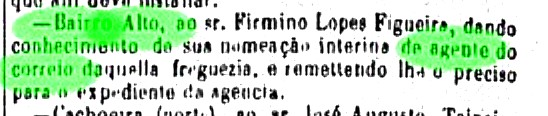
Wie im Verzeichnis der kaiserlichen Postämter (Tabella das Agencias do Correio do Imperio, Rio de Janeiro, 1885) zu lesen ist, gab es dort ein Postamt seit 1881.

Der kaiserliche Poststempel ASP-0040a (Abb. Mário Celso Orsi Jr.) ist die Nachahmung eines französischen Typus, mit der Inschrift APPARECIDA DE BOTUCATU oben und Stern zwischen Klammern unten, allerdings größer als das Vorbild. Die Daten in der Mitte gehen bisher von 1885 bis 1906.

Inzwischen fand sich auch eine stumme Abstempelung aus Apparecida de Botucatu in der Sammlung Fuad Ferreira Fo.:

1889 (FF)
Categories
Carimbologia A-B

Apody/Appodi, Rio Grande do Norte (ARN-0015)

Villiers de l’Ile Adam: Carta (…) das Provincias do Rio Grande do Norte e Parahiba, 1848

Another name: Apudi

The freguesia of S. João Baptista das Várzeas do Apody was founded in 1766 at the vila of Porta Alegre on the north bank of the Apodi River, 340 km west of the future provincial capital Natal. It became a vila in April 1833 and a town in March 1887.

There are three known dates of creation of the local post office. Firstly in April 1818, as R. Koester writes in Carimbologia II. Then again in 1836, as noted in the Directory of Imperial Post Offices (Tabella das Agencias do Correio do Imperio, Rio de Janeiro, 1885). And lastly in April 1852, as Nova Monteiro tells us in Administrações e Agencias Postaes do Brasil Imperio (Brasil Filatelico/RJ, 1934-5; Reprint SPP 1994-1999). Only one postmark was found for the Empire: ARN-0015c (image: José L Pedreira) is a double circle with the inscription APPODI at the top. The only copy has a partially hand-written date of 1881.

Atlas do Imperio do Brasil, 1868

Anderer Name: Apudi

Die Freguesia von S. João Baptista das Várzeas do Apody wurde 1766 bei der Vila von Porta Alegre am Nordufer des Flusses Apodi gegründet und lag 340 km westlich der späteren Provinzhauptstadt Natal entfernt. Der Ort wurde im April 1833 zur Vila und im März 1887 zur Stadt erhoben.

Es sind drei Gründungsdaten fürs örtliche Postamt bekannt. Erstmals im April 1818, wie R. Koester in Carimbologia II schreibt. Dann 1836, wie im Verzeichnis der kaiserlichen Postämter (Tabella das Agencias do Correio do Imperio, Rio de Janeiro, 1885) vermerkt. Und zuletzt im April 1852, wie uns Nova Monteiro in Administrações e Agencias Postaes do Brasil Imperio (Brasil Filatelico/RJ, 1934-5; Reprint SPP 1994-1999) mitteilt. Bur ei Poststempel wurde fürs Kaiserreich gefunden: ARN-0015c (Abb. José L Pedreira) ist ein Doppelkreis mit der Inschrift APPODI oben. Das einzige Exemplar hat ein teilweise per Hand eingetragenes Datum aus 1881.

Categories
Carimbologia A-B

Apiahy, São Paulo (ASP-0030)

Atlas do Imperio do Brasil, 1868

The settlement with the sonorous name Santo Antonio das Minas do Apiahy (St. Anthony of the Mines of Apiahy) was founded in March 1771, 310 km southwest of the future provincial capital São Paulo, and belonged to the Vila of Sorocaba. It became a vila in August of this century, but Apiaí – as it is written today – has only been a town since December 1906.

Two creation dates for the local post office have been found. The first one was in March 1836, as reported by philatelist Mario Celso Orsi Jr. and confirmed by the regional press:

O Paulista Official, 11.03.1836

The second agency creation took place in April 1874, and this is also reported by the press:

Correio Paulistano, 21.04.1874

Three postmarks have been found for this post office in the 19th century, the first of which cannot yet be definitively confirmed: ASP-0030a (Fig. M. Orsi Jr.) has been identified on a numeral issue from 1850:

ASP-0030a (MO) 1850ff

It was followed by the French type ASP-0030b (Coll. Klerman W. Lopes): a double circle with the inscription APIAHY above and the star between brackets below. The only specimen so far has a date from 1886 in the centre. Next there came ASP-0030c (image from the internet): a double circle with the inscription AGENCIA DE APIAHY at the top and an ornament in X at the bottom. The dates in the centre go from 1890 to 1906.

Villiers de l’Ile Adam: Carta (…) da Provincia de São Paulo, 1847

Die Siedlung mit dem sonoren Namen Santo Antonio das Minas do Apiahy (Skt. Anton der Minen von Apiahy) wurde im März 1771 310 km südwestlich der späteren Provinzhauptstadt São Paulo gegründet un gehörte zur Vila von Sorocaba. Geich im August d. Jh. wurde daraus eine Vila, aber erst seit Dezember 1906 ist Apiaí – wie es heute geschrieben wird – eine Stadt.

Zwei Gründungsdaten furs örtiche Postamt wurden gefunden. Erstmals im März 1836, wie der Philatelist Mario Celso Orsi Jr. meldete und durch die Regionalpresse bestätigt wird:

O Paulista Official, 11.03.1836

Die zweite Agenturentstehung fand im April 1874 statt, und das wird ebenfalls durch die Presse gemeldet:

Correio Paulistano, 21.04.1874

Drei Poststempel wurden für dieses Postamt im 19. Jahrhundert gefunden, wobei der erste noch nicht endgültigt bestätigt werden kann: ASP-0030a (Abb. M. Orsi Jr.) wurde auf einer Zifferausgabe von 1850 identifiziert:

ASP-0030a (MO) 1850ff

Ihm folgte der Französische Typus ASP-0030b (Samml. Klerman W. Lopes): ein Doppelkreis mit der Inschrift APIAHY oben und dem Stern zwischen Klammern unten. Das bisher einzige Exemplar hat ein Datum aus 1886 in der Mitte. Danach kam ASP-0030c (Abb. aus dem Internet): ein Doppelkreis mit der Inschrift AGENCIA DE APIAHY oben und einem Ornament in X unten. Die Daten in der Mitte gehen von 1890 bis 1906.